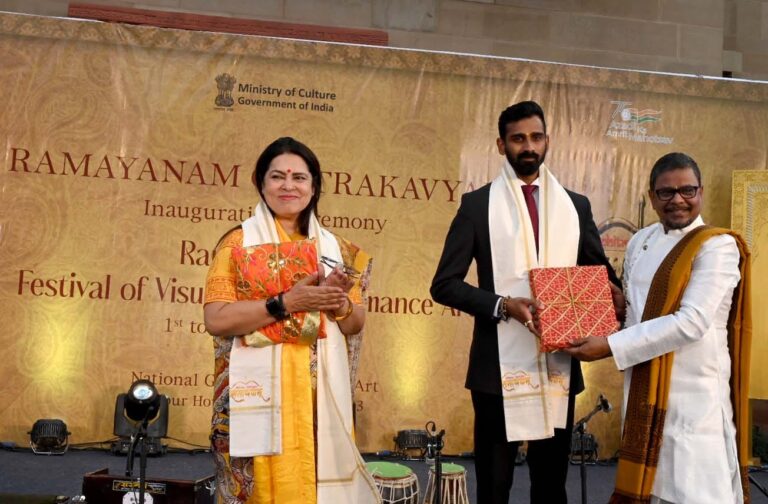
March 04, Colombo (LNW): Minister of Water and Estate Infrastructure Development, Jeevan Thondaman, inaugurated the ‘Ramayanam Chitrakavyam’ exhibition at the National Gallery of Modern Arts (NGMA) in New Delhi.
The event was graced by Minister of State for External Affairs and Culture, Meenakshi Lekhi, as the Guest of Honour.
Minister Thondaman underscored the deep cultural significance of the Ramayana in both Sri Lanka and India, emphasising its role in fostering understanding and strengthening bilateral ties.
He highlighted the potential for cultural tourism between the two countries, particularly through the Ramayana trail and Buddhist pilgrim circuit, noting various sites in his constituency associated with the epic.
State Minister Meenakashi Lekhi emphasized the universal wisdom and moral guidance offered by the Ramayana, connecting civilisations across time and geography.
She acknowledged Sri Lanka’s rich cultural heritage intertwined with the epic, citing landmarks like Ashok Vatika (Sita Eliya).
Dr. Sanjeev Kishor Goutam, Director General of NGMA, described the exhibition as a celebration of the enduring legacy of the Ramayana, showcasing the creativity of Indian artists across different genres.
The event highlighted the profound historical and cultural ties between Sri Lanka and India, symbolising the shared heritage and interactions that have shaped both nations over centuries.
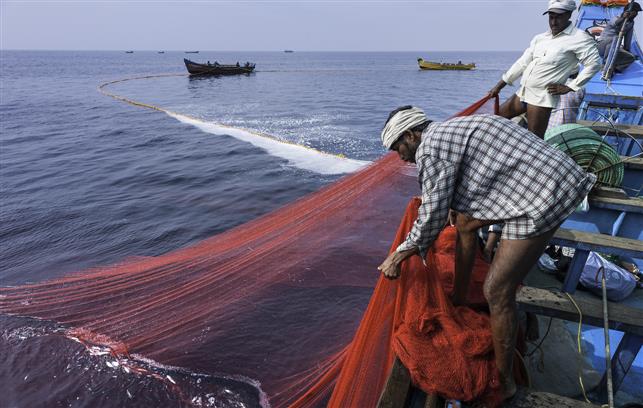
March 04, Colombo (LNW): Sri Lanka on Sunday (03) saw hundreds of Sri Lankan fishermen hailing from Jaffna, Mullaitivu, and Mannar districts staging a protest against their Indian counterparts, and accusing them of illegal fishing within Sri Lankan waters by sailing to the International Maritime Boundary Line (IMBL) in their trawlers.
Expressing agitation over recurrent incidents of alleged illegal fishing by Indian fishermen, the Sri Lankan fishermen called upon authorities to intervene and prevent further incursions into their territorial waters.
They warned of escalating protests if the situation persisted unchecked.
In recent months, fisher organisations have organised various demonstrations, including protests outside the Indian consulate in Jaffna, underscoring the contentious nature of the issue in bilateral relations between India and Sri Lanka.
Tensions over fishing rights have led to confrontations, with Sri Lankan Navy personnel reportedly firing at Indian fishermen and confiscating their boats in instances of alleged incursions into Sri Lankan waters, particularly in the Palk Strait—a key fishing area shared by both nations.
Incidents of Sri Lankan authorities arresting Indian fishermen for trespassing the International Maritime Boundary Line and fishing in Sri Lankan waters have been periodic.
This month alone, over 40 Indian fishermen were apprehended by the Sri Lanka Navy.
In 2023, Sri Lanka’s Navy detained 240 Indian fishermen and 35 trawlers for alleged poaching activities within Sri Lankan waters, highlighting the ongoing challenges in managing fishing disputes between the two countries.
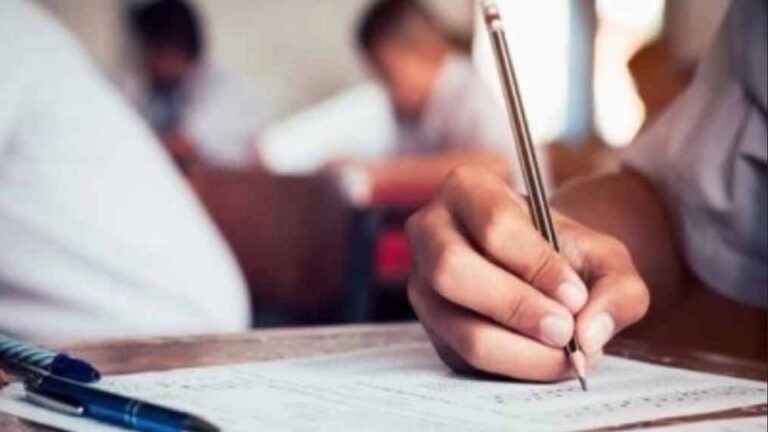
March 04, Colombo (LNW): In response to recent concerns regarding leaked term papers across various provinces, education officials are actively addressing the situation.
Sirisoma Lokuwithana, Secretary of the Western Province Ministry of Education, has scheduled discussions with the State Printing Corporation for today to address the issue.
Chamara Bamunu Arachchi, Secretary of the Sabaragamuwa Provincial Education Department, has confirmed the initiation of a formal investigation into the leakage of the Grade 10 English Second Paper.
Following the discovery of the leaked paper, necessary revisions have been made, and a rescheduled exam is planned for next Wednesday.
The Central Provincial Education Director has proactively directed Regional Directors to investigate any potential leaks of final examination papers.
As of now, no confirmed instances of leaked papers have been reported in the Central Province, and examinations will proceed as scheduled tomorrow (04).
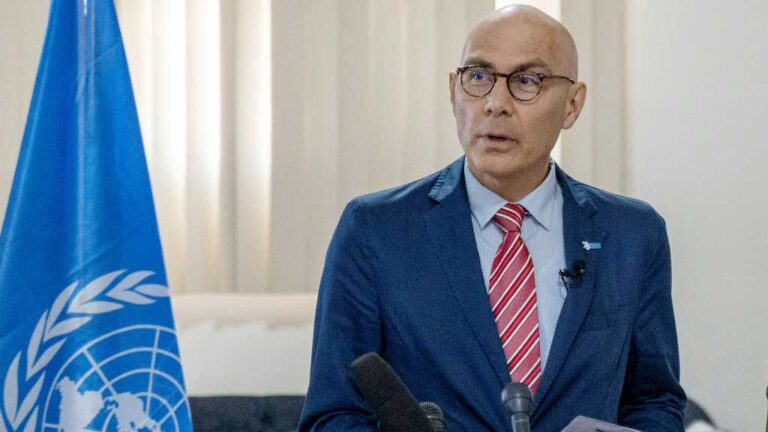
March 04, Colombo (LNW): During the 55th Session of the Human Rights Council, UN High Commissioner for Human Rights Volker Türk expressed profound concern regarding Sri Lanka’s proposed legislative actions, cautioning against potential infringements on fundamental rights and freedoms.
Türk highlighted the introduction of several new laws, including the Online Safety Act, Anti-Terrorism Bill, Electronic Media Broadcasting Authority Bill, and NGO Supervision and Registration Bill.
He warned that these laws, if enacted, could grant extensive powers to the executive and security forces, leading to severe restrictions on freedoms of assembly, association, and expression.
Additionally, Türk underscored the ongoing economic crisis in Sri Lanka, noting a surge in poverty levels to an estimated 27.9% and a significant decline in household incomes.
Despite government efforts, social protection remains strained, with a considerable portion of the budget allocated to debt servicing.
Addressing human rights violations dating back to the end of the civil war 15 years ago, Türk pointed out unresolved disappearances, land disputes, and unfulfilled promises of devolution by Provincial Councils and Local Government bodies.
Furthermore, Türk expressed concerns about the delayed justice for victims of the Easter Sunday bombings, despite the introduction of draft legislation for a Commission for Truth, Unity, and Reconciliation.
Reports of surveillance, harassment, and arrests of civil society representatives and journalists persist, indicating a worrisome environment for accountability and truth-seeking.
Highlighting reports of abductions, unlawful detention, and torture, including sexual violence, Türk stressed the urgent need for comprehensive security sector reforms.
Despite these challenges, Türk reiterated the importance of addressing the root causes of conflict and economic crisis for genuine reconciliation and sustainable peace.
Türk urged the Sri Lankan government to reconsider regressive laws and authoritarian approaches, emphasising the necessity for credible accountability measures to investigate and prosecute human rights violations and economic crimes.
He also called on member states to support these efforts, including through universal jurisdiction and targeted measures against alleged perpetrators.
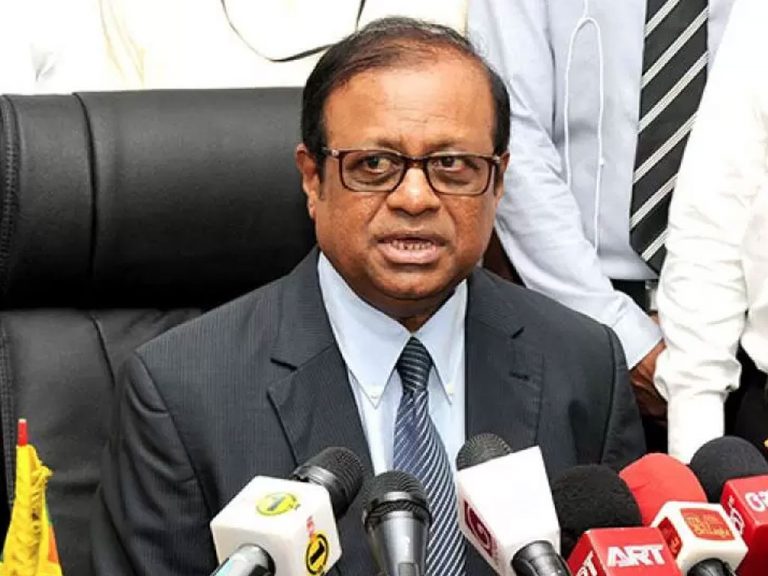
March 04, Colombo (LNW): Education Minister Susil Premajayantha has announced a reduction in the number of subjects for the GCE Ordinary Level (O/L) examination to seven, with the remaining three focusing on industry and environmental knowledge.
This adjustment aims to ensure that no student fails the O/L or Advanced Level (A/L) examinations.
Additionally, steps are being taken to provide professional training in subjects aligned with students’ preferences and skills.
Among the 337,000 A/L students this year, 50,000 will receive training in English, IT, and guidance at 300 centres nationwide starting from March 5th.
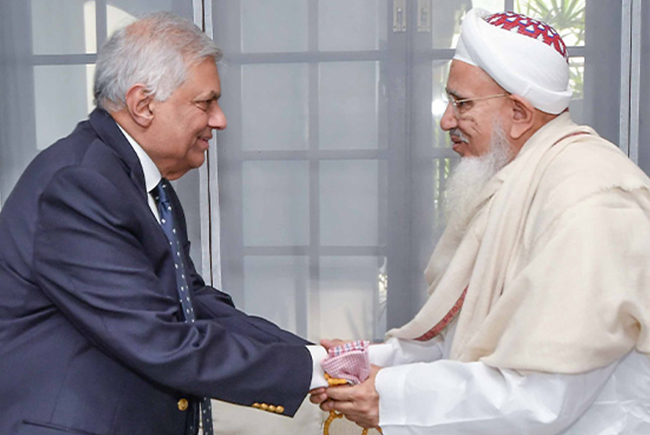
March 04, Colombo (LNW): A notable meeting occurred yesterday (03) afternoon between His Holiness Dr. Syedna Mufaddal Saifuddin Saheb, the spiritual leader of the Dawoodi Bohras, and President Ranil Wickremesinghe at the President’s official residence on Paget Road.
The Dawoodi Bohra community, spanning approximately one million members worldwide across countries such as India, Pakistan, USA, UK, Canada, Sri Lanka, and Australia, convened for this occasion.
Dr. Syedna Mufaddal Saifuddin Saheb engaged in a warm and cordial discussion with President Ranil Wickremesinghe, expressing gratitude for the President’s efforts in strengthening Sri Lanka’s economy.
During their dialogue, Dr. Syedna Mufaddal Saifuddin Saheb highlighted the upcoming Bohra Conference slated for this year near the Bambalapitiya Bohra Mosque.
As a gesture of goodwill, a book documenting various programmes and religious services conducted by the Bohra community over the past four years was presented to the President.
The event was attended by a delegation comprising leaders of the Dawoodi Bohras, lending significance to the occasion.
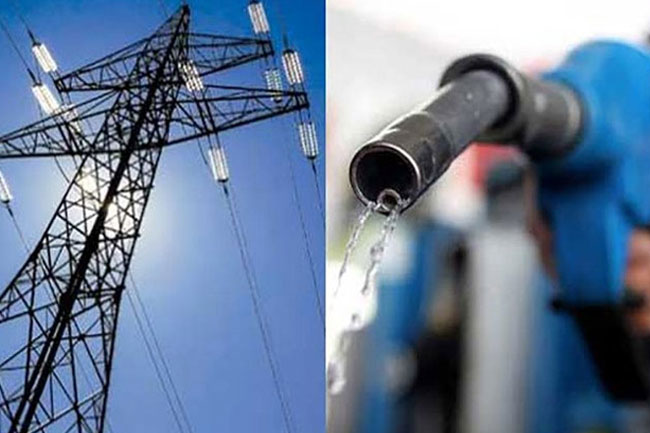
March 04, Colombo (LNW): An Extraordinary Gazette has been released, designating all activities related to electricity supply and the distribution of petroleum products and fuel as essential services.
The Gazette, issued on Sunday (03), was authorised by Secretary to the President Saman Ekanayake, under the direction of President Ranil Wickremesinghe.
The declaration affirms that these specified services are deemed Essential Public Services, recognising their indispensable role in sustaining community life.
It encompasses services offered by Public Corporations, Government Departments, Local Authorities, Co-operative Societies, or any affiliated entities engaged in these vital services, ensuring they remain uninterrupted for the welfare of the populace.
March 04, Colombo (LNW): Showers or thundershowers may occur at a few places in Kalutara, Ratnapura, Galle and Matara districts in the evening or night, the Department of Meteorology said in its daily weather forecast today (04).
Mainly dry weather will prevail elsewhere in the island.
Marine Weather:
Condition of Rain:
Showers or thundershowers may occur at a few places in the sea areas extending from Kalutara to Matara via Galle in the evening or night.
Winds:
Winds will be north-easterly in the sea areas extending from Kankasanthurai to Matara via Trincomalee, Pottuvil and Hambantota, and winds will be north-easterly or variable in direction in the other sea areas around the island. wind speed will be (20-30) kmph. Wind speed may increase up to (40-45) kmph at times in the sea areas off the coasts extending from Colombo to Kankasanthurai via Puttalam and Mannar and from Matara to Hambantota.
State of Sea:
The sea areas off the coasts extending from Colombo to Kankasanthurai via Puttalam and Mannar and from Matara to Hambantota can be fairly rough at times.
In the Manichean universe of the Zionists and the Lankan state their actions are beyond reproach, but the actions of the oppressed are unjust and immoral. They make no allowance for the historical reasons for resistance. Violence by the oppressed is not new. The First Nations of Australia resisted the colonisers from 1788 to just before the Second World War; there were indigenous rebellions in many parts of what is now South America and in the United States, including the Nat Turner revolt by enslaved African Americans; there was the Mau Mau rebellion in the British colony of Kenya. There were many others less well known. What they share is resistance to a better armed and resourced enemy. Armed resistance follows a period where the possibilities of negotiation are narrowed until they are non-existent and violence seems for some the only other choice.
The Israeli and Lankan states have been extraordinarily successful in deflecting attention from the causes of revolt by denouncing as terrorists those seeking their rights, and using this as an excuse for military repression and discrimination. In this they are aided by many in the mainstream media who use the colonisers’ talking points and attempt to deflect legitimate inquiries. At the same time, it must be acknowledged that many journalists have lost their lives attempting to tell the truth. Meanwhile the local media is choked with government propaganda. The colonising governments have powerful international backers who provide arms, money, and political capital. On the Israeli side are the United States, the European Union and Britain. On the Lankan side are China, India, Russia, Israel. The United States also gave limited support.
The government of post-independence Lanka is deaf to the demands of the Tamil community when it comes to parity of language, the allocation of resources and jobs and the recognition that Lanka is a multi-cultural society, as evidenced by the 1972 and the subsequent 1977 Constitutions and the latter’s plethora of amendments which stated that Lanka is a Sinhala Buddhist state. Dissent, whether in the form of protests or peaceful non-cooperation was met by the might of the state and anger of the majority community. Countless hundreds lost their lives and houses in the riots. The more notable ones occurred in 1958 and 1977. In 1983 an army patrol was ambushed by the LTTE, with the army retaliating by killing unarmed civilians. It resulted in a pogrom in the capital city Colombo, in which many rioters were brought in government vans and their leaders were provided with lists of Tamil names and houses. Thousands of homes were looted and burnt; many of the women were raped and around 3,000 killed, while the police looked on. The government did not express any sympathy, but directly blamed the Tamils[i] for the pogrom. It disenfranchised Tamil parliamentary representatives and passed a law giving the Lankan government the right to do what they pleased with properties affected by the pogrom. The result was not hard to predict. An exodus of 150,000 refugees flooded the North, the East and India, passing into the willing arms of the LTTE. By the 1984 the civil war was transformed from a low-level intermittent conflict into a full blown one.[ii]
As the towns and countryside controlled by the LTTE fell under the overwhelming firepower and the 160 thousand troops of the Lankan state, defeat loomed. Facing them were the remnants of the LTTE and 300,000 unarmed civilians. The Lankan army could have sent their small well trained mobile units to destroy the LTTE as they had no means of escape, being trapped on an isthmus. Instead, the Lankan army, navy and air force used overwhelming fire power on an area that at the start of the siege was maybe eight square kilometres and at the end around one kilometre. The area in the end contained probably a quarter of a million defenceless civilians. The initial UN figures of 40,000 killed is now seen as overly conservative, with figures of 80,000 to 100,000 being more likely.
The wounded were left to die because it was too dangerous to rescue them, and if rescued they received treatment that was at best rudimentary. Hardly any drugs and anaesthetics were available, and in the end hospital staff asked the UN and the Red Cross not to give out their coordinates for fear it would attract more shellfire. The survivors were hungry, thirsty, sleep-deprived, terrified, and their will to live deserted them; how many died of hunger and lack of water can only be guessed at.
Many wanted to escape this charnel house but were terrified into staying. Even if they could successfully navigate the mines lain across the borders of their prison, they were at risk of being shot at by the Lankan forces, and if taken they would face a fraught future in an internment camp. That is why so many Tamil civilians remained.[iii]
Gaza is an artificial construct of the Zionist state, an area of 365 sq kilometres in which over two million human beings are squashed in like sardines. It has one of the highest population densities in the world. More than 70 per cent of the population are refugees or descendants of refugees. Half the population is under the age of 18. It has one of the highest unemployment rates in the world. Before the current bombardment, it had an overall unemployment of around 46 per cent, with a 70 percent unemployed rate for young people. It nevertheless has, like Lanka, a high literacy rate. The inhabitants are virtually caged between the Zionist forces and the Egyptian ones. This blockade is enforced by land, sea and air and severely curtails ordinary commerce as there is a blockade on many goods and services that could make their lot tolerable. This blockade is also human as it prevents many Gazans from being gainfully employed beyond their cage.
There have been restrictions or a ban on many items necessary for living a tolerable life.[iv] These include building materials, light bulbs, candles, matches, books, refrigerators, shoes, clothing, sheets and blankets. Food items include tea, coffee, sausages, flour, meat and pasta. Other items include cigarettes, fuel, pencils and pens. The only entrance is in Rafah, which is intermittently closed.[v]
These policies have resulted in most of the population of Gaza being dependent on humanitarian aid and the whims of the Israeli government. They put up with restricted access to food and water, difficulties in ensuring their children get to school safely and even in burying a loved one. Now there is widespread infrastructure devastation, together with the contamination of water and soil brought on by the continual siege and repeated air strikes.[vi]
Professor Sara Roy, a knowledgeable and sympathetic observer, remarked on one of her visits to Gaza that here ‘is a land ripped apart and scarred, the lives of it people blighted. Gaza is decaying under the weight of continued devastation unable to function normally ………….’ Professor Roy concludes that the decline and disablement of Gaza’s economy and society have been deliberate, ‘the result of state policy – consciously planned, implemented, and enforced …. And just as Gaza’s demise has been consciously orchestrated, so have obstacles preventing its recovery’.[vii]
Since the elections of 2007, Gaza has been controlled by Hamas, defined by Israel and its allies as a terrorist organisation. Periodically Hamas have attempted to break the siege. They have done this futilely and ineffectually by raining rockets on the occupiers. Since 2007 Gaza has suffered three major Israeli assaults which have killed more than 3,500 Palestinians, as well as a decade and half of economic blockade and military siege.[viii]
Post October 7 things have become worse. It is estimated by US intelligence sources as reported to CNN that around 40 to 45 per cent of the 29,000 bombs dropped on a defenceless civilian population are “dumb bombs”. Countless of these undirected bombs are behemoths – 2,000-pound bombs. Even places that could be deemed civilian shelters and no-go areas are not immune. Hospitals, homes, UN compounds, ambulance, mosques, a church, and a university have been targets. Like the Lankan government, the Israeli government claims to be rooting out terrorists in a measured way.
The last section attempts to humanise the oppressed from the terrorist narrative impose on them by their oppressors. The paper ends with challenging the world powers be they be: India, China, United States, EU, Russia, and Britain to not give a free pass to their geopolitical allies. In this case, the Zionist state, or the Lankan state.
To be continued
3 March 2024
[i] The government of the day also blamed erroneously blamed left-wing parties like the Janatha Vimukthi Peramuna (JVP) – Peoples Liberation front.
[iii] Cooke, Michael, ‘War Crimes in Sri Lanka Stain or Slander?’ Groundviews, 16/9/2018.
[iv] It should also be noted that a similar ban was in place in the north of Lanka. Before 2002 nearly 70 items were banned from being taken into a the Wanni district. This was relaxed during the Norwegian facilitated ceasefire. See: http://edition.cnn.com/2002/WORLD/asiapcf/south/01/15/slankasanctions/index.html
[v] Eid, Professor Haidar, ‘Israel’s policies in Gaza are genocidal,’ Mondoweiss, August 2018. Retrieved: https://mondoweiss.net/2018/08/israels-policies-genocidal.
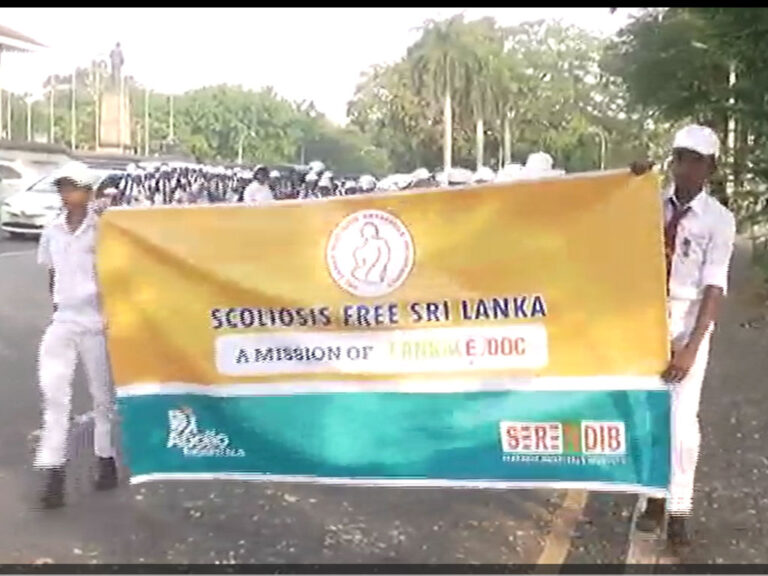
March 03, Colombo (LNW): A special ‘walk’ event unfolded at Colombo Independence Square yesterday (02) with a primary objective of enlightening the public about the making a scoliosis free Sri Lanka.
Organized by Serendib Group and Lanka E Doc Company, the event witnessed the participation of a multitude of individuals, including prominent figures from various fields. Dr. Niluka Welikala, President of both organizing entities, underscored the global necessity of creating awareness among parents regarding scoliosis in children which has a high incidence among adolescent girls in Sri Lanka.
Dr. Welikala emphasized that the dearth of awareness among parents has resulted in a diminished capacity to prevent the progression of the disease in children. Hence, she stressed the crucial role of educating parents about scoliosis. Among the notable participants were Dr. Panwila Ananda Thero, Head of Attanagalla Rajamaha Vihara, and Venerable Thiniyawala Palitha Thero. Justice Minister Vijayadasa Rajapaksa, Minister of State for Transport Lasantha Alagiyawanna, and Dr. Sajan K Hegde, Chief Spine Surgeon, Apollo Hospitals Dr Appaji Krishan Senior Spine Surgeon Apollo and Dr Ruwanthi Perara – Senior Consultant Paediatrician along with other Indian and Sri Lankan specialist doctors.
Dr. Niluka Welikala expressed gratitude for the support extended by Apollo Hospitals Group of India to the program and stated that the walkathon with nearly one thousand participants should be the worlds largest scoliosis awareness walkathon. Mr Jithu Jose , Vice President International Division of Apollo Hospitals proposed the vote the thanks.
The event served as a significant step forward in the collective effort to combat scoliosis and ensure a healthier future for the people of Sri Lanka.