Home Blog Page 1247

President Ranil’s firm resolve for reforms pays dividends.

0

The IMF Executive Board after much speculation completed the first review under the 48-month Extended Fund Facility with Sri Lanka, providing the country with access to SDR 254 million (about $ 337 million). This brings the total IMF financial support disbursed so far to SDR 508 million (about $ 670 million) out of the total amount of SDR 2.286 billion (about $ 3 billion). The IMF program according to an IMF statement will continue to support Sri Lanka’s efforts to restore macroeconomic stability and debt sustainability, safeguard financial stability, and enhance growth-oriented structural reforms. This is certainly an endorsement of the President’s firm resolve and commitment to the reform agenda despite being politically very unpopular and gives a huge advantage to the opposition.

Unfortunately for the public many of the reforms are a bitter pill to swallow. The Government on the other hand needs to up their game and walk the talk when selling these austerity measures to the public. In fact, the IMF statement highlights the difficulty of implementing some of the reforms. The statement noted, “Today’s Board approval recognizes the challenging policy actions implemented by the Sri Lankan people to put the crisis behind them. Sri Lanka’s performance under the program was satisfactory. All quantitative performance criteria for end-June were met, except the one on expenditure arrears. All indicative targets were met, except the one on tax revenues. Most structural benchmarks were either met or implemented with delay by end-October 2023. These macroeconomic policy reforms are starting to bear fruit and the economy is showing signs of stabilization, with rapid disinflation, significant revenue-based fiscal adjustment, and reserves build-up.”


Cost of reforms

The IMF has said repeatedly that the key to transitioning from stabilisation to a full and swift recovery is sustaining the reform momentum amid strong ownership by the authorities and more broadly, the Sri Lankan people. The IMF has urged the authorities to continue to build on these hard-won gains and further advance revenue mobilisation, align energy pricing with costs, strengthen social safety nets, rebuild external buffers, safeguard financial stability, combat corruption and enhance governance.


Fiscal consolidation

As the IMF highlights in their latest statement very clearly, strengthening the revenue-based fiscal consolidation with revenue administration reforms is critical to recover from program slippages and to fund the provision of essential Government services. The IMF also points out that accumulating reserves, supported by exchange rate flexibility, remains an important priority under the EFF. They further highlight that implementing the bank recapitalisation plan and strengthening the financial supervision and crisis management frameworks are crucial to safeguarding financial sector stability to remain steadfast on the reform commitments.


Leadership

Despite all the negativity, Sri Lanka has reached several important milestones in putting debt on the path towards sustainability. Timely resolution with external private creditors is now a must, this should help restore Sri Lanka’s debt sustainability over the medium term. However, the imposition of high income and direct taxes to meet revenue targets causes havoc that overshadows its intended economic benefits to a country. Therefore getting the right mix of indirect taxes and direct taxes can prove potent in driving domestic economic growth, capital formation, and attracting foreign investment and domestic investment.


Excessive taxation

The President has said increased tax revenue was essential for improving the country’s financial situation and addressing the debt crisis. Unfortunately excessive direct and indirect taxes can in many instances place a heavy burden on both individuals and businesses. While these taxes are meant to support governments to deliver on its mandate, it can have unintended consequences. Often excessive tax reduces the disposable income for individuals, reducing their ability to spend and invest. For businesses, high taxes can hamper growth, reducing capital for expansions that then create jobs. Numerous examples exist where third-world economies have been forced to raise taxes to demonstrate fiscal responsibility to multilateral agencies. However, this approach often leads to a vicious cycle. Increasing taxes can stifle economic growth, resulting in less revenue collection than expected, ultimately undermining the very goal it aims to achieve – economic growth and poverty reduction.


Way forward

While fiscal responsibility is crucial, it must be balanced with the need to promote economic growth and not hit the poor hard. We need to look at tax reduction strategies, simplification of tax systems, and increased efforts to combat tax evasion (many people don’t pay any taxes, just a few hundred thousand people pay taxes) and increase the pool of taxpayers. The Government by promoting a favourable tax environment, can prevent economic stagnation, encourage savings and attract new foreign investment. We need to improve revenue collection rather than continue to increase tax rates and squeezing the existing tax payers dry. Otherwise the typical middle-class family that is struggling due to the taxes reducing their overall buying power, will continue to negatively affect businesses and retailers across the country.

Sri Lanka has the lowest Government revenue among South Asian countries, amounting to only 9.1% of its GDP. Therefore in the final analysis heaping taxes on the people who actually pay is certainly not an option anymore. There are several other options that can be pursued with a little bit of common sense with in the Government service that can raise serious revenue for the Government and also strengthen the social safety net and thereby safeguarding the poor and the vulnerable of our country.

DailyFT

Sri Lanka joins hand with Busan to bolster industrial investment.

0

By: Staff Writer

Colombo (LNW): The Chamber of Young Lankan Entrepreneurs (COYLE) and The National Chamber of Exporters, partnered with the Busan Economic Promotion Agency of South Koreas to bolster inward industrial investment in Sri Lanka.

They held discussions recently to find ways and means to broaden operational opportunities for Sri Lankan businesses in Busan to stimulate positive returns.

Mr. Jin Yang Hyun, President and CEO of The Busan Economic Promotion Agency who joined the discussion online, acknowledged Sri Lanka’s potential with financial incentives, strategic presence and access to raw materials.

However, concerns were raised about the barriers to entry, particularly with regard to inefficiencies on the part of local authorities, impacting investment timelines.

It was pointed out that addressing these concerns requires a comprehensive examination of Sri Lanka’s investment processes.

The Board of Investment (BOI) plays a crucial role and its efficiency is key to facilitating foreign investment into the country.

Accordingly, Sri Lanka needs to streamline its processes, as the bureaucratic complexities are adverse oppose to countries like Vietnam and Thailand who are dominating the region.

Furthermore, initiating operations within an Export Processing Zone (EPZ) in Sri Lanka demands a closer look, and the Island needs to match other competitive nations whilst also exhibiting economic and political stability.

The discussion also touched on Busan’s economy, and the advantages it presents for Sri Lankan businesses.

For example, setting up operations in Busan provides an opportunity for Sri Lankan companies to tap into the significant buying power of the South Korean market, enhancing their export potential.

Companies establishing operations in Busan can also contribute to inward remittances for Sri Lanka, strengthening the economic ties between the two nations.

It was revealed that identifying sectors currently exporting to South Korea and encouraging them to set up operations in Busan could further augment the bottom line for Sri Lankan businesses.

Overall, the dialogue ended on a strongly positive note, with COYLE, empowered by speaker Mahinda Yapa Abeywardana and MP Dayasiri Jayasekara, who is also the President of the Sri Lanka Korea Association, pledging assistance to companies from Busan interested in exploring industrial and commercial operations in Sri Lanka.

Ultimately, the discussion made clear the need for Sri Lanka to quickly enhance its accessibility, efficiency, and ease of doing business in order to compete on a global scale and benefit from foreign investment on a larger scale.

BOI collaborates with Chinese Academy of Sciences to attract green FDIs’.

0

By: Staff Writer

Colombo (LNW): Sri Lanka Board of Investment has embarked on an ambitious initiative to attract green and digital foreign direct investments FDIs’ into the country on collaboration with the Chinese Academy of Sciences (CAS).

The Chinese Academy of Sciences (CAS) and the BOI recently concluded a series of meetings and fact-finding visits to the BOI zones and find new opportunities for fruitful long-term bilateral relationships.

The NetZero commitment of the nations and industries and sustainable strategic planning of the BOI has paved the way to develop its zones management to attract green and digital FDIs’ to the country hence it is evident that Sri Lanka needs world-class collaborators to reach these significant strategically important key measurements.

Therefore, the Chinese Academy of Sciences’ world view and vision of collaboration with the nation and its mission of research and innovation and further developing a merit-based learning ecosystem will enable the BOI to leapfrog the process of developing a greener and sustainable zones management system.

In the context of the near future, both parties are looking forward to working together and developing a synergistic relationship.

The Chinese Academy of Science has a mandate to explore and harness high technology and the natural sciences for the benefit of China and the world.

Comprising a comprehensive research and development network, a merit-based learned society, and a system of higher education, CAS brings together scientists and engineers from China and around the world to address both theoretical and applied problems using world-class scientific and management approaches.

CAS has further defined its development strategy by emphasizing greater reliance on democratic management, openness, and talent in the promotion of innovative research. The academy aims for a bright future as one of the world’s top S&T research and development organizations.

Drawing from the BOI’s previous insightful discussions with CAS, it has identified several pivotal activities that will constitute the foundation of fruitful collaboration.

These activities hold inherent advantages that align harmoniously with our shared goals and finally reach a Memorandum of Understanding (MoU) between CAS and BOI During the meeting CAS will support the BOI in fulfilling the undermentioned projects.

Following the National Determined Contributions (NDCs), BOI is committed to consulting with CAS to craft an integrated eco-industrial park concept. By aligning our strategies with sustainable practices, we will bolster the park’s environmental footprint and play an active role in fulfilling national sustainability objectives.

SL SME apparel exporters urge the state support for resilient recovery.

0

By: Staff Writer

Colombo (LNW):With global economic challenges impacting Sri Lanka’s apparel sector, small and medium enterprises (SMEs) are moving from the drawing board into realization of envisaged plans with numerous options to weather the cascading impacts of declining orders.

Several SME apparel exporters are seeing potential opportunities especially in the Indian market. The majority of Sri Lankan apparel SMEs primarily export to the United States, United Kingdom, EU and India, reflecting the industry’s regional partnerships.

The Sri Lanka Chamber of Garment Exporters (SLCGE) yesterday commended the remarkable resilience of its apparel SME membership for rapidly adapting to tough global market conditions and ending the year with zero closures.

As the apex body for SMEs in the apparel sector, the SLCGE comprises 76 members – all of which operate outside of Sri Lanka’s Free Trade Zones (FTZ).

“Over the past year, our industry has been hit hard with a 20% reduction in orders,” stated SLCGE Chairman Bandula Fernando. “SME apparel producers are among the worst impacted. However, they have also been among the first and fastest to respond to market contractions.

Hence, even as the order book contracted, they have ensured that all existing orders have been completely fulfilled to the highest quality standards.”

“Their success in these trying times is a phenomenal achievement and a testament to their resilience and adaptability. But it is now imperative that our industry, the Government and all stakeholders work together to support a rapid recovery in the SME apparel sector.”

He added that the industry’s priority was to double-down on trade facilitation in order to strengthen market access for these SMEs to at least get to the same level their regional competitors currently enjoy.

“Sri Lanka’s largest apparel firms have already set their sights on high-value niches in new and emerging markets across the globe.

Responding to concerns over a reported 20% reduction in apparel sector jobs over the past 12 months, Fernando explained how the SLCGE’s members had successfully mitigated the worst impacts on jobs and livelihoods by avoiding retrenchment. “Instead, we placed a freeze on new hires,” he explained.

“The majority of the 20% reduction in employment from the apparel sector was contained to natural attrition, which in turn prevented the mass job losses that had been the cause of much speculation over the past year.

Some companies did request employees to stay at home, but these decisions are made in discussion with the individuals involved and responsible authorities, ensuring arrangements are in place to minimize impact on their livelihoods.

To address these challenges, the SLCGE has taken proactive measures, engaging in direct market access initiatives through buyer and consumer engagement. In particular, the Chamber is focused on strategic exploration of untapped markets in East Europe, the Middle East and East Asia.

Sri Lankan banks tops a list of lenders in the Asia-Pacific region.

0

By: Staff Writer

Colombo (LNW): Sri Lankan banks topped a list of lenders in the Asia-Pacific region with the best total stock returns, as stakes grow that the worst for the South Asian nation’s economy may have passed, banking sector reports revealed.

Hatton National Bank PLC, Sampath Bank PLC and Commercial Bank of Ceylon PLC logged the highest total stock returns among peers in the region this year according to a list compiled by S&P Global Market Intelligence.

Hatton National and Sampath posted total returns of more than 50%, albeit on the back of equally sharp declines earlier.

Sector looks past peak non-performing loans as rates ease, gradually re-opens lending taps Central Bank report highlighted.

The banking sector asset quality weakness held steady between June and September this year, but the industry is confident that the worst is over for them as they said they are seeing a slight moderation in the non-performing loans at present as the economy shows signs of some level of stabilization.

According to the latest quarterly data made available on banks by the Central Bank through September, banks saw their ‘stage 3 loans to total loans and advances’, the new accounting term for the traditionally called non-performing loans, holding steady at 13.4 percent, same as in the June quarter.

Sri Lanka’s banking sector was on a rollercoaster ride during the last four years or so as they were hit by multiple crises from the pandemic related business disruptions to the economic crisis which triggered mass scale defaults to the prospects of likely implications from the domestic debt optimisation.

Their stage 3 loans ratio which was at 8.4 percent at the onset of the economic crisis last year in the first quarter of 2022 steadily rose to 12.9 percent a year later before peaking at 13.4 percent by mid-year in 2023.

The breakdown of the status of the stage 3 loans between the licensed commercial banks and specialized banks however diverge somewhat.

While commercial banks improved their asset quality only modestly from 13.9 percent at its peak in June to 13.7 percent by September, the specialized banks saw its ratio rising from 9.3 percent to 10.1 percent in the same two periods.

Commercial banks have however begun to see further moderation in their non-performing loans coming into the ongoing fourth quarter as the easing interest rates are helping both the borrowers and the lenders alike in getting back into their activity.

While recent private sector credit data have shown that banks have clearly begun to reopen their lending spigots only gradually and cautiously, the borrowers are also showing some inclination as rates have come off their recent peaks.

Further, the language from the commentary by the banking sector chief executives which accompanied their September quarterly reports also showed growing willingness by them to lend more and also less concerns by them on the non-performing loans than a year ago.

The International Monetary Fund approving to release their second program tranche this week after holding back for more than two months would also help the country and the sector to look past the worst of the economic crisis going into 2024.

The banks have also begun to ramp up their capital as seen from the recent announcement for debenture issuances in a sign that they are gearing up for a high lending season from next year as the rates are expected to be further moderate after back-to-back policy rate cuts.

The rising loans and improving financial health of borrowers would help the sector to further see their non-performing loans ratios moderate next year.

Urgent Directive to Resume and Accelerate Rural Road Development Projects in Eastern Province

0

State Rural Road Development Minister Sivanesathurai Chandrakanthan issued a pressing directive to promptly resume and expedite the completion of rural road development projects in the Eastern Province, originally halted midway under the Integrated Road Development Programme (I Road Project) supported by the Asian Development Bank (ADB).

Speaking on the status of ongoing projects and the challenges faced during their implementation, the State Minister convened a discussion at the State Rural Roads Development Ministry in Sethsiripaya, emphasizing the need for resolution.

During the meeting, the State Minister urged the Project Director overseeing the I Road Project to prioritize the completion of rural road development initiatives in Ampara, Trincomalee, and Batticaloa districts, emphasizing the immediate need to expedite these endeavors.

Furthermore, the project engineer received directives to accelerate the installation of essential road infrastructure such as signboards, white lines, and pedestrian crossing markings on completed roads.

The progress review meeting witnessed the participation of several officials, including MPs D. Weerasinghe and Kapila Athukorala, alongside Rural Road Development State Ministry Additional Secretary B. Ranaweera, and the Project Director of the Integrated Road Development Programme, collectively strategizing to overcome obstacles and propel the swift completion of vital rural infrastructure projects in the region.

Health Minister Emphasizes Strengthening Healthcare Services

0

Health Minister Dr. Ramesh Pathirana underscored the critical need for revitalizing Sri Lanka’s primary, secondary, and tertiary healthcare services, emphasizing the significance of restoring credibility within the population. Speaking to the media following an inspection tour of Maharagama Apesksha Hospital, the Minister highlighted key insights into the current state of healthcare in the country.

Addressing the country’s abundant human resources within the healthcare system and its robust infrastructure, the Minister emphasized the need for a structured network to efficiently deliver health services. He expressed concern over the escalating number of children affected by cancer in Sri Lanka, stressing the urgency of implementing awareness programs to combat both communicable and non-communicable diseases effectively.

Dr. Pathirana acknowledged Sri Lanka’s unique healthcare landscape, extending from basic medication like Paracetamol to advanced treatments such as radiation therapy, alongside provisions for food and drink, all without the necessity of insurance coverage.

During the visit, the Minister inspected the ongoing construction of a four-story ward complex, funded by the Ruhunu Maha Kataragama Temple at a cost of Rs. 150 million, demonstrating collaborative efforts to enhance healthcare infrastructure.

Recognizing the challenges faced by hospital staff, Minister Pathirana emphasized the continuous maintenance of adequate medicine stocks within the hospital premises.

The event saw the presence of Hospital Director Dr. Aruna Jayasekara, Basnayake Nilame of Ruhunu Kataragama Temple Dishan Gunasekara, Deputy Director of the Hospital, administrative officers, doctors, and dedicated hospital staff, collectively engaging in discussions aimed at advancing healthcare services in the region.

Agriculture Department Issues Alert on Pest Threats to Paddy Fields

0

The Agriculture Department has issued a crucial warning to farmers regarding three destructive insect pests currently ravaging paddy cultivation across multiple districts of the island. With approximately 22,000 hectares of paddy fields affected by the White Back Plant Hopper, Gray Plant Hopper, and Leaf Curl worm, Agriculture Director General Malathi Parasuraman stressed the urgency for farmers to be vigilant.

Parasuraman urged farmers to promptly notify Agriculture Department officials upon detecting these insects in their fields and to strictly adhere to the guidance provided by agriculture consultants.

Asserting that preventive measures can mitigate these insect damages, Parasuraman highlighted that agricultural consultants and officials across all areas have been duly notified. Furthermore, Parasuraman disclosed the deployment of specialized agriculture teams for comprehensive field inspections.

In a cautionary advisory, Parasuraman warned against the use of substandard insecticides or following recommendations from sources lacking expertise in handling these pests. Mixing insecticides with other substances was discouraged, emphasizing that ineffectual application of chemicals could prove futile due to the pests’ resistance to harmful compounds.

The Director General stressed the significance of employing only the pesticides recommended by the Agriculture Department, emphasizing the importance of strategic steps to combat these resilient pests effectively.

Sri Lanka-Japan Negotiations Revive Hope for Stalled LRT Project

0

The Minister of Urban Development and Housing, Prasanna Ranatunga, disclosed ongoing negotiations between the Sri Lankan and Japanese governments to revive the dormant Japan-funded Light Rail Transit (LRT) initiative. Amid diplomatic discussions, both parties are recalibrating the project’s scope and estimated costs, primarily impacted by the COVID-19 pandemic and economic challenges. Ranatunga expressed optimism, foreseeing the project recommencing shortly.

The recalibration process, central to the bilateral dialogue, is slated to lead the way for next year’s reactivation of public facility relocation and land acquisition efforts. Following discussions between Sri Lanka and Japan, decisions have been charted to propel the project’s progression. An initial feasibility study laid the groundwork for this venture, appointing an international consulting firm to devise comprehensive blueprints, contracts, tender documents, estimates, and monitoring services for the Malambe to Pettah LRT route, with an initial allocation of US$120 million.

Commencing in April 2019, this preparatory phase was slated for a 91-month completion. However, the project encountered a halt on December 31, 2020, after a 21-month consultation period. Notably, despite the cessation of activities, 60% of the fundamental scheme plans and 78% of the detailed blueprints were already finalized. Soil tests and pre-feasibility studies were also completed until the Malambe section.

The acquisition of land for the project initiated, identifying a total area of 22 hectares. Although much of the land acquisition phase is near completion, compensation for the acquired lands remains outstanding.

With substantial progress made in planning and preliminary groundwork, the Sri Lanka-Japan negotiations are pivotal in rekindling hopes for the LRT project’s revival, poised to alleviate transportation challenges and enhance connectivity across targeted areas.

Dollar rate in Sri Lanka today(Dec 15)

0

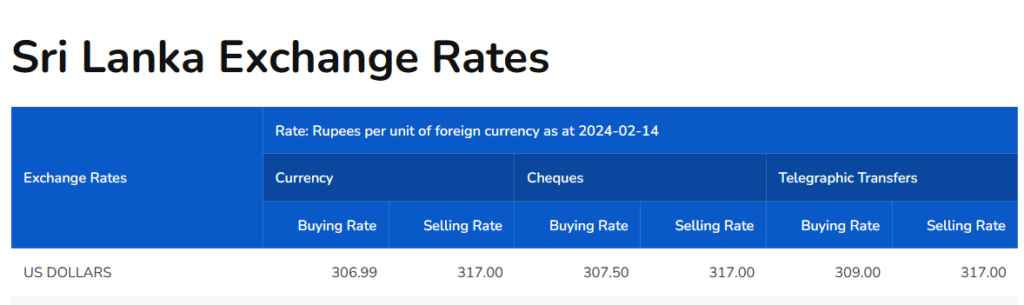
The Sri Lankan Rupee exhibited stability against the US Dollar today (Dec 15) at commercial banks in Sri Lanka, maintaining similar rates compared to Thursday’s figures.

At Peoples Bank, the rates for buying and selling the US Dollar experienced a slight decrease, shifting from Rs. 321.18 to Rs. 320.94 for buying and from Rs. 332.38 to Rs. 332.12 for selling.

Meanwhile, Commercial Bank reported a minor increase in the buying rate of the US Dollar, rising from Rs. 319.50 to Rs. 320.37, while the selling rate remained constant at Rs. 330.50.

At Sampath Bank, there were no alterations in the rates, with both the buying and selling rates for the US Dollar remaining steady at Rs. 322 and Rs. 331, respectively.