Home Blog Page 1278

IMF-WB 2023 Annual Meetings secure financial assistance to Sri Lanka

0

By: Staff Writer

Colombo (LNW): The 2023 Annual Meetings of the International Monetary Fund (IMF) and the World Bank Group will take place in Marrakech, Morocco, from October 9-15, 2023. The theme for this year’s meetings is “Global Action, Global Impact.”

The Annual Meetings are the largest gathering of global policymakers, business leaders, and civil society representatives, providing a forum to discuss and address the world’s most pressing economic and development challenges.

The meetings also provide an opportunity for member countries to engage with the IMF and World Bank on their specific needs and priorities.

For Sri Lanka, the 2023 Annual Meetings are particularly important. The country is currently facing a severe economic crisis, with high inflation, low foreign reserves, and a large debt burden.

The government is in the process of negotiating a bailout package with the IMF, and the Annual Meetings will provide an opportunity for Sri Lankan officials to discuss their progress and seek support from other member countries.

In addition to the official meetings, the Annual Meetings also feature a variety of side events and seminars on a wide range of development topics.

These events provide an opportunity for Sri Lankan policymakers and other stakeholders to learn about best practices and network with experts from around the world.

The Annual Meetings provide an opportunity for Sri Lanka to secure financial assistance from the IMF and other member countries.

The government can use this assistance to help stabilize its economy and finance its development programs.

It also provide an opportunity for Sri Lanka to attract foreign investment. The country can use the meetings to showcase its investment potential and to meet with potential investors.

The Annual Meetings feature a variety of side events and seminars on a wide range of development topics. Sri Lankan policymakers and other stakeholders can learn from the experiences of other countries and share their own best practices.

Overall, the 2023 IMF and World Bank Annual Meetings are an important opportunity for Sri Lanka to advance its economic and development goals.

Experts opine that the government should make the most of this opportunity to secure financial assistance, attract foreign investment, share best practices, and build relationships with other countries and international organizations.

One of the key events at this year’s annual meetings is the release the World Economic Outlook’s October 2023. The World Economic Outlook (WEO) which provides a comprehensive analysis of the global economic situation, including economic growth, inflation, and other key macroeconomic indicators.

The WEO serves as documentation for meetings of the International Monetary and Financial Committee (IMFC) and forms the main instruments of the IMF’s global surveillance activities.

Sri Lanka to create Family-Friendly Tea Industry

0

By: Staff Writer

Colombo (LNW): The Centre for Child Rights and Business in Sri Lanka is brewing a transformation in the tea industry as it prepares to host its annual “Co-Creating a Family-Friendly Tea Industry” conference on October 17.

The theme of the conference 2023 is ‘Dignity’ and it will be held in the capital of Colombo.

Supported by Save the Children’s Country Office in Sri Lanka and the Planters Association of Ceylon, this multi-stakeholder event marks a significant step forward in the quest for dignity and child rights within the tea sector.

The Centre launched the Child Rights in Business (CRIB) Tea platform. This innovative platform has initiated a culture of collaboration and idea-sharing among stakeholders, igniting a fresh wave of solutions and initiatives.

At the core of this year’s conference is the mission to co-create solutions for child rights challenges, including critical discussions on key priorities affecting tea plantation communities, encompassing youth skill development, parental care, housing and land rights, fair wages, child protection, education, and gender equity in the tea industry.

Notably, The Centre will recognise outstanding Seal members who have demonstrated their commitment to child rights and made positive strides since the CRIB platform was launched.

Dr. Ines Kaempfer, CEO of The Centre, underscores the importance of making supply chain and business processes family-friendly, elevating the quality of life for employees.

Echoing this statement, Ahila Thillainathan, the Country Director for The Centre in Sri Lanka, emphasised the goal of embedding child rights in every facet of business operations. “

Dr. Roshan Rajadurai, Media Spokesperson for the Planters Association of Ceylon, further stressed the need for unified action, particularly in the face of current economic challenges. “For decades, women have been the backbone of Sri Lanka’s tea industry. It is our collective responsibility to safeguard these vulnerable populations.”

Julian Chellappah, Country Director of Save the Children’s Country Office in Sri Lanka added “For over 8 years, Save the Children has worked tirelessly to improve the lives of children in tea estates, supporting local child protection systems and empowering youth to stand up for their rights.

Central to the conference’s spotlight is The Centre’s ground-breaking “Mother and Child-Friendly Seal for Responsible Business,” introduced in 2022.

This pioneering initiative equips businesses to evaluate and address child rights risks within their operations and supply chains, fostering collaboration with diverse stakeholders. For further information on the “Mother and Child-Friendly Seal for Responsible Business

The ‘Co-Creating a Family Friendly Tea Industry’ Conference 2023 is set to bring a diverse group of integral stakeholders to the table in reimagining business practices with dignity and child rights at the forefront.

Sri Lanka – Nation Building, Devolution and the 13th Amendment (Part 3)

0

Dr. Lionel Bopage

Link to Part 2

The 13th Amendment

The accord with India signed in 1987 was followed up with the enacting of the 13th Amendment[i]. This established nine provincial councils within a unitary state, with limited legislative and executive powers. These councils became toothless tigers in that the executive president held powers to override any of the provisions the amendment empowered. This doomed the process even before it could be implemented. Since then, nationalists of almost all tendencies from the right to the left including the JVP, made every effort to place hurdles against any attempt at the full devolution of power.

Developments since the Accord

In 2003, Prime Minister Ranil Wickremasinghe’s administration offered a LTTE dominated interim administration in the North-East, however, the LTTE demanded an Interim Self-Governing Authority (ISGA). Under the existing unitary form of Constitution, this was not possible as some powers that were asked for could not be granted. Yet, negotiations could have continued to find some middle-ground. However, President Chandrika Kumaratunga took over the ministries of defence, interior and media held until then by the Prime Minister. President Kumaratunga also dissolved Parliament in 2004.

During the last phase of the armed conflict, President Mahinda Rajapakse appointed an All Party Representative Committee (APRC) with a 17-member panel of experts to make specific proposals for a constitutional settlement of the conflict. However, a divided panel of experts produced a ‘majority report’ with eleven members favouring strong power-sharing, while other members disagreeing[ii]. The majority went on to state that the country’s multi-ethnic, multi-lingual, multi-religious and multi-cultural character be recognised, while safeguarding its unity and territorial integrity. It also proposed to recognise the peoples of the island as ‘the constituent peoples of Sri Lanka’ with every constituent having the right to its due share of state power. Its recommendations were ignored by the central government yet again making a mockery of the government’s commitment to devolution.

The Lessons Learnt and Reconciliation Commission (LLRC)

The LLRC appointed in May 2010 after the end of the civil war submitted their report in 2011 and made a number of extensive recommendations. The well-received report stressed the obligation to develop a political solution with the government taking the initiative by presenting its own thoughts in a formal proposal to address the causes of the national question through a high level national dialogue inclusive of the representatives of the minorities. It also emphasised that implementation of any power-sharing mechanism needs to be done within the broad framework of a sovereign, politically independent and multi-ethnic Sri Lankan state.[iii]

The Rajapakse Administration repeatedly assured the international community, particularly India of its commitment towards a political solution[iv]. Despite this, like past regimes, it took no meaningful steps towards that end. Many attempts were made to dilute the 13th Amendment, against which there was opposition from some members of the UPFA itself. The regime tried to divert attention away by appointing another Parliamentary Select Committee. However, the Tamil parties and the UNP demanded that the government first put its position on a political solution on the table. The regime did nothing to address the issues that fuelled the armed conflict.

Indian factor

Sri Lanka reluctantly abided by India’s demand to accept the 13th amendment as the purported solution to the national question, as the ruling elites have been undermining any meaningful solution. The sad and inescapable fact was that the political elite and many of the left cynically used ethno-linguistic and religious differences to mobilize electoral advantage. As a result, in the south, there was intense opposition not only to the Indo-Lanka Accord, but also to the alleged Indian interference in Sri Lanka’s internal affairs.

Certain factions within the ruling United National Party (UNP), the main opposition Sri Lanka Freedom Party (SLFP), and the Janatha Vimukthi Peramuna (JVP) opposed both the Accord and devolution. The SLFP mounted a legal challenge to the Thirteenth Amendment. With the change of leadership to Mrs Chandrika Bandaranaike Kumaratunga, the SLFP adopted a pro-devolution position and strongly advocated for power-sharing in order to address the national question, as pertained to the Tamil community of North and East backgrounds in the island.

President Kumaratunga presented the Constitution of the Republic of Sri Lanka Bill in August 2000. The Bill proposed a non-unitary framework, and a clear division of powers between the Centre and the Regions with no concurrent list to dispute. However, due to the political manipulations, the Bill was not put to a vote. Manipulations for grabbing political power between the leaders of the SLFP and the UNP, and the chauvinist positions the JVP had taken towards addressing the unjust problems the Tamil community faced, resulted yet again in another missed opportunity.

The issue of devolution once again came to the front during the regime elected in 2015. A steering committee comprising all political parties represented in Parliament and chaired by the Prime Minister was set up to make proposals on prevailing constitutional matters including centre-periphery relations. The interim report presented to the Constitutional Assembly in 2017 covered subject matters including principles of devolution[v]. Yet again it did not proceed due to the lack of political commitment and leadership.

Highlighting the escalating tensions in the north and east due to land acquisition for expansion of military installations, Buddhist heritage conservation at Hindu and Muslim sites, and forestry protection, India continues to press Sri Lanka on power devolution citing the “two guiding principles” of supporting both the aspirations of Tamils for equality, justice, dignity, and peace; and the unity, territorial integrity, and sovereignty of Sri Lanka. India is also concerned due to the ongoing lack of progress by the Sri Lankan government in addressing the issues the Tamil community have been subjected to, and has asked the Sri Lankan regime to “work meaningfully” to keep its promises[vi]. At the 54th session of the UN Human Rights Council India’s representative has asserted that:

“… progress on the same is inadequate and we urge the Government of Sri Lanka to work meaningfully towards early implementation of its commitments to ensure that the fundamental freedoms and human rights of all its citizens are fully protected …”

Prior to the 13th Amendment, Sri Lanka was a typical centralised and unitary state. Legislative power was exercised by Parliament, executive power by the President, and judicial power through courts. During the armed conflict, the Rajapaksa regime pledged multiple times, to provide a solution based on a 13th + (plus) arrangement. Yet, they were shrewd enough not to define it. It can come as no surprise that the Tamil youth  turned to militancy to gain their rights as equal citizens.

Judicial interpretation

It is difficult to find a set of core constitutional principles that are coherently and judicially developed in relation to ‘devolution within the unitary state’. Legal challenges against the 13th Amendment and the Provincial Councils Bill were based on arguing that those were inconsistent with Articles 2 and 3 of the Constitution in that Sri Lanka is a unitary state, and the devolution proffered was an unconstitutional alienation of the sovereignty of the people. If the Supreme Court determined that devolution was materially affecting the unitary state and the sovereignty of the people, then the amendment can be validly enacted only if it was approved at a referendum as well as a two-thirds majority in Parliament. A full bench of the Supreme Court by a majority decision held that the Amendment did not require a referendum and once enacted by Parliament, the Provincial Councils Bill would be constitutional. Both the 13th Amendment and the Provincial Councils Bill were enacted in November 1987.[vii].

8 October 2023

To be continued


[i] https://www.lawnet.gov.lk/thirteenth-amendment-to-the-constitution-2/

[ii] Edrisinha R, Gomez M, Thamilmaran T A & Welikala A 2008, Power-Sharing in Sri Lanka: Constitutional and Political Documents, 1926-2008, Colombo: CPA

[iii] Fernando L 1981, The End of Village Committees, In Tribune (Ceylon News Review) September 12, 1981, and cited in Matthews B Nov 1982, District Development Councils in Sri Lanka, Asian Survey, 22 (11), 1117-1134, University of California Press

[iv] Daily Mirror 2012, Full Implementation of 13th Amendment Plus, MR Tells Krishna, By Dianne Silva, http://www.dailymirror.lk/16141/full-implementation-of-13th-amendment-president-tells-krishna

[v] Constitutionnet 2017, Steering Committee, The Constitutional Assembly of Sri Lanka, The Interim Report of the Steering Committee, https://constitutionnet.org/sites/default/files/2017-09/Interim%20Report%20of%20the%20Steering%20Commmittee%20of%20the%20Constitutional%20Assembly%20of%20Sri%20Lanka_21%20September%202017.pdf

[vi] The Hindu 14 Sep 2023, Citing ‘inadequate progress’ on rights front, India urges Sri Lanka to keep its promises, Availalble at: https://www.thehindu.com/news/international/citing-inadequate-progress-on-rights-front-india-urges-sri-lanka-to-keep-its-promises/article67298994.ece

[vii] The Thirteenth Amendment to the Constitution (1987); and the Provincial Councils Act, No. 42 of 1987 – http://www.priu.gov.lk/ProvCouncils/ProvicialCouncils.html

Previous Article:

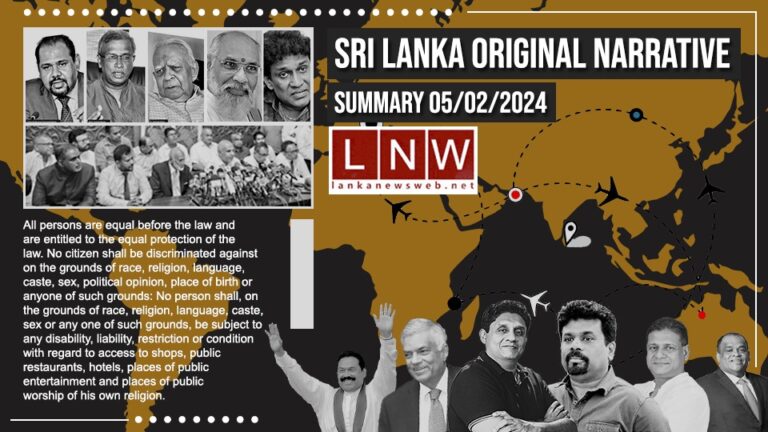
Sri Lanka Original Narrative Summary: 10/10

0

  1. State Finance Minister Ranjith Siyambalapitiya says import restrictions on all items except vehicles, will be relaxed immediately: LKR expected to be under severe pressure soon with more imports, “hot-money” exits, and dwindling Forex reserves.
  2. Economic analyst Danusha Gihan Pathirana expresses shock that the CB Governor Nandalal Weerasinghe who is also the custodian of the EPF, has stated that using pension funds & excluding private bondholders from the DDR is in the best interests of the Fund: castigates the Governor’s claim that it’s a “unique solution” to the debt crisis “discovered” by local experts and that SL does not need local experts to implement the same procedures practiced elsewhere in the world.
  3. SLPP MP Gevindu Cumaratunga charges that the Finance Ministry’s continued postponement of answering a question related to the EPF in Parliament more than 2 months ago, raises serious concerns about state policy and transparency: alleges there is a significant difference between the interest rates paid in 2022 for the Provident Fund of Central Bank officers (29%) and that paid to ordinary EPF Members (9%).
  4. Opposition Leader Sajith Premadasa alleges the Govt is planning to postpone National elections scheduled for next year: says it’s being done under the guise of amending electoral laws:also says an election can’t be expected from a President who ridicules the demand for elections by saying “there is no election to be postponed”.
  5. President Ranil Wickremesinghe expresses deep concern over recent attacks in Israel and it’s implications for Sri Lankans and Israelis in both countries: directs the Foreign Ministry to facilitate the return of all Israelis from SL to Israel and urges Police to ensure the security of Israelis in SL.
  6. Business tycoon & MP Dhammika Perera, 55, announces his intention to contest the next Presidential Election: says he will do so if political parties confirm that they will support him to obtain 51% of the vote: Perera has served as the Chairman or Director of a large number of listed & unlisted companies: his charity (DP Education) provides support for students in the IT sector.
  7. President Ranil Wickremesinghe says cotton cultivation needs to be promoted among small-scale backyard farmers in order to expand production levels and save foreign exchange for the country.
  8. SJB MP Nalin Bandara laments that an SJB MP who visited Geneva recently missed the opportunity to speak at the UNHRC Sessions: says his colleague Hector Appuhamy was given the 45th slot at the Sessions but there was no time for him to speak at the sessions by the end of the day.
  9. Pivithuru Hela Urumaya leader Udaya Gammanpila says President Ranil Wickremasinghe owes an explanation to the public as to why a successor to the IGP C D Wickremaratne couldn’t be named before the end of the incumbent Police Chief’s 2nd 3-month extension.
  10. Top SL spinner Maheesh Theekshana is likely to play in the 2nd World Cup Cricket match against Pakistan today: Assistant Coach Naveed Nawaz says Theekshana wasn’t risked in the 1st game against South Africa as per medical advice.

Two STF personnel killed, five others injured in tragic accident in Vavuniya

0

Colombo (LNW): Two Police Special Task Force (STF) personnel were killed in a tragic accident in Vavuniya, leaving five others wounded last (09) night, Ada Derana reported.

The incident occurred around 9:30 p.m. in Velikulam during a heavy rainstorm last night.

The STF’s Land Rover Defender collided with a cow, leading the vehicle to veer off its path and crash into a wall.

The deceased, two Police Constables from the STF, were 29 and 31 years old, from Kurunegala and Medawachchiya, respectively.

Among the injured are a Sub-Inspector, two Sergeants, and the vehicle’s driver, a Police Constable, and were admitted to the Vavuniya Hospital. Two of them are reportedly in critical condition.

Vavuniya Police have launched investigation into the incident.

Aviation Sector reports profit of Rs. 22 bn within first 08 months

0

PMD: In a significant development, Sri Lanka’s aviation sector has reported a substantial profit of Rs. 22 billion in the period spanning from January to August 2023, said Minister of Port, Shipping and Aviation Mr. Nimal Siripala de Silva, during a news briefing held at the President Media Centre (PMC) Oct (09) focusing on the theme ‘Collective Path to a Stable Country’.

The Minister highlighted that approximately Rs. 10 billion from this profit has already been contributed to Treasury, providing a much-needed boost to the country’s finances.

He further said that efforts are underway to restructure Sri Lankan Airlines, the national carrier, with a focus on improving its operations and financial performance. Importantly, the government is committed to ensuring the job security of the approximately 6000 employees of the airline during this restructuring process. To facilitate this, an international consultant has been appointed. This consultant is expected to bring expertise and best practices to guide the restructuring efforts.

The Minister highlighted the success of operations at Palali International Airport, emphasizing that the airport has completed 200 flights. This achievement underscores the airport’s increasing significance and efficiency in handling air travel.

The Minister acknowledged the challenges faced by the aviation sector in the past, including the impact of the COVID-19 pandemic, reduced tourist arrivals, and a dollar crisis that affected fuel supply for airplanes. He mentioned that, at one point, fuel for airplanes had to be procured by sending aircraft to Madras to obtain the necessary fuel.

To address these challenges, the Minister of Petroleum and Minister Nimal Siripala de Silva intervened and facilitated the import of aviation fuel by the private sector, ensuring a stable supply of fuel for airplanes. Additionally, modern technology was employed to develop Bandaranaike International Airport, earning it recognition as a prominent airport in Southeast Asia.

Efforts were made to increase the frequency of flights by different airlines operating in Sri Lanka. This likely contributes to improved connectivity and accessibility for travellers.

These developments in the Sri Lankan aviation sector signify a positive turn in its financial performance, reflecting resilience in overcoming challenges. The government’s interventions, such as facilitating fuel supply and enhancing airport infrastructure, have contributed to this success. Increased profitability in the aviation sector is expected to have a positive impact on the country’s overall economic stability.

Among the key points highlighted by Minister Nimal Siripala de Silva:

“In accordance with the report, Emirates Airlines currently operates 28 flights per week, China Eastern Air operates 05 flights weekly, Etihad offers 06 flights, Qatar Airways provides an impressive 35 weekly flights, Air Arabia manages 11 flights, Air India operates 17 flights, and Jazeera Air conducts 04 flights per week. Furthermore, several other airlines have expressed their commitment to commence operations in Sri Lanka.

Additionally, it is noteworthy that the operations at Palali International Airport continue to demonstrate remarkable success. Specifically, the flight operations between Madras and Palali, which are scheduled three times a week, have already completed a total of 200 flights, underscoring the airport’s increasing prominence and efficiency.”

The Minister pointed out that Bandaranaike International Airport, Katunayake once a scarcely frequented facility, has now evolved into a bustling aviation hub. Notably, in the month of August, it catered to the needs of over 650,000 passengers. This surge in passenger traffic has contributed significantly to its financial prosperity. In the first eight months of this year alone, the airport has managed to generate a substantial profit of Rs. 22 billion through its aviation services. A commendable portion of this profit, amounting to Rs. 10 billion, has been allocated to the national treasury.

In parallel, a strategic initiative is currently underway to attract potential investors to the Mattala Airport. Furthermore, measures have been put in place to actively mitigate the airport’s operational losses, thereby ensuring its long-term sustainability and financial health.”

“The Cabinet has recently granted approval for a comprehensive restructuring plan for SriLankan Airlines. Following the submission of this proposal to the Treasury, constructive discussions have taken place in collaboration with the World Bank. In an effort to ensure transparency in the restructuring process, it was recommended to enlist the assistance of an international consultant. Consequently, a qualified consultant has been appointed, and crucial steps are actively being taken to expedite the restructuring of SriLankan Airlines. If progress aligns with the planned timeline, the anticipated benefits should be realized by February of the forthcoming year.

It is essential to note that the airline presently does not own any aircraft; instead, all available aircraft are leased. Acquiring new aircraft is not an immediate process and generally involves a waiting period of approximately one year post-order. Due to the absence of A330 aircraft in the current fleet, the airline faces limitations in offering services to destinations such as England, France, and Australia. The existing fleet primarily comprises A320 aircraft, which are unsuitable for long-haul or remote operations. Thus, the restructuring of the airline is imperative to address these challenges effectively.

Recent operational setbacks have resulted in substantial losses amounting to approximately $6 billion. While unions have attributed these delays to technical faults in the aircraft, it’s important to emphasize that pilots must possess certification from a qualified aeronautical engineer before they can undertake flight operations. Moreover, a noteworthy contrast exists in the monthly flight hours flown by our pilots compared to those from other airlines. The majority of our pilots have averaged only 63 flight hours per month, whereas their counterparts in other airlines often accumulate a hundred flight hours. In light of this, a plea is made to our aviation professionals to demonstrate unwavering commitment to institutional success, fostering a culture of responsibility and accountability.

It’s worth mentioning that pilots in our employment receive a monthly salary of four million rupees (40 lakhs). While there have been demands for higher salaries, citing comparisons with the remuneration packages offered by global aviation giants, it is essential to recognize that substantial salary increments may not be feasible in the current circumstances.

Furthermore, Tata’s acquisition of Air India, which includes orders for 250 Boeing 777 aircraft, presents opportunities for collaboration. These collaborations, possibly with regional airlines, offer the potential to secure the future prospects and rights of the 6000th employee of the Sri Lankan company, thereby fortifying the industry’s position.”

Malaysia confirms support for SL’s entry into RCEP

0

Colombo (LNW): Malaysian Minister of Foreign Affairs, Dato Seri Diraja Dr Zambry Abd Kadir, confirmed Malaysia’s support for Sri Lanka’s bid to join the Regional Comprehensive Economic Partnership (RCEP).

This was during a recent meeting with Prime Minister Dinesh Gunawardena at Temple Trees, Colombo.

Sri Lanka’s inclusion in RCEP would enhance its economic ties with the larger South East Asian community, the Sri Lankan Premier pointed out. Minister Zambry Abd Kadir reciprocated by acknowledging the importance of Sri Lanka in their region and ensured unwavering support.

Gunawardena also expressed his commitment to the ASEAN vision for the Indo-Pacific, promising to actively further this economic viewpoint.

The dialogue between the leaders revolved around enhancing bilateral ties, specifically focusing on the potential for expanded trade and investment cooperation within frameworks like the Indian Ocean Rim Association.

The Sri Lankan Prime Minister invited Malaysian investors to explore opportunities in Sri Lanka’s growing sectors, such as hospitality, education, and pharmaceuticals, acknowledging Malaysia’s position as one of the island nation’s top investment partners in recent years.

The Prime Minister appreciated Malaysia for assisting Sri Lanka during last year’s economic hardship. Referring to the strong historical connections and closeness between the two nations, Minister Zambry Abd Kadir conveyed his government’s eagerness to fortify economic and trade relations.

High-level Malaysian delegation included Under Secretary Generals Dato Syed Mohamed Bakri Syed Abdul Rahman and Ahmed Kamrizamil Reza and High Commissioner Badli Hisham Adam.

State Minister Suren Raghavan, MP Yadamini Gunawardena and Secretary to the Prime Minister Anura Dissanayake also attended the meeting.

President urges swift action to replace Bambalapitiya Railway Station Flyover

0

Colombo (LNW): Following directions from President Ranil Wickremesinghe, President’s Secretary Saman Ekanayake has tasked M.M.P.K. Mayadunne, Secretary of the Ministry of Transport and Highways, with the immediate construction of a temporary access route to the Bambalapitiya railway station.

This provisional pathway is aimed at aiding passenger entry and is expected to be completed within ten days.

Owing to its deteriorated state, the current flyover will be taken down, with plans to finish the construction of a new one in five months.

The President has engaged the State Development and Construction Corporation for the project, providing Rs. 50 million for the initiative.

The design and building process will be overseen by the Road Development Authority, with operations having begun on October 09.

Today’s (Oct 10) weather: Heavy showers above 75 mm expected in several areas

0

By: Isuru Parakrama

Colombo (LNW): Showers or thunder showers will occur over most places of the Island during the afternoon or night, and fairly heavy showers above 75 mm can be expected at some places in Uva, Central, Sabaragamuwa and Easten provinces, the Department of Meteorology said in its daily weather forecast today (10).

Showers may occur in coastal areas of southern province during the morning, the statement added.

General public is kindly requested to take adequate precautions to minimise damages caused by temporary localised strong winds and lightning during thundershowers.

Marine Weather:

Condition of Rain:
Showers or thundershowers will occur at a few places in the sea areas around the island.
Winds:
Winds will be southerly and speed will be (20-30) kmph. Wind speed can increase up to 40 kmph at times in the sea areas off the coast extending from Puttalam to Kankasanthurai via Mannar.
State of Sea:
The sea areas off the coast extending from Puttalam to Kankasanthurai via Mannar will be moderate. Temporarily strong gusty winds and very rough seas can be expected during thundershowers.

Ferry Service between SL and India delayed due to unspecified reasons

0

Colombo (LNW): The initiation of the rapid passenger ferry service connecting Nagapattinam in Tamil Nadu with Kankesanthurai in Sri Lanka has been delayed due unspecified reasons, The Hindu reported.

Syed Zuhair, Director of K.P.V Shaik Mohamed Rowther & Co Private Limited, the agency handling ticket sales for the ferry, said the service was originally set to begin on October 10.

While the exact reasons for the postponement are not stated, it is anticipated that the service will likely commence on October 12.

Previous report: