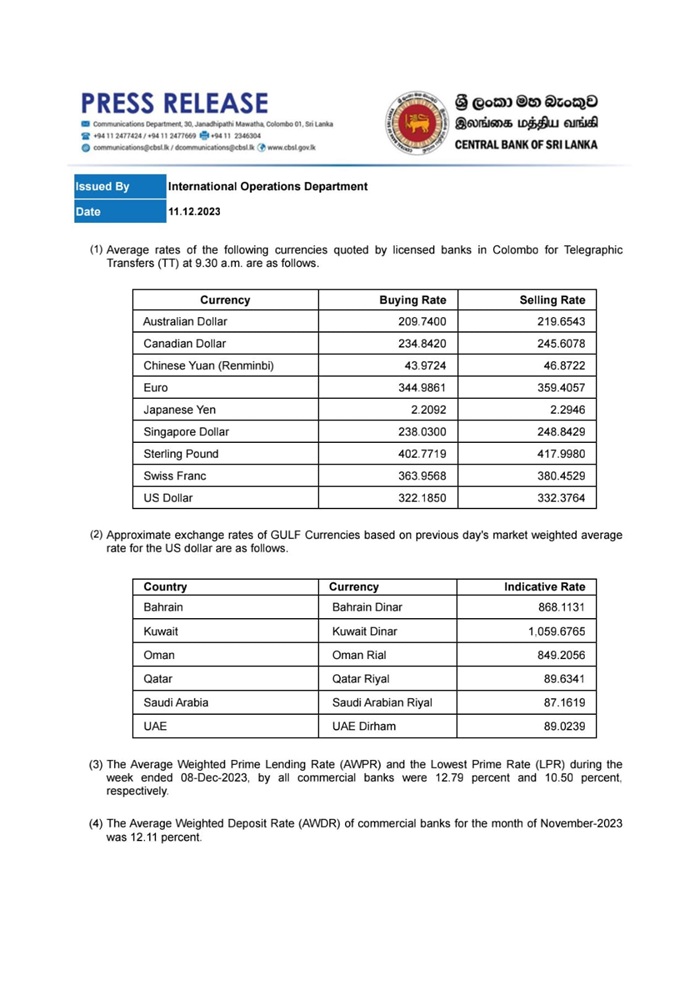
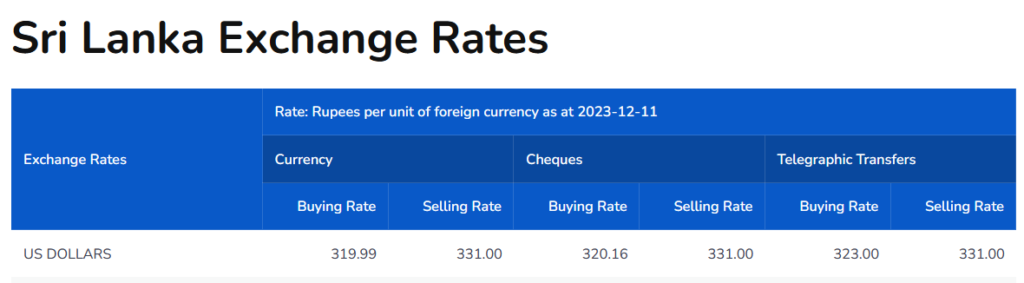
Colombo (LNW): The Sri Lankan Rupee (LKR) indicates further depreciation against the US Dollar today (11) in comparison to last week’s Friday, as per the official exchange rates released by the Central Bank of Sri Lanka (CBSL).
Accordingly, the buying price of the US Dollar has increased to Rs. 322.18 from Rs. 321.83, and the selling price to Rs. 332.37 from Rs. 331.66.
The Sri Lankan Rupee, meanwhile, indicates appreciation against several other foreign currencies.
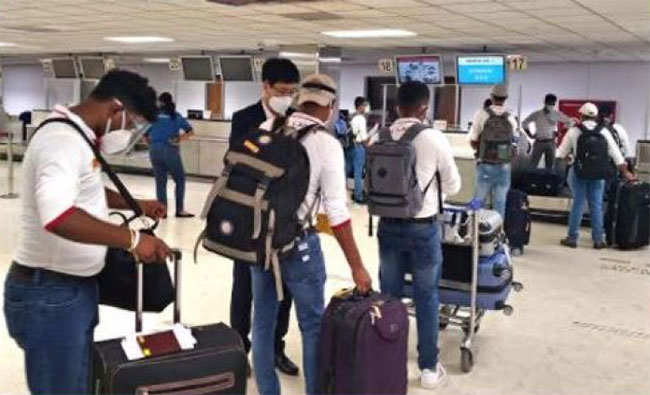
Colombo (LNW): Sri Lankan migrant workers have supported the country in overcoming the recent economic crisis by sending remittances through banks.
Minister of Foreign Employment Manusha nanayakkara expressed his commitment to formulating new policies aimed at providing much-needed facilities to migrant workers.
The National Policy and Action Plan on Migration for Employment Sri Lanka 2023 – 2027 symbolises our unwavering commitment to harnessing the potential of Sri Lanka overseas workforce.
It will be focusing on Investment, Innovation, and Inclusion, we envision a future where migration for employment isn’t just about remittances, but a holistic investment in the prosperity and resilience of Sri Lanka. Minister Nanayakkara said.
Worker remittances surged beyond US$ 500 million for the second consecutive month in November, data released by the Central Bank showed.
This not only reflects a seasonal increase but also underscores the sustained momentum observed in funds sent home by Sri Lankan expatriates through official banking channels throughout the greater part of this year, rebounding from a nadir hit last year.
Sri Lankans working abroad sent back US$ 537.3 million as remittances in November, bringing the cumulative eleven-month inflows to US$ 5,399.8 million, an increase of 62.9 percent over the same period in 2022.
Depreciation of the currency by about 80 percent, which helped to significantly reduce the gap between the official exchange rate and market rates, and the crackdown on unofficial money exchanging channels have primarily contributed to the surge in remittance inflows to the country this year.
Traditionally, March and December stand out as the two months with the highest volume of remittances, as Sri Lankan expatriates tend to send more money to their family and friends back home due to the festive season.
There is widespread anticipation that the International Monetary Fund (IMF) will release its second tranche of programme funds, amounting to around US$ 330 million this week.
This additional financial support is expected to provide further bolstering to the external sector. The increased remittances in recent months can also be attributed to a record number of departures since last year.
Many individuals left the country in search of job opportunities and improved living conditions amid the economic crisis.
Remittances continue to be the primary source of foreign exchange for Sri Lanka, with the potential to contribute approximately US$ 7.0 billion in a typical year.
The Minister pointed out that US$ 4.3 billion was received in the first nine months of this year, and foreign remittances from Sri Lankans living abroad have surged by 75%, compared with the previous year.
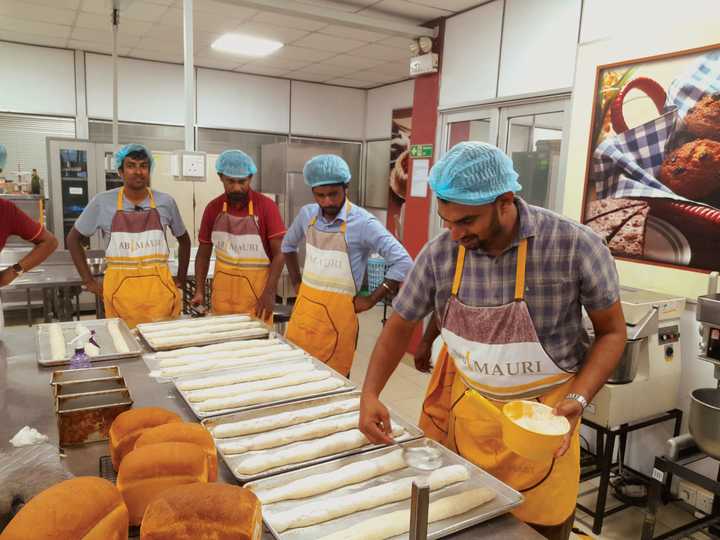
Commitment to national baking industry stresses high quality & excellence training
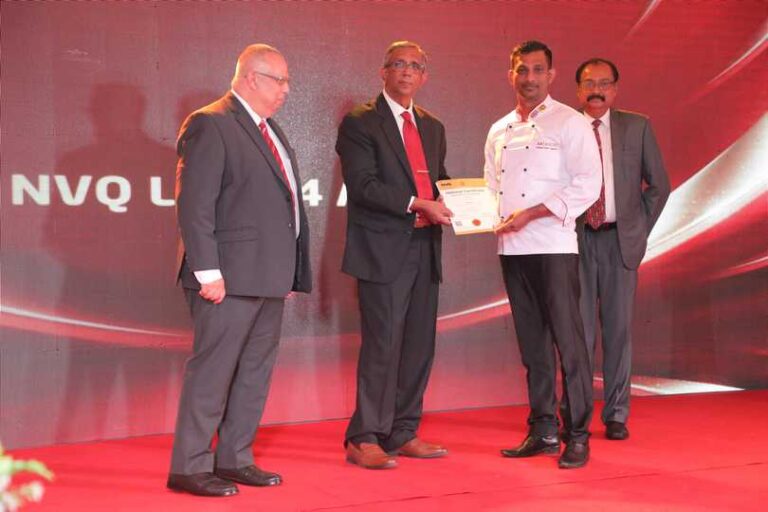
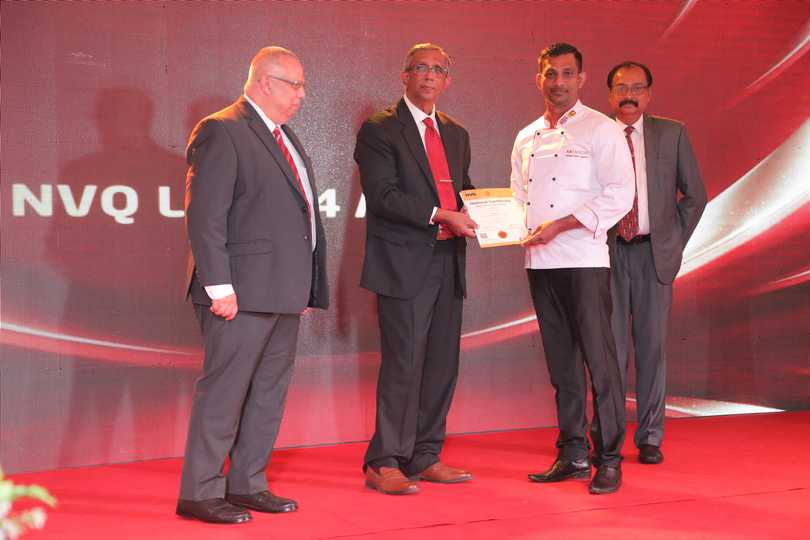
AB Mauri Lanka Pvt Limited, a leader in yeast and bakery ingredient solutions, has reached new heights in National Vocational Qualification (NVQ) for its employees.
Recently, more than two dozen employees successfully completed nationally recognized NVQ certification training on multiple levels that assess individual capabilities, competencies and skills in specific job roles and responsibilities.
“We are committed to empowering the baking industry in Sri by helping provide high-quality finished baked goods,” said Surajdeen Seiyad, Director AB Mauri Lanka Pvt Limited. “Our team maintains high standards, and this certification training is representative of the excellence we strive for in the careers of our employees but also the businesses of our customers.”
Unlike traditional academic qualification, NVQs are focused on hands-on experiences, making them an ideal choice for industries like the bakery sector where these skills and expertise are crucial. In today’s dynamic job market, employers are increasingly seeking candidates with not just theoretical knowledge but also practical skills relevant to their job functions. These formalized qualifications do play a pivotal role in bridging the gap between academic learning and applications found in the real world.
For baking, unique skill requirements are needed, ranging from precise measurement functions to intricate decorating techniques. Baking NVQ programming includes a range of modules that go even further to assess hygiene and safety protocols as well as customer service actions.
“Within the NVQ baker program, various training for our sales and technical experts was conducted at Levels III, IV and V,” said Sutharshini Navaratnaraja Manager, Human Resources, “Qualifying at these stages not only provides our team members with added confidence and knowledge in interactions with customers, but it also enables them to troubleshoot potential baking challenges and address opportunities as they arise. Ultimately, NVQ reflects our commitment to the baking industry here in Sri Lanka by fostering excellence, innovation and the highest of standards that have a profound and lasting impact well into the future.”
About AB Mauri Lanka Pvt Limited
AB Mauri Lanka Pvt Limited provides innovative solutions and applications for bread, buns and other baked products to industrial, mechanised and craft bakers in Sri Lanka. Our specialised portfolio of products includes Mauripan and Prime Dry Instant baker’s yeast and a range of premixes and bakery ingredients such as bread and bun improvers, softeners, flavours, leaveners, emulsifiers and enhancers. We aim to be the preferred yeast and bakery ingredients solutions provider through superior technology, quality, service, and innovation. More information is available at www.abmauri.com.
Colombo (LNW): Sri Lanka’s most diversified conglomerate and exporting powerhouse, Hayleys and its subsidiaries were celebrated for their unwavering commitment to excellence, value-addition and innovation, clinching 17 awards at the 25th Presidential Export Awards held recently.
Accounting for 5.5% of the nation’s total export income, the recognition won by the Hayleys Group at this year’s awards further consolidates its role as an essential contributor to an export-led Sri Lankan economic revival, capturing new markets with sustainable innovations.
The Hayleys Group export manufacturing strategy places strong emphasis on value addition to sustainably and ethically sourced home-grown raw materials.
In turn, this creates positive value for the national economy. Its purification, eco-solutions, agriculture and hand protection sectors are among the Group’s leading examples of significant value addition on local raw materials.
Organised by the Sri Lanka Export Development Board (EDB), the prestigious awards celebrate excellence in export performance, showcasing the country’s most innovative and dynamic exporters.
Hayleys Chairman and Chief Executive Mohan Pandithage said: “These awards are a symbol of our unwavering commitment to supporting our nation’s economy.
The conglomerate contributes 5.5% of Sri Lanka’s total export income, and exceeded $ 650 million in the last financial year; a testament to our people’s dedication and the impact of diverse business sectors,” Pandithage added.
The Group’s purification sector, led by Haycarb won top honours for the coconut shell products sector as the recipient of the Best Exporter Awards for 2021/22 and 2022/23.
Dipped Products received the ‘Best Exporter in Rubber Products’ for 2022/23, while Alumex was crowned as the Overall emerging exporter for the year 2021/22. Alumex also won a merit award in the Light Engineering Products category for 2022/23.
Similarly, Hayleys Agriculture subsidiary Quality Seed Company Ltd., was presented with the Overall Best SME Exporter of the Year 2022/23, in addition to winning the Best Exporter Awards in the Floriculture category for both 2021/22 and 2022/23. HJS Condiments Ltd., the exporter of value-added agri-produce, was recognised as the Best Exporter in the processed fruits, nuts and vegetable category for 2021/22 and 2022/23.
Meanwhile, three subsidiaries of the conglomerate’s transportation and logistics arm, Advantis, won a total of five awards.
Advantis-Free Zone received the awards for ‘Best Exporter Hub Operations and Entrepot Trade for 2021/22 and 2022/23, Advantis – Bunkering won the awards for ‘Best Exporter Marine and Offshore Services for 2021/22 and 2022/23, and Hayleys Energy Services, won a Merit award in the ‘Marine and Offshore Services’ category for 2021/2022.
Hayleys Fabric received merit awards in the Knitting Fabric sector for both 2021/22 and 2022/23.
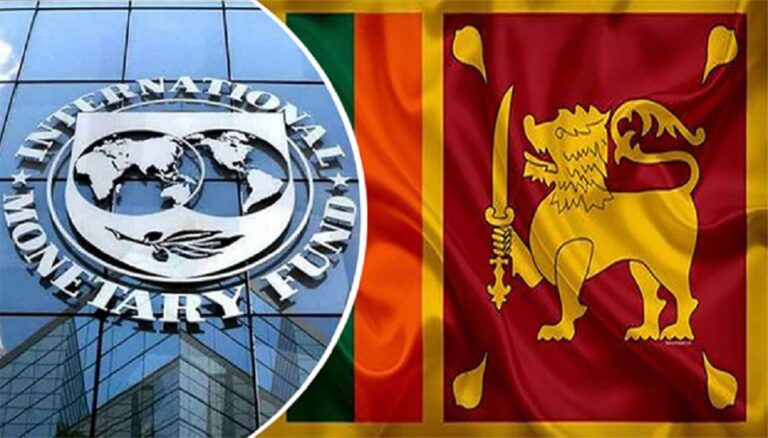
Colombo (LNW): Sri Lanka has made “good progress” in meeting quantitative targets in a number of commitments made to the International Monetary Fund (IMF) ahead of its executive board review tomorrow, Central Bank sources claimed.
The government has made good progress in terms of quantitative targets. Except for revenue targets, all targets have been met including inflation, reserves, etc on a quantitative basis,” a senior finance ministry official said.
Structural reforms such as the recently passed central bank act are also being met, he added.
Sri Lanka has made significant progress in its debt restructuring efforts, reaching agreements with domestic and foreign creditors to reduce the country’s unsustainable debt burden.
In July 2023, Sri Lanka completed the restructuring of its domestic debt. The restructuring involved extending the maturities of domestic bonds and reducing interest rates.
Sri Lanka has also made progress in restructuring its external debt, which amounted to around 61% of GDP in 2022. The government has reached agreements with the Paris Club of creditor nations and is in negotiations with private creditors.
Completion of the review by the IMF’s Executive Board requires important matters.The first if the implementation by the authorities of all prior actions; and the second is the completion of financing assurances reviews.
The IMF Executive Board will consider the agreement in principle between the Sri Lankan authorities and their official creditors represented by the Official Creditor Committee (OCC) on a debt treatment by December 12, Foreign Affairs Minister Ali Sabri said today.
He told Parliament that there is a high possibility of Sri Lanka getting the second tranch of the IMF extended fund facility within the next couple of weeks.
The Minister said it was a remarkable international victory that Sri Lanka was able to get the OCC agreement on debt treatment.
The transparency in Sri Lanka’s ongoing International Monetary Fund (IMF) programme improved in November following the publication of several supporting documents with the 2024 budget, according to the latest update of Verité Research’s ‘IMF Tracker’.
The supporting documents have provided information on the progress of six commitments that were previously classified as ‘unknown’. Five of the commitments have now been reclassified as ‘met’ and one – the tax revenue target – as ‘not met’, Verité Research said.
“Of the 73 commitments due by end-November,12 are ‘not met’, 15 are classified as ‘unknown’, and 46 as ‘met’. Therefore, 63% of the commitments due by end November have been verifiably completed. This means, however, that Sri Lanka’s overall performance remains less than impressive, it said.
The IMF board will vote tomorrow (12 December) on the disbursement of the programme’s second tranche of around USD 330 million, which was originally expected in September.
IMF Tracker will be updated with the revised set of commitments and timeframes that are likely to emerge from the request for board approval to disburse the tranche.
Colombo (LNW): Sri Lanka is now harnessing the maximum potential of the cruise destination with scenic beauty, diversity of its product offering, access to sea ports located in Colombo, Galle, Hambantota, and Trincomalee.
In the wake of significant growth of cruise tourism this year three cruise ships arranged by Aitken Spence Travels have arrived in a single day to port of Colombo yesterday.
Vasco Da Gama and Mein Schiff 5 and MS Seven Seas Navigator have brought approximately 4,000 passengers from all three vessels on a single day, the company said.
The cruise season began last month with the arrival of ‘Resilient Lady’ from Virgin Voyages, a part of Sir Richard Branson’s renowned group.
The visit of Marella Discovery 2 that arrived in early had special significance, marking its first return to Sri Lanka post-Covid and the first turnaround operation in the country.
Operated by TUI, this cruise brought three flights to Colombo for disembarking cruise passengers.
Notably, the Vasco Da Gama cruise marks its maiden call to Sri Lankan shores allowing its passengers an opportunity to immerse themselves in the vibrant city of Colombo before continuing their voyage to the Trincomalee port.
They will explore the wonders of Minneriya, Dambulla, Sigiriya, Polonnaruwa, and the enchanting sights of the East Coast. Further, this cruise will have turnaround operation in Male, Maldives.
The seamless arrangement of hosting three cruise ships at the same time all in one day is a testament to Aitken Spence Travels’ exceptional ability to cater to the diverse desires of large groups of concurrent visitors.
As the month progresses, the company looks forward to the arrival of MS Nautica on December 17th. This vessel is set to navigate the waters of Sri Lanka for three days, making stops at the ports of Colombo and Hambantota.
Aitken Spence Travels is committed to providing an extensive array of curated excursions, inviting all visitors to indulge in the diverse landscapes and rich culture of Sri Lanka
The lineup of 14 cruise calls to the ports of Colombo, Hambantota, and Trincomalee with the various cruise agents will continue till the end of December 2023 bringing in seas of tourists to the country.
Commenting on this significant achievement Mr. Nalin Jayasundera, Managing Director of Aitken Spence Travels stated that “the company is hoping to serve over 10,000 cruise passengers throughout these two months.
Ms. Stasshani Jayawardena, Jt. Deputy Chairperson of Aitken Spence, expressed the belief that the Government would develop infrastructure of the Colombo port to be a cruise hub.
Colombo (LNW): The Sri Lankan Rupee (LKR) indicates depreciation against the US Dollar today (11) in comparison to last week’s Friday, as per the exchange rates of leading commercial banks in the country.
At Peoples Bank, the buying price of the US Dollar has increased to Rs. 321.42 from Rs. 320.94, and the selling price to Rs. 332.63 from Rs. 332.12.
Commercial Bank indicates a different drive, with the buying price of the US Dollar dropping to Rs. 319.99 from Rs. 320.86, and the selling price remaining unchanged at Rs. 331.
At Sampath Bank, the buying price of the US Dollar has increased to Rs. 323 from Rs. 322, and the selling price to Rs. 332 from Rs. 331.
State Defence Minister Pramitha Bandara Tennakoon says all 252 Security Forces from the Navy, Civil Defence Forces & Army will be withdrawn with immediate effect from the Mihintale sacred site: explains this decision was based on statements by Chief Incumbent of Mihintale Rajamaha Viharaya & Opposition Leader Sajith Premadasa.
National Chamber of Exporters Chairman Jayantha Karunaratne says exporters are grappling with various challenges, such as unreasonable taxes imposed at an inappropriate time which are impacting their operations.
State Minister Indika Anuruddha says separate inquiries by Ministry of Power & Ceylon Electricity Board will be held into the recent islandwide power breakdown: CEB spokesman says initial data shows that lightning strikes on the Kotmale to Biyagama transmission line caused the power breakdown.
Parliament adjourns till 9.30am today (Monday) due to the lack of a quorum during the VAT (Amendment) Bill debate: Chief Government Whip Prasanna Ranatunga says the Bill will be debated in Parliament today & passed.
Justice Minister Wijeyadasa Rajapakshe says 3 new Bills that will make it easier to get a divorce will be presented to Parliament next month: namely, Matrimonial Causes Act, Recognition of Foreign Divorce Judgements Act and Code of Civil Procedure.
Project to install solar panels for schools to start from next year: pilot programme in the Minuwangoda Education Division: aim is to provide relief to schools with electricity bills of more than Rs.20,000 per month.
SJB “Economic Guru” & main advocate for higher taxes MP Harsha de Silva now laments the Govt is to impose VAT on 97 additional goods: such goods & services to include infant food “Thriposha”, local coconut milk products, medical equipment, ambulances, mobile phones, tractors, locally manufactured textiles, eggs, milk, mammotees, petrol, diesel, gas, fertilizer, tea green leaf, copra, solar panels, & locally manufactured software.
State Minister of Finance Ranjith Siyambalapitiya says the VAT increase to 18% from Jan’24 onwards, the reduction of the VAT threshold to Rs.60 mn, & removal of VAT exemptions from 97 items, is expected to increase inflation by only 2.5% as per the information from the Central Bank.
Parliament Select Committee on Gender Equity and Equality learns that, at present, women constitute over 15% of the Police Service and despite undergoing identical recruitment, training, deployment, & retirement processes as their male counterparts, the female officers report systemic injustice specifically in the promotion phase.
SL Under-19 Cricket team cruises to a comfortable 7-wicket win against cricketing minnows Japan to open their Asian Cricket Council Under-19’s Asia Cup campaign, in Dubai: SL now tops Group ‘B’ where Bangladesh and United Arab Emirates are also part of.
Colombo (LNW): Postal workers across the island will continue an island-wide token strike today (11), confirmed the Joint Convener of the Joint Postal Trade Union Collective, Chinthaka Bandara.
The strike has been initiated in protest against the sale of Department of Posts buildings to foreign companies, a move that has garnered support from 27,000 postal workers.
The collective stance also includes a demand for a Rs.20,000 allowance for government employees starting January 2024.
The nationwide postal strike, which commenced at 4:00 pm on Sunday (10), is slated to persist until midnight on Tuesday (12).
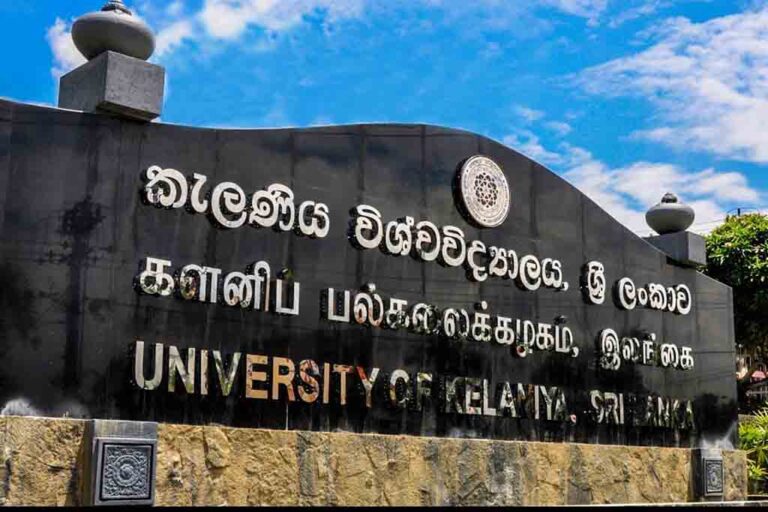
Colombo (LNW): Academic activities at the University of Kelaniya which has been temporarily shut down due to security breach will recommence from today (11) under several steps, announced the campus administration.
All faculties of the university except the Faculty of Medicine had been closed on December 04, following the abduction and assault of a security officer attached to the campus.
Commenting on the incident, Vice Chancellor of the university Senior Professor Nilanthi De Silva asserted that any party willing to lodge a complaint on the matter can attend to it on Tuesday at 9 – 11 am. Reopening of the faculties for academic activities will take under several steps, and accordingly, students of Science, Computer and Technology, Commerce and Management faculties can attend to their academic activities from today, she added.
Social Science and Human Arts faculties will reopen for studies on December 18.