Colombo (LNW): A token strike will be held on August 03, 2023 in demonstration of the disapproval of the failure to cancel the circular issued by the Health Secretary censoring health workers from producing statements to the media without the consent of their departmental heads.
The strike action has been organised by the Academy of Health Professionals, and its Chairman Ravi Kumudesh revealed that the Health Secretary has not yet responded to the queries made regarding the communique in question.
A special conference will also be held on August 03, with health professionals and civil organisations together disclosing many other issues pertaining to the country’s Health Service, Kumudesh asserted.
Earlier, trade unions and concerned individuals pointed out that the communique in question is a direct blow in the head against the health employees’ freedom of expression and freedom of speech.
The said circular failed to mention the provisions of the Establishment Code concerning trade unions and health professionals’ associations, Kumudesh added.
The Hindu: As a large creditor to Sri Lanka, China is welcome to join the effort steered by Japan, India and France to help the island nation cope with its debt distress, India’s Finance Minister Nirmala Sitharaman said on Saturday.
She also called upon the International Monetary Fund (IMF) and the World Bank to speed up relief measures for countries facing debt vulnerabilities.
Terming multilateral development banks’ (MDBs) reforms and debt-relief measures for many stressed economies as the top two finance track priorities for India during its G-20 Presidency, Ms. Sitharaman said that a comprehensive, better and quicker approach is required to address the problem within the common framework of the IMF and World Bank, as well as “outside” it.
“I quote the ‘outside of it’ equally as much as within the framework, as we have the example of Sri Lanka, a middle-income country which got into distress because its earnings were limited to tourism and some other areas like export of tea… Sri Lanka required a quick redressal, although outside of the framework because they are a middle-income country,” she noted in a discussion at the India Japan Forum.
In Sri Lanka’s case, Japan, which holds the G-7 Presidency currently, quickly took the lead to address the distress, she pointed out. “Japan came up, along with France and India, with a quick committee of creditors group, which started addressing the issue. And of course, it was an open forum, it wasn’t limited to just to the three countries, China is welcome to participate as one of the big creditors,” Ms. Sitharaman said.
Japan’s leadership in such cases with “a constructive approach to address debt distress” has been well-received, the Minister said, adding that this is an indicator that the G-7 and G-20 together would come up with solutions to the problem.
While the MDBs are acting to alleviate debt distress, they need to be “more nimble”, the Minister said, noting that “we are looking at situations where countries are waiting for more than three or four years after the application seeking some redressal, to get the actual resolution of the issues”.
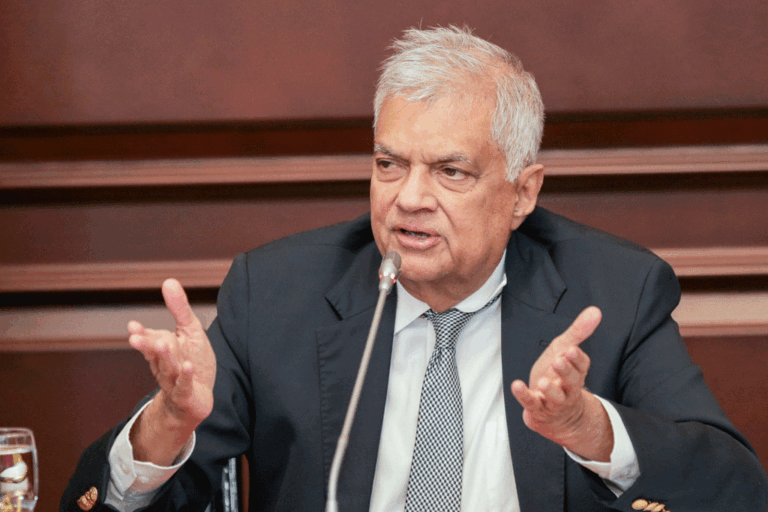
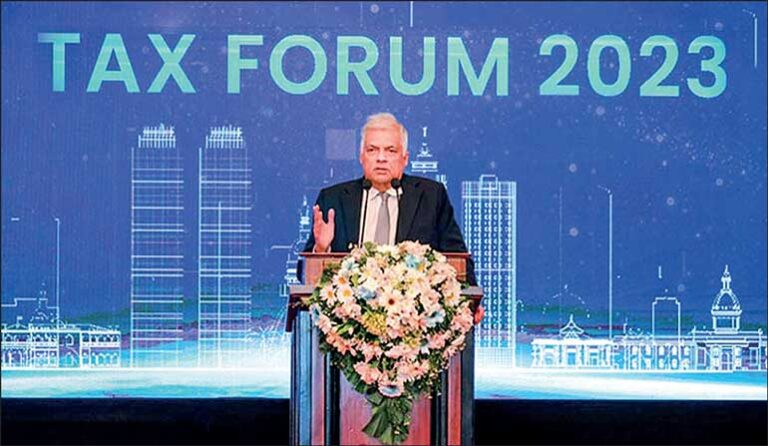
President Ranil Wickremesinghe during his meeting with Japanese Foreign Minister HAYASHI Yoshimasa expresses gratitude to the Japanese government for their support in the debt restructuring process: The talks also revolve around key areas of cooperation, namely the Light Rail Transit, the East Terminal, the Kandy Development Plan, Central Highway, and the expansion of the BIA Airport.
WB Country Director for Maldives, Nepal and Sri Lanka Faris Hadad-Zervos says at least 3.18 million middle class persons in Sri Lanka will fall into poverty level with the rising cost of living and loss of income in the economic crisis; adds this has doubled the national poverty level to 25 per cent: adds 13.1% of the population (2.9 million people) falls under the ‘poor’ category; reveals while poverty jumped to 15% in urban areas, it skyrocketed to 52% in rural areas.
Journalist and YouTuber Tharindu Uduwaragedara who was brutally assaulted and arrested by Borella Police while he was reporting on a protest in Colombo granted bail by the Colombo Chief Magistrate Court: National Movement for Social Justice calls for an immediate investigation into the inhumane attack.
India’s Finance Minister Nirmala Sitharaman says as a large creditor to Sri Lanka, China is welcome to join the efforts steered by Japan, India and France to held the island nation to cope with its debt distress: adds a comprehensive, better and quicker approach is required to address the problem within the common framework of the IMF and World Bank, as well as “outside” it.
The Colombo stock market achieves a sharp rebound with foreign investors stepping up buying, boosting the year to date net inflow to Rs. 3 bn: The active S&P SL20 shot up by nearly 4% and the active ASPI by 2.5%: Turnover gained to Rs. 3.3 bn involving 95.5 million shares.
The Academy of Health Professionals says they have organised a token strike on August 03, to protest against the failure to cancel the circular issued censoring health workers from producing statements to the media without the Ministry’s approval: Union Chief Ravi Kumudesh says the Health Secretary has not yet responded to the queries made on the communique in question; asserts a special conference will be held on the same date, where health professionals and civil organisations will together reveal many other issues pertaining to the country’s health service.
Higher Education State Minister Suren Raghavan says President Wickremesinghe’s proposal to implement the 13th Amendment to the Constitution without Police powers as a measure to foster national harmony may not be popular, but it is a forward-looking decision for the future of the country; adds this will pave the way for a new political journey anticipated by the young people who have been actively engaged in the ‘Aragalaya’.
The Human Rights Commission says it conducted a Suo Motu (on its own motion) investigation on the death of a patient who was under residential treatment at the National Institute of Mental Health (NIMH): adds it would call for reports from relevant parties related to this incident and summon all concerned individuals as well, for a detailed inquiry at the Commission as early as possible.
Power and Energy Minister Kanchana Wijesekara says the CPC has informed that anticipating the fuel price revision next month, 101 fuel station dealers for 92 Petrol and 61 fuel station dealers for Lanka Auto diesel have not maintained 50% stock capacity: adds that however, the dealers have placed adequate orders to maintain stock requirements as of yesterday: asserts the CPC took over the management of a few fuel stations last month, which had not maintained minimum stocks, and legal proceedings are being made on multiple other dealers.
Reports surface claiming that the names of Sports Minister Roshan Ranasinghe’s two daughters were among the 21 names that have been included in the letters of endorsement from Sri Lanka Cricket for Australian visas allegedly put forward by SLC President Shammi Silva: A draft of the Auditor General’s report into the expenses incurred by SLC for the 2022 T20 World Cup in Australia revealed that SLC had spent Rs. 68 million on sending its officials to Australia, while also revealing 35 names of individuals.
BBC: England bowler Stuart Broad says he will retire after the conclusion of the fifth Ashes Test at The Oval.
The 37-year-old has taken 602 wickets in 167 Tests, making him the second most successful paceman in Test history behind team-mate James Anderson.
Broad said he made the decision on Friday evening.
“It’s been a wonderful ride, a huge privilege to wear the Nottinghamshire and the England badge as much as I have,” he told Sky Sports.
“I’ve been thinking about it for the last few weeks but England v Australia has always been the pinnacle for me.
“I’ve loved the battles I’ve had with Australia. I’ve got a love affair with Ashes cricket and I think I wanted my last bat and bowl to be in Ashes cricket.”
England reached 389-9 on day three of the series finale, leading by 377, with Broad batting late in the evening.
If they complete victory over the final two days, they will draw the series 2-2, denying Australia a first Ashes win in England since 2001.
Broad has taken 20 wickets in the series, the most by an England player, and has admitted his own surprise at being fit to play in all five Tests which have been played in just six weeks.
He has been one of England’s great performers in Ashes cricket, taking a record 151 Test wickets against Australia.
“I’m loving cricket as much as I ever have,” Broad said.
“It’s been such a wonderful series to be a part of and I’ve always wanted to finish it at the top.
“This series feels like one of the most enjoyable and entertaining I’ve been a part of.”
‘I got emotional when I told Jimmy’
Broad made his debut against Sri Lanka in December 2007. Last week, during the fourth Ashes Test in Manchester, he became just the second pace bowler after Anderson to take 600 Test wickets.
“He just said ‘are you joking?’,” Broad told BBC Test Match Special, after being asked when he gave Anderson the news.
“We then had a hug. It is always hard.
“When I spoke to Jimmy, I got a bit emotional. But ultimately we have a game to win here. We can do the reminiscing afterwards if we get the job done.”
After defeat in the 2021-22 Ashes series in Australia, Broad and Anderson were dropped for a tour of West Indies in the spring of last year but were then recalled when captain Ben Stokes and coach Brendon McCullum took over.
“I told Stokesy [England captain Ben Stokes] last night and told the changing room this morning and to be honest, it felt the right time,” Broad said.
“I have thought a lot about it and even up until 8 o’clock last night I was – I wasn’t 50/50 – but I was a little bit unsure.
“But once I went to Stokesy’s room and told him I felt really happy.
“I feel really content with everything I have achieved in the game and ultimately the decision came down to I knew I wanted to leave the game loving cricket and my last memories being a really enjoyable changing room.”
An England great retires
Broad also played 121 one-day internationals and 56 T20s – leading the T20 side between 2011 and 2014 – although has solely played the Test format since 2016.
He took 8-15 at Trent Bridge against Australia in 2015 – one of a number of superb wicket-taking spells that have defined his career.
He also took 5-5 in just 5.1 overs against India at the same ground in 2011, including his first Test match hat-trick as MS Dhoni, Harbhajan Singh and Praveen Kumar fell in successive deliveries.
Against South Africa in 2016, he claimed a remarkable 5-1 in 31 balls.
Broad ‘delivered’ in the ‘big moments’
Speaking on Test Match Special, Sir Alastair Cook, Broad’s former England captain, paid tribute to the bowler’s ability to perform on the biggest stage.
“I’m a bit emotional,” said Cook, who played 123 times with Broad in Tests.
“You always get questioned about heart and whether you’re good enough in big moments.
“The one player to deliver, alongside Ben Stokes, in the big moments is Stuart Broad. And what a feeling that must be for a player.”
Michael Vaughan was England captain when Broad made his debut.
He said: “I have nothing but a huge amount of respect.
“I remember when he first came into the England side, he was just different. He wanted to captain himself, thinking about the game all of the time.
“If there has been a bit of niggle or a hot moment in the game, it has always been when Stuart has been around. He has been fantastic for the England side.”
Richard Gould, chief executive of the England and Wales Cricket Board, paid tribute to Broad, calling him “quite simply one of England’s all-time greats”.
Debt restructuring support, infrastructure projects, and high-tech investment opportunities among key topics during high-level talks.
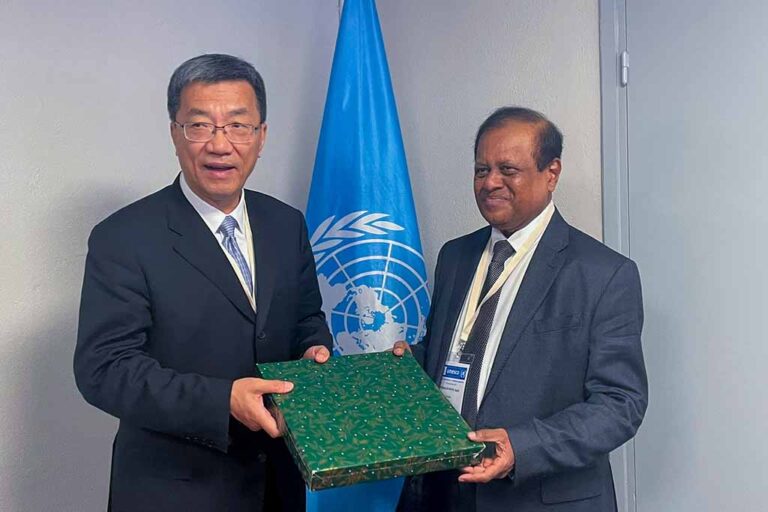
Foreign Minister of Japan Hon. HAYASHI Yoshimasa paid a courtesy call on President Ranil Wickremesinghe in Colombo,July (29). During the meeting, the two dignitaries engaged in discussions concerning the bilateral relationship between Japan and Sri Lanka, with a mutual commitment to further strengthen their traditionally robust ties.
President Wickremesinghe expressed his gratitude to the Japanese Government for their support in the debt restructuring process and shared details of French President Emmanuel Macron’s offer, aiming to play a pivotal role in enhancing the common platform for debt restructuring and expediting the process.
Another significant aspect of their talks revolved around key areas of cooperation, namely the Light Rail Transit (LRT), the East Terminal, the Kandy Development Plan, Central Highway, and the expansion of the Bandaranaike International Airport. Both parties expressed the importance of expediting the implementation of these projects.
Additionally, they delved into bilateral, regional, and global issues, emphasizing their shared commitment to maintaining the region as a peaceful and stable area. President Wickremesinghe also highlighted the investment opportunities in Sri Lanka’s high-tech industries, envisioning a transformation from a labour market-oriented economy to one that caters to cutting-edge technological advancements. This strategic move is expected to present significant prospects for Japanese investors.
The visiting Minister, Hon. HAYASHI Yoshimasa, arrived in Sri Lanka on July 28th for a two-day official visit. During his stay, he will engage in discussions on bilateral relations with President Wickremesinghe, Prime Minister Dinesh Gunawardena, and his Sri Lankan counterpart, Minister Ali Sabry.
Accompanying Hon. HAYASHI Yoshimasa for these discussions were esteemed Japanese officials, including Murakami Manabu, the Senior Foreign Policy Coordinator; Arima Yutaka, the Director General of Southeast and Southwest Asian Affairs; Endo Kazuya, the Director General of International Cooperation; and Okano Yukiko, the Deputy Press Secretary from the Japanese Foreign Ministry. Additionally, present at the talks were HE Hideaki Mizukoshi, Ambassador of Japan to Sri Lanka, Mr Tomosaburo Esaki, Executive Assistant to the Minister, Mr Taro Tsutsumi, Director of the Southwest Asian Affairs Division, and a delegation of Japanese Foreign Ministry officials.
The Sri Lankan delegation included Minister of Foreign Affairs Mr Ali Sabry, the Senior Advisor to the President on National security and Chief of Staff Mr Sagala Ratnayaka, Foreign Secretary Ms Aruni Wijewardane, Economic Advisor to the President Dr R.H.S. Samaratunge.
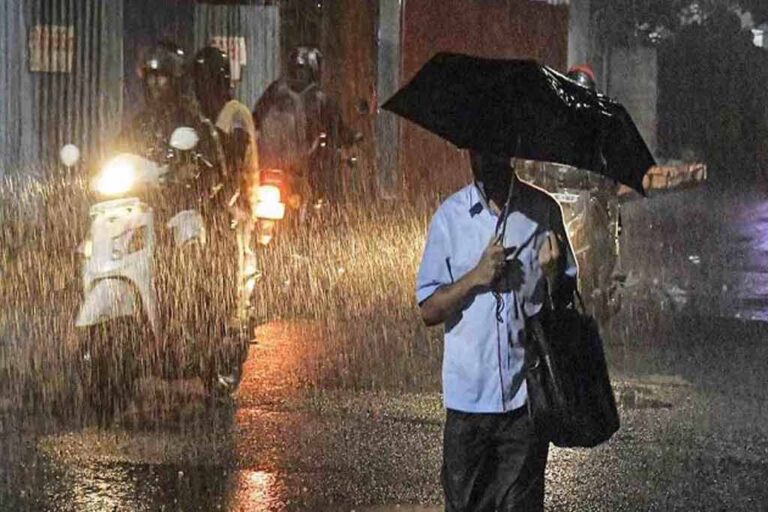
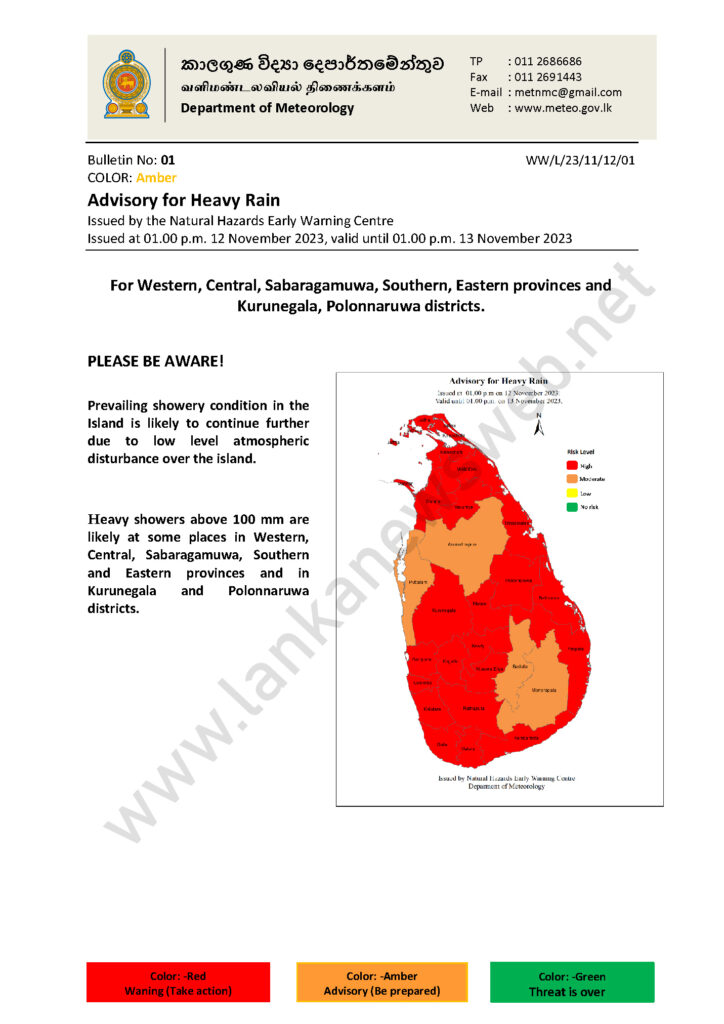
Colombo (LNW): Several spells of showers will occur in Western and Sabaragamuwa provinces and in Kandy, Nuwara-Eliya, Galle and Matara districts, and showers or thundershowers may occur at a few places in Ampara and Batticaloa districts during the evening or night, the Department of Meteorology said in its daily weather forecast today (30).
Mainly fair weather will prevail elsewhere over the Island, the statement added.
Fairly strong winds about 40 kmph can be expected at times in western slopes of the central hills, Northern and North-Central provinces, and in Hambantota and Trincomalee districts.
Marine Weather:
Condition of Rain:
Showers or thundershowers may occur at a few places in the sea areas off the coast extending from Colombo to Matara via Galle.
Winds:
Winds will be south-westerly and speed will be (30-40) kmph. Wind speed may increase up to (50-60)kmph at times in the sea areas off the coast extending from Hambantota to Pottuvil and in the sea areas off the coast extending from Chilaw to Trincomalee via Mannar and Kankasanthurai.
State of Sea:
The sea areas off the coast extending from Hambantota to Pottuvil and in the sea areas off the coast extending from Chilaw to Trincomalee via Mannar and Kankasanthurai will be rough at times. The other sea areas around the island may be moderate.
AHRC: The purpose of the proposed Bill on the Contempt of Court is to criminalise the acts which may be considered to constitute the offence of contempt of court and to punish it. Clearly, this proposed Bill is meant to create offences under the contempt of court and therefore the purpose is to create criminal offences.
In creating criminal offences there are set legal processes and legal provisions binding in all instances where offences are created and also when the offences are investigated, prosecuted and adjudicated. Once an offence is created the ordinary course of law that prevails in the country takes over and these processes should be followed. That is the very meaning of the equality before law and this provision is recognized by article 12(1) of the constitution. Thus, a person accused and dealt with under the law for contempt of court should be treated first as a suspect, then as an accused and finally convicted as a convicted person all within the general framework of the law that prevails within the country.
Besides, the equality before law as recognized under article 12(1) , this is also based on the very notion of the rule of law. In a succinct definition of rule of law, former Lord Justice Tom Bingham has summed up this notion as follows: “all persons and authorities within the state, whether public or private, should be bound by and entitled to the benefit of laws publicly and prospectively promulgated and publicly administered in the courts”. Thus, all the obligations and the entitlements of everybody emanates from the same principles which are equally applied to all.
From this it follows that like any other criminal offence contempt of court as an offence should have a clear definition. As can be demonstrated from every offence in the penal code and other offences created under other statutes, there is always a clear definition which gives the boundaries within the scope of which the crime is understood and also prosecuted and adjudicated.
The definition of the crime sets the limits for the investigators into any complaints relating to commission of such a crime to compare the evidence available and to assess whether requirements of the definition have been met by the kind of evidence that is available. Thus, the investigators into crime is strictly bound to conduct his operations within the framework of the definition of the crime. This first of all implies, there is a definition of the crime.
The task of the Attorney General in particular is to examine the available evidence and to assess whether there is a likelihood of conducting a successful prosecution in order to prove the elements of the crime as enshrined in the definition of the crime. If, no such definition exists, the prosecutor has no jurisdiction to go into the matter at all.
The same is true about the courts and the judges. A trial judge when conducting a trial on crime will strictly confine him or herself to the legal limits within the definition of the crime. All other matters will be excluded from all trial proceedings. The presiding judge will ensure that nothing outside the scope of the definition of the crime tried will be brought into the proceedings. And in doing so, he will also be bound by the laws relating to criminal procedure and also evidence ordinance. All such trials are only possible when a definition of crime is available.
The defense of the accused also confined within the framework of the definition of the crime. The accused may take up the position that if there is no definition of the crime, that he is unable to answer the charges. His duty in offering defence is determined by the legal definition of the crime on which he is charged. He has a right to know the charge and its legal definitions, he has the right to get assistance of lawyers, in order to have such definitions and all legal matters explained to him and also articulate his own position in terms of this legal framework. Where a definition clearly exists the accused can prove his position by challenging any of the important aspects of the elements of the crime. If he successfully challenges any of these aspects, he would be discharged of any criminal liability. Even if he were to be convicted mistakenly, he would have a right to appeal and in the appeal, he could take up matters about the definition of the crime under which he is charged and as to whether the prosecution has discharged its duties of proving all the essential elements of the crime against him through legally valid evidence. If any of this fails, he has right to be discharged.
All these matters are important because in the draft Contempt of Court Bill, there isn’t any clear definition or in fact any definition at all of what is called the ‘crime’ of contempt of court. Therefore, as this particular statute is meant entirely to be a criminal statute it fails to be such a statute at all. Mere passing of a statute by whatever majority cannot create a criminal offence for as long as the criminal offence has not been statutorily defined. Therefore, voting on a bill that is supposed to create a criminal offence, which has failed to do so is a futile exercise. Thus, proceeding with this Bill as it is now will not serve any legally valid purpose because the offence that it is trying to create is not defined by law
The danger of passing such a statute is that it could be made use for any purpose at all and there would be no predictability about the limits and the manner in which such a law can be misused.
It should be noted that misuse is possible as all persons are human and therefore are susceptible to committing errors inadvertently or even willfully. The persons engaged in the administration of justice despite all their good intentions and qualifications could still commit errors.
There are instances in which such things have happened relating to contempt of court which has already come under disapproval of the UN Human Rights Committee when examining two cases submitted by Sri Lankan citizens to this committee under the provisions of the optional protocol for ICCPR. These cases are the case of Tony Michael Anthony Fernando (1189/2003) and the case of S. B. Dissanayake (E-3585/04 EN). Particularly in the case of Tony Michael Anthony Fernando, the alleged offence was that he talked loudly in court. It would be quite strange if talking loudly in court becomes a part of a definition of the crime of contempt of court. As recorded by the UNHRC, what really happened was that Mr. Michael Anthony Fernando took an objection for the then Chief Justice presiding over a case in which Mr. Fernando was the complainant. Despite of the objection, the Chief Justice presided very the Bench and asked Mr. Fernando the basis on which he is making this objection, i.e. objection to hearing of the case by the Chief Justice. Mr. Fernando read from the constitution article 12(1) and said that is the basis on which he is making the submission. The chief justice immediately asked him to stop speaking threatening that if he were to speak a word more he would have one month more to each of those words for the sentence that he has in mind which was one year of rigorous imprisonment. And Mr. Fernando was taken from the courts to the prison immediately and spent the full sentence. It was this case that was disapproved by UNHRC in written view expressed under the special procedure recognised under the optional protocol to ICCPR. Similarly, S. B. Dissanayake was sentenced for two years of rigorous imprisonment for using some derogatory words against the court. In neither of these occasions, did the accused have the benefit of being charged under a well-defined offence with also the description of the possible consequences.
The question of definition also arises due to some other provisions of the proposed Bill such as section 8(1) b and c. These subsections allows a motion to be filed by the Attorney General or any other person about the commission of an offence under the act at the court. There is no provision within the act explaining what is the process by which the Attorney General should get involved on matters relating to contempt of court. What is the process by which the AG receives information, processes information and also assesses the legal basis of such information as well as legal implications of these information. In the absence of a definition of an offence, all the considerations by the Attorney General would be purely of a subjective nature. The Attorney General thus becomes an officer having to exercise the power about an undefined matter. This in any case is impossibility of performance in a legally valid manner. Therefore, the whole process of illegal definitions, and other matters which are arising out of the general law of the country and the new process of the law should all be taken into consideration in trying to define the role of the Attorney General in terms of prosecutions on contempt of court offence. In all other crimes the AG is not an initiator of the legal proceedings. There is a whole process which proceeds by way of investigations and gathering and assessment of evidence before the Attorney General comes into the picture and these are responsibilities of other departments and officers.
Besides being legally absurd and vague, these provisions of the act also leaves room for abuse. There had been cases when the work of the Attorney General’s department has been criticised by lawyers appearing in cases for example, when they point out that the information provided by the Attorney General’s Department/representative to the court is false or incorrect, AG’s department has moved that such criticisms amounts to contempt of court and therefore the lawyers should be prosecuted for contempt of court. In one instance, such an application was recorded by the court and was referred to the Chief Justice for his consideration on whether to take action against the lawyer. This shows the tendency to extend the contempt of court idea not only to courts but also departments such as the AG’s department.
Also, the act states that any other person can also bring up a matter by way of a motion. This practice of any other person bringing in a petition has been a practice which has come to the notice of even courts as a possible abusive practice. In the famous case of Natasha Edirisooriya the case relating to the use of ICCPR act which came to be condemned in a highly appreciated judgment by a High Court judge who noted that mere petition by however a prominent person even a famous monk by itself should not lead to the beginning of legal proceedings, implying that without satisfying the requirements of law relating to criminal offence actions should not be taken. It applies even more to serious issues such as contempt of court which unscrupulous persons could abuse.
Thus, all these matters require clear legal articulation if the proposed law is not to create opportunities for all sorts of abuses rather than for the protection of proper and peaceful proceedings of cases in individual instances which is the core element of the contempt of court jurisdiction.
Indian Naval Ship ‘Khanjar’, an indigenously built Missile Corvette of Khukri-class, is scheduled to visit Trincomalee from 29-31 July 2023.
2. The Commanding Officer of the Indian Naval Ship, Commander NVS Phani Kumar will be calling on Commander Eastern Naval Area. Further, various professional interactions will be conducted on VBSS, Gunnery and Missile Operations. A reception is planned to be hosted onboard for senior officials from Military and Civil administration. Post departure a Maritime Partnership Exercise with Sri Lanka Navy Ship off Trincomalee is also planned on 31 July 2023.
3. In order to further people-to-people connect and familiarize the people with Indian Navy and its capabilities, the ship will be open for a visit by school children. In addition, public will have the opportunity to visit the ship on 30 July 2023 at Trincomalee Port. The ship will also carry out a Yoga Session, Beach Cleaning and Special School in Trincomalee.
4. The visit of the Indian Naval Ship Khanjar, a Khukri-Class Corvette, is also significant in view of the potential for cooperation between India and Sri Lanka for augmenting capabilities of Sri Lanka Navy for efficiently addressing shared challenges for maritime security in the region.
5. It may be recalled that Indian Naval Submarine Vagir had earlier visited Colombo from 19-22 Jun 2023 for celebrating the International Day of Yoga (IDY-2023). Visits by Indian Navy vessels to Sri Lanka further strengthen the camaraderie and interoperability between the Navies of the two neighbours, in keeping with India’s SAGAR (Security and Growth for All in the Region) doctrine and ‘Neighbourhood First’ policy.
AHRC: The debate on how important caste consciousness is in Sri Lanka today and whether class consciousness has replaced caste consciousness requires that we briefly examine the the beginnings of capitalism in Sri Lanka, as well as the introduction of certain liberal approaches to the administration of the country during the Western colonial period, in particular, during the time of the British colonial administration.
Fortunately, there is a now available a vast body of literature about the emergence of a class of persons who took the opportunities opened up during the colonial period to acquire various amounts of wealth and become not only an influential economic group but also a prominent social class in Sri Lanka. Books such as ‘Nobodies to Somebodies: The Rise of the Colonial Bourgeoisie in Sri Lanka’ by Kumari Jayawardena and “Sri Lankan Subordinates of the British: English Educated Ceylonese in Official Life 1865-1883” by W.M.D.D. Andradi are two examples of the many other books and articles that document the emergence of this new class. There are now even YouTube presentations about this class of persons. These presentations have resulted in creating a rather lively debate about the background and development of the families who became members of that relatively rich economic class and influential social group. These families at a later time, i.e. particularly after Independence in 1948, also played a prominent role in political developments. Our interest here is on the wealth of information that is now available on these developments, which throw light on issues related to the development of a social consciousness, not only among those newly emergent political elites but in the country as a whole.
The argument that is often used to stress the importance of class over caste is that among those who became part of this newly rich and socially significant group, there was a significant group of persons who were earlier considered as belonging to the lower castes. For example, a small section of persons from the Karawa caste (fisher folk), due to opportunities that opened up for trade in liquor, were able to amass a substantial amount of wealth that enabled them to gain some sort of social prominence. They acted as if they had acquired the same class interest as the other groups that had found ways to make substantial sums of money.
However, before the British established their rule overall of Sri Lanka in 1815, for over 10 centuries, there had been a continuous period of caste based social organisation in Sri Lanka. The two basic principles on which that social organisation was based on was the prohibition against social mobility and uneven and disproportionate punishment. The entire social order and the social consciousness of the caste based society during this period were founded on these two draconian principles. The questions regarding to what degree the newly emergent ‘capitalist’ class abandoned these two principles and whether any new social consciousness emerged out of these principles, are the measures to assess whether caste consciousness was erased or weakened and whether to what extent it was replaced by class consciousness. A further question is: what kind of class consciousness did this newly formed power group bring to the country?
These issues are not merely of academic interest. Today, when the country is in the midst of its worst economic downturn in history, the question that is often asked in almost all debates, is how did Sri Lanka get into this enormous abyss that resulted in extreme wide scale poverty and disorder. What invariably comes up during such discussions is the link between the newly emergent ‘capitalist’ class in Sri Lanka and its responsibility for the present catastrophic situation. There is almost unanimous agreement that this capitalist class has played a very visible role in causing those conditions which have brought the country to the present impasse to develop. However, what needs to also be discussed is why this ‘new capitalist class’ was unable to play a dynamic role to transform the country into an economy that has vitality. These days, there are comparisons with countries in the neighbourhood in Asia and elsewhere which in 1948 were in many ways in relatively worse conditions than Sri Lanka was at the time of Independence, but which today are in a much better position from the point of view of both economic development and also in regard to the improvement of the people’s lives. At the time of Independence, Sri Lanka ranked quite high in its social index and was even considered by some as having the possibility of providing an example of a country that could become a model economically, as well as politically, from the point of view of achievements in terms of democracy, the rule of law, and the well-being of the people. The key questions that remain at large are as to whether ‘the new capitalist class’ was responsible for this failure and if so, why did they choose to go in that direction.
The above questions are related not merely to economic policies, but also about questions of social consciousness. Entrenched habits that affected social consciousness, which were a product of 10 continuous centuries of repeated social behaviour habits remained part of the baggage that was carried by this new class of people, as well as the people in the country as a whole. The new capitalist class was unable to provide a dynamic leadership to uplift the country by promoting capacities for entrepreneurship, which would have brought a new life into multiple forms of economic activities for which there was a great potential within the country.
In short, the new capitalist class did not have the imagination to fulfil the role of developing Sri Lanka into a modern economy, as well as a modern system of governance. It is in looking for an explanation for the failure of the emergence of such an imagination that we find the continuous influence of the previous social consciousness that persisted, which has its roots in the long centuries during which caste was the basis of all social and economic relationships.
The impact of caste based principles as a retarding factor on the development of the imagination of Sri Lankans
The prohibition against social mobility is an enormously effective retarding factor in the development of social consciousness. In fact, the maintenance of this caste principle requires that the majority of the population, who were classified as lesser human beings – the Sinhala common term was Kula-heena (less in caste) – had to adjust their minds so that they could accept the limitations that were imposed on them. Were they to resist those imposed restrictions, they would be subjected to the practices rooted in the other principle, which was uneven and disproportionate punishment. The two principles were tied together. The constant and continuous application of these two principles created the type of mind that subconsciously accepted submissions to all the limitations imposed on them. The oppressed and the oppressor alike were both trapped by the same social rules. No room or space was allowed to think outside these rules. In that context, to think within the box meant to think within the limitations imposed by the rules on which the caste system was maintained.
Although during the period of Western influence, particularly the British influence, some headway was made in undermining the principle of the prohibition against social mobility and also that of uneven and disproportionate punishment, the kind of colonial economic engagement of these foreign powers in Sri Lanka was not capable of transforming Sri Lanka into a dynamic modern capitalist State. This of course is to be expected. The colonial masters introduced a certain number of new economic enterprises and also accompanying administrative measures with the limited interest of ensuring their own advantage. The particular forms of economic enterprises that were developed, such as coffee and tea plantations, and the creation of facilities to obtain the benefits of these enterprises, such as roads, and other modes of transport and related matters, as well as the requisite mercantile activities were of a limited nature. These colonial practices and policies were related to feeding the needs of the industrial revolution in their own country.
Educational developments during the colonial period did have some limited impact on weakening the effect of the above mentioned two principles of the caste based society. The schools provided opportunities, though to a limited extent, which did not hitherto exist in Sri Lanka. Those who acquired some wealth were also able to go to Europe, particularly to England, to further their professional education and become doctors, lawyers, engineers, accountants and other professionals and for those individuals who benefitted, and this did result in a certain limited weakening of what had been an absolute prohibition against social mobility.
The introduction of a legal system based mostly on the common law traditions of the United Kingdom and before that certain legal traditions which came to be known as the Roman Dutch law, in an abstract sense introduced certain universal principles based on the principle of equality before the law. This principle was completely unknown on the Island prior to the introduction of those principles of equality. While during a very early period, usually known as the “Anuradha Pura” period, there was a certain universality of moral and ethical principles which was mostly based on Buddhist social principles, these were not the same as the laws that were introduced as a result of the Western influence. These earlier moral principles that had universal applications would have nurtured much more respect for human beings as human beings. However, the principles of universality during an earlier stage of history were not alien to Sri Lanka.
However, sometime in the 8th and 9th Centuries Anno Domini, the caste system was introduced and became the foundational framework for all social organisation in Sri Lanka. From then on, by a gradual process, any ideas about the universality of the principles of equality and fairness relating to human beings were suppressed. ‘Graded’ humanity became the core principle and there was no room for any kind of recognition of the equality of human beings.
In modern times, through the study of the histories of many countries, there is a growing, greater awareness of how not only a person’s mind, but also how the social conditions could be created by the repeated practice of various forms of repression of the people. The histories of slave systems have revealed an enormous amount of details of how adept and robust human beings could be made submissive and forced to agree to do whatever menial task was assigned to them by a process of, on the one hand, the deprivation of food and on the other, by disproportionate and harsh punishments. There are many other forms of repression such as apartheid in South Africa, where a minority of persons imposed draconian punishments and limitations on a vast number of black people. These kinds of oppression have lasted for long periods of time. The feminist movements have revealed the manner in which women were oppressed by various ways in systems of patriarchy. The struggle for women’s equality is a marked feature of our time, but it still remains a formidable task to suppress the obstacles which are against such assertions of the equality of all persons. As a result, in many countries, women do not have basic rights and socially and economically are still treated as being inferior.
Dr. B.R. Ambedkar, in his brilliant work on these areas, has demonstrated that caste is a much worse form of oppression than even slavery. A slave owner had to buy his slaves and he would use them as a means of producing wealth for himself. In order to do this, he had to maintain the slave by providing him with adequate food and meet his or her basic needs so that the slave would be in a condition to work for the benefit of the master. If the slave died or was weak, part of the master’s wealth was lost. This was like a cattle owner losing his cattle. Even to that minimum extent, the slave owner considered it in his own interest to keep the slave alive and healthy. Besides this, there was also the principle that if the slave owner wanted, he could free the slave and thereby the slave would become a free person. In the case of caste, both these options are absent. Whether a person in the so called “lower” castes existed or died was not a matter of concern for the so called “upper” castes. No obligations were owed by the members of the “upper castes” to the members of the “lower” castes. The obligations between the master and servant, the employer and employee did not exist within these caste relationships. The caste relationship was one of absolute obedience and whether some form of remuneration would be paid or not depended entirely on the individual master and there was no set of obligations or rights agreed upon by the society.
These brief considerations of a vast subject about which there is a great amount of research material, are only to engage in a discussion of how the imagination gets retarded when for nearly 10 centuries people live within a severely restricted social environment. These draconian principles of neglect and suppression were the norm that created the social consciousness of a particular society.
Approach to competition
In a caste based society, competition was prohibited to the persons in the so called ‘lower’ castes on the basis of the oppression due to the absolute prohibition against social mobility. Competition implies the right for a person to improve oneself. However, the caste principle was to ensure that a person remained within one’s fixed position and way of life, and also to ensure that the rigid immobility was transmitted to future generations. Making efforts to improve oneself would only be allowed within the assigned task for that particular caste group. For example, a person could be a mason, a carpenter, a scavenger, and he/she was allowed to improve what he/she was doing in that occupation. But, his/her efforts would never allow him/her to cross his/her caste boundary. The natural result was that there was not much of an incentive to compete or to improve oneself.
Another approach to controlling competition was to deny education to the so called ‘lesser’ humans. This of course was the most effective way by which competitiveness can be controlled. It ensures the existence of a large mass of people who are capable only of one or other form of physical labour. The challenge that could potentially arise from a child from an economically worse off background posing a threat to those who are enjoying privileges did not arise in this way.
Two stories from Indian literature illustrate this aspect. One is the story of Shambuka. Shambuka was from a “low caste” origin. It was strictly forbidden for the lower castes to read the Hindu Shastras – the sacred books. They did not even have access to these books. However, in some way, Shambuka managed to find these books and secretly read and master them. One of the arts that he mastered was the art of the yogis. By the control of the breath, yogis were able to do amazing things such as hanging from a tree in the posture of bats and they would stay that way for long periods of time. There were yogis who had mastered that art and in particular areas, they used to engage in this practice. Shambuka who had also mastered this ability, was in the habit of practicing it.
It is said that during this time, a senior Brahmin lost one of his teenage sons. It is also said that he took the body of his dead son and walked to the house of the leader of the Brahmins, Rama. The senior Brahmin complained to Rama that some curse has befallen them in their midst and that that is how one of their children could die in that way. He said that there must be somebody who had entered into the arena that belongs to them and that that was the cause of his misfortune. He asked Rama to set out to find out who the intruder was and to destroy him. It is said that Rama went looking for this person in his special vehicle, bringing with him a mighty weapon given to him by the gods. Rama went on enquiring about all those who were engaged in such exercises as based on yogic practice and also asked for their genealogy. The way to determine who was Brahmin was through his genealogy. All the persons that Rama questioned were able to narrate a long history of their ancestors and Rama was satisfied of their credibility. Then, he came to Shambuka. When Shambuka was asked about his genealogy, he very humbly replied, “Sir, I don’t have such a genealogy. I am a person born to a low caste and I acquired these skills by my own efforts”. He expected that this would be appreciated. Instead, Rama took his mighty weapon and slew him immediately. And, it is then further said that the gods came down and praised Rama for his great deed.
The second story is about Ekalavya, the “low caste” archer. The following poem presents the basic facts of this story.
“Ekalavya the low-caste archer
Art of the arrow
Can’t be borrowed
From guru to guru
The law said in a narrow line
This be imparted
He was young
Of eternal laws ignorant
Dreamed day and night
To be a swift dispatcher of arrows
To heaven and to hell
Not for us my son
This art
For Vedas has made us low caste
Archery is for the higher caste
Suffering for the lower caste
Mother told the boy
Besides gurus’ demand Dakshina
Only rich can give
Those who steal knowledge
They do not forgive
Mother told the boy
From afar the boy watched
Hiding often in trees
How the guru taught his boy
Secretly doing the same
Oh what a joy
Soon it was simple play
Every move he could display
An image of the guru
Of wood he made
Before playing prayed
Once when meditating
Heard a dog barking
Sent a small arrow
To where the noise was
Lightly closing the dog’s jaws
The guru and the trainee prince were passing
Marvelled at what they were seeing
Was some god in jest
Their hard learning belittling
Guru sadly wondered
Looking around saw a boy praying
Before an image so like his
The guru in a flash saw what was happening
“If I be your guru
My Dakshina now give”, he demanded
Money and gold I have none
Great sir, but even my life
I will give to learn from you
The art of the arrow
The unwise boy said
For generations learned in cunning
The guru smiled promising
“Your left thumb be the Dakshina
In exchange I will teach
The art of the arrow.”
Swiftly guru gave the knife
Swiftly the boy obeyed
The thumb he accepted,
And quickly he departed
Having protected his art
Old tale here ends
But may I add
If I was that lad
A different end
This tale would have had.
Though the stories are of Indian origin, the principles contained in those two stories are fundamental to maintaining the rigid hierarchy in a social organisation based on caste. Sri Lanka was such a society for more than 10 centuries. The deep impressions that were created in the psyche, in the mind, as well as in consciousness of the people, and which have been reinforced through such long social practices, have remained very firm. Removing these deep scars requires very conscious intellectual movements as well as consciousness raising education and the sharing of the various levels of awareness and discussions of options, together with developing social and political organisations, particularly at times of economic and political upheavals that are capable of uprooting and removing from the people’s consciousness, the backward thought patterns of everyone in the society.
Entrepreneurship, initiative and creativity
One of the disturbing revelations about Sri Lanka’s economic problems is the collapse of so many small and medium sized businesses, including those in the manufacturing industries, as well as service enterprises. While there may be many factors contributing to causing this, the absence of a culture which encourages initiative, creativity, and the spirit of enterprise also plays a significant role in affecting these businesses.
In regard to this phenomenon, once again, we return to the basic principle of the prohibition against social mobility and the role it plays in retarding the spirit of initiative, creativity and enterprise.
Entrepreneurship requires the inculcation of habits of management, the consideration of material factors and the responses of human beings as well as the re-arrangement of social relationships to enable the security needed for the practice of various types of trades and commerce and creativity, new inventions and also developing new models of organising exchanges and the like. These habits do not come about overnight. It takes a long period of time in a favourable environment to create new inventions and once a new invention comes into existence, the freedom of reflection and criticism is required in order to make further developments of those inventions or breakthroughs so as to create new inventions. Thus, the making of inventions is the product of ongoing criticism, reflections and conversations. When any new invention is closely studied, it would reveal a very long history over many decades or even over many centuries of development which are subjected to ever more complicated developments over time.
It is only in a highly interactive society that enjoys inter-related social relationships that can provide a suitable, favourable environment for the development of various enterprises, especially new enterprises. In such a favourable environment, there is both the encouragement of initiatives and an appreciation for creativity and originality. Such a society also provides opportunities for those who are willing to experiment, to think afresh and to try new things in order to improve economic and social capacities. An environment that provides encouragement and appreciation to persons provides them with psychological support that is an essential element for the development of various efforts which can give rise to the development of various enterprises, small or big. This in turn will also create opportunities for many other persons to earn their livelihoods and to overcome past patterns of poverty and deprivation that have prevailed in societies for a long time.
For the reasons set out above, caste based societies create an environment which contradicts the circumstances and prevents the development of the environment described in the previous paragraph. Caste based societies maintain negative attitudes in regard to taking up initiatives, have various ways of impeding creative efforts, as well as placing obstacles in the way of persons taking the initiative to develop various forms of enterprise. Every such attempt to do something new or different is considered as entering into forbidden territories. This sense of a forbidden territory creates not only physical boundaries, but also psychological confines.
People tell each other that they should not cross the boundaries assigned to them, or as it is more frequently expressed, they should know their place. There are a thousand ways of reminding people what their ‘place’ is. A whole culture has developed that uses various kinds of linguistic expressions, gestures, as well as openly repressive methods that are used to ‘remind’ people not to embark on new ventures and not to try to do things that may create conflicts which may result in violence.
Violence is a key aspect of that second draconian principle on which the caste based society is rooted. Any small differences or views, or even some simple expressions that are disliked by another person could easily end up in quarrels, physical violence, and even murder.
In such a caste based society, people subconsciously, or even unconsciously, develop certain perceptions or fears when interacting with others. In such a situation, a critical spirit of enquiry and exchanges of views cannot develop spontaneously. People even fear spontaneity. The reason for that fear is the concern about what kind of violent reactions might develop even when making a simple joke. Instead of a simple disagreement of views, things would often turn to the use of abusive language, or even worse, shouting insults and using other types of provocations that may easily end up in violence or create long term misunderstandings or even enmities.
In such a social environment, people do not trust each other. Distrust has become a very common social attitude and way of relating to others. Being over careful of what to say and what to do, purely because of the fear that it might lead to misunderstandings and possible violence, has become quite a normal way of life.
Naturally, in these circumstances, the freedoms of speech, association, and assembly are looked upon with suspicion. Being overcautious in expressing any view or organising any project has become part of the habitual way of thinking and acting. This results in the further suppression of creativity.
In such circumstances, creativity is easily suppressed and in place of rational and creative discourses, quarrelsome speech and provocative behaviour have become the norm and act as barriers to the enhancement of refined methods of social discourse.
The cumulative effect of all these factors is the retardation of a person’s intellect, of a person’s creative facilities and also the restraint of any enterprising spirit that a person may have. All these elements contribute to retarding the development of the economic and social potential of a society. Unfortunately, the Sri Lankan situation at present perfectly exemplifies this type of retarded mental development that has come down from past habits which were formed by caste based social relationships.
Just before the Prague Spring in 1968, when the Communist regime in Czechoslovakia seemed briefly to relax, Milan Kundera managed to publish a novel about a joke. The joke, sent by a young man to a girlfriend on a postcard, read: “Optimism is the opium of the people! A ‘healthy’ atmosphere stinks of stupidity! Long live Trotsky!” It landed the young man in a lot of trouble.
The novel, his first, sold well. But when later that year Soviet tanks rolled in, forcing his country back into line, “The Joke” disappeared from bookshops. He himself was kicked out of the Communist Party (he had been expelled before, in 1950, for being critical, but had reapplied) and was fired from his lecturer’s job at the Academy of Fine Arts. Since no one was now allowed to employ him, he played dance gigs in the taverns of mining towns. Eventually, though, there was nothing doing in Czechoslovakia, so he and his wife Vera left for France, and stayed.
In retrospect, writing “The Joke” had been a bad decision. But it was good at the time. That was life. You had only one, with no second or third chances to take a different course. His novels were full of characters struggling, like him, to unpick the past, predict the future and, on the basis of that, jump the right way. In the most famous of them, “The Unbearable Lightness of Being”, the protagonist Tomas first appeared standing at a window, ruminating. Should he invite the lovely bartender Tereza to his room, or not? Would he get too involved? If so, how would he get out of it? After spending the night with her, the questions only multiplied.
Tomas, like his creator, made a bad (or good) decision to defy the party. He lost his post as a surgeon and became a window cleaner. He also decided, for good or bad, to stay with Tereza. But all through the novel he had wrestled with his creator’s favourite theme, the weighing of opposites. The Greek philosopher Parmenides had stated, in particular, that lightness was positive and heaviness negative. Lightness was the realm of the soul, space, separateness and freedom; heaviness was to be earth-and-body-bound, rule-bound and constricted. Clear enough.
But not so fast. Lightness also made both history and life insubstantial, airy as a feather, the happenings of a day. It justified betrayal, irresponsibility and breaking ranks (as he from the party), where heaviness stressed duty and obedience. Most important, lightness was about forgetting, and heaviness insisted on remembrance. What was the self, but the sum of memories? In “The Book of Laughter and Forgetting” the heroine, Tamina, clung constantly to the memory of her dead husband even when making love with other men. Was that a good or a bad thing?
The question applied especially to Czechoslovakia, in its highly vulnerable position on the map. How could it survive without remembering its past great men, Hus, Comenius, Janacek, Kafka, or without the language they had spoken? Memory gave it identity, and gave Czechs themselves the only power they had against the states that oppressed them. In 1967 Mr Kundera appealed to fellow-writers to seize the moment with their pens. But he still resisted the thought of enclosing cultures within borders. Borders between ideas were there to be crossed.
In Paris after 1975, living in an attic flat on the rue Récamier, feasting on frogs’ legs and eventually writing a trio of novels in French, it seemed to him that notions of “home” and “roots” might be as illusory as the rest of life. His Czech citizenship had been revoked and, though he still mostly spoke Czech, he was almost indifferent when, in 2019, he got it back. Like Goethe, he saw literature becoming global and himself as a citizen of the world.
He had been one for a long time. His youthful reading was mostly French: Baudelaire and Rimbaud, but especially Rabelais and Diderot. French wit and experiment wonderfully foiled the socialist realism imposed on art and literature by the post-war Soviet regime. He fed it into his writing to defy the kitsch all around him. Sadly, it was kitsch he had fallen for himself when, at 18, he eagerly joined the party: all those heavy, emotional images of wheatsheaves, mothers and babes, hero-workers brandishing spanners, the glowing brotherhood of man. He saw himself as a knife-blade, cutting through the sweetish rose-tinted lies to show the shit—and the mystery—beneath.
Because truth was mysterious. And novels were a wide-open territory of play and hypotheses where he could question the world as a whole: digressively like Sterne in “Tristram Shandy”, or adventurously, like Cervantes’s Don Quixote. No answers, questions only; answers (in advance) were what kitsch provided. He played with philosophical musings, psychological analysis, investigations of misunderstood words, irony, eroticism and dreams. It could make a mish-mash for readers, especially Anglophone ones, and no other novel did as well as “Unbearable Lightness”, though “Laughter and Forgetting” and “Immortality” sold respectably. The Nobel talk came to nothing, and he was glad, because he preferred reclusive delving to any sort of fame.
He liked to call his novels “polyphonic”: a word learned from his father, a concert pianist and musicologist. The many voices, parts and motifs in his work were united by “novelistic counterpoint” into a single music. His chief hero in the enterprise was Janacek, whose photo hung beside his father’s in the Paris flat: a composer who had refused to write by the rules but made directly for the heart of things. He doubted he himself had got anywhere close. Since the world couldn’t be stopped in its headlong rush, it was best just to laugh at it. The devil laughed, because he knew life had no meaning; the angels, as they flew over, laughed too, knowing what the meaning was.
As a child he often sat at the piano playing two chords fortissimo, C minor to F minor, until his father furiously removed him. But as those chords became heavier he felt himself grow lighter until, in a moment of ecstasy, he seemed to float free of time. If that was unbearable lightness, he—and many others—spent an awful lot of their brief, insignificant lives trying to find it again. ■
This article appeared in the Obituary section of the print edition under the headline “When angels laugh”