Colombo (LNW):The World Bank has said that it will continue to support the Aswesuma social welfare benefit program to protect Sri Lanka’s poor and vulnerable.
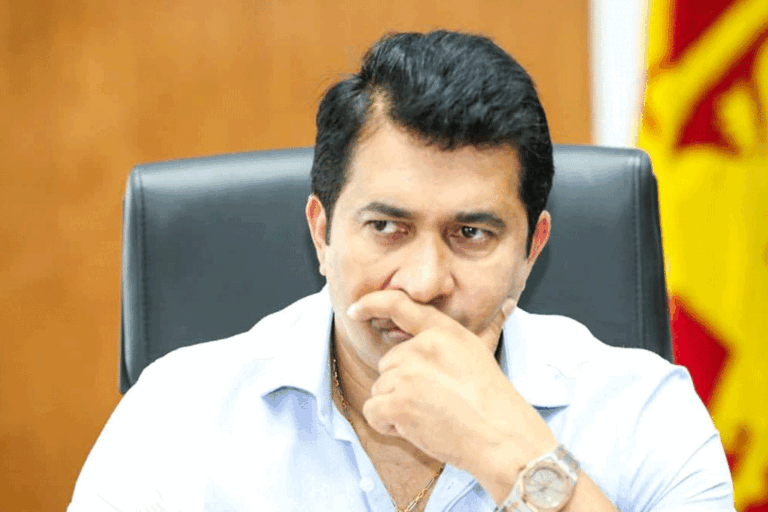
Faris H. Hadad-Zervos, the World Bank Country Director for Maldives, Nepal and Sri Lanka posted on X, formerly known as Twitter, that he met with State Minister Shehan Semasinghe and the Chairman of the Welfare Benefits Board on the progress of the Aswesuma payment scheme, and commitment to reach the 2 million families target.
On the 9th of May 2023, Sri Lankan President Ranil Wickremesinghe gave out directions for the initiation of “Aswesuma” welfare benefit payments, which are scheduled to commence from July 1st.
Accordingly, these payments will be distributed among four social categories, namely transitional, vulnerable, poor, and extremely poor.
Additionally, the usual allowances for the differently-abled, elderly, and kidney patients will also be provided
According to the President’s Media Division, the distribution of funding is as– 400,000 transitional beneficiaries will receive Rs.2,500per month until December 31, 2023,– 400,000 vulnerable beneficiaries will receive Rs.5,000 per month until March 31, 2024,– 800,000 poor beneficiaries will receive Rs.8,500 per month
– Extremely poor beneficiaries will receive Rs.15,000 per month for three years beginning July 1, 2023.
Effective from July, the Welfare Benefits Board implemented a direct crediting system, ensuring that beneficiaries’ bank accounts are directly credited with the necessary welfare benefits.
This encompasses the correction of any previous errors in social welfare benefits and the continuation of existing Government assistance programs such as Samurdhi and Elderly Assistance, said the President’s Media Division.
The ‘Aswesuma’ welfare benefit program, initiated by the President as part of the social safety net to alleviate the ongoing economic crisis, is being overseen by Minister of State for Finance Shehan Semasinghe, with involvement from various Government agencies, including the Ministry of Finance.
President Wickremesinghe highlights the need for historical reassessment and preservation of Sri Lanka’s rich heritage.
President Ranil Wickremesinghe, speaking at the “Sitawaka – Sisu Arunalu” program held at Rajasingha Central College Hanwella this morning (25), called for a fresh analysis of the life and character of King Sitawaka Rajasingha, a courageous and patriotic king of historical significance. The event, which distributed school equipment and uniforms to 12,000 schoolchildren, was made possible through the support of the Chinese government.
The President emphasized that King Rajasingha, has been overshadowed by history due to a reference in Chulavansa made two centuries after his reign. President Wickremesinghe urged a reconsideration of the historical approach that has favoured victorious figures while neglecting those who faced defeat.
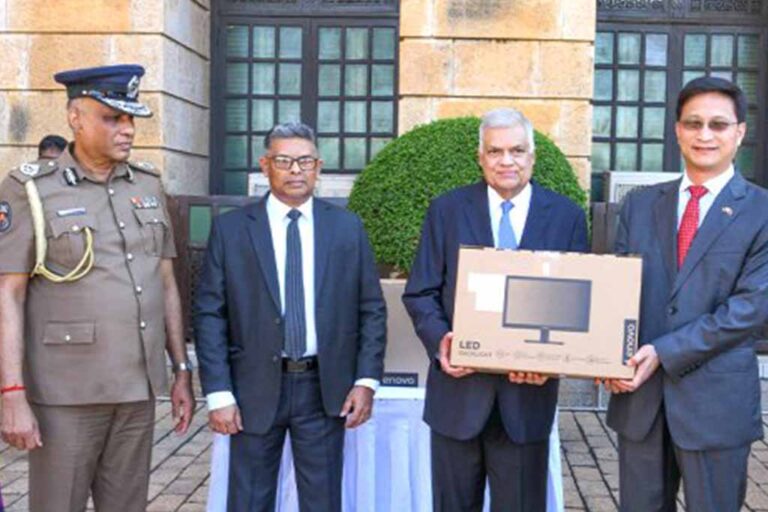
Symbolizing the distribution of school equipment and uniforms, the President presented school equipment to several students during the event. It is worth mentioning that this assistance is a direct outcome of the Prime Minister’s visit to China. Hanwella, Avissawella, situated in the Western Province, boasts an advanced education system. The Prime Minister is making a substantial commitment towards its further development.
Highlighting the significance of preserving historical and cultural heritage, President Wickremesinghe revealed that he has instructed the Department of Archaeology to explore the archaeological treasures of Sitawaka Kingdom. This effort aims to shed light on the historical significance of the region and pave the way for the construction of a museum dedicated to Sitawaka’s history.
President Wickremesinghe emphasized the need for the country’s children to receive both modern education and knowledge about Sri Lanka’s rich cultural history. He expressed his commitment to ensuring that Sri Lankan youth are equipped with the skills and knowledge necessary to shape the nation’s future.
Furthermore, President Wickremesinghe called for a re-evaluation of the character and history of King Sitawaka Rajasingha, suggesting that the narrative surrounding those who lost battles in history should be reconsidered. In an effort to encourage knowledge-sharing, President Wickremesinghe invited local school students to submit facts about the Kingdom of Sitawaka and King Sitawaka Rajasingha. He pledged to reward the school that submits the most compelling information.
Despite recent economic challenges, President Wickremesinghe assured that the government remains committed to allocating more resources for free education and healthcare. He expressed his dissatisfaction with the current education system and his determination to transform Sri Lanka into a vocational training centre while providing children with an education system that empowers them for the future.
Regarding the General Certificate of Education (GCE) at both Ordinary and Advanced Levels, there is a coexistence of the public school education system and private tuition services. This situation entails significant parental investment in education. The government is actively seeking input from educators and students to develop a new education system that addresses these aspects.
Additionally, efforts are underway to create an environment conducive to providing professional education to children. The government aims to transform Sri Lanka into a hub for vocational training through the reorganization of vocational education programs. This initiative aims to equip citizens with the necessary professional knowledge for the nation’s future development, following models adopted by countries like Australia.
During the event, a poem was recited in honour of King Rajasingha, highlighting his historic significance. King Rajasingha’s actions are recognized for preventing Sri Lanka from facing a fate similar to Mozambique or Angola and for being the only South Asian king to successfully defeat the Portuguese.
President Ranil Wickremesinghe expressed the importance of preserving the historical legacy of Kingdom of Sitawaka, emphasizing its role in safeguarding Sri Lanka’s independence. To ensure this heritage is passed down to future generations, he announced plans to establish a museum in the Sitawaka area.
Furthermore, the President instructed Chief of Defence Staff Mr. Shavendra Silva to oversee the construction of memorials at key historical battle sites, such as Mulleriyawa and Danthurei. These efforts aim to commemorate the bravery and sacrifices of those who contributed to Sri Lanka’s history.
President Wickremesinghe emphasized the need to revisit the legacy of King Sitawaka Rajasingha, a courageous and patriotic leader who has been overlooked by history. He pointed out that historical accounts, like Chulavansa, have often favoured winners over losers, neglecting those who lost battles. As a result, he called for a re-evaluation of King Sitawaka Rajasingha’s character and contributions.
In addition, President Wickremesinghe instructed the Department of Archaeology to commence work on preserving the archaeological significance of the Sitawaka region, which is expected to undergo rapid urbanization in the coming years. This proactive approach aims to safeguard the historical heritage of Sitawaka from potential loss, similar to what occurred in the city of Kotte.
President Wickremesinghe stressed the importance of understanding the past while building the future. To encourage this, he invited students from Sitawaka schools to submit essays detailing the history of Kingdom of Sitawaka. A prize will be awarded to the school with the most outstanding submission, promoting a deeper appreciation of Sri Lanka’s historical heritage among the youth.
Meanwhile Prime Minister Dinesh Gunawardena underscored the significance of education as a vital investment in the country’s future. He emphasized the government’s unwavering commitment to the educational sector and acknowledged the importance of providing essential school equipment, generously provided by the Chinese government, to students.
The Prime Minister also paid tribute to the historical role of Rajasingha Central College Hanwella as the first Central College in the Kelani Valley, which has educated numerous students who have gone on to contribute significantly to the nation’s development. He emphasized the collective efforts of various governments that have made substantial contributions to the growth and advancement of Rajasingha Central College, Hanwella.
Mr. Qi Zhenhong, the Chinese Ambassador to Sri Lanka also highlighted the strong and friendly partnership between China and Sri Lanka, characterized by mutual respect and trust. He emphasized the collaborative nature of the relationship, where both nations consistently support and assist each other.
Acknowledging the temporary difficulties faced by the Sri Lankan people, Ambassador Qi expressed confidence that, under the leadership of President Mr. Ranil Wickremesinghe and Prime Minister Mr. Dinesh Gunawardena, the country would overcome these challenges and pave the way for a brighter future.
Ambassador Qi reiterated China’s commitment to supporting Sri Lanka in achieving sustainable development and addressing prevailing economic issues.
The event was attended by Justice Minister Dr. Wijayadasa Rajapaksa, Public Security Minister Tiran Alas, Members of Parliament Jagath Kumara and Yadamini Gunawardena, Western Province Governor Marshal of the Air Force Roshan Gunathilake, Jagath Surasena Principal, Rajasingha Central College as well as teachers, parents, students and other dignitaries.
Colombo (LNW): In a historic milestone, Sri Lanka witnessed the grand unveiling of its very first centrally-monitored, fully-automated, women-operated Lanka IOC Filling Station, recently.
This event symbolizes empowerment, inclusivity, and technological advancement. Situated in the heart of Colombo, at Hospital Square.
It is the first new filling station inaugurated within the city limits in the last two decades and will serve its customers 24 hours a day, seven days a week.
The close proximity to the hospital ensures that doctors, patients, and all visitors have easy access to essential services, LIOC officials said.
More than just a fuel station, this initiative represents a leap forward in the realm of women’s empowerment and the diversification of professional roles.
Behind this visionary project is Ninewells Hospitals, renowned as the largest specialized hospital in Sri Lanka and a champion of women’s and children’s health.
Ninewells Hospitals is also a participant in the UN Global Compact’s women’s equality programme, underscoring its commitment to advancing gender equality on a global scale.
The Lanka IOC filling station, embracing cutting-edge technology, redefines the refuelling experience.
At its core is the revolutionary NPND system, short for ‘No Print, No Delivery’, a marvel of automation that streamlines transactions, enhancing efficiency and customer satisfaction.
This system ensures that the next customer is served only when the receipt for the previous transaction has been successfully delivered.
A number of distinguished guests were present at the inauguration ceremony, including the. DV Chanaka – State Minister for Power and Energy, Dr. Satyanjal Pandey – India’s Deputy High Commissioner in Sri Lanka, Mr Sumal Perera – Chairman of the Access Group of Companies and Mr Dipak Das – Managing Director of Lanka IOC PLC.
The new filling station also features automated pricing, guaranteeing accurate and up-to-date rates, across a wide range of available fuels, including LP 92, LP 95, Lanka Auto Diesel, Lanka Super Diesel, Extra Premium Euro 3, and Extra Mile Diesel, along with lubricants and Laugfs LP Gas cylinders.
Beyond fuel, the station offers comprehensive vehicle services, from detailing to tyre and wheel alignment, Café 9, a delightful cafeteria is a special feature awaiting for customers.
The Absolute Detailing and Tyre Shop by Access Motors, specializing in interior and exterior cleaning services, provides your vehicle with the utmost care and attention, all while offering exceptional value for money.
The Sri Lankan Rupee continues to maintain its stability against the US Dollar at commercial banks in Sri Lanka on September 26, showing consistency compared to the rates observed on Monday.
At Peoples Bank, the exchange rates for the US Dollar remain unaltered, with the buying rate at Rs. 316.91 and the selling rate at Rs. 330.13.
According to the Commercial Bank, the buying rate for the US Dollar has seen a slight decrease from Rs. 318.18 to Rs. 317.20, while the selling rate remains steady at Rs. 328.50.
Similarly, at Sampath Bank, the buying and selling rates for the US Dollar remain unchanged at Rs. 318 and Rs. 328, respectively.
Opposition groups in Sri Lanka held discussions with the International Monetary Fund (IMF) delegation, currently in the country to conduct the first review of the Extended Fund Facility (EFF) arrangement for Sri Lanka. The meeting took place at the office of the Opposition Leader in Colombo and was led by Peter Breuer, Senior Mission Chief for Sri Lanka, representing the IMF.
During the discussions, the agreements previously established between the government and the IMF were thoroughly examined. Opposition groups conveyed their concerns to the IMF regarding the potential impacts of the domestic debt restructuring program on the employees’ provident fund.
Opposition Leader Sajith Premadasa informed the IMF delegation that, under their government, the existing agreement would be subject to review, with the aim of formulating a more people-friendly agreement that prioritizes strategies for the nation’s development.
Sri Lanka is facing multiple crises – economic, political and cultural. How the government deals with these is crucial to the future of the country. The failed unitary form of government, in particular, the excessive powers of the executive presidency need to be curtailed. Devolution of power and a more equal balance between the executive, judiciary, parliament, bureaucracy and regions need to be renegotiated if we are to come out of the crises.
It is in this macro light that this paper should be viewed. However, this paper will not focus on the class based issues underpinning the national question, except to note that under neo-liberalism, differences in plural societies are utilised to prop up authoritarian capitalist governance systems that are beset with crises.
Nation-Building
Nation building is an evolutionary and long-term course of action, rather than a revolutionary and overnight process. It needs to develop and grow through an internal process, not via an external intervention or by an imposed agenda. It also needs economic, social, and political development as well as institutions that protect the fundamental rights of the people and communities. In addition, the nation-building effort needs to ensure equal access to jobs, education, and health for all among other things.
For long-term democratic nation-building to be successful, we need to recognise the importance of democratic values, within the civic sphere that will develop and sustain them; rather than just emphasising economic development or state-building. Currently we have only received rhetorical banalities from the political elite shorn of any real meaning of this crucial issue.
Political decentralization can empower citizens or their representatives engaging in decision-making processes. Greater participation is assumed to lead to better informed decision making that are more relevant to the plural societies like Sri Lanka. With political decentralisation, citizens will come to better know their representatives and in turn they will be more cognisant of the needs and desires of their electorates. For decentralisation transfers responsibility for planning, financing and managing certain public duties from the centre and its agencies to regional ones, thus making it more local and accountable. This can be achieved by de-concentration, delegation, and devolution of authority with each of these having their own characteristics.
It should be noted that centralization and decentralization do not need to be an “either-or” scenario. Practical examples around the globe have demonstrated that an appropriate balance of centralization and decentralization can ensure effective and efficient government service delivery. Centres can play a crucial role in promoting and sustaining decentralization efforts. This can be done by developing proper and effective national policies and regulations needed for decentralization, thus creating or maintaining the necessary enabling environments that allow regional, provincial, and local units to take on more responsibilities for undertaking new functions.
The two uprisings in the south and the three decade long armed conflict in the north are examples that reflect the fact that if people are excluded from sharing any political power, they are more likely to challenge the legitimacy of the existing system. Federalism or devolution is a means of sharing power among diverse political entities irrespective of their ethnic or regional ties. Democracy will survive better if successes and burdens are shared fairly and equitably.
The current political system is based on ‘winner-take-all’ system, where one political party or group monopolise all the privileges and economic benefits. Devolution in contrast allows different ethnic and regional groups an ability to determine their own affairs, thus making them feel more secure. They may gain more confidence in and commitment to the existing system, and a general sense that the system is fair and inclusive.
In the UK devolution became a major political issue in the early 1970s, as Scotland and Wales demanded greater control over their own affairs. A referendum was held in 1979, to determine the people’s will for devolution. The electorate was needed to approve it with a two-fifths majority, but voters in Wales and Scotland rejected it. However, in 1999 under Tony Blair’s regime, power was devolved, Scotland had a parliament and later, Wales a Welsh Assembly. The Good Friday Agreement of 1998 provided Northern Ireland with its own parliament.[ii]
In Sri Lanka, proponents of devolution have been demanding clearly defined powers the Provinces can wield. During the Constitutional reform process under the previous regime led by President Maithripala Sirisena and Prime Minister Ranil Wickremasinghe, the Chief Ministers of the seven ‘southern’ provinces asked for proper devolution as envisaged under the 13th Amendment. However, nothing came to fruition.
[i] Reiter R, Grohs S, Ebinger F, Kuhlmann S and Bogumil J 2010, Impacts of decentralization: The French experience in a comparative perspective, Ruhr-Universität; Published in French Politics 8(2010), 2, 166-189, Available at: https://d-nb.info/1078649812/34
US Under Secretary Victoria Nuland meets Foreign Minister Ali Sabry: reportedly raises concerns about the upcoming visit of Chinese research vessel Shi Yan 6: Minister Sabry reportedly says Sri Lanka can’t exclude China from docking in a Sri Lankan Port according to the SPO in place for foreign vessels.
Former CB Governor Ajith Nivard Cabraal says SJB MP Harsha Silva’s attacks on his testimony before the “PSC on Causes for SL declaring Bankruptcy” is an attempt to browbeat him from giving an accurate account of the events surrounding the bankruptcy announcement: also says the announcement was a part of a conspiracy: asserts he would expose those who engineered the organised bankruptcy.
State Defence Minister Pramitha Bandara Tennekoon says SL risks facing more Easter Sunday style attacks: urges the legislature not to undermine intelligence services as their services were required to prevent the next attack.
Ratnapura High Court sentences former Senior DIG of the Sabaragamuwa Province Lalith Jayasinghe to 5 years imprisonment for influencing the Kahawatte Police OIC to refrain from arresting MP Premalal Jayasekera in connection with a shooting incident in the lead-up to the 2015 Presidential Election.
Education Minister Susil Premajayantha says arrangements have been made to ensure that school textbooks for next year will be distributed among the students, before the commencement of the 2024 school year.
Police say there have been 77 incidents of shooting so far this year whereby 46 persons, including a 6-year-old, were killed and 35 persons were injured.
A group of Tamil asylum seekers on a tiny British territory of Diego Garcia in the Indian Ocean win their fight against being forcibly returned to SL.
Minister of Health Keheliya Rambukwella says only 13% of the Pfizer vaccines imported to the country to immunize against Corona virus had been used and the rest destroyed after their expiry dates.
Kandy Diocese Bishop and Chilaw Apostolic Administrator Bishop Valence Mendis says it is ludicrous that the Govt has chosen to appoint more Committees to probe the Easter Sunday terror attacks, instead of implementing the recommendations of the Presidential Commission of Inquiry which probed the carnage.
Sri Lanka wins the Asian Games Women’s Cricket Silver Medal: lose to India by 19 runs in the Final: India – 116/7 (20 overs), Udeshika Prabodhani – 16/2: SL – 97/8 (20 overs), Hasini Perera – 25.
A minor tremor measuring 2.4 on the Richter Scale was reported in the Buttala area, as confirmed by the Geological Survey and Mines Bureau. The tremor was recorded at approximately 11:20 p.m. yesterday (25).
All four seismic stations in the country detected the minor tremor, which originated from a depth of approximately one kilometer beneath the earth’s surface.
The ICJ considers that revisions made to the draft of proposed anti-terrorism legislation, while positive, fail to sufficiently correct the deficiencies of the earlier draft and, if adopted, would risk serious human rights violations.
The revised bill, in its clause 3 continues to define acts of terrorism in a vague and overbroad matter and undercuts the inherent authority of the judiciary, as people may be detained for two months solely on order of the secretary of the Defence Ministry.
“The overbroad definition coupled with the restriction on the authority of magistrates to review initial Detention Orders is in contravention of fundamental rule of law principles and must be further revised if Sri Lanka is to deliver on its promise to protect the human rights of all of its inhabitants,” said Ian Seiderman, ICJ’s Legal and Policy Director.
The ICJ stresses that these provisions contravene article 13 of Sri Lanka’s Constitution, as well as article 9 of the International Covenant on Civil and Political rights, to which Sri Lanka is a party.
On 15 September 2023, the Ministry of Justice of Sri Lanka published the revised version of the Anti- Terrorism Bill (ATA), which would repeal and replace the Prevention of Terrorism (Temporary Provisions) Act No.48 of 1979 (PTA). A first draft of the Bill was published in March 2023 and according to government ministers the current revision was aimed at removing certain problematic provisions from the earlier draft. The ICJ had previously expressed concerns about that draft.
“Sri Lanka should dispense with special regimes like the ATA and instead address terrorism offences through criminal procedures that comply with the rule of law,” said Ian Seiderman. “At the very least, the Ministry of Justice must revise the present draft in line with international human rights law and standards before parliament takes action on it.”
Among the vague and overbroad provisions of the draft bill are the “encouragement of terrorism” (clause 10) and “dissemination of terrorist publications” (clause 11), under which persons can be detained for sharing or causing to be published statements which are interpreted by the authorities to be in support of terrorism or terrorism activities. The burden of proof for such offences would be unacceptably reversed under the bill, as the accused would be required to prove before the high court that they had not consented to or approved the utterance or publication of such statements.
The prescribed punishment for these offences is imprisonment up to 15 years and/or a fine up to one million rupees. Property owned by the accused may also be forfeited to the State.
The bill would provide the President with excessive powers to restrict the exercise of human rights, including to impose restriction orders on individual persons, proclaim curfews, designate prohibited places, and make regulations to implement “rehabilitation programmes” for persons regarding whom the Attorney-General has recommended a deferment or suspension of criminal action. Rehabilitation programmes in the past have served a punitive function, as accused persons have often been effectively coerced into accepting rehabilitation particularly in cases where the prosecutor has lacked evidence of criminal conduct.
The ICJ notes the several positive changes in the revised draft, including the removal of the death penalty as a possible punishment and removal of the power of the Deputy Inspector Generals (DIGs) of Police to issue Detention Orders (DO). The new draft would also allow the Magistrate to discharge suspects, in the absence of a DO, where the Magistrate determines that there is no justification for the arrest. DOs, which may only be issued by the Secretary to the Ministry of Defence would now allow for detention of two months without charge, as opposed to three months contemplated by the earlier draft of the bill. Finally, the revised bill removes mention of the Board of Review, which would have been empowered to hear appeals against DOs in the previous draft, and provides time limits for declarations of prohibited places by the President.
The revised draft also retains the improvements made to the PTA in the first draft including the removal of a provision which accepts “confessions” made before a police officer while in detention as evidence in courts; the issuance of a document by the arresting officer notifying arrest to a family member of the arrested person; employing women police to question or conduct searches of women detainees; access to translations in a language of the accused’s choice; and production before a magistrate every 14 days when a person is detained under a Detention Order (DO).
However, among its many flaws, the draft law is silent on compensation and redress mechanisms for those affected by abuse and misuse of the law. This is a significant shortcoming, as detainees have languished in custody for years under the PTA and have had the cases against them dismissed decades later.
Background
Past experience with the PTA has shown that provisions relating to ‘encouragement of terrorism’ or ‘dissemination of terrorist publications’ are open to abuse particularly against persons from minority communities including journalists. For instance, Ahnaf Jazeem ,whose book of poetry was spuriously identified as promoting “extremism”, was subjected to human rights violations, including arbitrary detention under the PTA. In May 2022, the UN Working Group on Arbitrary Detention stated that Sri Lanka had violated international human rights law by detaining Ahnaf Jazeem.
The ICJ has repeatedly called for the repeal of the Prevention of Terrorism Act, which has been used to arbitrarily detain suspects for months and often years without charge or trial, facilitating torture and other abuse. United Nations human rights bodies have also called on Sri Lanka to enforce a moratorium on the use of the Prevention of Terrorism Act and to repeal the Act.
23 September 2023: I met comrade H A Seneviratne during the main trial of the Criminal Justice Commission (CJC) held in 1972. He was one of the junior attorneys who worked alongside comrade Bala Tampoe, the principal lawyer. Tampoe was a well-known veteran leftist, the founder of the Ceylon Mercantile, Industrial and General Workers Union (CMU) and a brilliant criminal lawyer. His team appeared on behalf of some of us who were still committed to exposing the state’s hypocrisy, and its pre-1971 suppression and terror. This repressive process against the JVP ultimately culminated in the insurrection of April 1971. Comrades Tampoe, Seneviratne and others dedicated their lives to protecting and upholding the democratic rights of working people, particularly trade union members.
A group of progressive activists including Bala and his team pioneered the protection of the human and democratic rights of JVP activists, who were held in detention at the time. Bala and his team were also members of the Fourth International holding Trotskyite political positions. They originated from the Lanka Sama Samaja Party (the LSSP). They ultimately joined together to form the Revolutionary Marxist Party (RMP) and were active in the CMU. What I found in all of them was a shared concern for humanity. As bright legal professionals they could have joined the ruling elite, and enjoyed all the interests, rewards, and privileges that it would entail.
Instead, they all became political activists, first and foremost due to their overriding concern for the oppressed. Among the trade union leaders, it was rare to find people like them, who earned respect both locally and internationally. They dedicated their lives to working people without personal or political gain. It is a pity that Sri Lanka is becoming increasingly devoid of people who work in such a self-less manner. Seneviratne and his fellow comrades believed in collective prosperity and fundamental freedoms. As humanists we have a lot to learn from their life experiences, particularly at a time when the world is driven in the opposite direction forcing society to forget humanity, but to put self-preservation first and foremost.
We all approached life as humanists, but with shades of sectarianism dominating in our political outlooks and activities. This was dependent on which political tendencies we belonged to, irrespective of the outcomes we realised as a result of our political activities. I remember Bala and H A teasing us during the trial and afterwards saying we were ‘Little Lenins’. When Comrade Rohana Wijeweera and I visited the CMU Head office in Kollupitiya, Colombo, we only met Bala and the CMU staff. We thanked Bala, his legal team and the CMU for consistently supporting us while in prison.
Comrade Seneviratne was calm and gentlemanly, despite his learned background. Unfortunately, comrades Bala and H A parted their ways later, after we were sentenced for waging war against the Queen’s Government in Ceylon. From what we heard from Bala, they had differences in prioritising trade union work. The last time I met him was in 2017, where we spoke about his literary and pro-feminist political activities.
As the decades pass, I cannot recall everything Comrade H A contributed to and accomplished during his life time. However, I can say that he was an incredibly charming person with a simple lifestyle. I have heard that his talents and interests extended beyond politics and human rights. I can recall trying to visit him at his home in Nawinna, Maharagama, but was unable to see him. Comrade Seneviratne was said to suffer from memory loss and did not wish to see anyone. Since then, I haven’t been able to get in touch with him.
Comrade H A Seneviratne’s passing will leave a gap that others will find difficult to fill in. I take this opportunity to pay my fraternal respect to him and politically honour him. My deepest sympathies are with his family, relatives, friends and comrades.