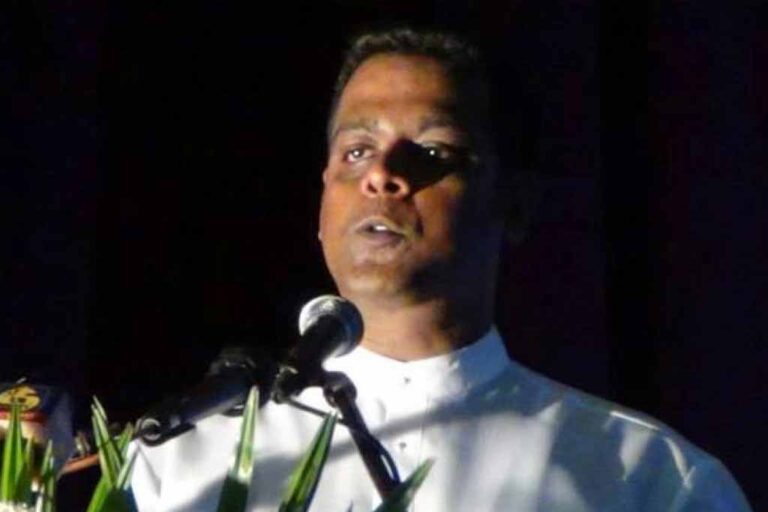
Colombo (LNW): Three complaints against State Minister and Ruling Party MP Sanath Nishantha over contempt of court will be taken up for hearing from October 27, declared the Court of Appeal.
This was when the said complaints were called in before the Appeal Court bench chaired by Justice Nissanka Bandula Karunaratne and comprised of Justice Chamath Morais yesterday (27).
Deputy Solicitor General Lakmini Giriharagama appearing for the Attorney General’s Department told the Court that the documents pertaining to the investigations involving the video evidence under the Evidence Ordinance have been presented to the Court and requested that dates be fixed for the hearing against Nishantha.
The complaints have been lodged against the State Minister by the Sri Lanka Judicial Officers’ Association, and Attorneys Priyalal Sirisena and Vijitha Kumara, accusing him of committing contempt of court through a statement in which he had allegedly commented on or near August 25, 2022 about the manner in which the magistrates behaved when the protesters of the ‘Aragalaya’ were granted bail.
My greetings to the Muslim community in Sri Lanka and around the world, observing Milad Un Nabi, being the auspicious occasion commemorating the birth anniversary of the Holy Prophet Muhammad, founder of Islam.
He is celebrated as the final messenger of Allah, known for profound teachings of love and peace that encompass humanity. His journey to spread the message of Islam in the challenging societal context of that time, was marked by significant trials. Even in the face of adversity, the Holy Prophet’s unwavering patience and equanimous strength served as powerful attributes. He was victorious in attaining his aspirations, through boundless sacrifices for faith and humanity.
As we celebrate Prophet Muhammad’s birthday today, it is timely to resolve to uphold the values that were the hallmark of his life, which include mutual understanding, brotherhood, assistance to one another and fairness. Our commitment to fostering social harmony is the most meritorious tribute which could be paid to his legacy.
I urge all Muslim brethren in Sri Lanka, to unite at this juncture in working towards strengthening the path, to secure a developed Sri Lanka by 2048. Let us together overcome the challenges facing our nation, while adhering to the principles espoused by the Holy Prophet Muhammad, in ensuring a brighter future for all.
I wish all those of the Islamic faith, a joyous Eid Milad-Un-Nabi, filled with love, peace and prosperity!
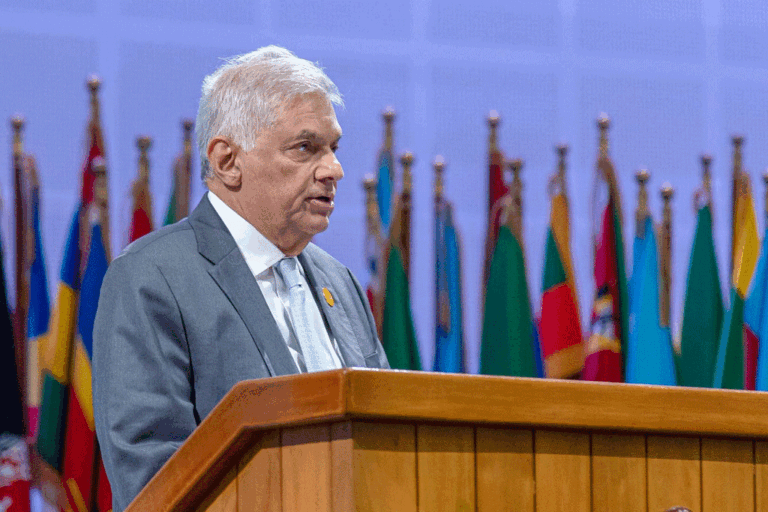
Ranil Wickremesinghe, President, Democratic Socialist Republic of Sri Lanka.
Colombo (LNW): Sri Lanka is to explore the high potential of mineral sands to become the next ‘billion-dollar industry’ in the country attracting foreign investors to develop the mineral sand exports with much value addition, Chairman of the Geological Survey and Mines Bureau (GMSB) R. Sanjeepan disclosed.
It will host the first-ever International Mining and Mineral Conference, investor forum and exhibition next month.
Ministry of Environment has planned the two day event at the BMICH in Colombo from 21 October, which has received the cabinet nod.
At least 500 foreign investors involved in the industry will be attracted to the event, he said.
The govern t plans to make the maximum utilization of its mineral resources to bolster the nation’s economic growth, and the potential for creating value-added products from these resources, a state minister said.
“Given the island nation’s rich mineral resources, the government has devised plans to expand investment opportunities,” State minister of Urban Development and Housing, Arundika Fernando said.
“The ministry taken the decision to extend investment prospects along the country’s coastline, collaborating closely with agencies such as the Investment Promotion Board and the Ministry of Lands,” Fernando said.
The minster said they were considering the introduction of a specialized bank dedicated to the development of domestic industries and introducing new legislation.
“The ministry will be introducing a new environmental protection and ocean protection bill in our country. This legislation will play a vital role in safeguarding our natural resources.”
“The Department of Coastal Conservation actively participates in initiatives aimed at enhancing the value of our mineral resources. These resources have the potential to yield significant value through the production of value-added goods.”
“The primary focus must centre on pioneering innovative programs that contribute to our country’s economic recovery. Timely and effective resource management is crucial for initiating income-generating initiatives.
Sri Lanka’s state-run Lanka Mineral Sands Limited is to export 60,000 metric tonnes of ilmenite to China this month after a shipment of 30,000 tonnes of Zircon mineral sands was shipped out of Trincomalee harbour earlier this month.
The EDB said it had identified the value-added mineral products sector as a potential sector to be developed and promoted in the international market, and met with members of the Chamber of Mineral Exporters (CME) to discuss growing the mineral-based industry in Sri Lanka.
CME members requested the government foster foreign investments and proposed that the state conduct a comprehensive ore reserves study to maintain transparency and informed decision-making within the industry.
They asked for government support in research and development, and a 300% tax rebate for research and development activities in collaboration with Sri Lankan educational institutions.
They also requested revising royalty systems grounded in pithead value, in line with international norms and pointed out the need for an equitable approach to royalty calculations to ease the financial burden on mining entities.
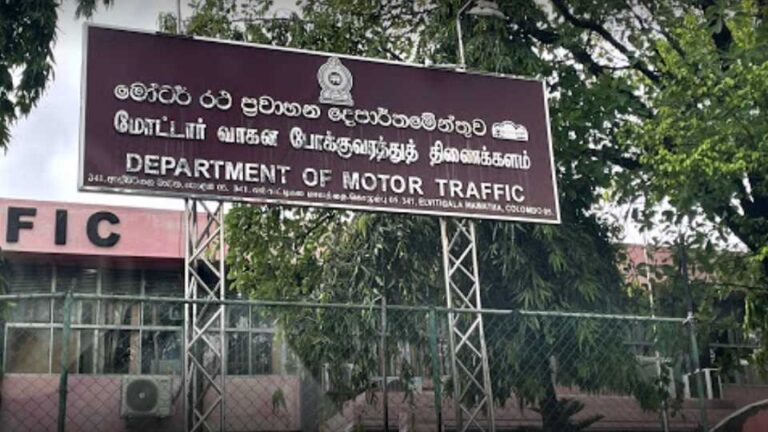
Colombo (LNW): Motor Traffic Department will be launching the new Electronic Revenue Licence System (eRL 2.0): Revolutionizing the Vehicle Revenue Licensing Process
The Information and Communication Technology Agency (ICTA) of Sri Lanka reveled that the upcoming launch of the Electronic Revenue License System (eRL 2.0) is on October 03, 2023.
This transformative system, developed in collaboration with the Provincial Department of Motor Traffic, promises to revolutionize the vehicle revenue license issuance system, improving the efficiency of the officers while delivering enhanced services to citizens.
eRL 2.0 is scheduled to be launched initially in eight provinces, including the North Western, Southern, North Central, Central, Sabaragamuwa, Eastern, Northern, and Uva Provinces. Meanwhile, the existing system, eRL 1.0, will continue to operate in the Western Province.
To facilitate the transition to eRL 2.0, the issuance of revenue licenses at all Provincial Motor Traffic Department Head Offices and Divisional Secretariat Offices across the country will be temporarily suspended on September 27 and October 2, 2023.
Additionally, the online system for obtaining revenue licenses will also be temporarily suspended until midnight on October 6, 2023. At its core, eRL 2.0 is designed to maximize efficiency and prioritize user-centeredness.
It simplifies the complexities of the vehicle revenue license system and allows officers and citizens to experience a seamless user process that empowers them to access services effortlessly and efficiently. In embracing digitization, eRL 2.0 envisions a Government that listens to its people and responds with agility and precision.
The Electronic Revenue License System (eRL) was initially introduced in December 2009, serving as Sri Lanka’s first connected transactional Government service.
The system operates as a centralized, web-enabled platform used by Divisional Secretariats to issue vehicle revenue licenses and provides an online service (eService) for license renewal.
It connects various stakeholders, including the Department of Motor Traffic (DMT), Provincial Departments of Motor Traffic (PDMT), Insurance companies, Emission testing companies, banks, and financial organizations.
As of date, the current eRL system has benefited over 6 million users per year on average, generating revenue worth LKR 10 – 12 billion per year.
The eRL system has consistently managed the revenue license records of all vehicles in the country and is hosted on the Lanka Government Cloud (LGC). This cloud-based infrastructure has ensured smooth operation, covering all Divisional Secretariat Offices at over 550 locations Island-Wide.
The launch of eRL 2.0 marks a significant step toward a more efficient and digitally driven Government. Citizens and stakeholders are invited to embrace this transformation, heralding a future of enhanced services.
Colombo (LNW): The Korea International Cooperation Agency (KOICA) provided a grant worth 6 million USD to the Ministry of Education and Tertiary and the Vocational Education Commission to implement the Tertiary and Vocational Education and Training (TVET) Career Platform, KOICA said in a statement.
The objective of this project is to establish an ICT-based career platform for TVET trainees for their development and to improve their employment status.
In addition to the development of the Career Platform, the project has also invested significantly in strengthening the capacities of the service providers attached to the platform.
Addressing the gathering, Muditha Malkanthi, the Additional Secretary of the Ministry of Education appreciated KOICA and the Korean Government for the provision of numerous grant arrangements for the development of the TVET sector in Sri Lanka.
She also mentioned that the TVET Career Platform is the latest initiative of the Korean Government with 6 million USD financial assistance and expected to see that this career platform will give clear career paths for the vocational students of Sri Lanka.
For the implementation of the project, KOICA engaged a Project Management Consultancy (PMC) team from UBION which has been working in the TVET and Edtech Fields in Korea for more than 20 years. The PMC facilitated the resources for the workshop as well.
KOICA (Korea International Cooperation Agency) contributes to the advancement of international cooperation through various projects that build friendly and collaborative relationships and mutual exchanges between Korea and developing countries.
It supports the economic and social development in developing countries, under the mission of ‘Leave no one behind with People- centered Peace and Prosperity.’
KOICA has been present in Sri Lanka for over two decades, with programmes that support a variety of sectors including education, health, rural development, water management and transportation.
One such intervention is the “R5n” programme, a joint project conducted with WFP since 2019. “R5n” aims to improve the lives and livelihoods of rural smallholder farmers by strengthening their resilience to recurring climate shocks, especially drought.
KOICA’s support for the procurement of maize to produce Thriposha complements its on-going assistance to the Government of Sri Lanka.
Colombo (LNW): Sri Lanka’s second tranche of a $3 billion loan from the International Monetary Fund is likely to be delayed as the island nation has failed to meet the programme objective and a global lender’s official said there is no fixed timeline on the disbursement of second tranche.
“Discussions are on-going, and the authorities are continuing to make progress on their plans for revenue mobilization targets, anti-corruption efforts, and other important structural reforms.
“Growth momentum remains subdued, with Q2 real GDP contracting by 3.1 percent on a year-on-year basis and high-frequency economic indicators continuing to provide mixed signals. Reserve accumulation has slowed in recent months,” Peter Breuer senior mission chief told a media conference in Colombo in Wednesday 27.
Sri Lanka has made commendable progress in implementing difficult but much-needed reforms.
These efforts are bearing fruit as the economy is showing tentative signs of stabilization. Inflation is down from a peak of 70 percent in September 2022 to below 2 percent in September 2023, gross international reserves increased by $1.5 billion during March-June this year, and shortages of essentials have eased. Despite early signs of stabilization months.
The executive board of the International Monetary Fund will decide on the adequacy of the ‘progress’ that is required in restructuring Sri Lanka’s foreign debt, in order to complete the first review of the island’s program with the agency,
The IMF Governance Diagnostic report would inform future reform measures to strengthen governance when published, the IMF mission announced.
The International Monetary Fund mission that visited Sri Lanka for the first review of the IMF-supported Extended Fund Facility program for Sri Lanka noted that despite early signs of stabilization, full economic recovery is not yet assured.
A new welfare benefit payment scheme was enacted with new eligibility criteria that aims to improve targeting, adequacy, and coverage of social safety nets.
To ensure financial stability, steps were taken on conducting bank diagnostics, developing a roadmap for addressing banking system capital and liquidity shortfalls, and improving the bank resolution framework, he pointed out.
The authorities have also made headway on regaining debt sustainability through the execution of the domestic debt restructuring and advancing discussions with external creditors.
As Sri Lanka is restructuring its public debt which is in arrears, Executive Board approval of the first program review requires the completion of financing assurance reviews.
These financing assurance reviews will focus on whether adequate progress has been made with debt restructuring to give confidence that it will be concluded in a timely manner and in line with the program’s debt targets.
However, revenue mobilization gains–while improved relative to last year–are expected to fall short of initial projections by nearly 15 percent by year end.
While partially due to economic factors, the onus of fiscal adjustment would fall on public expenditure if there were no efforts to recoup this shortfall.
Colombo (LNW): 13 individuals were sentenced to death in two separate cases yesterday (27), despite no such executions being carried out since 1976.
Yesterday, the Colombo High Court sentenced five people to death for heroin trafficking, and the Kalutara High Court eight persons over a murder reported twenty years ago.
In the Colombo High Court case, the defendants were found guilty of transporting over 152 kilograms of heroin in a fishing vessel, which was intercepted by the Sri Lanka Navy off the coast of Ratmalana in 2019.
The verdict was produced by Justice Namal Ballale, stating that the charges filed by the Attorney General against the defendants had been proven beyond any reasonable doubt.
In the Kalutara High Court case, the suspects were found guilty of murdering a resident of Kalali Place in Kalutara by stabbing him with sharp weapons in 2003, and following a twenty year long trial, the suspects were found guilty and sentenced to death by Kalutara High Court Judge Pradeep Abeyratne.
Sri Lankan international cricketer Danushka Gunathilaka has been found not guilty of sexual assault by a Sydney judge who said the evidence established there was “no opportunity” for him to have removed a condom during sex, and that he was truthful in his police interview, a report by The Sunday Morning Herald disclosed.
The 32-year-old batsman was accused of “stealthing” during sex with a 29-year-old woman without her knowledge in her eastern suburbs home on November 2, 2022. He pleaded not guilty to sexual intercourse without consent and faced a four-day trial before Judge Sarah Huggett in Downing Centre District Court.
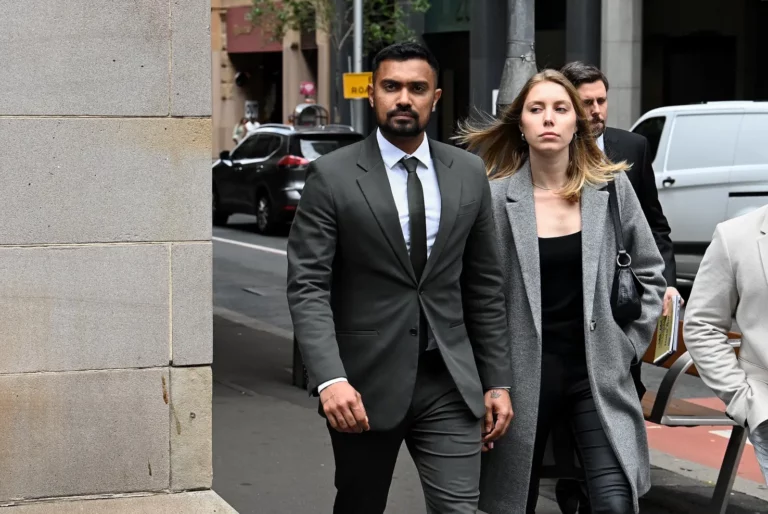
Sri Lankan cricketer Danushka Gunathilaka (left) arrives at Downing Centre District Court for a judge’s verdict after he faced trial accused of sexual assault.Credit: Kate Geraghty
Delivering a verdict of not guilty on Thursday, the judge said: “The evidence establishes that there was no opportunity for the accused to remove the condom … because that intercourse was continuous.”
The trial heard Gunathilaka, also known as Danny, and the woman matched on Tinder on October 29 and talked over Instagram and WhatsApp, including via video calls.
They met for drinks at the Opera Bar followed by dinner at Frankie’s Pizza and then caught a ferry to the complainant’s home, where Gunathilaka recorded her playing guitar and singing.
“The mood as captured by those videos seemed relaxed, happy and playful,” the judge said.
She said the complainant came across as intelligent and not as a witness “motivated by a desire to give deliberately false evidence”, but there were occasions when she formed the impression the woman appeared “motivated to paint the accused in an unfavourable light”.
The woman, who testified over two days, alleged Gunathilaka kissed her forcefully and slapped her buttocks on the ferry to her house, and “ambushed” her by pushing her back on the lounge. She accepted under cross-examination she had said “let’s go to my room” and lit candles “to create a mood”.
The woman claimed Gunathilaka choked her at least three times and slapped her buttocks during forceful intercourse in her bedroom for 10 to 15 minutes.
She said she noticed a condom on her bedroom floor within three to five seconds of the sex ending. The woman alleged Gunathilaka threw it there, but did not see him do it.
CCTV shows the pair leaving the Opera Bar arm-in-arm.
Crown prosecutor Gabrielle Steedman submitted the sexual episode “turned out very differently to what she [the woman] expected or wanted” and his behaviour was “entirely consistent with someone who would, in that state of mind, remove his condom, despite her clear wishes to the contrary”.
Gunathilaka’s barrister Murugan Thangaraj, SC, said there was “no window” for Gunathilaka to have removed the condom during sex, and the woman had described it as “continuous sexual activity”.
“That ends it. The Crown cannot prove its case at all, let alone to the requisite standard, with that evidence,” Thangaraj said.
Gunathilaka was arrested in the early hours of November 6 in the Hyatt Regency Hotel as the Sri Lanka team left for the airport. He let police search his hotel room, where they found a Burberry satchel bag containing two wrapped condoms.
“That he would wear a condom on occasion is supported by the fact that two unused condoms were located in his property,” the judge said.
Gunathilaka participated in a two-and-a-half hour recorded interview. Asked by police “At any point, did you put your penis into her without a condom on?” Gunathilaka replied, “No, no, no.”
He admitted he had told the woman he did not like to have sex with a condom, and she was the one who got a packet out.
“I never said ‘I want to do it without condoms’, and we did it with condoms,” Gunathilaka said.
The judge said Gunathilaka “answered every question asked of him in the interview, and I formed the distinct impression he was doing his best to be truthful and assist the police”.
“There is no reason at all to reject or disbelieve what he said in that interview,” Huggett said.
The court heard the woman had cried while telling friends Gunathilaka “turned into an animal” and “something really terrible happened”. Regarding the condom, she told them “I don’t know if he took it off” and “I’m not sure, I just have a feeling”.
The judge said: “In my view, the complaint evidence undermines rather than supports the complainant.”
Thangaraj said the woman was “demonstrably unreliable” and CCTV from the ferry and wharf showed the pair kissing and hugging, which did not match her narrative that his client was forceful and aggressive.
Gunathilaka was suspended from cricket following his arrest. He made his international debut in 2015 and has represented Sri Lanka in more than 100 matches including eight Tests. He travelled to Australia for the T20 World Cup but was ruled out with a hamstring tear after playing one match.
He was granted a judge-alone trial due in part to pre-trial media interest. The proceedings were expedited by consent after the court heard he financially supported his parents with his earnings.
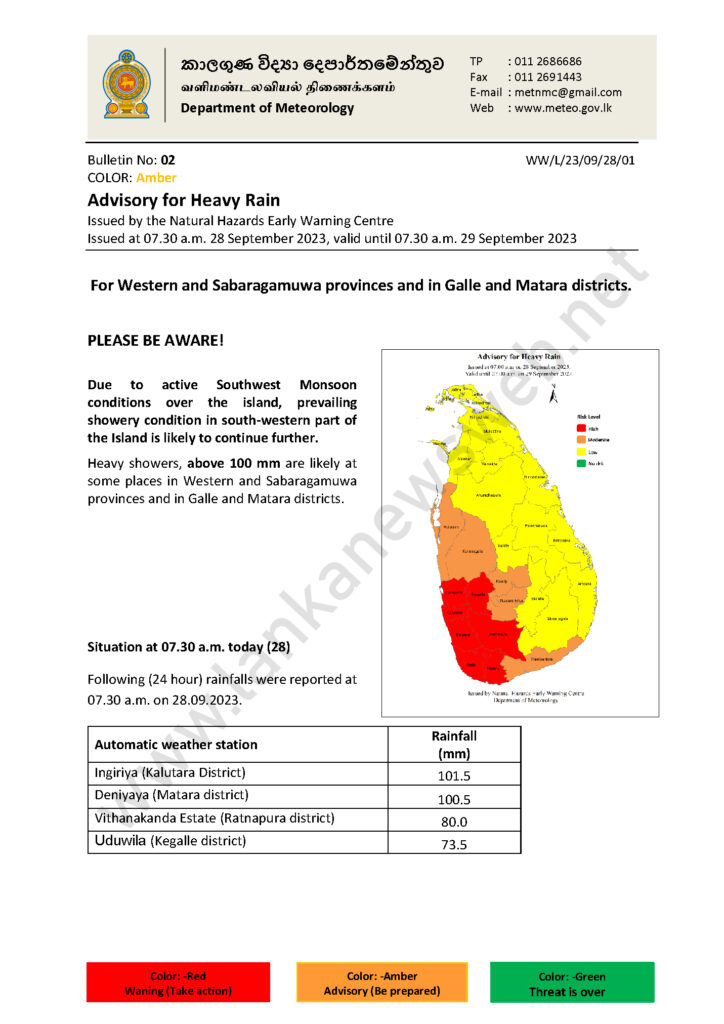
Colombo (LNW): Due to active Southwest Monsoon conditions over the island, prevailing showery condition in south-western part of the island is likely to continue further, announced the Natural Hazards Early Warning Centre of the Department of Meteorology in an advisory statement today (28).
The Dept in its daily weather forecast said showers or thundershowers will occur at times in Western, Sabaragamuwa, Southern and North-western provinces and in Kandy and Nuwara-Eliya districts.
Heavy showers about 100mm can be expected at some places in Western and Sabaragamuwa provinces and in Galle and Matara districts, the Dept added.
Fairly strong winds about (40-45) kmph can be expected at times in western slopes of the central hills, Northern, North-central, and North-western provinces and in Trincomalee and Hambantota districts.
Showers or thundershowers will occur at several places in Uva and Eastern provinces during the evening or night.
General public is kindly requested to take adequate precautions to minimise damages caused by temporary localised strong winds and lightning during thundershowers.
Marine Weather:
Condition of Rain:
Showers or thundershowers will occur at several places in the sea areas off the coast extending from Puttalam to Hambantota via Colombo, Galle and Matara.
Winds:
Winds will be south-westerly and speed will be (30-40) kmph. Wind speed can increase up to (50-60) kmph at times in the sea areas off the coast extending from Puttalam to Kankasanthurai via Mannar and from Hambantota to Pottuvil. Wind speed can increase up to 50 kmph at times in the sea areas off the coast extending fromPuttalam to Hambantota via Colombo, Galle and Matara.
State of Sea:
The sea areas off the coast extending from Puttalam to Kankasanthurai via Mannar and from Hambantota to Pottuvil can be rough at times. The sea areas off the coast extending from Puttalam to Hambantota via Colombo, Galle and Matara will be fairly rough at times. Temporarily strong gusty winds and very rough seas can be expected during thundershowers.
IMF Senior Mission Chief Peter Breuer dashes the Govt’s hopes: says “there’s no fixed timeline for the 2nd tranche to be disbursed”: also says the next disbursement will depend on sustaining reforms and progress in the debt front: analysts say this is a huge setback to the Govt which was solely dependent on this IMF programme for its continuity.
Several analysts who strongly advocated an IMF programme last year as being the “only solution” to the crisis, offer reasons for the present debacle; Advocata’s Dhananath Fernando says SL has to improve its tax system by following “international standards of transparency”: Economist Talal Rafi says the main issue is the external debt restructuring and that he hopes President Ranil Wickremesinghe’s visit to China can make progress on this matter: also says this setback will force the Govt to work harder on structural reforms.
Export Development Board says earnings from merchandise exports increased by 6.8% (month-on-month) in August’23 to USD 1.09 bn, compared to July’23, but down by 10.91% YoY, compared to August’22.
Minister of Power & Energy Kanchana Wijesekara says legislation to restructure the Ceylon Electricity Board and Ceylon Petroleum Corporation will be presented to Cabinet within the next 2 weeks.
Professionals’ Trade Unions Collective led by the Govt Doctors meet the IMF delegation: discuss their demands including tax relief: state they have been informed by the IMF delegation that it’s the Govt that must take measures to address the demands of professionals since the IMF has granted authority to the Govt to make suitable changes to its tax policy.
Hatton National Bank MD/CEO Jonathan Alles says SL’s banking sector may have lost about 10,000 employees during 2023, out of which a significant number have migrated: also says banks now have to resort to massive recruitment drives to fill the vacancies.
Well-known Human Rights Activist Jehan Perera says the country’s economy which shrank by over 7% last year and by 11% in the 1Q23, is continuing its downward plunge: also says the much touted absence of shortages & queues is not due to the economic performance picking up, but because people have less money to spend.
SLPP MP Mahindanada Aluthgamage says doctors are leaving the country not because of higher taxes, but due to the education of their children: analysts however point out that SL experienced the exodus of qualified doctors & consultants mainly after the Govt raised taxes early this year.
A representative of the Abhimani Women’s Collective says SL’s sex workers are facing fundamental rights violations including unlawful detention and cruel, inhumane & degrading treatment.
SLPP rebel group spokesman Professor G L Peiris says the enactment of the Online Safety Law is to suppress political dissent: asserts that investors would be wary of having any dealings with the Wickremesinghe-Rajapaksa Govt as a result of the new Online Safety Law and the new Anti-Terrorism Law.