Air China, the prestigious national carrier of the People’s Republic of China, has announced the resumption of flights between Chengdu, located in the vibrant Sichuan province, and Colombo, the bustling capital city of Sri Lanka. Commencing from July 3rd, the airline will offer convenient travel options connecting these two destinations.
The flights between Chengdu and Colombo will operate three times a week, specifically on Mondays, Wednesdays, and Fridays. Travelers can look forward to the seamless air travel experience provided by Air China.
Passengers departing from Chengdu Tianfu International Airport will witness their flights touching down at the esteemed Bandaranaike International Airport (BIA) in Colombo at 08:55 p.m. The return flights are scheduled to depart for Chengdu at 10:15 p.m., ensuring a well-rounded travel itinerary.
This renewed air route between Chengdu and Colombo signifies the growing importance of connectivity between China and Sri Lanka. It presents an excellent opportunity for business, tourism, and cultural exchanges, fostering closer ties between the two nations.
Air China’s decision to reinstate these flights reflects their commitment to providing enhanced travel options and contributing to the development of robust international air connectivity. Passengers can now enjoy the convenience and comfort offered by Air China as they embark on their journeys between Chengdu and Colombo.
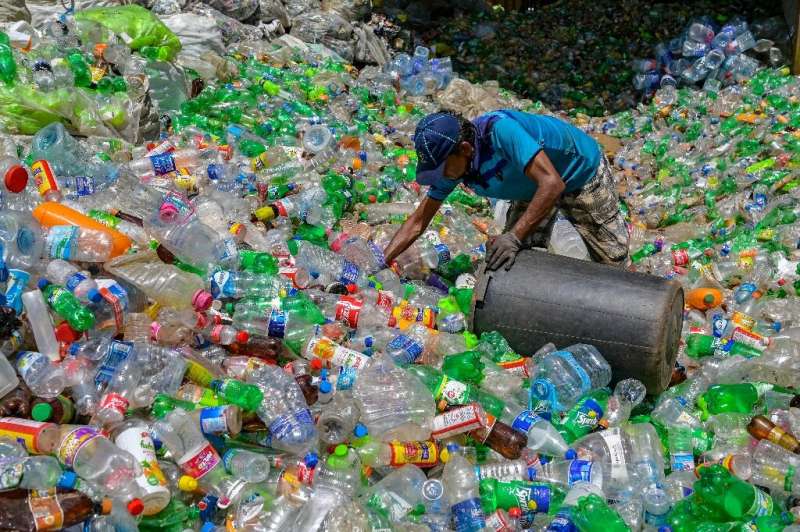
Heart-wrenching images of revered elephants and cattle eating plastic in Sri Lanka have prompted politicians to toughen pollution laws, but skeptical conservationists warn past bans were repeatedly ignored.
After an estimated 20 elephant deaths and countless other wild animals perishing due to single-use plastics in the past decade, officials say a law banning many such items is expected to come into force within weeks.
Bags, bottles and packaging are also blamed for clogging drains and causing urban flooding, as well as encouraging a surge in potentially deadly dengue—spread by mosquitoes that breed in stagnant water.
“We want to create an awareness about the responsible use of plastics,” Anil Jasinghe, the country’s top environment official, told AFP.
Jasinghe said regulations to be published soon will outlaw the sale of a string of single-use plastic items, including cutlery, cups, drinking straws and plastic flower garlands.
But it is not Sri Lanka’s first attempt to tackle the problem.
Repeated raids ineffectual
Jasinghe admits that implementation has been a problem, noting that a 2006 ban on super-thin plastic bags and food wrapping was openly flouted by manufacturers.
“Of course, we raid them time and again, but by raiding we cannot solve the issue,” he said.
“We need to have that environmental literacy, so that you change your production lines to better, more environmentally friendly production.”
In 2017, a notorious garbage dump on the edge of the capital Colombo was shut when a mountain of rotting rubbish collapsed, killing more than 30 people and damaging hundreds of homes.
Soon afterwards, Sri Lanka banned all plastic shopping bags—but the rules were once again not strictly enforced.
Similarly, a ban on plastic sachets—popular for small portions of everything from washing powder to shampoo—was sidestepped by manufacturers who increased the volume to just above the legal minimum.
In addition to manufacturers subverting laws, cash-strapped Sri Lanka also struggles to process what it produces.
The island’s unprecedented economic crisis that began late in 2021 means there has been a pile-up of trash because of a shortage of fuel for garbage trucks.
The United Nations says Sri Lanka recycles just three percent of the plastic products it consumes, less than half the world average of 7.2 percent.
The United Nations says Sri Lanka recycles just three percent of the plastic products it consumes, less than half the world average of 7.2 percent.
Plastic bottles are not included in the ban, but the country’s largest recycler of them says it can handle nearly two-thirds more than it is currently processing—if it could collect the refuse.
“We have the capacity to recycle 400 metric tons a month, but currently we do only 250 tons,” said Prasantha Malimbadage, CEO of recycling at Eco Spindles.
The company is turning throwaway plastic bottles into polythene yarn that goes into the manufacture of clothing by top international brands.
At Eco Spindles’ recycling facility south of Colombo, nearly 350 workers sort bottles that are crushed and torn into small plastic flakes, the raw material for yarn.
“Ten bottles go to make a T-shirt and 27 bottles go to make a graduation gown,” Malimbadage said.
Haphazard disposal
A 2020 study by the local Centre for Environmental Justice showed single-use plastics such as bags, food wrappers, straws, polystyrene boxes, cups and cutlery made up almost 15 percent of urban waste.
The South Asian nation of 22 million people generates more than 1.5 million tons of plastic waste annually and half of it ends up in canals, rivers and eventually the Indian Ocean.
Cleaning up plastic and stopping more production will also aid health, campaigners say.
Health authorities say the spread of dengue fever has spiked dramatically, from 35,000 cases and 26 deaths in 2021, to 76,600 cases and 72 deaths last year.
“Where plastic containers are dumped, there is a spike in dengue,” said Lahiru Kodituwakku of the National Dengue Control Unit.
“There is a strong correlation between the spread of dengue and plastic waste”.
Regardless of whether the goal is better health outcomes or reducing pollution, anti-plastic campaigners say implementation remains the key.
“This is a good move,” said Nishshanka de Silva, founder of local environmental group ZeroPlastic Movement.
“But I am concerned if they will actually go ahead and enforce it.”
In a recent development, the Ministry of Health has announced its decision to extend the compulsory retirement age for specialist doctors in the public service to 63 years. This decision was conveyed to the Court of Appeal by the Attorney General on Tuesday during the hearing of a writ application filed by 176 specialist doctors challenging a Cabinet decision to revise the retirement age of government doctors.
Initially, on October 17, 2022, the Cabinet of Ministers had approved a revision to the retirement age of specialist doctors, setting it at 60 years. However, in response to the petition, the Health Ministry’s secretary informed the Attorney General that health authorities have decided to extend the retirement age to 63 years.
During the court proceedings, Additional Solicitor General Nerin Pulle, representing the Attorney General, informed the judge bench that the Cabinet of Ministers is also expected to make a decision regarding this matter.
President’s Counsel Sanjeewa Jayawardena, who represented the petitioners, expressed his appreciation for the decision taken by the health authorities to extend the retirement age for specialist doctors.
Considering the urgency of the situation, the Appeals Court judge bench, presided by Nissanka Bandula Karunaratne and Justice A. Marikkar, agreed to hear the petition today itself, as requested by the president’s counsel. This decision comes as some specialist doctors were scheduled to retire from service on June 30.
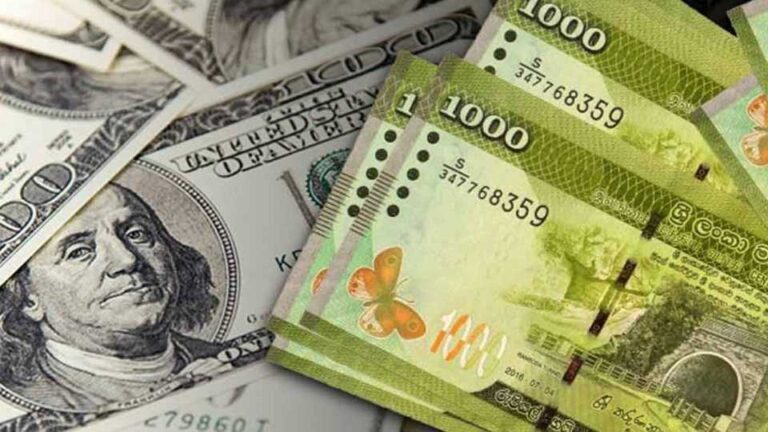
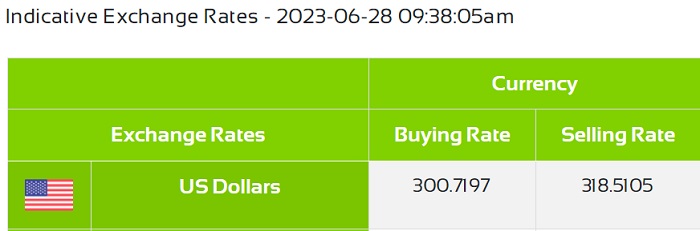
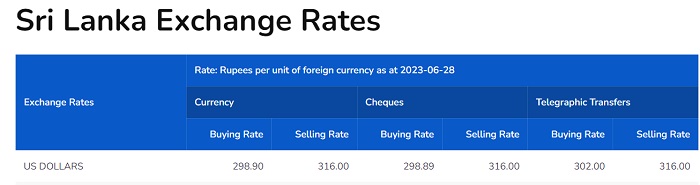
In a stable trading day, the Sri Lankan Rupee maintained its position against the US Dollar at commercial banks in Sri Lanka on June 28. The exchange rates remained relatively unchanged compared to the previous day.
At People’s Bank, the buying rate for the US Dollar slightly increased from Rs. 299.74 to Rs. 300.71, while the selling rate rose from Rs. 317.47 to Rs. 318.51.
According to Commercial Bank, the buying and selling rates for the US Dollar remained steady at Rs. 298.90 and Rs. 316, respectively.
Similarly, at Sampath Bank, there were no changes in the buying and selling rates of the US Dollar, which remained at Rs. 300 and Rs. 315, respectively.
President Ranil Wickremesinghe says Govt expects to restructure USD 17 bn out of USD 41 bn of foreign debts within 5 years: asserts that accordingly, local debt must also be restructured: analysts point out that USD 13 bn of the foreign debt referred to by the President is not subject to re-structure as it is due to “priority” creditors (WB, ADB & IMF) and therefore only USD 28 bn will be eligible for re-structure: analysts further say that expecting the balance private & bi-lateral creditors of USD 28 bn to accept a 60% “haircut” of USD 17 bn is a very unlikely proposition.
President Ranil Wickremesinghe says restructuring of domestic debt will not affect the Member balances of the EPF & ETF as well as the rate of return paid in the past: based on the President’s comments, analysts fear the Govt would default on the interest payment of approximately 20-25% due for the year 2023 on the balance of the Members’ accounts as at end-Dec’22.
President Ranil Wickremasinghe says the local debt restructuring will not affect the deposits in the banking system & will not affect any interest on bank deposits that is currently being paid: analysts point out that when the Govt debt is re-structured, there is a distinct possibility of the default by the Govt affecting the liquidity and stability of the banks.
Central Bank’s T-Bill auction yesterday fails miserably with only Rs.55 bn (42%) accepted out of Rs.130 bn: LKR continues to depreciate for the 3rd consecutive day and tumbles to Rs.316.72 per USD: Stock Market loses steam and ASPI crashes by 0.69%.
Customs Senior Director Sudaththa Silva says 5 local traders detected with gold filled in plastic capsules inserted in their rectums, while trying to leave the country: Customs officials retrieve 15 such capsules that altogether bore 5,650 grams of gold in a “gel” like solution, valued at Rs.107 mn.
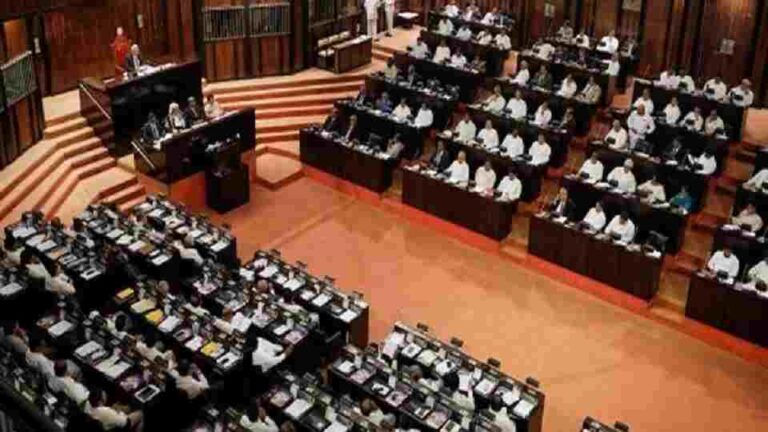
Speaker Mahinda Yapa Abeywardana convenes a special session of Parliament on Saturday, 1st July at the request of the PM: informed sources say Parliament is to be convened on Saturday to obtain approval for the domestic debt restructuring process: analysts point out that similar approval was not sought when certain Sri Lankan authorities first announced Sri Lanka’s debt default and restructuring on 12th April 2022.
SLPP MP Namal Rajapaksa says the determination of eligible recipients for the “Aswesuma” benefits has caused great injustice to those already receiving Samurdhi: SJB MP S M Marikkar says the Govt has curtailed the Samurdhi benefit to implement the “Aswesuma” to deceive the people: State Minister Anupa Pasqual says people must not to be victims of politically motivated agendas launched by various groups to stop the “Aswesuma” welfare plan.
Health Minister Keheliya Rambukwella issues gazette to reduce prices of 60 types of medicines by 16%.
Attorney General informs Court of Appeal that the Health authorities have taken a decision to raise the retirement age of Consultant Specialist Doctors to 63 years.
Sri Lanka beats Scotland by 82 runs in ICC Cricket World Cup Qualifier: Sri Lanka – 245 all out (49.3 overs): Pathum Nissanka 75, Charith Asalanka 63: Scotland – 163 all out (29 overs): Maheesh Theekshana 41/3, Wanindu Hasaranga 42/2.
The Ceylon Chamber of Commerce, a leading business association in Sri Lanka, emphasizes the importance of patience and trust in the ongoing domestic debt restructuring process. Echoing the Central Bank of Sri Lanka, the chamber highlights that maintaining stability in the financial system and safeguarding the interests of depositors are top priorities.
It is crucial for all stakeholders to allow for a comprehensive and meticulous examination of the proposed debt restructuring plan. Constructive dialogue based on the final document is essential to achieve meaningful consensus while keeping the national interest at the forefront.
The chamber urges all political parties and concerned stakeholders to act responsibly and await the finalization of the debt restructuring plan. This step is integral to the broader agenda of ensuring debt sustainability and facilitating other necessary reforms. While acknowledging the concerns expressed following the government’s announcement of its intention to restructure domestic debt, the chamber emphasizes the need to approach the matter with sensitivity and avoid misinformation and speculation that can fuel uncertainty among the public.
Several spells of showers will occur in Western and Sabaragamuwa provinces and in Kandy, Nuwara-Eliya, Galle and Matara districts.
A few showers will occur in North-western province.
Showers or thundershowers may occur at a few places in Uva province and in Ampara and Batticaloa districts during the evening or night.
Fairly strong winds about (40-45) kmph can be expected at times in Western slopes of the central hills, North-central province and in Puttalam, Hambantota and Trincomalee districts.
General public is kindly requested to take adequate precautions to minimize damages caused by temporary localized strong winds and lightning during thundershower.
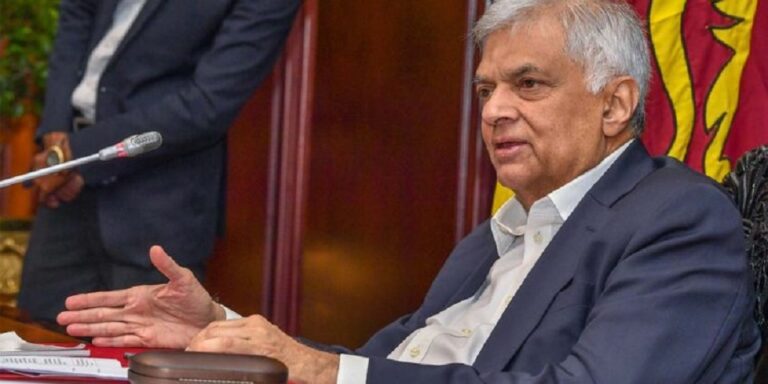
Inaugurating the ‘Laksiyane Mandiraya’ Administrative Complex in Gampaha, President Ranil Wickremesinghe provided reassurance that the restructuring of domestic debt in Sri Lanka would not have any adverse effects on public funds, including the Employees’ Provident Fund (EPF). He emphasized that the rate of return for superannuation funds would remain unaffected by the debt restructuring measures.
Addressing concerns about the stability of the country’s banking system, President Wickremesinghe affirmed that both public and private banks would remain unthreatened by the restructuring of domestic debt. He specifically mentioned that the deposits of over 50 million bank depositors would not be impacted, and there would be no changes to the current interest rates offered on bank deposits.
To expedite the debt restructuring process, proposals for both foreign and domestic debt restructuring will be presented to the Cabinet on the same day as the inauguration of the complex.
The President highlighted the urgency of restructuring Sri Lanka’s debt, as failure to do so would result in the public debt surpassing 100% of the Gross Domestic Product (GDP) by 2035. He also mentioned that foreign creditors have expressed their agreement to participate in the debt restructuring process.
President Wickremesinghe stressed the importance of restructuring both external and domestic debt to ensure debt sustainability in Sri Lanka. He acknowledged the burden carried by foreign creditors, noting that the country is expected to receive 17 billion US dollars from them over the next five years. The President also emphasized the need for local creditors to contribute to the debt restructuring efforts.
The proposed debt restructuring plan aims to safeguard public bank deposits and protect the depositors of all banks regulated by the Central Bank. President Wickremesinghe assured that the proposed method of domestic debt restructuring poses no harm to bank depositors and will not lead to a collapse of the banking system. On the contrary, it will pave the way for a restructuring process that can rebuild the economy.
The President highlighted his discussions with international figures during his visit to France, including Commonwealth Secretary General Patricia Scotland, IMF Managing Director Kristalina Georgieva, Netherlands Deputy Prime Minister and Finance Minister Sigrid Kaag, US Treasury Secretary Janet Yellen, and Japanese Foreign Minister Yoshimasa Hayashi. They expressed their commitment to assisting Sri Lanka in its economic recovery and debt restructuring.
President Wickremesinghe also mentioned his telephone conversation with Indian Finance Minister Nirmala Sitharaman, who expressed India’s intention to positively contribute to Sri Lanka’s debt restructuring and economic stability. Detailed discussions on the matter are expected to take place during the President’s upcoming visit to India.
Additionally, Foreign Minister Ali Sabri’s visit to China aimed to enhance bilateral relations and strengthen economic ties between the two countries. Minister Sabri held fruitful discussions with China’s Foreign Minister, Mr. Qin Gang, focusing on deepening cooperation.
During the visit, President Wickremesinghe met with the Chinese Finance Minister, Liu Kun, in Beijing, where he was briefed on China’s economic stabilization and progress plan. China’s Exim Bank Chairman, Wu Fulin, and other officials appointed for the purpose of restructuring Sri Lanka’s foreign debt, expressed their commitment to contributing to the debt restructuring process.
The inauguration of the Administrative Complex was attended by Prime Minister Dinesh Gunawardena, several ministers and state ministers, Gampaha District Development Committee Chairman, Members of Parliament, and other dignitaries.
Speaker Mahinda Yapa Abeywardene has issued a special Gazette notification, summoning the Parliament to assemble at 9.30 a.m. on Saturday, July 1st. The notification comes in light of the impending debt restructuring proposal, scheduled to be presented in the Parliament for adoption this week, according to political sources.
In an effort to ensure the presence of ruling party MPs, an earlier notice was circulated on Sunday (25) instructing them to remain in Colombo and cancel all other engagements, including overseas travel. This strategic move highlights the significance attached to the debt restructuring plan.
Meanwhile, President Ranil Wickremesinghe has outlined a comprehensive timetable for the proposal. He stated that the debt restructuring program will be submitted to the Cabinet on Wednesday, followed by presentations in the parliament and before the Committee on Public Finance (COPF) on Friday, June 30th.
During an interview with FRANCE 24 at the Summit for a New Global Financing Pact in Paris, President Wickremesinghe emphasized that the program will undergo parliamentary debate on Sunday and ultimately gain approval from the parliament.
The proposed debt restructuring initiative holds great importance for the nation’s financial stability, and its progress through the parliamentary process marks a crucial step toward addressing the economic challenges faced by the country.
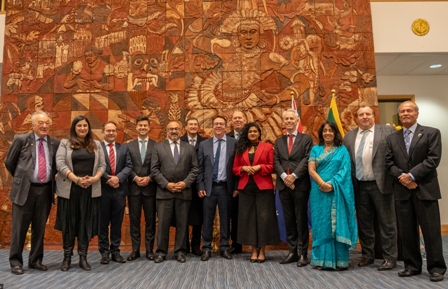
Australia Sri Lanka Parliamentary Friendship Group was relaunched in Canberra on 19June 2023 at the Sri Lanka High Commission. This group which has been in existence earlier and had been dormant for the last 3-4 years was relaunched under the Chair of Member of Federal Parliament, Sri Lanka born Cassandra Fernando of the Labour Party and Vice Chair Senator James McGrath of the Liberal Party.
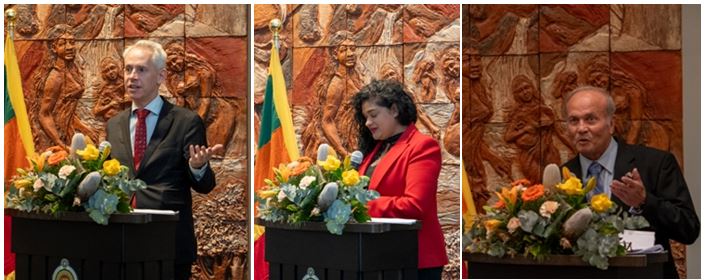
The important feature of the event was the attendance of Hon. Andrew Giles, Minister for Immigration, Citizenship, Migrant Services and Multicultural Affairs of Australia who spoke of Australia’s multicultural population and the Australian Government policy to address the needs of the expatriate communities to help especially new comers to integrate into the Australian society. In that context he stated that the Friendship Group could act as a catalyst to link the two countries and that as the Minister for Multicultural Affairs he is happy to support such initiatives.
The High Commissioner while welcoming the Minister and the Members of Parliament present at the event and also those who could not attend the function due to Parliament Proceedings, stated that the High Commission is keen to work closely with the federal Members of Parliament in order to strengthen ties between Sri Lanka and Australia including with the Sri Lanka-Australia Parliamentary Friendship Group already set up in the Sri Lanka Parliament and explore areas of cooperation for the benefit of the two countries. High Commissioner added that she is happy and proud to have two ladies with Sri Lankan connections for the first time in the Australia Federal Parliament, Cassandra Fernando and Dr. Michelle Ananda-Rajah of Sri Lankan decent.
In her address, the Chair, Cassandra Fernando referred to her close affinity to Sri Lanka and her desire to see close cooperation between her country of birth and Australia. She spoke of the need to create a greater understanding between the two countries and to promote bilateral relations. The Vice Chair, Senator McGrath of the Liberal Party in his remarks added that his party would also support any initiatives taken by the Friendship Group.
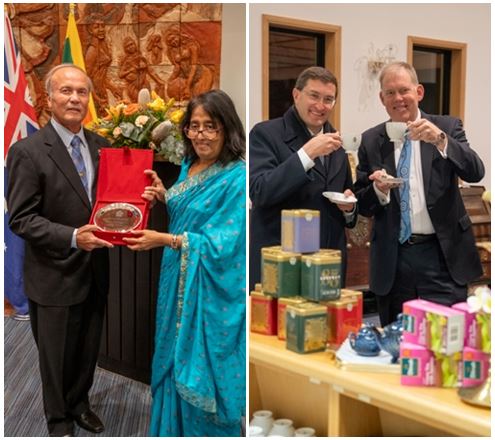
As the Honorary Consul for Sri Lanka in Queensland Mr. Anton Swan is completing his tenure of office having served over 30 years as Honorary Consul, the occasion provided an opportunity to bid farewell to him. The High Commissioner spoke of some of the highlights of his 50 years in Australia and the Medal of the Order of Australia (OAM) he has received from the Australian Government and the services he has rendered to Sri Lanka for over 30 years.
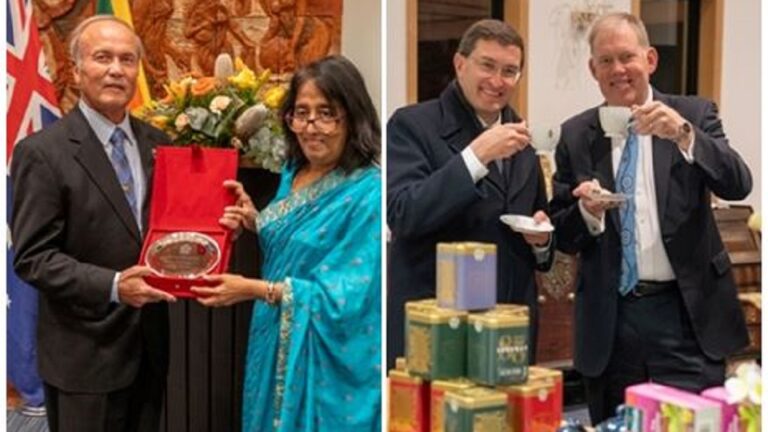
In appreciation and recognition of his services to Sri Lanka in an honorary capacity, Mr. Swan was presented with a plaque. Mr. Swan too spoke on his work and stated that he was happy to have served his motherland, Sri Lanka and the Sri Lankan Community.
During the event, a video clip sent by the Sri Lanka Tourism Promotion Bureau (SLTPB) on Sri Lanka and especially on the tourist attractions was shown to the audience.
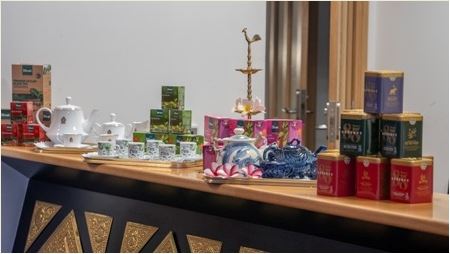
A Ceylon Tea stall was also set up to promote ‘Ceylon Green Tea’ given the increasing demand of Australians for sustainable, nutrient rich and a healthy drink. The Sri Lanka Tea Board sponsored ‘Ceylon Green Tea Stall, while ‘Dilmah’, a prominent Ceylon Tea exporter in the Australian marked provided gift tea (flavoured green tea) to the invitees. Ceylon tea promotion videos depicting ‘sustainable-grown’ variety of Ceylon tea for the world market were screened at the reception. The event was held alongside a live demonstration on ‘Ceylon Green Tea Tasting Session’ by the staff of the Mission.
A Sumptuous Sri Lankan Cuisine including hoppers catered by Sri Lankan chefs in Canberra was enjoyed by the participants.