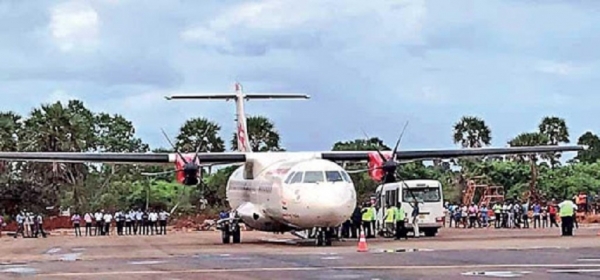
The discussion between High Commissioner Moragoda and Bhatia was centred around the critical importance of enhancing air connectivity as an essential means of increasing tourism inflows to Sri Lanka.They agreed that tourism, particularly tourism inflows from India, is a key pillar in the economic recovery of Sri Lanka, and discussed ways and means to harness the potential of increased connectivity to enhance tourism.
High Commissioner Moragoda also presented a copy of the publication “Geoffrey Bawa; Drawing from the Archives”, which contains the drawings of Sri Lanka’s iconic architect the late Geoffrey Bawa, to Mr. Bhatia.
Founded in 2006 by Rahul Bhatia and Rakesh Gangwal, IndiGo is the largest airline in India by passengers carried and fleet size, with a 54.6% domestic market share as of February 2023. It is also the largest individual Asian low-cost carrier in terms of jet fleet size and passengers carried, and the fourth largest carrier in Asia. The airline has carried over 300 million passengers last year. The airline operates about 1,600 daily flights to more than 100 destinations both domestic and international.
Colombo (LNW): The government is set to widen the tax base rather than increasing tax rates without adverse impacts on the processes of investment and on living conditions of the low and middle income groups in Sri Lanka.
In this context fresh amendments to Inland Revenue Act will be introduced soon to raise revenues from the current level of 14-15 % of GDP to higher levels of above 20 % of GDP that are visible in more developed countries in the world.
Whatever the methods adopted in the short run to mobilize the required funds for financing development projects, eventually it is tax revenue buoyancy that is required because tax revenues are needed to repay in future the loans taken today with interest as well as to meet the continually rising new resource needs of the government official sources said.
With an aim to broaden the tax base by enabling electronic payments coupled with mandatory reporting for state institutions, the government plans to bring in fresh amendments to Inland Revenue Act, No.24 of 2017 in Parliament for approval this Friday.
Under the proposed amendments, Finance State Minister Ranjith Siyambalapitiya yesterday revealed that it would be made mandatory to submit the tax files of personal income taxpayers in electronic format.
“The new amendments will provide the necessary provisions to discourage cash transactions. So, we can calculate real taxes owed by taxpayers based on their electronic transactions.
If someone makes over Rs.500, 000 worth of purchases on a daily basis, then the Inland Revenue Department (IRD) would not permit them to reduce the amount above Rs.500,000 from their expenses. Therefore, they will definitely have to follow an electronic payment method,” he said.
Although earlier it was not mandatory for state institutions such as the Motor Traffic Department and state banks to report their transactions to the IRD officially, the minister noted that once the proposed amendments are passed in Parliament, such state institutions, which perform large numbers of transactions with the public, would be required to report them to the IRD.
In addition, the minister noted that the proposed amendments would also resolve the complications related to the withholding tax.
It has become a big problem as agents have not been able to release interest incomes below Rs.100,000, which doesn’t fall under the withholding tax bracket, to depositors in an expedited manner.
Under the proposed amendments, the withholding agents will be enabled to release such funds within a short period of time,” he added.
Colombo (LNW): A year after crisis-hit Sri Lankans stood in long queues outside fuel stations, foreign oil companies will be able to sell fuel in the island nation at a lower rate than what the state-owned oil firm sells at present, Energy Ministry sources said.
The Sri Lankan cabinet of ministers recently decided to grant licenses to foreign oil companies to sell oil in the domestic retail market.
Three companies – China’s Sinopec, United Petroleum of Australia, and RM Parks of the United States in a collaboration with Shell — will soon start operating in the country
The US-based oil company RM Parks Inc. and the British multinational oil and gas company Shell PLC have held a discussion with Minister of Power & Energy Kanchana Wijesekera on commencing retail fuel sales in Sri Lanka in the first week of June this year.
The lawmaker held a virtual meeting with the officials of the two companies yesterday (April 26) to discuss the agreements, policies, logistics, and timeline pertaining to the commencement of operations here.
Accordingly, it was decided to set a date in mid-May to sign the relevant agreements, Wijesekera said in a tweet.
Following a visit to the Ceylon Petroleum Storage Terminals Limited (CPSTL) tank farm last week the technical officials of the RM Parks Inc. and Shell PLC offered to upgrade CPSTL berthing facilities to be in line with international standards and safety requirements, the minister said further.
Officials of Power & Energy Ministry, the Central Bank of Sri Lanka, the Board of Investment, the Ceylon Petroleum Corporation & the CPSTL also joined the discussion.
Meanwhile, team of China-based Sinopec officials and technical experts are currently in Sri Lanka to finalize the agreements and commencement of operation for retail fuel sales here.
They met with Wijesekera on Tuesday (April 25) to decide on a timeline, conditions of the agreement and other concerns.
Accordingly, it has been decided to sign the relevant agreements by mid-May and commence the operations 45 days after the signing, the minister said in a tweet posted earlier.
Last month, the Cabinet of Ministers green-lighted a proposal to allow three foreign oil companies to commence their fuel distribution operations in Sri Lanka.
Thereby, retail licenses will be granted to China-based Sinopec, Australia-based United Petroleum and US-based RM Parks Inc., in collaboration with London-based Shell PLC.
Minister Wijesekera, earlier this month, revealed that each company will handle 150 CPC dealer-operated filling stations in the local market.
At present, a total of 1,142 filling stations are under the purview of the CPC, however, the corporation fully owns only 234 of them, the minister explained, adding that 450 out of the remaining 908 filling stations owned by private distributors would be allocated to the three foreign oil companies.
Singapore has executed a man for conspiring to traffic cannabis despite pleas for clemency from his family, activists and the United Nations.
BBC: Tangaraju Suppiah, 46, was hanged at dawn on Wednesday over a plot to smuggle 1kg (35oz) of cannabis.
Activists said he had been convicted on weak evidence and received limited legal access during his prosecution.
But Singapore authorities said he had been given a fair trial and criticised those who questioned the courts.
Singapore has some of the world’s toughest anti-drug laws. It argues these are a necessary deterrent to drug crime which is a major issue elsewhere across South-East Asia.
On Wednesday, Tangaraju Suppiah’s family gathered at Changi Prison near the city’s airport in the east to receive his body.
“The family said they weren’t going to give up on him until right until to the end,” anti-death penalty activist Kirsten Han told the BBC.
“They still have a lot of unresolved questions about his case, and the evidence against him. It has been such a harrowing experience for them.”
The nation’s stringent drug laws and use of capital punishment put it increasingly at odds with advanced nations and others in the region, activists say.
Singapore’s neighbour Malaysia abolished mandatory death penalties earlier this month, saying it was not an effective deterrent to crime.
Meanwhile cannabis has been decriminalised in many parts of the world – including in neighbouring Thailand, where its trade is encouraged.
“It is just illogical to know that countries nearby are enjoying cannabis in food and beverages, and using it for its medical benefits, while our country is executing people for the very same substance,” local activist group the Transformative Justice Collective said.
Singapore’s courts on Tuesday had rejected a last-minute appeal from Tangaraju Suppiah’s family against his conviction.
The UN’s Human Rights Office had on Tuesday also called on Singapore to “urgently reconsider” the execution, saying the death penalty violated international norms.
Tangaraju Suppiah had been convicted of “abetting by engaging in a conspiracy to traffic” about 1kg (35oz) of cannabis from Malaysia to Singapore in 2013.
He was not found with the drugs or during the delivery. But prosecutors said he had been responsible for co-ordinating it, and they traced two phone numbers used by a deliveryman back to him.
Tangaraju denied his involvement – and said he had not been the person communicating with the deliveryman. He said he had lost one of the phones and denied owning the second one.
Singapore’s law mandates the death penalty for those guilty of trafficking narcotics – including cannabis, cocaine, heroin, and ketamine – beyond a certain quantity.
Image caption, Leela Suppiah (centre) spoke to reporters on Sunday pleading for her brother’s life
Convicted traffickers who can prove that they were only couriers may be able to avoid the death penalty. Drug possession and consumption draw lesser punishments including prison and fines.
In Tangaraju Suppiah’s last appeal, the judge agreed with the prosecution that he had been responsible for co-ordinating the delivery, which made him ineligible for a more lenient sentence.
Activists had raised concerns that he had not been given adequate access to a Tamil interpreter and had been forced to represent himself at his last appeal because his family was unable to secure a lawyer.
Singapore authorities say he requested an interpreter only during the trial, and not earlier. They also said he had access to legal counsel throughout the process.
Sir Richard, who had previously criticised the 2022 execution of intellectually impaired Nagaenthran Dharmalingam, said the latest case was “shocking on multiple levels”.
In a blog post on Monday, he said Singapore “may be about to kill an innocent man” on the back of “more than dubious circumstances”.
Rebutting his allegations, Singapore’s Home Affairs Ministry accused him of “disrespect for Singapore’s judges and our criminal justice system”.
It said the death penalty was “an essential component” in a multi-pronged approach that had been “effective in keeping Singapore safe and secure”.
Tangaraju Suppiah’s case marked the country’s first execution this year.
It is also considered a “high application” country, where at least 10 executions have been carried out in the past five years.
The US and South Korea are the only two OECD member countries that have retained the death penalty for drug offences, but they have not carried out such executions in the last five years, according to HRI.
Colombo (LNW):The Sri Lanka Bureau of Foreign Employment (SLBFE) says that the Director of the South Korean Human Resources Department based in Sri Lanka, has agreed to provide 8,000 job opportunities for Sri Lankans in S. Korea this year, exceeding the job quota of 6,500 offered earlier.
This agreement was reached during the discussion held this morning between the Director of the Korean Human Resources Department and the Minister Manusha Nanayakkara, the SLBFE said in a statement.
It had also been agreed to refer 600 people who are currently registered in the Korean job website after passing the Korean language proficiency test under the production sector category for jobs in the shipbuilding sector.
Priority will be given to job seekers registered in the website, whose period for securing a job will expire by December 31 this year.
Accordingly, these jobs are to be provided by shifting the job category from the production sector of the website to the ship construction sector.
Thus, candidates who are willing to change their job category from production to the shipbuilding industry should apply for it as soon as possible, the statement added.
The S. Korean Human Resources Department has also agreed to conduct examinations and recruit 900 welders and painters for jobs in the shipbuilding industry under the E9 visa category from next year.
The Director of the Korean Human Resources Department has also informed the Minister that from next year, the Korean Language Proficiency Test will be conducted using the UBT system instead of the current computer-based CBT system.
Sri Lanka ha received an employment quota of 6500 jobs from South Korea previously for the year 2023.
The Sri Lanka Bureau of Foreign Employment (SLBFE) said in a statement that the employment quota was the highest received thus far and an increase of 28.79% in comparison to last year (2022).
The SLBFE further said that 1453 more jobs have been received in 2023 in comparison to the 5047 jobs that were received in 2022.
Among the 6500 jobs offered for this year, 14,588 applicants have been placed on the waiting list for vacancies in South Korea.
These include 12,189 job opportunities in the manufacturing sector, 2149 in the fisheries sector, and 250 in the construction sector, the SLBFE said.
The SLBFE further said that Sri Lanka was able to send 6639 migrant workers to South Korea last year, despite having a quota of 5047 jobs due to constant discussions with the South Korean authorities and Minister of Labour and Foreign Employment Manusha Nanayakkara.
The excess cadre from last year will be dispatched this year to South Korea, the SLBFE added.
The Sydney Morning Herald: One of the reasons I’m not really a fan of big, organised tours is that you never get the chance to go free range in a destination. Everything you see and do is packaged and proscribed. The story is worked out ahead and you have to fit into it.
It’s the people you meet spontaneously who make the experience wonderful, more than beautiful vistas or wiggling your toes in white sand. At least, for me.
The locals in Sri Lanka are better than the beaches.Credit: iStock
I’m just back from Sri Lanka, a country where the hospitality and friendliness of local people to strangers is off the charts.
Two things stand from this trip. One is a lesson in what we as travellers can do for the people of our host country. The other is what they can do for us.
The tiny village of Rathmale near Sri Lanka’s south coast amounts to not much more than a small market, a couple of streets of shops and two barbers. There’s an intersection of two roads, a few dogs, and that’s about it.
There are many benefits when you leave the confines of your tour or hotel room and get down among the locals.
I was with a few friends wandering the market when a young girl came up to us and asked if she could practise her English. Her name was Upeksha, she said, and she and her dad had been driving by on his scooter, when he suggested she try out her language skills on the tourists. (Great dad, by the way.)
She was in her late teens and studying English at school, she told us. She was so bright and personable, and her English was pretty good. She said she was so happy that we had agreed to speak to her.
I asked her what she wanted to do when she left school. “I want to be a fashion designer,” she said. As it happened, in our small group was an editor from Harper’s Bazaar in Asia. Many of us had fashion experience, so we spent a long time encouraging her, and there was an exchange of WhatsApp numbers, so she could contact the editor for advice.
“I am so lucky to meet you,” she beamed. Never in her wildest dreams could she have imagined she could meet such people. Dad came by to pick her up, and they drove away, both wearing the biggest smiles you could imagine.
A few days later, I was staying in a resort on the south-west coast, near the town of Ahungalla. The resort sat in a small, modest village of small houses and shacks along a shady lane. I went for a stroll in the village and many people came out to say hello.
One of them was a woman standing in the driveway of a larger house, which looked quite new. I said how much I liked her house. “Would you like to come in and see it?” she asked. Of course I would!
Ranmali made my husband and I strong, sweet tea and brought out some biscuits. They were living in their son’s house, they explained. He and their daughter were in Romania, working in hospitality. They were looking after their grandson. The house was full of toys. She showed us her grandson’s very neat homework.
She then brought out all the family photos and then made a video call to her son on WhatsApp to say hello. We showed her our family photos in exchange. “You can stay with us next time,” she offered.
Her husband volunteered to take us across the road to their temple, which overlooked the sea. We agreed, not expecting much. As it turned out it was an exquisite 300-year-old monastery with small rooms full of ancient wall paintings and many brightly painted Buddhist statues. It included rooms that held enormous, intricately carved Hindu gods.
The monk (one of three) showed us around and gave me a porcupine quill as a gift.
We wouldn’t have gone there if I hadn’t had this fortuitous meeting in the lane with Ranmali. And if we hadn’t been open to meeting strangers without suspicion. And if they hadn’t been open to us.
I stayed in several beautiful resorts along the Sri Lankan coast this trip, but my memories of the people are the most cherished.
Perhaps you need to be a people person, but there are many benefits when you leave the confines of your tour or hotel room and get down among the locals.
The best thing I gained from this trip was the restored faith in my fellow humans.
Colombo (LNW):Sri Lanka’s existing limited infrastructure and resources in the health care waste management system has created an additional burden on Health Care Facilities (HCFs) and the Health Ministry to safeguard staff and the environment, research report revealed.
According to the Central Environmental Authority (CEA), it is estimated that daily clinical waste generation is around 25 Metric Tonnes (MT) in the country.
In this context the Health ministry has accorded priorty to strengthen infectious waste management in government hospitals by implementing healthcare waste management project to implement infectious waste management in government hospitals
Accordingly Japan International Cooperation Agency (JICA) has stepped in to support this project by providing Japanese Yen five hundred and three million (Approximately Rs 1.3 bn)
The Project aims to strengthen infectious waste management by installing medical waste incinerators in selected public hospitals, thereby contributing to the reduction of health hazards.
In order to achieve the above purpose, 15 hospitals have been selected to install incinerators covering all the provinces in Sri Lanka.
A total of 15 incinerators will be provided in two capacities with LP Gas burners, automatic temperature control systems and compliance with the environment standards under the project.
It will also extend the necessary technical guidance to the Ministry of Health as a soft component of the project for Training of Trainers (TOT) to maintain the system after the installation of equipment under the Project.
The relevant Exchange Notes related to the grant has been signed by K.M Mahinda Siriwardana, the Secretary, Ministry of Finance, in the presence of MIZUKOSHI Hideaki, the Ambassador of Government of Japan to Sri Lanka.
The Grant Agreement was signed by K.M Mahinda Siriwardana, Secretary, Ministry of Finance, Economic Stabilization and National Policies and YAMADA Tetsuya, Chief Representative, JICA Sri Lanka Office on April 26, 2023 at the Ministry of Finance.
It has been found that many hospitals, particularly regional and base hospitals lack adequate resources for proper medical waste disposal, so they burn clinical waste openly, instead of incinerating such waste.
“Though the medical staff is well aware of the consequences of not doing proper incineration, finance and admin officers do not fully understand the implication and hence tend to give low priorities,” the research report revealed.
The report also highlighted the gendered nature of healthcare waste management, with more than eighty percent of sanitation workers being women, which is largely unrecognized with increased exposure to risks and solid waste contamination.
In 2019, the National Audit Report on Health Care Waste Management (HCWM) pointed out that healthcare waste and solid waste management is a major social and environmental challenge in Sri Lanka which needs urgent attention.
Colombo (LNW): The Ministry of Defence has responded to several claims made by former Minister Wimal Weerawansa in his recently launched book “Nine: The Hidden Story” involving Gen. Shavendra Silva, Chief of Defence Staff (CDS) and former Army Commander), stressing that they are baseless and therefore, false.
The Full Statement:
Clarification by the Ministry of Defence on a statement made by Hon. Wimal Weerawansa MP regarding the Chief of Defence Staff and former Army Commander
Deputy National Security Advisor Level Meeting of the Colombo Security Conclave, a security conference organized between friendly countries in the South Indian Ocean region, was held in India on 07 July 2022. The Ministry of Defence emphasizes that under the directions and approval of the then President of Sri Lanka and the Defence Ministry, the Chief of Defence Staff (CDS) and former Commander of the Army General Shavendra Silva participated in the Meeting representing the Government of Sri Lanka.
Appearing on the “Paththare Visthare” programme of Hiru TV, today (26 Apr), Journalist Chamuditha Samarawickrama quoting from the speech made by Hon. Wimal Weerawansa MP at the launching ceremony of his book “Nine; The Hidden Story” (නවය; සැඟවුනු කතාව), had alleged that the first plan by those behind the protests on May 09, 2022 was to assassinate the then Executive President and the defence heads inside the President‟s House and that General Shavendra Silva‟s visit to India, aroused suspicion.
Accordingly, the Ministry of Defence further emphasizes that the above statement is baseless and the Chief of Defence Staff and former Commander of the Army General Shavendra Silva was on an official visit to India in July 2022 to attend the meeting of the Colombo Security Conclave with the approval of the then President of Sri Lanka and Ministry of Defence.
Colombo (LNW): Tourism Minister Harin Fernando’s ceaseless absence at the Cabinet meetings over the past weeks has raised speculations about the ‘opposition MP-turned-rogue’ Minister’s stance in serving in the Cabinet, in what theorists suggest as a signal to turn down the Ministry.
Being a member of the Cabinet, which is the Executive body that approves the highest decisions of the state administration, one should attend to all Cabinet meetings, bearing the collective responsibility of the Cabinet, considered of which a number of Cabinet Ministers have already warned Fernando not to miss the meetings.
But Fernando has seemingly not changed his habit of avoiding these meetings, hence the speculations being surfaced, according to sources.
Political sources claimed that the Tourism Minister’s ceaseless conduct has also attracted President Wickremesinghe’s special attention, raising the possibility of developing a ground for the two to personally discuss this matter soon.
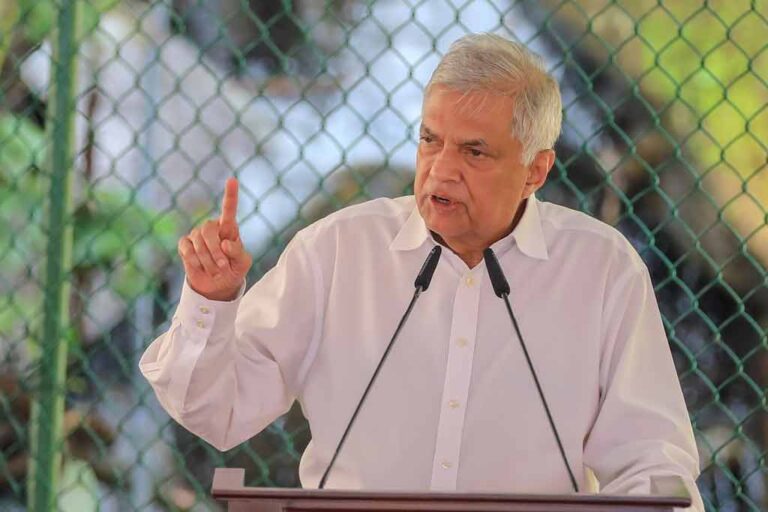
PMD: In a special statement delivered to Parliament on April 26, President Ranil Wickremesinghe announced that Sri Lanka is on the path of renaissance and is re-emerging as a success story, with the expectation of support from the entire nation to carry it forward.
The President highlighted the progress made in the Sri Lankan economy, which had previously collapsed due to riots, arson, and state bankruptcy. In just eight months, the country has turned its fortunes around and is now known as the ‘Sri Lanka comeback story’.
The President also spoke about the International Monetary Fund agreement, which he presented to Parliament. He acknowledged that the country had failed to implement previous agreements with the International Monetary Fund, despite entering into 16 such agreements.
However, the President emphasized that there is no other active option for Sri Lanka but to sign an agreement with the International Monetary Fund at present.
President Ranil Wickremesinghe reassured the public that the restructuring of local debt would not harm members of the Employees’ Provident Fund.
Furthermore, he stated that a social safety net has been implemented to protect low-income people and create financial stability in the country.
With these measures in place, the President is optimistic about Sri Lanka’s future and urged the nation to work together towards a brighter future.
Following is the full statement made by President Wickremesinghe;
I would like to address the concerns that have been raised in the media and elsewhere about the economic and financial issues that our country has faced. In July 2022, Sri Lanka was hit with riots, arson, and state bankruptcy, causing a complete loss of trust in our country. However, after eight months, we have managed to turn things around and it’s now being called the Sri Lanka comeback story. We have entered the path of renaissance and are reborn, and I am counting on the support of the whole country to take it forward.
Let me give you a brief overview of the situation we faced. Our tax cuts in late 2019 cost us 4% of gross domestic product, and things only got worse with the Covid epidemic. In February 2022, the Sri Lankan Rupee depreciated by 40% against the US Dollar within three months, and it continued to depreciate. Economic growth contracted by 7.8% throughout 2022, and inflation in September 2022 exceeded 70%, with food inflation rising as high as 95%.
In this challenging backdrop, I decided to assume the presidency in July 2022 because I believed that our country could recover. If I had not taken responsibility during a time of agitations and protests, our country would have been completely destroyed. I didn’t hesitate even when the paintings in my home library were burnt down and destroyed.
At that time, Sri Lanka’s total debt was 83.6 billion US dollars, with foreign debt at 41.5 billion US dollars and domestic debt at 42 billion US dollars. By now, our overall debt ratio as a percentage of GDP has become 128%. Due to non-repayment of bilateral and private loans, the amount of outstanding debt from April to December 2022 was estimated at 2.7 billion US dollars.
By the middle of 2022, Sri Lanka was unable to import goods and services from abroad due to the worsening foreign exchange deficit. In May 2022, interest related to foreign loans failed to be paid. This was the first time in the history of Sri Lanka that we had to face such a situation.
As soon as I took over the government, I began negotiations with the International Monetary Fund, the World Bank, and the Asian Development Bank. As a result, in September, we reached an agreement with the International Monetary Fund regarding extended credit facilities.
The comprehensive credit facility consists of six major reforms, which are as follows:
(a) Revenue Based Fiscal Consolidation – This reform includes institutional changes related to the public finance sector, strengthening the social security network, and introducing business reforms in the public sector.
(b) Restructuring of Public Debt
(c) Implementation of multiple strategies to ensure the restoration of financial stability, including the formation of foreign reserves under a flexible foreign exchange rate regime.
(d) Implementation of relevant policies and reforms to ensure the stability of the financial sector.
(e) Implementation of structural reforms necessary to control corruption – In this regard, the Minister will present the relevant draft.
(f) Taking necessary measures to enhance economic growth
Today, we received the financing assurance from foreign creditors, with the Paris Club and India working together to grant it. India was the first to publish it, and we are grateful for that.
China is expected to deal with it separately, so we will discuss with the Paris Club and India on one hand and negotiate with China on the other. After these discussions, we will have talks with private creditors. This agreement will enable us to receive approximately $3 billion from the International Monetary Fund over the next four years, with the potential to obtain about $7 billion from other institutions. This money is crucial for us.
Additionally, we have regained the trust of foreign banks and financial institutions, with economic stability already being established in the country. Social Security is receiving more funding, and investors are showing a keen interest in Sri Lanka.
We have entered into agreements with the International Monetary Fund 16 times in the past, but we have not fully implemented them. On the 17th occasion, when we achieve stability, we must address our long-term weaknesses and move forward with a new program.
One of the points to address is debt restructuring talks with our bilateral countries and private creditors. We want to restructure these loans, as failure to do so will result in a loss of liquidity. In order for the government to move forward, the restructuring must be done in rupees or dollars. The government wants to obtain funds for this service.
Therefore, we must first negotiate with foreign creditors. We hope to initiate these discussions soon, with domestic debt restructuring also being considered. A final decision has not yet been made, but it is important to discuss this issue. Negotiations cannot be held with terms and conditions already in place. It is easier for us to join negotiations without conditions.
Every aspect must be given special attention to ensure that no one is harmed in the process. Some banks may express their inability to cope with the program, but it is important for them to accept it in order to move the economy forward.
There are concerns that the stock market may collapse, and some may not be able to offer different conditions. However, decisions will be made in parliament, and appropriate measures will be taken to ensure that no harm is done to anyone, such as the members of the Employees Provident Fund.
We have initiated necessary programs to support the poor, and the World Bank has provided funding for this. We are currently implementing a program to give aid to those who truly deserve it and remove those who do not. Our aim is to create financial stability and protect the low-income people.
To achieve these objectives, we are holding joint discussions with the Paris Club and India on one platform, while separate negotiations with China are also underway. We have nothing to hide, and several steps need to be taken in this regard.
We have taken 09 prior actions (PAs) which we agreed to so we are qualified. Under that these are;
Fiscal Consolidation
• Cabinet approval of revenue measures to support fiscal consolidation during 2023 in line with program parameters.
• Parliament approval of a revised 2022 Budget that is in line with program parameters.
• Submission to Parliament of the 2023 Appropriation Bill that is in line with program parameters.
Fiscal Structural Reforms –
• Cabinet approval to automate monthly retail fuel price adjustment as prescribed by the 2018 fuel pricing formula to achieve cost recovery.
• Cabinet Approval to automate semi-annual cost-recovery based electricity price adjustment.
Multiple pillars –
• Cabinet approval of the new Central Bank Act with amendments from the bill submitted to Parliament in November 2019 in consultation with IMF- Staff. That has been done and we have to pass the bill here.
Financial Stability –
• Cabinet approval of Banking (Special Provisions) Act to strengthen key elements of the CBSL’s Crisis management powers.
• Hiring by the CBSL of an independent firm to conduct banking sector diagnostic exercise based on Terms of Reference and time line established in consultation with IMF staff.
Price Stability –
• Increase policy interest rates by 100 basis points to ensure forward – looking real policy rates on firmly upward path
The next item is I want to inform the House of the Proposed Quantitative Performance Criteria (PC) and Indicative Targets (IT).
Central Government primary balance 2022 -895 Bn by end December we want to make it -209 Bn.
The net official international reserves US$ -3 Bn 540,000. By end December we want it to be -1 billion 592,000.
Net credit to the government of the CBSL Rs. 2 Trillion 834 billion. By end December it should be 2 Trillion 740 Billion.
The Stock of expenditure arrears of the Central government 2022 60 Billion it will be 30 billion.
Central government tax revenue flow 2022 it was 1 Trillion 751,000 end March it was 650 billion but I must say we have fallen short in some areas such as Customs because the imports have been reduced, but on other had we have increased direct Taxation. The tax revenue finally the target for the end of the year is 2.9 billion.
Social spending by the central government 142 billion by 2022, 187 Bn by end of 2023. The Treasury guarantees ceilings was 1.159 Trillion last year and it will go up to 1 Trillion700 Bn.
I would like to tell you the Structural Benchmarks required for macroeconomic adjustment.
• Parliamentary approval of the new Central Bank Act which will be tabled in parliament next month –
• Completion of the asset quality review component of bank diagnostic exercise for the two largest state-owned banks and the three largest private sector banks
• Parliamentary approval of the welfare benefit payment scheme and the application of the new eligibility criteria to identify low-income families for receiving welfare benefit payments – End of May
• Cabinet approval of a comprehensive strategy to restructure the balance sheets of the CEB, CPC, Sri Lankan Airlines, and the Road Development Authority – End-JUNE
• Cabinet approval of a full revision of the Banking Act – End-JUNE
• Enact new anti-competition legislation to harmonize it with the United Nations Convention against Corruption, pending comprehensive asset recovery provisions. it is a new anti-corruption legislation – End-JUNE
• Cabinet approval of revenue measures to support fiscal consolidation during 2024 – End-JULY
• Development by the CBSL of a roadmap for addressing banking system capital and Foreign exchange liquidity shortfalls and intervening in banks assessed to be non-viable – End-JULY
Completion of the rollout of the ITMIS, expanding its coverage to all 220 heads – End-SEP
Publication of the report of an IMF-led governance diagnostic technical assistance mission to assess Sri Lanka’s anti-corruption framework – End-SEP
Submission to Parliament for the first reading of the 2024 Appropriation Bill – End-OCT
Determination by the MOF of the size, timing, instruments, and terms and conditions for potential government recapitalization of viable banks which are unable to close capital shortfalls from private sources – End-OCT. 2023
Parliamentary approval of the 2024 Appropriation Act and the spending allocations in line with program parameters – End-DEC. 2023
Submission to Parliament of a new PFM law that will authorize the budget formulation process, roles and responsibilities of relevant agencies, and information and accountability requirements – End-DEC. 2023
Improve the Bulk Supply Transaction Account (BSTA) to accurately measure the electricity subsidy, and start using it to determine the cost recovery based electricity tariff and government transfer requirement – End-DEC. 2024
Parliament approval of a full revision of the Banking Act – End-DEC. 2023
Set retail fuel prices to their cost-recovery levels with monthly formula based adjustments, and compensate the CPC for providing any fuel subsidies with on budget transfers – Continuous
Adjust the end-user electricity tariff schedule to its cost-recovery with semi-annual formula-based adjustments on a forward-looking basis in January and July each year – Continuous
The last one is Achieving Debt Sustainability
• Debt stock: Public debt should decline below 95 per cent of GDP by 2032
• Post-programme gross financing needs: average annual gross financing needs of the central government during 2027- 32 should remain below 13 per cent of GDP compared to 34.6% in 2022
• Post-programme foreign exchange debt service: annual foreign exchange debt service of the central government should remain below 4.5 per cent of GDP in each year over 2027-32 compared to 9.4% in 2022
• Programme financing gaps: debt service reduction during 2023-27 should be sufficient to close external financing gaps.
Under staff baseline scenario, US$17 billion in debt service reduction is required, including the arrears accumulated in 2022
So we are trying to get a 17 billion debt reduction on that side. Do you want it or not. Are we going in for debt restricting? We can’t manage without debt restructuring. That is what I want to make it clear to all the members.
However stability alone is not enough for us. In actuality, the nominal GDP for 2019 was just $89 billion during this period. The gross domestic product will be the same in 2028 as it was in 2019. If we stay with the growth rate of 3%, we can lose the national income of nine years. If we maintain the current growth rate of 3%, we may lose nine years of national revenue. Furthermore, it has been predicted that the Sri Lankan GDP will decrease by around 3% in 2023.
Economic positivity will likely be confirmed in the fourth quarter of 2023. If the economy grew at least 3% or 7% each year starting in 2019, our GDP would be worth 110 billion dollars. But if we go to 5%, it will be 130 billion dollars. In fact we believe we will be able to reach 3% or 4% in the first two to three years.
Following that, we must aim for a growth rate of at least 6% to 7% over this time period. That should be agreed upon by everyone in this House. However, this may be done at 7% or 8%. We have opportunities for that. That is why we are restructuring the entire legal system. Some regulations have to be removed. Some people wonder why corporations are being sold. They can be better run by the private sector. We leave them to the private sector.
In addition, various restrictions have been imposed for 25 to 30 years, depending on the preferences of each ministry. Let us now look at the economy and decide which limits will be retained and which will be lifted. A highly competitive social fair market system is required. We require a green economy. The economy must be digitalized. There are several activities available for this. Agriculture is being modernized, and new industries are being introduced. That is something I will address separately.
We have no other option but the IMF agreement. There have not been alternative suggestions. If there is no other alternative, let’s approve this. I also urge the opposition to work together. Let’s get both parties together and pass this.
Representatives of the International Monetary Fund visit our country every six months. Therefore if there are any shortcomings, we may address them and find a solution. Trade unions have highlighted concerns about taxation. All of these people will discuss and come up with a solution, and then we will all join together and develop a single national policy framework.
What is the country’s national policy framework till 2048? There are policies and initiatives in place for the first five years. Let’s discuss them. There is a national assembly. In particular, there are other committees. Let’s make the entire parliament a government to implement this program. Let’s get together for this. There may be differing viewpoints. However, everyone must back this initiative.
Now we have to build the country for 2048. If we do not accomplish this, we would be betraying the country’s youth. Their future has been destroyed. Think about the youth of the country. Don’t just think about grabbing power only. If this program is not done, none of us will be able to survive in another two or three years. So I urge everyone to come together to approve this. After that we will come together and prepare the set of policies required until 2048. I also, urge you to provide support to implement the program during the next five years.