December 07, Colombo (LNW): President Anura Kumara Dissanayake has underscored the need for an emergency-style operational framework—one that surpasses the limits of routine public administration—to restore normal life in the aftermath of the recent disaster.
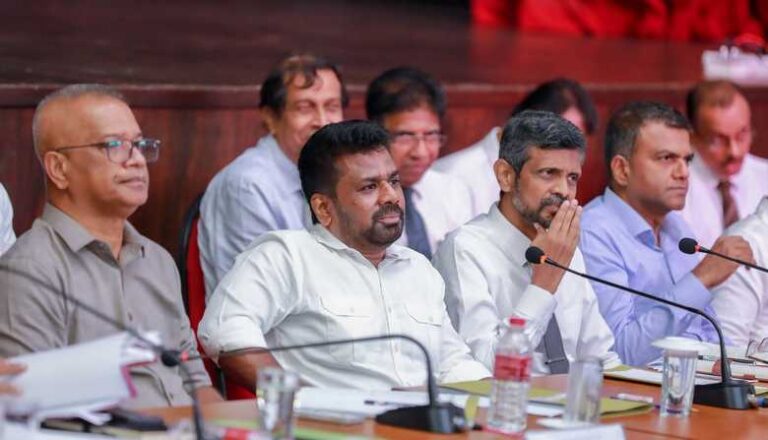
Speaking at the Kandy District Coordinating Committee meeting held at the District Secretariat yesterday morning (06), the President carried out a detailed review of urgent recovery efforts now under way. These include clearing blocked roads, restoring electricity and water, ensuring fuel availability, repairing irrigation systems and reconnecting disrupted communications.
He directed officials to make full use of funds already allocated for the next 25 days, insisting that road-clearing work must be completed quickly while long-term reconstruction continues in parallel. Water supply, he said, must be fully restored within three days, with bowsers deployed wherever required. The Tri-Forces have also been instructed to provide technical and logistical backing as an extraordinary measure.
The President further ordered Divisional Secretariats to coordinate the cleaning of household wells and pressed for electricity in the district to be reinstated—at least temporarily—by 31 December. Comprehensive restoration work will follow in the second phase of the recovery programme.
Turning to agriculture, he called for an urgent assessment of arable land, emphasising the need to prioritise the cultivation of both paddy and vegetables to stabilise food supplies. Irrigation authorities and agrarian officials have been told to work in closer alignment to guarantee water distribution. Compensation payments of Rs. 200,000 for affected farmers are to be expedited, with vegetable growers entitled to Rs. 150,000 per hectare. Adjustments will also be made to compensate banana growers facing similar losses.
Livestock losses were discussed at length, with the President urging that detailed records be maintained and damaged farms revived quickly so that farmers can regain income and the wider food supply—particularly milk and poultry—can recover.
Fuel shortages in Pussellawa and Meetalawa, caused by road blockages, were also addressed. The President instructed the Road Development Authority, the Tri-Forces and the Police to jointly ensure fuel reaches these areas by the end of the day.
He stressed the importance of reopening schools without delay so that scheduled examinations can proceed, and examined progress made in restoring healthcare services, railways and communications. Damage to homes and public institutions, along with resettlement needs, was also discussed. The President said nearby state lands would be identified for relocating affected families, and emphasised that compensation for house repair and reconstruction must be properly utilised. All payments arising under the 2025 Budget must, he insisted, be completed before 31 December to avoid placing pressure on next year’s finances.
A long-term solution to the garbage crisis in Gampola was also considered. Until the release of Mahaweli land is formalised, the President directed that temporarily available Ceylon Electricity Board land be used for waste disposal.
He noted that while natural disasters may be unavoidable, the scale of devastation can be reduced through proper planning. He called for a scientific study of the Central Highlands and a comprehensive plan to rehabilitate the region’s fragile ecological systems. Local authorities, he said, must enforce their powers rigorously to prevent unauthorised construction, and the Ceylon Electricity Board should refuse power connections to illegal settlements.
Despite early fears that recovery would take months, the President stated that significant progress has been made in a remarkably short period. With sustained cooperation, he said, the country can move swiftly towards full restoration.
He ended by expressing his deep appreciation for the hard work demonstrated by state officials and the Tri-Forces throughout the crisis response.
President Calls for Extraordinary Coordination to Rebuild Lives in Post-Disaster Kandy
Switzerland Sends Specialist WASH Team and Equipment to Bolster Sri Lanka’s Post-Storm Recovery

December 07, Colombo (LNW): Switzerland has dispatched a shipment of vital Water, Sanitation and Hygiene (WASH) equipment—along with a team of technical experts—to assist Sri Lanka in managing its ongoing relief operations after the recent bout of extreme weather.
The consignment touched down at Bandaranaike International Airport yesterday (06), where it was formally handed over by members of the visiting Swiss WASH Mission.
The delegation was led by Martin Bölsterli, the mission’s team leader, accompanied by senior coordinator Yvonne Josy Müller. Both emphasised Switzerland’s commitment to supporting countries facing severe humanitarian strain.
Among the supplies delivered were advanced water purification units designed to provide safe drinking water in areas where local systems have been damaged or contaminated. In addition, Swiss specialists have been deployed to work alongside Sri Lankan teams in setting up and maintaining the equipment, as well as advising on broader sanitation challenges emerging in hard-hit communities.
Receiving the donation on Sri Lanka’s behalf was Sunil Jayaweera, former Director of Preparedness at the Disaster Management Centre (DMC), who has returned to volunteer in the national response following his retirement.
He described the assistance as “timely and immensely practical”, noting that access to clean water has become a critical concern in several districts.
Officials say the support will not only help stabilise current conditions but also strengthen the capacity of humanitarian agencies working to restore essential services. The arrival of the Swiss mission adds to the growing wave of international assistance extended to Sri Lanka as recovery efforts expand in scope and urgency.
Dozens of Reservoirs Overflow as Authorities Move to Repair Storm-Damaged Irrigation Network
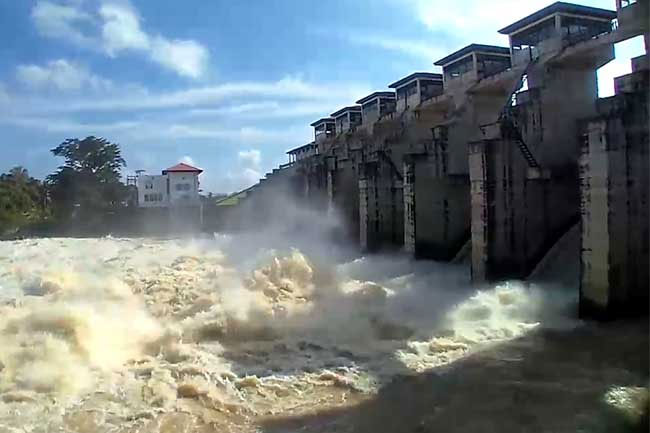
December 07, Colombo (LNW): The Irrigation Department has confirmed that around 30 major reservoirs and nearly 40 medium-sized tanks are currently overflowing following days of persistent, intense rainfall.
Director of Irrigation (Water Management), H.M.P.S.D. Herath, said the situation is being closely monitored, though engineers do not anticipate significant flooding in low-lying areas at present.
Among the reservoirs spilling excess water are Senanayake Samudra in Ampara, Mahawilachchiya, Mahakanadarawa and Rajanganaya in the Anuradhapura region, Deduru Oya in Kurunegala, Lunugamvehera in Hambantota and the Sorabora reservoir in Badulla.
According to Herath, the Rajanganaya Reservoir is currently discharging about 6,476 cubic feet of water per second into the Kala Oya, while the Angamuwa Reservoir is releasing approximately 1,164 cubic feet per second.
Despite the opening of spill gates, officials insist that the controlled releases remain relatively modest and pose no immediate risk to surrounding communities. Even so, the recent deluge has caused notable damage to several irrigation structures, prompting rapid emergency repairs.
Work on the damaged South Canal of the Rajanganaya Reservoir is already under way and is expected to conclude by the end of today (07), allowing irrigation to resume for farmland dependent on its supply. At the same time, renovation of the Elahera Yodha Canal is progressing with the help of military personnel and local farming groups.
Herath noted that the completion timeline will hinge on the weather in the coming days and the volume of water being released from the Moragahakanda Reservoir.
Temporary reinforcement of other compromised structures is continuing under departmental oversight, with teams deployed across several districts to ensure the network remains stable.
In a separate update, L.S. Sooriyabandara, Director of Irrigation (Hydrology & Disaster Management), reported that Baddegama and Ratnapura recorded the highest rainfall in the past 24 hours, receiving between 30 and 35 millimetres.
He added that although water levels in the Malwathu Oya near Thanthirimale rose above normal earlier, they have since begun to subside. No flooding is expected, as water is being released purely as a precaution to manage reservoir levels.
Major tanks such as Deduru Oya, Rajanganaya and Nachchaduwa, along with several medium-sized reservoirs in Anuradhapura, continue controlled water releases to ease inflows as authorities maintain heightened vigilance over the island’s water systems.
New National Hotline ‘1904’ Launched for Reporting Essential Service Disruptions

December 07, Colombo (LNW): The Office of the Commissioner General of Essential Services (CGES) has introduced a new rapid-response hotline, 1904, enabling the public to report difficulties in accessing key services anywhere in the country. Officials say the service is designed to streamline complaints, strengthen coordination among agencies, and speed up responses during emergencies or unexpected service breakdowns.
Residents may use 1904 to flag problems relating to electricity, fuel supply, drinking water and sanitation, public transport, food and other basic goods, telecommunications and ICT services, hospital and emergency medical care, as well as irrigation and other critical services listed under Gazette Extraordinary No. 2464/29. Authorities have indicated that additional categories may be incorporated as national needs evolve.
All calls will be routed to the CGES Operations Centre, where trained staff will verify each report, assess its urgency, and relay it to the appropriate response units. Officials noted that improved digital tracking tools have been integrated into the system to ensure that complaints are properly monitored until they are resolved.
The CGES has urged the public to use the number responsibly and to provide clear, accurate details so that teams on the ground can act swiftly. Early feedback from trial operations suggests the hotline could significantly reduce delays in responding to service failures, particularly during adverse weather or periods of heightened demand.
Myanmar Sends Emergency Aid Flight to Assist Sri Lanka’s Flood-Hit Communities
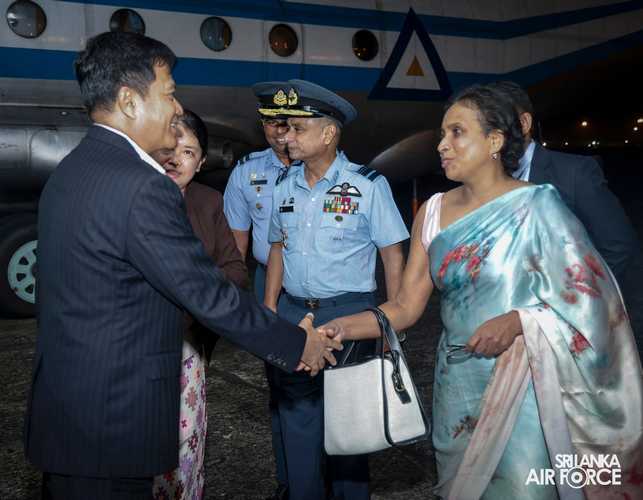
December 07, Colombo (LNW): A military transport aircraft from Myanmar touched down at Katunayake Air Force Base late last night (06), delivering a significant shipment of relief items for Sri Lankans struggling in the aftermath of severe weather.
The aircraft, which arrived with a formal government delegation on board, carried a range of urgently needed supplies, including medical equipment, hygiene products and other essential goods requested by local authorities.
Officials described the gesture as a timely show of regional solidarity at a moment when many communities remain overwhelmed by flood damage and disrupted infrastructure.
Sri Lanka’s Ambassador to Myanmar, Marlar Than Htaik, joined Myanmar’s Ministry of Foreign Affairs Director General, Zaw Phyo Win, and several senior representatives in overseeing the official handover. They emphasised the importance of continued cooperation between the two nations as recovery efforts escalate.
Accepting the consignment on behalf of the Sri Lanka Air Force, Air Vice Marshal Deshapriya Silva, together with a contingent of Air Force officers, expressed appreciation for the support. He noted that the supplies would be swiftly distributed to areas where humanitarian needs remain most acute.
Flood-hit Sri Lanka: Death toll climbs to 618
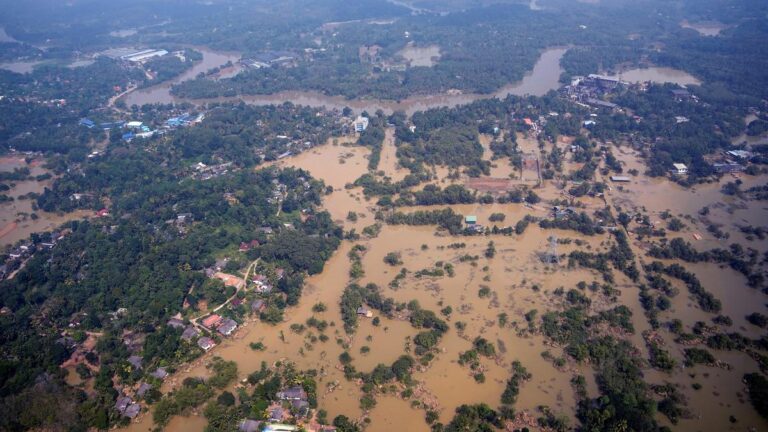
December 07, Colombo (LNW): The country remains in the grip of a deepening humanitarian emergency as relentless storms batter every corner of the island.
As of 8 p.m. yesterday evening (06), officials at the Disaster Management Centre (DMC) reported that the confirmed death toll has risen to 618, with 209 people still unaccounted for as rescue teams continue combing through debris and flood-stricken areas.
According to the latest assessments, all 25 districts have suffered some degree of disruption, with more than 2 million residents—representing over 583,000 families—feeling the impact.
Gampaha, Puttalam and Colombo have borne the brunt of the devastation, each struggling to cope with widespread flooding, landslides and the collapse of essential services.
Authorities say around 100,000 people are currently seeking refuge in nearly 1,000 emergency shelters, many of which are operating beyond their intended capacity. Aid workers on the ground describe increasingly strained conditions as supplies run thin and damaged infrastructure hampers delivery routes.
The DMC’s preliminary damage survey indicates that at least 4,071 homes have been completely lost, with an additional over 71,000 sustaining partial destruction. Local officials warn that these figures may climb as previously inaccessible areas are reached and assessments continue.
Despite the bleak outlook, volunteers, rescue personnel and community groups are pressing on, with many calling for accelerated relief efforts as the weather shows few signs of easing.
Northeast monsoon condition gradually establishes over the Island: Showers expected (Dec 07)
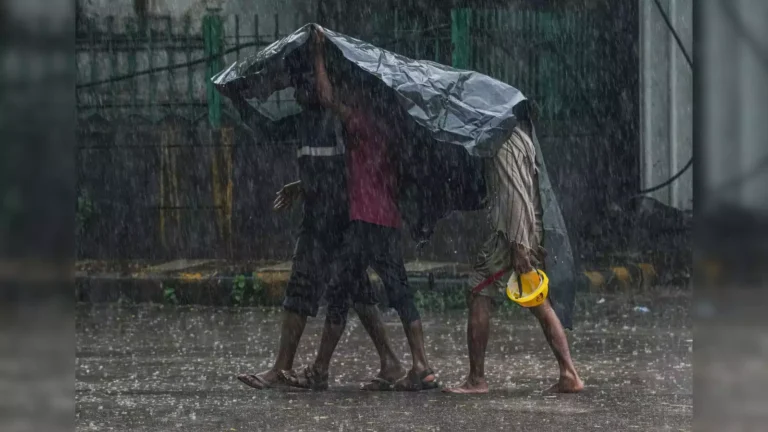
December 07, Colombo (LNW): The Northeast monsoon condition is gradually establishing over the island, the Department of Meteorology said in its daily weather forecast today (07).
Several spells of showers will occur in Northern, North-Central, Eastern Uva provinces and in Matale and Nuwara-Eliya districts.
Showers or thundershowers will occur in the other areas of the island after 1.00 p.m. Fairly heavy falls above 50 mm are likely at some places in Western and Sabaragamuwa Provinces and in Galle and Matara districts.
Misty conditions can be expected at some places in Western, Sabaragamuwa, Central and Uva provinces during the early hours of the morning.
The general public is kindly requested to take adequate precautions to minimise damages caused by temporary localised strong winds and lightning during thundershowers.
Marine Weather:
Condition of Rain:
Showers or thundershowers are likely at several places in the sea areas off the coast extending from Batticaloa to Puttalam via Trincomalee and Kankasanthurai. Showers or thundershowers may occur at several places in the sea areas off the coast extending from Puttalam to Matara via Colombo and Galle in the evening or night.
Winds:
Winds will be North-easterly in the sea areas around the island. Wind speed will be (20-30) kmph. Wind speed can increase up to 45 kmph at times in the sea areas off the coast extending from Puttalam to Kankasanthurai via Mannar.
State of Sea:
The sea areas off the coast extending from Puttalam to Kankasanthurai via Mannar may be fairly rough at times. The other sea areas around the island may be slight to moderate. Temporarily strong gusty winds and very rough seas can be expected during thundershowers.
Fresh Border Clashes Erupt Between Pakistan and Taliban Forces Despite Recent Ceasefire
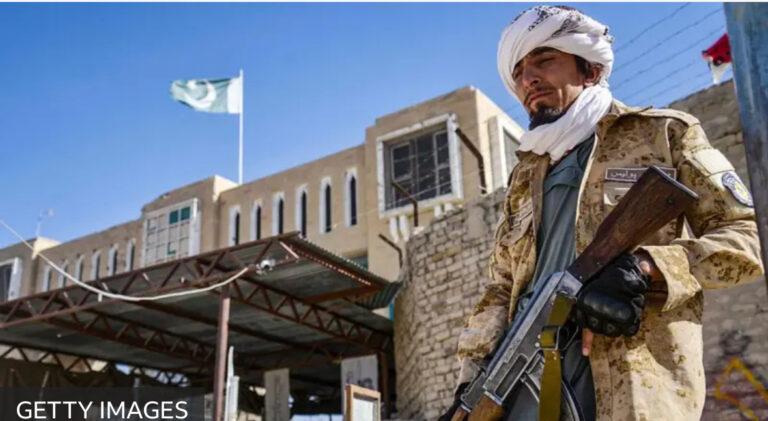
Tensions along the Pakistan and Afghanistan frontier escalated once again as fierce clashes broke out overnight, with both sides accusing the other of violating a fragile ceasefire agreement. The latest fighting forced residents of Spin Boldak, a key Afghan border city along the 1,600 mile (2,600 km) frontier, to flee in large numbers.
Medical officials in Kandahar confirmed to BBC Pashto that four bodies had been brought to a nearby hospital, while four others were treated for injuries. Reports from Pakistan indicated at least three additional casualties.
The two countries have experienced recurring skirmishes in recent months, with the Taliban administration repeatedly accusing Pakistan of launching air strikes inside Afghan territory. Islamabad, meanwhile, maintains that militant groups sheltering in Afghanistan continue to orchestrate attacks inside Pakistan.
Four Hours of Heavy Fire
Both governments confirmed that they exchanged fire overnight but each insists the other side initiated hostilities.
Mosharraf Zaidi, spokesperson for Pakistan’s Prime Minister Shehbaz Sharif, described the incident as “unprovoked firing” by Taliban forces.
“An immediate, befitting and intense response has been given by our armed forces,” his statement read. “Pakistan remains fully alert and committed to safeguarding its territorial integrity and citizens.”
The Taliban, however, rejected those accusations. A spokesperson for the Afghan government stated that Pakistan had “once again initiated attacks,” forcing Taliban forces to respond defensively.
Eyewitnesses on the Afghan side said the exchange began at around 22:30 local time (18:00 GMT) on Friday. Videos from the area showed crowds of families escaping on foot and by vehicle as artillery echoed across the border.
Ali Mohammed Haqmal, head of Kandahar’s information department, accused Pakistan of using both light and heavy artillery, claiming that several civilian homes had been struck by mortar rounds.
Ceasefire Under Strain
The renewed violence comes less than two months after Pakistan and the Taliban reached a ceasefire mediated by Qatar and Turkey. That agreement ended more than a week of clashes, the deadliest since the Taliban seized power in 2021, which left dozens dead and raised concerns about regional stability.
Despite the ceasefire, distrust between the two neighbours has persisted. Islamabad continues to allege that Afghanistan provides safe haven to militant groups, including the Pakistan Taliban (TTP), which has carried out at least 600 attacks on Pakistani forces over the past year, according to the Armed Conflict Location and Event Data Project (ACLED).
The Taliban government denies offering sanctuary to any armed groups, accusing Pakistan of externalising its own security failures.
Negotiations Continue Without Breakthrough
Delegations from both countries met in Saudi Arabia last week for a fourth round of talks aimed at achieving a broader peace agreement. However, the discussions ended without major progress.
Sources familiar with the negotiations told BBC News that both sides had reaffirmed their commitment to the ceasefire, even as the situation on the ground remains volatile.
With cross border tensions escalating again, the durability of the ceasefire and the prospects for a lasting political settlement face renewed uncertainty.
Sri Lanka’s First Post-Crisis Dollar Bond Signals Renewed Investor Faith

Sri Lanka’s return to foreign-currency borrowing took a significant step forward this week, with the Government successfully securing the full US$50 million sought from its first Domestic Dollar Bond issue since the 2022 debt crisis. The auction, conducted by the newly established Public Debt Management Office (PDMO) rather than the Central Bank, drew US$89 million in total bids — a level of demand that officials describe as a “strong vote of confidence” in the country’s stabilisation trajectory.
The issuance marks more than a routine borrowing exercise. It is the first test of whether domestic financial institutions are willing to place dollar liquidity in Government instruments after the trauma of the sovereign default, when confidence collapsed and foreign-currency debt markets froze. The robust oversubscription signals that local banks now view Sri Lanka’s short-term macroeconomic and external-sector conditions as improving, supported by disinflation, steadier reserves and progress on external debt restructuring.
The breakdown of bids reveals investor preference for shorter tenors amid lingering risk perceptions. The one-year bond attracted US$45.5 million in bids, with US$33 million accepted at a 5.7% fixed rate, while the two-year tranche drew US$42.5 million, of which US$17 million was accepted at 6.1%. In contrast, the three-year maturity received only US$1 million, and authorities rejected the offer entirely a reflection both of cautious investor sentiment and the Government’s intention to avoid locking in higher long-term costs.
Financial analysts say the pricing, although above pre-crisis levels, represents a workable middle path for a country still rebuilding trust. The rates suggest that domestic banks perceive lower sovereign risk than in 2023–24, yet still demand a meaningful risk premium for lending dollars to the Treasury.
The bond’s broader economic significance lies in three areas. First, it helps diversify the Government’s funding base away from purely rupee borrowing, easing pressure on domestic interest rates and the banking system’s liquidity. Second, by tapping local dollar savings rather than external commercial markets, the State avoids the higher costs and refinancing risks associated with international sovereign bonds an essential consideration while the country remains unrated by some agencies and only gradually regaining credit credibility.
Third, the issuance functions as a signalling tool. A successful dollar-denominated auction indicates to external creditors and multilateral institutions that Sri Lanka’s financial system is stabilising and able to support selective foreign-currency funding. It also strengthens the PDMO’s mandate to manage public debt independently, a key structural reform under the IMF programme.
The Finance Ministry has left the door open to tripling the size of the programme depending on future requirements and market appetite. But analysts caution that careful pacing is essential: premature expansion could strain dollar liquidity, while measured issuance could gradually rebuild market depth without destabilising the banking sector.
For now, the auction stands as a cautiously optimistic milestone, the first clear sign since the crisis that Sri Lanka can re-enter dollar markets on its own terms.
HSBC Exit Marks Shift toward Local Dominance in Banking

HSBC’s decision to exit Sri Lanka’s retail banking business—now set to be acquired by Nations Trust Bank (NTB) for Rs. 18 billion signals a deeper transition underway in the island’s financial sector: the steady retreat of international retail operators and the corresponding rise of homegrown institutions as the primary custodians of domestic savings and consumer credit.
While NTB’s acquisition is positioned as a strategic growth move, the broader implications point to a global banking realignment. Over the past decade, large multinational banks have increasingly scaled down operations in smaller markets, favouring regions with higher returns and lower regulatory cost burdens. HSBC’s withdrawal fits this pattern, although the bank will continue its corporate and investment banking services in Sri Lanka.
For Sri Lankan depositors, the shift raises important questions about access to international banking networks, foreign currency services and the level of global integration typically associated with institutions like HSBC. Many customers—including expatriates, entrepreneurs and high-net-worth individuals valued HSBC for its global connectivity more than its domestic presence. The transition to NTB will therefore be scrutinised for its ability to maintain cross-border service quality, digital efficiency and wealth-management capabilities.
For NTB, the deal provides a once-in-a-generation opportunity to expand scale. Gaining nearly 200,000 new customers will significantly deepen its footprint in the premium segment, positioning it as a stronger contender among mid-sized banks. The larger deposit base will improve liquidity ratios, enhance lending power and strengthen the bank’s stability profile—key advantages at a time when Sri Lanka’s financial sector is emerging from currency pressures, non-performing loan challenges and capital adequacy demands.
Economists say the transition could have a stabilising effect on the financial ecosystem. Allowing a domestic bank to absorb a foreign bank’s retail operations prevents market disruption, protects customer deposits, and ensures continuity in loan servicing. It also means that profits and economic value generated from retail banking will increasingly remain within local institutions, potentially strengthening domestic capital formation.
However, the shift also underscores Sri Lanka’s need to modernise its banking environment to remain attractive to global players. As multinational banks exit, the burden falls on domestic institutions to uphold internationally recognised service standards, digital capabilities and compliance frameworks.
HSBC and NTB have jointly committed to a seamless transition, with regulators closely supervising the handover. While the move marks the end of an era of foreign retail banking presence in Sri Lanka, it also opens a chapter where domestic banks play a more influential role in shaping the country’s financial future. The success of this transition will be measured by how well customer trust is retained and how effectively NTB leverages this expansion to modernise and strengthen the wider banking landscape.