In an ambitious move to enhance Sri Lanka agriculture productivity with modern technology in grain processing technology, a leading local conglomerate Hayleys Group will be introducing the all-new Shizuoka Circulation type Grain Dryer.
Hayleys Agriculture, one of Sri Lanka’s leading agricultural solutions providers, partnered with Shizuoka Seiki Japan, which has been manufacturing agricultural machinery for over 40 years, is set to introduce the Circulation type Grain Dryer, with cutting-edge Japanese technology, in an effort to enhance the country’s grain processing industry.
The Shizuoka Grain Dryer will revolutionise the grain drying process, which has long been bottlenecked by the use of conventional drying methods in the local grain processing industry.
A large portion of the industry currently relies on the sun-drying process, which results in high damage to the grain during the milling process for consumption and low germination rates for seed-purpose grain processing due to the long drying periods and low consistency, agriculture ministry sources said.
On the other hand, the entire process was made even more challenging due to the susceptibility to environmental changes as well.
It is with these issues in mind that Hayleys Agriculture introduced an all-new, specifically designed grain drying system that can stand out from its competitors in the market through its improved drying mechanism that reduces grain damage and encourages even drying regardless of the weather condition.
The Grain Dryer is equipped with a specially designed bucket elevator and screw system to minimize any mechanical damage to the grain.
It also ensures an even distribution of grain within the dryer to enhance the consistency of the process. Another key feature is an improved online grain moisture analyzer that provides highly accurate and continuous drying parameter readings, which allows for better control of the process. On top of that, the compact design of these dryers makes installation, maintenance, and operation extremely easy and user-friendly.
Sumith Herath, Director/General Manager and SBU Head of Agri Equipment Division of Hayleys Agriculture commented: Sri Lankan farmers will be able to get firsthand experience of the fine mix of trustworthiness and reliability that Shizuoka has gained worldwide through decades of manufacturing agricultural machinery and technological advancements.
Aalong with Hayleys Agriculture’s unparalleled customer care, pre and after sales service capabilities, as all dryers are subject to a manufacturer’s warranty, which will be provided by Shizuoka through Hayleys Agriculture.
Authorities have initiated a thorough investigation into an alleged misappropriation of a significant sum of money amounting to Rs. 45 million at the Samurdhi Bank branch located in Welewewa. A total of six individuals, including former chief managers and multiple cashiers associated with the branch, have been apprehended in connection with the incident.
Following their arrest, the suspects were presented before Anamaduwa Magistrate Nimesha Patabendige, who subsequently ordered their remand until May 25. The financial crimes unit of the Criminal Investigation Department has taken charge of the investigation, actively probing the details surrounding the incident.
The authorities are committed to uncovering the truth behind this alleged misappropriation and ensuring that those responsible are held accountable for their actions. The investigation aims to shed light on the circumstances surrounding the incident at the Samurdhi Bank branch and bring about a just resolution to the matter.
A Special Dengue Prevention and Control Programme launched in Colombo and its suburbs in response to the rapid spread of Dengue in the Western Province: About 60 teams deployed to control the situation: Over 30,000 Dengue cases reported in 2023; 50% of them reported from the Western Province.
UN’s Food and Agriculture Organisation initiates a US$ 1.5 million project via funding from China as part of the South-South Cooperation (SSC) programme, to improve the quality and value of Sri Lankan fruits in the global market by improving the production and commercialisation of fruit value-chains in Sri Lanka: Project said will be implemented in Kalutara, Gampaha, Moneragala, Anuradhapura and Kilinochchi.
JVP former MP and trade union leader Wasantha Samarasinghe says the Ranil-led regime is following the same old principle of selling the country’s resources for debt repayment under the pretext of complicated words like ‘debt optimisation’ confusing the public and even the banking sector; urges the public to assemble against the government’s policy and protect public assets.
President Ranil Wickremesinghe pledges to modernise the country’s education sector to create a young generation “equipped with knowledge and nourished with abilities” within the next ten years; asserts a Cabinet committee has already been appointed in this regard; laments had the money spent on corporations during the past 10 years been invested on education, Sri Lanka would have “the best education in Asia.”
Lawyers appearing for Social Media Activist Darshana Handungoda who is under censorship say Sri Lanka’s Attorney General’s Department for the first time in history has filed a lawsuit against freedom of information; laments the AG should play a role for the betterment of the people of the country; alleges the AG’s Office has misled the Judiciary.
Tourism Minister Harin Fernando says Air China, a renowned Chinese carrier, is set to launch flights to Sri Lanka from July 2023; asserts the airline will initially operate three flights per week to the country; adds the move is poised to “bolster tourism and enhance connectivity between the two nations, opening up new avenues for travellers and fostering bilateral relations.”
The Colombo Hight Court temporarily lifts the overseas travel ban imposed on Health Minister Keheliya Rambukwella and MP Patali Champika Ranawaka: Ban on Rambukwella lifted until November 30; ban on Ranawaka lifted until September 23.
President Ranil Wickremesinghe addressing he 10th Environment Pioneer President’s Medal Awarding Ceremony 2020 – 2021 says Sri Lanka would establish the world’s first international environmental university to “bolster global efforts in tackling climate change.”
Indian business magnet Mukesh Ambani’s Reliance Industries inks a deal with SL cricketer Muttiah Muralitharan’s company Ceylon Beverage International for a mega-project: Reliance is entering agreements with an aim to capture the maximum share of the Indian soft drink market and is expected to emerge as strong competitors for major companies like Pepsi and Coca-Cola.
Sri Lanka women win by 44 runs over Bangladesh women to win the series 2-1 in the third and final T20 game played at SSC grounds: Harshitha Samarawickrama and Nilakshi de Silva hit half centuries and were involved in an unbroken 102-run fourth wicket stand.
According to the latest forecast by the Department of Meteorology, intermittent showers and thundershowers are anticipated in several regions of Sri Lanka. The Western, Sabaragamuwa, Central, North-Western, and Northern provinces, along with the Galle and Matara districts, are expected to experience showers or thundershowers. Moreover, the provinces of Western and Sabaragamuwa, as well as Kandy, Nuwara-Eliya, Galle, and Matara districts, may encounter fairly heavy showers exceeding 75 mm.
In addition, other parts of the country may also witness intermittent spells of showers. Furthermore, it is advised that the public remain cautious as strong winds, ranging from 40-45 kmph, may occur sporadically across the island. Precautionary measures should be taken to mitigate any potential damage caused by localized strong winds and lightning during thundershowers. Stay updated with the latest weather information and ensure adequate preparations are made to safeguard against adverse weather conditions.
The three short depositions, written in rustic Bengali in 1849, told the story of a young woman named Chandra. Pregnant as a result of an illicit affair, and in danger of being banished from her village, she was given poison one night by her mother and her sister. After several hours she expelled a small bloody fetus, and then, just before dawn, she died. “I administered the medicine in the belief that it would terminate her pregnancy,” her sister declared to the village scribe who’d been put to work by local law-enforcers. “I did not realise it would kill her.”Listen to this story.
The depositions amounted to no more than a few dozen lines. But the historian who found them saw far more there than the scant details of a young life cut tragically short. He teased out what the wider context revealed about the Indian subcontinent: about its strict caste rules, its legal frameworks, its ways of disciplining transgression, the mores and pressures of its village elders (almost always men) and the unspoken solidarity among women that underpinned so much of rural life in Bengal then.
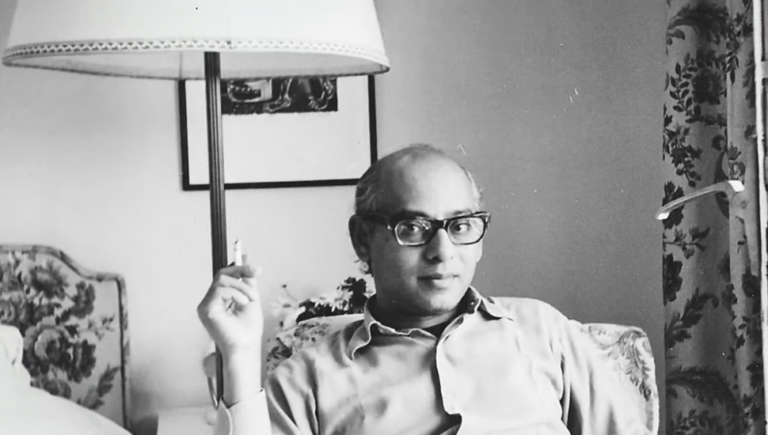
His essay, “Chandra’s Death”, is still widely quoted. It appeared first in 1987 in the fifth volume of “Subaltern Studies: Writings on South Asian History and Society”, a series started by a soft-spoken, balding academic working in Manchester, Sussex and then Canberra rather than at the Oxbridge colleges that had long dominated the study of India’s grand past. “How is one to reclaim this document for history?” he asked. That question lay at the root of the movement he launched with a group of younger scholars, both Indian and British. Most of them had studied in the West, and were keen to throw off the conservatism of other historians.
“Subaltern Studies” would become a manifesto for a new kind of Indian history written outside the mainstream of the ideas of both the colonial period and the era of Jawaharlal Nehru’s leadership. These were stories of India from the bottom up, or as one fellow academic liked to call it: “insurgent history”. Through the six volumes of “Subaltern Studies” that he edited between 1982 and 1989, he showed over and over how change in India had not been, as many historians would have you believe, a case of elites acting first, with the peasantry always following obediently behind. The poor and marginalised had their own ideas about the change they wanted and had always been prepared to fight for it, whether it was the indigo revolt of 1859 or the many Dalit movements of the mid-20th century. Edward Said, no slouch himself when it came to revisionist essays about colonial history, called Ranajit Guha’s writing “a brilliant example of revolutionary historical method”.
He had alighted upon the term “Subaltern” in the prison diaries of Antonio Gramsci. A founder of the Italian Communist Party, Gramsci wanted a word that corresponded to Marx’s proletariat, but which was better suited to an agrarian society like Italy. Though the word had come to mean a young British officer in India, it also means lower status. The double meaning appealed to Mr Guha’s sense of humour. Using unorthodox sources, including songs and plays, and writing from the vantage of India’s “subalterns”—the slum-dwellers, tribespeople and women of all classes, but especially poor rural women—the Indian historian repurposed Gramsci’s term for the post-colonial world, giving it an entirely new life.
That he was almost 60 when the first “Subaltern Studies” came out didn’t bother him. Nor was he troubled by the fact that he was retired when, at last, he became a cult figure among historians, anthropologists and cultural theorists the world over. Non-conformity was something he’d been preparing for all his life. He was born the son of a middling land-owning family in what is now Bangladesh, but found the life of an entitled upper-caste Hindu intolerable, even though his grandfather taught him Sanskrit and he spent hours reading English literature in his father’s library.
A new essay by Partha Chatterjee, a distinguished political theorist and close friend of Mr Guha’s, explains how he was affected by his background. When the family tenants came to his grandfather’s house “they would never sit down and would touch the feet of even the children of the master’s family”. Like many young Bengalis then, he joined the Communist Party and later went on to work for it full-time. The party offered new opportunities. He told Mr Chatterjee that he travelled to Paris, freshly liberated from Nazi occupation, to eastern Europe and across Russia by train in one of the first foreign groups to visit China after the revolution. But when the Soviet Union invaded Hungary in 1956, he resigned from the party and found a home at the new Jadavpur University in what was then called Calcutta.
There he turned to Bengal’s feudal system. As Mr Chatterjee explains, Mr Guha wanted to understand how laws introduced in the late 18th century to create enterprising farmers instead ended up producing the hated zamindari system of extracting heavy rents from tenant farmers. Other historians were not convinced by his argument that it was what Mr Chatterjee calls “a necessary consequence” of British colonial rule. His doctoral thesis was turned down, though it was eventually published in 1963 as “A Rule of Property for Bengal”. That book, Mr Chatterjee writes in his essay, is now “a classic of modern Indian history”.
Revolting peasants
He took a job teaching at Sussex University. He wrote about the brutality of Indira Gandhi’s government. And then he became fixated during a year spent in India on the crushing of the communist Naxalite movement and its aftermath. Returning to England, he studied the long history of peasant revolts. The creation of “Subaltern Studies” was the obvious next step.
After years battling historical orthodoxy, he found a fresh insight in his late 70s, says Mr Chatterjee: that the truth of human life was not to be found in history, but in literature and in the words of ordinary people—people like the young woman who was poisoned for being pregnant.■
This article appeared in the Obituary section of the print edition under the headline “Bottom-up history”
Colombo (LNW): Seventeen children were physically/sexually abused and even killed in Sri Lanka from 2020 to July 2022, but as the small talk behind closed doors remains the norm, backed surprisingly by the silence of the mainstream media, let alone the authorities, the country moves forward with its share of ignorance over child abuse, a national crisis avoided by many.
It is in this backdrop have activists and civil movements begun to fight back demanding justice and assurance for the protection of children, and recently authorities have been urged to take immediate action against the occurrence of child abuse under religious immunity, a component so deep that even those vocal about child protection hang back over the controversy.
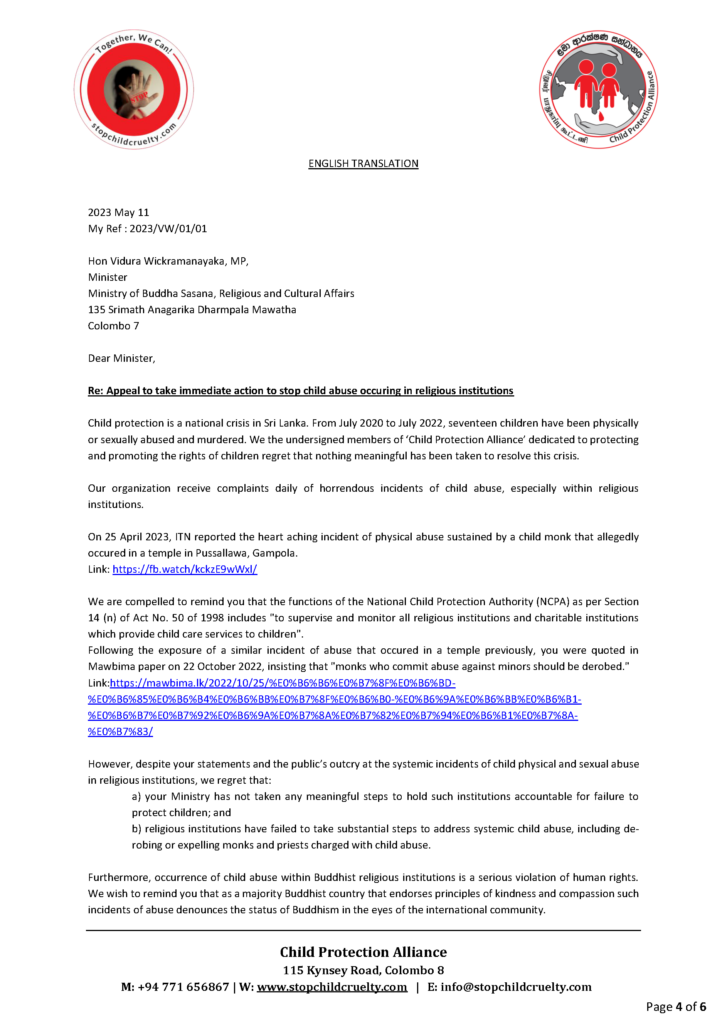
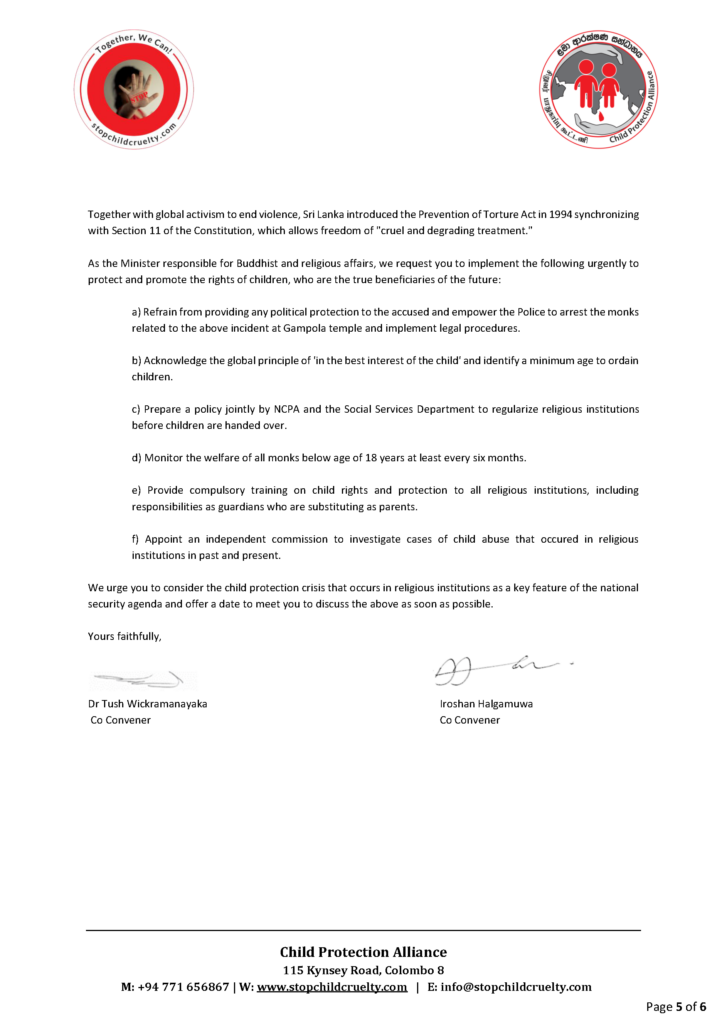
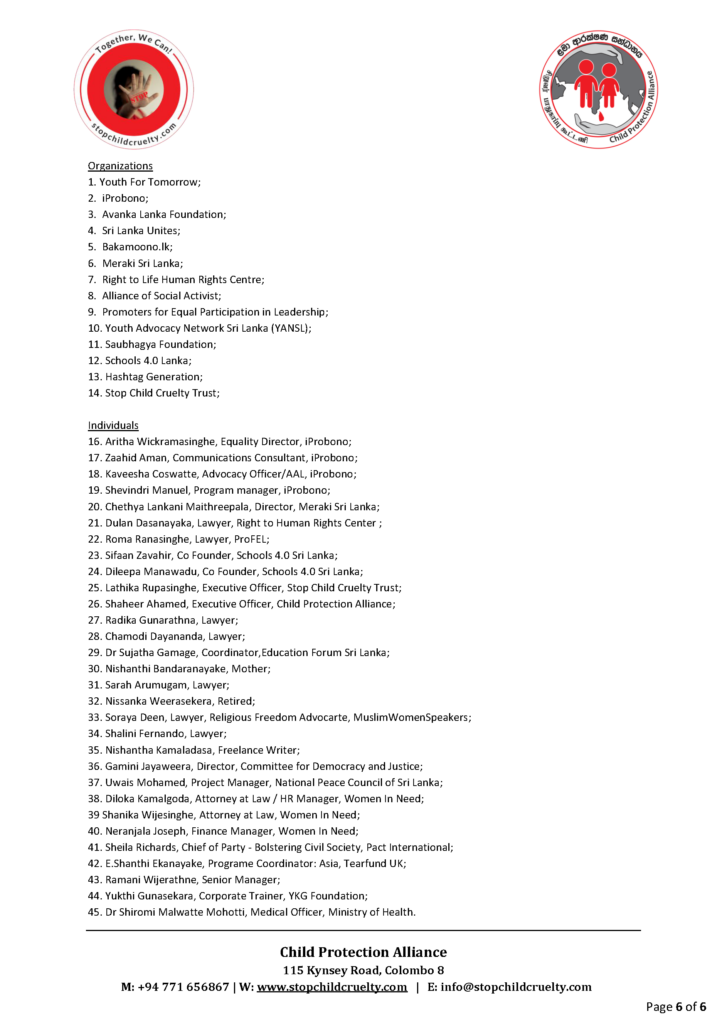
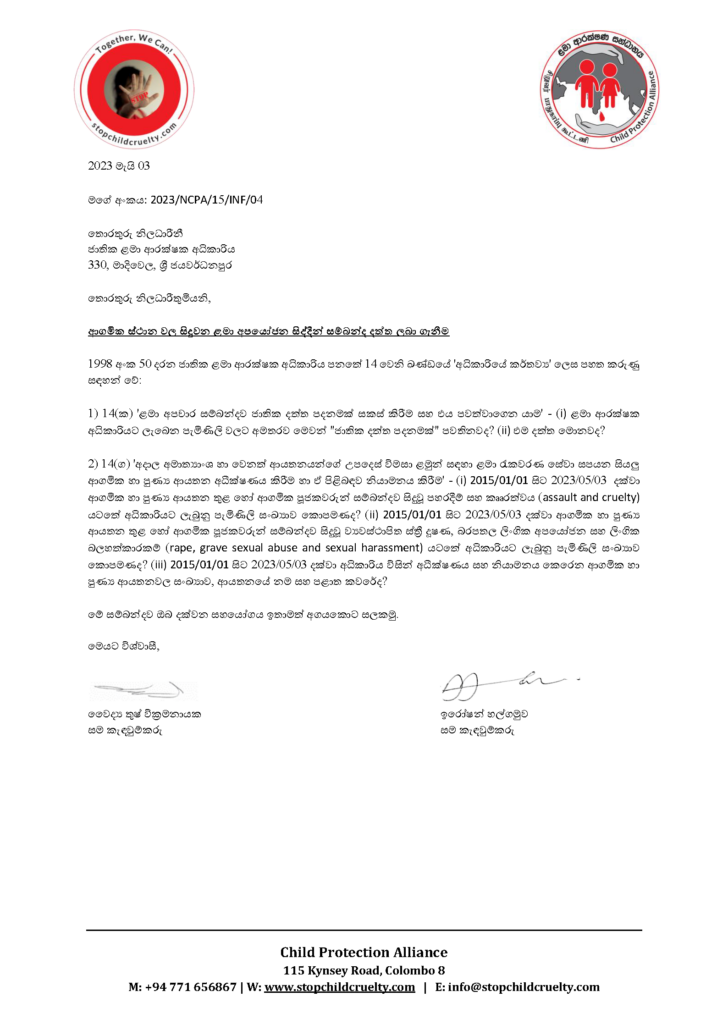
The Child Protection Alliance together with civil movements and human rights activists and other concerned parties has sent a letter to the Ministry of Buddha Shasana, Religious and Cultural Affairs with 45 signatories, and a letter to the National Child Protection Authority (NCPA) shedding light onto this crisis.
The Child Protection Alliance recalling the responsibilities of the government for the children of this country cites the functions of the National Child Protection Authority (NCPA) as per Section 14(n) of Act No. 50 of 1998 which includes “to supervise and monitor all religious institutions and charitable institutions which provide child care services to children,” thereby urging the authorities to take immediate action against child abuse of occurrence in such places.
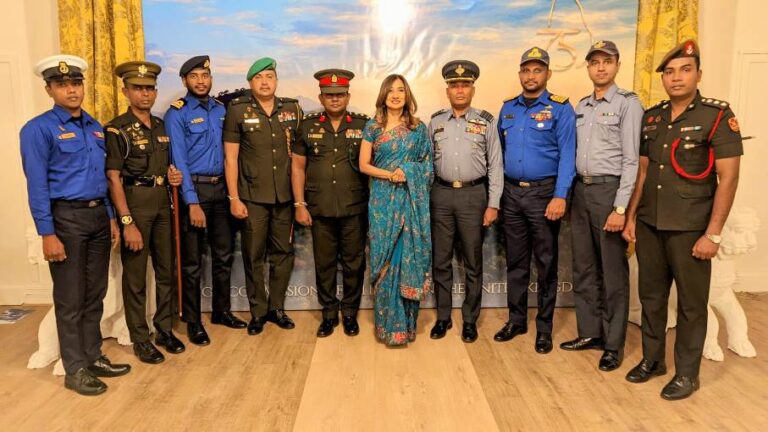
On the invitation of the British Government, a ten-member contingent of Sri Lanka armed forces visited the UK from 30 April – 7 May 2023 to take part in the Coronation Procession of Their Majesties King Charles III and The Queen Consort.
The delegation reached London on 30 April 2023 and took part in the rehearsals conducted by the UK Ministry of Defence. On 3May, High Commissioner of Sri Lanka to the United Kingdom Saroja Sirisena met the members of the delegation at the High Commission and expressed appreciation on taking part in the Coronation Procession.
On 6 May, the contingent joined the Coronation Procession which accompanied Their Majesties the King and the Queen Consort from Westminster Abbey to Buckingham Palace through the streets of Central London after the Coronation. The Coronation Procession included Military representatives from 33 Commonwealth nations and six British Overseas Territories. The Household Cavalry Mounted Band and The King’s Troop Royal Horse Artillery led the Procession, followed by 400 service personnel from the Armed Forces of the Commonwealth flanked by 114 Guardsmen of the Household Division carrying Realm and Commonwealth flags.
The delegation was headed by Captain BGPFA Wickramasuriya of Sri Lanka Navy and Group Captain PN Gunathilake of Sri Lanka Air Force. Other members of the delegation were Major W W N C Waduge, Captain A T W P Hewage and WO 1 W P D R Weerasinghe of Sri Lanka Army, Lieutenant DWCU Wimalaguna and Petty Officer RM Aruna of Sri Lanka Navy, Flight Lieutenant MADAP Munasinghe and Flight Sergeant Wickramasinghe MAPR of Sri Lanka Air Force.
The latest research in the sector confirms travellers are more attentive to environmental issues
Rome, 09 May 2023 – Sustainability is a more topical issue than ever and people are increasingly adopting habits and lifestyles aimed at limiting their impact on the environment. The tourism industry also fits into this context: in fact, an increasingly growing number of travellers choose to spend their holidays according to principles of sustainability and respect for the territories.
This trend is reflected in the numbers: according to the latest data of the Swg observatory released in March of this year, four Italians out of five would be willing to experience sustainable tourism, thus preferring to stay in a certified environmentally-friendly structure at the same cost. As far as the environmental protection initiatives are concerned, almost 70% of the sample respondents are in favour of limited access and traffic restrictions and 73% would be ready to do without their cars and to use public transport or ecological vehicles.
The trend is also confirmed by the results of the study on the impact of sustainability on the Italian tourism supply chain conducted by Deloitte in partnership with AICEO. According to the data gathered from this research, 64% of respondents stated that the effects of climate change have led them to consider travelling in a more sustainable way: a percentage which reaches 71% among those under 25 years of age. The will to shift towards sustainable tourism is especially driven by the desire to protect the territory (60%) and reduce environmental impact through ecological means of transport (52%). The growing attention towards sustainability is also reflected in the strong recovery of train travel, which recorded over 1 million passengers a day in 2022. As clearly emerged at the BIT 2023, the International Tourism Exchange, Italy is a particularly popular destination for foreign tourists, whose purchases of Trenitalia products have increased by 25% in 2022 compared to the pre-Covid period.
The possibility to move quickly from one major city to another thanks to High-Speed transport and the vast offer of regional and Intercity trains precisely responds to the demand for a more sustainable tourism that is attentive to the environment, territories and communities.
Such attention is also shared by True Italian Experience, a digital hub whose goal is to promote, diffuse and develop the Italian tourism market: a tourism consisting of unique experiences built around the passions and interests of travellers, always in full respect of sustainability and social responsibility principles. Maurizio Rota, CEO of True Italian Experience, confirms such commitment:
“More and more tourists are attentive to the sustainability issue. As a result, True Italian Experience offers travel packages designed to interconnect the various Italian locations using the railway system. True Italian Experience provides packages aimed at discovering the territory and which can be combined with sectors such as cycle tourism and electric mobility to ensure intermodal solutions in line with the principles of sustainability and social respect.
In fact, True Italian Experience believes sustainability concerns both the environment and social responsibility. As a result, our travel packages favour the young start-ups scattered over small towns nationwide and which foster and develop tourism from a digital perspective that would not otherwise have a preferential access to the market. In particular, we value the tourism businesses, cooperatives and start-ups present throughout remote areas of our Country and which thus focus on the development of a sustainable and gentle type of tourism.”
The video news can be found at the link: https://we.tl/t-EZdoPFzQMh
Joint Press Release by the Embassy of Sri Lanka, Washington D.C., and Heart to Heart International, United States
Under the guidance of His Excellency Ambassador Mahinda Samarasinghe, Heart to Heart International has obtained all necessary government approvals for the fifth in-kind donation of urgent medical aid, worth approximately $5,735,953 USD (i.e., LKR 1.87 billion), to the people of Sri Lanka. Facilitated by the Ministry of Health in Sri Lanka and this Embassy, the fifth donation has arrived in Colombo, Sri Lanka, via air on 08 May 2023. The latest donation includes specialized medicines such as labetalol for high blood pressure; prednisone to treat several conditions, such as inflammation, severe allergies, and asthma etc.; and fluticasone salmeterol to treat symptoms of asthma and shortness of breathing.
The Sri Lankan Embassy in Washington, D.C. is immensely thankful to Heart to Heart International for the generous donations made to the people of Sri Lanka. Heart to Heart International has borne all expenses, and the donation will be received by the Ministry of Health for immediate distribution at no cost to the people of Sri Lanka.
Headquartered in Lenexa, Kansas, Heart to Heart International (HHI) is a global humanitarian organization focused on improving access to health. Since its inception in 1992, HHI has delivered medical aid and supplies worth $2.5 billion to more than 130 countries, including within the United States. HHI responds to natural disasters both domestically and internationally by supplying medical relief and mobilizing volunteers. The organization is a 4-star Charity Navigator charity, a BBB Accredited charity and is on the “Philanthropy 400.”
Embassy of Sri Lanka, Heart to Heart International,
Colombo (LNW): A committee of Sri Lanka’s official bilateral creditors, of which China is yet to formally join, expressed broad agreement to provide debt relief to the debt-ridden nation, in its first official meeting held this week, following the country’s assurances on transparency and equal treatment to all creditors.
“The creditor committee for Sri Lanka will pursue its work to find an appropriate solution to Sri Lanka’s external debt vulnerabilities, consistent with the parameters of the IMF programme,” the Paris Club said in a statement after the committee’s first meeting held on Tuesday.
The official creditor committee is formed by 17 countries and is co-chaired by India, Japan and France.
China, which has not joined as an official member of the committee, participated in the meeting as an observer, along with Saudi Arabia and Iran.
During the meeting, the IMF and World Bank representatives presented the latest macroeconomic developments regarding Sri Lanka and the current status of their engagement with the country.
The creditor committee reiterated its invitation to China and other bilateral official creditors to formally join it while stressing on the equal treatment to all creditors.
“It stresses the importance for private creditors and other official bilateral creditors of Sri Lanka to provide a debt treatment on terms at least as favourable as the ones agreed by this creditor committee, in line with the comparability of treatment principle.
It reiterates its invitation to other bilateral official creditors to formally join the creditor committee,” the statement said.
The government recently revealed its plan to hold separate debt restructuring talks with China, following China’s reluctance to join the official creditor committee.
However, the committee acknowledged the assurances given by President Ranil Wickremesinghe to all the official bilateral creditors on transparency and equal treatment in the debt restructuring process.
“The creditor committee takes note of the open letter addressed by the President of Sri Lanka to all its official bilateral creditors on March 14, 2023, assuring transparency and comparability of treatment for all external creditors and ensuring that no side arrangements inconsistent with comparability of treatment will be made with any creditor,” it stated.
Sri Lanka is expecting US $16.8 billion in external debt relief in order to return to the path of debt sustainability,
By end of 2022, the debt stock of central government and guaranteed SOEs stood at US $45.5 billion, of which US $30.8 billion amounting is considered for debt restructuring, excluding multilateral loans, new loans and bilateral swap lines.
The government expects to finalize the restructuring exercise of external debt (both bilateral and foreign) by September this year.