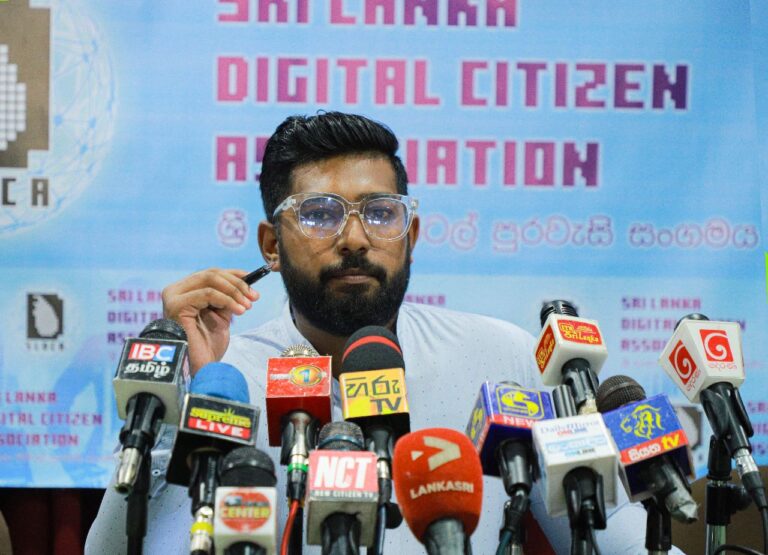
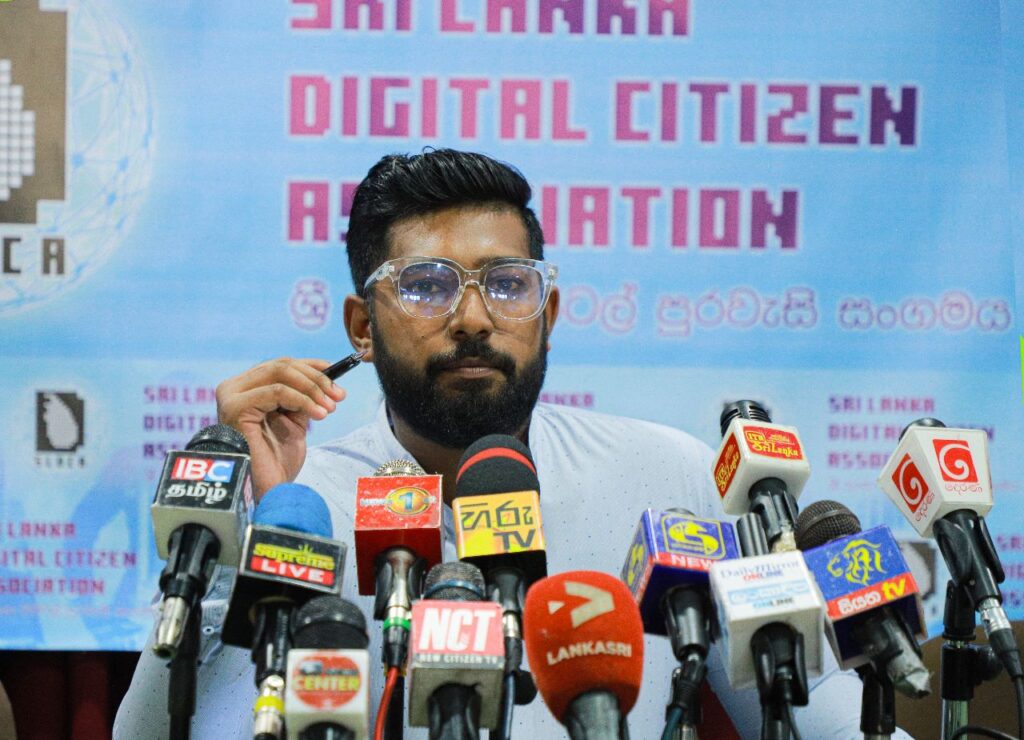
Colombo (LNW): A digital voting system should be introduced in the country as soon as possible as it would benefit the country in a variety of ways, including a significant cost reduction when conducting polls, Sri Lanka Digital Citizen Association said.
Sri Lanka Digital Citizen Association Convener Amanda Ranasinghe emphasized that it would bring down the cost of election sharply and the election staff required.
Speaking at a press conference today, Ranasinghe pointed out that digitizing the voting system should not be considered as a cost incurred, but as a future investment.
He added that a digital voting system has to be introduced without thinking of political advantages or disadvantages if democracy and the people’s supremacy are respected.
“It is said that the Local Government Elections would get postponed due to the inability to print and hand over the ballot papers for the postal vote on the required date. The printing bill amounts to millions. Why cannot we move to a digital system? Digital voting will save a considerable amount of money spent on transport, staff payments and security,” he said.
“The Government envisions to make this country prosperous by 2048. Digitizing the public service is necessary for that. What steps has the Government taken in that direction?” he questioned.
He pointed out that India introduced a mobile-based e-voting system in 2021 during the COVID-19 pandemic, aiming at senior citizens, people with physical disabilities and those working in remote areas. “It was a pilot project and it was 95 percent successful. At the same time, it has been using an electronic voting system to prevent crowding at polling stations since 1989. If India can do it, why cannot Sri Lanka, which has a population of only 22 million, do it?” he asked.
The Association requested to go for an electronic postal voting system, a mobile-based voting system or a web based system for e-voting. “Our proposal is to initiate a pilot project in three selected cities. Change the laws where necessary to accommodate e-voting. Not only voting, time has come to digitize all services,” he commented.
Decades of looking to the IMF for salvation has yielded only crises. Sri Lanka’s economic crisis demands urgent relief measures for a desperate citizenry and a new, self-sufficient model of development
Sri Lanka has been subject to a great lie: the IMF solution! For close to a year now, the country has been implementing the International Monetary Fund’s recommendations with complete obedience. The sudden devaluation of the Sri Lankan rupee, a drastic increase in interest rates, the withdrawal of fuel subsidies and severe cuts to state expenditure all amount to harsh austerity measures. The consequence is economic devastation as the country sinks into a depression. Millions now suffer dwindling incomes, tremendous increases in the cost of living, food insecurity and even starvation.
Yet the much-touted IMF funds presented as a way to salvation, a meagre USD 2.9 billion over four years under the proposed agreement, have proved elusive. Compare this amount to Sri Lanka’s foreign earnings for last year, which added up to USD 18 billion. The IMF insists that Sri Lanka first convince a range of creditors to commit to restructuring its defaulted external debt before the organisation’s Executive Board will release the funds. But Sri Lanka’s economy is in free fall. Its GDP contracted by roughly a tenth last year and is on the path to continued contraction this year. Under these circumstances, the IMF agreement and its paltry funds may as well go into the dustbin.
Some of us have seen this crisis coming for a long time. A few months after the end of the civil war in May 2009, Sri Lanka obtained an IMF Stand-By Arrangement of USD 2.6 billion. This gave the green light to a considerable inflow of speculative foreign capital, in addition to commercial borrowings at extremely high interest rates in the form of International Sovereign Bonds (ISBs). At that point, the warning bells began ringing for critical analysts who could see the consequences. But back-slapping and self-congratulation among Sri Lanka’s elites continued amid a boom in economic growth built on a dubious basis, including speculative investment in urban beautification and needlessly large infrastructure projects. This debt-driven boom soon petered out.
Sri Lanka’s lop-sided economic structure, with a bloated import bill and unrestrained financial speculation, now faces a reckoning. The years of conspicuous consumption through imports from abroad are over.
Sri Lanka then faced balance-of-payments problems, which pushed it towards an IMF Extended Fund Facility of USD 1.5 billion in June 2016. Some of us sounded the alarm again as the government at the time, led by Ranil Wickremesinghe, pursued another IMF-led solution. But, again, our critique fell on deaf ears. Worryingly, the following month, with the IMF’s approval, Sri Lanka went ahead and floated another USD 1.5 billion in ISBs. Indeed, the latest IMF agreement – the 16th deal between Sri Lanka and the organisation over the decades – offered nothing new. Rather, it promoted Sri Lanka’s continued liberalisation of trade and capital accounts, dating back to the opening of the economy in 1978. The crisis tendencies in the Sri Lankan economy were ramified through adherence to IMF packages.
Historical memory is short in Sri Lanka, particularly among the elite. The crisis accelerated with the onset of the Covid-19 pandemic three years ago. Again, we warned of the imminent dangers of an unsustainable balance of payments and the need to drastically reassess and reprioritise imports for the purpose of maintaining foreign reserves, given decreasing streams of foreign earnings. That would have meant restricting the import of luxury consumer goods while using the available foreign exchange for essential supplies and intermediate goods necessary to boost domestic production. The arrogant Rajapaksa regime then in power nevertheless persisted in the blind hope that fortunate times were just around the corner. It argued that tourism, for example, would soon pick up. Meanwhile, the opposition and neoliberal think-tanks proposed yet another IMF agreement as the magic bullet. Worse, they even started calling for an early default on Sri Lanka’s external debt. Their convoluted logic was that once the country defaulted, it would have to surrender to the IMF and all its conditionalities, such as austerity and fiscal consolidation. There could be no way forward other than with the IMF.
The reality is that tourism will not be enough to revive Sri Lanka’s growth during a period of painful austerity. The same goes for any number of hare-brained ideas that may now be touted by the country’s economic establishment
That is exactly what the government led by Gotabaya Rajapaksa did in April 2022. It prematurely defaulted on its external debt while the finance minister went on pilgrimage to Washington DC to the annual meetings of the IMF and the World Bank. The default was premature because only USD 78 million in debt-servicing was due that month, while the next large ISB repayment, of USD 1 billion, was due in July 2022. Only in Sri Lanka could the elite celebrate when the country defaulted on its sovereign debt for the first time in its history. They were confident that Sri Lanka would get bridge financing from donors, an IMF agreement with additional funds in three months, and a rapid process of debt restructuring. Ten months later, the outcome of these expectations remains a shameful zero. There is no more bridge financing. No IMF funds. And an agreement on debt restructuring appears uncertain at best.
Given all the above, Sri Lanka is a case in point of consistently insipid economic policymaking. It is also a study in how the myth of an IMF quick-fix can paralyse a country, putting on hold policies and relief measures urgently needed to help a citizenry drowning in economic depression. As the country awakes to the great lie of an IMF solution, it is forced to go back to the drawing board – not just to deal with the social devastation and political backlash that the IMF agreement is bound to generate, but also because the global order that provided its reference points is unravelling.
From debt to a new development model
Sri Lanka’s long engagement with the IMF and the broader neoliberal policy consensus – austerity, privatisation, and the liberalisation of trade and capital markets – has been an utter and complete failure. Nevertheless, for the IMF and Sri Lanka’s establishment, resolution of the crisis appears to call for the introduction of austerity measures like the ones applied to many other countries that have experienced sovereign default, along with restructuring of defaulted debt. The idea is that Sri Lanka’s problems are rooted in a fundamental mismatch between its macroeconomic indicators and the debt it has accumulated.
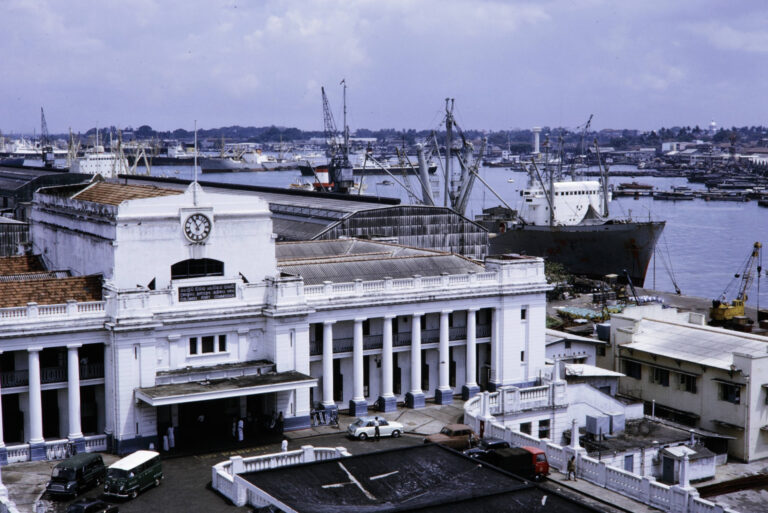
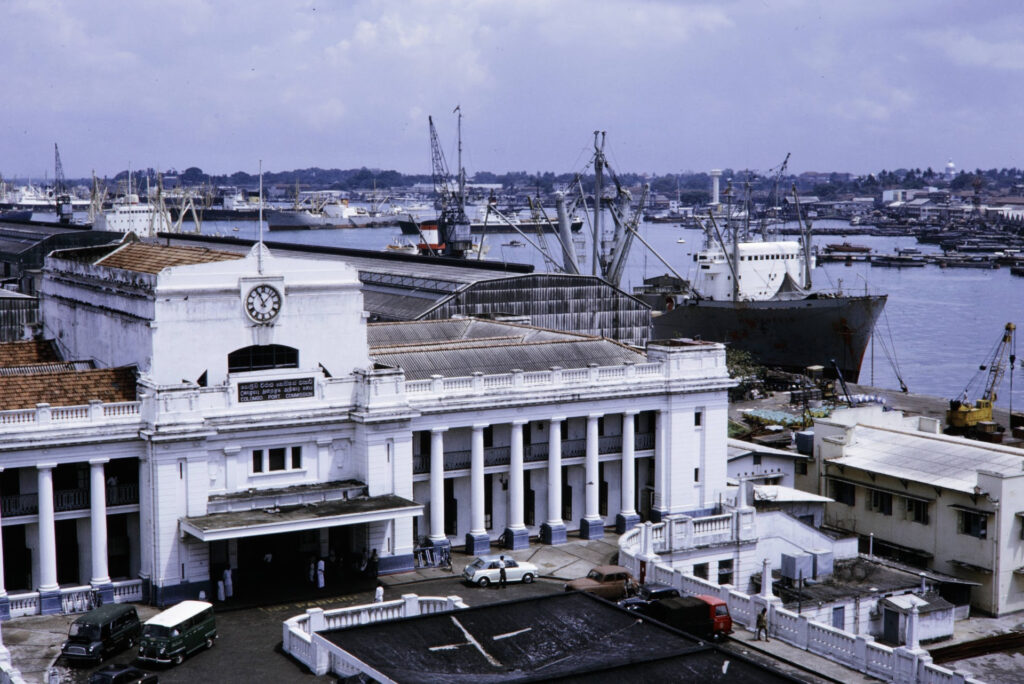
The port of Colombo before the 1970s. Sri Lanka was once sceptical of subordination to global capital, but JR Jayewardene’s open-economy reforms in 1978 turned the tide. Photo: AGSL Digital Photo Archive / University of Wisconsin-Milwaukee Libraries
This framework is being applied, however, in the context of a world order that is fast breaking down because of the contradictions of neoliberal globalisation. Over the last decades, the push for free trade, unfettered global financial flows and the privatisation of essential services has continued to expose countries to the crisis-ridden dynamics of global capitalism. But everything appears to be coming to a head, epitomised in many ways by the case of Sri Lanka. As major publications such as the Financial Times have noted, although exogenous shocks such as the Covid-19 pandemic and war in Ukraine have played a role, these have interacted with underlying trends in the global economy. This includes extreme wealth inequality and an unsustainable model of growth driven by financialisation, exposed most vividly by the global financial crisis of 2008.
In the aftermath of the 2008 crisis, however, and coincident with the end of the civil war, Sri Lanka was one of a series of emerging market “success stories” celebrated by boosters of neoliberalism. Now that the country’s shaky financial structure has been exposed, establishment commentators around the world are instead using Sri Lanka as an example of crony capitalism and corruption. Supposedly, such bad actors can only be routed by further imposing the rationality of the market on public institutions. Whereas the big banks in the United States responsible for the 2008 crisis obtained bailouts from the state because they were “too big to fail,” Sri Lanka is apparently small enough that the rules of moral hazard once again apply. The failed logic of the neoliberal development model – including the reliance on external-oriented policies, from tourism to foreign commercial borrowings – here justifies further entrenching it through austerity. Because of the country’s severe economic crisis, however, such a remedy means that people suffer and possibly even perish from what the sociologist Karl Polanyi called “social exposure.” Child malnutrition is skyrocketing and food insecurity is becoming pervasive – recent estimates from the UN’s Food and Agriculture Organisation indicate that roughly a fourth of Sri Lanka’s population is food insecure. Even this extreme suffering is unlikely to dislodge the elite consensus about an IMF solution. But the disruptive political and social consequences, and resulting waves of agitation, will continue.
The question is, how can investment be channelled into those sectors necessary for the country to achieve self-sufficiency in the goods and services ordinary people need for survival?
Moreover, Sri Lanka’s crisis is occurring at the conjuncture of major global developments. Global growth, especially in trade, is likely to continue slowing in the face of a complex set of challenges, from geopolitical polarisation to the impact of climate change. In this scenario, how can Sri Lanka’s debt be made sustainable by further exposing the country to these chilling headwinds? The central plank of the IMF solution – that Sri Lanka achieve a primary surplus by 2025 – stands in direct contradiction to the lack of the public investment needed to cope with these shocks. Conventional debt-sustainability analysis is predicated on the belief that by engaging in macroeconomic reforms such as fiscal consolidation, defaulting countries can regain their financial footing by having the surplus funds to both repay old loans and service new ones. However, in the case of Sri Lanka, which is already undergoing an economic depression, national private investment is withdrawing, and speculative capital is fleeing the country. The idea that foreign investors will step in to fill the breach flies in the face of Sri Lanka’s long experience with similar false projections.
Sri Lanka did not always have an unshakeable belief in the benefits of subordination to global capital. After the 1956 general election, there was a clear push to challenge the colonial relations in which the country’s comprador elites were embedded. Through a new balance of class forces, there was much greater emphasis on industrialisation focussed on import substitution, to try and diversify the economy away from plantation exports. Sri Lanka undertook major investments in critical industries, such as those producing intermediate and capital goods, including with support from socialist countries. But even these efforts were constrained by over-reliance on a narrow political base among the urban working class and a lack of rural mobilisation. By the time of the global economic downturn of the 1970s, the radical wing of the left-leaning United Front was led by NM Perera, the finance minister. It made a belated attempt to prioritise self-sufficiency in food production and address the immediate concerns of working-class people, especially given rising global prices for essential goods. But these efforts failed due to internal contradictions within the ruling coalition led by the bourgeois Sri Lanka Freedom Party, the consolidation of Sinhala Buddhist nationalism and state repression, external pressure from the West and the rising frustration of the electorate.
The idea that Sri Lanka can achieve higher stages of development by pursuing the same growth path rooted in dependency on the external sector is a non-starter.
The subsequent regime, led by JR Jayewardene, introduced the open-economy reforms in 1978, which meant a strong emphasis on liberalisation. Sri Lanka’s engagement with the outside world reverted to subordination to powerful institutions that represented the interests of global capital. The IMF and the World Bank provided the necessary justification in terms of access to external finance. Meanwhile, the Jayewardene regime suppressed organised labour, including by crushing the general strike of 1980. In this and other ways, the regime prepared a more conducive terrain for extraction and exploitation. The beginning of the civil war between the government and Tamil separatists in the country’s north and east in 1983 put some constraints on this approach, as the state continued to rely on mobilisation in the south. But the overall trajectory was epitomised by the collapse of any real alternative to neoliberal policies. The consensus was that for Sri Lanka to develop it would have to import its economic vision from outside – a vision clearly shaped by the interests of global capital. The processes of financialisation and debt-driven growth accelerated with the end of the civil war.
This strategy has failed to bear fruit in terms of real improvements in working people’s livelihoods. It has also triggered the current crisis. Nevertheless, in the many years since Sri Lanka embarked on liberalisation, justification for foreign commercial borrowing has been rooted in the enduring assumption that the country need only “unlock its growth potential”. A range of services and industries meant to earn foreign exchange have been bandied as model opportunities. After the early days of the open economy, it became clear that a developed garment industry was not a precursor to moving up the “global value chain.” This was especially true in the absence of a clear, concerted intervention by the state in the form of industrial policy. Global institutions and policy-makers then pivoted to celebrating the rise of the service economy, including the boom in tourism. Sri Lanka continued to depend, however, on a hidden economy of remittances from migrant workers abroad, which is also now under strain.
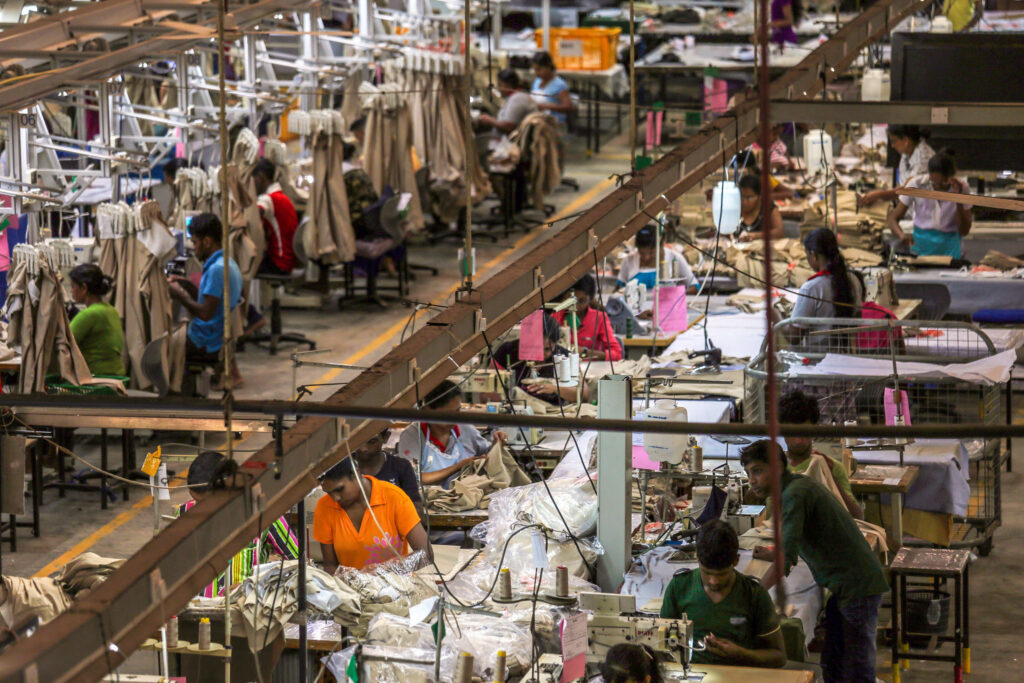
Workers at a garment factory. The focus on the garment industry as a path up the “global value chain,” just like neoliberal strategies, has failed to bring real improvements to working people’s livelihoods. Photo: Asian Development Bank / Flickr
The idea that Sri Lanka can achieve higher stages of development by pursuing the same growth path rooted in dependency on the external sector is a non-starter. The neoliberal development model has collapsed. The Sri Lankan establishment has practically admitted as much by seeking lower-income status for the country to obtain more concessional financing from international donors and aid agencies. At the same time, the government, led by Ranil Wickremesinghe, is eager to celebrate the return of tourists after a long absence caused by the Covid-19 pandemic and the Easter Sunday terror attacks in 2019. But the reality is that tourism will not be enough to revive Sri Lanka’s growth during a period of painful austerity. The same goes for any number of hare-brained ideas that may now be touted by the country’s economic establishment in the absence of serious thinking about an alternative development model.
Sri Lanka’s lop-sided economic structure, with a bloated import bill and unrestrained financial speculation, now faces a reckoning. The years of conspicuous consumption through imports from abroad are over. The question is, how can investment be channelled into those sectors necessary for the country to achieve self-sufficiency in the goods and services ordinary people need for survival? This perspective is a far cry from the IMF solution, which presupposes Sri Lanka’s continued subordination to a global economic structure that has clearly failed. Taking up the question of an alternative means returning to issues that had supposedly been bypassed with the triumph of neoliberal globalisation. It requires revisiting the many “reforms” – from the push for trade and capital-account liberalisation to the promotion of foreign direct investment and privatisation – that it has entailed.
Towards self-sufficiency
Under these circumstances, the idea of self-sufficiency offers a crucial response to the rapidly changing, uncertain global order. This churn may provide an opportunity for foresighted actors within Sri Lanka to demand a fundamental re-conceptualisation of how external engagement fits into the country’s development model. If it is imperative to revive the country’s domestic food production, for example, how would this flow into a broader rethinking of the composition of intermediate imports needed for production? What type of external financing would be necessary to develop the domestic food system?
Global growth, especially in trade, is likely to continue slowing in the face of a complex set of challenges. In this scenario, how can Sri Lanka’s debt be made sustainable by further exposing the country to these chilling headwinds?
Sri Lanka’s domestic debt is also a critical part of the equation for overcoming the current economic depression. That includes the need for counter-cyclical spending, as opposed to pro-cyclical policies of fiscal consolidation. But external development finance would also continue to play a role. The key question is whether such borrowings are integrated into a process of planning, so that an alternative development vision takes precedence over the mainstream understanding of market-steered investment that has long shaped countries such as Sri Lanka. The country must push back against global capital geared towards the sole end of financial extraction. Indeed, the lion’s share of foreign direct investment into Sri Lanka went into speculative investment in real estate rather than ventures that increased local industrial production. Development financing should be reconfigured as part of a bottom-to-top restructuring of the economy, along with changes in trade policy away from excessive imports. That is necessary both to repay the current debt – with deep haircuts for creditors, if not debt cancellations – and as a means to develop Sri Lanka in the long run.
This alternative goes back to similar points made by development economists such as Ha-Joon Chang and Abhijit Sen, who were early critics of the Washington Consensus. Such critical economists recognised the flaws in the previous model of import substitution, but they framed it as an ongoing concern of the balance of social and class forces required to ensure that capital, as it grows, is also disciplined to invest in critical sectors. In Sri Lanka’s case, that process of disciplining capital must now include prioritising imports of essential and intermediate goods necessary for production. It also requires revamping the defunct public-distribution system to ensure food security and prevent outright starvation. As the economy stabilises, further measures must also include redistribution and investment through a wealth tax on existing property and assets.
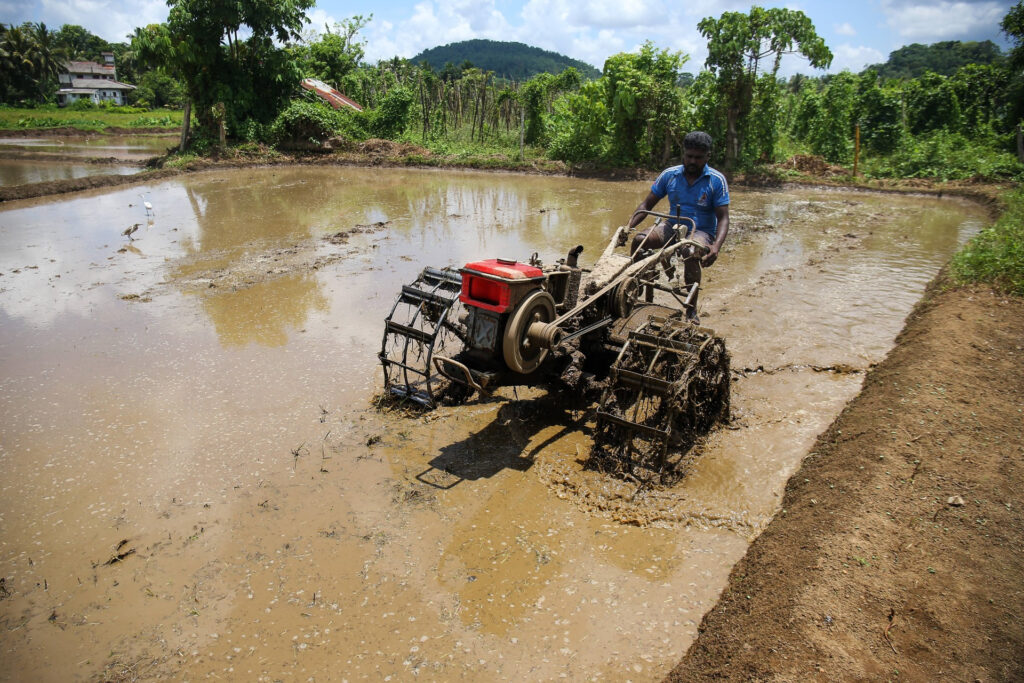
A farmer works a paddy field amid Sri Lanka’s economic crisis. Rising food insecurity and other forms of deprivation call for urgent relief measures and an overhaul of the country’s development model, including a rethink on relations between its rural and urban arenas. Photo: NurPhoto / IMAGO
Sri Lanka has to have stronger debates about its development vision, including a rethink on relations between its rural and urban arenas. There must be greater room for rural industries rooted in the livelihoods and reproductive needs of ordinary people. This is a far cry from the elites’ vision of the economy, which has repeatedly driven Sri Lanka into financial difficulties. There is now tremendous anger in the country because of the devastating fall in living standards. This discontent, in addition to the unravelling global order, may finally trigger a break with liberalisation.
For the IMF, of course, a programme rooted in self-sufficiency with wealth taxes and reinvigorated public investment will be a step too far. It is entrenched in its own institutional processes, despite the organisation’s fuzzy rhetoric around its newfound supposed awareness of the social implications of austerity-driven bailout agreements. Nevertheless, Sri Lanka’s crisis may offer a turning point for those global and domestic coalitions that are aiming to push back against renewed subordination to global financial capital. That means rethinking a number of trends that have long coalesced under the banner of economic liberalisation. After decades of repeated mistakes and failures, with consequences for the people on an unprecedented scale, will the establishment at last be forced to reconsider Sri Lanka’s development model?
It is very important for every responsible party, including every citizen, to have a proper understanding of the true nature of the serious crisis that our motherland is facing today.
There can be no debate among many of them as to who is really responsible for the crisis the country is facing today. However, at this moment, we cannot avoid raising the question as to whether all parties are working with a real understanding of the great danger the country is facing.
We raise this issue with a sincere feeling about the entire nation, without any power aspiration or patronage of any political camp, and because we have a responsibility to inherit a progressive country for the future generations without being trapped by race, caste, religion or other narrow limits.
Tday our country is not in a situation where we can divide and fight with each other for power, but in a situation where the country needs to be built by putting collective responsibility in front. It is very important that the Government all other political parties and institutions that have to deal with national responsibility, and all citizens in general understand the need of the hour.
Therefore, we appeal to all parties at this moment to stop all activities that may hinder the well-being of the country, at least for a certain period of time. We believe that it is important for the Government to listen to the people’s sentiments and understand the issues well and resolve the issues through the Parliament. We would like to further point out the need to hold elections in a timely manner while respecting the people’s opinion.
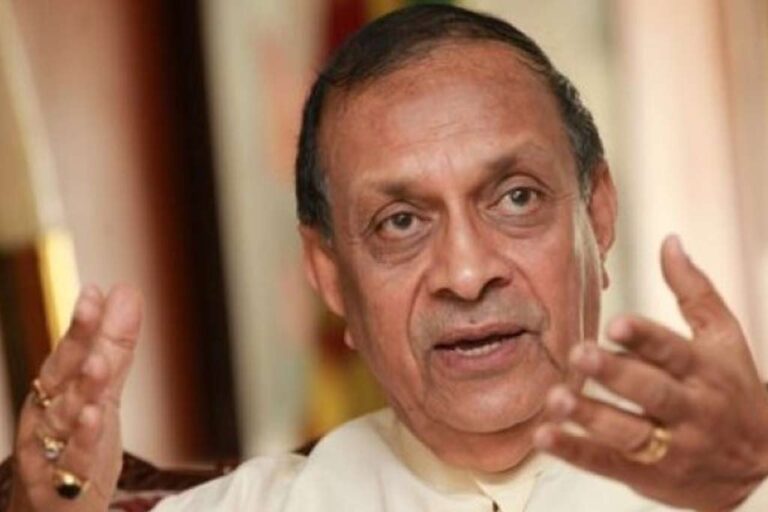
Karu Jayasuriya Chairman National Movement for Social Justice (NMSJ)
Colombo (LNW): L.E. Susantha Silva has been appointed as the Chairman and a Member of the Board of Directors of the Pradeshiya Sanwardhana Bank (Regional Development Bank: RDB), with effect from February 15, 2023.
The appointment has been made by the Secretary of the Treasury as instructed and approved by the President in his capacity as the Minister of Finance, Economic Stabilisation and National Policies, in terms of Sections 11(2), 11(3) and 12(1) of the Pradeshiya Sanwardhana Bank Act No. 41 of 2008.
Mr. Silva previously served as the Managing Director of the Ceylon Petroleum Corporation, and as his successor Ravi Wijegunawardena filled in the post.
Sri Lanka: Sri Lanka is tangled in the worst financial crisis in over seven decades, triggered by a severe shortage of foreign exchange that forced the country to annouce a suspension of foreign debt repayments in April 2022.
Sri Lanka’s cabinet has approved loan repayments worth $2.6 billion in the first half of this year, in line with its debt suspension plans, its cabinet spokesperson said on Tuesday.
The island of 22 million people is tangled in the worst financial crisis in over seven decades, triggered by a severe shortage of foreign exchange that forced the country to annouce a suspension of foreign debt repayments in April 2022.
However, Sri Lanka will continue to repay multilateral loans from several organisations including the World Bank and Asian Development Bank, cabinet spokersperson and Transport Minister Bandula Gunawardana told reporters.
The loan repayments will include $2 billion in foreign loan repayments and $540 million in interest payments.
Repayments will also include $709 million in dollar-denominated Sri Lanka Development Bonds and $46 million in interest payments, Gunewardana added.
Sri Lanka signed a preliminary agreement for a $2.9 billion bailout with the International Monetary Fund (IMF) last September but has to put its debt on a sustainable path before disbursements can begin.
“Talks with the IMF are at the final stage but they have not been concluded so it is imperative that public finances are handled carefully. These debt repayments will be done within the borrowing limits set in the budget for 2023,” Gunawardana said.
India and Paris Club members have declared support to help Sri Lanka’s debt restructuring but the island is still in negotiations with China, which is the largest bilateral lender, for simmilar financing assurances, Gunawardana said.
The Export-Import Bank of China has provided Sri Lanka with a debt extension, China’s Foreign Ministry said on Monday, noting that China is willing to negotiate a medium- and long-term debt disposal plan with the country in a friendly manner, and do its best to promote Sri Lanka’s debt sustainability.
The remarks come as several local and international media reported that the International Monetary Fund (IMF) is considering approving Sri Lanka’s bailout, even without the formal assurance of debt-restructuring support from China, citing people familiar with the discussions.
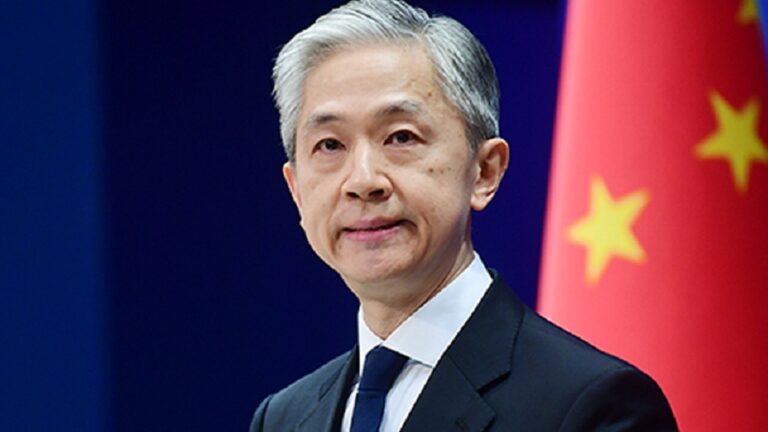
In response, Wang Wenbin, spokesperson for the Chinese Foreign Ministry, told a press conference on Monday that China has already provided Sri Lanka with a letter supporting the sustainability of Sri Lanka’s debt, expressing its willingness to extend the debt due in 2022 and 2023.
During the period, Sri Lanka will not have to repay the loan principal and interest of the Export-Import Bank, helping Sri Lanka to ease short-term debt pressure, the official said.
“We are willing to use this window to negotiate a medium- and long-term debt disposal plan with Sri Lanka in a friendly manner, and do our best to promote Sri Lanka’s debt sustainability,” Wang said.
The IMF, World Bank and Group of 20 nations chair India separately held virtual discussions Friday on global sovereign debt ahead of the finance ministers and central bank governors’ meeting in Bangalore this week.
The roundtable included officials from countries that have requested debt treatments under the G20 framework – Ethiopia, Zambia and Ghana – as well as middle-income countries such as Sri Lanka, Suriname and Ecuador, which have faced their own debt problems, Reuters reported.
The roundtable comes amid growing frustration over the slow pace of discussions on debt relief for some nations. Rather than seeking a global resolution, some have tried to blame China.
Chinese observers have urged developed countries to take more responsibility in addressing the debt risks faced by some nations, rather than using China as an excuse to shirk blame.
They pointed out that there are many reasons why some countries become mired in debt – the US Fed’s interest rate hikes, the global energy and food crises and other issues, warning some in the West to share the responsibility and seek a more “fair and just” solution.
The funding from USAID will help WFP address humanitarian needs and prevent food insecurity of vulnerable communities in Sri Lanka from deteriorating further, WFP Sri Lanka Acting Country Director Gerard Rebello said.
He was speaking at the welcome ceremony of U.S. Agency for International Development (USAID)’s Bureau for Humanitarian Assistance (BHA) Director for Asia, Latin America and the Caribbean Stephanie Wilcock, on a visit to Sri Lanka.
“Sri Lanka continues to experience significantly high levels of food insecurity, affecting over 30% of the population, most notably among the poor,” said WFP Sri Lanka Acting Country Director Gerard Rebello.
“We are extremely grateful for the invaluable support from the Government and people of the United States, which has been critical in enabling WFP to expand its emergency assistance, ” he said adding that the funding from USAID will help WFP address humanitarian needs and prevent food insecurity from deteriorating further.”
The United States has funded nearly one-third of Sri Lanka’s emergency operation requirement, with a contribution of $ 20 million (Rs. 7.3 billion) in 2022. T
he funds allow WFP to provide cash, food assistance and value vouchers to food-insecure families, and to support national food and nutrition programmes, including school meals and Thriposha, a fortified blended food product for pregnant and nursing mothers and young children.
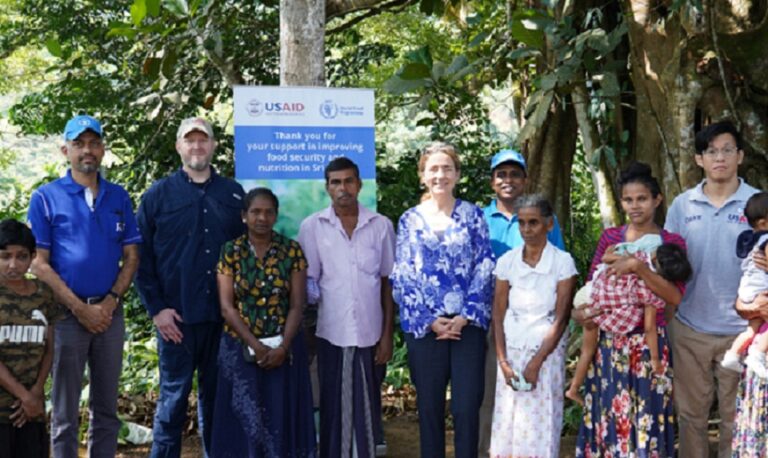
The United Nations World Food Programme (WFP) welcomed U.S. Agency for International Development (USAID)’s Bureau for Humanitarian Assistance (BHA) Director for Asia, Latin America and the Caribbean Stephanie Wilcock, on a visit to Sri Lanka.
During the visit, Wilcock met with poor rural communities to understand their food and nutrition needs, and how WFP’s US-funded programs will help them overcome challenges brought on by the economic crisis.
As part of the visit, Wilcock travelled to Ratnapura, where she spoke with food-insecure families faced with high food prices and unemployment.
The community will soon receive US-funded cash assistance through WFP worth Rs. 20,000 (approximately $ 55) for four consecutive months which will empower them with the choice to meet their essential needs in local markets, while also helping to boost the economy.
USAID’s long-time support for the Government of Sri Lanka through WFP has helped improve the country’s capacity in disaster risk management, particularly against natural hazards.
During the trip, Wilcock also visited an emergency operations centre in Ratnapura to observe how US funding has enabled district-level emergency coordination systems development. Wilcock was given an overview of how the centre provides timely information to safeguard communities from natural hazards such as floods and landslides.
WFP, with funding from donors like the US, has reached two million people since June 2022 through its emergency operation, with plans to reach 3.4 million people with food and nutrition assistance in the coming months.
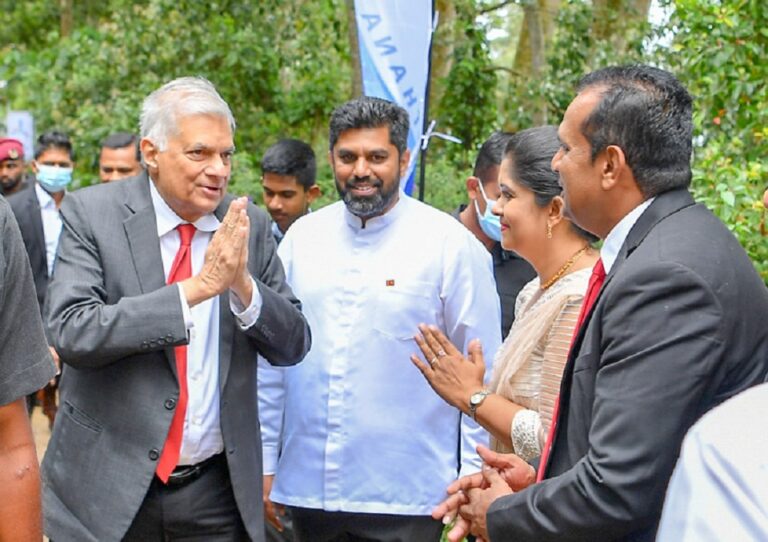
President Ranil Wickremesinghe stated that an Economic Commission will be formed as early as possible to approve investment projects in order to provide more opportunities to local and foreign investors.
The President also stated that it has the potential to significantly boost the country’s economy.President Ranil Wickremesinghe made these remarks today at the opening of the country’s first migratory bird park and eco-tourism zone in Hanthane, Kandy (20).
President Wickremesinghe further said: he remembered another bird park when he arrived here. President J.R. Jayawardene established the parliament on the bird park that was constructed during the reign of King Parakramabahu VI. There are now various types of birds, as well as crows.
The creator of the park Mr. Nishantha Kottegoda spoke about the 20 years of hardship that went into building this bird park.
However, Mr. Kottegoda has bestowed the country with an International Bird Park today. According to him, this international practice was inspired by Singapore’s Jurong Bird Park. Singapore’s Jurong City was created as an investment zone.
More investment opportunities are necessary for Sri Lanka to embark on a new economic path. It takes ten years to approve a firm after an investor arrives in Sri Lanka.
This situation should be changed. Production, export economy and technical sectors should be developed under a new economic plan. More chances for domestic and international investment should be provided for that, President said.
The economy won’t grow if it takes a foreign investor ten years to arrive and begin investing in Sri Lanka. President J.R. Jayawardena passed the Greater Colombo Economic Plan in a short period of three months and Sri Lanka got its economic benefits.
President Premadasa approved the 200 garment industries program in three weeks. In this way, if the investment opportunities are not increased, it is not possible to strengthen the economy of Sri Lanka.
Instead of the Board of Investment and the Board of Exports, we should appoint an Economic Commission and come to a system of giving approval for investments through one agency.
Minister Dilum Amunugama has been assigned to arrange that. The report will be available within the next two to three weeks. Accordingly, we hope to implement it in the future, he disclosed.
He thanked Mr Kottegoda for donating this bird park to the nation by providing value to the tourists.
Chairman of the Migratory Bird Park and Ecotourism Zone Nishantha Kottegoda said:There is also a unit to treat and release injured birds in the park, which consists of birds native to foreign countries, migratory birds, etc.
The park also has a unit for breeding and exporting exotic birds, an educational and recreational centre for school students and a study of natural birds.
This project was started under the “Yali Pubudamu Sri Lanka” program. The first phase could be completed this year amid various obstacles from the government officials.
To move this project forward, the government officials asked for a super luxury bus that could run in Colombo as a bribe. This project had to be stopped many years ago because it could not be provided. Anyway, we have been able to declare open the first phase today.
Adjacent to the Hantane Tea Museum premises, this 27-acre exotic bird park and eco-tourism zone is home to over a hundred species of migratory birds.
Established at a cost of Rs. 490 million, exotic birds are housed in large cages and the animals are cared for by a group of nearly one hundred workers.
This park has been established based on a study of birds that are not native to Sri Lanka for a period of 40 years. It is also special that many exotic birds can be bred in this country.
In the first phase of the Bird Park and eco-tourism zone, facilities for local and foreign tourists to see migratory birds, an educational training centre for zoology students, a bird orphanage, a bird home and a quarantine unit has been established.
Sri Lanka is now in an unprecedented economic and humanitarian crisis ten months after the declaration of so-called preemptive debt default on April 12 by newly appointed Governor of the Central Bank Nandalal Weerasinghe by ousted President Gotabaya Rajapksa, several economic experts warned.
In the wake of public uprising, President Gotabaya Rajapaksa fled Sri Lanka on July 13 to Maldives three months after the declaration of the debt default and in his absence, he appointed Prime Minister Ranil Wickremesinghe as acting president.
Later he was constitutionally elected in parliament by majority vote of people’s representatives to bear the brunt of the previous evils plus the repercussions of the debt default of the then regime.
The rest is now history tainted with numerous predictions relating to the date of unlocking the IMF’s US$2.9 billion bail out loan by CB chief Nandalal whose habit was to name and shame messengers of the public for divulging the status of the current economic situation.
The pre-emptive default declared by Nandalal was premature because only US$ 78 million in debt-servicing was due that month, while the next large ISB repayment, of $1 billion, was due in July 2022.
According Central bank records at that time released by then Governor Ajith Nivard Cabraal there was an expected forex inflow of over US $ 10.7 billion in the pipeline as at April 4
Of the above pipeline, a sum of $ 4.5 billion was confirmed as being in the final stages by April 3 and a further amount of around $2.6 billion was very likely to materialize over the short term,
These forex receipts would have enabled the Government to settle the maturing payments due in 2022, while also rolling over several other existing loans, including Sri Lanka Development Bonds and Foreign Currency Banking Unit (FCBU) loans.
But all these were not metrailsed due to the country’s status of default as no one was willing to give loans to a country which is publicly declared bankrupt.
However the new governor Weerasinghe was confident that Sri Lanka would get bridge financing from donors, an IMF agreement with additional funds in three months, and a rapid process of debt restructuring.
But now everyone knows the situation after ten months under strict monetary policy of the Central Bank.
The CB’s sudden devaluation of the Sri Lankan rupee, a drastic increase in interest rates, the withdrawal of fuel subsidies and severe cuts to state expenditure all amount to stringent austerity measures shrinking the economy like a useless balloon without air.
The consequence is economic devastation as the country sinks into a depression. Millions now suffer dwindling incomes, tremendous increases in the cost of living, food insecurity and even starvation.
This situation was forecasted by several economic experts and it was reported in local media but CB governor was adamant in targeting messengers. And now he is planning to attend IMF spring meetings with his gim band of stooges spending public money .
Despite CB’s back peddling, President Wickremasinghe’s has made bold attempts to navigate the ship in troubled waters by introducing far reaching fiscal adjustments , But it is now caught up in debt default storm as a result of restructuring process hangs on the balance.
Unlocking these funds, however, depends on the IMF receiving assurances from major bilateral creditors that they will eventually provide an adequate amount of debt relief.
The Paris Club of traditional (Western) government creditors has provided the necessary assurances. China, however, is Sri Lanka’s biggest bilateral creditor and so far has only committed to a two-year moratorium from its Exim bank on debt service payments– and only India has given firm assurance to the IMF.
China claims that loans from China Development Bank – its other policy bank engaged in overseas lending – should be treated as commercial and outside the framework for official creditors.
Now the IMF is compelled to consider Sri Lanka’s case without chinese debt relief and it is delaying the likelihood of a quick resolution.
The country’s economic crisis is pushing majority Sri Lankan households into poverty with prices about 60 per cent higher and the World Food Program estimating more and more households are suffering shortages.
This will lead to another people’s uprising under the demand of holding elections under the provocation already instigated by opposition political parties.
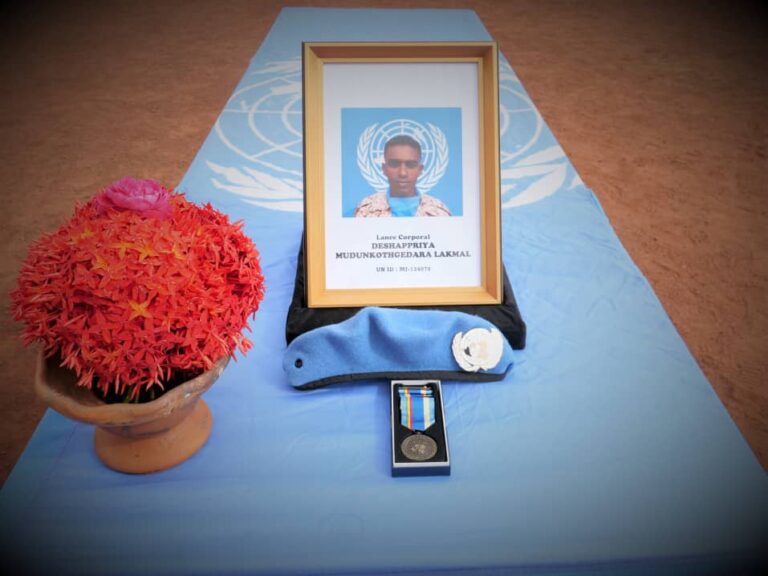
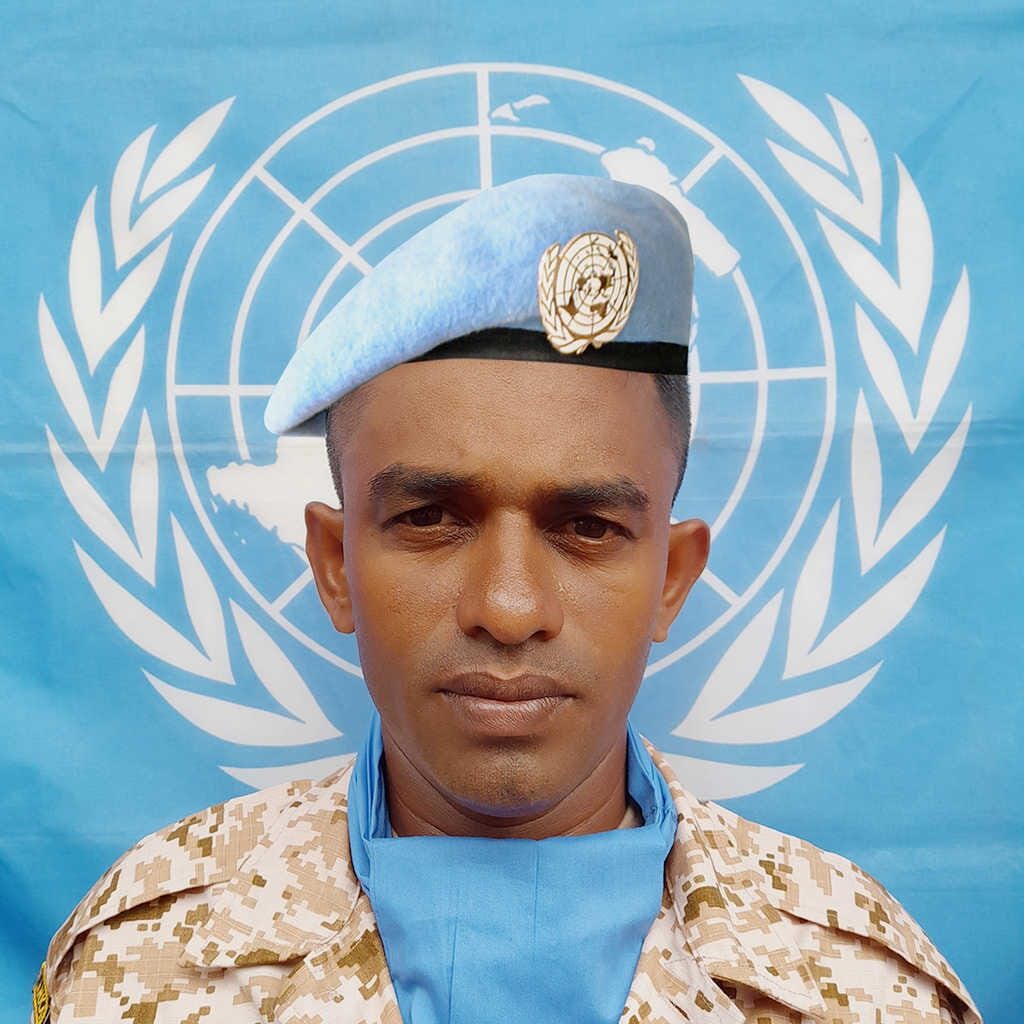
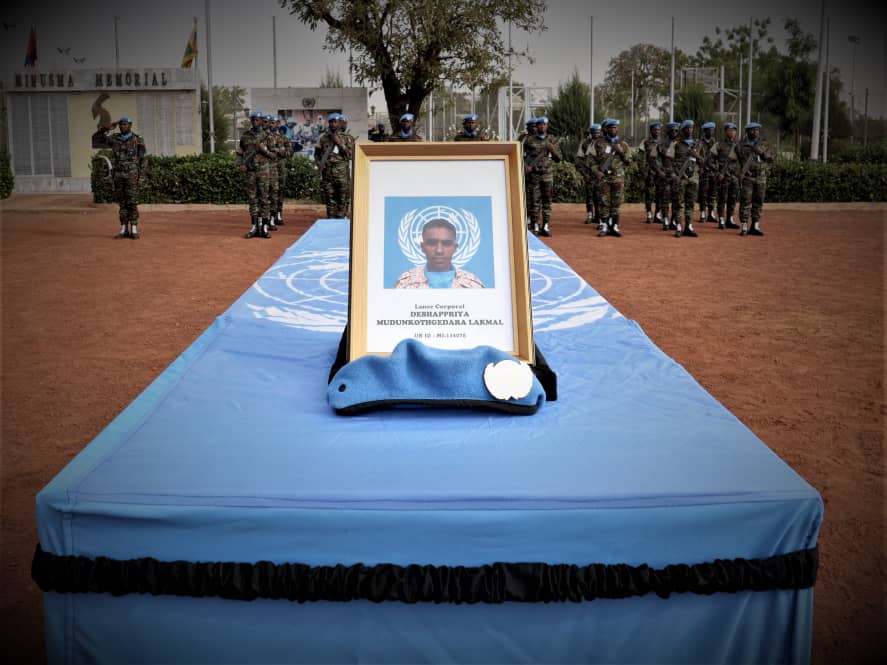
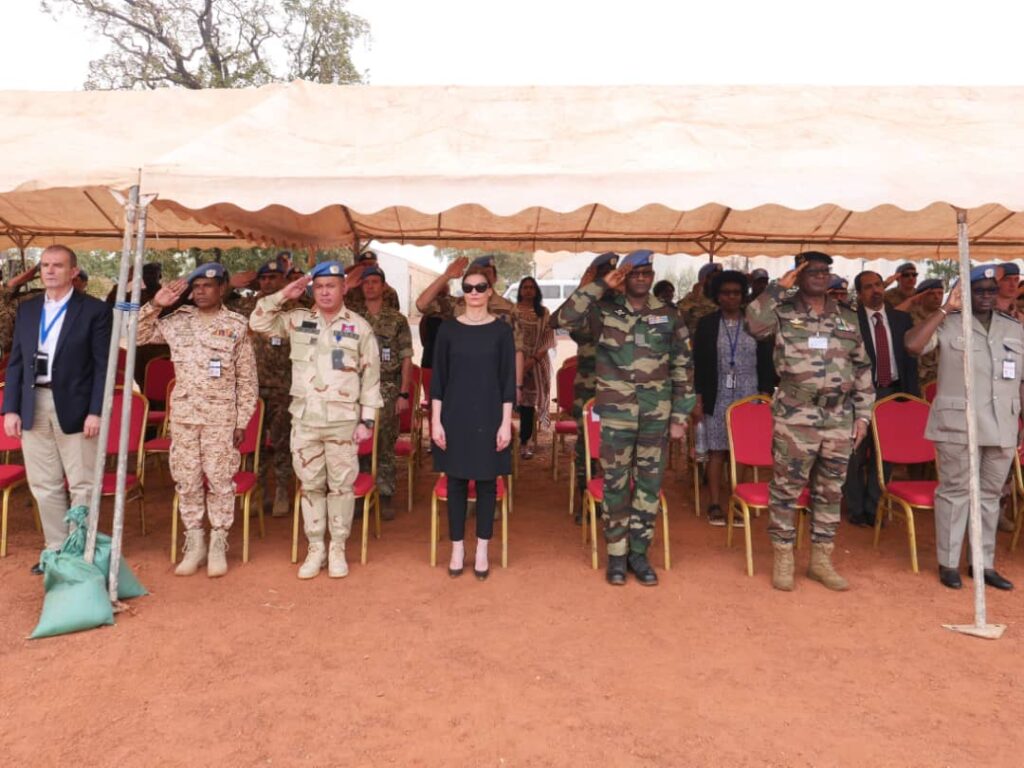
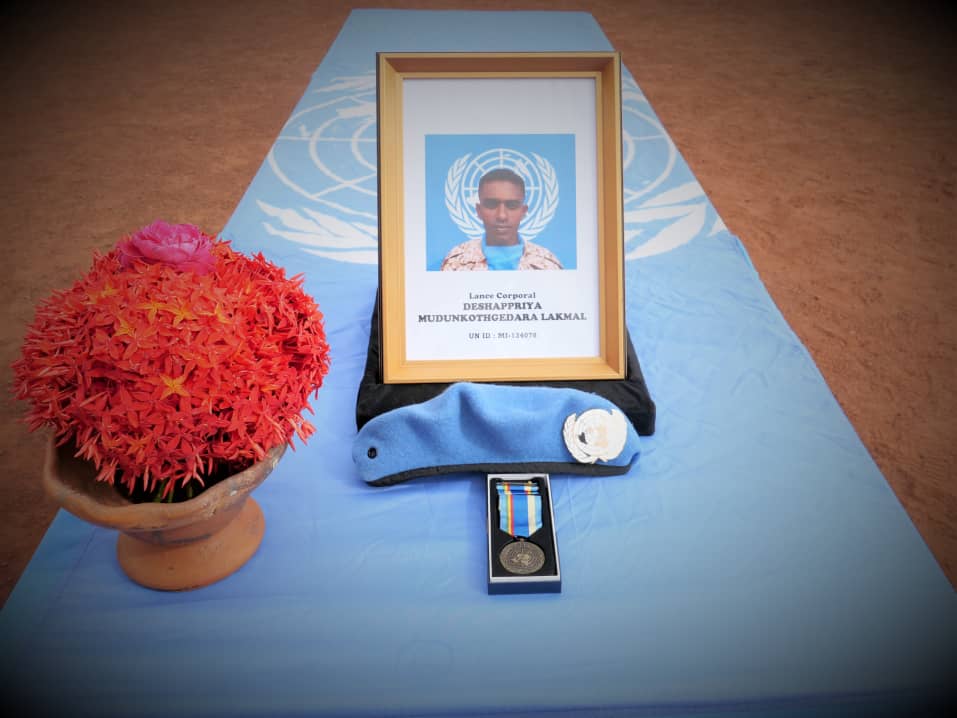
Colombo (LNW): Peacekeeping troops of the United Nations Multidimensional Integrated Stabilisation Mission in Mali (MINUSMA) on Thursday (16) formally presented a military salute and bid farewell to the late Lance Corporal M.G.L Deshapriya (42) of the 6 Sri Lanka Army Service Corps who had passed away on 11 February 2023 following a sudden cardiac arrest upon admission to the MINUSMA Bamako Level – 3 Hospital.
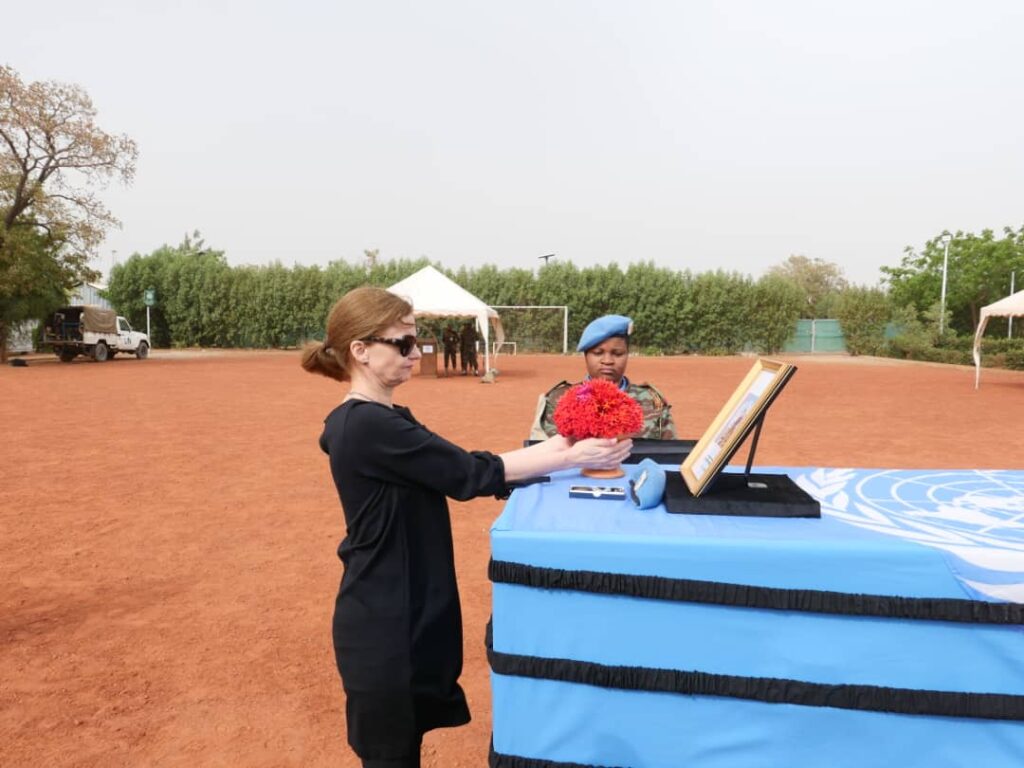
In conformity with UN traditions, MINUSMA troops presented a salute lowering flags and honoured their comrade during the formal military parade before floral tributes were made to the coffin, draped in the UN flag by Ms Daniela Kroslak, Deputy Special Representative of the Secretary-General for United Nations Multidimensional Integrated Stabilisation Mission in Mali (MINUSMA) and Deputy Chief of MINUSMA Operations in the presence of a gathering of MINUSMA Officers and Other Ranks, including the Commanding Officer of the Sri Lankan Combat Convoy Company (CCC) of the MINUSMA.
The remains of late Lance Corporal M.G.L Deshapriya (42), a father of two children, resident in Medawachchiya is to be brought to Sri Lanka shortly for final funeral arrangements.