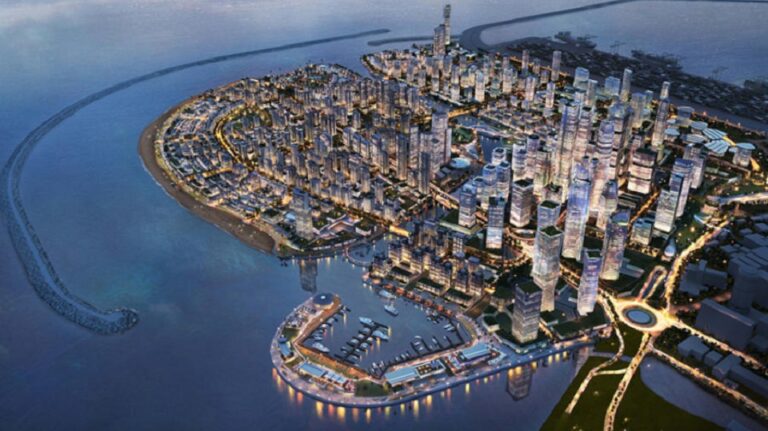
The infrastructure development activities of Port City Colombo, the largest foreign direct investment (FDI)-driven project in Sri Lanka, are slated to be completed by the end of this year, Investment Promotion Ministry Secretary M.M. Nayeemudeen said.
He stated this during the National Steering Committee meeting held at the Investment Promotion Ministry on Tuesday.
“The project implementation is now in full swing, with the land reclamation work already completed in 2019. As such, the infrastructure work and landscaping work are progressing and nearing the full completion,” Nayeemudeen pointed out.
He also stressed the importance of carrying out the infrastructure development activities according to a predetermined schedule, so that the deadlines can be met in time.
Accordingly, he instructed the relevant officials to adhere to a time frame and complete the balance construction activities.
Furthermore, Nayeemudeen assured his intervention to clear up the hindrances that may pop up in future, in order to ensure the smooth operation of the Port City Colombo project.
Officials representing various ministries and institutions, including the Defence Ministry, Public Security Ministry, Colombo Port City Economic Commission, CHEC Port City Colombo (Pvt.) Ltd, Sri Lanka Port Authority, Colombo Municipal Council and Road Development Authority, participated in the meeting.
The Port City Colombo project, with US $ 1.4 billion FDI, is co-developed by the government of Sri Lanka and CHEC Port City Colombo (Pvt.) Ltd, under the theme of the Belt and Road Initiative.
The Port City will have 6.30 million square metres of build up space once it is fully completed. In terms of the land area, out of 269 hectares of land acquired, 178 hectares will be made available for investment opportunities in the future. The project, once completed, will have a knock-on effect on the property value of the country.
With infrastructure development slated for completion by the third quarter of the New Year 2023, Colombo Port City Colombo, is set to attract foreign direct investment (FDI) amounting to US$1.5 billion during the vertical development phase, finance ministry report on investment opportunities projected.
At least four mega projects with an investment inflow of $953 million were in the pipeline following the finalization of necessary logistics and the regulatory frame work in accordance with the Colombo Port City Economic Commission Act, the report revealed.
The balance $547 will be invested in port city logistic and infrastructure development activities, senior finance ministry official said.
Sri Lanka’s biggest FDI-funded port city development project has commenced with $1.4 billion committed by the project company, CHEC Port City Colombo Pvt Ltd, $1.2 billion having been already invested.
Thulci Aluwihare, Deputy Managing Director of the management company said, they will implement marketing strategies and proceed with other matters of logistics as soon as possible after the enactment of new regulations.
Port City Colombo is expected to add $13.7 billion per annum to Sri Lanka’s GDP when fully operational by acting as a hub for international investment, trade, finance, entertainment, leisure and other services, he added
Sri Lanka is to be on the rankings list especially with the brand-new infrastructure development of the Colombo International Financial City special economic zone and International Financial Centre is currently under construction.
Port City’s basic infrastructure development work nears completion
Sri Lankan workers in Qatar contributes US $600mn to the economy
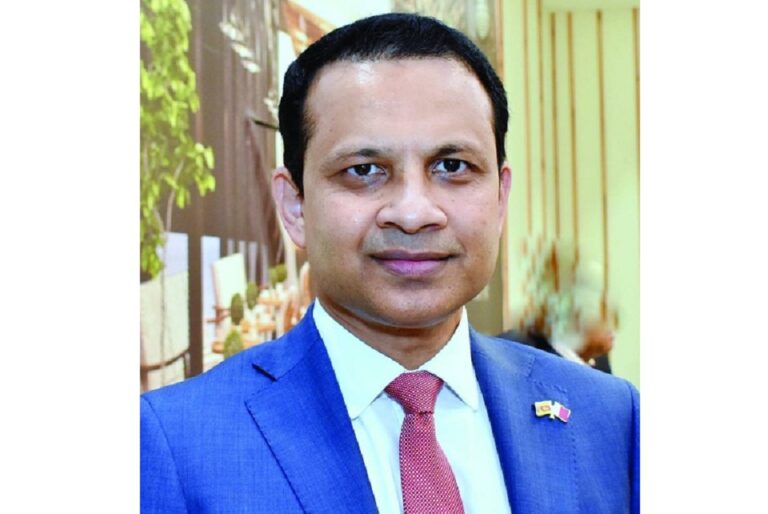
The Sri Lankan expatriate community in Qatar, which is around 120,000, generates about $600mn in remittances to the South Asian nation’s economy, the country’s top diplomat in Qatar has said.
Speaking to Gulf Times on the sidelines of the ‘Taste of Sri Lanka’ festival organised recently by the LuLu Group, Sri Lankan ambassador Mohamed Mafaz Mohideen emphasized that Sri Lankan remittance outflow is a “significant contribution” from Qatar.
The ambassador also noted that the value of Qatar-Sri Lanka bilateral trade has been averaging $90mn year-on-year (y-o-y). The majority of Sri Lankan exports to Qatar is composed of apparel, fruits, and vegetables, with special emphasis on bananas, as well as superfoods being the latest addition.
He also pointed out that Sri Lanka’s trade office in Qatar is working to attract more tourists from Qatar to the South Asian nation, which is known for its attractive tourist destinations.
“This sector is continuously growing and it requires little effort from Sri Lanka because our country has a lot of beautiful tourist spots to offer. We have a product that has been recognized around the world,” the ambassador stressed.
Citing reports, Mohideen noted that Sri Lanka was recently adjudged as “one of the topmost destinations” and “safest countries to be traveled.”
“There had been good, positive reviews about Sri Lanka’s tourism sector, so that has been attracting a lot of inbound tourism. This is our tourist season and we’re seeing the numbers climb rapidly, which is a positive sign because tourism contributes about $2bn to $3bn to Sri Lanka’s economy,” he explained.
The ambassador also lauded the LuLu Group’s support and employment generation for Sri Lankans both in Qatar and across the GCC. He stressed that business between LuLu Group and Sri Lanka has steadily increased annually in terms of food exports and manpower, which has grown from 25 to over 500 employees in the last two weeks.
Mohideen lauded the operations of LuLu’s export distribution facility in Colombo, saying it allows the group to easily source local products and engage in farm-to-market operations, which provide local suppliers access to international markets.
On the country’s economic growth, the ambassador acknowledged the challenges of attracting investors and foreign direct investments into Sri Lanka in light of the country’s economic turbulence. However, he emphasiZed that “every downturn presents opportunities.”
“As we are emerging from this tough period, it will definitely present lots of opportunities and serious investors in a variety of sectors, such as real estate, agriculture, hotels, hospitals, ports, and tourism. These are areas that we are looking at and targeting to attract investors. There’s still so much that we can do,” he added.
The Census and Statistics Dept to update SL economic indicators
The Department of Census and Statistics (DSC) has been taking measures to update Sri Lanka’s economic indicators following allegations of delaying the compilation of economic data without proper surveys.
Doubts over the accuracy of Sri Lanka’s economic indicators were long cast by politicians, economists, and even the Central Bank (CBSL).
The, then CBSL Governor Dr. Indrajit Coomaraswamy expressed serious doubt on the accuracy of economic indicators compiled by the DCS
He pointed out that even though the DCS adopted new methodologies to conduct surveys, the lack of resources stood in the way of the methodology being utilized successfully.
This was the second time the CBSL questioned the accuracy of statistics compiled by the DCS. In December 2018, Dr. Coomaraswamy cast doubts on the GDP growth rate of Sri Lanka, saying he believed it was higher.DCS,
The Cabinet has cleared the path for the Department of Census and Statistics (DSC) to update the Colombo Consumer Price Index (CCPI) and the National Consumer Price Index (NCPI) with new base years and new expenditure weightages with effect from January this year.
President Ranil Wickremesinghe in his capacity as the Minister of Finance, Economic Stabilization and National Policies sought the approval of the Cabinet of Ministers to update the base year of NCPI from 2013 to 2021 and CCPI from 2013 to 2019 with effect from January 2023.
The re-based NCPI will also be updated with new weighting based on consumer spending in 2019 and it is to be compiled and published every 21 days from January 2023.
According to latest data, CCPI stood at 244.3 points in January recording a 54.2 percent YoY increase in inflation. NCPI in December last year stood at 256.3 points with 59.2 percent YoY increase in inflation.
The rebasing exercise is likely to have a positive impact on inflation calculations.
The country entered into a hyper inflationary environment last year following the devaluation of the rupee in March and pre-emptive default on its external debt in April.
However, Cabinet Spokesperson Minister Bandula Gunawardana stressed that the re-basing is carried out based on sound scientific reasoning and with political interference.
“The reference year for the first data series of the National Consumer Price Index is 2013.
The items contained in the goods and services basket and the weights of goods and services should also be updated to reflect the current consumption expenditure of households in Sri Lanka,” the Department of Government Information noted.
NCPI is a key determinant of Gross Domestic Product deflation while being a more descriptive indicator of overall inflation in the country, while CCPI is a leading indicator of inflation in urban areas of the Colombo District.
India: The biggest friend of Sri Lanka
Addressing the Tata Tiscon Dealer Convention 2023 on 7 February 2023 in Colombo, H.E Dinesh Gunawardena, Prime Minister of Sri Lanka called on the Indian companies to invest further in Sri Lanka. Outlining the benefits of Indian investments in Sri Lanka, Prime Minister of Sri Lanka highlighted that 90% of components used by Lanka Ashok Leyland were indigenous. He also referred to India as the biggest friend of Sri Lanka in the time of crisis in his address.
2. Speaking at the event, High Commissioner H.E Gopal Baglay said that both Government of India and Indian corporates are working to build relationships that are beneficial to the people within and beyond India, especially the neighbours, under Prime Minister Narendra Modi’s Neighbourhood First Policy. He added that the driving force behind this spirit of engagement was community-centered business practices and philosophy of Vasudhaiva Kutumbakam (world is one family).
3. Referring to India and Sri Lanka as ‘civilisational twins’, the High Commissioner noted that both Governments are promoting people to people as well as business to business ties. He added that presence of numerous Indian business entities for the convention was the biggest vote of confidence not only in the relationship between the two countries but also in Sri Lanka’s potential.
4. Business and commercial linkages between the two countries are witnessing steady growth. India was the largest investor and also the biggest export destination for Sri Lanka in 2021. India continues to be the largest source of tourists as well. Indian companies in Sri Lanka actively support Sri Lanka’s economic recovery through increased economic activities, value addition of products, services, job creation for Sri Lankan nationals and direct assistance to the people of Sri Lanka through various CSR activities.
***
Colombo
7 February 2023
The Country We Lost to Sinhala-Buddhism
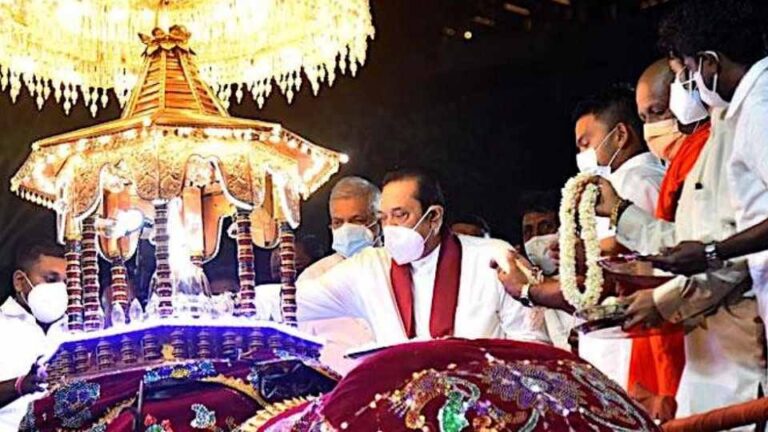
Photo courtesy of Daily Mirror
Tisaranee Gunasekara (Ground Views)
“Our challenge is to devise some arrangement which enables us to coexist if not in amity then at least in forbearance.” Jawaharlal Nehru (quoted in Andre Malraux’s Anti-Memoir).
During Black July, marauding mobs, when uncertain about the ethnic identity of a potential victim, would order him/her to recite the five precepts in Pali or the chant Itipiso Bhagawa. (The irony is grotesque in the extreme; the first precept is a pledge not to kill any living being; Itipiso mentions the nine qualities of the Buddha, starting with araham, a composite which includes eradication of hatred). The assumption was that no Tamil was a Buddhist or would even know the basics of Buddhism.
The Buddhist renaissance of the 19th century departed from the Buddha’s teachings in two significant ways. It accepted and accommodated the caste divide which was imposed on the Sangha by Kandyan kings. It also ghettoised itself within the Sinhala race, developing a perspective towards minorities that was suspicious, fearful and inimical.
Had the Buddhist renaissance stayed loyal to the Buddha’s own teachings, we might be spending the 75th year of independence in a different Sri Lanka.
The Buddhist reformers of the 19th and early 20th centuries could have addressed the caste issue within the Sasana and within Sinhala society. Both the need and the opportunity were present. Doing so would also have been in accordance with the Buddha’s teaching and practice. But the subject stayed off limit, a compromise to which all three nikayas seemed to have given their tacit consent.
So caste division within the Sangha was and remains the elephant in the room. Everyone knows it is there, yet no one talks about it. Many probably assume it has been there for millennia instead of a couple of centuries. It is not so much a taboo subject as an impolite one. Washing one’s dirty linen in public might be apposite idiom.
The new Buddhism, which came into being in the 19th century evolved a system similar to the separate but equal formula used by white racists in the American South to justify Jim Crow laws. Had the plan by Kandyan kings and upper caste monks to limit higher ordination to members of the Govigama caste worked, there could have been an internal revolt against this egregious departure from one of the most basic tenets of the Buddha’s teachings. But once non-Govigama castes were able to form their own nikayas, a complex system of vested interests (spanning both monks and lay dayaks) seemed to have come into being and solidified. So while caste divisions are alive and well within the Sangha, even those who want to reform the order make no mention of this issue, at least in public.
Anagarika Dharmapala came from a non-Govigama caste. But he chose to ignore the distortion of Buddhism by the inclusion of caste into the ranks of Sangha. Instead he opted to unite all Sinhala-Buddhists by creating multiple enemies/threats. His played the lead role in inserting minority-bashing into 19th century Buddhist renaissance, making explicit prejudices that were implicit or latent.
Although he is considered a hero of the struggle for independence, the main focus of his ire was not British rulers. His attacks on the British were more cultural than political. Dharmapala, together with other literary giants of that time such as Piyadasa Sirisena and John de Silva, interpreted independence not just as freedom from colonial rule but also as liberation from minority presence and alien religio-cultural influences. In this narrative the predominant enemy was not British colonialists but Tamils, Indian-Tamils, Muslims, Malays, Burghers and Christians. The main sin of the British was favouring these alien communities above the true owners of the land, thereby facilitating their exploitative activities and corrupting influences.
A Sangha that rejected caste (as the Buddha did) could have taken on caste oppression in the island. Lanka could have produced her own Dr. Ambedkars, reaching out to oppressed caste members of all ethnic groups, including plantation Tamils. A Buddhism that was not mono-ethnic and anti-minority could have become the binding agent of a new Lankan nation. In Buddhism sans the Sinhala qualification, the Sasana could have had a significant Tamil component, becoming what the Buddha intended it to be – a refuge for every human irrespective of birth.
Would Sinhala Only have succeeded in such a land? Could Black July been possible in such a land?
The wrong nation
The Mahavamsa myth of the Buddha anointing Lanka as the only place in which his teachings in its pristine form would survive focused on the land and not the race. Consequently, the key requirements for kingship in Lanka seemed to have been a royal lineage and adherence to Buddhism rather than tribe, race or land of birth. Nayak kings of Kandy had many predecessors, including such illustrious ones as King Nissanka Malla of Polonnaruwa (12th century). According to his own rock inscriptions, the King was a member of the Kalinga dynasty and was born in India.
Adding race to religion seemed to have been a 19th century construct. Anagarika Dharmapala and others of his ilk fused Sinhala and Buddhism into one inseparable identity and called it nation. This concept of nation, consciously and with forethought, excluded or marginalised anyone who was not of Sinhala race and Buddhist religion. It was hierarchical at best, murderous at worst.
Underpinning this concept was what I call the host and guest theory, the a-historical claim of Sinhala-Buddhists being the only true owners of the island. Thus all ethnic/religious minorities are aliens, here on sufferance, irrespective of how long they had been living here and how much they had contributed to the land. Flowing from these two premises was a dangerous belief – that Sinhala-Buddhists have a right and a duty to keep the minorities in line and punish them if they overstep the boundaries. (The similarity of this view and European anti-Semitism is striking. It is instructive that it was Anagarika Dharmapala who ensconced the Aryan myth into Lankan politics. The Sinhala race was defined as Aryan and Aryans were defined as the only really noble people in the world, unlike the inferior Dravidians.).
The periodic outbreaks of violence against this or that minority may not have happened without this deeply entrenched belief of belonging and not-belonging.
In all the riots that marred our 75 years of independence from 1958 to 2019, the actual killing and the pillaging were the work of a criminally-inclined minority. But this minority was able to carry out their deadly work because of the existence of an enabling environment consisting of conniving state entities (especially the police and the armed forces) and a society of (approving or indifferent) bystanders.
For politicians, Sinhala-Buddhism not only provided a certain path to power. It was also a convenient way to manage class differences and economic injustice.
According to another beloved myth, Lanka was a land where everyone lived free from want, and on a more or less equal basis, until the imperialists turned up. Imperialists introduced economic exploitation into this island, by favouring the minorities in matters of education, business, and employment.
Thus was born a Lankan version of national-socialism. According to this Sinhala-Buddhist socialism, all minorities are reactionaries by birth (including Sinhala-Christians). Since they were favoured by colonialists they are pro-imperialist. Since they became rich by exploiting poor Sinhala-Buddhists, they are pro-capitalist. Elite is synonymous with Tamil/Muslim/Christian while people is the same as Sinhala and Buddhist. Even the plantation Tamils were turned into a privileged minority in this rendition, cosseted workers with secure jobs and free housing.
S.W.R.D. Bandaranaike’s Pancha Maha Balawegaya formed the shock troops of this brand of socialism. The virus would soon affect the once anti-racist left movement, to the point that LSSP and the CP demonstrated against Dudley-Chelva Pact chanting, Dudlige bade masala wade. The closed economic experiment of the United Front government would become this distorted ideology’s quintessential expression, the JVP of the first and second insurgencies its logical conclusion.
The Rajapaksas were and remain the current inheritors of this toxic legacy. If the SLPP does not get wiped out at the upcoming local government polls, it will be because of Sinhala-Buddhists who regard them (especially Mahinda Rajapaksa) as the only bulwark against deceptive and marauding minorities.
Change?
In January Kandy police arrested six young men for drunken and disorderly conduct. They all turned out to be monks from temples in Kandy dressed in civvies to paint the town red. The leading monks are silent about this clear breach of vinaya, just as they have nothing much to say about monks torturing other monks under the guise of ragging in the Buddhist and Pali University.
But when it comes to devolution, the monks have plenty to say. The four chief prelates have issued a joint communiqué opposing the full implementation of the 13th Amendment. Other monks are threatening to carry out protest actions, including the surrounding of Colombo by a saffron brigade.
When India made its parippu drop, putting an effective stop to the Vadamarachchi offensive, Sinhala patriots did not pour into the roads expressing willingness to die for the motherland. That outbreak of violent patriotic fervour happened when the Indo-Lanka Accord was signed. The rioters’ problem with the accord was not the Indian part but the Tamil part that it entailed devolving some power to Tamils.
The hysteria surrounding the full implementation of the 13th Amendment is the clearest possible indication that Sinhala-Buddhist supremacism is not a spent force. The hosts and guests concept of Sri Lanka remains alive. The long Eelam war is still seen as a result of Tamils forgetting their status as permanent guests and foisting outrageous demands on the ever patient and endlessly generous Sinhala hosts. Devolution is still considered dangerous because it would undermine the natural hierarchical order, paving the way for the destruction of the land, the race and the religion. Monks, as an institution, remain a serious impediment to national reconciliation.
How can a truly Lankan nation be born when the majority extremists remain wedded to the idea of a Sinhala-Buddhist nation? How can the popular cry of change be anything but a sham if it does not address this vital issue?
True, the embrace of various non-Buddhist rituals is a violation of the Buddha’s teachings. It is an issue that needs to be addressed. But the seminal problem with Sinhala-Buddhism is really the Sinhala part, and the resultant willingness to protect Sinhala-Buddhist nature of Sri Lanka even at the point of a gun.
As Prof. S.J. Tambiah pointed out, main features of Anagarika Dharmapala’s Buddhist revival included “a denigration of alleged non-Buddhist ritual practices and magical manipulations”. (Buddhism betrayed). A demand for a return to a more rational Buddhism can still be located within and coexist with a mono-racial Buddhism and its inevitable corollary of suspicion of and antipathy towards all minorities.
Gangodawila Soma Thero began his public career as a reformer committed to purifying Buddhism of non-Buddhist (Hindu/animist) influences and practices. From this (like Dharmapala, Martin Luther, Al-Wahhab of Nejd, and others of the same link), he made a seamless transition into ethno-religious-fanaticism. It was Soma Thero, the reformer, who unearthed and exploited the Muslim-phobia that had been buried deep in the collective Sinhala-psyche since 1915. The connection between that deliberate mining of Muslim-hate to the Galagoda Atte brigade, the anti-Muslim violence of Aluthgama and Digana and the Easter Sunday attack is almost linear.
So long as Lankan history is defined as an unending struggle to prevent alien races/religions/cultures from taking over this sole home of Sinhalese and sole refuge of pure Buddhism, the potential for anti-minority violence (and reactive violence by minorities) would remain. The tipping point could be the 13th Amendment, a new mosque, kovil or a church, a road accident, a private fight. As minorities cannot be displaced geographically in this day and age without risking punitive international reaction, they have to be reminded of their proper place, if necessary through violent means. Riots are not just memories of a past most of us prefer to forget. They are possibilities of a future many of us would not want to live in, unless the ideologies that enabled them are faced and addressed.
According to media reports, social media activist Dharshana Handungoda has been arrested by the CID when he returned to Sri Lanka from Dubai. Silencing of dissent is not the way to societal peace and stability but to disharmony and conflict. That is another lesson of the past we should endeavour not to repeat, not if a better future is our real goal.
Dinesh Schaffter death no murder? Autopsy report raises controversy
By: Isuru Parakrama
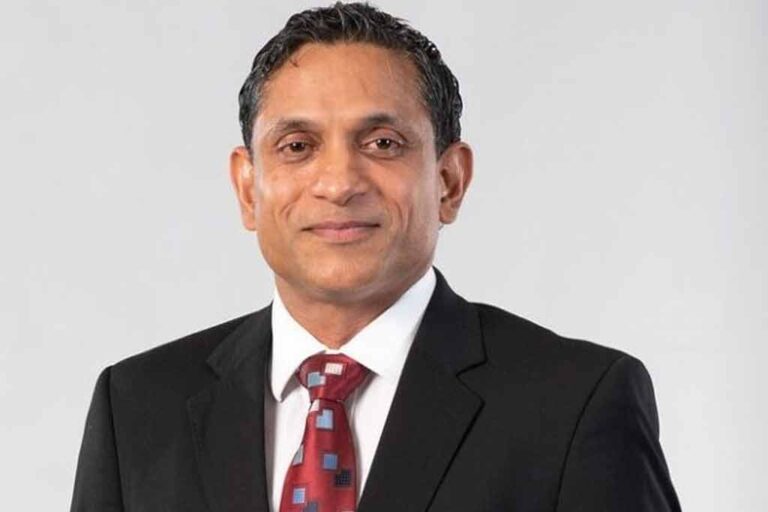
Colombo (LNW): The death of Dinesh Schaffter, renowned businessman and Director of Janashakthi Group, was ruled due to cyanide poisoning, as autopsy reveals.
The autopsy report on Schaffter’s death was presented to No. 02 Magistrate Court of the Hulftsdorp Court complex by the investigative officers yesterday (08). The report reveals that his death was due to cyanide poisoning and the wounds sustained due to being strangled were not fatal.
However, Anuja Premaratne PC appearing for Schaffter argued that the medical reports produced on his client’s death are contradictory, suggesting that the same medical officer has produced two different causes of death.
Showers or thundershowers may continue at several place in island

By: Isuru Parakrama
Colombo (LNW): A few showers will occur in Northern and Eastern coastal areas, and showers or thundershowers may occur at a few places in Sabaragamuwa province and in Galle and Matara districts during the afternoon or night, said the Department of Meteorology in a statement today (09).
Mainly fair weather will prevail elsewhere over the island.
General public is kindly requested to take adequate precautions to minimise damages caused by temporary localised strong winds and lightning during thundershowers.
Marine Weather:
| Condition of Rain: |
| A few showers will occur in sea areas off the coast extending from Hambantota to Mullaitivu via Pottuvil and Trincomalee. Showers or thundershowers may occur at a few places in the other sea areas around the Island in the evening or night. |
| Winds: |
| Winds will be north-easterly and wind speed will be (20-30) kmph. Wind speed may increase up to (40-45) kmph at times in the sea areas off the coast extending from Mannar to Colombo via Puttalam and in sea areas off the coast extending from Matara to Pottuvil via Hambantota. |
| State of Sea: |
| The sea areas off the coast extending from Mannar to Colombo via Puttalam and in sea areas off the coast extending from Matara to Pottuvil via Hambantota will be fairly rough at times. The other sea areas around the Island may be slight to moderate. |
Sri Lanka Original Narrative Summary: 09/02
- President Ranil Wickremasinghe reopens Parliament: says he is ready to take unpopular decisions for the sake of the nation: asserts people will realise the importance of those decisions in 2 to 3 years: also says if PAYE tax is abolished, the country will lose Rs.100 bn.
- Police say the CID has recorded a statement from former President Gotabaya Rajapaksa over the recovery of Rs.17.85 million in cash from the President’s House on 9th July 2022.
- Cabinet approves Census and Statistics Dept intention to “update” the CCPI and NCPI with “new base years and new expenditure weightages” with effect from Jan’23: the re-based indices to be “based on consumer spending in 2019”: re-basing exercise expected to “have a positive impact on inflation calculations”.
- Cabinet Spokesperson and Minister Dr Bandula Gunawardana says the Govt
could renegotiate with IMF on exempting allowances other than salary payments of state employees from personal income taxes: also says the staff agreement with IMF is not final. - President’s Office says the Govt spent only Rs.11 mn on the 75th National Independence Day celebrations this year, which is less than the estimated amount.
- Govt takes step back to exempt some allowances for individuals for fuel, drivers and vehicles: Inland Revenue Dept issues circular to that effect: previously, non-cash benefits were added to compute PAYE tax and the move resulted in most Govt employees getting into the tax net for the first time.
- President Ranil Wickremasinghe says Sri Lanka will remain bankrupt for at least 3 more years while he works “to repair the battered Govt finances following an unprecedented economic crisis”: in May’22, CB Governor Dr Nandalal Weerasinghe said “the economy will stabilise in 3 months”.
- Opposition Leader Sajith Premadasa says only the SJB can solve the issues faced by people: asserts the current administration can’t provide people with their
basic needs: also says the Govt can only increase taxes and tariffs and the people are suffering. - Central Bank suffers 2nd consecutive weekly setback at the Treasury Bill auctions: able to sell only Rs.53.6 bn out of the original offer of Rs.100 bn: interest rates mainly static at 91-day T-Bills at a staggering 29.88%: 182-day at 28.72% and 364-day at 27.72%.
- Market sources say Securities and Exchange Commission is now headless since the resignation of its Chairman Viraj Dayaratne a month ago.
BOI Chief meets with ex UN Secretary General
By: Isuru Parakrama
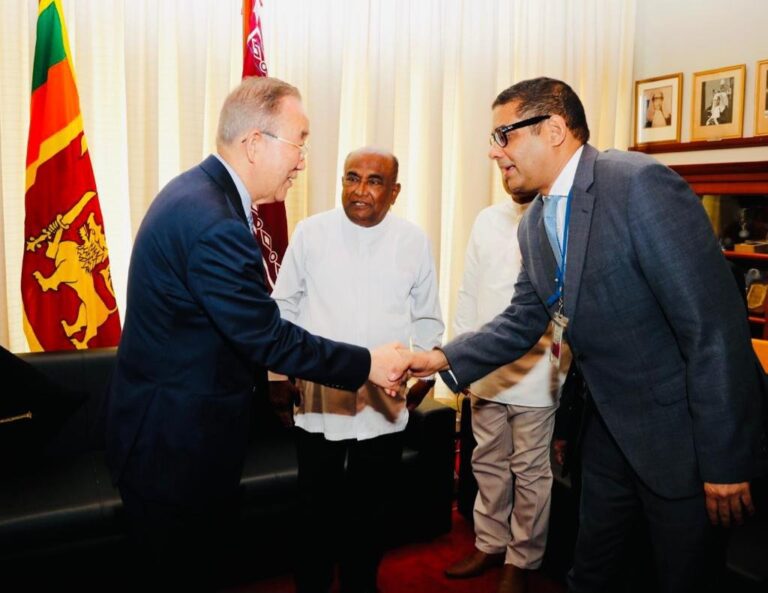
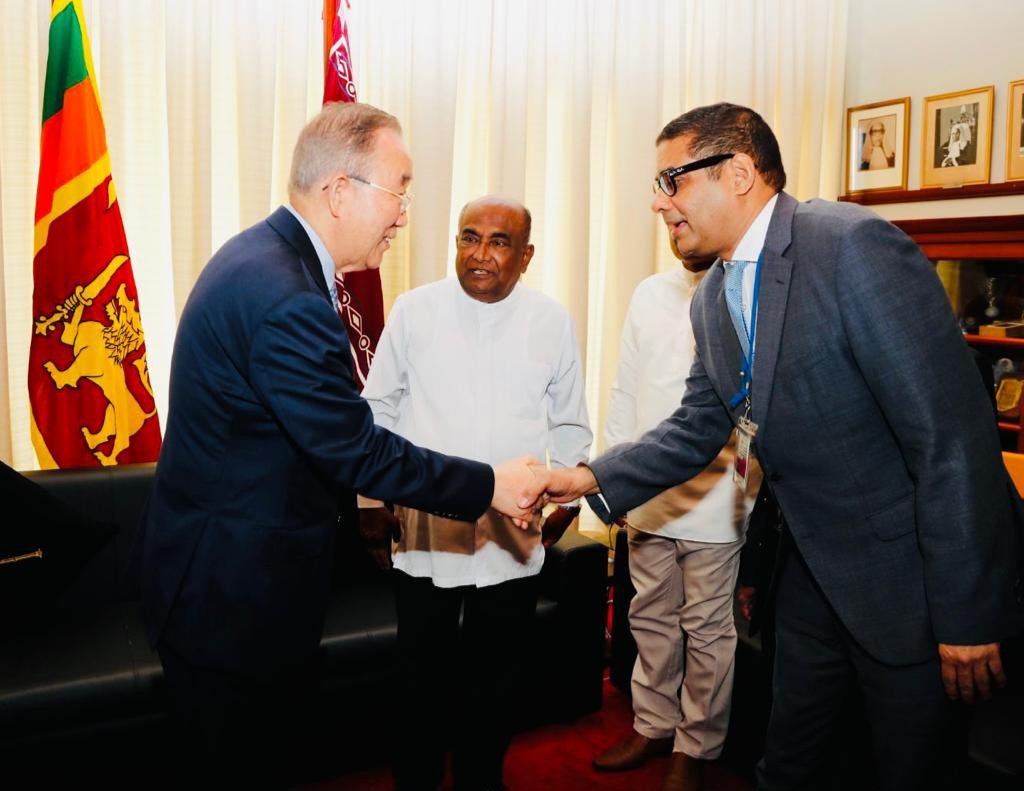
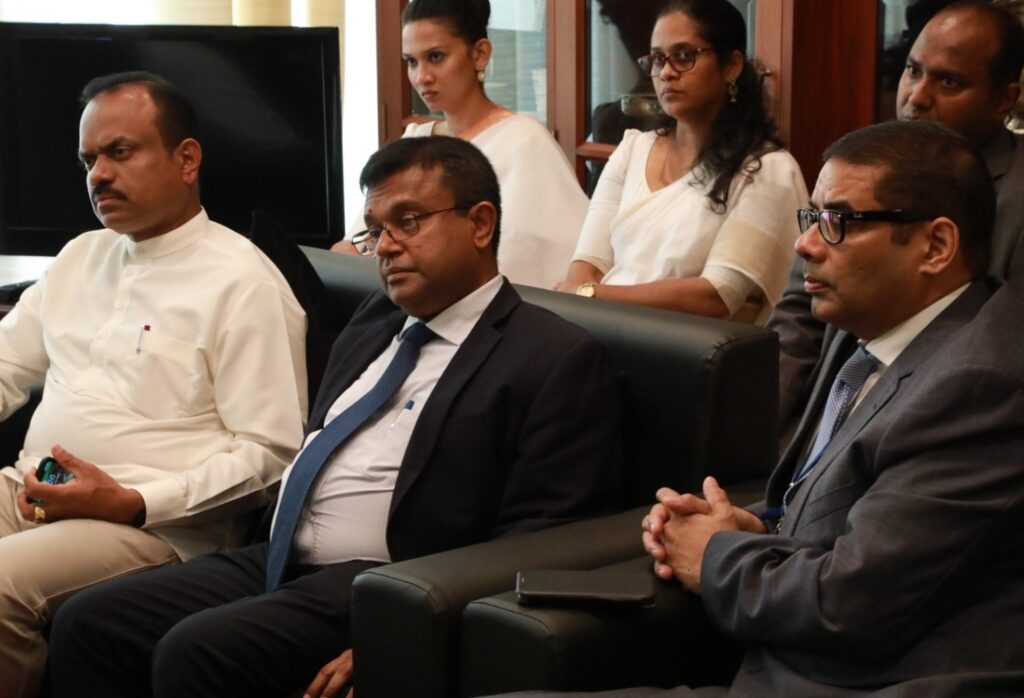
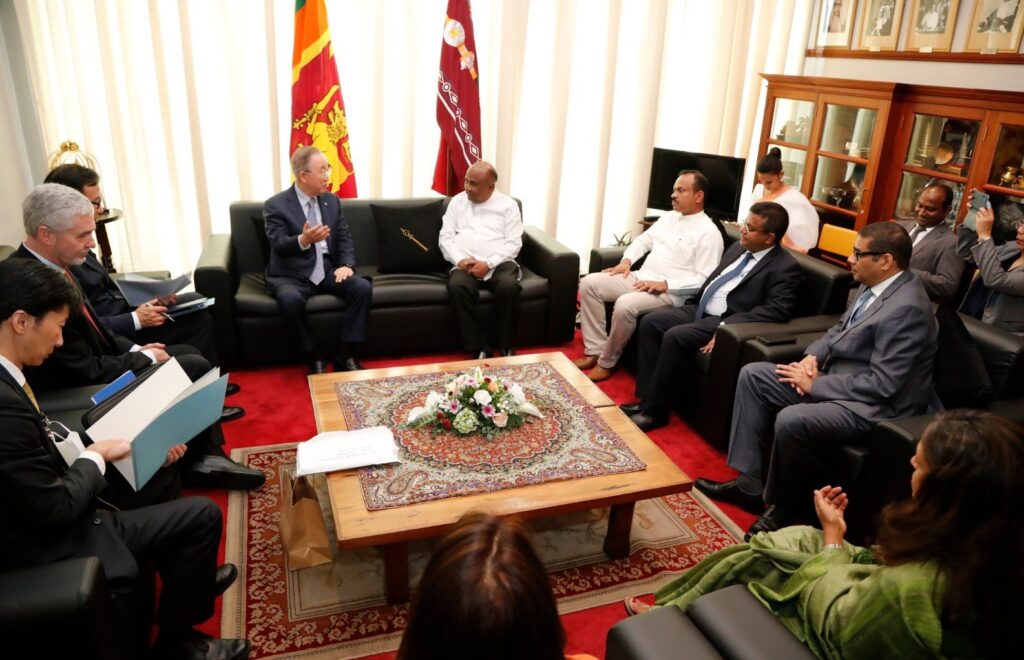
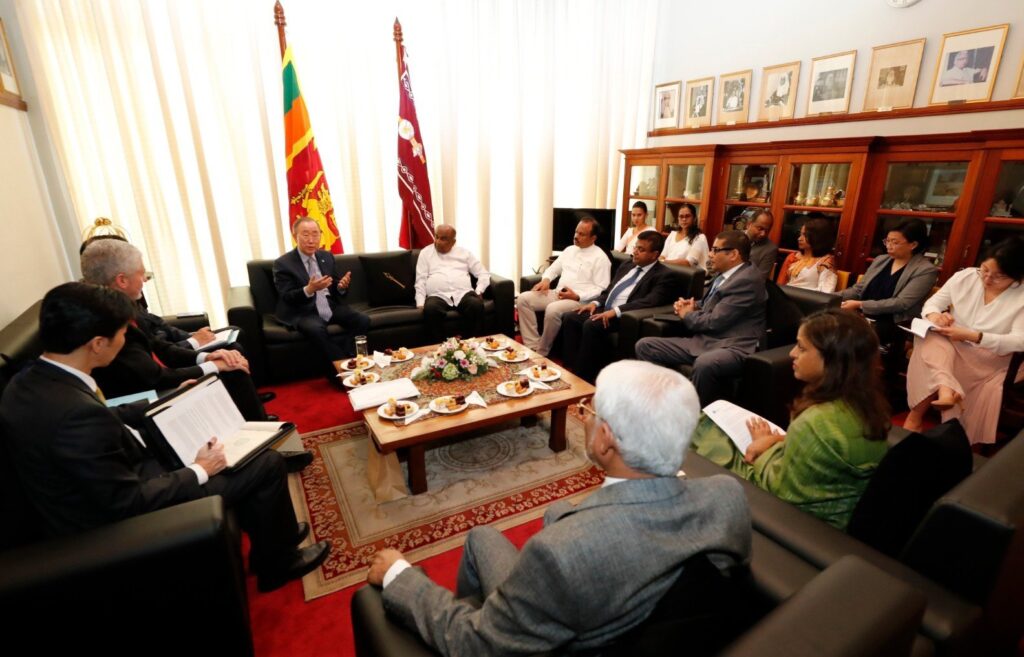
Colombo (LNW): Chairman of the Board of Investment (BOI) of Sri Lanka Dinesh Weerakkody yesterday (08) met with former Secretary General of the United Nations and current President of Assembly & Chair of the Council of the Global Green Growth Institute (GGGI) Ban Ki-Moon at the office of the Speaker in Parliament.
The delegations together held a cordial discussion about the country’s current situation and paid focus on green finance options and capacity building beneficial for Sri Lanka.
2021 GCE OLs reveal downfall of Royal, Ananda, Nalanda dominion!
By: Isuru Parakrama
Colombo (LNW): The results of the 2021 G.C.E. Ordinary Levels Examination have revealed the best performance of a number of schools outside Colombo, breaking the decades-old trend of Colombo schools holding dominion.
Below is the list of twenty schools with best results;
- Ratnawali Girls College, Gampaha
- Devi Balika Collage, Colombo
- Vidya College, Matale
- Visaka Balika Vidyalaya, Colombo
- Panadura Balika Maha Vidyalaya, Panadura
- Thakshila Madya Maha Vidyalaya, Horana
- Bandaranayake College, Gampaha
- Vembadi Higher Girls College, Jaffna
- Seewali Madya Maha Vidyalaya, Ratnapura
- Pinnawala Madya Maha Vidyalaya, Pinnawala
- Ranabima Royal College, Peradeniya
- Pushpadana Balika Maha Vidyalaya, Kandy
- Sri Lanka – Singapore Mithrathwa Vidyalaya, Weeraketiya
- Badulla Madya Maha Vidyalaya, Badulla
- Hindu College, Jaffna
- Bandaranayake Central College, Veyangoda
- Musaeus College, Colombo
- President’s College, Minuwangoda
- Eheliyagoda Madya Maha Vidyalaya, Eheliyagoda
- Anuradhapura Central College, Anuradhapura