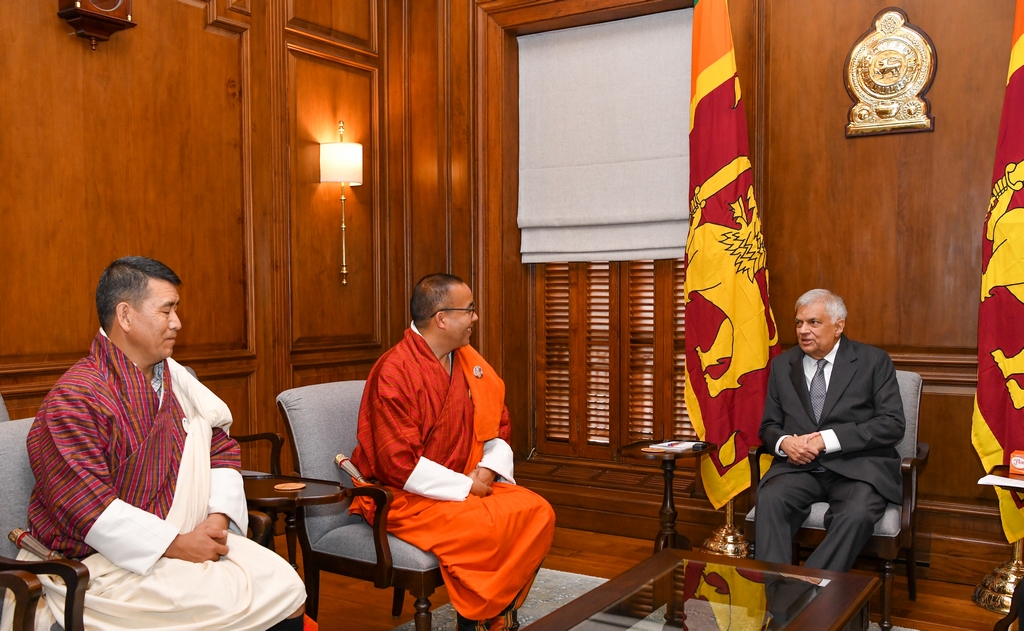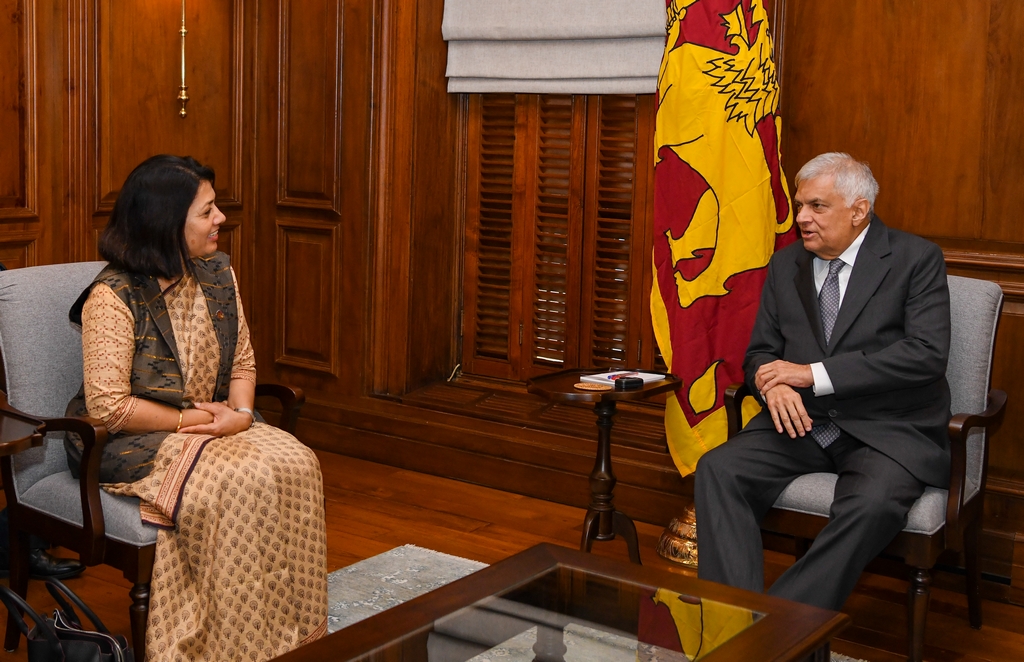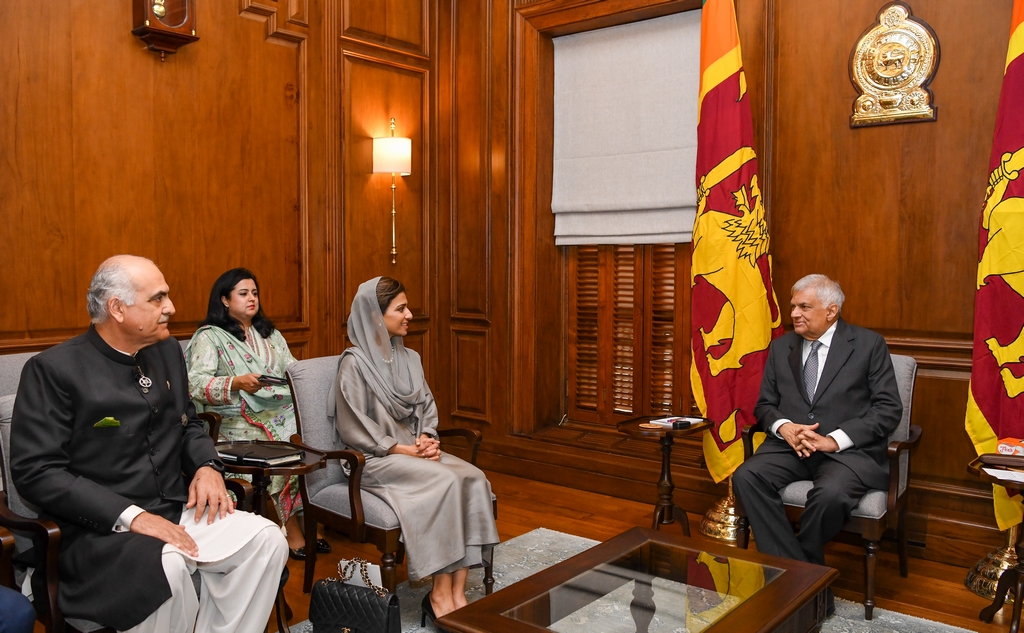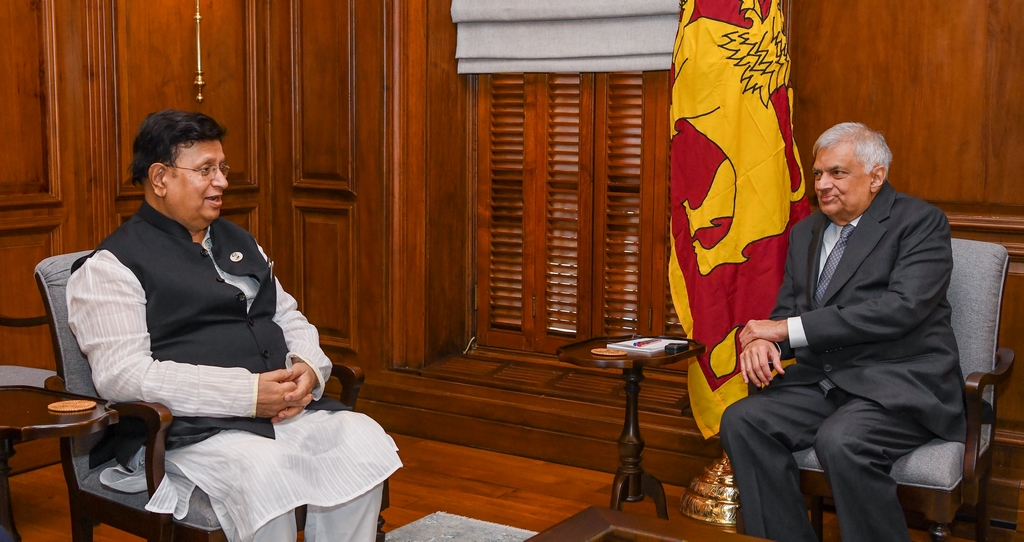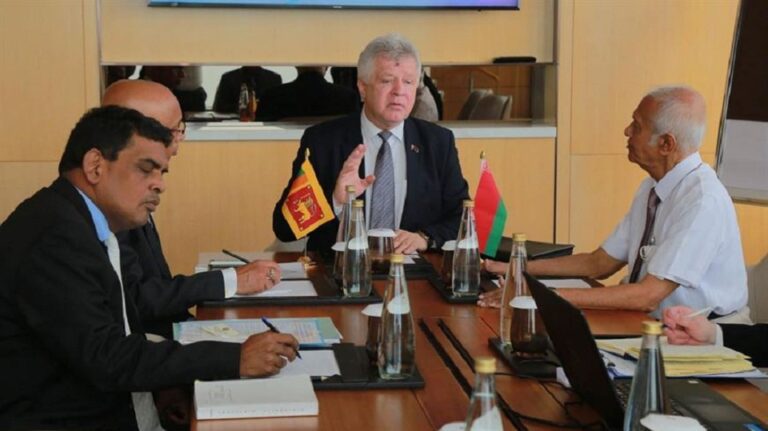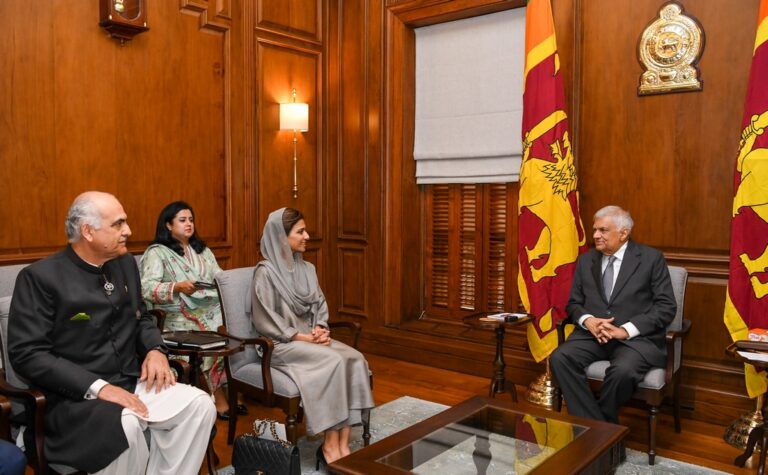
The Minister of Foreign Affairs, Hon. Ali Sabry met with the Australian High Commissioner Paul Stephens at the Ministry on 30 September, 2022. The Foreign Minister congratulated the High Commissioner on his appointment as the Head of the Mission to Sri Lanka.
The Foreign Minister appreciated the recent immediate humanitarian assistance extended to tackle domestic challenges.
Australian High Commissioner referred to possibilities for investment in the energy and education sector. Foreign Minister welcomed investments from Australian Companies in Sri Lanka.
The Foreign Minister also discussed a range of bilateral issues including matters of mutual interest at the multilateral level.
Senior officials of the Ministry of Foreign Affairs and the Australian High Commission were also present.
Permanent Representative of Sri Lanka to the United Nations in New York, Ambassador Mohan Pieris appointed asthe Chair of the United Nations First Committee
The First Committee of the United Nations which deals with matters relating to disarmament and international security appointed Sri Lanka’s Ambassador and Permanent Representative to the United Nations, Mohan Pieris as its Chair by acclamation on 29 September 2022.
The work of the United Nations is primarily carried out by six (6) Main Committees. The First Committee deals with disarmament, global challenges and threats to peace that affect the international community and seeks out solutions to the challenges in the international security regime. The Committee works in close co-operation with the United Nations Disarmament Commission and the Geneva-based Conference on Disarmament.
The First Committee of the United Nations will begin its substantive work on 03October 2022.
Ambassador Pieris was appointed Permanent Representative of Sri Lanka to the United Nations in January 2021. He is the former Chief Justice of the Supreme Court of Sri Lanka and prior to that held the position of Attorney General of Sri Lanka. Ambassador Pieris has extensive experience working with and within the United Nations, including on the UN Human Rights Council and on disarmament issues. He is the current Chairperson of the UN Special Committee to Investigate Israeli Practices Affecting the Human Rights of the Palestinian People and Other Arabs of the Occupied Territories.
The Permanent Mission of Sri Lanka to the United Nations
All duties imposed on the import of raw materials for the domestic manufacture of sanitary napkins will be removed and the tax concession will be provided for five main raw materials.
The waiving off of the duties will pave for a domestically manufactured sanitary napkin to be sold for a maximum retail price of Rs. 260 – 270.
“All duties imposed on imported raw material for domestically manufactured sanitary napkins waived off and the importers of finished sanitary napkins will get Zero rate VAT benefit. The President directs the authorities pass the benefit to consumers,” the President’s Media Division said in a statement.
Accordingly, domestically manufactured sanitary napkins will be taxed at zero rate of VAT and the 15 per cent custom duty, 10-15 per cent cess and 100 per cent port and airport development tax will be waived off.
President Wickremesinghe has given instructions to the relevant officials regarding the tax concession and the importers should obtain the recommendation of the Secretary of the Ministry of Industries, do they wish to obtain the relief.
Importers of finished sanitary napkins will also be entitled to zero rate VAT relief, the PMD added.
More than Rs. 93 billion per month is required to settle the paychecks of 1.5 million public servants in Sri Lanka, analysts pointed out.
Despite treasury bills being printed in the recent past without any limit to settle the salaries of the public servants, agreements reached with the International Monetary Fund (IMF) have severely restricted the printing of money.
In the backdrop, the salaries of the public servants are also facing a crisis, and the government’s ongoing efforts to increase the state tax revenue by introducing new tax schemes lead to the question of how long can such operations last as a solution to the economic crisis of Sri Lanka, whilst weighing on tax further aggravates the general public and the public servants alike.
Meanwhile, enrolments at the public service have been suspended and the retiring age being limited to 60 will slash the public service by 25,000 by the end of 2022, official records disclosed.
Nonetheless, enrolments will continue to fill vacancies at certain essential public sectors such as the Medical Sector and the Engineering Sector in order to maintain an uninterrupted service, the GOSL said.
Withstanding the above circumstances, analysts warn that the GOSL will be compelled to slash the salaries of the public servants, hence endless reports being surfaced on Social Media corroborating the claim.
The GOSL, on the other hand, strongly denies the claim, as on one occasion State Minister of Finance Ranjith Siyambalapitiya assured that no decision was taken to slash the salaries of the public servants. Such speculations are being propagated by organised groups to provoke unrest among the general pubic, he added.
The Ceylon Tobacco Company revealed it has decided to increase the prices of two types of cigarettes, namely GoldLeaf and Benson & Hedges, by Rs. 05.
Accordingly, the price of a GoldLeaf cigarette would be Rs. 85 and the price of a Benson & Ledges, Rs. 90.
The price revision comes in following the imposition of the newly introduced Social Security Levy, which is in effect since October 01, the Company added.
The World Bank has proposed to downgrade Sri Lanka from a ‘middle-income’ country to a ‘low-income’ country, a proposal previously made by India, confirmed State Minister of Finance Ranjith Siyambalapitiya.
In the midst of Sri Lanka’s worst economic crisis, the repayment of foreign debt has also been suspended and requests submitted to the creditors for debt restructuring have not been responded with positive feedback.
WB envoys told the Sri Lankan authorities that being categorised as a low-income country would be an added advantage to receive aid and low-interest loans to overcome the crisis, and the Government of Sri Lanka (GOSL) is currently considering the option, correspondents said.
Despite the island nation being labelled as a ‘low-income’ country being economically advantageous given the crisis, its long-term impact should also be paid attention to, the GOSL viewed.
Expenses on special presidential commissions appointed for various purposes for the last eight years have been estimated to be Rs. 504 million.
The highest amount was reportedly spent on the Special Presidential Commission appointed by ex President Gotabaya Rajapaksa in 2020, an allocation of Rs. 120 million.
During Maithripala Sirisena’s tenure as the President, five Commissions were appointed, namely the Presidential Commission of Inquiry on the Central Bank Bond Scam, the Presidential Commission of Inquiry to probe the Easter Sunday Attacks, the Commission to Investigate Serious Corruptions during the Mahinda Rajapaksa Regime, the Commission to Investigate Frauds and Corruptions of the Good Governance Regime and the Commission to Investigate the SriLankan Airlines Affair.
During Gotabaya Rajapaksa’s tenure as the President, the Commission to Investigate the ETI Affair, the Commission to Investigate the Role of the Presidential Commissions appointed to date, the Presidential Commission on International Cooperation and the Commission to Investigate Customs Affairs were appointed.
Despite many of these commissions concluding their investigations and having their reports handed over, none of the recommendations have been implemented to date, begging the question as to what was the point of appointing these bodies in the first place spending millions of rupees of public funds, had none of them ever served the country.
“Too many factual errors to count in this piece. I do not know who Mark Finlay is but he needs to do more research before publishing. Shame on #LNW for not fact checking,” Ratwatte wrote on his Twitter handle providing an article about ‘Air Ceylon.’
“The most comprehensive piece on Air Ceylon was written by my dear friend Roger Thiedeman in #Airways of August 1998 but I cannot find that on the web,” he added.
LNW wishes no ill-will to provide false information to our readers and we value the golden principle of ‘right-to-reply,’ and Mr. Ratwatte’s response is hence of importance.
Airlines of South Asia — Part 4
By Suren Ratwatte
Great expectations
As the 1940s drew to an end, there was a great feeling of expectation in Colombo. The Second World War had ground to an awful end with the use of the atomic bomb in August 1945. The human cost of the conflict had been high, with Ceylonese youth serving in Imperial British forces throughout the world. But, except for a brief scare in April 1942 when the Imperial Japanese Navy attacked the island, Ceylon had largely escaped unscathed from the terrible conflict.
Britain, depleted by the war effort, was preparing to withdraw from India. It was obvious that Ceylon would gain independence soon as well, though there was little local pressure to achieve this. The Government of Ceylon, looking to build a new nation, decided to set up its own airline as part of this effort.
Named Air Ceylon (IATA code: AE) and equipped with three war-surplus Douglas DC-3 Dakotas (see photo above taken at Ratmalana), operations formally began in December 1947. Given the many economic and cultural links between India and Ceylon, the first overseas destination was Madras (now Chennai), replicating the pioneering Tata Airline’s flights before the war.
Trials and tribulations
The trials and tribulations of Air Ceylon is a fascinating story in itself. Numerous writers, have approached the subject with varying degrees of success. The definitive work is probably the comprehensive piece by Roger Thiedeman, published in the August 1998 issue of Airways magazine.
Suffice it to say, that in common with most of the airlines of the era, Air Ceylon too was poorly conceived, under-capitalized, run by bureaucrats on a shoe-string budget and subject to constant political interference. Despite a number of alliances with multiple foreign airlines, including Australian National Airways (ANA; 1949–1953), KLM Royal Dutch Airlines (1956–1962), Britain’s overseas flag-carrier BOAC (1962–1972) and UTA French Airlines (1971–1976), AE was never to see even a brief period of consolidation and solid financial performance.
KLM Super Constellation in AE colors — courtesy ALK_VA
During this period the airline operated a modest network of international flights using, initially, the Douglas DC-4 Skymaster (supplied by ANA). Later the Lockheed 749 Constellation, a 1049 Super Constellation (above) and a Lockheed 188 Electra turboprop, all provided by KLM, were utilized. Later still, during the BOAC partnership, de Havilland Comet 4s and BAC (Vickers) VC10s were operated. During the UTA collaboration three different Boeing 707s, 720s and a Douglas DC-8 flew on behalf of Air Ceylon. Toward the end of its existence Lanka’s national carrier also leased two more DC-8s from airlines of questionable repute. In fact, Air Ceylon has the dubious distinction of operating more aircraft types in its short history than many much larger airlines.
AE Electra with KLM registration in Colombo — courtesy DP
Regional and domestic network
Air Ceylon also operated a regional network, initially using the DC-3s, but in one of the few sensible fleet choices, purchased a turboprop Hawker Siddeley (Avro) HS 748 in 1964. This proved to be a capable and rugged workhorse, particularly for domestic flights. The operation was reasonably successful and expansion was in order. Yet in a typically puzzling decision, the government then purchased a French-built Aérospatiale N (Nord) 262! This aircraft, especially its turboprop engines, proved unsuitable for tropical conditions and barely lasted two years in service, to be replaced later by a second HS 748: a good example of poor decision-making leading to a significant financial penalty. What prompted the government of Ceylon to purchase the French aircraft is best left unexplored.
HS 748 Avro — courtesy ImageEvent
The final major acquisition by Air Ceylon was a Hawker Siddeley HS 121 Trident, which was inducted in 1969. Pakistan’s PIA had introduced this tri-jet type only recently, as we saw in an earlier column, so the choice was not unreasonable. Arguably the acquisition of the Boeing 727 would have been a much better choice, but with British commercial interests still prevailing at the time, the Trident was an understandable choice. The Trident allowed Air Ceylon to expand regionally to Bangkok, Delhi, Bombay (now Mumbai) and finally Sharjah in the UAE by the late 1970s.
Air Ceylon Trident in flight — Twitter
One of AE’s milestones was the inauguration of scheduled services to the Maldives Islands in 1967. This was to service the growing tourist demand to these idyllic islands and was initially an ad-hoc service using the venerable DC-3s. The first airline to provide scheduled service to the Maldives, Air Ceylon missed an opportunity to consolidate and build on what was to become a tourist Mecca within a few years.
AE DC-8 — courtesy DP
The demise
By the late 1970s Air Ceylon was struggling to survive. The DC-8–43 pictured here (registration 4R-ACT; a relatively rare variant with Rolls-Royce Conway turbofan engines) had been leased from Templewood Aviation, which had earlier provided a Boeing 720. When the partnership with UTA was terminated, Air Ceylon purchased the DC-8–53 used by the French carrier. Several leased aircraft, including a Convair 880, a Boeing 720 and two VC-10s, were used at different times to bolster lift, but AE proved unable to capture its fair share of the rapidly growing tourism market to Sri Lanka and the Maldives, or the labor traffic to the Gulf via Sharjah.
Changes in government led to much speculation about corruption, financial mismanagement and a litany of other accusations. A Presidential Commission of Inquiry was tasked to investigate corruption and malpractice in Air Ceylon. The newly elected government of Sri Lanka decided to establish a separate airline, named Air Lanka, for international routes based out of Katunayake airport to the north of Colombo. Air Ceylon was to continue some limited flying, mainly domestic, out of the smaller Ratmalana airport.
The final blow came in September 1978, when a bomb destroyed one of the two remaining Avro 748s, which was parked at Ratmalana, shortly after it returned from a flight to Jaffna
Air Ceylon with its proud fatality-free flying record of 32 years, quietly went out of existence in 1979.
The exaggerated negative portrayal of the current situation in Sri Lanka is taxing the hard-hit tourism sector, making it increasingly difficult to move towards the path of revival.
Despite several attempts by the industry stakeholders to share the improved situation for tourists, where effective measures are taken to ensure they are cushioned against the prevailing challenges in the national economy.
Campaigns were being carried out by certain non-governmental organisations (NGOs) to assist the island nation in its time of need are proving to be counter-effective, a senior official of Tourism Ministry said.
The tourism industry stakeholders noted that due to the said campaigns, it is rather unfortunate that the key source markets are under the impression that Sri Lanka is not equipped to cater to the needs and wants of international travelers.
The participation at the IFTM in Paris was an eye-opener for the tourism sector, as it showcased the perception of destination Sri Lanka in the international platform.
“Having just attended the IFTM in Paris and having visited tour operators in France, Belgium, the Netherlands and other key source markets, it is disappointing to report that the one salient common question being asked is ‘does Sri Lanka have a food shortage?’
This question is then followed by ‘aren’t children facing malnutrition?’” said the Sri Lanka Association of Inbound Tour Operators (SLAITO) sharing an update on its participation in the travel show it attended in France this month
The campaigns carried out by the UNICEF, Lions Clubs International in Sri Lanka and various INGOs to collect funds to feed the children in Sri Lanka, using pictures of undernourished African children on their publicity material, have worsened the image of the island nation, the association said.
The SLAITO asserted that irresponsible statements from local government bodies together with images of street protests being quelled using force, the negative images going out into the world far outweigh any positive publicity efforts.
“All this is at a time when the need of the hour is earning foreign exchange for our basic requirements, for which tourism is the ideal industry.
We need the collective support of all Sri Lankans to help rebuild the tourism industry and in the process, to help to come out of this economic crisis, in a sustainable manner, by earning the required foreign exchange as opposed to depending only on handouts,” the SLAITO said.
Sri Lanka State Pharmaceutical Corporation has failed to maintain adequate pharmaceutical supplies to provide quality patient care and prevention services during the economic crisis period arising out of the exchange deficit and other factors as at 13 May 2022 , Auditor General Department’s special audit report revealed.
The main reason for the pharmaceutical shortage at hospitals was the failure of the corporation to carry out a medicinal drug procurement in accordance with a proper time table and its lack of constant monitoring process on the progress of pharmaceutical procurement orders and its activation for the past several years.
The State Pharmaceutical Corporation has to pay around Rs.4.28 billion to suppliers, Peoples’ Bank and Bank of Ceylon by April 2022 for medical supplies ordered by the Corporation from the local market, audit inspection detected .
The total amount payable was Rs 3.11 billion for suppliers, Rs 920 million for Peoples Bank and Rs.250 million for Bank of Ceylon for pharmaceutical supplies by 2022 April 20.
According to Corporation’s information provided to the Auditor General that there was a total financial requirement of Rs. 23,123 million as at 2022 May 25.
The State Pharmaceutical Corporation has disbursed Rs. 7,135 million for issuing letters of credit, payments to suppliers and imports and clearances for orders in the Medical Supplies Division and Rs. 15,988 million for settling bank overdraft facilities for medical supplies as at 2022 April 20.
The report recommended to avoid delays in the procurement process and that responsibility be delegated to the relevant officials by effectively executing the activities related to the files sent by the State Pharmaceutical Corporation of Sri Lanka.
It has to be submitted to the Ministry Procurement Committee and the Cabinet Procurement Committee according to a proper procurement plan and procurement schedule.
A safe stock of 03 months should be maintained for each medical supply for effective control, the report suggested adding that the procurement lead time is about 11 months and although it is necessary to maintain a safe stock of 06 months.
It is recommended that consideration be given to reducing the level of secured stock by minimizing procurement time due to the lack of adequate storage facilities and the high cost.
The Auditor General’s report has suggested that action be taken to implement a re-order stock level based ordering system to reduce the lead time required for medical supplies.
It has been directed to pay attention to maintaining stock levels for appropriate medical supplies items and properly update and use the computer system.