The death of businessman Dinesh Schaffter has neither been ruled nor reported as suicide, Police said.
Police Spokesman Nihal Thalduwa stressed that further investigations are underway and no breakthrough has been made yet.
As of now, statements have been recorded from about 175 persons and about 14 items taken as evidence have been forwarded to the Government Analyst, he added.
In addition, phone analyses, bank records and documents pending obtainment are being collected and investigations are being conducted via other data as well, Thalduwa said.
The Police Spokesman noted that probes are being carried out to locate direct evidence and no ruling has been made whether this was a suicide, a homicide or something else, adding that no suspect has been identified so far.
Five persons including an Officer-in-Charge (OIC) of Police and two foreigners have been arrested in connection with an ATM fraud of over Rs. 10 million.
Among the arrestees are two Bulgarian nationals, one of whom is of Canadian citizenship, and the OIC of Meegahathenna Police Control Division.
The two foreign nationals were seized at a luxury apartment in Colombo and the Police OIC, in Amugoda, Pitigala.
The Computer Crimes Division of the Criminal Investigation Department (CID) is conducting further investigations into the case.
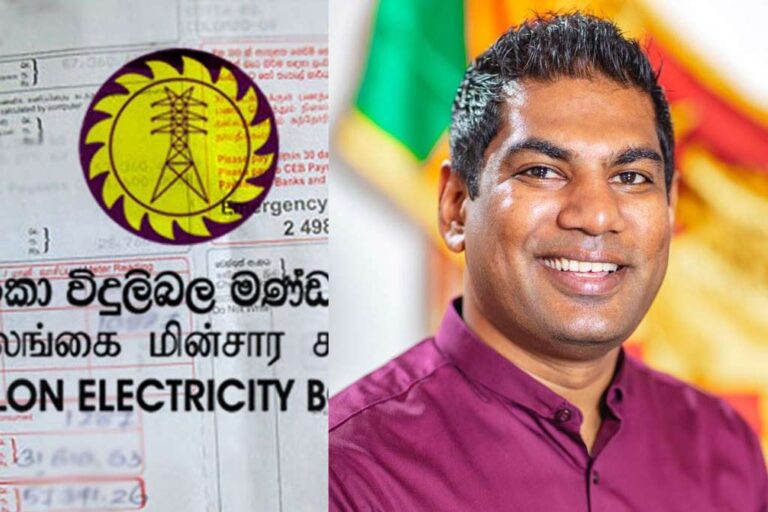
The Cabinet of Ministers has granted the approval to amend the general policy guidelines pertaining to an electricity tariff hike, said Energy Minister Kanchana Wijesekara.
The Cabinet approval granted to amend the general policy guidelines for the electricity industry and to implement a cost reflective electricity tariff to be implemented from January, 2023, the Minister wrote on Twitter.
A final decision in this regard would be made after having discussions with the Public Utilities Commission of Sri Lanka (PUCSL), according to sources.
Cabinet approval granted to amend the general policy guidelines for the electricity industry and to implement a cost reflective electricity tariff to be implemented from Jan 2023.
Industries Minister Dr Ramesh Pathirana states the gem industry will aim to achieve USD 1 bn in exports in 2023: promises to facilitate value-addition of gems by enabling all technology and equipment related to value-addition to be duty-free: assures the establishment of a pension plan for gem miners: at present, gem exports are about USD 250 mn.
Central Bank says exports contracted by a massive 17.9% (USD 217 mn) in Nov’22 to USD 994 mn, hit by Govt import bans and controls: exports declined in Oct’22 as well, by 11.8% (USD 141 mn) to USD 1,051 mn: apparel factory owners say there has been significant reductions in orders in recent times.
TNA MP M.A. Sumanthiran appeals to the Govt of India to “exercise its authority” to achieve the objectives of the Indo-Lanka Accord and support the legitimate political objectives of the Tamil people in Sri Lanka.
JVP leader Anura Kumara Dissanayake says the SJB has gone into a state of panic, ahead of up-coming Local Govt elections: says it is evident through the recent statements made by the SJB Leader, General Secretary and National Organiser.
Head of Lotus Tower Management Prasad Samarasinghe says the landmark Tower has received half a million visitors so far: also says over Rs.268 mn in revenue has been collected.
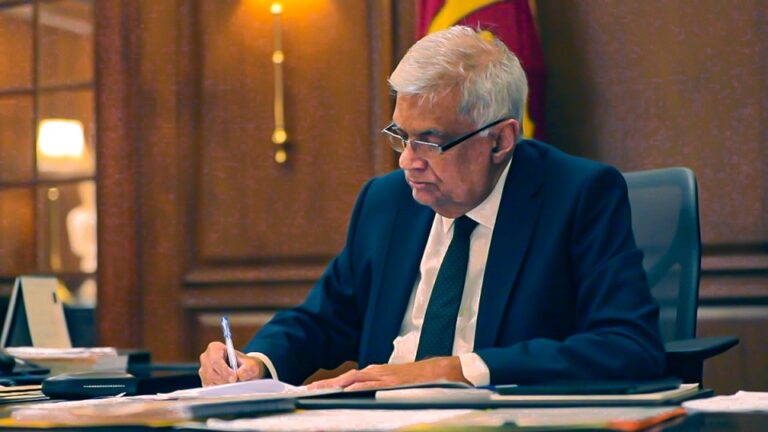
President Ranil Wickremasinghe says the IMF has not made “an immediate reduction in the defence expenditure of the Govt”, a pre-condition for the provision of the long awaited and much-touted approval of the USD 2.9 billion Facility to be disbursed over 48 months: admits however that the IMF is looking for the reduction of military expenditure in stages.
Agriculture Minister Mahinda Amaraweera requests Govt to provide the necessary funds for paddy purchasing before spending funds on elections scheduled for Mar’22: says elections can be held at a later date.
Cabinet approves the implementation of a cost-reflective Electricity Tariff Formula based on which the tariff will be increased, but does not specify the time-frame for its implementation.
SLFP General Secretary Dayasiri Jayasekara says, if as alleged by former President Ms Chandrika Kumaratunga the present SLFP leader and former President Maithripala Sirisena should be held responsible for the 2019 Easter Sunday terror attacks, in the same way, she should be held responsible for the LTTE attacks.
State Finance Minister Ranjith Siyambalapitiya says the payment of PAYE Tax of State & Semi-Govt sector employees from funds of the respective institutions, will be prohibited.
President Ranil Wickremesinghe said he is deeply concerned about the recent tense situation that erupted in Brasilia.
In a statement, the President emphasised that Sri Lanka not long ago experienced similar attempts by groups to overthrow democratic structures through unconstitutional means.
“Such hostilities are condemned, and we stand in solidarity with the President, Government and people of Brazil in this hour of confrontation,” the President wrote.
He added that it is imperative that democracy and its institutions are universally respected by all citizens.
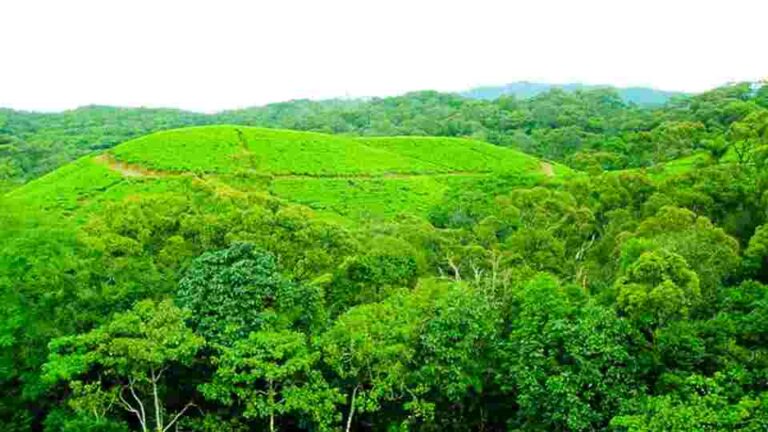
The Conservator General of Forests Mr. K.M.A Bandara said that the media reports implying that Sri Lanka’s forest cover has decreased to 16% are false.
He said this in response to a query made regarding the media report on the instructions of President’s Secretary Mr. Saman Ekanayake. The Presidential Secretariat had focussed its attention regarding these reports published in the media.
The assessment of forest cover is carried out every five years and the census conducted in 2020 is scheduled to be completed in June this year. According to the census conducted in 2015, the natural forests of Sri Lanka stood at 29.15% (1,912,970 hectares) of the total land extent.
The Conservator General of Forests also said that although there has been some reduction in the amount of forests due to various development activities and other human activities in the country, there has definitely been no decrease in the amount of forests up to 16% as stated in the media reports.
According to media reports, if the forest area in Sri Lanka is 16% of the total land extent, then the existing forest area in the country should be 1,040,000 hectares. This means that 872,970 hectares of forests should have been destroyed during the seven years from 2015, which is 124,710 hectares per year and 341 hectares of forest destruction per day.
He also said that the method used to assess the forests should have been described in the presentation of data on forests. Basic points such as the definition of forests, the method of estimating forest size, and the estimation of forest size should have been mentioned in the report. However, there is no source from which the relevant data was obtained in the media reports suggesting that the forest cover had decreased.
The Conservator General further stated that if there is widespread forest destruction, as reported in the media, it should have been observed by the Department of Forest, the Department of Wildlife Conservation, the Sri Lanka Police, and the Sri Lanka Air Force, which monitors forests from the air. However, such extensive forest destruction has not been reported to any of these institutions. He also stated that the Forest Department is updating forest maps and that no such forest destruction was observed during those activities.
The Supreme Court has issued notices to Monetary Board members of the Central Bank of Sri Lanka (CBSL) Sanjeewa Jayawardena and Rani Jayamaha, based on fundamental rights (FR) petitions filed against 39 persons including the previous administration.
The notices were issued as the said individuals failed to appear in Court. The petitions were called in before the Supreme Court Bench chaired by Chief Justice Jayantha Jayasuriya, and comprising Justices Buwaneka Aluvihare, Vijith Malalgoda, L.T.B. Dehideniya, and Murdu Fernando.
39 persons, including the former President, former Prime Minister, and former Finance Minister are cited as respondents to the case filed by the Transparency International Sri Lanka (TISL) former Chairman of the Ceylon Chamber of Commerce (CCC) Chandra Jayaratne, Dr. Mahim Mendis from the Open University of Sri Lanka (OUSL), and former National Swimming Champion Julian Bolling, on the allegation that these individuals are directly responsible for Sri Lanka’s unsustainable foreign debts, its hard default on forex dept repayments, and the economic meltdown.
The petitions will be called in again on March 20, 2023.
Long gone are the throngs of protesters who occupied an area around the president’s office for months during Sri Lanka’s worst economic crisis since independence.
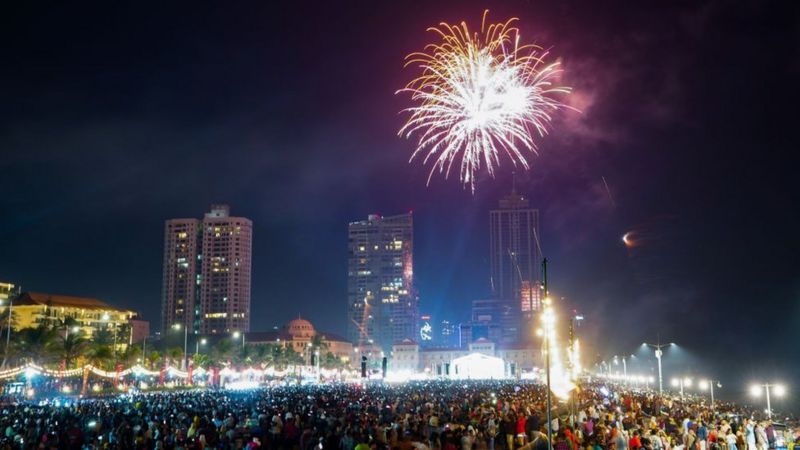
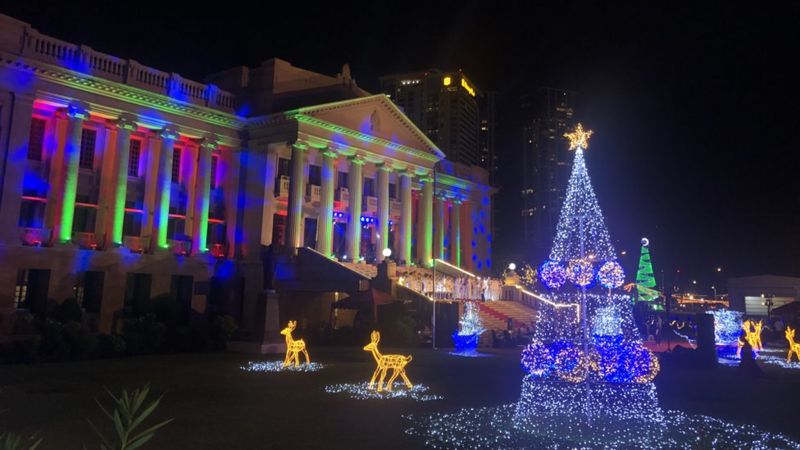
Instead a slew of carollers sang to the public from across the heavily-guarded fences of the Presidential Secretariat. Next to the building rose an 80 ft (24m) Christmas tree, the signature piece in a landscape dotted with décor, food stalls and musical shows. And as fireworks ushered in the new year, a massive crowd flocked to the oceanfront promenade known as Galle Face Green.
It was all part of a festive zone planned by the government as a year-end tourist attraction in the central business district of Colombo, Sri Lanka’s capital.
But for many locals, who used the site as their “ground zero” for Occupy-style protests from April to August and demanded their leaders resign, there is little to celebrate.
Thousands gathered at the former protest site to ring in the New Year
“It’s disgusting,” says Swasthika Arulingam. “It’s an indecent display of wealth that this country does not have, and of resources this country is denying to the weakest sectors of our population.”
The carnival lighting is particularly galling, she adds, given that the state-run electricity board has incurred a loss of 150bn Sri Lankan rupees (£344m) this year.
The prospect of extended daily blackouts looms again. Food staples, transport fees and children’s school supplies are increasingly unaffordable. And the new year brings with it steep tax hikes that will only compound the misery.
There is “a kind of pseudo-stability” right now, Ms Arulingam says, but residents are under tremendous stress as it grows harder to make a living.
Christmas carollers sing on the steps of the president’s office, which was occupied by protesters in July
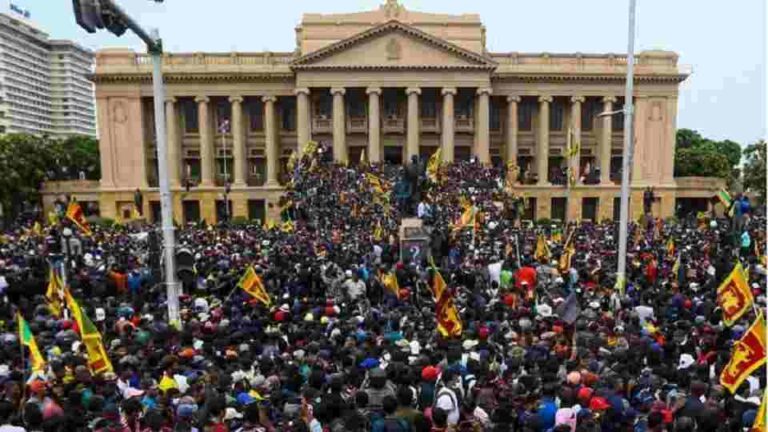
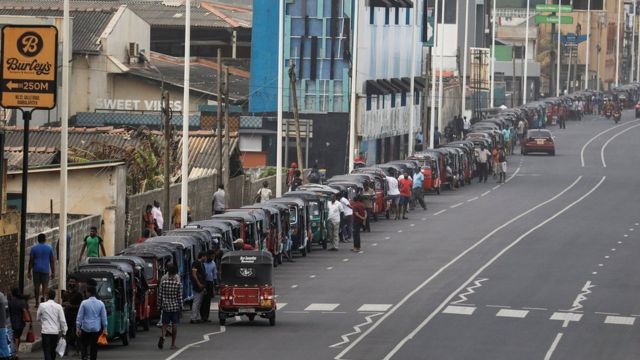
Through much of last year, Sri Lankans faced acute shortages of food, fuel and other basic supplies after a slew of government policies followed by the pandemic had depleted foreign reserves and left the country teetering on the edge of bankruptcy. Lengthy fuel queues and power outages sparked months of mass unrest, culminating in the storming and occupation of then-President Gotabaya Rajapaksa’s official workplace and residence in July, forcing him to flee the country.
Six months on, with more pain on the horizon, there have been calls for early elections. Mr Rajapaksa’s parliament-appointed replacement, Ranil Wickremesinghe, has largely demurred, but local government elections are expected to take place next month after a one-year delay.
Mr Wickremesinghe has also cracked down on the anti-government protest movement and its leaders, after vowing that he will not allow “fascists” to “tear up our constitution”.
“Any form of protest is controlled in Sri Lanka right now,” says Shreen Saroor, a local human rights campaigner. “He has kept his powers well intact to do what he needs to do and in case he needs to call on the military to control the country.”
Ms Saroor points to how Mr Wickremesing has retained the powers of executive presidency – he can deploy security forces, and issue detention orders under what is known as the Prevention of Terrorism Act (PTA).
Critics say the system, which heavily centralises power in the hands of the president, was bolstered by the Rajapaksas during their two decades in power, and lacks the appropriate checks and balances. Calls for abolishing it and reforming the constitution were a key demand in last year’s protests.
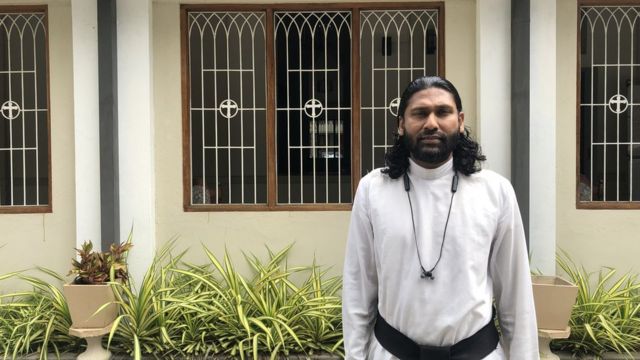
Father Jeewantha Peiris, a Catholic clergyman, is among the protest leaders who have been charged with various criminal offences, including assault and unlawful assembly, under PTA. He is fighting back in court against what he calls “baseless accusations”.
Image caption, The 2022 protests were a freedom struggle that united all Sri Lankans, says Father Jeewantha Peiris
Parliament “totally betrayed” the people when they voted in Mr Wickremesinghe as president, he says, referring to the former six-time prime minister as “another culprit who had been engaged with the corrupt system”.
“Apparently the crisis is now solved but, underneath, its real causes have not been treated,” he says. “Corruption is still taking place. Real issues like malnutrition and medicine shortages exist. Downtrodden people cannot face this inflation.”
The state is intimidating citizens like him, he alleged, but “unless they bring to account those who have committed economic injustices and violated human rights, this crisis will not be solved”.
Father Peiris is the parish priest to mostly Tamil-minority rubber estate workers in the village of Doloswala in the south-central Ratnapura district. He says successive governments have neglected Sri Lanka’s poorest and most vulnerable.
When the pandemic arrived, he claims, villagers fell ill in droves with no ability to socially distance inside their homes and no access to vaccines – and with schools shut, their children suffered with no prospect of remote learning.
“Mothers would come to my cottage and cry for their starving children,” he says. “As a priest working among them, I could not wait around and watch them in their daily misery.”
With his black locks and pristine white cassock, the parishioner was at the Galle Face Green protests every day. His message: the country needs a national movement for structural change.
He describes it as the first time Sri Lankans united, in a struggle for the greater good, irrespective of race, religion or ideology: “We had no divisions among us and we all felt we were victims.”
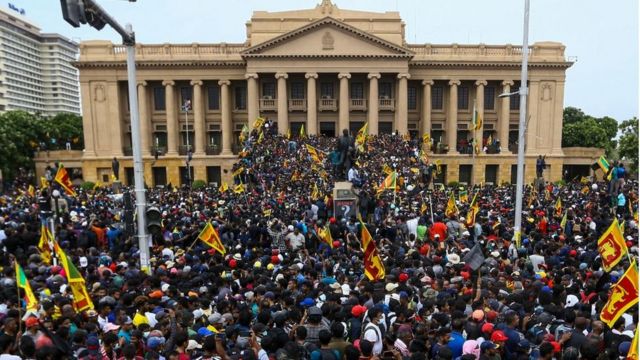
Image caption, Protesters broke into the president’s office on 9 July
Beginning on 9 April, daily demonstrations quickly grew into “GotaGoGama” – a word that combines the Sinhalese word for “village” with protesters’ demand for Mr Rajapaksa to step down as president.
Camped opposite the Presidential Secretariat, the little community spawned rallies, candlelight vigils, stage dramas and a huge library of donated books, all focused on broadening political literacy.
It commemorated atrocities from Sri Lanka’s past, held open forums about minority divisions and, when government-aligned thugs brutally laid siege to the site, grew even stronger.
But by July, as protesters grew increasingly restive over Mr Rajapaksa’s refusal to leave office, the crowds had grown larger and more uncontrollable.
In the days after the president’s home and office were stormed, as Mr Rajapaksa fled to the Maldives and finally resigned, security forces under the orders of his successor reclaimed the two buildings and raided the GotaGoGama protest camp, arresting demonstrators and dismantling their tents.
With many of its key figures now behind bars, facing legal action or under regular surveillance, the so-called “aragalaya” – or people’s struggle in Sinhala – has largely gone silent.
“It was a national movement, a vision of what Sri Lanka could be,” says Dr Paikiasothy Saravanamuttu, founder of the Centre for Policy Alternatives, but “the middle class has deserted it, the ordinary community groups have all deserted it”.
“[Mr Wickremesinghe] successfully changed the narrative to show there’s a good aragalaya and a bad aragalaya, and what we’re now lumped with is the bad aragalaya,” he says.
Image caption, Queues for fuel snaked along Colombo’s streets at the peak of the shortage in July
Dr Saravanamuttu argues that sections of the population, particularly older Sri Lankans, view Mr Wickremesinghe as the best possible option to salvage the cash-strapped economy, but he must adhere to a reasonable timetable for elections at the local and presidential level.
“The sooner we have some legitimacy, the better,” he adds. “But from Ranil’s point of view, he wants to be elected president of this country, so he’s not going to do anything that will register a huge rebuke against any government that he is heading.”
As Sri Lanka waits on a US$2.9bn (£2.4bn) IMF bailout and financing assurances from China and other bilateral creditors, its people will struggle for a while longer. Dr Saravanamuttu warns a fresh outbreak of mass protests is on the cards in the near future, particularly in areas outside of Colombo where people are poorer and will be hit harder by rising food costs and fuel shortages.
“People will come out, not because they want constitutional reform or they want impunity checked, but because they can’t survive,” he says. “And that might be more dangerous, because it will be spontaneous and it will have a them-versus-us dimension.”
For Buwanaka Perera, a 27-year old social media activist who helped organise the GotaGoGama protests, whatever comes next, the protest movement of 2022 has left a permanent mark.
“People stood up against monsters and gave them the finger,” he says.
“We managed to send Gotabaya home. If people could send him fleeing, and hiding in [army] camps and on islands, there’s no stepping back from that.”
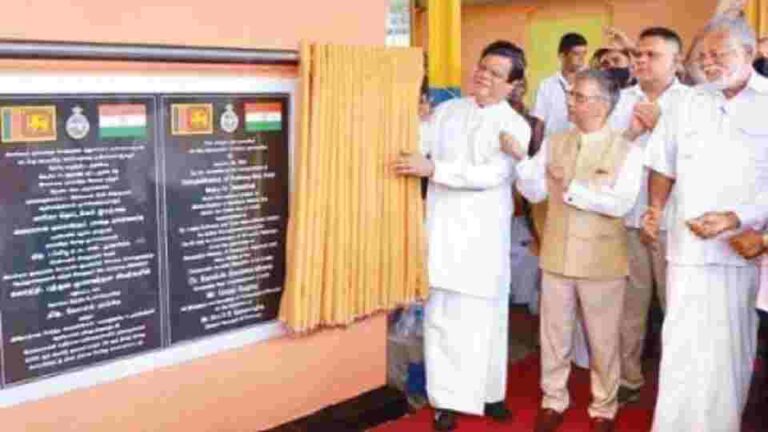
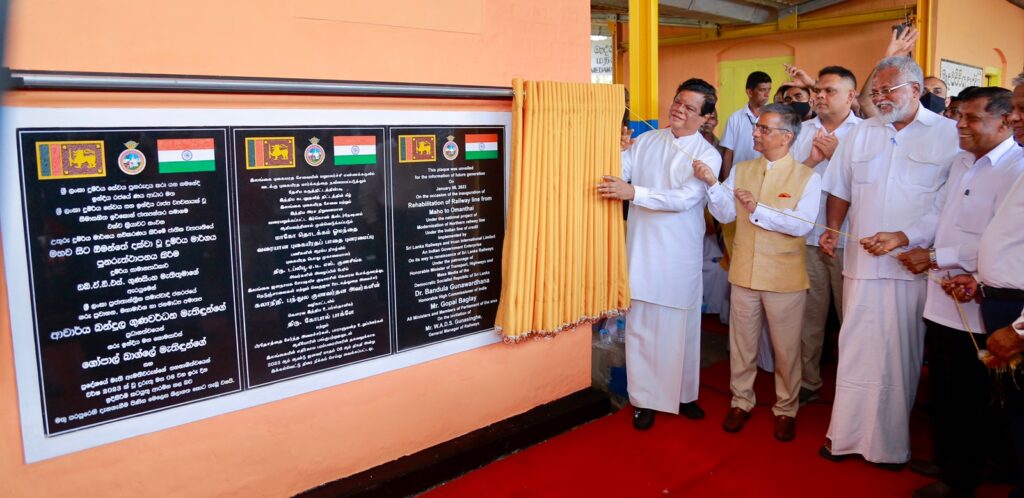
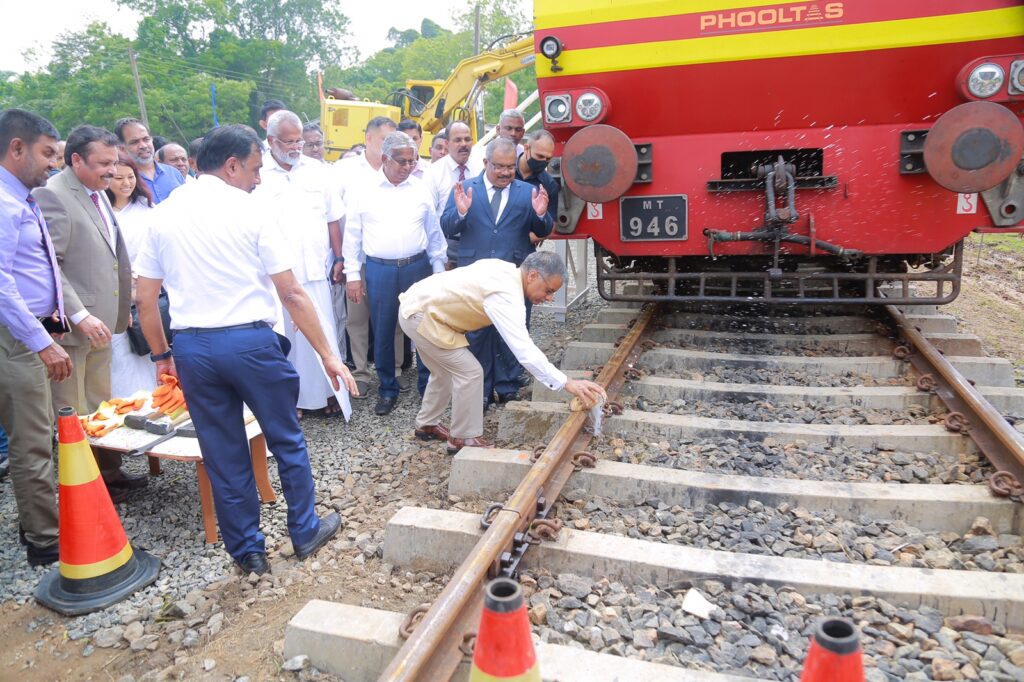
On January 08, 2023, Hon. Minister of Transport of Sri Lanka Dr. Bandula Gunawardane and High Commissioner of India to Sri Lanka H.E. Mr. Gopal Baglay ceremonially launched track rehabilitation work at Medawachchiya for upgradation of Railway Line including ancillary works from Maho to Omanthai (128Km) being undertaken by an Indian Public Sector company, IRCON, under an existing Indian Line of Credit (LOC) of USD 318 million at a cost of USD 91.27 million. Hon. Minister of Fisheries Mr. Douglas Devananda, Hon. State Minister of Finance Mr. Shehan Semasinghe, Hon. State Minister of Highways Mr. Sirapala Gamlath and senior officials from the Sri Lankan Ministry of Transport were present at the event.
2. In his remarks, Hon. Minister of Transport thanked India for the support extended to Sri Lanka, especially in the transport sector. Appreciating the work done by IRCON in Sri Lanka in the past few years, he called for greater Railway cooperation between the two countries.
3. The High Commissioner highlighted that India has executed projects of over USD 1 billion in the Railways sector under 5 Indian LOCs. In addition, projects of about USD 180 million are either ongoing or in pipeline under existing LOCs. He underscored the importance of modernization of Railways in enhancing mobility of goods and services in Sri Lanka thereby boosting economic activity. The High Commissioner also stressed the importance of strengthening connectivity internally as well as with India for enhancing pilgrimages, tourism, trade and economic benefits for the people of both countries. He stated that India will work with Sri Lanka to introduce green and sustainable transport solutions.
4. As a long-standing development partner of Sri Lanka, Government of India has executed several projects in Sri Lanka under its concessional loans and grant schemes. Of the different sectors of cooperation under these facilities, the upgradation and modernization of Sri Lankan Railways has been one of the priority areas. IRCON started its operations in Sri Lanka in March 2009 and has contributed towards modernization of Sri Lanka Railways by reconstructing the entire railway line network in Northern Province (253 Km) and upgradation of Southern line (115 km). It has also contributed to ensuring safety and reliability through a modern signaling & Telecommunication system on a 330 km stretch of Railway line.
5. India’s support to Sri Lanka under various LOCs has continued even after April 2022. Recently, 125 out of the 500 India-made Mahindra SUVs being supplied under an LoC were handed over to Sri Lanka Police. Similarly, 75 out of the 500 Ashok Leyland buses being supplied under an LoC were handed over to the Sri Lanka Transport Board last week.
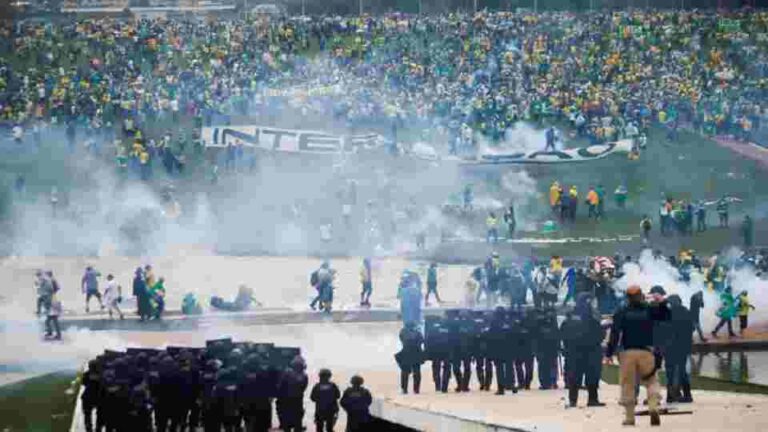
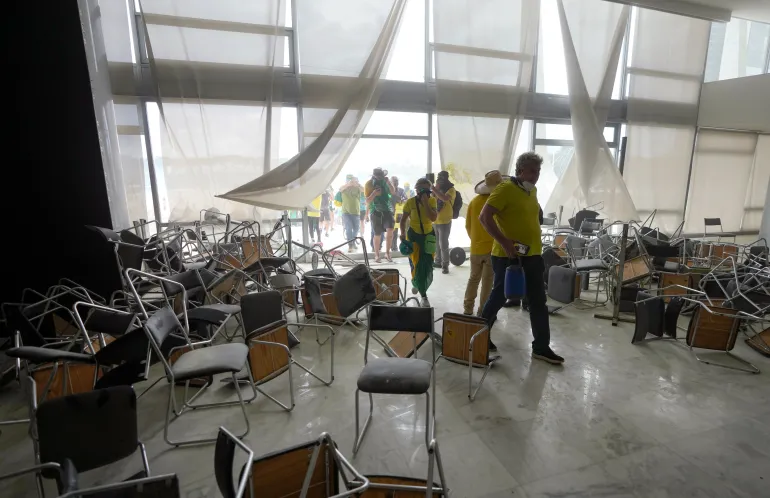
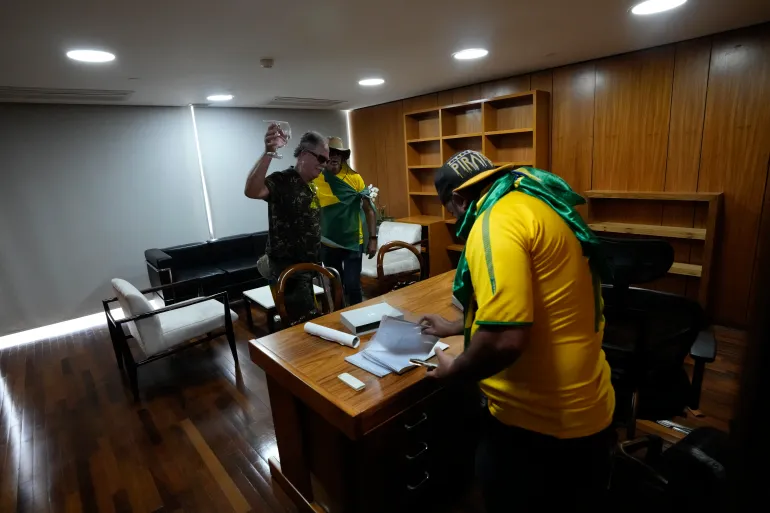
Videos on social media showed Bolsonaro supporters smashing windows and furniture in the National Congress and Supreme Court buildings on Sunday. They climbed onto the roof of the Congress building, where Brazil’s Senate and Chamber of Deputies conduct their legislative business, unfurling a banner that read “intervention” and an apparent appeal to Brazil’s military.
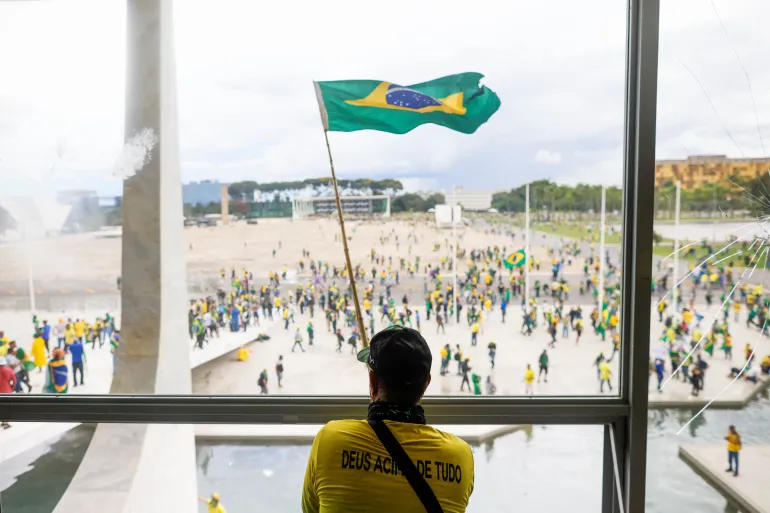
Images on TV channel Globo News also showed protesters roaming the presidential palace, many of them wearing green and yellow – the colours of the Brazilian flag, which have also come to symbolise the Bolsonaro government.
One social media video showed a crowd outside pulling a policeman from his horse and beating him to the ground.
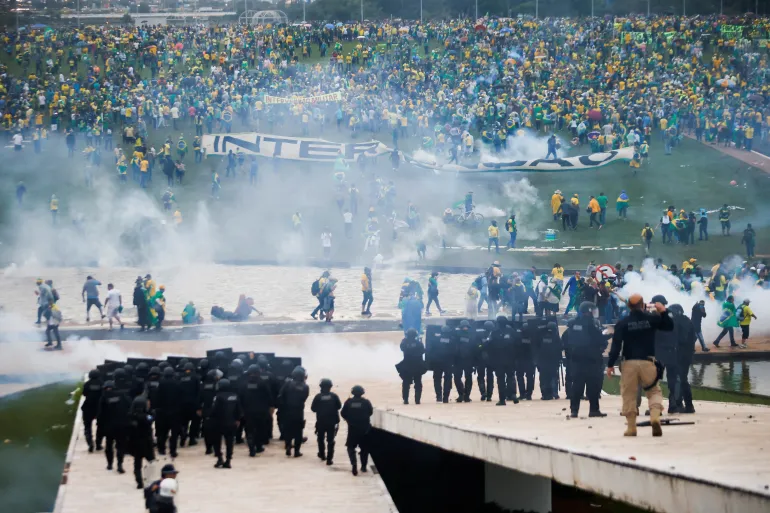
Security forces used tear gas in an effort to push back the demonstrators with local media estimating about 3,000 people were involved in the incident.
The siege, which lasted a little over three hours, comes just a week after the inauguration of Bolsonaro’s leftist rival, President Luiz Inácio Lula da Silva.
Responding to the invasion, Lula declared a federal security intervention in Brasilia that will remain in place until the end of the month.
In a press conference, he blamed Bolsonaro and complained about a lack of security in the capital, saying authorities had allowed “fascists” and “fanatics” to wreak havoc.
“These vandals, who we could call fanatical Nazis, fanatical Stalinists … fanatical fascists, did what has never been done in the history of this country,” said Lula, who was on an official trip to Sao Paulo state. “All these people who did this will be found and they will be punished.”
Bolsonaro, who has yet to concede defeat in the October 30 vote and is currently in the US state of Florida, has peddled the false claim that Brazil’s electronic voting system was prone to fraud, helping to fuel protests against Lula’s win.
Supporters have blocked roads, set vehicles on fire and gathered outside military buildings calling on the armed forces to intervene.
“This genocidist … is encouraging this via social media from Miami,” Lula said, referring to Bolsonaro. “Everybody knows there are various speeches of the ex-president encouraging this.”
Bolsonaro was silent for nearly six hours about the chaos in Brasilia before posting on Twitter that he “repudiates” Lula’s accusations against him.
The former president added that while peaceful demonstrations were part of democracy invading and damaging public buildings “crosses the line.” He did not attend Lula’s inauguration.
Reporting from Rio de Janeiro, Al Jazeera’s Monica Yanakiew noted that some Bolsonaro supporters had been camped out in Brasilia since the election.
“People from this camp and from other parts marched toward the square in Brasilia, called the Three Powers square, because in this same square you have Congress, the presidential palace, and the Supreme Court and they’ve entered the three buildings,” she said.
“They went inside the Supreme Court, which they consider to be their main enemy, because they say that the Supreme Court is biased, and recognised an election that they say is stolen,” Yanakiew said, noting that the incident occurred after Lula’s January 1 inauguration, when authorities were less likely to expect such a siege.
However, she added the “big question” remained as to why demonstrators were so easily able to overrun security forces during the incident, which took place when legislators, justices and other officials were not on the premises.
The storming recalled the January 6 invasion of the United States Capitol by supporters of former President Donald Trump, who like Bolsonaro’s supporters, also claimed without evidence that the 2020 US presidential election was “stolen”.
US President Joe Biden described the situation in Brazil as “outrageous” and that he looked forward to continuing to work with Lula.
“I condemn the assault on democracy and on the peaceful transfer of power in Brazil. Brazil’s democratic institutions have our full support and the will of the Brazilian people must not be undermined,” Biden said on Twitter.
Brazilian law professor Diego Amparo said that like Trump, Bolsonaro had for years fomented distrust in government institutions.
“It’s the kind of rhetoric that was seen not only in the election cycle, but throughout the whole presidency of Bolsonaro,” he told Al Jazeera. “So this moment is really the concrete symbol of several years of trying to discredit the political and judicial institutions in the country.”
He added that many local officials and members of the armed forces maintain ties with Bolsonaro, making it a “very complicated situation” for Lula and his government to navigate.
On Twitter, Brazil’s Justice Minister Flavio Dino said: “This absurd attempt to impose their will by force will not prevail.”
“The government of the Federal District has ensured there will be reinforcements. And the forces at our disposal are at work,” he said.
Chief Justice Rosa Weber and Justice Alexandre de Moraes pledged punishment for the “terrorists” who had attacked the country’s democratic institutions, while the heads of both houses of Congress denounced the attacks publicly.
Senate President Rodrigo Pacheco said he was in permanent contact with Brasilia’s Governor Ibaneis Rocha, and said that the entire police apparatus had been mobilised to control the situation.
Rocha later said on Twitter that more than 400 people had been arrested over the invasion. But the Brazilian police later revised the figure down to 300.
Rocha said those arrested “will pay for the crimes committed”.
“We continue working to identify all the others who participated in these terrorist acts this afternoon in the Federal District. We continue to work to restore order,” he tweeted.