January 04, Colombo (LNW): Public Administration Minister Chandana Abeyratne has voiced strong criticism of wildlife officials, accusing them of neglecting their duties as wild elephants continue to wander into villages, placing rural communities at risk.
Speaking at a special District Disaster Management Committee meeting in Puttalam, the Minister said there had been repeated complaints from residents about elephants entering residential areas, yet timely action to chase the animals away was often lacking.
He alleged that officers attached to the Department of Wildlife Conservation frequently failed to respond, even when villagers attempted to contact them directly by telephone.
The discussion, held yesterday (03) with the participation of local community members, focused on the growing human-elephant conflict in the district and the urgent need for more responsive and coordinated interventions.
Abeyratne stressed that the safety of villagers must be treated as a priority and called for greater accountability from relevant authorities in addressing the ongoing problem.
Minister Criticises Wildlife Authorities Over Elephant Intrusions in Villages

Schools Nationwide to Reopen Tomorrow (Jan 05)
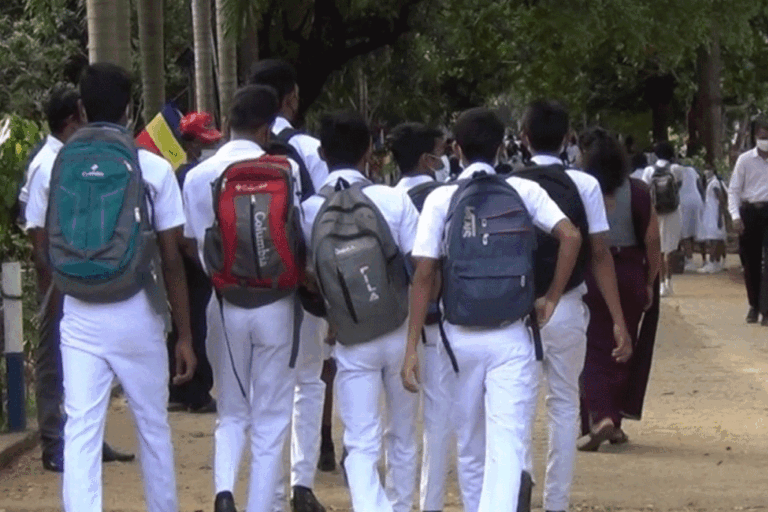
January 04, Colombo (LNW): Schools across the country are set to reopen tomorrow (04), marking the start of the first phase of the first term of the 2026 academic year, education authorities have confirmed.
The Ministry of Education said that all government schools, government-approved private institutions and pirivenas will resume classes in line with the new academic calendar. Teaching and related activities will recommence simultaneously, bringing students and staff back after the year-end recess.
Officials noted that the structure of the first school term for 2026 will follow the guidelines outlined in a circular issued on 9 December 2025, which sets out the timetable and key arrangements for the year ahead.
The Ministry also recalled that the previous academic year was formally concluded in late December, with Sinhala and Tamil medium schools closing on December 22 and Muslim schools ending their term on December 26.
Rs. 150 Billion Earmarked for Repair of Disaster-Hit Roads: Minister
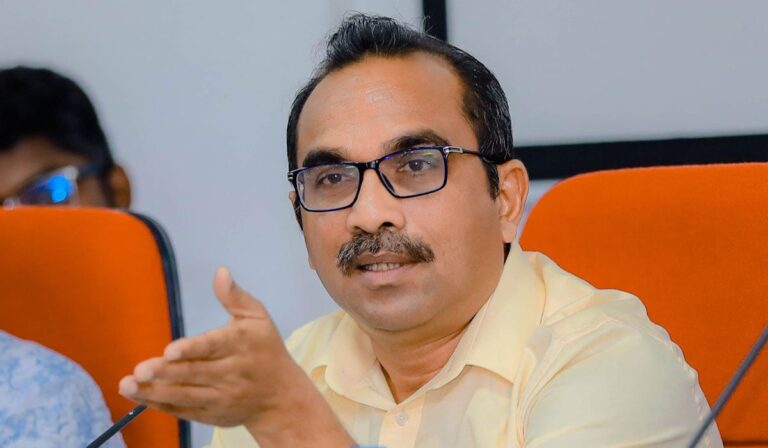
January 04, Colombo (LNW): The Government has set aside Rs. 150 billion to restore roads damaged by recent natural disasters, Minister of Transport, Highways and Urban Development Bimal Rathnayake announced, underscoring the priority being placed on rebuilding essential infrastructure.
Speaking on the issue, the Minister said several planned central government programmes aimed at upgrading rural road networks have been temporarily suspended. He explained that resources and manpower are being redirected towards urgent repairs and relief work in areas worst affected by disasters, where transport links are critical for daily life and economic activity.
Rathnayake assured the public that the administration is focused on a swift and effective recovery, with repair work expected to commence in phases to ensure connectivity is restored as quickly as possible across the country.
He also appealed for unity during what he described as a national emergency, noting that while citizens are entitled to support any political party during election periods, the present situation calls for cooperation beyond political differences.
The Minister urged political groups, civil society and the wider public to work collectively and extend their support to recovery efforts, emphasising that rebuilding the country’s infrastructure will require a shared commitment and a sense of national solidarity.
Grade 6 English Textbook Controversy: Preliminary Report Handed Over
January 04, Colombo (LNW): A preliminary report into the controversy surrounding the Grade 6 English learning module has been handed over to the Ministry of Education, as authorities intensify efforts to determine how an unsuitable website reference found its way into official teaching material.
According to Education Ministry Secretary Nalaka Kaluwewa, the initial inquiry examined the processes involved in preparing and approving the module, with particular attention paid to the source of the questionable content.
Alongside this, the National Institute of Education is conducting its own internal review to assess possible procedural lapses.
Kaluwewa said arrangements are underway to appoint an independent committee to pinpoint responsibility for the error and recommend corrective action. At the same time, subject specialists within the Ministry have been asked to propose urgent revisions to the module so that it can be safely issued to schools without further delay.
Officials indicated that the revised material will be released to students as soon as the recommended amendments are completed and approved, in order to minimise disruption to classroom teaching.
Separately, the Criminal Investigation Department has accelerated its own inquiry after a formal complaint was lodged by the Education Ministry. Investigators have already recorded statements from several individuals, including senior officers of the National Institute of Education. To ensure the investigation proceeds without interference, the Director General of the NIE has temporarily relinquished her duties, pending the outcome of the ongoing probes.
FACETS Sri Lanka 2026 Opens in Colombo, Drawing Global Spotlight to Island’s Gem Trade
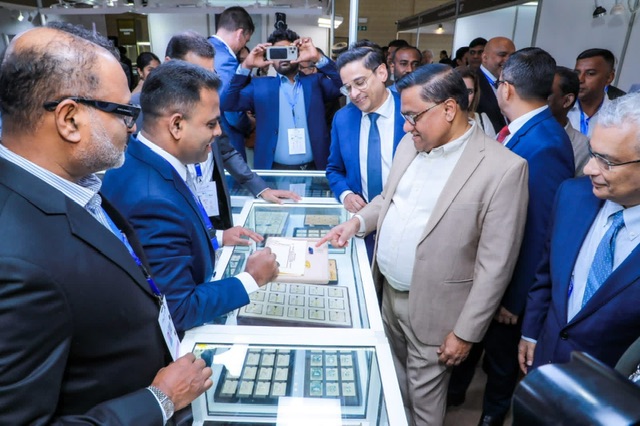
January 04, Colombo (LNW): Sri Lanka’s flagship international gem and jewellery exhibition, FACETS Sri Lanka 2026, was formally launched yesterday (03) at the Cinnamon Life Hotel in Colombo, marking the return of one of Asia’s most influential trade showcases for the industry.
The opening ceremony was held under the patronage of Minister of Industry and Enterprise Development Sunil Handunnetti and Minister of Foreign Affairs, Foreign Employment and Tourism Vijitha Herath. The three-day event, which continues until January 05, has been organised through a collaboration between the Sri Lanka Gem and Jewellery Association, the National Gem and Jewellery Authority and the Export Development Board.
Now in its 32nd year, FACETS Sri Lanka has established itself as a key meeting point for the global gem and jewellery trade, drawing buyers and industry professionals from markets such as China, India, the United States and across Europe. Organisers noted that this year’s edition is particularly significant, with representatives from several internationally recognised gem and jewellery houses taking part for the first time, alongside a strong presence of local traders and exporters.
The exhibition is designed to strengthen commercial links between Sri Lankan exporters and overseas buyers, while opening new avenues for investment and long-term partnerships. Visitors are being offered a broad view of the country’s gemstone wealth, finished jewellery and value-added products, reflecting both traditional craftsmanship and modern design trends.
FACETS Sri Lanka 2026 is also being promoted as a platform to highlight ethical sourcing, sustainability and the enduring reputation of Sri Lankan gems in the global marketplace. The inauguration was attended by senior government officials, Chairman of the National Gem and Jewellery Authority Dr S. P. Chaminda, members of the diplomatic community and leading figures from the industry, underscoring the sector’s importance to the national economy.
Low-level atmospheric disturbance continues to influence island’s weather: Showers expected enhance (Jan 04)

January 04, Colombo (LNW): The low-level atmospheric disturbance located to the east of Sri Lanka continues to influence the island’s weather, and therefore, showery condition is expected to enhance over the Northern, Eastern, and Uva Provinces during the coming days from January 5th, the Department of Meteorology said in its daily weather forecast today (04).
Showers will occur at times in Eastern and Uva provinces and in Polonnaruwa, Matale and Nuwara-Eliya districts.
A few showers will occur in Anuradhapura and Hambantota districts.
Showers or thundershowers may occur at a few places in Sabaragamuwa provinces and in Kaluthara, Galle and Matara districts after 2.00 p.m.
Strong winds up to 50 kmph can be expected at times over Eastern slopes of the central hills, Northern, North-central, North-western and Eastern provinces and in Hambantota, Gampaha Colombo and Monaragala districts.
The general public is kindly requested to take adequate precautions to minimise damages caused by temporary localised strong winds and lightning during thundershowers.
Marine Weather:
Condition of Rain:
Showers will occur at several places in the sea areas off the coast extending from Kankasanthurai to Pottuvil via Trincomalee and Batticaloa.
Winds:
Winds will be north-easterly and wind speed will be (30-40) kmph. Wind speed can increase up to (50-55) kmph at times in the sea areas off the coast extending from Galle to Hambantota via Colombo, Puttalam, Kankasanthurai, Trincomalee and Batticaloa.
State of Sea:
The sea areas off the coast extending from Galle to Hambantota via Colombo, Puttalam, Kankasanthurai, Trincomalee and Batticaloa will be rough at times.
The other sea areas around the island may be fairly rough.
Coconut Exports Break Billion-Dollar Barrier in Landmark Year

January 04, Colombo (LNW): Sri Lanka’s coconut-based exports have crossed the US$ 1 billion mark in 2025 and are expected to finish the year at close to US$ 1.2 billion, underscoring a dramatic surge from the previous year and signalling a turning point for the island’s coconut industry.
The sector recorded earnings of about US$ 800 million in 2024, making the latest performance a year-on-year increase of more than 40 per cent. Officials describe this as a significant milestone that confirms coconuts as one of the country’s most promising export commodities.
Deputy Minister of Industry and Entrepreneurship Development Chathuranga Abeysinghe said the industry has rapidly evolved into a strategic pillar of Sri Lanka’s export economy. He expressed optimism that continued policy reforms, productivity gains and access to new international markets could lift coconut-based exports to as much as US$ 2.5 billion by 2030.
Despite the strong growth, authorities acknowledge that limited nut productivity remains the sector’s biggest bottleneck. In response, the Government launched a series of structural measures in 2025 aimed at improving yields and expanding the extent of cultivated land, though officials caution that the benefits of these interventions will take time to materialise.
To address immediate pressures, policymakers focused on encouraging changes in domestic consumption patterns. This included promoting more efficient household use of coconuts, introducing substitute products for everyday needs and encouraging simple practices to reduce wastage at the consumer level.
In parallel, exporters were permitted to import coconut milk and kernel-based products strictly for re-export, a move that helped maintain export supply chains without disrupting the local market. Although only small volumes were brought in, the decision was credited with preventing shortages while preserving the industry’s export momentum.
Authorities say the achievement reflects close cooperation between government institutions, industry stakeholders and the public. With productivity reforms continuing and international demand for coconut-based products on the rise, Sri Lanka’s coconut sector is now firmly positioned as a long-term driver of export growth, with ambitious targets set for the years ahead.
Online Payment of Traffic Fines to Go Nationwide from Mid-January

January 04, Colombo (LNW): Motorists across Sri Lanka will soon be able to settle traffic spot fines online, with the GovPay digital payment system set to be rolled out islandwide by January 15, police officials have announced.
Deputy Inspector General of Police in charge of Traffic Control and Road Safety, W. P. J. Senadheera, said the groundwork for the initiative has already been completed. Speaking to the media in Colombo, he noted that police officers have been equipped with the necessary technology and training to ensure the system is fully operational by the target date.
The move is aimed at reducing delays and inconvenience for road users, allowing drivers to pay fines quickly and securely without the need for lengthy roadside procedures. Officials believe the new arrangement will also streamline traffic enforcement and improve overall efficiency.
DIG Senadheera stressed that under the revised process, motorists are not required to hand over cash to police officers under any circumstances. He reminded the public that both offering and accepting bribes are criminal offences and will be dealt with accordingly.
He further explained that strict adherence to the law would be maintained and that the digital payment system is expected to enhance transparency, while protecting police officers from allegations of financial impropriety in the course of their duties.
Navy Nets Massive Drug Haul as 2025 Crackdown Intensifies
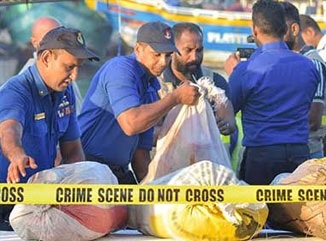
January 04, Colombo (LNW): Sri Lanka’s Navy has reported a sweeping series of anti-narcotics operations this year, uncovering illicit drugs and contraband worth more than Rs. 75 billion and detaining hundreds of suspects as part of an expanded national effort to curb organised crime at sea and on shore.
Operating under the government’s “A Nation United” drive to protect younger generations from the dangers of drugs, naval units stepped up patrols and intelligence-led raids across the island and its surrounding waters.
The campaign has relied heavily on cooperation with other law enforcement bodies and maritime partners, both domestic and international, reflecting what officials describe as a more coordinated and aggressive strategy.
Since the beginning of 2025, these operations have resulted in the interception of large consignments of heroin, crystal methamphetamine, hashish, cannabis sourced locally and overseas, as well as prescription medicines, foreign cigarettes and Kendu leaves. In total, 376 Sri Lankan nationals have been taken into custody in connection with these detections.
Among the most significant seizures were more than 1,050 kilogrammes of heroin, valued at over Rs. 25 billion, and close to 3,000 kilogrammes of crystal methamphetamine with an estimated street value exceeding Rs. 47 billion. These discoveries alone led to the arrest of 169 suspects and the seizure of 11 local fishing boats allegedly used for trafficking.
Naval teams also confiscated over 5,700 kilogrammes of foreign cannabis, detaining 73 suspects and impounding 19 vessels, while a separate series of raids resulted in the arrest of 11 individuals found with locally grown cannabis. Smaller but high-impact operations uncovered tens of kilogrammes of hashish and more than 1.6 million prescription tablets believed to have been diverted into illegal markets.
In addition to narcotics, the Navy intercepted large quantities of smuggled goods, including hundreds of thousands of foreign cigarettes and more than 67,000 kilogrammes of Kendu leaves, a commodity often linked to illicit trade networks. Dozens of suspects and vessels were detained in connection with these seizures.
Authorities say all suspects, boats and confiscated items have been handed over to the relevant agencies for further investigation and prosecution. Naval officials insist the intensified operations will continue throughout the year, signalling a sustained push to disrupt drug trafficking routes and weaken the criminal networks behind them.
Trump Claims US Has Captured Venezuela’s President as Strikes Hit Country
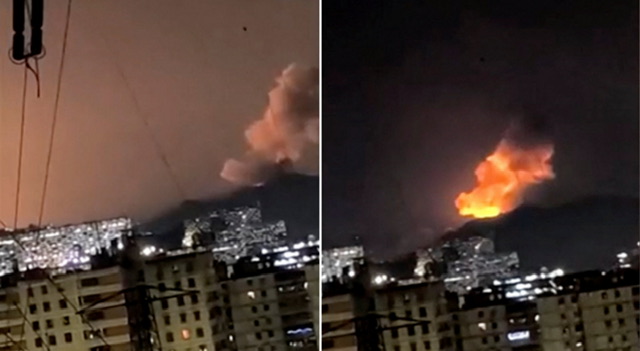
In a dramatic and unverified claim, former US President Donald Trump said the United States has captured Venezuelan President Nicolás Maduro and his wife following what he described as “large-scale” US military strikes against Venezuela.
In a statement released publicly, Trump claimed that Maduro had been flown out of the country after being taken into US custody. However, no official confirmation has been issued by US authorities, and details surrounding the alleged operation remain scarce.
Venezuela’s government strongly rejected the claims, condemning what it called “military aggression” by the United States. Officials announced a nationwide state of emergency and demanded “immediate proof of life” for President Maduro and his wife, warning that the claims could amount to disinformation and psychological warfare.
State media reported heightened security measures across the country, while senior Venezuelan officials accused Washington of violating international law and threatening regional stability. As of now, there has been no response from the US Department of Defense or the White House addressing Trump’s statement.
International observers have urged caution, stressing the absence of verified evidence and warning against escalating rhetoric. The situation remains highly fluid, with global attention focused on whether official confirmation or denial will emerge in the coming hours.