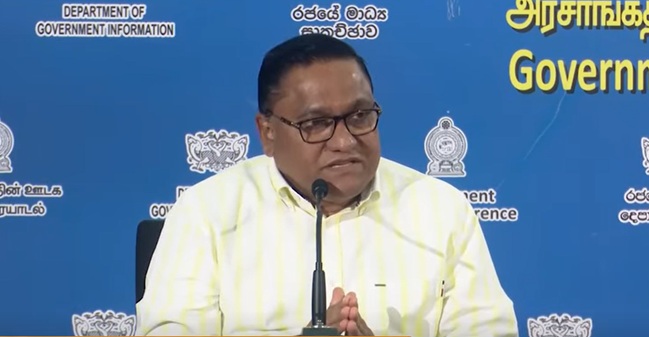
January 04, Colombo (LNW): The committee appointed to examine irregularities found in a newly produced Grade 6 English learning module has completed its investigation and submitted its findings, according to Education Minister Vijitha Herath.
Addressing journalists at a media briefing held today (04) at the Department of Government Information, the minister said the report would now be reviewed and that appropriate measures would be taken in line with its conclusions. He added that the authorities intend to act swiftly to prevent similar lapses in future educational materials.
The controversy arose after it emerged that the newly printed module contained a reference to an unsuitable website, prompting the immediate suspension of its distribution. The Ministry of Education launched an internal inquiry following a formal complaint, amid concerns over how such content found its way into material meant for schoolchildren.
The textbook was developed by the National Institute of Education (NIE) and had already gone to print when the issue was detected. Subsequently, the Secretary to the Ministry of Education, Nalaka Kaluwewe, filed a complaint with the Criminal Investigation Department, requesting a parallel criminal probe into the matter.
Mr Kaluwewe indicated that there was reason to believe the reference may have been inserted deliberately by an external party without authorisation. He stressed, however, that the document in question was not the final, legally approved version of the textbook and that ultimate responsibility for approval rests with the relevant education authorities.
As investigations continue, the Director General of the NIE, Professor Manjula Vithanapathirana, has temporarily stepped aside from her post, pending the outcome of the inquiry. The ministry has reiterated that safeguarding educational standards and protecting students remain its top priorities.
Inquiry Report Handed Over as Probe Continues into Grade 6 English Textbook Controversy
Parliamentary Pensions (Repeal) Bill Gazetted
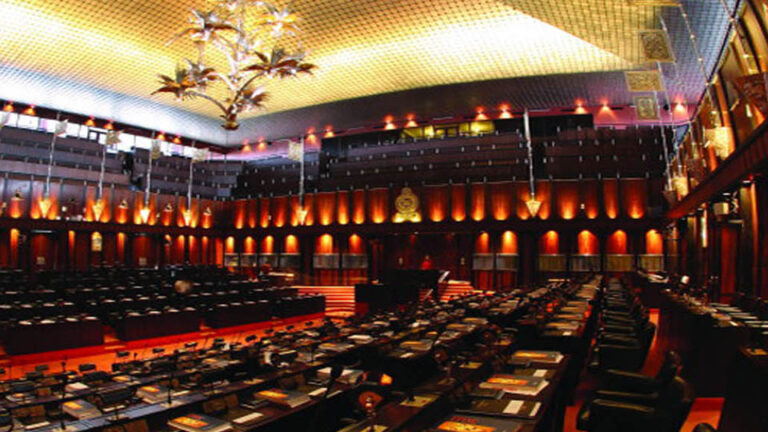
January 04, Colombo (LNW): Steps have been taken to dismantle the long-standing pension scheme for Members of Parliament, with a new bill formally published in the government Gazette proposing the repeal of existing legislation.
The Parliamentary Pensions (Repeal) Bill aims to do away with pension benefits currently enjoyed by MPs and their spouses, which are provided under the Parliamentary Pensions Act introduced in the late 1970s. If enacted, the proposed law would bring an end to these entitlements altogether.
The gazette notification was issued under the authority of the Minister of Justice and National Integration, signalling the government’s intention to press ahead with the reform. The move follows earlier approval by the Cabinet of Ministers to place the draft legislation before Parliament for debate and endorsement.
Before its publication, the bill was examined and cleared by the Attorney General, after which the Cabinet authorised both its gazetting and its subsequent submission to Parliament. Cabinet ministers had already agreed in principle to repeal the parliamentary pension law at a meeting held on June 16, 2025, paving the way for the current step.
JVP Denounces US Action in Venezuela as Assault on Sovereignty
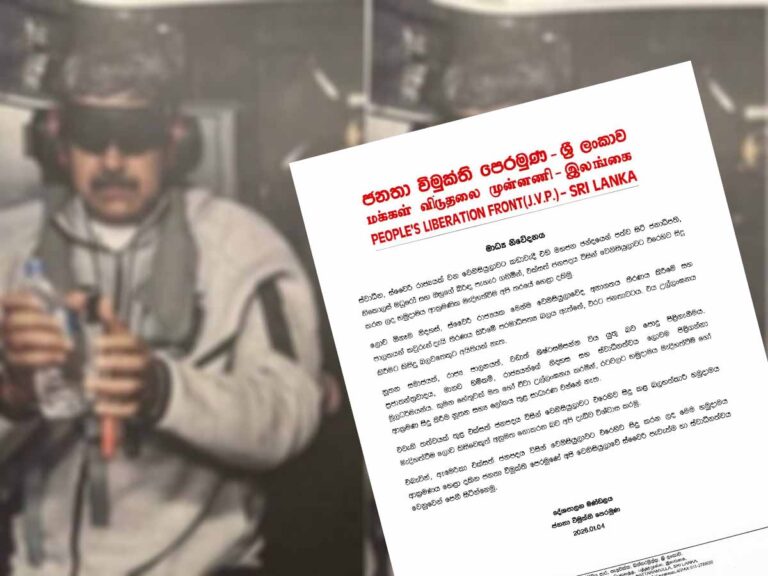
January 04, Colombo (LNW): The Janatha Vimukthi Peramuna (JVP) has sharply criticised recent actions by the United States in Venezuela, including military strikes and the detention of President Nicolás Maduro and his wife, describing the episode as an unacceptable violation of international norms.
In a statement released today, the party said the United States had overstepped all boundaries by intervening in the affairs of what it called an independent and sovereign nation. The JVP argued that President Maduro, having been chosen through a popular mandate, could not be lawfully removed or detained by an external power acting unilaterally.
The statement emphasised that, as with any self-governing country, decisions about Venezuela’s political future and leadership must rest solely with its citizens. According to the JVP, no state—regardless of its military or economic power—has the authority to override the will of another nation’s people.
The party also warned that such actions undermine the very principles frequently championed by the international community, including democracy, human rights and respect for national sovereignty. Resorting to military force, it said, erodes global stability and sets a dangerous precedent in international relations.
Concluding its remarks, the JVP reiterated its firm opposition to the United States’ intervention in Venezuela and expressed solidarity with the Venezuelan people, calling for respect for their independence and the peaceful resolution of political disputes.

Western Province Debt Surge Raises Alarms over Fiscal Stability

By: Staff Writer
January 04, Colombo (LNW): Sri Lanka’s local government debt profile has taken a sharp and uneven turn, with the Western Province emerging as the epicentre of a dramatic escalation that is raising serious concerns about fiscal discipline, service delivery, and the long-term economic health of the country’s most economically vital region.
According to Finance Ministry data, total outstanding debt held by Provincial Councils and local government authorities rose by nearly 25% in the six months to 30 September 2025. In absolute terms, liabilities increased by Rs. 1,268 million, reaching Rs. 6,419 million. However, this aggregate figure masks a striking regional imbalance. The Western Province alone accounted for more than the entire net increase, with its debt ballooning by Rs. 2,349 million—a staggering 389% surge within just half a year.
The Western Province, home to Colombo and the nation’s commercial core, plays an outsized role in Sri Lanka’s economy. As such, mounting liabilities at the local level carry broader implications. Economists warn that rising debt could constrain future infrastructure spending, crowd out essential services, and eventually require either higher local taxes or increased transfers from the central government.
In contrast, several other provinces moved in the opposite direction. The North Western Province reduced its outstanding debt by over Rs. 600 million, while the Uva and Central Provinces posted reductions exceeding one-third of their previous liabilities. These declines suggest that fiscal consolidation is possible under existing frameworks, further intensifying scrutiny of Western Province financial management.
While some provinces recorded modest increases such as the Southern and Sabaragamuwa Provinces their debt growth was marginal compared to the Western Province’s spike. Finance officials note that the concentration of debt growth points to province-specific factors rather than a nationwide trend.
For residents, the implications are tangible. Local government debt is often linked to delayed maintenance, stalled development projects, and reduced spending on sanitation, transport, and public health. If servicing costs rise, citizens may face higher rates, levies, or reduced quality of municipal services. In a province already grappling with congestion, cost-of-living pressures, and infrastructure strain, additional fiscal stress could deepen everyday challenges.
Analysts also warn that unchecked local debt could become a contingent liability for the national government, particularly amid Sri Lanka’s ongoing efforts to restore fiscal credibility. With the Western Province contributing a significant share of national revenue, financial instability at the local level risks undermining broader economic recovery.
The data underscores a pressing need for tighter oversight, transparent borrowing frameworks, and clearer accountability mechanisms especially in provinces where debt growth is accelerating at an alarming pace.
SL Electricity Tariff Shock Amid Crisis: Is Cost-Reflective Pricing Justified?
By: Staff Writer
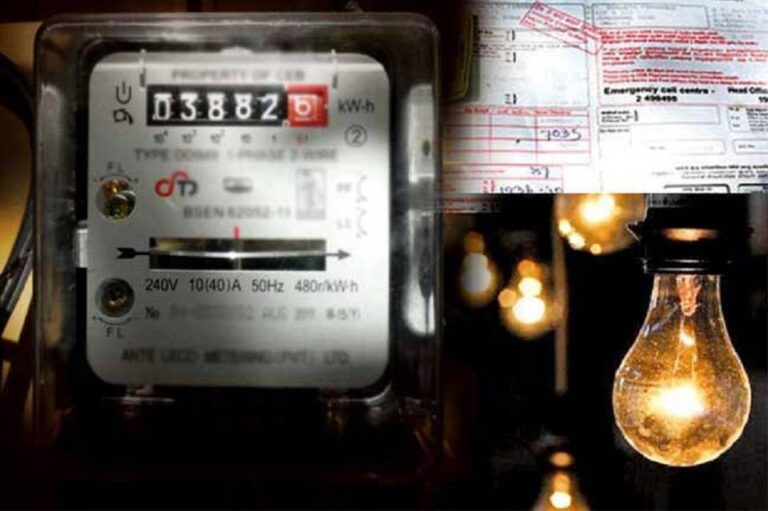
January 04, Colombo (LNW): Sri Lanka’s proposed electricity tariff increase has reignited a contentious national debate, placing the Government’s economic reform agenda on a collision course with public hardship and political accountability. As households reel from the aftermath of Cyclone Ditwah and rising living costs, the proposed 11.57% tariff hike has drawn sharp criticism, particularly from the Opposition, who argue that the timing and scale of the increase are both unjust and contradictory to electoral promises.
Opposition Leader Sajith Premadasa has emerged as one of the strongest critics, warning that millions already displaced or economically strained by the cyclone would bear an unfair burden. He has accused the Government of abandoning commitments made while in Opposition, when current leaders pledged to reduce electricity bills by as much as 33%. Instead of relief, consumers now face higher charges, a move Premadasa describes as a breach of the public mandate.
However , the Government’s position is rooted in structural reform. In response to public backlash, the Ministry of Energy has released the National Electricity Policy for public consultation, outlining a binding framework aimed at restoring financial discipline to the power sector. Issued under the amended Sri Lanka Electricity Act, the policy marks a decisive shift away from politically administered tariffs toward a pricing regime based on long-term system costs and financial sustainability.
Central to the policy is the reaffirmation of cost-reflective tariffs, a cornerstone of Sri Lanka’s ongoing International Monetary Fund (IMF) Extended Fund Facility program. The policy asserts that electricity prices must reflect the true cost of generation, transmission, and distribution, while ensuring the financial viability of utilities. Any subsidies, it states, must be transparent, targeted, and explicitly funded rather than hidden through cross-subsidisation.
To address social concerns, the policy allows for limited “lifeline” tariffs for vulnerable consumers, subject to regulatory approval. However, it makes clear that broad-based subsidies are incompatible with long-term sector stability. The framework also formalises the unbundling of the Ceylon Electricity Board (CEB), creating separate entities for generation, transmission, distribution, and system operations, with a strengthened National System Operator overseeing planning and dispatch.
Renewable energy expansion is positioned as a strategic priority, but the policy introduces tighter controls, emphasising competitive procurement and grid stability over ad hoc approvals. Digitalisation, loss reduction, and demand-side management are also highlighted as tools to contain future tariff pressures.
The IMF has repeatedly underscored the importance of these reforms. During its last review mission, IMF officials stressed that cost-recovery pricing remains a continuous structural benchmark, warning that losses at the CEB would ultimately fall on taxpayers. While the tariff hike may be economically defensible within this framework, critics argue that without timely relief measures, cost-reflective pricing risks deepening social inequities during a period of national vulnerability.
Profitable Banks and Finance Companies Face Moral Test Amid Flood Relief Crisis

By: Staff Writer
January 04, Colombo (LNW): Sri Lanka’s banking and finance company sectors entered the final quarter of 2025 in their strongest financial position in years. Balance sheets expanded, profitability surged, and asset quality improved across both licensed commercial banks and non-bank finance companies. Yet this resurgence has coincided with one of the country’s worst climate-related disasters in recent years, raising difficult questions about responsibility, urgency, and fairness in post-disaster recovery.
According to Central Bank data, the banking sector’s total assets reached Rs. 24.5 trillion by end-September 2025, while profit after tax rose sharply to Rs. 279 billion. Credit growth accelerated, deposits expanded, and capital buffers remained well above regulatory minimums. The finance company sector recorded similarly strong momentum, with assets growing over 35 percent year-on-year and profits rising nearly 60 percent in the first half of the financial year.
Against this backdrop, the government has formally directed banks and finance companies to provide large-scale financial relief to households and businesses affected by the cyclone and widespread floods. These directives include loan moratoriums, restructuring facilities, and concessional credit for rebuilding damaged homes, vehicles, machinery, and livelihoods. On paper, the sector appears well-equipped to shoulder this burden.
However, affected communities report a stark gap between policy announcements and on-the-ground relief. While banks continue to report rising net interest income and declining impairment charges, disaster victims describe slow processing of relief applications, rigid eligibility criteria, and limited outreach in rural flood-hit areas. Finance companies, despite improved asset quality and declining non-performing loans, remain cautious in extending fresh credit to borrowers whose assets have been destroyed.
Meanwhile, government-led public relief and reconstruction spending has progressed at a noticeably slower pace. Budgetary allocations have been announced, but disbursement remains delayed, forcing banks and finance companies into the role of de facto first responders. At the same time, the state has intensified revenue collection efforts, tightening tax enforcement and fee recovery even as disaster-hit households struggle to rebuild.
This imbalance has created a perception that private financial institutions are being asked to move quickly, while public-sector relief mechanisms advance at a crawl. Industry insiders warn that without clear risk-sharing frameworks or partial government guarantees, forced relief lending could eventually strain balance sheets particularly among smaller finance companies with higher credit-to-deposit ratios.
As of late 2025, Sri Lanka’s financial system is stable, liquid, and profitable. The real test now lies beyond ratios and returns. Whether banks and finance companies can translate financial strength into timely, humane disaster relief while the state accelerates its own rebuilding commitments will define the sector’s credibility in a climate-vulnerable economy.
Sri Lanka Billion-Dollar Coconut Boom Depicts long-Term Policy Inheritance

By: Staff Writer
January 04, Colombo (LNW): Sri Lanka’s coconut export sector crossed the symbolic USD 1 billion mark during the first ten months of 2025, a milestone the government has been quick to celebrate. According to figures released by the Export Development Board (EDB), coconut and coconut-based exports earned USD 1,033.9 million from January to October 2025, reflecting a year-on-year growth of 43.83 percent.
While the Industries Ministry has framed this performance as evidence of its policy success, a closer examination suggests the surge owes much to groundwork laid years earlier rather than a sudden policy breakthrough.
The Ministry of Industry and Entrepreneurship Development highlights the shift from raw coconut exports to value-added products such as liquid coconut milk, virgin coconut oil, coconut cream, desiccated coconut, activated carbon, and coco peat.
Officials argue that this diversification strategy underpins the revenue growth and currently accounts for 7.2 percent of Sri Lanka’s total export earnings. However, industry analysts note that most large-scale processing facilities, export certifications, and market access agreements were established well before the current administration took office.
Global demand trends also played a decisive role. Rising health consciousness in North America, Europe, and East Asia has steadily increased demand for plant-based oils, dairy alternatives, and sustainable industrial inputs like activated carbon.
Sri Lanka, already positioned as a trusted supplier, benefited from this global shift rather than creating it. Exporters confirm that order volumes began expanding as early as 2022, driven by international market recovery and long-term branding of Sri Lankan coconut products.
On the cultivation side, however, the picture is less optimistic. Coconut productivity per hectare remains below potential due to aging plantations, erratic rainfall, and limited replanting. Farmers continue to face fertilizer access issues, fluctuating farmgate prices, and labor shortages. These structural weaknesses raise questions about the sustainability of export-led growth if upstream cultivation constraints are not addressed.
The government’s projection of reaching USD 2.5 billion in coconut export revenue by 2030 has also drawn skepticism. Without substantial new investment in replanting, irrigation, research, and smallholder support, exporters warn that processing capacity could soon outstrip raw nut availability. In that scenario, Sri Lanka risks importing coconuts to feed its own export industry undermining both margins and farmer livelihoods.
By end-2025, the coconut sector’s headline success is real but incomplete. The billion-dollar figure reflects favorable global markets and long-maturing investments rather than a single year’s policy performance. Whether this momentum can be sustained will depend less on press releases and more on long-overdue reforms in cultivation, productivity, and farmer resilience.
Prime Group Pledges Rs. 200 Million to National Recovery Effort After Cyclone Ditwah
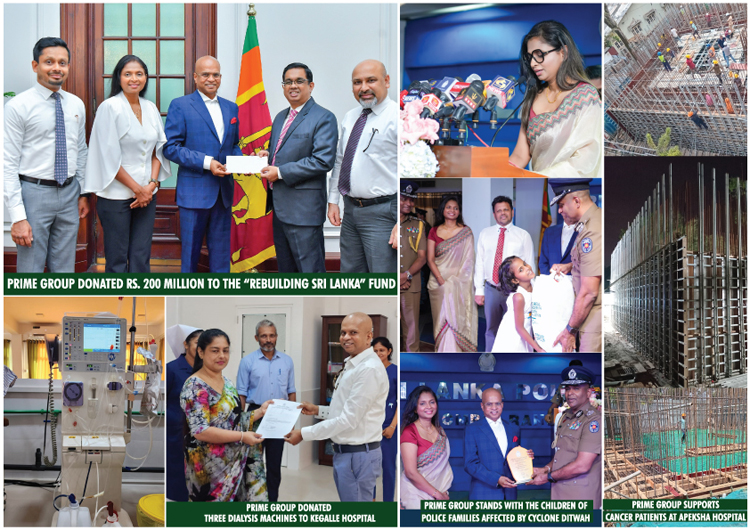
January 04, Colombo (LNW): Prime Group has made a significant contribution of Rs. 200 million to the Rebuilding Sri Lanka Fund, offering major corporate backing to the country’s recovery efforts following the devastation caused by Cyclone Ditwah.
The donation is widely regarded as one of the largest commitments made by a private sector entity towards post-disaster reconstruction.
The Group said the contribution reflects its belief that businesses have a responsibility that goes beyond commercial success, particularly during times of national hardship. Prime Group has long positioned itself as a corporate citizen with a strong focus on social responsibility, especially in the areas of education and healthcare.
Co-Chairperson of Prime Group, Sandamini Perera, reiterated this philosophy, noting that the company views investment in education as an investment in the nation’s future, while strengthening healthcare is seen as a moral obligation to society. She emphasised that these values continue to guide the Group’s long-term initiatives.
In the immediate aftermath of the cyclone, Prime Group also stepped in to support families directly affected by the disaster. Special assistance was extended to the children of police officers impacted by the cyclone, with full school supply kits provided for the new academic year to ensure their education continued without interruption. The Group highlighted its solidarity with frontline officers who serve communities under difficult and often dangerous conditions.
Prime Group’s contributions to healthcare have also had a lasting impact across the country. The donation of three dialysis machines to Kegalle Hospital has improved access to essential treatment for patients suffering from kidney disease. In addition, the Group is preparing to deliver a specialised radiation bunker with advanced chemical leak protection to the Apeksha Hospital, a critical facility required for the operation of Linear Accelerator machines used in cancer treatment. This development is expected to significantly reduce waiting times for radiotherapy and improve patient outcomes.
Further strengthening public healthcare services, Prime Group continues to support and maintain Ward 38 at the Kalubowila Teaching Hospital, enhancing the hospital’s ability to provide care to a growing number of patients.
Reflecting on the Group’s three decades in operation, Chairman Premalal Brahmanage said that true leadership is defined by the positive difference made in people’s lives. He added that Prime Group remains committed to contributing to the nation’s wellbeing, rebuilding communities and creating a more secure and hopeful future.
With a 30-year history marked by sustained social investment and nation-building efforts, Prime Group says it remains steadfast in its mission to support Sri Lanka’s recovery and long-term development.
Ex-Sathosa Transport Manager Detained in Probe Over Alleged Vehicle Misuse

January 04, Colombo (LNW): The Financial Crimes Investigation Division has taken into custody a former transport manager of Sathosa as part of an ongoing inquiry into the alleged improper use of a state-owned vehicle, police sources confirmed.
The suspect, identified as Indika Ratnamalala, was arrested in connection with accusations that a lorry belonging to Sathosa had been unlawfully utilised for private purposes.
Investigators are examining claims that the vehicle was used by Johan Fernando, the son of former minister Johnston Fernando.
State Drug Manufacturer Plans Major Expansion with New Products in 2026

January 04, Colombo (LNW): Sri Lanka’s State Pharmaceuticals Manufacturing Corporation (SPMC) has announced plans to roll out ten new medicines this year, signalling a further expansion of its domestic production capacity and product range.
In a statement, the state-owned manufacturer said it is aiming to produce around four billion tablets and capsules over the course of the year, building on steady growth achieved in recent times. At present, the corporation manufactures about 70 different pharmaceutical items that are supplied mainly to the public health sector.
Last year marked a record-breaking period for the SPMC, with output reaching an all-time high of more than 3.6 billion tablets and capsules. The corporation also reported its strongest monthly performance in March, when production peaked at approximately 385 million units.
During 2025, five new pharmaceutical products were added to the local market, while the corporation maintained an uninterrupted supply of medicines to meet all requirements issued by the Medical Supplies Division, despite ongoing challenges faced by the health sector.
Financially, the SPMC closed 2025 on a strong note, generating revenue of over Rs. 27 billion.