A project to provide a nutritional food allowance amounting to Rs. 45,000 will be granted to pregnant mothers during their pregnancy period starting from this year, the Ministry of Women, Child Affairs and Social Empowerment announced.
The nutritional allowance, which was introduced by the previous Good Governance Regime amounting to Rs. 20,000 evenly divided throughout the ten months of pregnancy, has now been revised to Rs. 45,000.
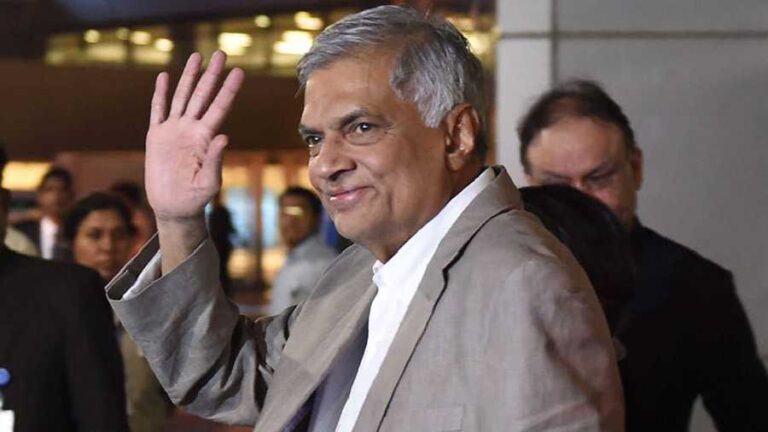
Sri Lanka’s President Ranil Wickremesinghe will be among twenty other world leaders to attend the ‘Voice of Global South’ virtual summit in India next week, Indian media claimed.
The event will be hosted by India and the President is set to leave soon, according to reports.
Over 120 countries have been invited to join the summit, which will be held on January 12 – 13, 2023, and it will have two sessions of heads of State and government to be chaired by Indian Premier Narendra Modi.
Other than neigbourhood countries, leaders from five countries from Africa (Angola, Ghana, Nigeria, Mozambique, and Senegal), three countries from the ASEAN grouping (Thailand, Cambodia, Vietnam) will be present, along with leaders of Uzbekistan, Mongolia, UAE, and Papua New Guinea, the reports added.
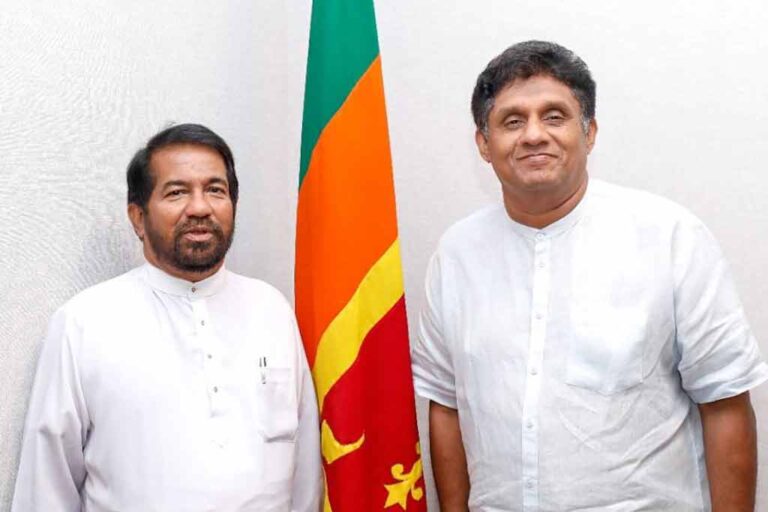
Ranjith Somawansa who served as the Sri Lanka Freedom Party (SLFP) Chief Organiser of Agalawatta met with Leader of the Opposition Sajith Premadasa and joined the Samagi Jana Balawegaya (SJB) yesterday (07).
Somawansa, a graduate of the University of Colombo and a prominent former student activist, previously served as the Minister of Health, Indigenous Medical Affairs, Probation and Child Care of the Western Province and the Minister of Education, Culture and Arts and delivered many services during his tenures.
He also served as the President of the Progressive Students Front and the President of the United Students Front of the University of Colombo, and entered politics through the SLFP at the invitation of Lady Sirimawo Bandaranaike.
He was elected as a Provincial Council member in 1993 and served under many titles including the House Leader and the Deputy House Leader of the Western Provincial Council for many decades.
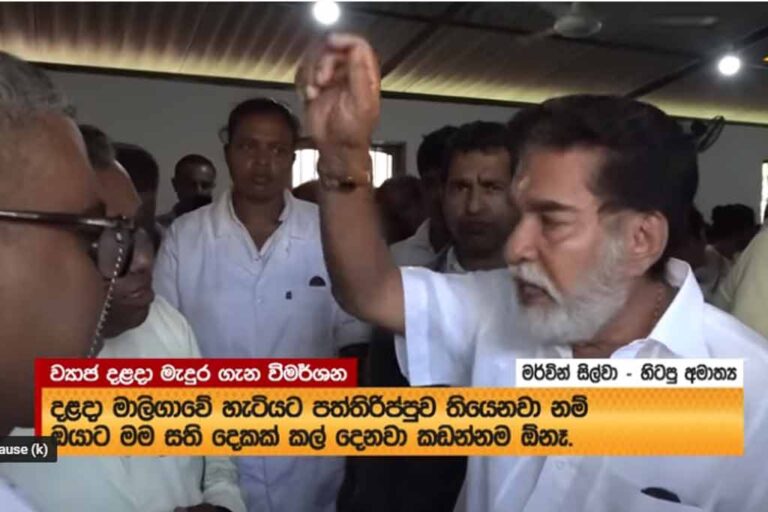
Former Deputy Minister Mervyn Silva, a politician with a notorious history of delinquent conduct by the abuse power who had not been much active in politics over the last decade, has once again appeared to turn the tide by barging into what it appears to be an octagon-shaped building resembling the holy Temple of Tooth Relic in Kandy currently in development in Wadakada, Pothuhera – Kurunegala yesterday (07) morning and ‘ordering’ its owner to smash it within two weeks.
The ex Minister’s move comes in following the the said building being at the centre of attention in a wider ongoing dialogue against the so called blasphemy, which according to critics is influenced by a political agenda to regain power, where a number of parties including the Chief Prelates of Buddhism had lodged a complaint to the Police that a ‘fake Tooth Relic Temple’ is being built. The President had also instructed the Police to launch a probe into the said construction.
Silva accompanying his supporters who barged into the building ‘ordered’ the building owner Bosath Senadhipathi to immediately change his name ‘Bosath’ to something else, and to wreck the whole place as its octagon shape resembles the Tooth Relic Temple within a period of two weeks.
UNP Chairman MP Wajira Abeywardana says holding the Local Government elections at this juncture will not solve the country’s burning issues: asserts it will not turnaround the bankrupt country: also says the total number of LG members has to be reduced to at least 4000.
Cabinet approves President Ranil Wickremesinghe’s proposal to set aside all state lands under the guidance of Divisional Secretaries.
President Ranil Wickramasinghe says Govt expects to receive India’s “response” regarding debt restructuring at the end of this month, “negotiations with China have re-commenced”, and expects the IMF facility to be received in the “first half of this year”: in May 2022, CB Governor Weerasinghe had assured the IMF facility would be in place and the economy stabilized by Aug’22.
All Ceylon Medical Officers’ Association General Secretary Dr Jayantha Bandara warns the lives of 10,000 cancer patients are in danger due to shortages in 15 vital cancer drugs: says 90% of the drugs used by them were in short supply.
Former President Gotabaya Rajapaksa returns from a private visit to Dubai: pictures of Rajapaksa with exotic animals in an exclusive animal park in Dubai go viral in social media.
Under the Indian “credit line”, 75 buses imported by the Govt: another 425 buses to be received this year: the buses “handed over” by Indian High Commissioner Gopal Baglay to Transport Minister Dr Bandula Gunawardena, Ports Minister Nimal Siripala de Silva, and Trade Minister Nalin Fernando.
Justice Minister Dr. Wijeyadasa Rajapakshe says Govt will introduce new laws as proposed by the Law Commission.
Several high-ranking Sri Lankan Buddhist Monks, who were on a pilgrimage to Bodh Gaya recently, seek a visit by the Dalai Lama to Sri Lanka.
Sri Lanka begins fresh austerity drive: freezes Govt recruitment: introduce new taxes and higher electricity and fuel prices: desperately try to secure the elusive IMF bailout: the IMF has so far ordered that the Govt’s 1.5 mn strong public service be trimmed, taxes sharply raised, and several State enterprises be sold.
India wins 3rd T20 Cricket International against Sri Lanka by 91 runs and win the series 2-1: IND – 228/5 (20): Sri Lanka 137 all out (16.4).
Sri Lanka and Bangladesh are now working together to enhance the ICT sector with the aim of improving connection creating new opportunities for development.
The High Commission of Sri Lanka in Dhaka organized a virtual meeting with the participation of the Information Communication Technology Agency (ICTA) in Sri Lanka and the Bangladesh Association of Software and Information Services (BASIS) this week to explore the opportunities of enhancing cooperation in the ICT sector and digital economy of both countries.
Making a comprehensive presentation, Associate Chief Digital Economy Officer of ICTA Sachindra Samararatne and Director Industry Development of ICTA Chiranthi Balapatabendi explained Sri Lanka’s ICT industry, its strengths and potential areas that can be collaborated. They also elaborated Sri Lanka’s 5-year strategy to develop the country’s Digital Economy.
Leading the discussion, Vice President of BASIS Fahim Ahmed and the officials of ICTA discussed potential areas of cooperation, which include connecting ICTA with BASIS members, exchanging ICT sector delegations, increasing links with universities to promote ICT education, sharing expertise in skills development and capacity building.
First Secretary (Commercial) Srimali Jayarathna of the High Commission of Sri Lanka participated in the discussion.
Bangladesh and Sri Lanka are two developing countries in South Asia and have commonalities in values and culture, and share similar developmental aspirations.
Both countries are members of the South Asian Association for Regional Cooperation (SAARC), the Bay of Bengal Initiative for Multi-Sectoral Technical and Economic Cooperation (BIMSTEC) and the Indian Ocean Rim Association (IORA), which has allowed both countries to foster engagement.
Sri Lanka and Bangladesh have already signed six Memorandums of Understanding (MoU) for strengthening youth development, agricultural research, exchange of professional knowledge, training of health nursing staff, international collaboration study and an interchange cultural program for 2021-2025.
Furthermore, Sri Lanka and Bangladesh, have decided to advance the process of signing the Preferential Trade Agreement (PTA) allowing duty free access to a range of goods between two countries to boost trade further.
This interim arrangement will be signed as it requires much time to complete a study for inking a Free Trade Agreement (FTA).
With a GDP of over US $ 305 billion, Bangladesh currently has the world’s 41st largest economy and forecasts suggest that the size of the economy could double by 2030.
Sri Lankan firms can explore opportunities in Bangladesh’s growing market for long-term growth prospects, which has also been called as next China, due to the low cost and high return in manufacturing.
In recent years, Bangladesh has emerged as a leading manufacturer of textile products and become a front runner in South Asia.
Focusing on Bangladeshi and Sri Lankan manufacturers’ own comparative advantages, both countries’ manufacturers have potential to further collaborate in the garment production process.
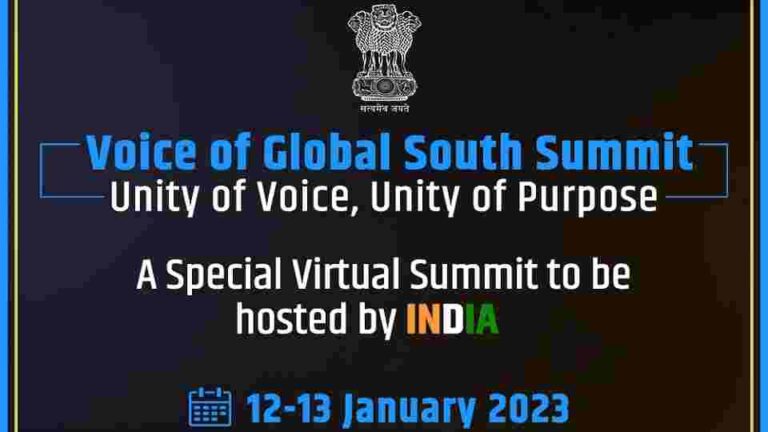
In a new and unique initiative, India will host a special virtual Summit on 12-13 January 2023. This “Voice of Global South Summit” under the theme “Unity of Voice, Unity of Purpose” envisages bringing together countries of the Global South to share their perspectives and priorities on a common platform. More than 120 countries are being invited to participate in this Summit.
2. The initiative is inspired by Prime Minister Shri Narendra Modi’s vision of Sabka Saath, Sabka Vikas, Sabka Vishwas and Sabka Prayas, and is underpinned by India’s philosophy of Vasudhaiva Kutumbakam.
3. India will work to ensure that the valuable inputs generated from partner countries in the Voice of Global South Summit deliberations receive due cognizance globally.
4. Further, India’s ongoing Presidency of the G20 provides a special and strong opportunity for those countries that are not part of the G20 process to share their ideas and expectations from the G20. This is in line with Prime Minister’s statement that India’s G20 Presidency will be shaped in consultation with not just our G20 partners, but also our fellow-travellers in the Global South, whose voice often goes unheard.
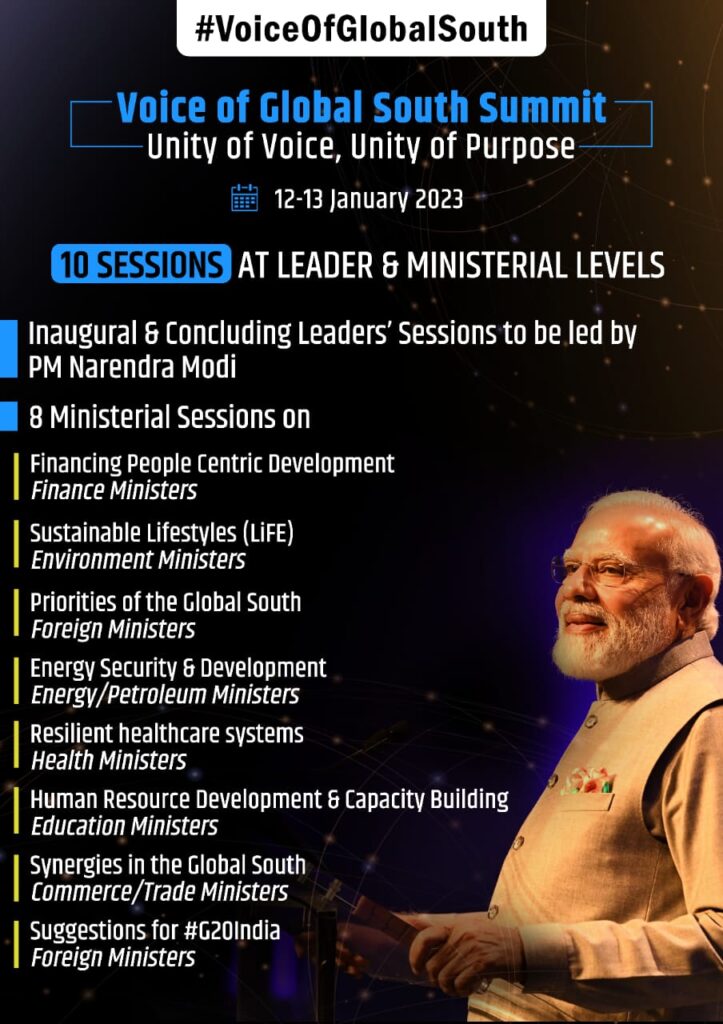
5. The Summit envisages ten sessions. Four sessions would be held on 12 January, and six sessions on 13 January. Each session is expected to witness the participation of Leaders/Ministers from 10-20 countries.
6. The inaugural and concluding sessions would be at Head of State / Government level, and hosted by the Prime Minister. The theme of the Inaugural Leaders’ session is “Voice of Global South – for Human-Centric Development” and that of the Concluding Leaders’ session is “Unity of Voice-Unity of Purpose”.
7. In addition, there would be 8 Ministerial sessions, with the following themes:
• Finance Ministers’ Session on “Financing People-CentricDevelopment”
• Environment Ministers’ Session on “Balancing Growth with Environment Friendly Lifestyles (LiFE)”
• Foreign Ministers’ Session on “Priorities of the Global South – Ensuring a Conducive Environment”
• Energy Ministers’ Session on “Energy Security and Development- Roadmap to Prosperity”
• Health Ministers’ Session on “Cooperation to Build Resilient Healthcare Systems”
• Education Ministers’ Session on “Human Resource Development and Capacity Building”
• Commerce and Trade Ministers’ Session on “Developing Synergies in the Global South – Trade, Technology, Tourism and Resources”
• Foreign Ministers’ Session on “G-20: Suggestions for India’s Presidency”
8. Further details regarding the Summit will be shared in due course.
(Contents have been taken from the Press Release issued by the Ministry of External Affairs on 6 January 2023.)
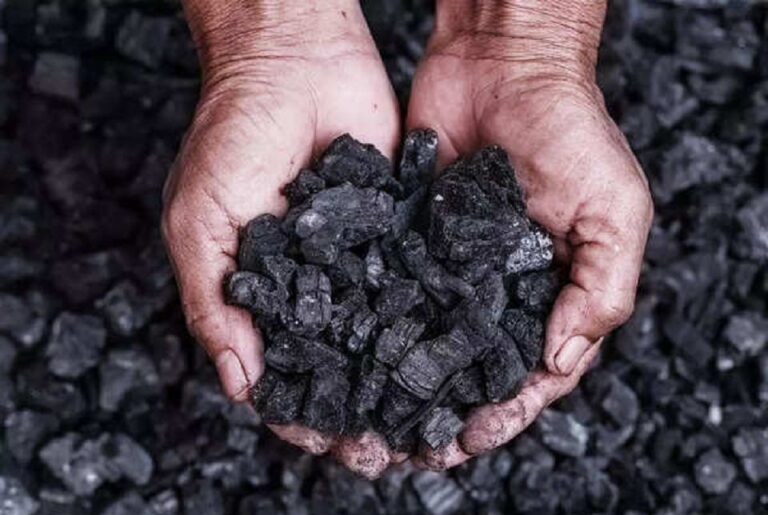
Sri Lanka is set to avoid impending eight to ten hour power cuts predicted by Ceylon Electricity Board Engineers Union and some officials as a result of the government’’s efforts to bring down coal to run Lakvijaya power plants materialized.
Seven ships of coal are scheduled to arrive in Sri Lanka within this month according to Shehan Sumanasekara, Chairman /Managing Director of Lanka Coal Company.
Accordingly seven ships, each carrying 60,000 metric tons of coal are scheduled to arrive in Sri Lanka on January 6, 7, 13, 20, 23, 27, and 31.
These coal ships are to be unloaded at Puttalam Harbor and the coal will be transported from there to Lakvijaya Power Plant in Norochcholai.
The Chairman of the Lanka Coal Company stated that regardless of various reports, the required coal can be supplied to the Norochcholai Power Plant without shortage, and accordingly, it will be possible to provide a continuous supply of electricity from the power plant.
As there is currently a problem in issuing letters of credit in the country, he has agreed with the supplier that 30 percent of the total amount will be paid when the coal is loaded on the ship and the remaining 70 percent will be paid when the coal is unloaded from the ship.
The chairman added that the required 30 percent of the payment has been made for all incoming coal ships.
Power and Energy Minister Kanchana Wijesekera reiterated that the 8-hour-long power cuts predicted by certain Ceylon Electricity Board trade unions will not materialize if the requested power tariff increase is granted this year and the arrival of coal shipments.
The proposal will be taken up by the Cabinet of Ministers on Monday 09. The price hike will happen legitimately and if anyone is against the decision can challenge it in the Courts,” he said .
Minister Wijesekera said the cost is based on average rainfall, noting that they still have a forecast for rain next year. “If there is more rain next year, we will reduce the price in July,” he added.
CEB General Manager said the proposed tariff hike in January is about 60% to 65% and it will be sought through the Cabinet of Ministers to offset costs.
Seneviratne claimed the electricity regulator, the Public Utilities Commission of Sri Lanka has not given a sufficient increase in the August tariff hike.
Many groups have voiced their objection to the proposal, claiming that it would be unfair to electricity users who had already seen an average 75% hike in electricity tariff across the board in August 2022.
Minister Wijesekera however said there is currently an effective subsidy of about Rs.100 billion to industries and Rs. 120 billion to households.
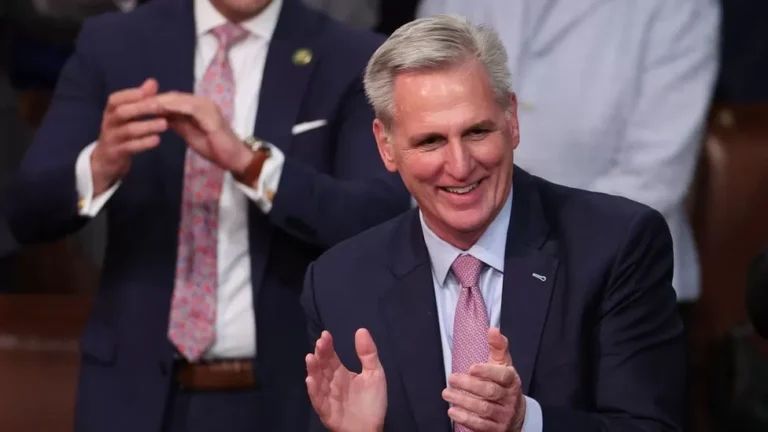
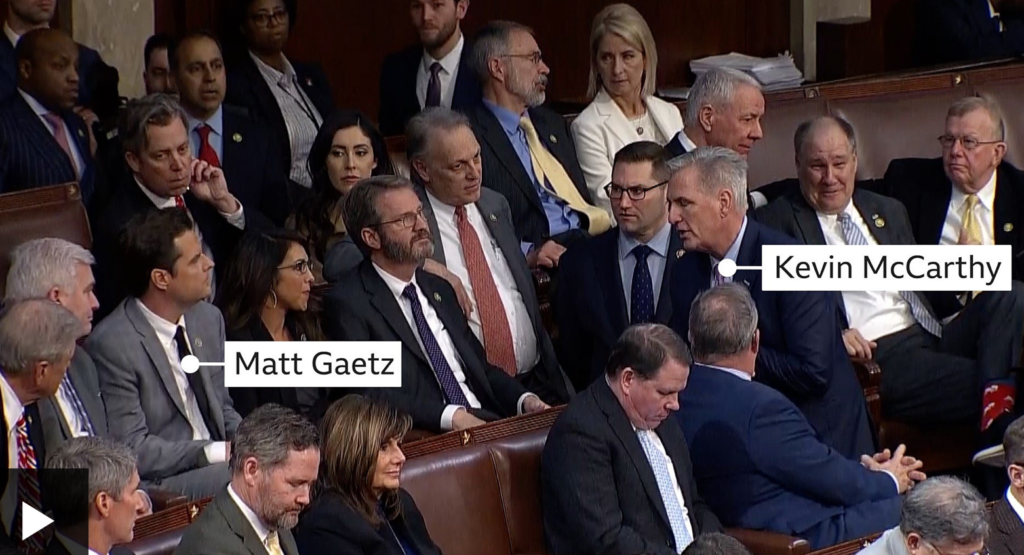
Kevin McCarthy has been elected Speaker of the US House of Representatives amid heated exchanges which almost saw fellow Republicans come to blows.
Mr McCarthy finally won the job after 15 rounds of voting, despite his party holding a majority in the chamber.
It came after a dramatic pressure campaign played out live on the House floor as party rebel Matt Gaetz was urged to vote for Mr McCarthy.
The Florida Congressman was among six holdouts who relented late on Friday.
Earlier, amid heated scenes in the chamber, Mr Gaetz had almost come to blows with Rep Mike Rogers – a supporter of Mr McCarthy. The Alabama congressman had to be physically restrained by colleagues as he bellowed and jabbed his finger at Mr Gaetz.
The Speaker sets the House agenda and oversees legislative business. The post is second in line to the presidency after the US vice-president.
Speaking after his confirmation, Mr McCarthy wrote on Twitter: “I hope one thing is clear after this week: I will never give up. And I will never give up for you, the American people.”
US President Joe Biden congratulated Mr McCarthy for his win and said he looked forward to co-operating with the Republican Party.
“The American people expect their leaders to govern in a way that puts their needs above all else, and that is what we need to do now,” he said.
Republicans have already pledged to launch investigations into Mr Biden’s family business dealings and administration.
After the 13th ballot was adjourned, Mr McCarthy insisted to reporters that he would “have the votes” to take the speakership on the next round.
In a remarkable turnaround in the 12th round of voting, Mr McCarthy was able to persuade 14 Republican holdouts to cast their vote for him. A 15th rebel followed suit for the 13th ballot.
But the California congressman was still three votes short of the 217 he needed to take the prized gavel, and in chaotic and dramatic scenes, he again failed to win on the 14th ballot.
The dissidents included members of the House Freedom Caucus, who argue that Mr McCarthy is not conservative enough to lead them as they work to stymie Democratic President Joe Biden’s agenda.
Mr McCarthy has offered various concessions to the rebels, including a seat on the influential rules committee, which sets the terms for debate on legislation in the chamber.
He also agreed to lower the threshold for triggering a vote on whether to unseat the Speaker, to only one House member, leading to the possibility that the Republican coalition could easily fracture again even after Mr McCarthy’s victory.
Senior Democratic Party lawmakers accused Mr McCarthy of ceding power to an extreme wing of his party and likened the stand-off to the riot exactly two years ago on Capitol Hill by Trump supporters who disrupted Mr Biden’s certification as president.
“Two years ago insurrectionists failed to take over the Capitol,” Congressman Eric Swalwell wrote on Twitter. “Tonight Kevin McCarthy let them take over the Republican Party.”
And Virginia Congressman Don Beyer referred to the angry scenes among Republicans that followed the 14th count.
“Unsettling that this process ends in threats of violence in the House Chamber, on this of all days,” he said. “Maybe it didn’t determine the outcome, but that is no way to conduct the people’s business. A dark and sobering moment will probably be remembered long after this session ends.”
The minority Democrats had continued to vote in unison for their leader, New York’s Hakeem Jeffries, the first black person ever to lead a party in Congress.
Friday was the first day that Mr McCarthy’s vote count actually surpassed that of Mr Jeffries.
Not since 1860 in the build-up to the American Civil War has the lower chamber of Congress voted this many times to pick a speaker. Back then it took 44 rounds of ballots.
In November’s midterm elections, Republicans won the House by a weaker-than-expected margin of 222 to 212. Democrats retained control of the Senate.
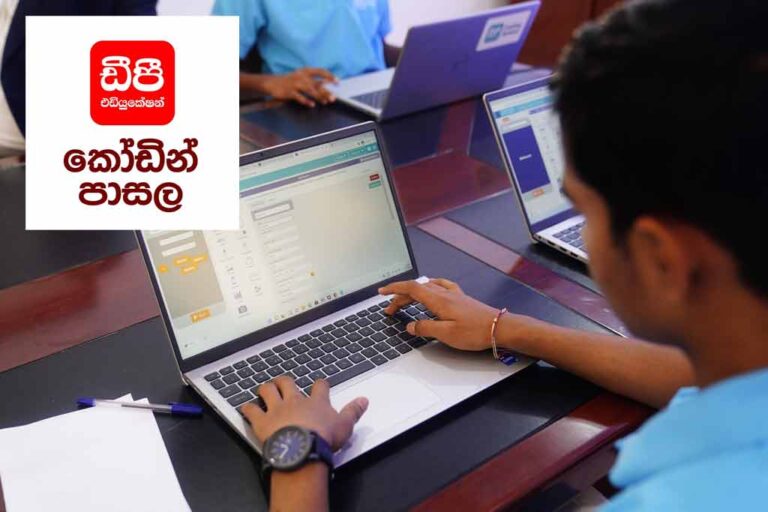
Following the introduction of the brand new ‘DP Coding School’ initiative launched by DP Education, parents often raised a number of questions during its initiation in different parts of the island.
Having these doubts would be very normal because the approach is new and may still be out of the ordinary career-based education initiatives you may have seen at the big top. DP Coding School is conducted with the aim of providing children with computer programming skills and opening the doors for them to apply for jobs with higher pay grades in the Coding field in the future, and will also contribute to foreign exchange and even going abroad.
Below are answers to some of frequently asked questions about DP Coding School:
Is knowledge on English Language necessary to study this course?
All lessons at DP Coding School are conducted in Sinhala and Tamil languages. Therefore, English Language is not required. In addition, in each of these lessons, 1 or 2 English words related to the subject are taught through computer programming. Therefore, those who complete the 324 parts of this entire package can add about 400 English words related to this subject to their vocabulary.
How many parts are in DP Coding School’s Complete Course?
It is planned to provide 324 projects covering 12 sectors. A digital certificate is offered for free once for every 8 projects.
What is the value of this course?
The value of the course in which all 324 projects are completed is Rs. 2.4 million. But it is offered Free of Charge.
Who can enroll?
Students can join this from first grade to any year. Anyone of any age who is interested in learning computer programming languages can join. Primary school children as well as people over 60 years of age are currently following this.
Course duration
The first 100 modules can be completed in 100 hours. Accordingly, a project takes about an hour. The video instructions of each of these projects are given in a very interesting way, so children can join them with great interest and fun.
What are the job opportunities that open from this course
Those who continue learning coding from this course can apply for jobs like Web Developer, Full stack Web Developer, Software Application Developer, Computer Programmer, and Data Scientist in the future.
Additional benefits for school students by following this course
Develops students’ logical thinking. Improves students’ creativity. Improves persistence. Develops resilience and flexibility. Improves communication skills. Improves students’ structural thinking. Improves students’ problem-solving skills. Helps students develop their mathematical ability. Helps students to feel satisfied. Develops students’ self-learning ability. Children will eventually become a person who can overcome the challenges of the 4th industrial revolution in the 21st century and contribute to the development of the country.
Having trouble registering for the course?
A Gmail account or a Facebook account is required to register on the code.org website. Currently, those 13 years of age or older can create an account and register as usual. Children under 13 can register via a Gmail account. The necessary instructions have been provided. Alternatively, parents can use their email account to register their children on the code.org website.
Guide your child to the new world with new knowledge in the New Year, and involve your child in this computer language (coding) course worth Rs. 2.4 million, which is provided completely Free of charge. Visit dpcode.lk today.