By: Staff Writer
January 06, Colombo (LNW): Sri Lanka’s gambling and casino industry is entering the new year under a significantly tougher tax regime, as sweeping amendments to the betting and gaming tax laws took effect on 1 January 2026. The Inland Revenue Department (IRD) confirmed that changes under the Betting and Gaming Levy (Amendment) Act, No. 25 of 2025 – revising the older Betting and Gaming Levy Act, No. 40 of 1988 – aim to boost state revenue by levying higher costs on both local players and industry operators.
Under the updated law, the Casino Entrance Levy (CEL) – a fee that must be collected from Sri Lankan citizens entering licensed gaming venues – has been doubled from US $50 to US $100 per entrant. The notice specifically states that all licensed casino operators must collect this levy in either foreign currency, its equivalent in Sri Lankan rupees, or another convertible currency from local citizens visiting the gaming floors. Operators must implement this new fee structure from the start of 2026 without exception.
In another major change, the Gross Collection Levy, which is charged on a casino’s total monthly receipts, has been raised from 15 % to 18 %. This increased rate applies to all bookmakers and gaming businesses whose gross monthly collections exceed Rs. 1 million, representing a marked rise in the tax burden on operators in what is already one of Sri Lanka’s most scrutinised sectors.
According to industry data and market listings, Sri Lanka is home to about 13 licensed land-based casinos, with the bulk concentrated in and around Colombo and a few in cities such as Wattala and Wennappuwa. Among the better-known establishments are Bally’s Casino Colombo, Bellagio Colombo, Casino Marina, Majestic Pride Lanka, Ballys Breeze, Sporting Times outlets, and MGM Casino. These venues offer a range of table games, poker, slot machines and often combine entertainment with bars and dining to attract both tourists and local high-rollers.
In addition to these traditional brick-and-mortar casinos, Sri Lanka’s gaming landscape is in the midst of transformation. Last year saw the launch of City of Dreams Sri Lanka, the country’s first integrated casino resort developed through a joint venture between John Keells Holdings and Hong Kong’s Melco Resorts & Entertainment. This multimillion-dollar complex in Colombo Port City is designed to attract high-end international tourism with luxury hotels, shopping, entertainment and extensive gaming facilities.
Despite this growth, regulation remains a topic of debate. The government announced plans to establish a Gambling Regulatory Authority (GRA) by mid-2026 to oversee all gambling land-based, ship-based, and online except traditional lotteries and social games. This authority is intended to standardise licensing, enforce compliance, curb money-laundering risks and streamline
While land casinos operate under clear licences, the online gambling space remains largely unregulated, with offshore platforms widely accessed by Sri Lankan players in a legal grey area. The new regulatory framework seeks to clarify these operations and pull more revenue from digital betting activity.
Government officials say the tax hikes are part of broader efforts to widen the tax base and help stabilise public finances following years of economic challenges. However, the industry faces criticism from some quarters over the social impact of gambling and its heavy tax burden, particularly on local players.
As the sector adapts to the new levy regime, both operators and patrons are closely watching how these changes will affect casino footfall, tourism appeal and long-term investment in Sri Lanka’s burgeoning gaming and leisure market.
Sri Lanka Doubles Casino Entry Fee as Betting Sector Tax Hike Kicks In

Labour Dept to crack down on EPF Defaulters Strengthening Enforcement
By: Staff Writer
January 06, Colombo (LNW): The Employees’ Provident Fund is often described as the backbone of Sri Lanka’s retirement system, but for tens of thousands of workers, that backbone is quietly cracking under the weight of unpaid employer contributions. Despite holding assets worth around Rs. 4.4 trillion and maintaining more than 21.5 million member accounts, the EPF continues to be undermined by persistent non-compliance, raising concerns about the effectiveness of enforcement mechanisms.
The Ministry of Labour has responded by upgrading its online complaint management system, allowing workers to report EPF-related violations directly through the Labour Department’s website. Officials insist this digital shift marks a turning point. Ministry Secretary S.M. Piyatissa says complaints are now actively followed up, with employees being informed of enforcement actions taken against defaulting employers, provided they submit their contact details.
Yet the scale of the problem suggests systemic weaknesses rather than isolated lapses. Parliamentary disclosures by the Ministry of Finance indicate that 22,450 companies have defaulted on EPF contributions since 2015, accumulating arrears of nearly Rs. 35 billion. These are not minor bookkeeping errors but sustained failures that have deprived workers of legally mandated savings over many years.
The current enforcement process begins with formal notifications, followed by discussions with company representatives. Legal action is taken only when these steps fail, and while courts can impose fines alongside recovery of dues, the lengthy process often works against employees. For workers nearing retirement or facing emergencies, delayed contributions may never fully compensate for lost investment growth.
This situation is particularly troubling given the central role the EPF plays in the national economy. Governed by the EPF Act No. 15 of 1958, the fund compels workers to part with a portion of their wages in the expectation of security and dignity in retirement. Employers, meanwhile, are entrusted with an even larger contribution obligation. When that trust is broken, the social contract underpinning the EPF is weakened.
Beyond retirement payouts, the fund supports housing loan guarantees and limited withdrawals for medical and housing needs, benefits that become meaningless if contributions are not credited on time. Moreover, as one of the largest domestic investors, the EPF’s stability underpins government borrowing and financial market confidence. Persistent defaults therefore threaten more than individual balances; they undermine economic credibility.
While the Labour Department’s digital reforms are a step forward, critics argue that relying on worker complaints places an unfair burden on employees, many of whom fear retaliation or lack awareness of their rights. Without proactive audits, automatic detection systems and faster penalties, the EPF risks remaining a giant fund with fragile enforcement. Until compliance becomes the rule rather than the exception, workers will continue to pay the price for institutional inertia.
Sovereignty Is Not a Shield: The Limits of Presidential Immunity

By: Roger Srivasan
A persistent myth continues to circulate in public discourse: that a sitting president enjoys absolute immunity from arrest or prosecution, guaranteed by the United Nations and insulated by the sacred principle of state sovereignty. It is an attractive fiction—simple, reassuring, and profoundly misleading. In reality, presidential immunity is neither absolute nor moral, and sovereignty has never been intended as a sanctuary for impunity.
The confusion begins with a fundamental misunderstanding of international law. The United Nations does not “grant” immunity to heads of state. No UN charter, resolution, or convention confers blanket protection on presidents simply by virtue of office. What exists instead is a body of customary international law, developed to facilitate diplomacy and ensure the orderly conduct of relations between states—not to shield leaders from accountability for grave wrongdoing.
International law recognises two forms of immunity. The first, immunity ratione personae, is personal and temporary. It protects certain senior office-holders—such as heads of state and government—from the jurisdiction of foreign domestic courts while they are in office. The second, immunity ratione materiae, attaches to official acts performed in an official capacity and may persist after a leader leaves office. Crucially, neither form was ever intended to be limitless.
Immunity is procedural, not moral. It delays prosecution; it does not extinguish culpability. Its purpose is pragmatic: to prevent diplomatic paralysis, retaliatory prosecutions, and the weaponisation of courts for political vendettas. It was never designed as a cloak behind which presidents could enable atrocities, orchestrate transnational criminal networks, or preside over the systematic corrosion of neighbouring states.
This distinction becomes decisive when conduct crosses a certain threshold. International crimes—genocide, crimes against humanity, war crimes, and serious transnational offences—pierce the veil of office. When a head of state knowingly facilitates large-scale criminality that spills beyond his borders, sovereignty ceases to function as a protective doctrine and begins to resemble a legal fiction maintained for convenience.
The post-war evolution of international law reflects this reality. The establishment of the International Criminal Court rests on a simple but revolutionary principle: no office, however exalted, places an individual above international criminal law. While jurisdictional limits and political constraints remain, the normative position is now settled. Accountability may be delayed; it is no longer denied.
History, moreover, has been an unsentimental tutor. Augusto Pinochet, once presumed untouchable, was arrested abroad despite his former status as head of state. Slobodan Milošević was transferred to international justice within years of wielding sovereign power. Manuel Noriega, a sitting leader at the time of his indictment, was prosecuted for narcotics trafficking. These cases differ in context and outcome, but they converge on a single point: sovereignty does not confer permanent legal invisibility.
It is here that intellectual discipline matters. To acknowledge the limits of immunity is not to endorse vigilantism, unilateral military incursions, or the theatrical abduction of leaders by foreign powers. International law does not legitimise lawlessness in the name of justice. Accountability must be pursued through lawful mechanisms: international courts, multilateral pressure, extradition processes, and collective diplomatic action. The rejection of impunity does not require the abandonment of order.
Yet it would be equally dishonest to pretend that sovereignty is inviolable when used as a weapon against the international community. A state that knowingly allows its territory, institutions, or leadership to become conduits for transnational criminal harm forfeits the moral force of its sovereignty claim. Sovereignty entails responsibility. When that responsibility is wilfully breached, the international system is not obliged to avert its gaze.
The insistence on “UN-guaranteed immunity” is therefore less a legal argument than a rhetorical refuge. It appeals to the language of law while hollowing out its substance. Worse still, it invites a dangerous inversion: that the very principles designed to preserve international order should be repurposed to protect those who undermine it.
Presidential office was conceived to serve the state, not to sanctify the individual. Immunity was crafted to protect diplomacy, not criminality. And sovereignty, though foundational to international relations, was never meant to function as an alibi.
The lesson, stated plainly, is neither radical nor vindictive. Power is not a pardon. Office is not absolution. And in a world increasingly shaped by transnational harm, the law cannot afford to confuse restraint with surrender.
IMF Grip, BOI Gridlock Stall Sri Lanka’s Investment Drive
By: Staff Writer
January 06, Colombo (LNW): Sri Lanka’s marginal recovery in Foreign Direct Investment (FDI) inflows masks deeper institutional and policy failures that continue to undermine the country’s ability to compete for global capital. While inflows edged just above the US$1 billion mark in 2025estimated at around US$1.1 billion compared to US$614 million the previous year analysts argue this improvement owes more to post-crisis normalization than to any coherent investment strategy.
At the center of the problem lies the Board of Investment (BOI), the state agency mandated to attract and facilitate foreign investments. Designed decades ago as a “one-stop shop,” the BOI today is widely seen by investors as constrained by outdated administrative structures, slow decision-making, and a near-total lack of policy flexibility. These shortcomings were underscored by the recent announcement that BOI Chairman Arjuna Herath will step down at the end of this month, just 16 months after taking office under the new government.
Although no official reason has been cited, Herath’s exit comes amid mounting frustration within government ranks over the inability to offer competitive incentives to investors. Any tax concession beyond existing frameworks requires approval from the International Monetary Fund (IMF), whose current programme treats such incentives as potential “revenue leakage.” Multiple proposals put forward by Sri Lankan authorities have reportedly been rejected by the IMF, often without consideration of their broader economic impact.
A Deputy Minister involved in IMF discussions said the Fund’s approach focuses narrowly on meeting revenue targets, rather than evaluating how selective concessions could expand the tax base, boost employment, and generate long-term growth. “There is no holistic assessment of economy-wide benefits,” the official noted, adding that alternative paths to revenue enhancement through private-sector expansion—are largely ignored.
This rigidity was reflected in Budget 2026, which offered few incentives to stimulate investment. Instead, the government lowered the VAT registration threshold from Rs.60 million to Rs.36 million annually, effectively widening the tax net at a time when businesses were hoping for relief. Despite stable headline macroeconomic indicators, dissatisfaction is growing within business circles, many of whom feel policymaking has become excessively IMF-driven.
Sri Lanka’s tax regime, coupled with high operating costs and policy uncertainty, offers little motivation for multinational firms to relocate or expand operations locally. Plans to introduce a politically sensitive property tax by 2027 even as state revenues improve have further dampened investor sentiment.
With indications that Sri Lanka will remain aligned with the IMF even after the four-year programme ends next year, concerns are rising about the absence of a clear, independent economic vision. Observers warn that without meaningful reform of institutions like the BOI, modest FDI gains risk stalling, eroding confidence in the government’s ability to deliver sustainable growth.
Coal Quality Dispute Raises Alarms over Power Generation Risks

By: Staff Writer
January 06, Colombo (LNW): Sri Lanka’s coal procurement process has come under renewed scrutiny following concerns over the quality of the first coal shipment supplied by a new vendor, raising serious questions about electricity generation efficiency, financial exposure, and procurement oversight.
The Lanka Coal Company (LCC) is currently withholding payment for a 60,000-metric-tonne coal shipment imported from South Africa by an Indian supplier, pending receipt of the Discharge Port Certificate. This follows allegations that the coal delivered is of lower quality than contractually expected. According to informed sources, initial documentation from the Load Port Certificate indicates a reduced calorific value, a key performance indicator for coal used in thermal power generation.
Officials within the Ceylon Electricity Board (CEB) have expressed concern that the lower calorific content could undermine operational efficiency at the Norochcholai Coal Power Plant, which supplies nearly 40% of Sri Lanka’s electricity. One senior source claimed that approximately 117 metric tonnes of the newly supplied coal would generate only about 285 megawatts of power, compared to 300 megawatts previously produced using 107–109 metric tonnes of Russian coal. The implication is clear: more coal would be required to generate the same electricity output, driving up operational costs.
While the price difference between the South African coal and earlier Russian supplies is margina estimated at around $1.50 less per tonne—energy experts note that price alone does not determine value. Lower calorific value can translate into higher consumption, increased ash disposal, greater wear on plant equipment, and ultimately higher generation costs passed on to consumers.
The shipment is the first of 25 consignments contracted under a long-term tender finalised toward the end of 2025, following months of procurement delays. Sources warn that if similar quality issues persist across future deliveries, the consequences could extend beyond short-term inefficiencies, potentially affecting national electricity pricing and energy security.
Compounding concerns are allegations surrounding the tender process itself. The procurement has been criticised by political groups, particularly the Frontline Socialist Party (FSP), which alleges irregularities in tender conditions that allegedly favoured the winning bidder, Trident Chemphar Ltd. Claims include significant reductions in coal reserve requirements and references to past controversies involving the company.
LCC General Manager Namal Hewage has acknowledged the existence of allegations but stressed that no payment will be made until the Discharge Port Certificate is reviewed. He maintained that contractual safeguards exist to impose penalties if quality failures are confirmed, while denying that the Load Port Certificate currently indicates a breach.
As Sri Lanka continues to rely heavily on coal-fired power generation, the unfolding situation highlights the high stakes involved in fuel procurement decisions where quality lapses or governance failures can quickly translate into national-level consequences.
Tiny AI Budget, Big Promises: Sri Lanka’s Digital Ambitions Under Scrutiny

By: Staff Writer
January 06, Colombo (LNW): Sri Lanka’s bold plan to create a network of national and potentially international AI data centres has generated excitement in policymaking circles, but the budget allocation of just Rs. 3 billion for 2026 has triggered intense debate among economists, technologists, and industry analysts who argue that the funding bears little resemblance to the scale of investment required to build and operate competitive AI infrastructure.
In the recently unveiled 2026 national budget, Rs. 3 billion was earmarked for AI development, national data platforms, and government-managed data centres as part of the country’s strategy to become a digital hub in South Asia. This includes Rs. 500 million specifically set aside to attract global and local investors to build data centres through subsidised land, lower initial electricity tariffs, and green energy incentives, alongside Rs. 750 million for AI research, cloud innovation, and workforce development programmes.
However, critics argue that these figures are insufficient even for preliminary engineering studies, let alone actual construction of data centres. Industry benchmarks suggest that a single mid-scale data centre without significant AI capabilities—can easily cost between Rs. 20 billion and Rs. 40 billion, a figure that dwarfs the entire AI allocation for Sri Lanka in 2026.
The absence of a publicly released feasibility study has become a central point of contention. Analysts warn that without a detailed assessment of site suitability, power availability, cooling requirements, network connectivity, and disaster risk, and long-term operational costs, government projections risk becoming aspirational slogans rather than realistic strategies.
One top official involved in planning acknowledged that natural disasters, such as Cyclone Ditwah and subsequent landslides, have made site evaluation far more critical than previously understood. Choosing unstable land for data centres could expose the entire project to prolonged outages, higher insurance costs, and long-term reputational damage.
Supporters of the project point to Sri Lanka’s non-aligned geopolitical stance and strategic location as potential competitive advantages. Officials have floated the concept of hosting “data embassies”secure AI and data services for foreign governments positioning Colombo as a regional digital hub. Yet such high-level aspirations require substantial backing, robust infrastructure, and investor confidence grounded in feasibility analysis rather than budgetary tokenism.
Another concern is energy capacity. AI-centric data centres require immense continuous power, sophisticated cooling, and redundancy systems. Even in neighbouring markets with far stronger technology ecosystems, building an AI-ready facility can run into hundreds of millions of dollars, excluding the ongoing electricity and maintenance costs.
Critics argue that the government’s approach risks repeating past patterns—announcing high-profile technology initiatives before establishing the technical, fiscal, and risk frameworks to support them. For Sri Lanka to genuinely compete in the global AI economy, analysts say, a realistic budget aligned with feasibility planning and staged investment—not token allocations—must be prioritised
Inside Krrish Square: Lessons from a Colombo Mega Project Gone Wrong

By: Staff Writer
January 06, Colombo (LNW): The unraveling of the Krrish Square development raises critical questions about project governance, investor accountability, and institutional preparedness in Sri Lanka’s urban development framework.
Conceived as a landmark mixed-use complex, Krrish Square was envisioned to reshape Colombo’s skyline through luxury apartments, commercial zones, retail outlets, and a seven-star hotel. Central to the plan was the restoration of the historic Transworks Building into a boutique heritage hotel, blending modern development with architectural preservation. Yet today, the project remains incomplete, mired in legal and financial uncertainty.
At the heart of the crisis lies Krrish Transworks Colombo Ltd., the local arm of India-based Krrish Group. After securing a 99-year lease from the Urban Development Authority in 2012 for Rs. 5 billion, the developer struggled to sustain funding momentum. According to UDA sources, financial constraints ultimately halted construction, triggering creditor action and court-ordered liquidation.
While the appointment of a liquidator has brought procedural clarity, it has also exposed systemic weaknesses. Large-scale projects of this nature depend heavily on sustained capital inflows, yet safeguards to ensure long-term financial capacity appear to have been limited. The absence of early warning mechanisms allowed problems to escalate before corrective action could be taken.
Another complicating factor is the involvement of apartment buyers who invested in the project before its collapse. Their financial claims now form part of the company’s liabilities, making it difficult for authorities to terminate the lease or reassign the land without lengthy legal resolution. This highlights the need for stronger consumer protection frameworks in off-plan property developments.
From a governance standpoint, the case illustrates the challenges faced by regulatory bodies once a project enters liquidation. Although the UDA retains oversight responsibilities, decision-making power now rests with the liquidator, constraining the authority’s ability to intervene swiftly in the public interest.
Constructively, the Krrish Square experience offers valuable lessons. Future mega developments could benefit from phased land leasing, stricter performance benchmarks, and clearer exit clauses if investors fail to meet funding or construction milestones. Enhanced financial vetting and mandatory escrow arrangements for buyer funds could also reduce systemic risk.
There is still a path forward. Once liabilities are clearly mapped, the project may attract new investors with the capacity to revive or reimagine the site. However, recovery will depend on transparent processes and a recalibrated approach to managing foreign-led urban developments.
Ultimately, Krrish Square is not just a story of a failed project, but a reminder that ambition must be matched by accountability. Strengthening institutional safeguards now could prevent similar outcomes and restore confidence in Sri Lanka’s urban transformation agenda
Electricity Tariff Hike Signals Turning Point in Sri Lanka’s Energy Transition

By: Staff Writer
January 06, Colombo (LNW): Sri Lanka’s proposed electricity tariff increase of around 11 percent for the first quarter of 2026 marks a significant moment in the country’s ongoing energy sector transformation, as the government attempts to balance financial stability, institutional reform, and long-term renewable ambitions.
The tariff revision, submitted by the Ceylon Electricity Board (CEB) to the Public Utilities Commission of Sri Lanka (PUCSL), is intended to cover electricity consumption from January to March 2026. If approved, the increase would apply across all customer categories, including domestic, industrial, commercial, and religious users. According to the CEB, the adjustment is necessary to offset an estimated Rs. 13.1 billion financial shortfall during the quarter.
A major contributor to this deficit is the cost of restructuring the state-owned utility. As part of the CEB’s ongoing carve-out process, the government has proposed a voluntary retirement scheme for 2,158 employees, funded through tariff revenue. The scheme, valued at Rs. 11.55 billion, offers payments ranging from Rs. 900,000 to as much as Rs. 5 million per employee. The cost has been converted into a five-year loan, with instalments beginning in early 2026.
Beyond workforce restructuring, the tariff proposal reflects broader financial pressures faced by the utility, including deferred payments to suppliers, rising interest costs, and damage caused by Cyclone Ditwah, which reportedly resulted in losses of nearly Rs. 20 billion to the electricity network.
Importantly, the timing of the tariff increase coincides with a pivotal phase in Sri Lanka’s renewable energy agenda. The year 2026 marks the final implementation stage of the Renewable Energy Resource Development Plan 2021–2026, which prioritises large-scale wind and solar projects and the development of renewable energy parks. To maintain momentum, the government has also unveiled a Green Energy Acceleration Plan for 2025–2030, aimed at fast-tracking clean energy investments and reducing reliance on imported fossil fuels.
Sri Lanka’s strategy extends beyond renewable electricity generation. The country is positioning itself as a regional hub for green hydrogen and green ammonia, supported by a National Renewable Hydrogen Policy launched in late 2025. The 2026 Budget further underscores this shift, announcing projects to produce green hydrogen using surplus renewable power during off-peak hours. Green ammonia, in particular, has been identified as a promising export fuel for the global shipping industry, leveraging Sri Lanka’s location along major maritime routes.
While the tariff hike remains subject to regulatory review and public consultation, it reflects the government’s attempt to reconcile short-term financial realities with long-term energy independence and sustainable economic growth.
GCE AL Exam: Department Imposes Ban on Tuition Classes for Subjects Yet to Be Sat

January 06, Colombo (LNW): The Department of Examinations has announced a sweeping ban on tuition activities linked to subjects yet to be sat under the 2025 GCE Advanced Level examination, with restrictions coming into force from midnight tonight.
Under the new directive, all classes, revision sessions, seminars and workshops connected to the remaining A-Level subjects are prohibited. The department has also outlawed the preparation, printing or circulation of so-called model papers or materials that claim to forecast examination questions.
Authorities further warned that advertising of any kind — including posters, banners, leaflets and promotions in print, electronic or online media — suggesting access to likely examination questions will be treated as a serious offence. The department stressed that individuals or institutions flouting these rules will face prosecution under the Examinations Act.
Members of the public have been encouraged to report violations to the nearest police station, Police Headquarters, the 119 emergency line or the Department of Examinations’ dedicated hotline, 1911.
The remaining papers of the 2025 GCE Advanced Level examination are scheduled to take place from 12 to 20 January 2026, with exams being held at 2,362 centres islandwide.
Sri Lanka Urges Calm and Dialogue Amid Tensions in Venezuela

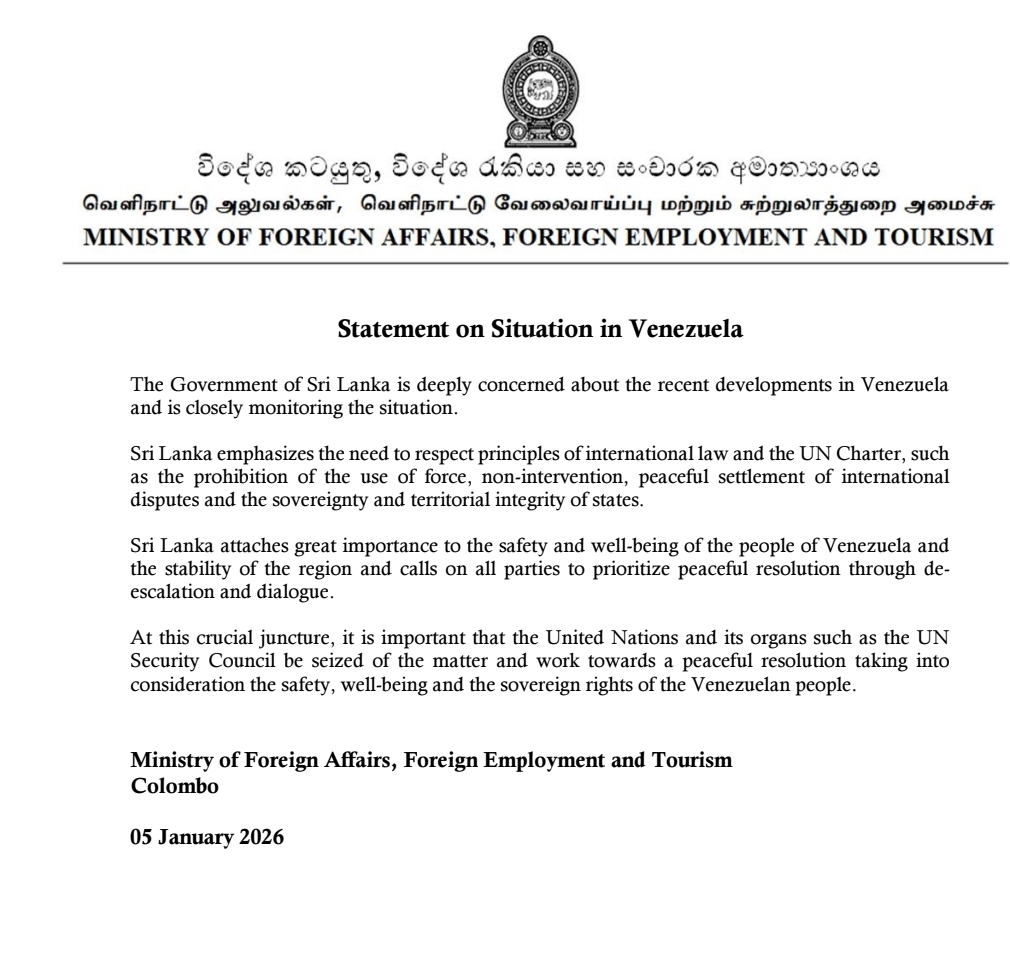
January 06, Colombo (LNW): Sri Lanka has voiced serious concern over the unfolding situation in Venezuela, calling on all sides to seek a peaceful way forward in accordance with international law and the principles set out in the United Nations Charter.
In an official statement issued yesterday (05), the Ministry of Foreign Affairs, Foreign Employment and Tourism said the government is following developments closely and reiterated the importance of upholding national sovereignty and territorial integrity, while rejecting the use or threat of force.
The statement emphasised the need for non-interference in internal affairs and urged the peaceful resolution of disputes through dialogue and restraint. It stressed that de-escalation is essential to safeguard the well-being of the Venezuelan population and to maintain stability in the wider region.
Sri Lanka further underscored the role of the United Nations and its relevant bodies, including the Security Council, in remaining actively engaged and facilitating a solution that fully respects Venezuela’s sovereign rights. The statement refrained from attributing blame or referring to any specific actions, instead focusing on principles and the need for a diplomatic outcome.