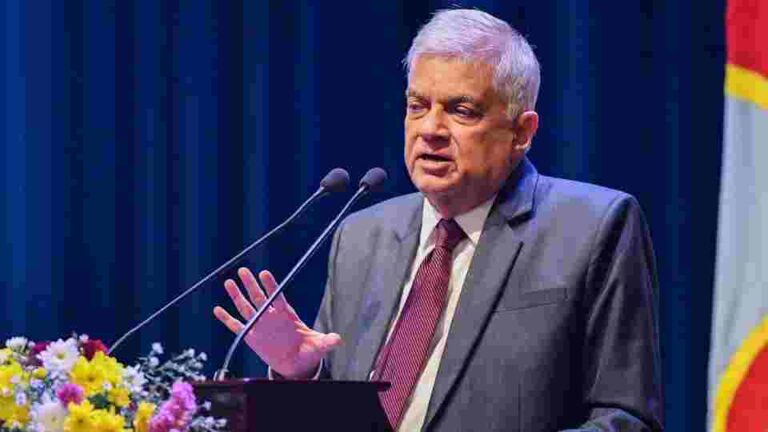
The attempt to recover the money amounting to US $ 6.9 million paid to the Chinese ship that delivered organic manure has failed, confessed Agriculture Minister, responding to a query in Parliament today (01).
Speaking to Parliament, the Agri Minister further noted that legal actions are being sought to recover the said money and the Attorney General has also been consulted in this regard.
A committee headed by the Ministerial Secretary has also been appointed to troubleshoot the crisis.
Sri Lanka and the International Monetary Fund (IMF) have reached a preliminary agreement on an emergency loan and a formal announcement will be made today after the successful conclusion of a week-long discussions between IMF and local official teams, official sources said.
The island nation, struggling with its worst economic crisis in more than seven decades, had sought up to $3 billion from the IMF.
Staff-level agreements are typically subject to the approval of the IMF management and its executive board, after which the recipient nations get access to funds.
A visiting IMF team held talks with President Ranil Wickreamasinghe, opposition leader Sajith Premadasa Sri Lankan government officials, including the treasury secretary, late into the night on Tuesday to address concerns on the political front, the sources said. Most of the technical details had been agreed beforehand.
The International Monetary Board team arrived in the island on Wednesday 24 to finalize discussions and to reach Staff-Level Agreement which will lead to to gain IMF Board Approval and unlock loan package including additional much-needed multilateral financings ,official sources said.
Sri Lanka is to continue engagement with creditors in order to obtain financing assurances although debt restructuring plan, which is crucial to reaching the eagerly awaited agreement with the IMF, is yet to be finalized.
A staff-level agreement would be an important milestone towards the IMF Board approval for the EFF programme, which in turn would help unlock bridging finance to support the much-needed external financing for Sri Lanka,” the Finance Ministry said.
The ministry shared that the Sri Lankan authorities are working with debt restructuring advisor Lazard and Clifford Chance to reach a consensus on debt restructuring arrangements with the creditors.
“The advisors have already prepared the analytical framework for the debt operation, prior to formal engagements with Sri Lanka’s creditors,” the ministry said.
The statement highlighted that the government is committed to engaging its creditors in good faith, with a view to reaching a comprehensive debt restructuring programme that provides a fair and sustainable outcome for all stakeholders. According to Central Bank Governor Dr. Nandalal Weerasinghe ,the International Monetary Fund’s disbursement of the Extended Fund Facility to Sri Lanka can be expected by the end of the year, subject to the success of debt restructuring with creditors and successful negotiations with the IMF.
“First part is to reach a staff-level agreement on the overall macro fiscal policy framework for the next 3-4 years and the medium-term framework, that we are coming closer to reaching an agreement on a macro fiscal framework,”he disclosed.
“The second part is for us to agree and negotiate with the debt targets for us to make our medium to long term debt sustainable. We are in the process of having this discussion. Only after that basically we can say where the debt targets we have to meet.”
He said that after ending discussions with the IMF and reach that agreemen,t then only they will approach the creditors,”.
Once we reach the staff-level agreement, then the timeline is set. Then we have to approach all our external creditors and start negotiating and discussing in good faith for us to obtain a relief on the debt service payments, he added.
“It is essential to get ‘financial assurance’ from Sri Lanka’s external creditors he said adding that CB thinks next about 3-4 months, hopefully if all goes well, if all external creditors are cooperating with the Sri Lankan government’s debt management strategy, then hoping that we would be able to get financial assurance somewhere is December.
This will be the requirement for IMF to allow the Central Bank to submit its paper to the executive board enabling them for disbursing the Extended Fund Facility of Around US $ 3 billion in tranches commencing from towards the end of this year, he claimed.
Adding a novel experience for the people of Sri Lanka, the operations of Lotus Tower in Colombo are scheduled to kick off on September 15, 2022, the President’s Media Division (PMD) announced.
Considered to be the tallest self-supported structure in South Asia, the Lotus Tower was vested with the public by former President Maithripala Sirisena in September 2019.
After it was declared open, the ‘Lotus Tower – Multifunctional TV and Telecommunications Tower’ was foreseen to be one of the significant landmarks and an epitome of the Sri Lankan economy, culture, and development.
Measuring up to 356 metres in height, the Lotus Tower was constructed with a cost to the tune of USD 113 million. A Chinese company granted USD 88.65 million while the rest was borne by the Sri Lankan government, according to the PMD.
The loan instalments are due to be completed by 2024. USD 66.3936 million of the loan has already been paid, the PMD added.
Colombo Lotus Tower Private Company is a company established in March this year under the Treasury and all its transactions are audited by the Auditor General’s Department.
The loan agreement between the Telecommunication Regulatory Commission of Sri Lanka (TRCSL) and China was initiated and the work on the Lotus Tower commenced in 2012.
Although its construction was planned to be completed in 2015, the planned date of completion could not be met.
The Chinese company completed the construction work and handed over the Lotus Tower to the Government of Sri Lanka on February 28, 2022.
Thereafter, Colombo Lotus Tower Pvt. Ltd. was established and its operations were entrusted to the company.
The Chief Administrative Officer of Colombo Lotus Tower Pvt. Ltd., Major General Prasad Samarasinghe (Rtd) said that the Lotus Tower is planned to avail new technological experiences along with entertainment similar to those found in wealthy countries around the world.
Among the attractions offered at Lotus Tower are adventure sports such as skydiving and bungee jumping.
Samarasinghe explained that so far 80 percent of local investors and 20 percent of foreign investors have joined the investment opportunities at the Lotus Tower.
Dialog Telecom Company and Sri Lanka Telecom Company have already reached agreements for investments of Rs. 200 million each.
Following the commencement of its operation, the members of the public will be allowed to visit the tower by purchasing a ticket for Rs. 500 or Rs. 2,000. For a foreign national, the ticket is priced at USD 20.
Those who purchase a ticket for Rs. 2,000 will be given the opportunity to enter the premises without standing in a queue and to climb to the top of the tower several times during a single visit. Meanwhile, those who purchase a Rs. 500 ticket will be allowed to visit the top of the tower only once.
The PMD said a QR code system is planned to be introduced in the future in lieu of tickets.
The Lotus Tower operations have been designed to meet the anticipated entertainment and recreational requirements of the public. The Lotus Tower is spread over 10.5 acres of land and will no doubt become an entertainment haven for the youth who desire adventure sports.
Colombo Lotus Tower Pvt. Ltd. states that it is currently negotiating with 58 investment companies and expressing interest in entering into agreements with 22 of them, and orders for 15 different events have been received until December 31 this year.
The chief administrator stated that after 2024, Lotus Tower has created the necessary environment to ensure profitability as a company and plans to continue its operations without burdening the Treasury.
Samarasinghe further stated that it is planned to carry out all these operations more successfully from January next year.
Those visiting the Lotus Tower can experience pubs, famous restaurants and souvenir shops on the ground floor, while several renowned commercial banks are also planned to be established on the ground floor.
The first floor is expected to be allocated for offices and it is also expected to establish a digital cinema hall. On the requests made by individuals and companies, steps have been taken to rent out space at the Lotus Tower on the basis of rates per square foot.
The third floor consists of a conference hall, which can accommodate up to 400 people at a time. Meanwhile, the open floor has been designed in such a manner that it can be used for various entertainment activities.
On the first floor, shaped like a lotus bud, a reception hall has been constructed that can accommodate about 400 people, and the upper floor is equipped with a revolving restaurant which no doubt, will be a novel experience for the public.
Further, the public will also have the unique opportunity of experiencing a bird’s eye view of the Colombo skyline from the highest observation deck.
Lotus Tower is also equipped with three of the fastest lifts in the country, made in line with Japanese technology. The public can look forward to experiencing these unique attractions when the Colombo Lotus Tower commences operations on September 15.
Colombo, Sri Lanka – September 1, 2022: An International Monetary Fund (IMF) mission led by Mr. Peter Breuer and Mr. Masahiro Nozaki visited Colombo from August 24 to September 1, 2022 to continue discussions on IMF support for Sri Lanka and the authorities’ comprehensive economic reform program.
At the end of the mission, Messrs. Breuer and Nozaki issued the following statement:
“The Sri Lankan authorities and the IMF team have reached staff-level agreement to support the authorities’ economic adjustment and reform policies with a new 48-month Extended Fund Facility (EFF) with a requested access of about SDR 2.2 billion (equivalent to US$2.9 billion).
“The new EFF arrangement will support Sri Lanka’s program to restore macroeconomic stability and debt sustainability, while safeguarding financial stability, reducing corruption vulnerabilities and unlocking Sri Lanka’s growth potential. The agreement is subject to the approval by IMF management and the Executive Board in the period ahead, contingent on the implementation by the authorities of prior actions, and on receiving financing assurances from Sri Lanka’s official creditors and making a good faith effort to reach a collaborative agreement with private creditors. Debt relief from Sri Lanka’s creditors and additional financing from multilateral partners will be required to help ensure debt sustainability and close financing gaps.
“Sri Lanka has been facing an acute crisis. Vulnerabilities have grown owing to inadequate external buffers and an unsustainable public debt dynamic. The April debt moratorium led to Sri Lanka defaulting on its external obligations, and a critically low level of foreign reserves has hampered the import of essential goods, including fuel, further impeding economic activity. The economy is expected to contract by 8.7 percent in 2022 and inflation recently exceeded 60 percent. The impact has been disproportionately borne by the poor and vulnerable.
“Against this backdrop, the authorities’ program, supported by the Fund, would aim to stabilize the economy, protect the livelihoods of the Sri Lankan people, and prepare the ground for economic recovery and promoting sustainable and inclusive growth.
“Key elements of the program are:
Raising fiscal revenue to support fiscal consolidation. Starting from one of the lowest revenue levels in the world, the program will implement major tax reforms. These reforms include making personal income tax more progressive and broadening the tax base for corporate income tax and VAT. The program aims to reach a primary surplus of 2.3 percent of GDP by 2024.
Introducing cost-recovery based pricing for fuel and electricity to minimize fiscal risks arising from state-owned enterprises. The team welcomed the authorities’ already announced substantial revenue measures and energy pricing reforms;
Mitigating the impact of the current crisis on the poor and vulnerable by raising social spending, and improving the coverage and targeting of social safety net programs;
Restoring price stability through data-driven monetary policy action, fiscal consolidation, phasing out monetary financing, and stronger central bank autonomy that allow pursuing a flexible inflation targeting regime. A new Central Bank Act is a cornerstone of this strategy;
Rebuilding foreign reserves through restoring a market-determined and flexible exchange rate, supported by the comprehensive policy package under the program;
Safeguarding financial stability by ensuring a healthy and adequately capitalized banking system, and by upgrading financial sector safety nets and regulatory standards with a revised Banking Act; and
Reducing corruption vulnerabilities through improving fiscal transparency and public financial management, introducing a stronger anti-corruption legal framework, and conducting an in-depth governance diagnostic, supported by IMF technical assistance.
“The IMF team held meetings with President and Finance Minister Ranil Wickremesinghe, Prime Minister Dinesh Gunawardena, Central Bank of Sri Lanka Governor Dr. P. Nandalal Weerasinghe, Secretary to the Treasury K M Mahinda Siriwardana, and other senior government and CBSL officials. It also met with Parliamentarians, representatives from the private sector, civil society organizations and development partners.
“We would like to thank the authorities for their candid approach and warm hospitality and are looking forward to continuing our engagement in support of Sri Lanka and its people.”
The Asian Development Bank (ADB) approved a US $200 million emergency assistance loan for Sri Lanka, with funds repurposed from other ongoing ADB projects, to improve food security and protect the livelihoods of the poor and vulnerable, especially women and children.
“Food insecurity has severely affected the people of Sri Lanka amid the current economic difficulties. This assistance will expand direct financial support for the poor and vulnerable, boost livelihood development activities and agricultural production, and enhance social protection systems,” said ADB Senior Education Specialist for South Asia Asako Maruyama.
He added that “This fulfills the government’s request for a partial cancellation of loan proceeds from ongoing projects and to use the funds for this emergency intervention.”
The project will continue, for at least 3 months, the temporary increase in the monthly cash grant amount and the number of beneficiaries of the existing social assistance programs, including the Samurdhi subsidy program for low-income families, and allowances for the elderly, persons with disabilities, and kidney disease patients.
It will also support, for at least 3 months, a temporary increase in the monthly value of food vouchers for pregnant and lactating women to be replaced with cash grants, and extend support to undernourished children under the age of 2.
To increase food production and offset increasing agricultural production costs, the project will provide financial support for a maximum of 2 hectares of land cultivated by each farmer in higher-yield zones during the upcoming cultivation season. Moreover, upgraded livelihood development programs for low-income families will be supported in selected districts over 18–20 months to restore livelihoods and enhance coping capacity and food security.
The project will also upgrade information technology systems and digital tools for the Samurdhi program and agriculture and agrarian development to enhance cash grant beneficiary selection, verification, monitoring, and communication, and improve financial, advisory, and other services for low-income families and farmers.
In addition, ADB will administer a $3 million grant from the Japan Fund for Prosperous and Resilient Asia and the Pacific to support basic needs, such as food, hygiene kits, and medicines, of vulnerable women, children, elders, and persons with disabilities in shelters and care homes and those at risk of being placed in institutional care.
It will strengthen referral and support mechanisms for victims of gender-based and domestic violence. To promote advanced practices and technologies for precision agriculture and improved crop productivity among farmers, it will support the upgrading and delivery of the Good Agricultural Practices certification program.
ADB is committed to achieving a prosperous, inclusive, resilient, and sustainable Asia and the Pacific, while sustaining its efforts to eradicate extreme poverty. Established in 1966, it is owned by 68 members—49 from the region.
The low-level atmospheric disturbance still persists in the vicinity of Sri Lanka.
Showers will occur at times in the Western, Sabaragamuwa, Central, North-western and Northern provinces and in Anuradhapura, Galle, and Matara districts. Fairly heavy showers above 75 mm may occur at some places in Western, Sabaragamuwa, Central, North-western and Northern provinces.
Showers or thundershowers will occur at several places in Uva and Eastern provinces during the evening or night.
General public is kindly requested to take adequate precautions to minimize damages caused by temporary localized strong winds and lightning during thundershowers.
On the apparent southward relative motion of the sun, it is going to be directly over the latitudes of Sri Lanka during 28th of August to 07th of September in this year. The nearest towns of Sri Lanka over which the sun is overhead today (01) are Kalpitiya, Dunupotagama (Anuradhapura District), Uttimaduwa, Nikawewa (Polonnaruwa District), Vellai (Trincomalee District) and Verugal (Trincomalee District) about 12.10 noon.
Marine Weather
Condition of Rain:
Showers or thundershowers will occur at times in the sea areas off the coast extending from to Colombo to Batticaloa via Puttalam, Mannar and Trincomalee
Winds:
Winds will be westerly to south-westerly and wind speed will be (20-30) kmph. Wind speed may increase up to (45-55) kmph at timesin the sea areas off the coast extending from Colombo to Pottuvil via Galle and Hambantota.
State of Sea:
The sea areas off the coast extending from Colombo to Pottuvil via Galle and Hambantota will be rough at times. The other sea areas around the island will be moderate.
In the wake of the heavy rainfall, the National Building Research Organisation has taken measures to issue red notices on landslides to several areas in the country.
Accordingly, Ratnapura, Kuruwita and Elapatha Divisional Secretariats of the Ratnapura District, and Palindanuwara Divisional Secretariat of the Kalutara District have been issued landslide red notices.
Meanwhile, early warning notices of level two landslides have been issued to Yakkalamulla, Nagoda and Baddegama Divisional Secretariats of the Galle District, Walallawita and Bulathsinhala Divisional Secretariats of the Kalutara District, Eheliyagoda, Kahawatta, Kalawana and Ayagama Divisional Secretariats of the Ratnapura District.
A person was killed by gunshot near the Balapitiya Hospital last (31) night.
The victim was a 28 year-old man, according to Police.
The Police revealed that while he was travelling on a motorcycle, a group came by a three-wheeler shot him with a T-56.
It is believed that there is a connection between this shooting and the similar shooting that took place earlier near a hotel in Ambalangoda, Police added.
Sri Lanka is on track to receive enough petroleum supply to overcome the present fuel crisis till the end of this year as three international suppliers have been awarded contracts in accordance with proper procurement procedure, Energy Ministry sources confirmed.
Ministry of Energy is taking every possible step towards normalizing fuel distribution to country wide fuel filling stations with the importation of petrol and diesel stocks in proper procurement process amidst wild allegations of the opposition political parties,
Minister Kanchana Wijesekera noted that only three international suppliers UAE based Coral Energy, Vitol Singapore and IOC India have submitted expressions of interest to fulfill the fuel requirement of the country in the wake of unfounded allegations of paying high prices for their fuel shipments.
He noted that the purchasing price of fuel from the international market cannot be compared with prices prevailing before the country’s declaration of preemptive debt default as it led the country towards black listing by banks worldwide.
Several opposition parliamentarians are making unfounded allegations of high premium payments of US$ 20 -29 per barrel of fuel in July-August period compared to February and March.
These politicians should understand and verify their facts before making such allegations as the premium price has gone up following the country’s declaration of preemptive debt default on April12 while international rating agencies downgrade Sri Lanka afterwards.
These politicians should be grateful for these companies specially Coral Energy for arranging fuel shipments for the country under unfavourable international market conditions created by Central Bank Governor Nadalal Weerasinghe announcing the foreign debt default.
Under the present set up of the country risk of debt default, no prime bank in the world is confirming the LC’s of Sri Lankan banks anymore, he said adding that nota single registered supplier other than these three suppliers have stepped into supply fuel.
Sri Lanka’s state-run Ceylon Petroleum Corporation has said it has enough diesel, petrol and kerosene both imported and refined locally and assured the public there will be no shortage, after a few fuel queues formed for the first time since a QR-code fuel ration system was introduced.
“CPC has diesel, petrol and kerosene available to distribute without a shortage. The refinery has started operations and steps have been taken to produce all fuel,” a statement said.
“Imported fuel is also available in the Kolonnawa and Murthurajawela storage facilities CPC is in the process of distributing the fuel and advised the public not to get distressed unnecessarily”.
The Cabinet appointed standing procurement Committee has recommended awarding the relevant crude oil procurement contract for seven months to Coral Energy based in the United Arab Emirates , Vitol Singapore and IOC INDIA to bring down refined oil shipments of petrol, diesel. Kerosene, jet fuel and crude oil till the end of this year, he revealed.
In the past, CPC has borrowed dollars or used suppliers’ credit to import oil without making immediate payments.
Now suppliers are no longer giving credit to the CPC. As a result, the CPC has to find dollars upfront to pay suppliers when there are forex shortages.
Earlier CPC used to have stocks of 2 to 3 weeks. Now the stocks are down to 5 or 6 days.Though ships are coming on time as ordered, a delay in unloading triggers shortages across the distribution network leading to stock outs.
By the time Sri Lanka declared debt default , US$ 750 Million worth payments were due to long standing Petroleum suppliers of the CPC That money is still remaining unpaid with no signs of any settlement.
Because of this default and because of the country’s risk (No Prime bank in the world is confirming the LC’s of Sri Lankan banks anymore), these suppliers together decided NOT to supply to CPC and also started preventing ship owners from carrying cargoes to CPC unless/until they were paid.
This has resulted in CPC struggling to buy any products in the market. Sapugaskanda refinery was closed for months and people started waiting for days in queues without any products.
Due to the relentless search and hard work by CPC staff, they were able to bring new suppliers to rescue the nation and CPC. Coral Energy was one such company and the company started actively trading only in June/July.
All procurement was one upon checking with tens of suppliers. Never a case a supplier quoting a higher rate was selected when a lower one was available.
Over two hundred award letters were given to representatives of foreign firms who quoted low with fancy prices but none of them have supplied fuel up to now. .
Under the circumstances the only question before the CPC was whether to buy from the very few suppliers who obviously charge high to mitigate their risks or keep the nation suffering in fuel crisis without any procurement at all.
Coral Energy has not only proved itself as a reliable supplier, the company has been very cooperative with CPC to ensure seamless supply of products whenever an order was given.
It is mandatory that CPC opens an LC 10 days before loading. But Coral Energy has been treated so badly that sometimes even after the ship came to Colombo waiting for weeks, CPC was unable to open an LC or pay US Dollars.
Coral Energy also took the historic step of accepting Sri Lankan Rupees to unload its first crude oil shipment with CBSL promising to convert it to US$ within 30 days.
For the first time in the history of Sri Lanka, CPC was able to unload an oil shipment paying LKR. A thankless contribution made by CPC and Coral Energy to the people of Sri Lanka.
Sri Lankan refinery experts first said only Iranian light is good. Then they said only Murban Crude is good. But now they say Siberian Light is good while Ural is bad.
Everyone has forgotten that it was Coral Energy which unloaded Siberian Light to Sapugaskanda and that too by accepting LKR. So Coral trying to supply only Urals is a baseless argument.
India buys one million barrels of Russian Crude a day and out of that 88% is Urals Crude. Coral Energy gets most of the refined products (Diesel, Petrol, Super Diesel, Petrol 95 and even Jet A1) from India (Reliance Refinery) and these are produced using Urals Crude.
So there is no logic in saying Ural is bad and incompatible for Spaugaskanda oil refinery, several energy experts said.
Whether it is Urals, ESPO or Siberian Light, Coral Energy offers a price based on Brent Index since their insurance and credit risk is hedged against Brent and they buy their urals on that basis.
So it is upto CPC to buy or not to buy. CPC can even ask any other seller to supply at a lower price because no one stops CPC from negotiating with any one else.
Of course CPC is S negotiating with tens of suppliers every day. This is how over 270 award letters were given to suppliers. Mainly new ones and none of them ever supplied.
On all the orders given to Coral Energy the local agent’s commission Is ‘ZERO’. It is documented and practiced to save the little dollars which CPC can save at all times. The local agent of Coral Energy is ‘Eve Shipping (Pvt) Ltd’.
Coral Energy is a US$ 50 Billion company. Companies like this always worry about their reputation and international image.
If local politicians like Patalee Champika Ranawake are making baseless allegations suppliers like Coral Energy will stop importing fuel to Sri Lanka.