Home Blog Page 1898

Our security forces should be equipped with technical knowledge – President Ranil

0

President Ranil Wickramasinghe emphasizes that in the future war may take place not only on land, air and sea but also in cyberspace so our Our security forces should be equipped with technical knowledge – President Ranil must be equipped with the necessary knowledge for such a technological war.

Pointing out that discipline, training and knowledge are needed to create a successful army, the President also said that the Sir John Kotalawala Defense University is already fulfilling all these matters.

President Ranil Wickramasinghe said this while participating in the ceremony held yesterday (25) afternoon to present the Presidential Colors and University Colors to General Sir John Kotalawala Defense University.

A military salute was accorded to the President who arrived at the Defense University in Kotalawala and an interfaith blessing was also held for the President’s colors and the university’s flag colours.

Then President Ranil Wickremesinghe made a special speech and presented the Presidential Colors and University Colors to General Sir John Kotalawala Defense University.

Later, the Vice-Chancellor of Kotalawala Defense University, Major General Milind Peiris, made a special statement and presented the university flag and colors.

The President, who also visited the museum at Walawwa, also made a note in the commemorative book of special guests. A special commemorative gift was presented for the President.

A strange model of payment is followed to pay CEB employees!

0

Janaka Rathnayake, Chairman of the Public Utilities Commission, says that a strange payment is being made for the employees of the Ceylon Electricity Board.

Question – Is a lot of money really going to the electricity board for salaries?

“I came to know this the day before yesterday, Not only the salaries EPF and ETF are generally provided for the employees of the Electricity Board. That’s the normal way. But did you know that all employees who work here for 20 years are paid a third of their salary, a pension for as long as they live? In which country do you pay the EPF and ETF and pay another pension with the money given by the public? I think this model should be studied in universities too, because this is a very strange model. This is the biggest company in Sri Lanka, if this continues, it will collapse and there will be a 24-hour power outage in Sri Lanka in the future.”

Janaka Ratnayake said this while participating in a conversation on Derana TV channel.

However, when asked about this, the Chairman of the Electricity Board, Nalinda Ilangakoon, had stated that there is a method of paying pensions that needs to be legally and properly managed in the Electricity Board.

WHO pledges essential medical supplies worth US$ 4 million to Sri Lanka,

0

The Director General of the World Health Organization (WHO) Dr. Tedros Adhanom Ghebreyesus pledged essential medical supplies worth US$ 4 million to Sri Lanka, President Media Division (PMD) said.

PMD said that the WHO Director had tasked the WHO Health Emergency Programme to take immediate action to meet the most urgent health needs of the people of Sri Lanka.

He said this in a congratulatory message to President Ranil Wickremesinghe on his appointment to the post of president.

He said that the WHO recognises the on-going economic pressure Sri Lanka is facing in addition to Covid-19 related pressure on the health system.

“Rising global food and oil prices have indeed presented a major challenge to many countries, especially their most vulnerable communities,” he said, adding that the World Health Organization stands ready to support the people of Sri Lanka during these challenging times.

Dr. Ghebreyesus noted, “To this end, I am pleased to inform you that I have tasked the WHO Health Emergencies Programme to take immediate action to meet the most urgent health needs of the people of Sri Lanka.

In collaboration with WHO’s Regional and Country Offices, as well as the Sri Lanka Ministry of Health and other relevant ministries, WHO will procure and deliver essential medical supplies valued at US$ 4 million.

Procurement has already been initiated and the list, including delivery times will be shared through the WHO Country Office.”

He also said that the WHO will closely monitor the health risks to the population including the functionality and resilience of the health system and provide the necessary technical assistance to strengthen provincial health services.

The Director General also assured his highest consideration in this regard and said that the WHO looks forward to continuing and strengthening collaboration with Sri Lanka to promote health, make the world safe and serve the vulnerab

Govt. to embark on motoring ventures to manufacture electric vehicles

0

The Sri Lanka government is to emabark on a motoring venture to manufacture and essemble electric Vehicles in the country with the assistance of the Lanka Electric Vehicle Association (LEVA),

This activity spearheaded by the Lanka Electric Vehicle Association (LEVA), with support from the GEF Small Grants Programme (GEF SGP), implemented by the United Nations Development Programme, has helped to demonstrate the viability of and paved the way for the commercial introduction of electric and hybrid vehicles on the streets of Sri Lanka’s capital, Colombo.

Initially planned as a demonstration and capacity building activity, LEVA switched to advocacy work, successfully lobbying the government to to support electric and hybrid vehicles.

The considerable success of lobbying led to government support in form of a favorable policy framework as well as lowered import duties for electric vehicle parts.

As a result, several private firms started assembling electric vehicles. Furthermore, the government in 2010, worked with LEVA to launch a pilot activity, to produce the first electric hybrid bus in Sri Lanka.

The main goals of the activity were to introduce zero emission electric and hybrid vehicles and to train unemployed youth to operate and maintain these vehicles.The activity also conducts an awareness campaign on the benefits of electric vehicles for reducing emissions and pollution.

he government is planning to launch motoring ventures on manufacturing and assembling of electric vehicles in the country while implementing other programs to convert TO E three-wheelers and buses to operate with electricity that are used for public transport into medium and short-term projects, Transport Ministry and Mass Media Additional Secretary Lalith de Alwis said.
ressing the media, he said 1.4 million three-wheelers are registered with the Department of Motor Traffic (DMT) and 500,000 three-wheelers out of the total capacity are engaged in direct transport services. Another 300,000 are engaged in public transportation indirectly.
“All the three-wheelers use a higher volume of fuel, and the government has to spend more money on importing fuel for them. Therefore, the DMT is hoping to initiate the conversion project from three-wheelers and move the project for the conversion of private vehicles and public transportation,” he said.

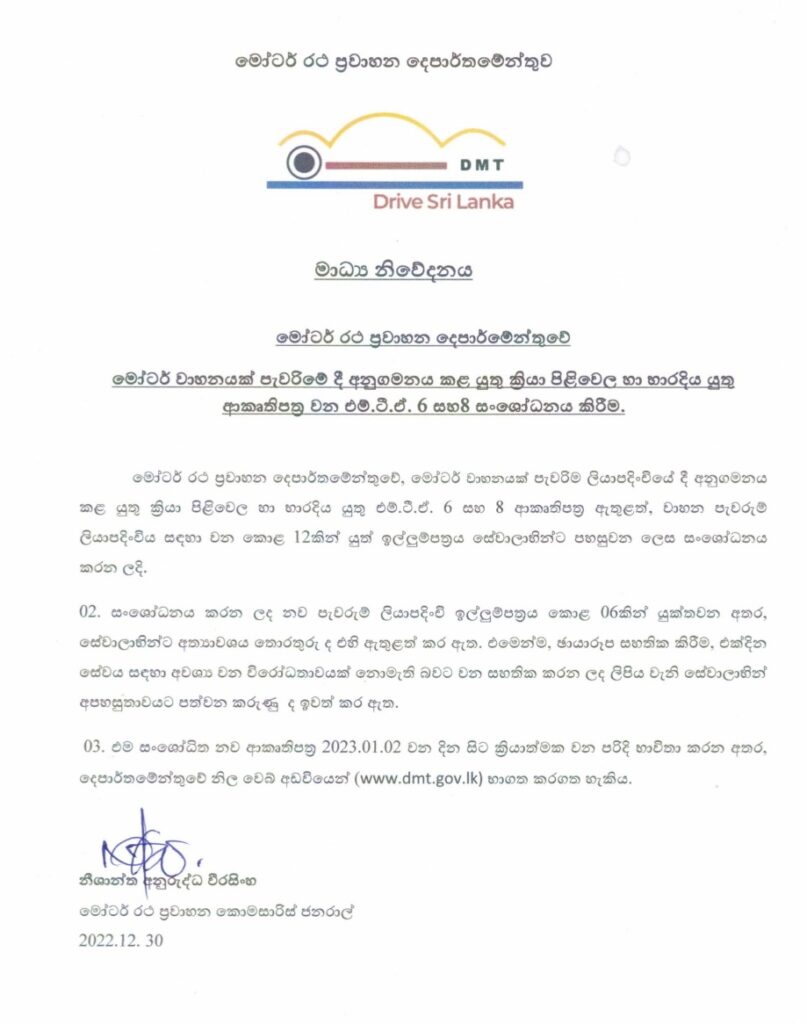
Meanwhile, DMT Commissioner General Nishantha Weerasinghe said that relating to the conversion of three-wheelers to electric, we have several issues with registering, regulating, and establishing standards for the institutions that provide the service as we do not have such information and the relevant technology.
herefore, the DMT launched a workshop with the help of the United Nations Development Program (UNDP). The pilot program of the project was to convert 300 three-wheelers from fuel to electricity operation.
Because of the significant environmental damage caused by the two-stroke three-wheelers, the government has decided to prohibit the registration, importation and the use of such vehicles.

But those three-wheelers are still in use. Therefore, the DMT has decided to start the conversion program from those as a pilot project.
The Commissioner General requested the local and international institutions that have the infrastructure to proceed with the conversion project to register with the DMT before the end of this month

Govt. makes policy commitments, convince China on IMF bailout

0

The government will go all out to convince China to support Sri Lanka with the aim of finalising the International Monetary Fund (IMF) bailout loan although it has to repay more debt to the West as International Sovereign Bond payments, official sources, closely connected to ongoing negotiations, said.

Sri Lanka is set to submit a comprehensive economic reform programme including the policies needed to correct structural imbalances over an extended period along with debt restructuring report prepared by financial and legal advisory firms Lazard and Clifford Chance LLP very soon (this month), a senior official said.

He noted that those negotiations with the IMF were more difficult and complex due to the country’s inability to service debts owing to dwindling reserves and dollar scarcity.

Once a staff-level agreement is reached, the country’s economic reform and debt restructuring plan (structural adjustment) will be submitted to the IMF Board of Directors for approval.

As of 2021, a staggering 81 per cent of Sri Lanka’s foreign debt was owed to US and European financial institutions, as well as Japan and India and 10 per cent owed to China, Finance Ministry data shows.

According to ministry statistics as of the end of April 2021, the majority of foreign debt around 47 per cent is owned by Western venture funds and banks.

The top holders of the Sri Lankan government’s debt, in the form of international sovereign bonds (ISBs), are BlackRock (US), Ashmore Group (Britain), Allianz (Germany), BS Switzerland), HSBC (Britain), JP Morgan Chase (US) and Prudential (US), a senior government official said.

The Asian Development Bank and World Bank were the other debtors which own 13 per cent and 9 per cent of Sri Lanka’s foreign debt, respectively.

Japan, owns 10 per cent of Sri Lanka’s foreign debt with India 2 per cent by the end of last year. According to Sri Lanka’s economic programme (structural adjustment plan), the government has to make at least nine commitments via fiscal policy measures.

According to the plan, major policy decisions are to be taken on increasing income tax rates, reduce income tax thresholds, increase VAT rate and reduce VAT threshold, setting up an independent debt office, continuation of high interest rate, continuation of high interest rate, and no more fixed exchange rates.

The other commitments are the listing of minority stakes of some SOEs in the stock market, making SOEs more transparent, restructure Sri Lankan Airlines, CPC and CEB and consider Samurdhi as more targeted welfare.

The government is also committed to introduce several other policy measures such as to introduce cost-based fuel pricing formula, electricity pricing formula, electricity bill increase, repeal the Monetary Law Act and pass the Central Bank bill to reduce political intervention in the banking regulator as well as relaxing import restrictions.

Electricity price rise raises accuracy of cost reflective formula

0

Sri Lanka’s overall electricity tariff hike of 75 per cent approved by the Public Utility Commission of Sri Lanka (PUCSL) considering Ceylon Electricity Board’s (CEB) cost reflective pricing methodology has raised issues relating to its accuracy and justifiability, official sources said.

The PUCSL can approve the tariff proposed by CEB and LECO only after adhering to cost-reflective methodology of recovering actual costs in a reasonable manner for its activities to be conducted efficiently, the Sri Lanka Electricity Act stipulates.

According to PUCSL, the CEB is targeting annual electricity sale revenue of Rs. 512 billion through this tariff revision although its actual average revenue was Rs.249 billion; several energy experts said adding that it was unjustifiable to approve such a price formula.

They categorically noted that this electricity pricing formula reflecting data compiled by CEB on costs is not based on any scientific and mathematical theories to evaluate the electricity spot price dynamics and it was formulated without considering the cost analysis using Finance Ministry or Central Bank statistics.

This was confirmed by several heads of economic think tanks as well as senior government officials serving in statistics, mathematical modeling and computing divisions and departments of finance and energy ministries.

According to Section 30 of the Sri Lanka Electricity Act, No. 20 of 2009, which governs the setting of electricity tariffs, the relevant licensees (CEB and LECO) are to set the tariff according to a cost reflective methodology approved by the PUCSL.

The electricity tariff must permit the licensee or power utility to recover all reasonable costs incurred in the carrying out of the activities on an efficient basis under this Act.

The tariff reflecting all reasonable costs for carrying out power generation and transmission activities efficiently must be approved by the Commission in accordance with general or specific policy guidelines endorsed by the Cabinet, Section 30 of the Act stipulated.

It cannot approve tariff revisions based on inaccurate and distorted or manipulated data and statistics.

The electricity bill of household consumers is to be increased by 95 per cent almost doubling the current bill and the lower segment of energy users in the category of less than 30 units will have to pay 264 per cent more than their present monthly bill in accordance with the present formula.

The higher end users of electricity consuming over 180 units will have to pay 75 per cent more than their current payment.

The increase in the electricity bill of commercial establishments is 37 per cent and industries 86 per cent, hotels 67 per cent, government institutions 90 per cent and places of religious worship 489 per cent.

Several heads of consumer protection associations said , this pricing methodology with disproportionate rates for various segments of the society will definitely be a burden for lower and middle income groups currently facing severe economic difficulties.

The PUCSL has made some adjustments to CEB’s electricity tariff revision with unbearable price increases to cover up its heavy costs including overheads corruption, waste and inefficiencies of the power utility, several energy experts and senior officials said.

Analysing the tariff structure proposed by the CEB and approved by the PUCSL with adjustments, former Energy Minister Patalee Champika Ranawake noted that the unbearable electricity price hike is a violation of the social justice principle.

This was an attempt to put the whole burden of heavy costs of the CEB due to its inefficiency, irregularities, weaknesses and corrupt practices on consumers, he said.

He added that successive governments and PUCSL should also bear the responsibility for not implementing cost effective pricing formula for nine long years since 2103 which should be devised by energy and mathematics experts based on two-factor model using differential equations to evaluate the electricity spot price dynamics.

Stocks on 91 types of essential drugs are almost drained! – GMOA

0

The Association of Government Medical Officers revealed that the stock of 91 types of essential medicines in the Central Drug Store had reached zero by the end of last week.

This report shows us that some anesthetic drugs, anti-cancer drugs, drugs for respiratory system-related diseases, heart disease drugs, pain killer drugs, all of these have been left unaccountable by the authorities until the stock level is zero.

As of now, there is a shortage of many medicines in the Maharagama Apeksha Hospital. Some medicines have become obsolete. Patients have to spend probably 10,000-15,000 rupees to buy these medicines at one time.

We should have three months of stock in the central drug store. The drug stores at the district level should generally have two months of stock. Major hospitals should have at least one month’s stock. There is no optimal stock anywhere. In the end, the patients have to buy these medicines from the private sector at a very unfair price.”

Dr. Haritha Aluthge said this while addressing a press conference held yesterday (25).

Private buses will be reduced by 50% due to lack of diesel – Gemunu

0

Gemunu Wijeratne, President of Ceylon Private Bus Owners’ Association, says that today (26) private buses in service will be reduced by 50% due to lack of diesel.

Gemunu Wijeratne said this while addressing a press conference held yesterday (25).

Contempt of Court : Investigation against Sanath Nishantha

0

Fort Magistrate Thilina Gamage has ordered the Criminal Investigation Department to investigate and report to him whether the statement made by Sri Lanka Podujana Peramuna Member of Parliament Sanath Nishantha in a recent press conference has insulted the court.

That was when the case related to the attack on the Gotagogama protest site on May 09 was called yesterday (24).

Upul Jayasuriya, the President’s lawyer who appeared on behalf of the activists informed the court that even though the defendants were informed to refrain from making statements and activities that would affect the judicial proceedings, Sanath Nishantha said that lawyers and some judges acted in a manner that was in favor of the activists during a press conference held on the 23rd.

The lawyer also submitted a video to the court to prove that statement.

Accordingly, the Fort Magistrate directed the Criminal Investigation Department to investigate whether the statement made by. Sanath Nishantha at the press conference has insulted the judiciary or its functioning and for that purpose to obtain the unedited videotapes from the media houses.

No diesel even for SLTB buses – another fuel shortage across the country?

0

The Sri Lanka Transport Board (SLTB) says that the diesel has not been provided to many depots across the country in 2 days. By now, the fuel stocks of several depots have been used up and there is a threat of intermission of bus operations.

The SLTB further mentioned that it is believed that the diesel stocks will be derived tomorrow, adding that however, it doesn’t make a specific statement regarding the date of the receipt of diesel.

The provision of fuel for private buses was done through the SLTB depots and due to the dearth of fuel in depots, the private bus operations have also come to a dead stop.

Meantime, the Association of Fuel Transport Tanker Owners declares that the release of diesel as well as petrol has been rigorously limited. The Association’s joint secretary, Mr. D.V Shanta Silva says that a fuel deficiency may occur again.

Due to the lack of fuel, many filling stations across the country have been closed and the fuel queues have formed again.

OV