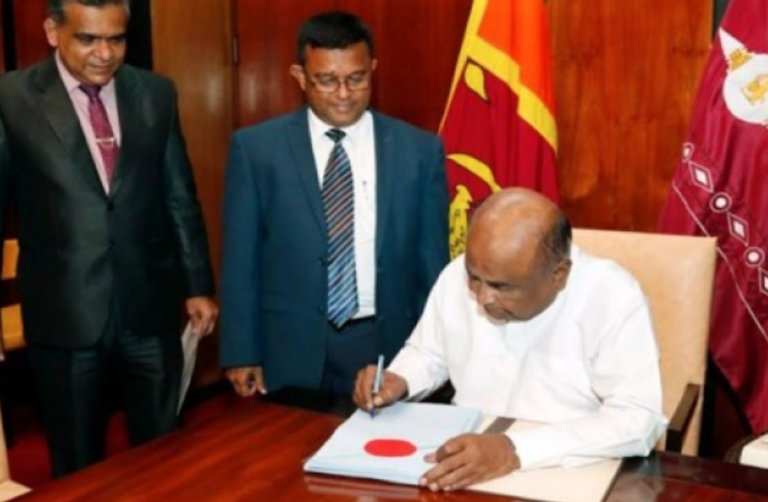
The Hon. speaker endorsed the first Bill of the year 2023 yesterday(17). Accordingly, the Speaker endorsed the certificate on Recovery of Possession of Premises Given on the Lease Bill.
This Bill entails provisions to make arrangements regarding the procedure for recovery of possession of leased premises under a lease agreement, to formalize the recovery of arrears of tax installments, money service charges and quantified losses, and to make arrangements for matters connected or incidental thereto. The said Bill was passed in Parliament on January 5th.
Accordingly, given the endorsement on the certificate on Recovery of Possession of Premises Given on Lease Bill, the stated shall come to effect as the Recovery of Possession of Premises Given on Lease” Act, No. 1 of 2023 from January (17).
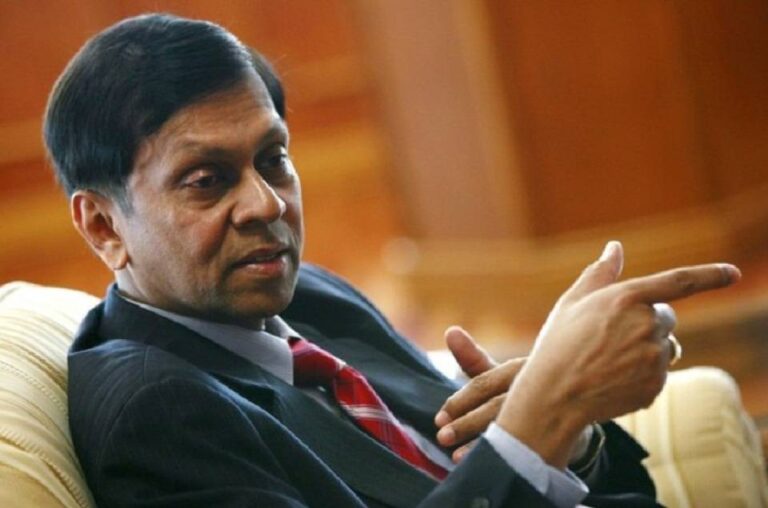
The overseas travel ban imposed on former Governor of the Central Bank of Sri Lanka (CBSL) Ajith Nivard Cabraal has been extended till February 16, 2023.
This was when the private complaint lodged by Keerthi Thennakoon against Cabraal was taken up before Colombo Additional Magistrate Harshana Kekunawala today (17).
The initial objections filed by Sampath Mendis PC appearing for the ex CBSL Governor was objected by filing answers by Maithri Gunaratne PC appearing for Thennakoon.
The Court allowed Mendis PC to submit counter-objections against the answers by the plaintiff, and the answers were ordered to be produced before Court by February 16, 2023.
The PC appearing for Cabraal informed the Magistrate that his client does not wish to elaborate on the extension of his overseas travel ban at this moment given that he has no intention of leaving the country whatsoever.
Accordingly, the Court ordered that the travel ban on the ex CBSL Governor be extended till February 16, 2023.
YouTuber Sepal Amarasinghe who was arrested and remanded on the allegation of inciting blasphemy via making a derogatory comment about the holy Temple of Tooth Relic in Kandy has been further remanded till January 31.
This was when the case against the activist was taken up before the Fort Magistrate Court today (17).
The Court has informed that the defendant is eligible to apply for bail through the High Court.
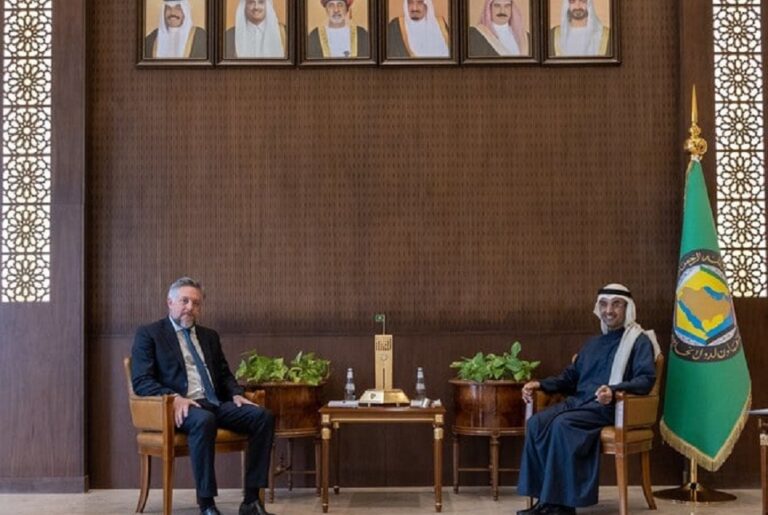
The Gulf Cooperation Council (GCC) has sought to strengthen relations between the GCC and Sri Lanka.
Dr Nayef Falah M.Al Hajraf, Secretary General of the Gulf Cooperation Council, underlined the significance of strengthening the bonds between the GCC and Sri Lanka, and the means to enhance and develop them, in a way that serves common interests.
The Secretary General’s statements came during a meeting with P.M. Amza, Ambassador of the Republic of Sri Lanka to the Kingdom of Saudi Arabia, on Monday, at the headquarters of the General Secretariat in Riyadh, a GCC statement said.
During the meeting, several issues were discussed, foremost of which were the means of cooperation between the GCC and the Republic of Sri Lanka in various political, economic and tourism fields, in order to accomplish common interests.
They also addressed the latest developments at the regional and international levels.
Sri Lanka Tourism Promotion Bureau is set to launch a promotional campaign to attract tourists from Kuwait, Bahrain, Oman and Qatar, as part of an on-going effort to develop the number of tourists visiting the island from the four Gulf Cooperation Council (GCC) cities.
As part of the promotional activities Kuwaiti, Bahraini, Omani and Qatari travel agents and tourism professionals will be provided the latest information and updates on Sri Lanka’s touristic offerings through presentations, workshops and a series of business development meetings.
Sri Lanka is one of the preferred destinations for Gulf tourists as it offers a distinctive, adventure-packed, eco-friendly, family-focused experience and offering.
With the country’s rich nature, heritage and culture, year-round schedule of festivals and special events, numerous parks and eco centres, luxury resorts and wellness centres, Sri Lanka has many reasons for GCC families to return to Sri Lanka again and again.
According to Sri Lanka Tourism Promotion Bureau “Kuwait, Bahrain, Oman and Qatar remain integral target markets for Sri Lanka’s tourism development.
The upcoming promotional campaign is one of many major activities Sri Lanka tourism conducts to ensure that key international travel agents maintain a close awareness and link with Sri Lanka’s tourism industry partners.
The aim is to mutually expand the business opportunities between both, while offering their clients quality tourism experiences.
Through the promotion campaign in four GCC countries , bureau’s expectations are that travel to Sri Lanka from these markets will continue to grow and thrive, reinforcing Sri Lanka’s status as a world-class destination for eco-tourism, cultural and family tourism.
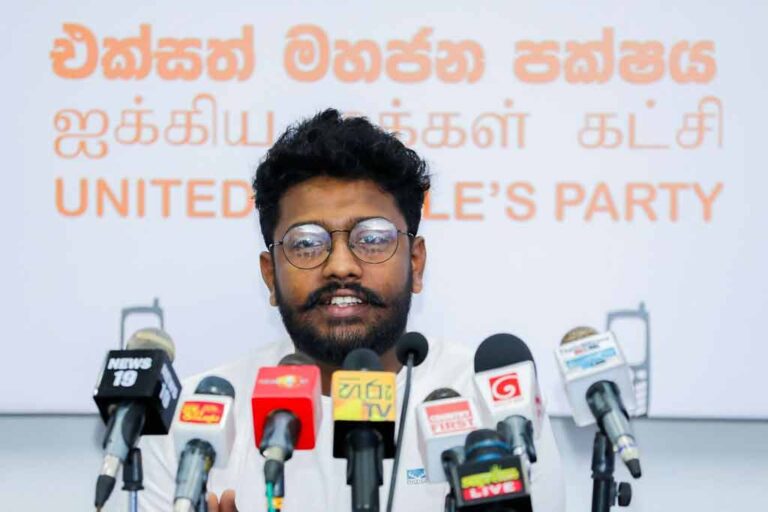
A group of activists from the ‘Aragalaya’ people’s protests has decided to contest the upcoming Local Government Election from the United People’s Party (UPP), secretaried by Public Security Minister Tiran Alles.
The Party will contest the Election under the ‘Mobile Phone’ symbol.
After changing the leader through the protests of the Aragalaya, further aggression will not be necessary, for everyone should be working towards economic stability of the country now, Avishka Viraj Konara aka ‘Konara’, YouTuber and Social Activist, calling in a briefing said.
He noted that he chose the UPP to enter politics because the Party has given an opportunity to work freely through his own programme to develop the digital economy of Sri Lanka.
The activist also revealed that he will be contesting for the Colombo Municipal Council under the UPP, whilst briefing the media projects he has already implemented to develop the country’s digital economy.
The move taken by the General Treasury to settle the salaries of the non-executive public servants on the designated date and the salaries of the executive public servants several days after the designated date has been approved by the Cabinet.
The move, which was made in compliance with the limits of the government’s cash flow in order to manage the expenses for the next few months from January, was approved during the Cabinet meeting held yesterday (16) and was revealed during today’s (17) briefing called in for announcing the Cabinet decisions.
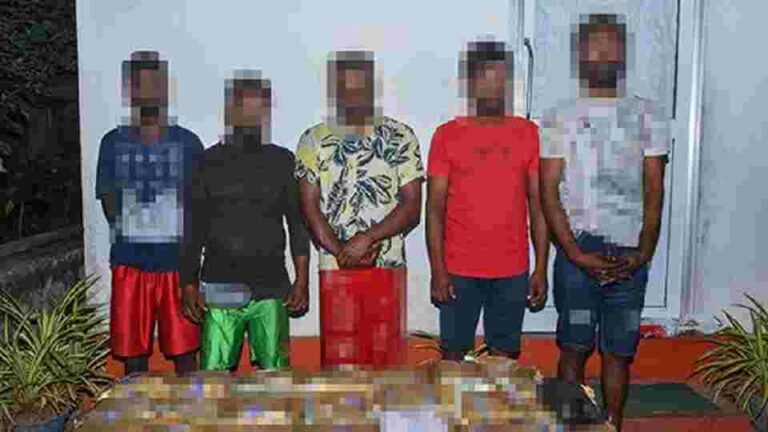
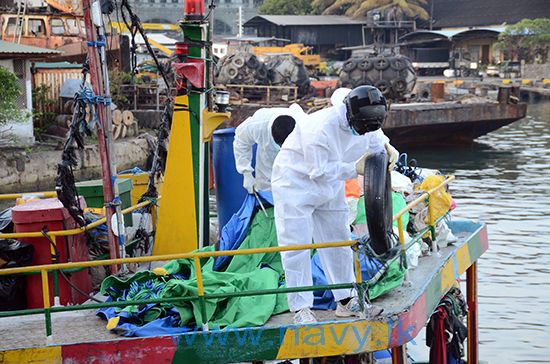
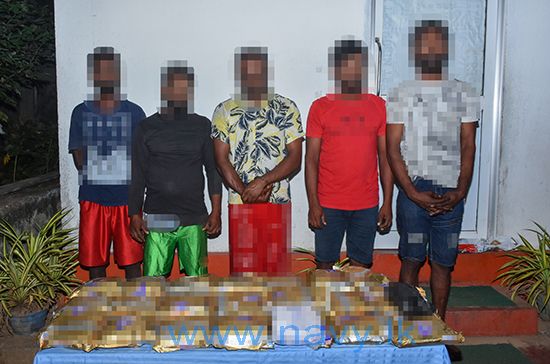
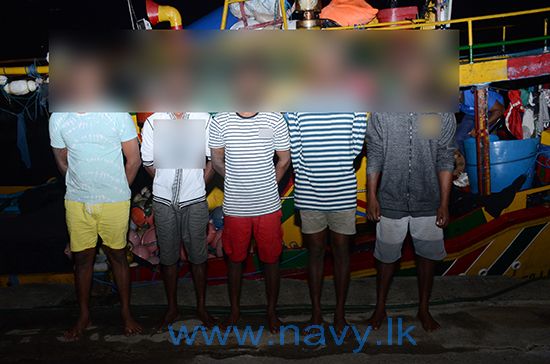
Sri Lanka Navy apprehended 10 suspects with 02 local fishing trawlers which were suspected to have smuggled narcotics into the island. The suspects and the fishing trawlers were escorted to the Port of Colombo yesterday (16).
The apprehension was made based on information revealed by the suspects of a local fishing trawler which was held during a special operation carried out by the Navy in waters west of Beruwala on 05th January. The same operation also led to the seizure of 23kg and 235g (including packages) of heroin smuggled by those suspects.
In order to curb illegal activities, including the smuggling of drugs via sea routes, Sri Lanka Navy conducts regular patrols and operations in the coastal and beach areas of the island. According to a coordinated operation carried out by the Navy together with other intelligence services, it has been revealed that a number of local multi-day fishing trawlers are involved in the smuggling of drugs into Sri Lanka.
During the apprehension made by SLNS Wickrama II on 05th January off Beruwala, 22 packages of heroin weighing 23kg and 235g (including packages) were recovered from the suspicious trawler (Reg. No. IMUL–A–1610–MTR Kingfisher – 6). Along with the consignment of narcotics, 05 suspects and the drug-carrying trawler were also taken into custody.
Based on information revealed by the suspects apprehended in that operation, two (02) more local multi-day fishing trawlers (Reg. No. IMUL–A–1888–MTR Kingfisher – 8 and IMUL–A–2029–MTR Kingfisher – 3) suspected of smuggling drugs to Sri Lanka were intercepted off the western coast by SLNS Gajabahu on 07th and 08th January.
During interrogation, the suspects aboard those trawlers admitted that they had thrown the stocks of narcotics overboard with the presence of the Navy. The interrogation also revealed that drug traffickers have developed a new strategy in which they remove inside components of the multi-day fishing trawlers’ Radar Domes and conceal drugs within.
The 02 fishing trawlers brought ashore are currently being inspected. Meanwhile, the fishing trawlers and 10 suspects will be handed over to the Police Narcotic Bureau for onward legal proceedings.
Going by the directives of the President and guidance of the Secretary of Defence, General Kamal Gunaratne (Retd) a range of anti-drug operations are being conducted across the island in order to eradicate the menace of drugs from the country. In this regard, Sri Lanka Navy in coordination with law enforcement agencies, too plays a pivotal role under the able leadership of Commander of the Navy, Vice Admiral Priyantha Perera, continuing operations to apprehend smugglers engage in such illegal acts in the guise of fishing.
The Foreign Employment Bureau of Sri Lanka will be introducing a new insurance policy for the protection of women leaving to the Middle East region for domestic work, a senior official of the ministry said.
Accordingly, the employer who hires the relevant female migrant worker must have obtained this insurance, and the insurance certificate must be submitted to the Foreign Employment Bureau to register the female migrant worker for foreign employment.
Women domestic workers leaving for Bahrain, Jordan, Kuwait, Lebanon, Oman, Qatar, Saudi Arabia and the United Arab Emirates can choose a suitable insurance policy from among the approved insurance schemes.
The employer must pay an amount of 110 to 140 US dollars for this new insurance for women going to work for a period of 2 years of service in those countries. The amount of insurance premium to be paid will increase in proportional to the duration of the employment contract.
If the employee dies or becomes permanently disabled due to accidents during the employment contract period, an amount of USD 15,000 will be paid as insurance compensation. In case of partial disability due to accidents, an amount of USD 10,000 is entitled as insurance compensation.
In addition to this, insurance compensation is also available for receiving medical treatment, surgery, and epidemic diseases such as Covid, and if a woman is sheltered in a safe house, she will be compensated with US $10 per day for the necessary expenses incurred during that period.
Meanwhile Sri Lanka’s cabinet of ministers has approved the reduction of the minimum age for females to depart to the Middle East as housemaids to 21 years from the current 23, Minister Bandula Gunewardena said.
“The cabinet approved the proposal by Foreign Employment Minister Manuusha Nanayakkara to encourage foreign remittances in the current currency crisis,” Minister Gunewarndene disclosed.
At the moment the age limit for Middle East employment for housemaids and other work was 23 year and for other countries 21 years.
A cabinet sub-committee was appointed on June 06 2022 to go into the matter under the Justice Minister.
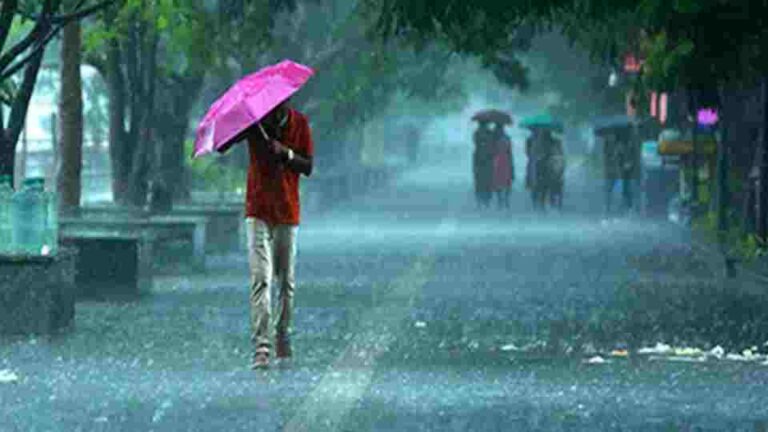
Showers or thundershowers will occur at several places in Western, Sabaragamuwa, Southern, Central, Uva and North-Western provinces during the afternoon or night and fairly heavy showers about 75mm can be expected at some places in Western and Sabaragamuwa provinces and in Galle and Matara districts, the Department of Meteorology said in a statement today (17).
Several spells of light showers may occur in the Eastern Province.
A few showers may occur in the Southern Province in the morning too.
General public is kindly requested to take adequate precautions to minimise damages caused by temporary localised strong winds and lightning during thundershowers.
Marine Weather:
Condition of Rain:
Several spells of light showers will occur in the sea areas off the coast extending from Trincomalee to Pottuvil via Batticaloa. Showers or thundershowers may occur in the other sea area during the afternoon or night.
Winds:
Winds will be north-easterly and wind speed will be (20-30) kmph. Wind speed may increase up to (40-45) kmph at times over the sea areas off the coast extending from Trincomalee to Colombo via Kankasanthurai, Mannar and Puttalam and the sea areas off the coast extending from Hambanthota to Pottuvil.
State of Sea:
Sea areas off the coast extending from Trincomalee to Colombo via Kankasanthurai, Mannar and Puttalam and the sea areas off the coast extending from Hambanthota to Pottuvil will be fairly rough at times. The other sea areas around the island may be slight to moderate.
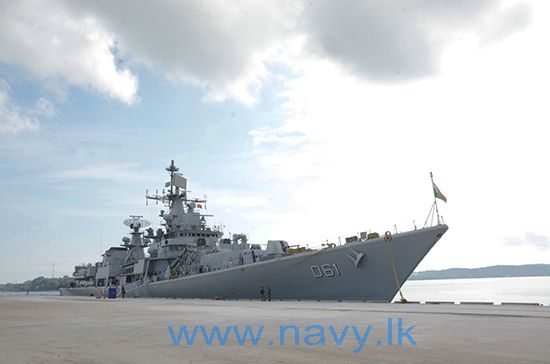
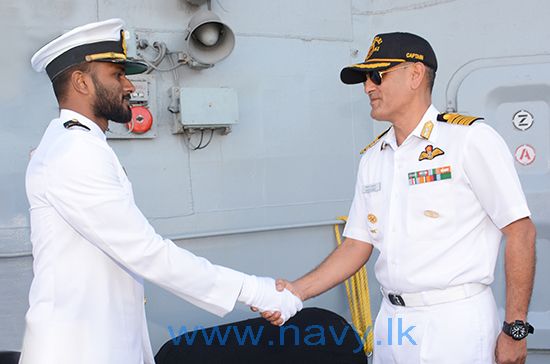
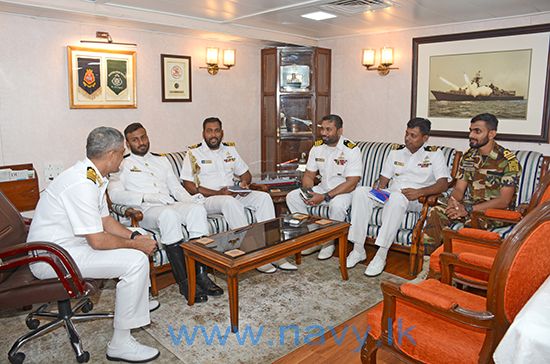
The Indian Naval Ship (INS) ‘Delhi’ arrived at the Port of Trincomalee on a formal visit on January 15.
The visiting ship was welcomed by the Sri Lanka Navy in compliance with naval traditions.
INS ‘Delhi’ is a 163.2m long Destroyer manned by a crew of 390 and the ship is commanded by Captain Shiraz Husain Azad.
In the meantime, the Commanding Officer of INS is scheduled to call on Commander Eastern Naval Area and Commandant Volunteer Naval Force, Rear Admiral Dammika Kumara on 16th January at the Eastern Naval Command Headquarters.
During the ship’s stay, the crew will take part in several programmes organized by the Sri Lanka Navy, with a view to promoting cooperation and goodwill between two navies. They are also expected to go on a sightseeing excursion in Trincomalee.
On the other hand, Sri Lanka Navy personnel will engage in a training visit onboard INS ‘Delhi’. Concluding the visit, INS ‘Delhi’ will depart the island on 17th January.