The retail industry which constitutes 23% of the country’s GDP has been hit hard by the ongoing forex crisis and urged the Government to resolve it fast before putting thousands of jobs at stake.
In a statement, Sri Lanka Retailers’ Association (SLRA) said the wider ecosystem of employees, suppliers, farmers and consumers of Sri Lanka impacted by the ongoing crisis and is pushing businesses to the brink of collapse.
The retail industry has been under tremendous pressure to deliver during the past one-and-a-half years, mainly owing to closures and disruptions due to the pandemic. The situation has been exacerbated since mid-2021 up to now due to increasing pressure on imports, which has been a core requirement for many retail businesses.
The retail industry in Sri Lanka plays a vital role in the country’s economy and it is pertinent to note that the national retail sales in Sri Lanka are approximately $ 13 billion. As a growing industry over the past years, it accounts for about 23% of the country’s GDP.
This industry also represents 14% of the labour market, with more than 1,100,000 people being employed within this sector in Sri Lanka. Additionally, the overall retail industry contributes significantly to the economic value chain of the country in many ways.
The Sri Lanka Retailers’ Association (SLRA), the apex body of organised retail in Sri Lanka, has raised growing concern about current standing of the local retail sector.
If the retail sector collapses completely, it will greatly affect its larger eco system that depends on retail, penetrating deep into the length and breadth of the country. The financial and social repercussions will be unprecedented and the loss of employment alone, will be disastrous.
The local retail sector accounts for over 30% of the national GDP and 14% of direct employment in the work force. Over 10% percent of households in Sri Lanka depend on employment in the retail sector.
A large section of the employment in this sector includes sales, cashiers, and lower mid-segment jobs, which are vital to keeping the country’s economy afloat, and providing deeper penetration of income streams across the country as well.
.Mr. Murali Prakash, President of the SLRA, commented on the current situation. “It is important that everyone come together with authorities, policymakers and stakeholders and work towards replenishing the local retail sector, as it is the backbone of our economy.
The SLRA cannot stress enough the importance of making the retail sector a priority, as without it, the economy would further dwindle, as other sectors that depend on retail will also collapse.”
The Social Security levy charged on basic essential items have further increased the burden on consumers. SLRA recommends to exclude the levy on basic essentials to provide relief to the consumers.
The SLRA urges the government and authorities to set up a system to facilitate the continuation of the retail sector business through a planned set of actions.
A 100% fail proof framework based on monthly availability that could be considered to rejuvenate the retail sector would ensure imports and provide a means of managing the current uncertainty in the country.
The SLRA also advocates transparency on how retailers should operate amidst the current crisis. It is imperative that frequent discussions by key authorities are taken place on a timely basis, as it is the only means of ensuring the survival of the local retail sector.
Sri Lanka retail sector on the verge of collapse

Dr. Sudarshini Fernandopulle, Anura Priyadarshana Yapa respond to claims on joining SJB!
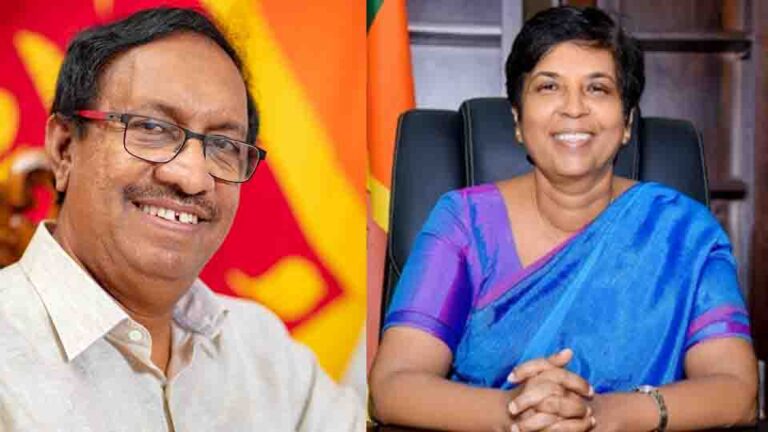
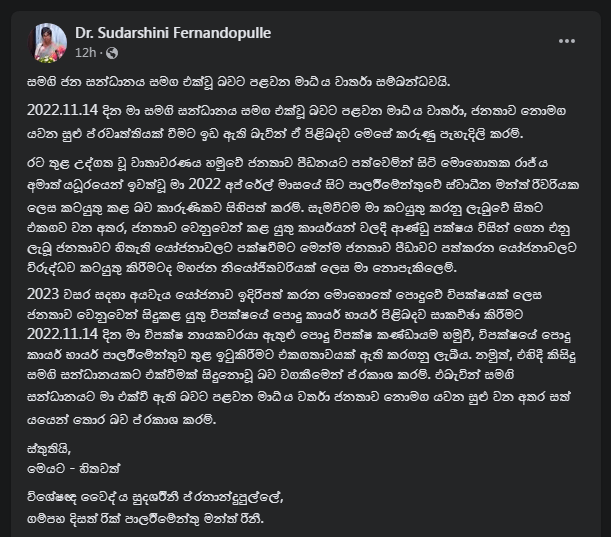
Responding to early reports on several Ruling Party MPs extending their allegiance to the alliance ‘Samagi Jana Sandhanaya’ formed by the main Opposition Party Samagi Jana Balawegaya (SJB) led by Leader of the Opposition Sajith Premadasa, Dr. Sudarshini Fernandopulle and Anura Priyadarshana Yapa have responded, stating that these claims are not entirely accurate.
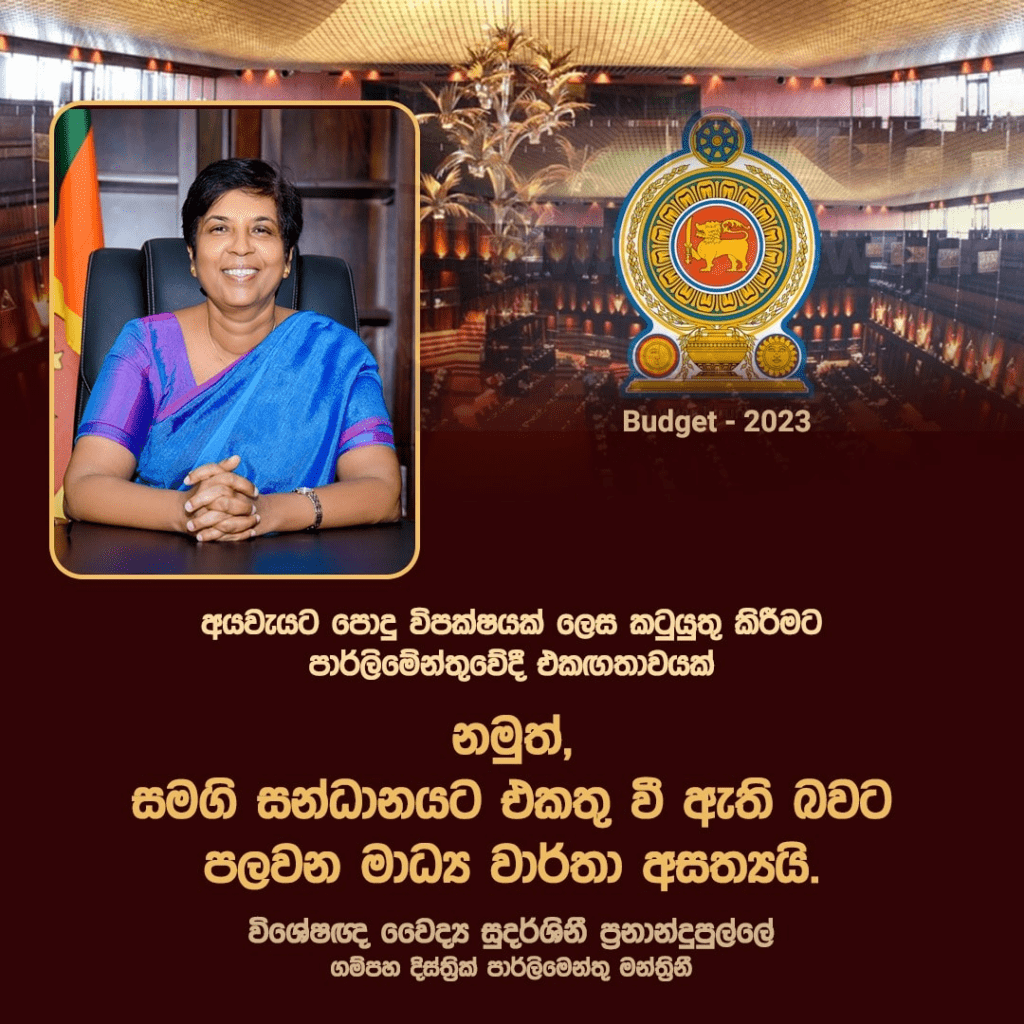
In a social media remark, Dr. Fernandopulle said that the reports on her pledging allegiance to the Samagi Jana Sandhanaya are deceiving and that she only entered an agreement on the common role of the Opposition in Parliament towards the 2023 Budget during her meeting with the Opposition Leader yesterday (14).
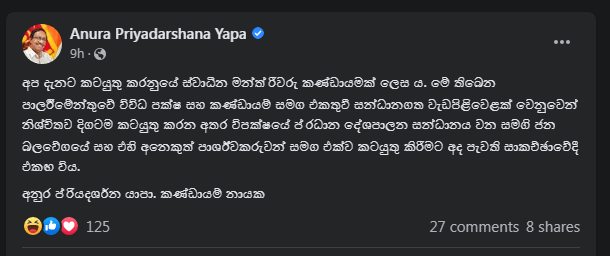
Commenting on the meeting with the SJB yesterday, Yapa stated that they currently serve in Parliament only as an ‘independent group’ and that they will continue to contribute to the establishment of a programme in the form of an alliance by holding talks with various parties and groups in Parliament.
MIAP
SL Bio Energy firm owner takes a Reputed Qatar investor on a ride

A reputed Qatar investor with high-level connections sued a Sri Lankan bio energy firm and its sole owner and Managing Director for US$ 3 million defraud in an investment scam.
Qatar Diplomatic circle had intervened into this matter as it will impact the good relations between the two countries but it was of no avail, informed sources said.
Western Province Colombo High Court will open the hearing of this civil jurisdiction case on December 14 following a petition filed by the Qatar investor Ali Abdulla Al Suwaidi.
In his petition he claimed that although he was the sole investor of the funds required as the capital for the 2 MW rice husk fueled power plant situated at Nintavur, Amparai, no shares were allotted to him.
The Managing Director (MD) of the Company Zainulabdeen Mohamed Hairu had unlawfully taken action to remove the Qatar investor who was a director and two other directors, his nominees of Bio Energy Solutions Pvt Ltd registered as a private limited liability company.
The Qatar investor also claimed that the MD had intentionally cheated and stolen his investment of $3 million by promising return of investment and fraudulently denied the clear title for share ownership of the company.
He cited the Company, Bio Energy Solutions (Private) Limited, Managing Director and four others as respondents.
He pleaded from the Court to issue an order that the Petitioner’s name be entered into the Share Register of the 1st Respondent Company to reflect the Petitioner’s investment of $ 3million in the 1st respondent Company.
The proposed power plant approved and acknowledged by the Board of Investment (BOI) Sri Lanka could supply at a generating capacity of 2 MW to the National Grid around the clock at about 1.5 to 1.6 Kg/hour rice husk consumption.
On that basis the proposed power plant would consume approximately 70 Metric Tonnes of rice husk per 24 hours and which was supposedly 20 percent of the rice husk available locally within a 1.5 Km radius of the proposed power plant at Nintavur
Passport and VISA charges to increase!
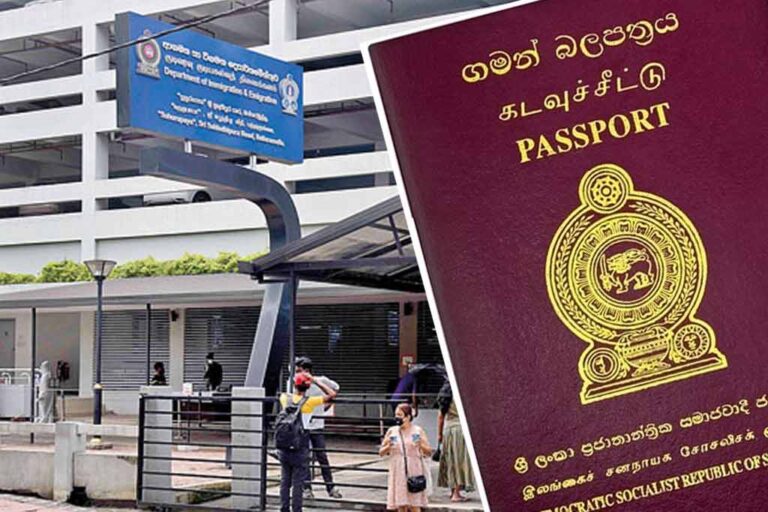
Various payments charged by government institutions are proposed to be increased by 20 per cent with effect from January 01, 2023, said President Ranil Wickremesinghe, during his 2023 Budget speech in Parliament yesterday (14).
Accordingly, all payments pertaining to the issuance of passports, visa and other services of the Department of Immigration and Emigration will also be proposed for a revision.
Nonetheless, various charges already increased in 2020, 2021, 2022 will remain unchanged via the new resolution, the President added.
MIAP
Heavy showers about 100 mm expected in some areas
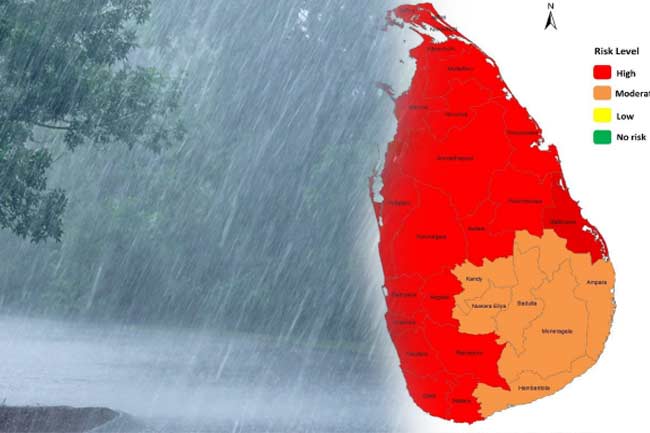
Showers or thundershowers will occur over most places in the island after 2.00 p.m, and heavy showers about 100 mm can be expected at some places in Southern, Sabaragamuwa and Uva provinces, said the Department of Meteorology in a statement today (15).
Showers will occur particularly in the coastal areas of Northern, Eastern and Southern provinces during the morning too.
Misty condition can be expected in Western, Sabaragamuwa, Uva and Central provinces and in Galle and Matara districts during the morning.
General public is kindly requested to take adequate precautions to minimise damages caused by temporary localised strong winds and lightning during thundershowers.
Marine Weather:
| Condition of Rain: |
| Showers or thundershowers will occur at several places in sea areas around the island. |
| Winds: |
| Winds will be north-easterly or variable in direction. Wind speed will be (20-30) kmph. |
| State of Sea: |
| The sea areas around the island will be slight to moderate. Temporarily strong gusty winds and very rough seas can be expected during thundershowers. |
MIAP
Sri Lanka Original Narrative Summary: 15/11

- President Ranil Wickremasinghe presents Budget 2023: says it is expected to achieve an economic growth rate of 7% to 8% through the social market economy based on reforms & modernization.
- Government to target public investment of Rs.1,220 bn in 2023; plans to be implemented to achieve FDI of USD 3 bn annually over the next 10 years: USD 3 bn expected from new exports annually from 2023-2032.
- Steps to be taken to reduce the budget deficit of 9.8% of GDP in 2022 to 7.9% of GDP in 2023: primary budget deficit of -4.0% of GDP in 2022 expected to be tightened to -0.7% in 2023.
- Sri Lankan Airlines, Telecom, Hilton, Water’s Edge and Sri Lanka Insurance to be “restructured”: proceeds to be used to strengthen forex reserves and Rupee.
- Budget proposes several new institutions: institution for “non-performing assets”: fully empowered centralized body for promotion of foreign trade & investment: Presidential Commission on Taxation: Agri-enterprise villages: and Authority to regulate Micro-finance loans.
- Central Bank rigidly fixes exchange rate for the past one week at Rs.360.97 (buying) and Rs.371.76 (selling) per USD: for the past 6 months, since 12th May 2022, the Central Bank has “fixed” the Rupee between Rs.360 & 370 per USD.
- Colombo Archbishop Cardinal Ranjith calls on Catholic lawyers to be “politically independent”: asks them to be the moral conscience of the nation.
- Reports emerge that 6 SLPP MPs Anura Yapa, Sudarshini Fernandopulle, Chandima Weerakkody, John Seneviratne, Jayaratne Herath and Piyankara Jayaratne have joined the SJB Alliance: Priyankara Jayaratne and Fernandopulle later deny the reports.
- Former Finance Minister Ravi Karunanayake expected to make a return to active politics: likely to be appointed as the new General Secretary of the UNP.
- Sri Lanka’s Women’s Rugby captain Dulani Pallekondage goes missing while participating at the Asia Rugby 7’s Series, in Korea: Incheon Police start investigation.
RSF unveils shortlist of nominees for its 30th annual Press Freedom Awards
Fifteen journalists and media outlets from around the world have been shortlisted for the 30th annual Press Freedom Prize that Reporters Without Borders (RSF) awards in three categories – journalistic courage, impact and independence. Russian journalist Dmitry Muratov, the 2021 Nobel peace laureate, will attend the awards ceremony in Paris on 12 December.
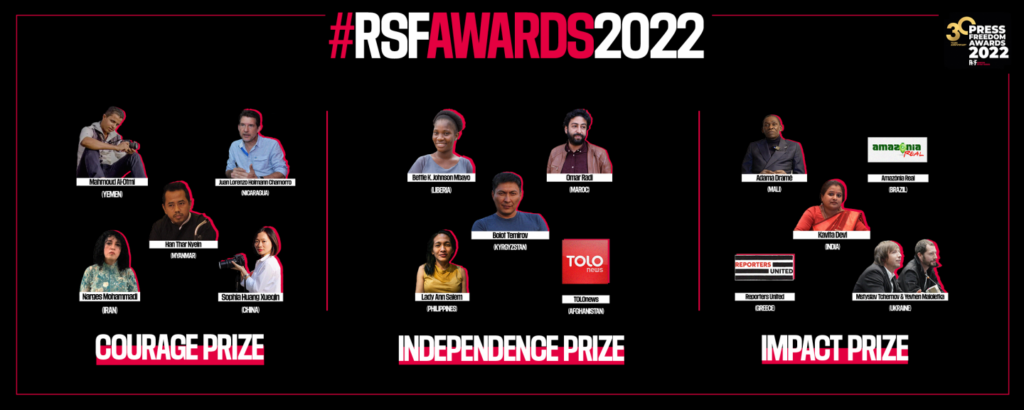
” For 30 years, the RSF prize has honoured the work of those who embody the ideals of journalism. In the digital age, the challenges facing journalism have evolved, but courage, independence and the pursuit of impact remain cardinal virtues. Those who embody them deserve to be honoured and supported. They will be at the 30th edition of the awards, which will be held in the presence of one of their most prestigious peers – Dmitry Muratov, the Russian journalist who was awarded the Nobel Peace Prize in 2021.
Christophe Deloire
Secretary-general of Reporters Without Borders (RSF)
The winners of the 30th edition of the RSF Prize will be announced at a ceremony in Paris on the evening of 12 December. Dmitry Muratov will open the event, which will be hosted by French TV presenter Daphné Bürki and will include performances by singer Jane Birkin, who has been campaigning for journalists in Myanmar.
Three former RSF laureates will present the individual prizes. They are Can Dündar, a Turkish journalist and specialist in Turkey’s media; Lina Attalah, cofounder and editor of the independent Egyptian newspaper Mada Masr; and Matthew Caruana Galizia, an investigative journalist and son of Daphne Caruana Galizia, the Maltese journalist who was killed in 2017 by a bomb placed in her car.
Prize for Courage
The Prize for Courage is awarded to journalists, media or NGOs who demonstrate courage in the practice, defence or promotion of journalism in a hostile environment and despite threats to their freedom or safety.
Juan Lorenzo Holmann Chamorro (Nicaragua)

Director general of the independent newspaper La Prensa since 2019, he was forced to announce the end of the newspaper’s print edition on 13 August 2021 because of a newsprint shortage orchestrated by President Daniel Ortega’s government. The police seized control of the newspaper’s installations and arrested Holmann the same day, taking him to the Judicial Assistance Directorate detention centre, known as the “torture cells.” Held there ever since, he has not been able to speak to a lawyer and has been allowed only seven family visits. In March 2022, he was given a nine-year prison sentence on a charge of money laundering, despite a lack of evidence to support the charge. La Prensa continues to exist in digital format and is now run from a location outside Nicaragua. It has never stopped reporting the news on its website, not even for a minute.
Mahmoud Al-Otmi (Yemen)

A freelance journalist originally from Al Hudaydah, a port city now controlled by the Houthi rebels, he has been covering Houthi human rights violations for Yemeni media outlets since 2014. He began receiving telephone threats soon after founding thealmmarsa.com website in Aden in 2018, in which he focuses on Yemen’s Houthi-ruled western provinces. His brother was jailed the following year in reprisal, and his father was forced to sign a document disowning him. A few months later, the Houthis managed to identify his car and the place where he lived. On 9 November 2021, his car was blown up as he was driving his wife, fellow journalist Rasha Al-Harazi, to hospital to give birth. She and the baby died on the spot. Al-Otmi was badly injured but survived. He is now based in the United Arab Emirates, where he continues to work.
Huang Xueqin (China)

A journalist, former Xinquaibao and Southern Metropolis Weekly investigative reporter, Sophia Huang Xueqin has worked in recent years to promote women’s rights, and to document and expose sexual harassment against women and girls, especially in the media environment. Sophia was arrested on 19 September 2021 in the southern city of Guangzhou together with labour activist Wang Jianbing under suspicion of “inciting subversion of state power”. She was arrested while preparing to leave China to study in the United Kingdom. Huang Xueqin was also previously detained for three months in 2019 under the charge of “picking quarrels and provoking trouble” for covering the pro-democracy protests in Hong Kong. In 2021, her article on female activist Li Qiaochu, published by Initium Media, received an award for Excellence in Reporting on Women’s Issues from the Society of Publishers in Asia (SOPA).
Narges Mohammadi (Iran)
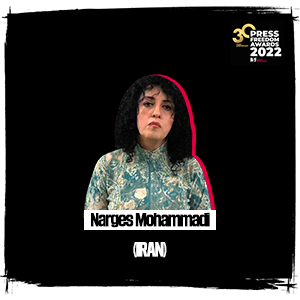
Repeatedly imprisoned during the past 12 years for fighting for press freedom and human rights, Narges Mohammadi is a symbol of courage. Even in prison, she has not stopped providing information about the appalling plight of prisoners in Iran, especially women prisoners. Her life has been a battle in which she has had to make many sacrifices so that her voice could be heard. Married to a journalist, Taghi Rahmani, she has two children she has not seen grow up, having spent only a few months out of prison since 2011. Despite having heart problems, she has been mistreated and tortured and has been given 154 lashes. But she does not lose hope and continues to call for civil disobedience, always with a smile on her lips. She has written dozens of articles from prison, has made a documentary and has even published a book entitled White Torture, based on her interviews with 16 prisoners.
Han Thar Nyein (Myanmar)
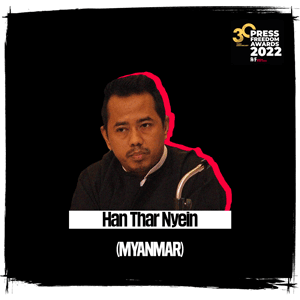
Arrested barely a month after the February 2021 military coup in Myanmar, Han Thar Nyein was one of the first targets of the junta’s persecution of independent journalists. The military had good reason to go after him. A decade ago, he co-founded Kamayut Media, a news agency that provided the world with reliable and original coverage of what was happening on the ground in Myanmar – a mission that he wanted to continue despite the coup. He is currently being held in the sadly notorious Insein prison on the outskirts of Yangon, where he has been subjected to extreme violence and torture, burns all over his body, rape threats and death threats. His Kamayut Media colleague Nathan Maung, a US citizen who was arrested at the same time as him, was quickly released thanks to diplomatic negotiations. But Han Thar Nyein had the misfortune to “be born only Burmese” and must continue to resist in prison.
Prize for Impact
The Prize for Impact is awarded to journalists, media or NGOs whose work has led to concrete improvement in journalistic freedom, independence and pluralism, or to an increase in awareness of these matters.
Mstyslav Tchernov et Yevhen Maloletka (Ukraine)
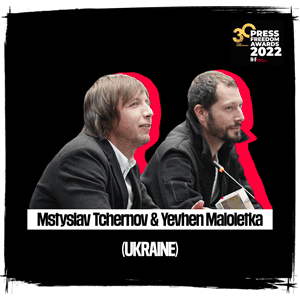
Reporting for the Associated Press, they were the only journalists to have documented the impact of the fighting and artillery bombardments in the Ukrainian city of Mariupol for 20 days in March 2022 for the international media. Their photo of a pregnant woman injured in the shelling of a maternity hospital went around the world and drew international public opinion’s attention to what was happening in the besieged city. They worked in extremely difficult conditions, with the Russian army looking for them because of the impact of their photos, but they were helped by the population, who were aware of the importance of their work.
Kavita Devi (India)
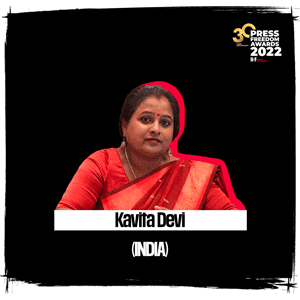
The co-founder and director of Khabar Lahariya, a news website operated solely by women journalists from rural areas, she has become a symbol and voice for the forgotten fringes of Indian society, for rural populations that don’t speak English or even Hindi. As she was born to a family from the Dalit community (formerly known as “Untouchables”) and was married off at the age of 12, her life should have followed the traditional path of home, children and livestock. But she managed to study and, with other students, founded Khabar Lahariya in 2002, rising to the challenge of imposing women journalists in the traditionally male-dominated media sector and turning the spotlight on the social, ethnic and religious discrimination suffered by India’s marginalised rural populations. She has thereby helped Indian society advance towards more representativity and citizen autonomy, and pluralist journalism independent of the traditional power centres.
Adama Dramé (Mali)
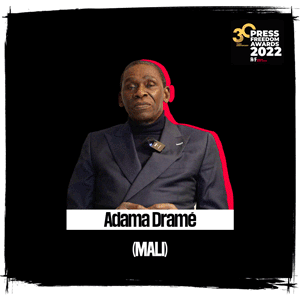
Without his determination, the Birama Touré case would have petered out. The director of the Malian investigative weekly Le Sphinx, he has been battling tirelessly ever since his reporter Birama Touré disappeared in Bamako one night in January 2016. An investigation carried out jointly by Dramé and RSF established that Touré was abducted, tortured and almost certainly killed in a state security detention centre for taking too close an interest in the activities of Karim Keïta, the son of the then president, who was ousted in a coup in 2020. Karim Keïta fled to Côte d’Ivoire after the coup but the Malian authorities have issued a warrant for his arrest, while the former head of Mali’s intelligence agency, Gen. Moussa Diawara, has been arrested in connection with Touré’s disappearance. These unexpected developments would not have happened without the revelations in which Dramé participated. Fearing for his life, Dramé has had to flee the country but he continues to investigate the case and hopes one day to find out exactly what happened to his missing reporter.
Amazônia Real (Brazil)

Founded in 2013 by two women, Katia and Elaize, Amazônia Real is an independent journalism agency based in Manaus, the capital of Amazonas state. Run exclusively by women, it produces ethical and investigative journalism, interviews those who are rarely seen in the mainstream media, and publishes multimedia reports on the impact of climate change, flooding and deforestation on the region’s indigenous communities and minorities, describing their lives and telling their stories. The national media have picked up its recent reports about clashes between police and illegal gold panners, the use of new industrial pesticides and the seizure of land from local communities. A non-profit organisation, it has chosen not to accept funding or resources from the state or from any person or company implicated in environmental crimes, forced labour or violence against women. When Dom Phillips and Bruno Pereira were murdered in June 2022, it produced many reports shedding light on the circumstances of their death and the work of the media in the Amazon.
Reporters United (Greece)

Reporters United is a network of reporters aiming to support investigative journalism in Greece, collaborate in cross-border investigations with international journalists and media, and publish stories that often struggle to find their place in the Greek press. It is extremely careful about the transparency of its funding and about its independence. Although subjected to intimidation lawsuits (SLAPPs) and denied access to state-held information, Reporters United has exposed major scandals, including spying on journalists, environmental abuses and corruption in Greece’s management of migration. As a rare island of journalistic professionalism in a sea of media polarisation and government propaganda, it must grapple with the major problems for press freedom in Greece, the EU country that is ranked worst in the 2022 World Press Freedom Index.
Prize for Independence
The Prize for Independence is awarded to journalists, media or NGOs for resisting pressure (including financial, political, economic or religious pressure) or because of the values and rules that enable them to resist.)
TOLOnews (Afghanistan)

Awarded the RSF Press Freedom Prize in 2005 and the City of Paris Medal for Heroes of Information in 2016, this privately-owned TV channel continues to operate in Kabul despite constant pressure from the Taliban since they took control of the country on 15 August 2021. It is one of Afghanistan’s biggest privately-owned TV news channels, and its impartial, fact-based reporting reflects the best principles of journalism. By continuing to operate, it emphasizes the fact that unbiased reporting can and must be maintained in any circumstances. It is for this reason that it is nominated for its independence in Afghanistan.
Omar Radi (Morocco)
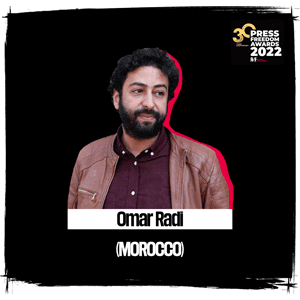
This investigative reporter and human rights activist has been subjected to judicial harassment for covering corruption and other sensitive subjects for more than ten years. The authorities began investigating him on suspicion of spying in June 2020, shortly after Amnesty International reported that the Pegasus spyware had been used to hack into his phone. A month later, he was jailed on the basis of a rape allegation and ended up being tried simultaneously on the completely different rape and spying charges, increasing doubts about the fairness of the trial. He was sentenced to six years in prison in July 2021. The authorities had been targeting him for at least three years prior to this trial. He began a hunger strike in April 2021 in protest against his detention but had to abandon it after 21 days because he suffers from Crohn’s disease, and has been in very poor health ever since.
Lady Ann Salem (Philippines)

She embodies journalism’s future in the Philippines, a new generation of journalists following the trail blazed by Maria Ressa. For this, she was subjected to red-tagging and was jailed in December 2020 on terrorism and “leftism” charges after police planted guns in her Manila home. A court ruled that her arrest was “null and void” in February 2021 but she had to wait another month before being released. She edits Manila Today and coordinates Altermidya, an alternative media network that prioritises in-depth articles, field reporting and investigations, and cover the fringes of Philippine society that the mainstream media ignore. A member of the International Association of Women in Radio and Television (IAWRT), she also fights for women’s rights.
Bettie K. Johnson Mbayo (Liberia)

This independent investigative journalist turned down all funding offers from government representatives when she founded The Stage Media (Liberia), a fact-checking and investigative journalism entity, in 2020. She is one of Liberia’s most authoritative sources of news and information. Her investigative reporting has documented and denounced at least six major scandals involving politics, corruption, human rights and the problems of women in her country. After she exposed one corruption case, senior officials offered her a contract to do public relations work for the government. She turned it down. Her family has also been pressured. After a story about a woman forced to remain in hospital because she couldn’t pay her hospital bill, Mbayo’s husband, who is a doctor, was threatened by the hospital’s director. He is often accused of “not controlling his wife.” The couple have also been offered international research grants in an attempt to get them to leave the country.
Bolot Temirov (Kyrgyzstan)
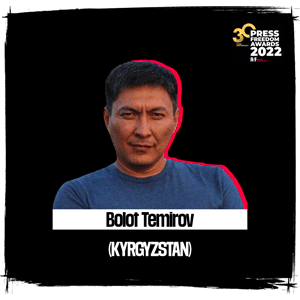
Harassed and spied on by the authorities, Kyrgyzstan’s best known investigative reporter resists judicial persecution and blackmail and continues to post his video reports on his YouTube channel, Temirov Live. As well as being prosecuted for possession of drugs (slipped into his pocket by the police during a raid in February 2022), he is being sued by the Kyrgyz Petroleum Company over one of his videos in three criminal cases opened in April. Domestic videos of him filmed with a hidden camera have been “leaked” online and the police have interrogated his wife and Temirov Live employees. He nonetheless persists in posting his investigation reports, which are mostly about corruption.
_____________________
This year’s prize jury consists of leading journalists and free speech defenders from all over the world. They are Rana Ayyub, an Indian journalist and Washington Post columnist; Raphaëlle Bacqué, a leading French reporter for Le Monde; Mazen Darwish, a Syrian lawyer and president of the Syrian Centre for Media and Freedom of Expression; Zaina Erhaim, a Syrian journalist and communication consultant; Erick Kabendera, a Tanzanian investigative reporter; Hamid Mir, a Pakistani news editor, columnist and writer; Frederik Obermaier, a German investigative journalist with Munich’s Süddeutsche Zeitung newspaper; and Mikhail Zygar, a Russian journalist and founding editor-in-chief of Dozhd, Russia’s only independent TV news channel. The jury is chaired by RSF president Pierre Haski, a French reporter and columnist.
Sri Lanka, Towards a New Beginning: President’s Full Speech on 2023 Budget
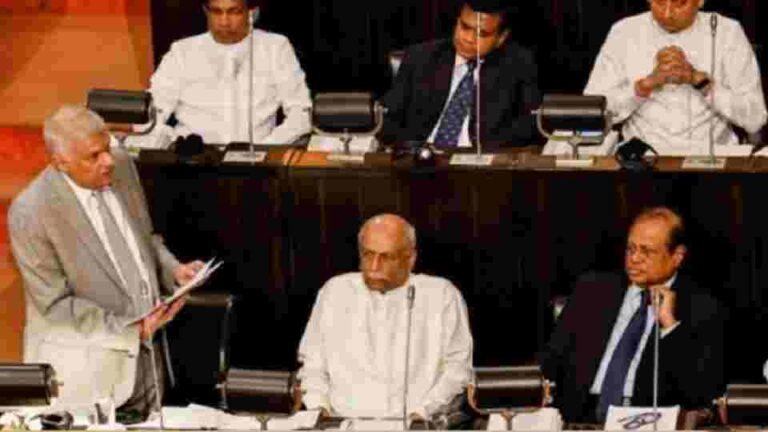
Budget Speech – 2023
Sri Lanka, Towards a New Beginning
Approach
Honorable Speaker,
A glimmer of hope on emerging from the economic abyss is currently visible, as a result of the strenuous and difficult policies we have been compelled to adopt during the past few months. After the era of waiting in queues for days and various protests, our distress has been eased to some extent, reaching a sense of satisfaction.
Negotiations with the International Monetary Fund (IMF) are currently in progress. We are in dialogue with India and China on debt restructuring, and confident that these discussions will lead to positive outcomes.
Inflation could be controlled to some extent due to the recent action in this regard. Similarly, the rupee is strengthening. We expect to sustain these developments. I am confident that by moving along the same path, we will be able to stabilize the economy within the next year.
But we cannot be satisfied and therefore must start a new journey.
Presenting the Interim Budget proposals last August, I stated that the purpose of these proposals is to lay the basic foundation for transforming the economy that has continued to exist in our country. On that occasion I proposed, that the process of building a new economy suitable for the modern world, would be initiated through the budget proposals of 2023.
Seventy-five years after independence, can we be satisfied with the status quo? Where did we go wrong? How did we go wrong?
I was born in independent Sri Lanka, one year after its independence. At that time, Japan had the most developed economy in Asia. It is well known that we were second. However today, the per capita income of Sri Lanka is USD 3,815, and Japan’s USD 39,285.
I recollect another personal experience of mine. In 1991, when I was the Minister of Industry, my Vietnamese counterpart came to Sri Lanka. He wanted to study our open economic system and industrialization strategies, which was granted. He was given the opportunity to discuss with the officials of the Greater Colombo Economic Commission. In 1995, while Sri Lanka’s foreign reserves were USD 2.1 billion, Vietnam’s was USD 1.3 billion. The Minister of Vietnam further studied our related policies before the return to his country. What is the situation today? In 2021 Vietnam’s foreign reserves are USD 109.4 billion, and Sri Lanka’s USD 3.1 billion.
Let’s look back. Let’s desist from politically tinted agendas. Why did we get it wrong? Where did we go wrong? What did we get wrong? Or, did we get anything wrong?
Today, our country has several main revenue generating sectors, namely agriculture, free trade zones, garment industry, tourism, gem and jewellery and foreign employment. Since independence, we have been able to create only a few sectors for the country to earn a foreign income. Beyond these, why have we not yet been able to create large-scale foreign income generating sectors? This is an aspect which requires extensive consideration.
In the past, have we projected our satisfaction in the present or the future? People were happy when private businesses were nationalized; rice distributed free. Governments that took such measures became popular temporarily.
In this manner, we were satisfied with installing an electric lamp on the street, but did not think further, for instance, in increasing electricity generation.
Is the long-term development of a country be based on popular decisions? Or, the right decisions? In many cases, popular decisions were taken instead of correct decisions for our country. Even today, many people seek to make popular decisions.
What was the result of this popular ruling tradition? To build a relief economy and mentality across the country. People are used to getting concessions as their right. Therefore governments do not work to create opportunities for people to develop, but only to provide relief.
Reminiscing the nineteen fifties, former Singaporean Prime Minister the late Lee Kuan Yew once mentioned that “in Singapore I followed the hard, but right path. Sri Lanka’s Bandaranaike followed the popular path”.
There is no future for the country by continuing on this popular path. There is no prosperity for the country by giving concessions while being in debt. So, let’s extricate ourselves from this situation now, and change our thinking.
So let’s think a new. Let’s create innovative approaches to move the country forward.
- 1977 Approach
- In 1977, the J.R. Jayewardene government took a positive step to change the economic perspective that existed. Instead of the failed closed economy, a different path was chosen. Instead of giving concessions, he created an economy that provided opportunities. The practice like providing free rice was discontinued. Instead, new opportunities were created to move forward with the people’s abilities. The economy was opened; the country flourished; poverty decreased, with the expansion of middle class.
- However the economic renaissance created in 1977 could not be rapidly advanced, for instance the factor of separatist terrorism hampered that journey. Necessary changes and reforms were not made in accordance with the ground situation.
- Instead of increasing the government’s income and foreign investments, the government’s expenditure rose beyond its limits. Much was spent to maintain loss-making State Owned Enterprises and unnecessary expenditure for political gains. These expenses were met not with the income earned by the country, but being in debt to the world.
- The Buddha’s teachings has resonance about borrowing, as contained in the”Samachchapala Sutra”, where borrowing should be for investment, and not for consumption. But what did we do? Borrow from other countries and spend on our consumption. We got lazy day by day. People got used to hand outs from the government. We were not thinking about the future of the country. A selfish society which only thinks about what the country should give its citizens was created gradually. Regrettably we were feasting on borrowed money.
- Therefore, the economic base and direction of 1977 changed completely.
- Aspirations of the Youth
- For 75 years after independence, we have been speaking about protecting national resources. The Youth are campaigning and advocate for the preservation of these resources. But have we really protected these and created for their future?
- The real national wealth of our country is the youth. Can we be satisfied with the work we have done so far in order to create educational, social and economic opportunities for the youth? If we have been successful in providing and protecting our youth, why should they be queuing to leave the country in large numbers?
- Many think that national resources are physical assets such as the Trincomalee oil tanks. Even with such categorisation they have been left to decay. At present we are bearing the cost of 420 government institutions and enterprises. The annual loss of these major 52 SOEs is Rs. 86 billion. I hope to table these lists of institutions in Parliament in two or three days. Has the country benefited from these institutions for many years or suffered?
- While our attention is on these institutions and enterprises considering these as national resources, we have failed to pay attention to the youth of the country, the hopes of our future generation receding.
- These young people hope for a better day, brighter future and a prosperous country. Therefore new approach, that goes beyond the traditional political engagement involving agitations, struggles and strikes is required.
- A look to the public gallery today shows a significant presence of young people, who all aspire for a better tomorrow, and a change in systems.
- We are creating this new economy for these young people, for their tomorrow.
- The new basis of the economy
- The economic base created in 1977 is no longer relevant for the present. It is broken, just like the closed economy that once functioned. So we have to think about the present anew. As Sugathapala de Silva’s play ” Marasad” has demonstrated ; We should look at the world with a new vision, like turning a pillow case inside out.
- Current world trends are different. World economic thinking is different. The way the world economy behaves is different. Therefore, we have to prepare a different new economic base to be in tandem with those new trends.
- I wish to outline two parts from two articles. Firstly the Gamini Viangoda espouses:
- “Be careful when someone that has caught the question by the tails says that they have the power to build the country. It is a lie when they say that they will put thieves and corrupt people in prison as soon as they come to power. It is a lie when they say that they will create a country free from corruption and waste. Although all the these are essential for the development of a country, we must realize tomorrow, if not today, that the answer to the question of the present day Sri Lanka lies in a more complex and difficult range.
- Secondly Chintana Dharmadasa upholds:
“This is why we have to think again. The struggle is not outside of us. It is within us. We have to do everything we can to win this economic struggle. We can uplift the people who are suffering from extreme poverty with an economic force that we rekindle. At this moment, that ‘s where the mission for the real people lies.”
- The difficulty and complexity of this crisis must be understood and a force created to revitalize the economy in emerging from this crisis.
- Through this budget, the new foundation for the Sri Lankan economy that can create that force is being laid.
- I wish to now outline some of the main aspects that we will focus.
- Due to the economic crisis, the whole country faces many difficulties. Families have struggled to put the food on the table; jobs are in jeopardy; income has been lost; businesses are At this juncture it has not yet been possible to completely get rid of all these hardships.
- People faced such impediments with the hopes of rebuilding their country. All of us are committed to revive the country. The benefits of the new economy we are building must be equitably shared among all. Equal opportunities will also be created for all. It is not an economic system that serves only a small group of society, but will elevate the entire populace.
- When Sri Lanka was a low-income economy, the basic necessities of life enjoyed by the people were minimal. But having been elevated to a middle-income economy, the standard of living also rose. This is normal even at the As the level of a household as the income level increases, the standard of living rises.
- In preparing the new economic base, we should focus on the lifestyles that society could sustain : A new journey must be started so that these lifestyles do not descend to a lower level again.
- Today’s youth who are technologically advanced have expectations for higher lifestyles. Therefore, the new economic base needs to pave the way to this end.
- Therefore, means of livelihood that we should be creating is to raise per capita income to match the lifestyles that young people aspire.
- In this context we will focus on taking care of poor and vulnerable It is necessary to examine whether all sections of society are receiving equitable benefits of health services, free education that is currently provided and the other welfare programs. These services should be made more efficient. Maximum benefits should be derived from the resources spent for these purposes.
- It is the acceptance of the present economic crisis, which would allow us to prepare the way forward. Therefore, in the midst of this crisis, it is important to pay special attention to the manner in which our welfare programs could be implemented more
- Parallely, entrepreneurs in the private sector should be assisted. This segment grew from the mid-19th century to the mid-1950 With the nationalization of their businesses, the private in Sri Lanka almost collapsed. As a result of the open economy introduced in 1977, private entrepreneurs re-careered, but were not adequately provided with the necessary facilities.
- Entrepreneurs were not favourably considered and were even labeled villains. In most of the tele dramas produced in Sri Lanka, the village shopkeeper (“Mudalali”) was portrayed as an evil character. Entrepreneurs across the scale were treated as exploiters.
- This situation must be changed. New entrepreneurs should be created and encouraged, for which, all necessary facilities should be provided. A policy environment should be created to make their work more effective.
- While encouraging private sector entrepreneurs, we should focus on regulating economic activities, investing in infrastructure, correcting market failures and maintaining law and order.
- I would like to define the new economy that we are going to build as a social market economy, or an “open economic system of social protection”.
- In this new economy, we will focus on three main aspects.
- An export oriented competitive economy.
- An environmentally friendly green and blue economy.
- A digital economy
- Creating such a new economic foundation is a challenging task. Such a new economy cannot be created merely by making changes in the tax system. New sources of revenue need to be found. New areas of economic activity must be identified. Extensive economic reforms and restructuring to be carried out.
- The creation of which will be two fold.
- The first will be – economic reforms and reorganization, while the second will focus on modernization.
- It is imperative to achieve rapid economic growth, for which the entire potential of the country must be tapped. Re-examination of the country’s resource base, as well as its reorganization is important. Education, health, agriculture and marine resources, industry, trade and investment, defence, foreign relations, etc., must all be modernized. We should carry out this socio-economic transformation in the global context. In particular, special attention should be paid to climate change.
- We will soon present the new legislations and legal amendments to the Parliament that are necessary for economic transformation.
- It is essential to establish a common social agreement between various parties for economic management. The legislature, executive, judiciary, professional groups, mass media, religious groups and various social organizations should be involved. This common unity is important in sustaining long-term social harmony, in order to move towards rapid economic growth.
- We expect to achieve the following goals, initially through the social market economy or social-security-open-economy that we are creating.
- High economic growth of 7 to 8 percent.
- Increasing international trade as a percentage of GDP by more than 100 percent
- Annual growth of US$ 3 billion from new exports from 2023 to 2032
- Foreign direct investment of more than US$ 3 billion in the next 10 years
- Creating an internationally competitive workforce with high skills in the next ten years
- 3. In order to achieve these goals, we need to create a competitive and high-performance modern economy, which would entail an export-oriented, led by the private sector. Our journey begins in 2023 with this budget. These budget proposals will set the pace for a new approach in making Sri Lanka a developed country by 2048 which marks 100 years of independence.
- These budget proposals are different from the traditional. We are used to reductions in prices of goods, salary increases concessions etc. through budget proposals. We like to see budget proposals that appear to be relief oriented even though it means indebtedness. We have lost our way by taking that popular route. Now we can no longer continue to go down such wrong paths.
- Our wedding will not be celebrated by falling into debt internationally. Therefore this budget will lay a foundation that ensures our ability stand on our own strength, in creating a new economy.
- If we build the future through the foundation created by this budget, we will be able to enjoy a prosperous economic environment by the end of 2023. The economic benefits will flow throughout the country.
- The economic reforms we are introducing are not limited to those agreed upon with the International Monetary Fund. These proposed reforms by the International Monetary Fund are limited only to economic stabilization.
- Our envisaged reforms and reorganizations are what the country has needed for a long time to build a new economy.
- This is a role that many governments have opted to ignore with popularity in mind. We will undertake onerous duty for the
- So , I would like to present the 2023 budget proposals:
- Macro-fiscal Framework
- Our fiscal stabilisation programme envisages government revenue increasing to around 15 percent of GDP by 2025 from the 8.3 percent of GDP as at end 2021.
- The government is targeting a primary surplus of more than 2 percent of GDP in 2025 and expects to improve upon this level thereafter.
- We aim to reduce public sector debt from around 110 percent of GDP as at end 2021, to no more than 100 percent of GDP in the medium term.
- It is expected that inflation will be brought back under control to a mid-single digit level in the medium term.
- In line with this, interest rates are also expected to gradually reach a moderate level.
- Once macroeconomic confidence is re-established and foreign exchange reserves are replenished through foreign finances, the adverse pressure on the exchange rate is also expected to abate.
- With the implementation of a series of growth enhancing structural reforms, the medium-term economic growth is expected to return towards 5 percent in the medium term and accelerate to a higher level thereafter.
- Trade and Investment
- Agency for External Trade and Investment
- As Sri Lanka is facing forex shortages due to the ongoing economic crisis, the inflows of forex should be reviewed. It is noted that for some time the coordination issues associated with the government agencies working for the external trade and investment affects the performance of the country’s exports. Besides, there are several incentive programmes being implemented by the government agencies to encourage exporters at present. Therefore, it is important to set up a single agency to create a conducive environment for promoting investment and external trade. Accordingly, a new agency will be established in place of the Board of Investment, Export Development Board, Sri Lanka Export Credit Insurance Corporation, National Enterprise Development Authority etc. with the enactment of a new law. For this purpose, I propose to allocate Rs. 100 million.
- New Economic Zones
- I propose to set up New Economic Zones in the Western Province, North-Western Province, Hambantota, and Trincomalee with a view to attracting foreign investments. Accordingly, steps will be taken for setting up of relevant infrastructure which is conducive for such investments. Investments and industrial zones currently operating under various government agencies will come under the New Economic Zone program for which a new law will be enacted soon. Besides, alternative mechanisms to the current practice of attracting foreign investors based on the tax concessions should also be examined. Rs. 300 million will be allocated for this programme.
- National Productivity Commission
- I propose to establish a National Productivity Commission as an independent institution to investigate/study productivity issues based on quantitative and qualitative data and recommend trade adjustments schemes, to advise the government on micro economic policies related to industries, and commerce and trade, to provide recommendations on the elements/aspects needing changes to the existing regulations on social and environmental issues, to train and guide the employees in industries that are closing down due to economic instability and the difficulty of adapting to new technologies, enabling them to find new job opportunities and if not, propose a compensation mechanism for employees who lost their jobs. The operations of the National Productivity Secretariat will also be incorporated into the proposed Commission. I propose to allocate Rs.100 million for the implementation of this proposal.
- Enhancing Access to Global Markets
- It is essential that Sri Lanka expands its market access whilst developing domestic supply capacity. Global trade is today driven by regional and global production networks such as ASEAN, where Sri Lanka has not yet been fully engaged to obtain benefits. Policy measures will therefore focus on enhancing Sri Lanka’s ability to compete in global markets through innovation, efficiency, and quality.
- Towards this end, Sri Lanka has resumed efforts to integrate with key markets such as India and China. Sri Lanka will also resume trade negotiations with Thailand, which along with the FTA with Singapore, sets the stepping stone for Sri Lanka to engage in dynamic regional trading arrangements such as Regional Comprehensive Economic Partnership (RCEP).
- I also propose to establish an International Trade Office to deal with all the international trade negotiations. This will initially be established under the Ministry of Finance and subsequently, it will be amalgamated with the Ministry of Foreign Affairs (MFA). Accordingly, the MFA will be renamed as Ministry of Foreign Affairs and International Trade.
- Logistics Infrastructure Development Programme
- Performance of the logistics infrastructure is another barrier for exporters, importers and investors. Therefore, I propose a three-year Logistics Development Programme during the period of 2023 to 2027 targeting to improve the logistics performance of Sri Lanka among the first 70 countries.
- Investment Friendly Environment
- There is a need for simplifying and making existing arrangements efficient to create a more business friendly environment. Accordingly, measures are required to reduce costs, procedures and time, and to improve transparency enabling the creation of a healthy business environment. Hence, I propose to allocate Rs. 200 million to the Ministry of Investment Promotion to introduce the necessary reforms in this respect.
- New Labor Policies
- Reforms in the labor sector is long overdue, in which both employee and employer should be protected in a manner to efficiently carry out productive economic activities. In a competitive export-oriented economy, both parties should productively participate in the promotion of the country’s progress. The laws, policies and institutional arrangements in the sector should not stall entrepreneurial abilities and business development. In fact, the environment should be conducive to make use of an individual’s talents while entrepreneurs’ risk-taking behavior too should be rewarded. The country’s labor laws being outlived and fragmented, I propose to enact a new, updated and unified labor law in a manner to benefit both employer-employee segments and the economy.
- Lands for Agricultural Exports
- A vast amount of land belonging to Janatha Estate Development Board (JEDB), Sri Lanka State Plantation Corporation (SPC), and Land Reform Commission (LRC) remains without being cultivated or productively utilized for a long time, due to various reasons: legal issues, institutional conflicts, lack of capital etc. There are possibilities of productively using such lands for the betterment of the economy. Accordingly, a programme will be devised to allow investors to productively utilize the land in a manner to increase both the production and exports. Hence, it is expected that large parcels of unutilized/unproductively used lands will be leased out on long-term basis to grow exportable crops. Further, a new law to facilitate the proposed agricultural land lease program will also be presented to this House.
- Disposal of Government Lands
- Although preliminary activities related to the disposal of government lands are carried out by District Secretaries/Government Agents through Divisional Secretaries/ Additional Government Agents, at a later stage such duties were also allocated to Sri Lanka Mahaweli Authority and the Land Reform Commission which were established for special requirements. It is reported that there are occurrences of discrimination and malpractice as preliminary activities related to disposal of lands are done in various ways by the respective entities. Therefore, as the aforementioned special requirements have already been met, a programme will be prepared during the next year to enable preliminary activities in relation to the disposal of all government lands including the disposal of lands under the above two institutions only by the Divisional Secretaries.
- Digital Technology
- The country sees the benefit of using digital technology in various economic activities and service delivery systems. Its beneficial effects were seen recently with the introduction of the QR system in the petroleum distribution by the Ministry of Power and Energy. Hence, I propose to appoint a Committee involving experts and relevant officials in the industry to examine and report to the Cabinet of Ministers on the requirement for furtherance of the digital technology industry, including required policy environment, laws, institutional support and facilities.
- Effective Use of Sri Lanka’s Mineral Resources for National Development
- It has been observed that the contribution to national development of Sri Lanka’s mineral resources remains at a low level. Therefore, it is proposed to appoint a Committee comprising the Ministry of Industry, Ministry of Environment, Geological Survey and Mines Bureau, National Agency for Public Private Partnership (NAPPP) and related institutions to formulate and implement an appropriate policy on how mineral resources could be effectively utilized for national development. The Committee report should be submitted to the Cabinet of Ministers in three months’ time.
- New Department for Cinnamon Industry
- Since the export of cinnamon products traditionally occupies a leading position, measures should be taken for the furtherance of this industry. Sri Lanka’s cinnamon products have developed a unique identity globally and its export of value-added products should further be encouraged. Therefore, I propose to establish a separate Department for the development of the cinnamon industry in Karandeniya area where cinnamon cultivation is widespread. Rs.200 million will be allocated to implement this proposal.
- New Project/Program Appraisal Scheme
- Many development projects/programs in the past have not produced desired results due to lack of proper identification and a systematic appraisal system being adhered to. As a result, the government had to use the tax revenue mobilized from other sources to repay the loans taken for such projects/programs. Subsequently, this has come to an unsustainable level for the economy also leading to the debt management issues confronted by the government today.
- Accordingly, new projects/programs to be considered in the future should be submitted to the National Planning Department after conducting a feasibility study to include financial, economic and technical aspects by the line agency/Ministry. The National Planning Department, having examined the respective projects/programs, should submit them to the National Development Committee with its recommendations. The Committee should re-examine the projects/programs to ensure policy consistency, viability, inter-sectoral alignments, priorities etc. before being recommended to the government. The composition of the National Development Committee will consist of members with relevant expertise drawn from the public and private sectors.
Tourism Industry
- Promotion of Marine Tourism
- Various new programs have been introduced in many countries to attract tourists. However, there is a lack of approach to develop maritime tourism considering advantages of the location of Sri Lanka. Therefore, three maritime zones in the Eastern, Southern and Western provinces will be identified and the related infrastructure in those areas developed. Accordingly, identification and development of the safety sea areas for tourists to engage in sea-related activities in the shallow seas, the development of related infrastructure including, anchoring bays for parking light yacht, necessary facilities for diving and other related activities and food courts are required. The necessary funds for this purpose should be provided by the Tourism Development Fund. To initiate the process, I propose to allocate Rs. 50 million from the 2023 budget.
18.2. I propose to facilitate the promotion of adventure sports such as white water rafting in order to popularize Sri Lanka as a destination for sports tourism.
General Education
- Providing Internet Facilities to Schools
- It is indispensable to provide internet facilities to schools for the advancement of the education system with the latest technology. Therefore, as the first step, free internet facilities to 1,000 senior and junior secondary schools located in remote areas will be facilitated with the contribution of the Telecommunication Regulatory Commission, along with the concept of Corporate Social Responsibility of institutions that provide internet facilities and other private sector institutions.
- Improving Facilities in Rural Schools
- The existing health and hygiene facilities in some rural schools are insufficient. Accordingly, a provision of Rs. 200 million will be made for the construction of sanitary facilities, particularly toilets with proper water facilities, or to provide water facilities for existing toilets in 139 provincial schools and 23 national schools, as well as in rural schools with minimal facilities.
Higher Education
- Increasing Merit-based Admissions to State Universities
- In admitting students to state universities, currently only all Arts stream students are selected on island-wide merit basis. However, 40 percent of the students are admitted on the basis of island wide merit in the commerce, technology, science and mathematics streams. In this context, a large number of students who demonstrate higher performance are deprived of the opportunity to enter the university. And also they suffer inconvenience and injustice, and have lost their opportunity to contribute to the country’s development. Therefore, it is necessary to introduce required steps to overcome the situation. Accordingly, I propose to increase the percentage of admissions to state universities on island wide merit basis from 40 percent to 50 percent with effect from the academic year 2022/2023. The Ministry of Education should take action to amend the system of admission to state universities.
- Post-Graduate Education Opportunities for Doctors
- The post-graduate studies for doctors, which are confined to the University of Colombo at present, should be expanded to provide opportunities to more doctors. Accordingly, I propose to establish postgraduate study programs for doctors in Peradeniya, Ruhuna and Jaffna universities. Those universities should take necessary action to establish legal and procedural arrangements to implement this proposal. Accordingly, I propose to allocate Rs. 60 million to implement this proposal. I also suggest to prepare a national policy for post graduate education locally for the doctors.
- Quality Assurance and Accreditation Board for the University Degrees
- I propose to set up a Quality Assurance and Accreditation Board to ensure the quality and accreditation of degree courses conducted in universities. Under this, it is expected to ensure the quality of all degree courses. The Ministry or Minister in charge of higher education should take necessary steps to implement this proposal with the necessary legal provisions. For this purpose, I propose to allocate Rs. 100 million.
- Foreign Scholarships for A-Levels Qualified Students and Graduates
- To mark the 75th anniversary of Sri Lanka’s independence, I propose to provide 75 scholarships for the Advanced Level qualified students who receive the highest results at the 2022 A-Level examination to follow degrees in foreign universities based on their chosen subject areas. Accordingly, a program should be prepared by paying attention to the selection of relevant foreign universities, entering into related MOUs, selecting students and providing necessary facilities to the selected students, etc. I propose to allocate the required funds from the President’s Fund.
- In addition, I also propose to provide opportunities for 75 graduates with excellent degree performances at state universities from selected degree courses to follow post-graduate degrees in recognized foreign universities. The required financial support for this purpose will also be obtained from the private sector and foreign donor agencies. The youth selected under this program should contribute to the development of the country after completing their post-graduate degrees.
- New Faculty of Medicine
- Currently, there are 11 medical faculties in Sri Lankan universities and 2001 medical students have been enrolled for the academic year 2020-2021. To further increase this number, I propose to establish a new medical faculty under Uva-Wellassa University. I propose to allocate Rs. 200 million for the establishment of this medical faculty.
- Separate Institution to Study History of Sri Lanka
- I propose to establish an Institution to undertake and facilitate research on the history of Sri Lanka. Accordingly, I propose to allocate Rs. 50 million for this purpose.
Reforms
- Public Service Reforms
- There are around one million four hundred and fifty thousand (1,450,000) public servants currently working in various government agencies. Hence, a large portion of government revenue is spent on their salaries. Therefore, it has become a challenge to allocate resources for other public purposes, including developmental purposes. Therefore, I propose to appoint a Presidential Commission to review all aspects of public service in line with current requirements and make recommendations including necessary reforms.
- Presidential Commission on Taxation
- It has been difficult to allocate resources to health, education and other important sectors due to the low level of government revenue generated from taxes in comparison to other countries. Accordingly, measures should be taken to gradually increase state revenue in the next few years. As such, I propose to establish a Presidential Commission on Taxation to study and make recommendations on the functioning, coordination and changes to be made in the tax structure, the institutions, procedures etc. This Commission will also examine the requirement for setting up of a centralized institution for managing government revenue.
- Promotion of Electronic Payment System
- I propose to make it mandatory for all government payments to be made electronically (online) with effect from 01.03.2024 including cash grants to the respective recipients as well as the payments for obtaining services from various government agencies by the public. Accordingly, all government agencies should also take action to prepare a program enabling online payments for those services and introduce the necessary legal changes as well. In this regard, required assistance should be sought from the IT Service Officers currently working in ministries and departments. I propose to allocate Rs.200 million for the implementation of this policy.
- Setting up of Data Protection Authority
- As we develop our digital economy, there is a need to regulate the processing of personal data in order to safeguard the privacy of our citizens from adverse impact of digitization. The government is committed to implement the Personal Data Protection Act, No. 9 of 2022 and will take steps to set up the Data Protection Authority in 2023. The new regulator will be independent and engaged with the Central Bank of Sri Lanka, Securities and Exchange Commission, TRCSL and all relevant sectoral regulators to ensure a proper governance of personal data.
- Insurance coverage for Private Sector Employees
- It is noted that the number of private sector employees who lose their jobs due to various reasons is on the increase. As this has become a very complex social issue with the current economic crisis, I propose to an insurance coverage to provide a monthly allowance for a maximum of three months covering the period from the loss of employment and re-employment and to establish an insurance fund for this purpose.
- Further, a large number of people are benefitted from the Agrahara health insurance system provided for government employees and I propose to provide similar health insurance to private sector employees as well.
31.3 A contribution is provided to the Employees’ Trust Fund by the employers on behalf of private sector employees. Therefore, it will be a duty and responsibility to provide some relief from the Employees Provident Fund. Accordingly, Accordingly, it would be appropriate to allocate a certain amount from the Employees’ Trust Fund for the proposed health and insurance coverage.
- Accordingly, Employees’ Trust Fund Act should be amended incorporating these two schemes under the Employees’ Trust Fund.
Food Security
- Electronic Scheme for Food Safety
- It is necessary to maintain an up-to-date data system for planning and implementing activities relating to food safety. Accordingly, information on all agricultural and livestock products of the household units should be obtained through an online process and the National Food Security Program should be planned accordingly. This program should be implemented by the National Food Security and Nutrition Unit.
- Development of Inland Fisheries Industry
- In order to increase the nutritional level of the public, the opportunity to obtain more fish products should be increased. Accordingly, I propose to allocate Rs. 100 million to increase the capacity of the existing fish breeding centers to facilitate inland fisheries industry.
Increasing Government Revenue
- Tax Policy Measures
- The need for increasing government revenue requires no explanation as many of the challenges that we face today is due to the lack of revenue of the government. The revenue has declined significantly to 8.3% of GDP in 2021, which is one of the lowest in the world. In order to correct this position while correcting the tax cuts introduced in late 2019, the government presented revenue measures on three occasions i.e. on 30 May 2022, the Interim Budget presented on 30 August 2022 and the Inland Revenue Bill presented in October 2022. The revenue proposals mainly included changes to the income tax and Value Added Tax (VAT) while addressing tax policy gaps and rationalizing tax concessions.
- Committed implementation of these tax reforms will help increase revenue in 2023 and beyond enabling to move away from costly monetary financing (money printing) to cover government expenditure in the future. The government is also committed that the tax policy measures are accompanied by the improved efficiency in public spending and fighting corruption.
- Crude estimates suggest that revenue forgone due to the VAT exemptions granted to various sectors, including electricity, transport and fuel, is estimated to be more than 1 percent of GDP. Hence, it is proposed to remove certain exemptions after review. Amendments to the VAT Act to remove certain exemptions will be made effective from 01 April 2023.
- It is noticed that some State-Owned Enterprises (SOEs) are still paying the PAYE / APIT tax liability of employees. This issue has been questioned at the Committee on Public Enterprises (COPE) and the Auditor General. Hence, I propose to stop such payments effective from 1 January 2023, since such tax should not be an expenditure to the entity (SOEs), although the personal emoluments are paid under collective agreements.
31.5 Tax on Beedi sticks
- In order to regularize the Beedi industry and deter people from Beedi consumption, I propose to impose a tax of Rs. 2 per Beedi stick. In addition, other fees payable for obtaining of certificates and licenses will be increased.
31.6 Phasing-out of Para Tariffs
- In order to promote the manufacturing industry, to remove the existing barriers to international trade, to provide the necessary incentives and facilities for local industries and projects including agriculture, CESS levy will be eliminated on a phased basis in three years commencing January 01, 2023. For Ports and Airports Development Levy, I suggest to phase out completely in five years. Accordingly, I am revising the current rates of Customs Import Duty from 0%, 10% and 15% to 0%, 15% and 20% to accommodate the proposed phasing out of para-tariffs / levies effective from January 01, 2023. Relevant work in this connection is being done to introduce a Trade Adjustment Program as well.
- However, the proposed tax policy will be implemented in such a way that it does not interfere with CESS levy on agriculture-based value-added industries.
- Non-Tax Revenue
- Increase in non-tax revenue is also important in the fiscal consolidation process. Hence, I propose to increase this fees and charges by 20 percent with effect from 2023. However, the fees and charges that have already been increased in the years of 2020, 2021, and 2022 will not be revised with this proposal.
- In the same vein, it is proposed to increase fees levied by the Department of Immigration and Emigration on Passport, Visa and other charges.
- Further, I propose to appoint a Committee to examine and make recommendations on the royalty, rent, and other non-tax revenue charged and collected by the government organisations to the General Treasury.
- I propose the daily transfer of all revenue and receipt collections by Ministries and Departments, directly to the General Treasury with effect from January 2023 to reduce the substantial cost of finance due to delay in remitting revenue collection to the Consolidated Fund. In this regard, General Treasury will take necessary action to issue the instructions in due course.
- Tax Administration
- Recent announcements of tax policy measures should go hand in hand with the tax administration measures to have a broader tax base, better compliance, and stricter enforcement. Accordingly, tax administration measures will be enhanced through improvements in technology, regulations, process improvements, and investing in Human Resources related to the Department of Inland Revenue, Sri Lanka Customs, and Department of Excise.
- Whilst the requirement of having everyone over 18 years of age opening a tax file is a first step, many of those who open files will be below the tax-free thresholds. Therefore, it is important to introduce measures that identify high income earners specifically and get them into the tax net. In this regard, I make the proposals in Annexure VI to improve the tax administration.
Expenditure Management
- Commitment to Manage Expenditure Effectively
- The importance of proper expenditure management to strengthen the fiscal consolidation process needs no elaboration. It should be in line with the efforts to increase the revenue as well.
- The Interim Budget introduced several proposals, including the introduction of new Public Financial Management (PFM) Act incorporating binding fiscal rules and appointment of an Inspector General to keep the expenditures in check, which will be implemented in the near future. In addition, a number of circular instructions have already been issued to ensure strict control of government expenditure.
- Establishment of a National Operations Centre (NOC)
- It is high time to establish a National Operations Centre (NOC) under the Department of Project Management and Monitoring of the Ministry of Finance for tracking implementation issues of all development interventions of the country and resolve emerging issues on a priority basis.
- In support of the efficient and effective functionality of the NOC, it is also proposed to establish a comprehensive Web-based National Development Information System within the NOC as the supportive tool for obtaining updated data and information for decision-making.
- Allowing Armed Forces Personnel to Retire Early
- I propose to allow armed forces personnel, other than special categories, to retire after 18 years of service. Measures will be taken to provide them with necessary training, enabling them to engage in productive economic activities.
- Difficult situation faced by public servants
- I am well aware that public servants and pensioners are in a difficult situation to manage their expenditure on monthly pay due to increase in transport cost, electricity and water tariffs and high food inflation.
- Further, I expect that the government revenue will be increased in about a year due to the economic recovery as a result of the measures taken by the Government. At the same time, it will be possible to implement the proposed reforms to make the public sector to optimum level. Hence, I believe that considerable relief can be given to the public servants and pensioners at the latter part of year 2023.
State Owned Enterprise Reforms
- Restructuring of SOEs
- The urgency of restructuring the most fiscally significant State-Owned Enterprises (SOEs) was reiterated several times during the last 6 months. As committed to in the Interim Budget, a Unit has now been established at the Ministry of Finance with the specific task of restructuring SOEs.
- Initially, measures will be taken to restructure Sri Lankan Airlines, Sri Lanka Telecom, Colombo Hilton, Waters Edge and Sri Lanka Insurance Corporation (SLIC) along with its subsidiaries, the proceeds of which will be used to strengthen both the foreign exchange reserves of the country, and the Rupee.
- The strategic interventions will be made to SoEs with the anticipation of achieving economies of scale and other benefits. Therefore, I propose to line up the similar nature of businesses by way of backward, forward or horizontal integration.
- The Gem and Jewellery Research and Training Institute will be merged with the National Gem and Jewellery Authority in order to provide services with better quality and efficiency to the gem-related craftsmen to increase export revenue. The government will also explore the possibility of setting up of a Gem Emporium (Gem Zone) for the benefit of the industry participants.
Debt Management
- Taking Selected SOE Debt to Government Balance Sheet
- As a part of strengthening the balance sheets of selected SOEs, loans from China Exim Bank to the government which had earlier reclassified as debts of the CEB, SLPA and AASL will be recognized as central government debt by end of December 2022. Guaranteed foreign exchange debt of the CPC will also be recognized as central government debt by end of December 2022.
Financial Sector
- New Financial Asset Management Companies Act
- I propose to introduce a new Financial Asset Management Companies Act to enable banks and finance companies to separate and transfer their non-performing bad assets to an asset management company. This will smoothen the resolution process of financial institutions by creating a swift removal of bad debts from an affected institution.
- Establishment of the Microfinance and Credit Regulatory Authority (MCRA)
- I propose to establish a Microfinance and Credit Regulatory Authority (MCRA) to ensure the protection of customers of microfinance and money lending businesses, while necessitating the reporting requirement to Credit Information Bureau of Sri Lanka (CRIB) by the regulated institutions.
- Blue and Green Financing Space
- Honourable Speaker, the country has over time created many assets that are environmentally friendly and has the potential to be monetized to access the growing blue and green financing space. Sri Lanka is a signatory to a number of key international agreements and has also agreed to be a part of the 30 by 30 initiative. In this regard, I propose to further the work on the Marine Spatial plan and identify and declare the Exclusive Economic Zones which will also pave the way to attract sustainable investments, including blue, green and sustainable financing, while the country progresses on its programme with the IMF.
Social Protection
- Welfare Benefits Policy
- Honourable Speaker, I draw your attention to the 19th paragraph of the Interim Budget Speech presented by me to amend the Appropriation Act, No. 30 of 2021. According to the Welfare Benefits Act No. 24 of 2002, the preparation of the social registry has already started by the Welfare Benefits Board (WBB). Accordingly, the beneficiary applications have been processed and the data systems are being processed. We have already published on 20th October 2022 the legal regulations to identify beneficiaries based on verifiable eligibility criteria.
- As the next stage of the process, it is planned to go to the homes of the applicants who have already registered to validate their eligibility to receive benefits and get a declaration related to it according to the Law. Accordingly, the process of selecting beneficiaries using new eligibility criteria will start in January 2023 and the eligibility list will be published. In line with the Welfare Benefits Act No. 24 of 2002, all welfare benefit payment schemes will be prepared based on that social registry system.
- The WBB will coordinate payments of all welfare benefits. Electronic payments of benefits under this social registry and all welfare benefit payment schemes framed thereunder are facilitated to the bank accounts of eligible beneficiaries. Payment under the new welfare benefit payment schemes are expected to start by April 2023. Until then, the existing welfare benefits schemes will be maintained.
- Continuing the Provision of Increased Allowances Paid to Beneficiaries of Samurdhi, Elderly, Differently-abled and Kidney Patients’ Allowances
- Honourable Speaker, a significant number of beneficiaries are wait-listed in anticipation of the current Elderly, Differently-abled and Kidney patient’s allowances. As they truly deserve relief, the General Treasury was instructed to allocate provisions through the budget, making the allowances available for the said persons.
- The government has paid close attention to curtail the difficulties faced by the community who are vulnerable due to the current economic crisis. Action has been taken to increase the allowances paid to more than 3 million people i.e. beneficiaries of Samurdhi, Elderly, Differently-abled and Kidney allowances and more than 726,000 economically affected families, from the revised budget of 2022. The government is focused on extending the respective relief herein to another four months.
- In respect of the aforesaid, an additional allocation of Rs. 43 billion will be provided, in addition to the provisions allocated from the Budget Estimates at present.
- Strengthening Elderly / Differently-abled / Widows as Household Entrepreneurs
- Elderly/disabled/low-income /widows are a segment that must receive more attention economically. It is possible to strengthen this community economically by utilizing their skills and labor, and thereby obtaining their contribution towards the development of the national economy. In that respect, I propose that a joint program be arranged for this purpose by the Ministries of Women’s Affairs and Industry. I propose to allocate Rs. 250 million for the year 2023 in this respect. Further, action will be taken to obtain the participation of the private sector under public-private partnership for promotion of their products in the market.
- Improving Child Nutrition
- Amidst the current economic crisis, an increase in acute malnutrition among children under 5 years of age is observed. Hence, I propose a sum of Rs. 500 million be provided to further strengthen the existing nutrition supplemental programmes in order to reduce health problems arising as a consequence.
Agriculture
- Expansion of Coconut Cultivation
- As there are new opportunities to generate foreign exchange to be created by promoting the export of coconut and related products, facilities should be provided for encouraging more value-added exports of coconut. It is a fact that in recent times, coconut lands are upon fragmentation used for other purposes. Therefore, necessary steps should be taken to protect the present coconut lands as well as to encourage the replanting of coconuts.
- Current legal provisions allow fragmentation of less than 4 hectares of coconut lands, resulting in the fragmentation of fertile lands which has severely impacted the annual coconut production. Therefore, I propose to amend the existing legal provisions and limit the fragmentation of coconut lands with less than one acre in extent.
- Establishing 10 Agro-entrepreneurship Villages
- It is expected to transform the farmers involved in the agriculture industry into agro-entrepreneurs and thereby generate employment opportunities. For this purpose, I propose to establish 10 Agro-Entrepreneurship villages in order to encourage export-oriented products with the use of modern technology. I propose to allocate Rs. 250 million for this purpose.
- Producing Triloka Wijayapathra
- The possibilities of producing Triloka Wijayapathra purely for the prurpose of exports will be examined for which an expert committee will also be established.
- Reducing Post-Harvest Crop Losses and Improve Storage
- Even if we work hard to increase agricultural production, over 30% of our output is lost due to various reasons, such as improper storage and transportation issues. Therefore, I propose to allocate Rs.150 million from the budget to develop required knowledge, technology and various infrastructure facilities to reduce post-harvest losses. I also propose to set up an export committee to obtain proposals, to prevent crop damages by animals.
Irrigation
- Enhancing Flood Protection Systems
- In order to enhance the flood protection systems, an additional sum of Rs. 500 million will be allocated for the implementation of irrigation systems based on Ma Oya, Aththanagalu Oya and Bentara Ganga.
Dairy Sector
- Increasing Liquid Milk Production
- In order to improve the local milk production, I propose to develop the Kundasale Artificial Insemination Center and adopt new technologies. For this purpose, I propose to provide Rs. 100 million in 2023. I encourage the private sector to enhance their capacities to help this endeavor.
Environment
- International University for Climate Change
- The effects of global climate change are real and complex. Sri Lanka should also contribute to the program for common survival of humanity by helping to mitigate and adapt to the effects of climate change. Accordingly, I am planning to establish an International University for Climate Change for the purpose of furthering knowledge, sharing experience, education, training, building capacities, and the development of programs in the areas of climate change mitigation and adaptation. For initial expenses for this purpose, I set apart Rs. 100 million.
- Green Hydrogen Technology for Development
- Since the world’s use of fossil fuels as a form of energy is costly and environmentally damaging, more attention has been paid to the use of renewable energy. Meanwhile, many countries are conducting various studies to use green hydrogen as energy. An advantage of this technology is that it is possible to use it to produce fertilizer. Considering the weather and climate conditions of Sri Lanka, there is an enabling environment for the production of green hydrogen (using water with solar power or wind power). Therefore, it is better to carry out research and development activities for its production on a commercial basis, on a scheme of public private partnership. Hence, I suggest commencing a joint venture project at a suitable location in the Putlam -Mannar coastal region.
- Community Participation to Increase Forest Coverage
- The importance of increasing forest coverage has been recognized in the context of the global warming trends. Accordingly, work related to the plan to restore 50,000 acres of degraded forest areas by 2027 should be expedited. In addition to that, appropriate programs should be implemented in public places, and water catchment areas to increase the cover even outside the forests. I propose to allocate Rs. 50 million for this purpose.
Research and Laboratory Facilities
- New Laboratory for Excise Department
- In the absence of a mechanism to examine the quality of alcohol products and evolve standards, it has become difficult to identify alcohol products which are available in the market that are unsuitable for human consumption and take legal action in this regard. Accordingly, I propose to establish a laboratory under the Excise Department to carry out tests related to alcohol products. Hence, I propose to allocate Rs.100 million for establishing the laboratory.
Transportation
- Establishing a Road Maintenance Fund
- The maintenance of the country’s road system is costly whereas the amount of provisions that can be allocated from the budget annually for this purpose is limited. Accordingly, I propose to establish a Road Maintenance Fund by charging an annual fee not less than Rs. 100 per vehicle when obtaining revenue licenses. The fund is expected to provide for road maintenance annually. To set up the fund, I propose to allocate Rs. 100 million in the 2023 budget. I request the Ministry of Highways to establish a mechanism for this purpose.
- Rehabilitation and Construction
- I propose to allocate Rs. 2,000 million in the year 2023 to rehabilitate the roads damaged by floods in order to reduce the sufferings undergone by the people. Action will also be taken to repair Garagoda Bridge across the Kelani River and complete the remaining work of the Raja Mawatha in Badulla. Action also will be taken to complete the remaining work of the District Secretariat of Galle.
Solar Energy / Electric Cars
- Facilities for Production of Solar Energy / Electric Cars
- In order to promote the production of electricity using renewable energy and to encourage the local production of related solar panels, solar panels used to produce solar energy under the combined classification code 8541.10 and inverters under the combined classification code 8504.40 are currently under taxation on imports. I propose to remove Port and Airport Development Levy and Social Security Levy effective 01.01.2023.
- Also, necessary incentives will be provided to promote the use of electric cars locally as well as assembling them. Accordingly, Social Security Contribution Levy will be waived only for organizations that assemble motor vehicles and add at least 25% local value and produce the required parts locally.
- Here, the Ministry of Industry should coordinate with all registered electric vehicle component manufacturers and approved local electric vehicle assemblers to ensure local value addition and use of locally produced electric vehicle components for the development of the local electric vehicle component manufacturing industry. I propose to establish a communication technology system for this purpose under the Ministry of Industry.
- The proposed information system should ensure automatically the value of locally sourced car components and the percentage of local value addition of the cars being assembled by every electric car assembly company for tariff concessions. This computerized information exchange system shall be developed and maintained by the Ministry of Industries.
- Solar Panels for Religious Places
- Actions will be taken to provide solar panels to religious places with the assistance from foreign sources and the government.
Promoting Youth Engagement
- Retaining the Youth in Agriculture Industry
- Retaining the youth community in the agriculture industry is extremely important in ensuring the country’s food security. For that, agriculture should also be modernized to suit the present-day. Hence, I propose to select 240 youth who are currently unemployed representing each district of the island and to empower them as Agricultural Entrepreneurs. For this purpose, Rs. 120 million will be allocated.
- Loan Scheme to Encourage Young Women Entrepreneurs
- Recognizing the importance of encouraging Young Women Entrepreneurs, who are engaged in informal household businesses, which are not covered by the Small and Medium-sized Enterprises Line of Credit Project, implemented under the financial assistance of the Asian Development Bank (ADB), a loan scheme will be introduced.
- Under this scheme, a young woman entrepreneur can obtain a loan up to a maximum of Rs. 250,000.00, empowering at least 1,000 young women entrepreneurs at its initial stage. This scheme is expected to be implemented through the Regional Development Bank (RDB) covering all the districts and for this purpose, as a start-up fund, Rs. 250 million will be allocated for 2023.
- Training of Youth for Foreign Employment
- I propose to allocate Rs. 50 million in 2023 to the National Youth Services Council to train youth for foreign employment opportunities.
Health and Sanitation Facilities
- Safety Seal (Sticker) for Drinking Water Bottles
- It has become a necessary to introduce a safeguard mechanism for the drinking water bottles to ensure the quality of the water bottles Accordingly, the Ministry of Health should take necessary action to introduce procedures to apply a safety seal (Sticker) to drinking water bottles at the production point. Further, the Ministry should ensure follow up action.
- Sanitary Facilities for Prisoners
- The sanctioned capacity of the prisons currently under the Prisons Department is 13,241. However, the current number of detainees (including suspects) is 25,162. Accordingly, the existing sanitary facilities are grossly inadequate, and it is necessary to enhance the existing facilities to the required level. Therefore, I propose to allocate Rs 100 million for this purpose. The Prisons Department needs to consider this as a priority task.
- Upgrading Hospitals
- I propose to upgrade the Badulla, Kurunegala and Polonnaruwa hospitals to the level of teaching hospitals.
- Paying Wards System in Government Hospitals
- I also propose to re-implement the Paying Wards System in government hospitals. As the first phase, this system will be established in national and base hospitals.
Monitoring Budget Implementation
- Appointment of Task Force to Monitor Budget Implementation
- It is observed that there are many shortcomings with regard to the implementation of budget proposals. However, it is required to ensure benefits to the public by implementing such proposals within the appropriate time frame. Therefore, I propose to establish a Presidential Task Force to carry out monitoring functions to expedite implementation of all budget proposals.
- A summary of the Budget is presented in Annexure I. The relevant amendments to the Appropriation Bill to increase the borrowing limit due to the adjustments for book/cash value of government securities for the financial year 2023 are presented in Annexure II.
I request all of you to join and “support “the journey of bringing positive change to the country through these budget proposals. We are using these suggestions as background for a new economic base. Let’s reach a common consensus and create a national economic policy framework. Let’s implement that policy framework for the next 25 years.
Every 5 years we can review our progress. Through such a review, we get the opportunity to further develop the policies that will make our journey towards our goal a success.
I have now provided this parliament with the necessary background to contribute to this journey. On one side, parliamentary sectoral committees, on the other, the National Assembly represents the Parliament. In addition, we have proposed several committees on public finance and financial services. As I recently drew to the attention of the Speaker, ” The Parliament has not yet fully formed these committees.
The sectoral committees can play a key role when the budget proposals that I have presented are implemented through the assistance of government officials. The finance committees can effectively intervene in the exercise of reducing public expenditure.
Therefore, I request that parliament establishes all those committees as soon as possible, creating the space to initiate the new journey.
Let’s make the best use of that space and join together to create a better future for our true national resource – our youth.
Accordingly, I request all of you to proactively contribute to the effort of revitalizing the country through the new economic foundation.
PMD
Saudi Business Delegation calls on Foreign Minister Sabry
The Deputy Board Chairman of Ajlan Group and the President of the Saudi Chinese Business Council in Saudi Arabia, Sheikh Mohamed Al-Ajlan, who is on a fact finding mission on investments in Sri Lanka, met with the Minister of Foreign Affairs M.U.M. Ali Sabry at the Ministry of Foreign Affairs on 13 November, 2022.

Minister Sabry briefed him on Sri Lanka’s economic resilience and potential investment opportunities at the Port City and in the areas of hospitality and renewable energy sector.
Sheikh Mohamed expressed interest in investing in Sri Lanka in promising sectors and sought the support of the Government of Sri Lanka. Ajlan Group is amongst the top real estate companies in Saudi Arabia, specializing in residential, industrial, commercial, and warehousing space. The company has made considerable investments in more than 25 countries.

State Minister of Foreign Affairs Tharaka Balasuriya and senior officials of the Ministry also attended the meeting. The Saudi delegation also included the Group CEO and Senior Management of Ajlan Group.
Ministry of Foreign Affairs
Colombo
14 November, 2022
Special legal framework to be formulated in the introduction of four new economic zones
Four new economic zones will be established in the Western and Wayamba Provinces and Hambantota and Trincomalee, and investment and production zones currently operating under various institutions will also be included in them, disclosed President Ranil Wickremesinghe, during his 2023 Budget speech in Parliament today (14).
A special legal framework will also be formulated in this regard, the President said, adding that these economic zones shall be of at least 1000 acres each, for not only manufacturing industries but also agriculture and tourism promotion will be carried out in these zones.
MIAP