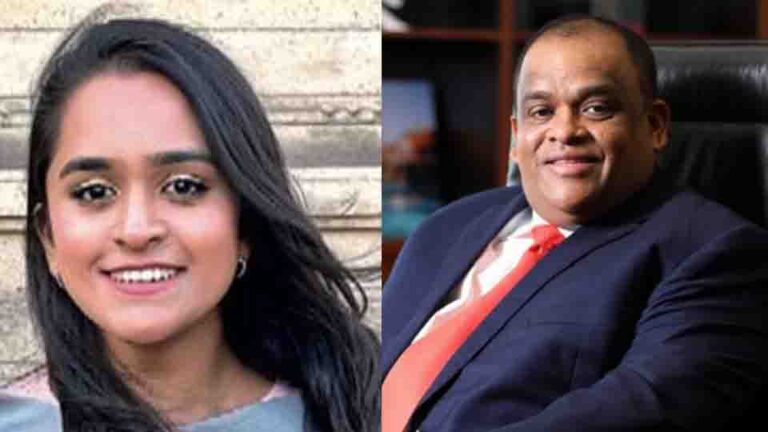
K.A. Donna Brindhini Perera, the eldest daughter of Ruling Party National List MP Dhammika Perera, has been appointed to the Boards of ten (10) listed companies under his control, making her the youngest businesswoman to serve on these listed companies as a Non-Executive and a Non-Independent Director.
These companies are the investment holding Vallibel One PLC, Hayley’s Group companies Haycarb PLC, Dipped Products PLC, Singer Sri Lanka PLC, The Kingsbury PLC, Hayleys Leisure PLC, and Hayleys Fabric PLC, as well as Lanka Walltiles PLC, Lankatiles PLC and Royal Ceramics PLC.
K.A. Donna Brindhini Perera
Being the daughter of the biggest investor and one of the youngest investors in listed companies in the early 2000s in Sri Lanka, Donna, 22, too is following in her father’s footsteps as a young businesswoman with her on Masters in Mechanical Engineering from the prestigious Imperial College, London, covering various fields such as manufacturing technology and management, entrepreneurship, corporate finance, statistics, and mathematics.
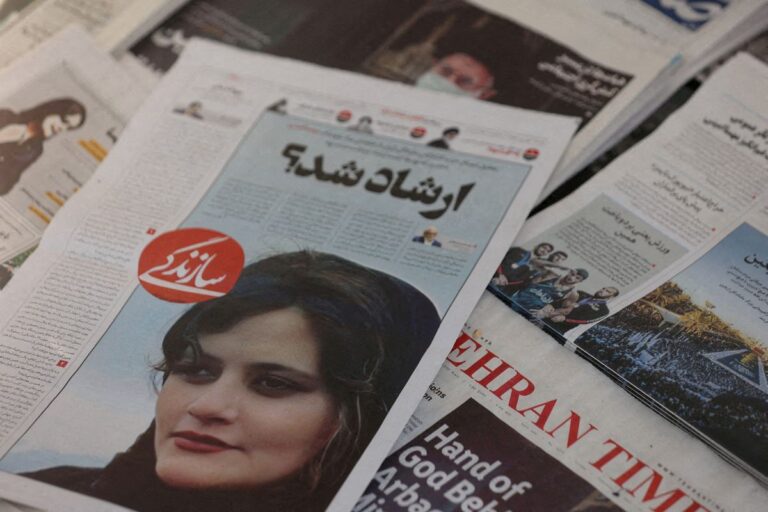
Protests broke out in restive southeastern Iran on Friday, with demonstrators attacking banks, state media reported, as a senior hardline cleric called for tough measures against demonstrators across the country.
The Islamic Republic has been gripped by five weeks of demonstrations that erupted after the death in police custody of 22-year-old Mahsa Amini last month.
On Friday, police arrested at least 57 people, described as “rioters”, after protesters threw rocks and attacked banks in the city of Zahedan, provincial police chief Ahmad Taheri was quoted as saying by the official news agency IRNA.
State television said up to 300 protesters marched in the city after Friday prayers. It showed banks and shops with smashed windows.
Videos posted on social media purported to show thousands of protesters chanting “Death to the dictator”, a reference to Supreme Leader Ayatollah Ali Khamenei, and “Death to Basijis”, in reference to the Basij militia which has been widely used to crack down on protests. Reuters could not verify the videos.
Zahedan is the capital of restive southeastern Sistan-Baluchistan province which is the home of Iran’s Baluch minority. Amnesty International has said security forces killed at least 66 people in a violent crackdown after Friday prayers in Zahedan on Sept. 30.
Zahedan’s top Sunni cleric said on Friday senior Iranian officials had to take responsibility for the Sept. 30 killings.
“For what crime were they killed? Officials, the country’s managers, the Islamic Republic’s Supreme Leader (Khamenei) who commands all armed forces are all responsible before God,” said Molavi Abdolhamid, a leading Sunni cleric, according to a video of his Friday prayers sermon in Zahedan posted on his website.
State media said at the time that “unidentified armed individuals” opened fire on a police station, prompting security forces to return fire.
Sistan-Baluchistan, on the borders with Pakistan and Afghanistan, is a hotbed of Sunni Muslim militant activity against the Shi’ite-dominated government.
In Tehran, hardline cleric Ahmad Khatami said: “The judiciary should deal with the rioters – who betrayed the nation and poured water into the enemy’s watermill – in such a way that others don’t again fancy to riot.”
“They have told deceived kids if they stay in the streets for a week the regime will fall. Dream on!,” Khatami said in a Friday prayers sermon, according to state media.
Iran has blamed “thugs” linked to “foreign enemies” for the unrest.
The nationwide protests have turned into one of the boldest challenges to Iran’s clerical rulers since the 1979 revolution. Protesters have called for the downfall of the Islamic Republic, although the protests do not seem close to toppling the system.
Videos posted on social media and said to be from northwestern Tabriz showed protesters shouting “Disgraceful!” at riot police who shot tear gas to disperse them on Friday.
Tabriz, Iran’s sixth most populous city, is home to many from the Azeri ethnic minority.
Other online videos purported to show protests in the central city of Isfahan and in Tehran’s Ekbatan highrise neigbourhood.
The activist news agency HRANA said in a posting that 244 protesters had been killed in the unrest, including 32 minors.
It said 28 members of the security forces were killed and more than 12,570 people had been arrested as of Friday in protests in 114 cities and towns and some 82 universities.
Meanwhile, CNN reported that the White House was in talks with billionaire Elon Musk about setting up SpaceX’s satellite internet service Starlink in Iran.
22nd Amendment to the Constitution passed in Parliament by a majority of 173 votes; 174 voted for: only MP Sarath Weerasekara votes against.
Russian Government contradicts Sri Lankan Ambassador in Russia: says it will not offer a “G2G” line of credit for Sri Lanka to import fuel and coal, but will facilitate a commercial line of credit: conveys displeasure over Sri Lanka’s refusal to accept MIR payment system.
Cabinet approves compensation payment of Rs.10 mn to the family of late SLPP MP Amarakeerthi Athukorale who was killed by an “Aragalaya” mob on 9th May.
State Minister for Finance Shehan Semasinghe admits IMF officials have asked Sri Lanka to complete “prior actions” under a staff level agreement early: explains that a key requirement is to obtain assurance of debt restructuring from bilateral lenders, including China and India.
Former CB Governor Ajith Nivard Cabraal says it’s now 7 months since seeking IMF help, but not a Dollar received yet from IMF or other bi-lateral lender: emphasizes USD 4 bn was raised in the 6-1/2 months he was Governor: reiterates every maturing debt was settled by the Government, when he was Governor.
Sri Lankan Rupee on a gradual depreciation path once again, although the Monetary Board had “fixed” it within a set range on 12th May: selling rate for USD on 30th September – 369.91: on 21st October – 371.24: depreciation of Rs.1.33.
Inflation, measured by the National Consumer Price Index jumps to an all-time Year-on-Year high of 73.7% in September: Food Inflation 85.8%.
ASPI slips 0.59% to close at 8,685 points: loses 12.5% so far this month: also loses 28.9% year-to-date: last year, CSE was one of the world’s best stock markets with a 80% return.
Aviation Minister Nimal Siripala Silva says Sri Lanka plans to continue construction work on the Katunayake Airport expansion project with USD 2.5 mn from Airport and Aviation Services: JICA funding for the project had stopped due to the April 12th debt default.
Public Security Minister Tiran Alles seeks Cabinet approval to promote 8,312 policemen and 1,105 policewomen including sergeants and constables who have completed their service periods.
The Department of Meteorology says that there will be occasional rain or thundershowers in Western, Sabaragamuwa, Central and North-Western provinces and Galle and Matara districts today (22), and heavy rains of more than 50 mm may occur in some places.
Today’s weather forecast states that there will be scattered rain or thundershowers in the Eastern and Uva provinces and in the Hambantota district during the evening or at night.
The department kindly requests the people to take necessary measures to reduce the dangers caused by temporary strong winds and lightning that may occur with thunderstorms.
The voting of the Parliament on the 22nd Constitutional Amendment – which is an extremely important moment in the country’s politics – was held yesterday (21) afternoon and only 180 Members of Parliament participated in it,
Accordingly, 44 MPs had not participated. They are 26 MPs from the ruling party, 13 from the opposition and 5 independent MPs.
The office of the chief organizer of the ruling party said that 11 of the members of the ruling party are currently abroad, so they could not come to cast their votes. They are the chief organizer of the ruling party, Prasanna Ranatunga, Mahinda Amaraweera, Pramita Thennakone, Siripala Gamlath, Anuradha Jayaratne, Sita Arambepola, Rohitha Abeygunawardena, Dhammika Perera, SMM Musharraf, Pradeep Undugoda and Nipuna Ranawaka.
It is also stated that the MPs representing the ruling party, Jayantha Weerasinghe, Sahan Pradeep Withana, Wimalaweera Dissanayake and Janaka Bandara Thennakoon did not come to the vote due to illness.
Former Prime Minister Mahinda Rajapaksa, Sanath Nishantha, Johnston Fernando, Sanjeeva Edirimanna, Sagara Kariyawasam, Pavitra Vanniarachchi, Jayantha Katagoda, Gamini Lokage and Professor Ranjith Bandara did not come to cast their votes without giving any such reasonable reasons.
The opposition MPs who did not turn up to vote yesterday are R Sampandan, Abdul Halim, Vadivel Suresh, Gajendra Kumar Ponnambalam, Selvarasa Gajendran, Hector Appuhami, Su Noharadalingam, P Velukumar, SM Marikkar, Hesha Withanage, MA Sumandhiran, Rasamanikkam Shanakian and Thavarasa Kalasan. Members of Parliament. Some of them were abroad.
Prof. GL Peiris, Upul Galappatti, Shan Wijayalal de Silva representing Mr. Dallas Alahapperuma’s independent group and Prof. Tissa Vitharana representing Wimal Weerawansa’s coalition were also not present to vote.
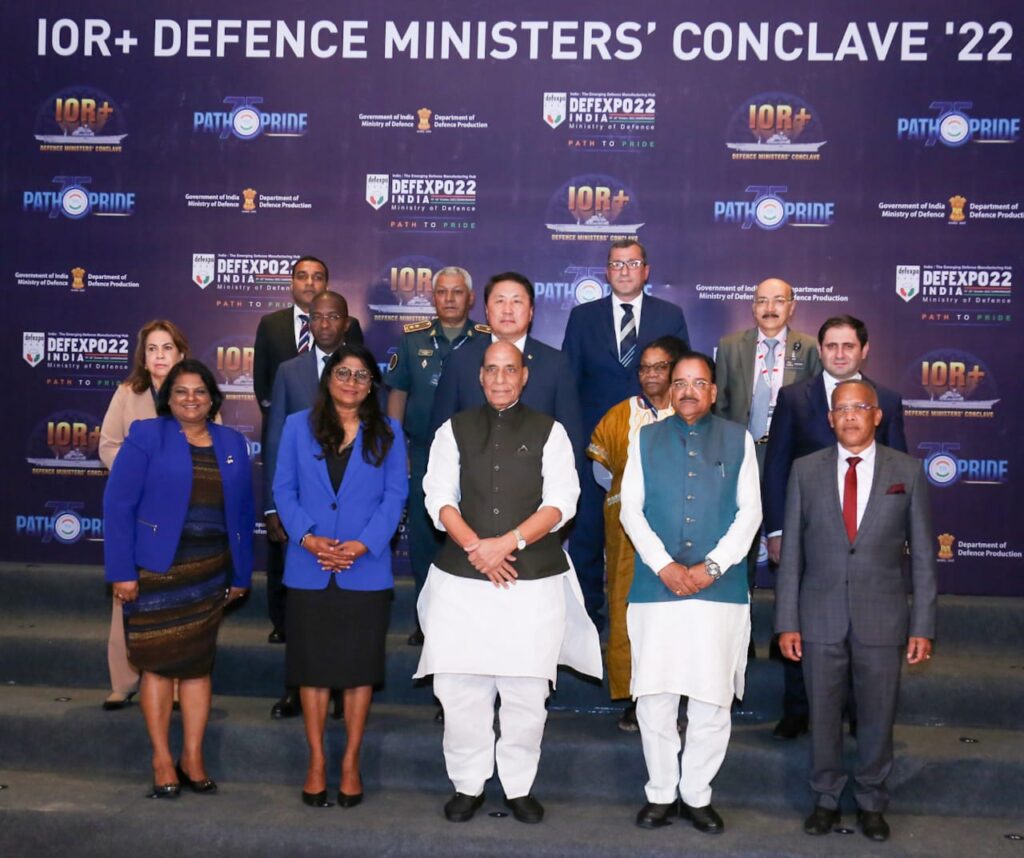
A three-member official delegation from Sri Lanka, led by State Minister of Defence Hon’ble Premitha Bandara Tennakoon and comprising Army and Navy officers, is currently on a visit to India for attending India’s premier biennial global defence exhibition DefExpo2022. The exhibition was inaugurated by Prime Minister Narendra Modi on 19 October 2022 at Gandhinagar, Gujarat. This is the second occasion in the past year during which a Minister from Sri Lanka is participating at an event inaugurated by Prime Minister Modi. It may be recalled that Ministers from Sri Lanka were a part of the inaugural international flight to Kushinagar airport in October 2021.
2. Speaking at DefExpo2022, Hon’ble State Minister Premitha Bandara Tennakoon hailed the partnership between India and Sri Lanka in the defence sphere. He highlighted the importance of defence industrial base in augmenting Security policy and noted that DefExpo 2022 provided a great avenue for a deeper understanding of the nature of transformation in modern warfare across five dimensions.
3. DefExpo2022 is the biggest-defence exhibition, which showcases the growing prowess of India’s defence industry to achieve the vision of ‘Make in India, Make for the World’ as well as self-reliance in the defence domain. Live demonstrations showcasing the equipment and skill sets of the Armed Forces, Defence Public Sector Units and industry were also organized.
4. The Sri Lankan dignitary met the Minister of State for Defence and Tourism of India Shri Ajay Bhatt on 17 October 2022 along the sidelines of DefExpo2022. During the meeting, India’s readiness to continue to support Sri Lanka in the defence sphere was reiterated. The Sri Lankan delegation also had cordial interactions with Defence Minister, Defence Secretary, Chief of Defence Staff and all three Service Chiefs of India during the visit.
5. Bilateral engagement in defence is multi-dimensional in nature. High level exchanges continued both ways despite the challenges posed by COVID-19. SLINEX (Naval Exercise) and exercise MITRA SHAKTI (Army Exercise) are held every year alternatively in India and Sri Lanka. Both Armed Forces collaborate closely in dealing with common security challenges such as drug and human trafficking. The Colombo Security Conclave has emerged as a key security platform in recent times to address such issues at a regional level. The first ever Dornier maritime reconnaissance aircraft from India to enhance the maritime surveillance capabilities of Sri Lanka was inducted into Sri Lanka Air Force Fleet on 15th August 2022 in the august presence of President His Excellency Ranil Wickremesinghe.
6. Experience sharing and capacity building has been a key pillar of India-Sri Lanka defence cooperation, which is marked by great camaraderie and mutual benefit in enhancing our shared security. Indian military establishments including NDC have been the preferred choice of the Sri Lankan Armed Forces for decades and have produced leaders of Sri Lankan Armed forces. Annually, 1500-1700 slots are allocated to Sri Lankan trainees which amounts to around INR 500-550 million (more than USD 6 million). Similarly, Indian Armed Forces officers are also hosted by the friendly Armed Forces of Sri Lanka, including for specialized training modules in various fields such as counter insurgency.
7. Both sides cooperate also on humanitarian aspects such as averting large scale environmental damages, expeditious supply of Liquid Medical Oxygen and other assistance materials, repatriation of around 700 Indian nationals back to their motherland with the assistance of Sri Lanka Armed Forces during COVID-19 etc.
8. The futuristic partnership between the two neighbours underscores India’s ‘Neighbourhood First’ policy as well as Security and Growth for All in the Region (SAGAR) doctrine. India will continue to strengthen its multi-dimensional cooperation with Sri Lanka for mutual benefit and also for enhancing regional peace, security and stability.
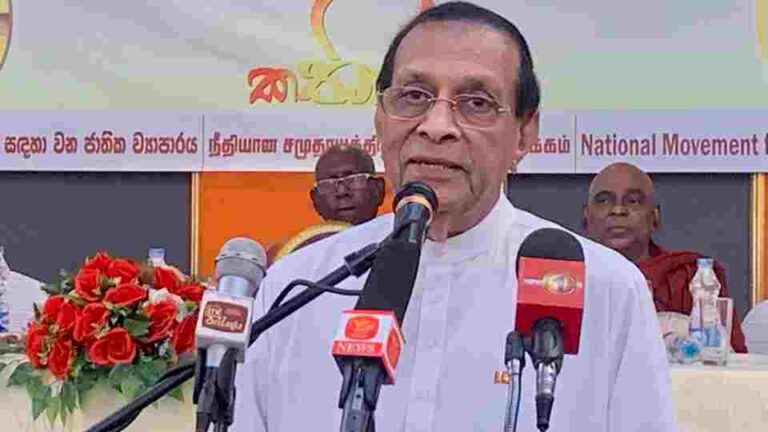
The parliament of Sri Lanka today passed the 22nd Amendment by revoking the 20th amendment to the constitution which had been adopted with the aim of converting the country to an autocratic authoritarian regime. We consider passing of the amendment as a victory for all citizens of Sri Lanka who value democracy.
We the National Movement for Social Justice would like to first and foremost thank all members of parliament as well as civil and political forces who continuously advocated for this constitutional reform.
We are organization that vehemently opposed 20A when it was introduced to achieve the aspirations of the former President and even after it was adopted, we emphasize once again that we do not believe that the 22nd amendment is sufficient and the last decisive step to secure the country’s democracy and protect the dignity and expectations of the people. We consider this decision taken by Parliament today as an extremely vital interim constitutional reform that should have been implemented until a new constitution is adopted. Accordingly, we consider this a significant achievement.
The National Movement for Social Justice always stands unwaveringly for a new constitution that will bring dignity to the people and ensure the betterment of the country. At this moment, we request all the political forces to be empowered by this achievement and take the lead in this task, of Strengthing democracy & taking the country for the well being of the people
The National Movement for Social Justice will continuously take the lead in abolishing the executive presidency and eradicating large-scale corruption from the country.
Karu Jayasuriya Chairman National Movement for Social Justice 21/10/2022
Rated Sri Lankan corporates in consumer-goods retail, power generation and home building will be among the most affected if the economic crisis deepens or is sustained for a prolonged period, says Fitch Ratings.
According to the New York-based credit rating agency, significant cost inflation affecting demand and profitability, import restrictions disrupting operations, and high-interest rates are key risks faced by domestic corporates in the next 12-18 months.
Based on Fitch’s base case forecast assumptions, Fitch Ratings projects that most other corporates will be able to weather the current economic downturn, supported by their presence in defensive industries, weakened competition, strong balance sheets, and adequate liquidity.
Fitch remarked that most rated corporates posted strong revenue growth and expanding margins in their June 2022 quarterly results due to inflation-led price hikes and sale of lower-cost inventory purchased prior to the sharp devaluation in the local currency in March 2022, however, the cost of new inventory has risen sharply since then, while high inflation and falling affordability will make it challenging to raise selling prices further.
There is also a significant increase in operating costs, which will be reflected more acutely in the next few quarters, and it is likely to pressure cash flow, the credit rating agency added.
Fitch estimates around 50% of our rated issuers would see rating pressure if economic conditions worsen in the next 12-18 months.
“The extension of an ongoing import ban beyond the next six months, a further rise in interest rates, prolonged high inflation leading to difficulties in raising selling prices, and delays in receipts from government counterparties could lead to a rapid deterioration in some companies’ liquidity positions, while leverage and interest coverage could weaken beyond our negative rating sensitivities.”
Some rated Sri Lankan corporates are more affected by the challenging macroeconomic environment stemming from the Sri Lanka sovereign’s distressed credit profile, Fitch Ratings says.
Sri Lankan corporates are grappling with rising costs and weakening disposable incomes, while the country’s weak foreign-currency reserves will continue to pressure imports, and the unprecedented spike in interest rates will raise borrowing costs and weaken financial flexibility.
Many other corporates face revenue and margin pressure from either their exposure to imported goods, discretionary demand, government expenditure, or high short-term debt.
However, most rated corporates have adequate headroom in terms of low leverage, sufficient interest cover and liquidity to weather challenges in the next 12 months.
Despite the challenges in the last 12 months, Fitch estimates that the aggregate leverage of rated
Corporates with exposure to discretionary demand, imported finished goods or government expenditure should see revenue fall by a sharper 15%-20% on average.
It gets almost three-quarters of its electricity from coal, and has 39 new coal-fired power plants under construction. It digs up and burns more of the stuff than any other country except China. And it is coal’s loudest advocate internationally: at last year’s climate conference in Glasgow, it was the skunk at the garden party, blocking efforts to phase out the fuel most responsible for global warming.
This soot-smeared intransigence, however, distracts from a dramatic countervailing trend. While his underlings defended coal, Narendra Modi, India’s prime minister, made a series of pledges in Glasgow that, if kept, will make his country a green-energy powerhouse. The most eye-catching was the promise that India would achieve “net-zero” emissions of greenhouse gases (ghgs) by 2070—meaning that any emissions that had not been eliminated by then would be offset in some way.
Mr Modi underpinned that goal with two exacting targets for 2030: to slash emissions by a billion tonnes from their current trajectory and, to that end, to increase non-fossil power generation (which includes nuclear and hydro as well as wind and solar) more than three-fold, from roughly 150gw to 500gw.
India is the world’s third-largest emitter of ghgs. If it were to meet Mr Modi’s targets, it would not just revolutionise its own energy mix, but also provide a big boost to global efforts to curb global warming. What is more, Mr Modi has declared it a “national mission” to develop “green hydrogen”, a clean fuel made using renewables which could help decarbonise industries that remain stubborn polluters the world over. But just how plausible are these ambitions?
India’s entire generation capacity, both clean and dirty, is currently only 400gw. So Mr Modi wants to build a whole second grid’s-worth of green power in just eight years. To reach that goal, India will need to invest some $500bn in clean energy and improvements to the grid, according to an estimate by Bloomberg New Energy Finance (bnef), a research firm.
Such a feat would not be unprecedented. China went from 44gw of solar capacity to 300gw in six years, and from 50gw of wind to 330gw in 11 years. But it was helped both by a huge manufacturing base in renewables and by an economy that excels at steering capital to favoured industries. Those are advantages that India lacks.
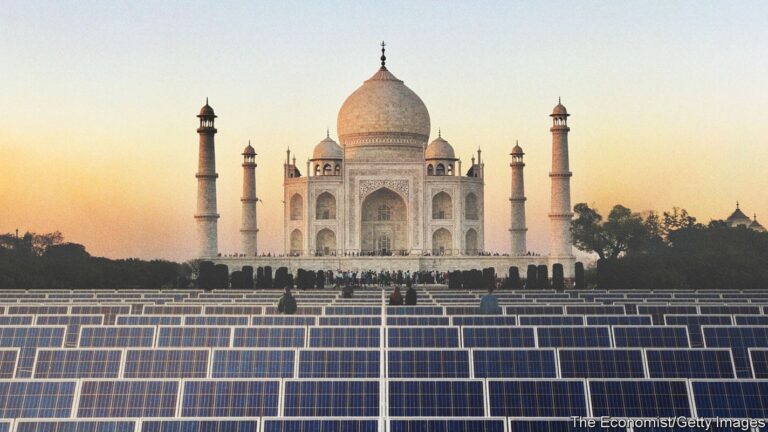
Renewable power is growing very fast in India. Solar generation capacity has increased 50-fold since 2012, to nearly 50gw at the end of last year. In the first half of 2022 another 7.4gw of solar was added. Indeed, when it comes to building new generating capacity, renewables have already supplanted coal. The capacity of new solar, wind and hydro plants constructed last year was nearly double that of new coal-fired plants (see chart 1).
Even so, investment in renewables is not proceeding fast enough to meet Mr Modi’s targets. The 11gw of renewable capacity added in 2021 is far less than the annual increment required. Nonetheless, there are good reasons to take India’s new green revolution seriously.
For one thing, reducing emissions is not India’s only motive for overhauling its energy system. Mr Modi also wants both to spur manufacturing and to trim the bill for imported fuel. “How long will we be dependent on others in the field of energy?” he asked during his address on Independence Day in mid-August. India spent more than 4% of gdp on imports of fossil fuels last year, a particularly vexing sum for a country with a persistent current-account deficit.
Greening India’s energy supply would also help reduce air pollution, a deadly scourge for many of its inhabitants. The World Health Organisation reckons that in 93% of the country, the level of air pollution is well above its guidelines. A study published in 2019 by the Lancet, a British medical journal, found that more than 1m Indians die each year as a result of the foul air. The choking smog that blankets much of north India especially at this time of year is a perennial political liability for the government.
Best of all, a big shift to renewables could help cut the cost of power generation. India’s sunny climate and low labour costs make it one of the cheapest places in the world to produce solar power. In fact, an analysis by the International Energy Agency (iea), a watchdog-cum-think-tank for energy-consuming countries, concluded that, after stripping out the effects of government subsidies, only the United Arab Emirates could rival it (see chart 2). That means that solar plants are a cheaper option for new electricity generation in India than coal- or gas-fired power stations. Power from windmills in India, although not the cheapest in the world, is also less expensive than that generated by burning fossil fuels.
What is more, India’s government is coming up with all manner of inventive policies to incentivise investment in clean energy. One of the big obstacles to any overhaul of the power industry is the sorry state of the electricity-distribution companies (discoms). Many of these state-controlled entities are all but bankrupt, with collective debts of perhaps $73bn. They do not look like the safest of counterparties for investors seeking to sell clean energy. So Mr Modi’s government has introduced a mechanism that in effect makes India’s federal government the financial backstop for new long-term contracts to provide renewable energy to the grid. It is also allowing solar and wind generators to bypass discoms completely to sell power directly to manufacturers of green hydrogen.
To overcome India’s ever-present problems of red tape and nimbyism, officials are setting up clean-energy parks with connections to the grid and speedy processing of the necessary permits. The government also uses reverse auctions to maximise investments in renewables at the lowest possible cost: developers state the minimum price they would be prepared to accept for the power they generate, with the lowest bids winning. It has conducted similar auctions for “round-the-clock” green power, meaning renewables coupled with some form of energy storage, to get around the intermittency of wind and sunshine.
These policies are working. Investors including Adani Group, one of India’s biggest conglomerates, are rushing to a renewables park in Kutch, a sun-drenched and windswept region of the state of Gujarat, for instance. With a planned output of 30gw, it will be the world’s biggest combined wind and solar farm.
By the same token, India is likely to receive offers to build generation capacity in excess of 25gw at its solar auctions this year. That is over ten times more than any other country (see chart 3). In August it held one of the world’s biggest auctions for grid-scale battery storage.
Industrious industrialists
Indeed, one of the strongest indications that India’s green ambitions are more than hot air is the enthusiasm of investors. Mukesh Ambani, the boss of Reliance Industries, another sprawling conglomerate, gushed in his latest message to shareholders, “We will have the world’s most affordable green energy within this decade, and these solutions will then be exported to other countries.”
Mundra, a busy port in Kutch developed by Adani Group, encapsulates the shifting priorities of India’s industrialists. It is one of the world’s busiest coal-handling ports, serving two huge coal-fired power plants nearby. But it is also home to a new solar-panel factory, a pilot plant building 160-meter-tall onshore wind turbines (among the world’s largest) and new buildings where equipment to produce hydrogen will be made.
“We welcome you to a future powered by the SOLAR REVOLUTION” bellows a billboard. Adani is “indigenising the entire supply chain” for clean energy, explains Arun Kumar Sharma, a senior manager.
Gautam Adani, the group’s founder and chairman (whose personal fortune of well over $100bn makes him one of the world’s richest people), claims his companies will spend $70bn on greenery in India by 2030. With nearly 5gw of solar generation capacity as of mid-2021, Adani Green Energy, one of the group’s divisions, is already on par with Italy’s Enel Green as the world’s leading developer of solar energy.
Not to be outdone, Mr Ambani plans to spend $80bn on clean energy in India. Reliance, like Adani Group, has made a mint from fossil fuels. But now it is developing a clean-energy cluster in Jamnagar, another port in Gujarat, which also houses the firm’s massive petrochemicals complex. Mr Ambani plans to build 20gw of solar generation capacity by 2025, all of it to be consumed by his group for captive needs. “Once proven at scale,” he says, “we are prepared to double the investment.” Morgan Stanley, an investment bank, describes Mr Ambani’s strategy as “full spectrum”, stretching from the manufacture of solar panels and batteries to the development of devices to make and use green hydrogen.
It is not just India’s behemoths that are embracing Mr Modi’s green vision; smaller companies are investing heavily, too. A firm called Greenko, for instance, is building the world’s biggest network of grid-scale energy storage using a technology called pumped hydro. It will use power from solar panels or windmills to pump water into elevated holding tanks. The water can then be released to turn turbines and generate power whenever electricity is needed. Mahesh Kolli, Greenko’s president, says it will spend $5bn by 2025 to construct 50gw of storage capacity.
ArcelorMittal Nippon Steel, an Indian joint-venture between steel giants from Europe and Japan, has just signed a $600m deal for Greenko to provide round-the-clock clean power to one of its mills. It chose this option not simply because the power will be green, but because it was cheaper than building a coal-fired plant.
In the longer run Mr Kolli sees his technology as the solution to the intermittency of power generated by windmills and solar panels. He wants to build a nationwide, grid-connected “energy-storage cloud”, akin to Amazon’s data cloud. When the wind drops or the weather clouds over in Gujarat, say, the firm’s pumped-hydro plants in Andhra Pradesh, to the south, could supply a compensating amount of clean power via the national grid to aluminium smelters in Odisha, to the east, run by Hindalco Industries, a big new customer. Unlike America, which has only limited connections between regional grids, India has a much better-integrated national grid, which makes such an idea feasible. The iea projects that it will have more pumped-hydro than any other country by 2026.
India is beginning to develop domestic supply-chains for clean energy. For example, Pune, a city in the state of Maharashtra which is already home to a cluster of car-part manufacturers, is becoming a clean-energy hub as well. Siddharth Mayur, a local and founder of h2e Power and homiHydrogen, has developed batteries for electric motor-scooters and auto-rickshaws that can be quickly swapped for fully charged ones when they run down. He is now making stacks, a component of fuel cells (which can be used to generate electricity from hydrogen), and is helping to foster local production of other parts. “By next year, 98% will be made within 60km of where we are sitting in Pune,” he says.
Ravi Pandit, chairman of kpit, an Indian software firm that counts big foreign carmakers as customers, thinks the inexpensive software and engineering talent that fuelled India’s success in information technology a few decades ago will help in green energy today. Thanks in part to the widespread desire not to concentrate too much manufacturing in China, he points out, foreign capital and technology is pouring in.
The focus of a lot of the investment is green hydrogen, which, it is hoped, will allow big industries such as steelmaking and fertilisers to decarbonise. India produces almost none of it at the moment, although it does consume some 7m tonnes a year of ordinary hydrogen, made using fossil fuels. Investors think it will be a good place to make the green sort, since the process requires a lot of clean power, which India’s solar industry can provide cheaply. India also produces very little natural gas, so there are few lobbyists campaigning against the development of a rival industry. The government has promised to provide incentives to green-hydrogen firms in a detailed policy to be unveiled soon.
With help from Stiesdal, a European clean-technology firm, Reliance is building a large factory in Jamnagar to manufacture electrolysers. These devices, powered by clean electricity from Reliance’s planned solar farms, will then be used to manufacture green hydrogen. Mr Ambani asserts that these investments will make India the first country to produce green hydrogen for $1 a kilogram, within a decade. (The current cost is more than $4/kg.) He dismisses doubters, pointing to his recent success in delivering data to mobile telephones at the world’s lowest cost.
Indian Oil, a state-owned energy giant that is the country’s largest consumer of dirty hydrogen, announced in August that it, too, was entering the green hydrogen business. It plans to invest $25bn in that and other clean technologies by 2046, as part of an effort to reach net-zero emissions by that year. “We will make India a green hydrogen hub,” says S.M. Vaidya, the firm’s chairman.
Foreign investors are also enthusiastic. John Cockerill, a Belgian technology firm, has established a joint-venture with Greenko to produce 2gw-worth of electrolysers a year. Ohmium, a buzzy American startup making electrolysers, has built its only factory in India. It hopes to reach an annual output of 2gw by the end of this year. It recently dispatched to America the first Indian-made electrolysers ever to be exported, and expects to begin sending consignments to Spain soon as well.
Goldman Sachs, an American investment bank, has a stake in ReNew Power, a renewables firm which is working with Indian Oil on its green hydrogen plans. TotalEnergies, a giant French oil firm, has bought a quarter of a division of Adani Group that is developing green hydrogen.
India’s green-hydrogen firms are even venturing abroad. Acme Cleantech Solutions, a solar-generation pioneer, has pivoted to making clean fuels. Together with Scatec, a Norwegian clean-energy firm, it is investing over $6bn to produce green ammonia (a derivative of green hydrogen) in Oman. The project is the first of its kind to be certified as carbon neutral. It also won commercial validation when Yara, a Norwegian fertiliser giant, agreed in July to negotiate a long-term contract to buy its green ammonia.
Rystad forecasts that India will be making more than 8gw of electrolysers a year by 2025 (roughly half the planned output of Europe, the world leader). Sanford C. Bernstein, an investment bank, reckons the hydrogen market in India could be worth $15bn to $20bn a year by 2030. Although it is not quite as bullish as Mr Ambani, Bernstein reckons “under $2/kg seems achievable towards the end of the decade”.
Much could still go wrong. For a start, India’s tycoons may not keep all their grand promises to lavish billions on the new green revolution. CreditSights, a research firm, has raised concerns about Adani Group’s high levels of debt. Especially with global interest rates rising, Indian conglomerates may struggle to finance vast investments in clean energy.
Even if the billionaires spend as lavishly as they have promised to, the lion’s share of the $500bn needed to meet Mr Modi’s targets will probably come from abroad. But foreign investors do not see India as risk-free. The rupee has depreciated steadily over the years, reducing outsiders’ returns. Mr Modi’s tendency to stoke sectarian tensions creates political risks. And foreign investors, too, may feel the pinch as interests rates rise and the world economy slows.
Yet India’s economy is growing faster than China’s. Demand for electricity is increasing fast enough that the country will need to build as much generating capacity by 2040 as the European Union currently possesses, whether green or not. The $30bn or so that bnef thinks India will need to invest in renewables each year to meet Mr Modi’s target, although a daunting sum by local standards, is only a tenth of the money put into wind and solar globally last year.
It is early days for India’s second green revolution, but the first shots have already been fired. Mr Pandit observes that the West had a hundred-year head start in the conventional automotive industry. It has been a long, hard slog for Indian firms to catch up and compete. In many areas of clean technology, by contrast, India suffers no comparable disadvantage. As a result, he predicts, it will excel: “India will do for hydrogen what China did for batteries.” ■