Cascading global crises have left 54 countries, including Sri Lanka, in dire need of debt relief, the UN said Tuesday (11).
In a new report, the United Nations Development Program warned that dozens of developing nations were facing a rapidly deepening debt crisis and that “the risks of inaction are dire”, AFP said.
UNDP said without immediate relief, at least 54 countries would see rising poverty levels, and “desperately needed investments in climate adaptation and mitigation will not happen”.
That was worrisome since the affected countries were “among the most climate-vulnerable in the world”.
The agency’s report, published ahead of meetings of the International Monetary Fund, the World Bank, and also of G20 finance ministers in Washington, highlighted the need for swift action.
But despite repeated warnings, “little has happened so far, and the risks have been growing,” UNDP chief Achim Steiner told reporters in Geneva.
“That crisis is intensifying and threatening to spill over into an entrenched development crisis across dozens of countries across the world.”
The poor, indebted countries are facing converging economic pressures and many find it impossible to pay back their debt or access new financing.
“Market conditions are shifting rapidly as a synchronized fiscal and monetary contraction and low growth are fueling volatility around the globe,” UNDP said.
The UN agency said debt troubles had been brewing in many of the affected countries long before the COVID-19 pandemic hit.
“The rapid build-up in debt over the past decade has been consistently underestimated,” it said.
The freeze on debt repayment during the COVID crisis to lighten their burden has expired and negotiations under the G20 Common Framework created during the pandemic to help heavily-indebted countries find a path to restructure their obligations have been moving at a snail’s pace.
According to available data, 46 of the 54 countries had amassed public debt totalling $ 782 billion in 2020, the report said. Argentina, Ukraine, and Venezuela alone account for more than a third of that amount.
The situation is deteriorating rapidly, with 19 of the developing countries now effectively shut out of the lending market — 10 more than at the start of the year.
A third of all the developing economies have meanwhile seen their debt labelled as being “substantial risk, extremely speculative or default,” UNDP’s chief economist George Gray Molina told reporters.
The countries at the most immediate risk are Sri Lanka, Pakistan, Tunisia, Chad, and Zambia, he said. Gray Molina said private creditors have so far been the biggest obstacle to moving forward with needed restructuring.
But he suggested that the current market conditions could pave the way for a debt deal, as private creditors see the value of their holdings plunge by as much as 60%.
“When emerging market bonds trade at 40 cents on the dollar, private creditors suddenly become more open to negotiation,” he said.
“The incentives are to now join a negotiation where you might accept the haircut of 20 cents on the dollar, 15 cents on the dollar, and 30 cents on the dollar.”
But willing creditors are not enough to actually nail down a much-needed debt-relief agreement, Gray Molina acknowledged.
“The missing ingredients at this moment are financial assurances from major creditor governments to clinch a deal.”
Steiner, who has repeatedly raised the alarm about the crisis, voiced hope the international community might finally recognize that action is in everyone’s shared interest.
“Prevention is better than treatment and certainly… much, much cheaper than having to deal with a global recession,” he said.
UNDP says 54 poor nations, including Sri Lanka, urgently need debt relief

Apparel manufacturers express concern on recent tax policy
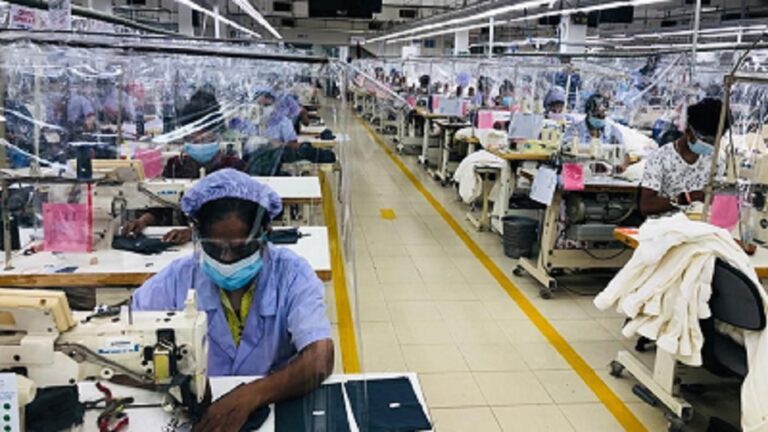
Sri Lanka’s apparel sector is currently witnessing a significant decline in orders, a pattern which the industry fears may continue indefinitely. The decline, which is attributed to a range of global factors, comes after impressive growth was seen in the first eight months of the year.
In an effort to steer away from the disturbing development, the Joint Apparel Association Forum (JAAF) stressed it is imperative for Sri Lanka to remain competitive, and offer potential and existing investors a competitive investor environment.
, JAAF urges the government to rethink the policy of increasing the corporate income tax rate by 100 percent, which would allow the apparel industry and all exporters to remain competitive and engage in business and investment in the region.
The JAAF noted that one of the recent policies that are impacting the apparel sector is the increased taxation on the industry.
It shared that it is deeply concerned by recent discussions for the removal of the concessionary rate granted to exporters, replacing this with a single rate of corporate taxation.
“This would mean the rate of corporate taxation doubling for exporters. The industry has been contributing 52 percent to export revenue continually throughout the crisis, a contribution that is critical to keep the economy afloat, despite challenging internal and external factors.
“An additional rate of taxation will make the apparel industry very uncompetitive when compared with regional peers,” said JAAF Secretary General Yohan Lawrence in a statement to the media.
Until September 2022, apparel exporters were liable to pay a concessionary corporate income tax rate of 15 percent (previously 14 percent).
However, aligned with the IMF staff-level agreement, the government tabled proposals in the 2022 interim budget to increase the standard corporate income tax rate to 30 percent from 24 percent, effective from the 1st of October 2022.
“JAAF is disturbed by this proposed increase as the apparel industry is already confronting a 25 percent decline in its order books for 4Q22 due to the softening of global markets,” Lawrence reiterated.
Speaking on behalf of apparel manufacturers, Lawrence said the forum fully understands and supports the need for the proposed tax reforms as the government is challenged with options to raise much-needed revenue.
According to JAAF, stakeholders are of the view that the industry is already heading into uncertainty in the next few months due to rising inflation in the biggest export markets, disruptions in global supply chains, and geopolitical tensions.
Sri Lankan banks brace for low credit growth amid high cheque returns
The Sri Lankan banks are bracing for low credit growth amid the rise in interest rates, rating downgrades, new taxes and the quality of the portfolio, all of which have impacted the banks’ capital growth.
A senior banker says that banks are forecasting single-digit credit growth this year, compared to last year’s 16%. Sri Lanka’s commercial banks provided a record amount of credit to the private sector in 2021, a reported SLRs810.5bn.
In 2022, the banking sector is wrestling with exposure to the country’s sovereign debt and economic vagaries. Apart from credit growth, analysts predict that these factors will weigh heavily on asset quality.
The Sri Lankan banking sector is slowly losing credibility on the international stage, with correspondent banks reluctant to guarantee transactions with the low credit ratings of the country and its inability to raise funds in the international markets.
The country’s bankers say that overseas banks are requesting a third-party guarantee to honour local LCs. This is quite similar to the situation in the 1970s when all LCs issued by Sri Lankan banks needed to be guaranteed by a third-party bank based in Singapore.
Banks are working on raising long-term debt with a view to meet FX liquidity requirements to support local currency lending demand at concessionary rates for specific economic sectors, but they are increasingly facing difficulties.
Many bankers say development finance institutions’ (DFI) credit lines are slowly tapering off. Amid the exchange rate issues, as well as lack of reserves and liquidity in the banking industry, some commercial banks were in discussion with DFIs to secure credit lines and beef up their foreign reserves.
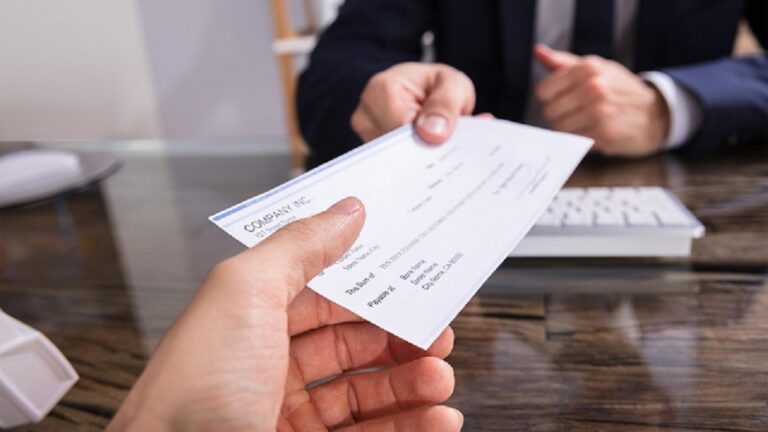
On average, Rs. 1 billion worth of cheques have been returned on a daily basis in the second quarter of 2022, as the overall cheque returns in Sri Lanka rose by 30% in the second quarter of 2022 (2Q22) compared to 1Q22, with the economy contracting by 8.4% in 2Q22, Central Bank data showed.
According to the payments bulletin released by the Central Bank of Sri Lanka (CBSL) for 2Q22, a total of 251,400 cheques have been returned during the quarter, with a total value of Rs. 59.6 billion compared to the 192,300 cheques returned in 1Q, indicating an increase by 30.7%.
The report also showed that the volume of cheques returned (as a percentage of the total volume of cheques received for clearing) increased to 3.2% in 2Q22 from 2.1% in 1Q22, while the average volume of cheques returned per day was 4,335.
The average value of daily cheques returned increased to Rs. 1 billion in 2Q22 from Rs. 681.3 million in 1Q22
WindForce powers agro production with new 10MW solar power plant
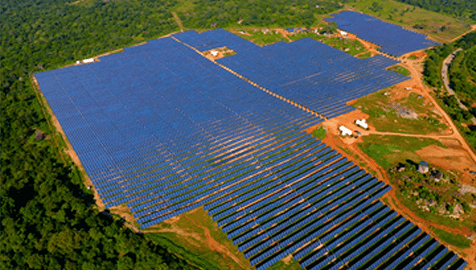
WindForce PLC, the largest renewable energy developer in Sri Lanka, reinforced its commitment for greener energy choices by opening a 10MW solar power plant in Vavunathivu in May, and 15 MW Hiruras Wind Power Plant in Mannar.
Power and Energy Minister Kanchana Wijesekera was the chief guest at the opening ceremony .
The construction of the 10MW ground mounted solar power plant started in September 2021 and was commissioned 10 months later. Being an agrivoltaic plant, Solar Universe is the first of its kind for the company, as well as for Sri Lanka.
Agrivoltaic plants combine the growth of agricultural crops with solar power production, optimizing the use of land to increase its efficiency.
Seeing that both solar power plants and agricultural crops need to be located in areas with access to ample levels of sunlight, the concept of agrivoltaic plants caters to the needs of the two sectors.
The Solar Universe plant, located in Vavunathivu, will consist of plots of land allocated to local farmers.
After considering the climate and soil profile in the area, crops such as peanuts, green chillies, beans, turnips and watermelons are already in the process of being grown.
This agrovoltaic plant supports the company’s efforts towards normalizing the use of renewable energy and creating a sustainable environment, in addition to increasing food production and creating a livelihood for the local communities.
WindForce PLC holds 33.33 percent stake in the new Solar Universe plant, which will additionally increase the company’s solar portfolio to 134.6 MW.
The company is simultaneously in the midst of constructing their latest wind power plant, Hiruras Power, in Mannar.
This 15MW (10+5) wind power plant is expected to be completed by the end of December, 2022.
This will increase the company’s wind portfolio to 84.2 MW. Overall, with the addition of Solar Universe and Hiruras Power, WindForce’s total installed capacity will increase to 245MW by the end of FY22/23 with an effective capacity of 146.5MW.
In the third Quarter 2021/22 financial results, the Group recorded a consolidated revenue of Rs. 3.6 billion, with Profit After Tax posting an increase of 4% to Rs. 2 billion from Rs. 1.97 billion YoY.
WindForce, which debuted on the Colombo Stock Exchange in April 2021, has since declared an unprecedented dividend pay-out of Rs. 1.76 billion.
WindForce, one of the first companies in Sri Lanka to enter solar power generation saw its foresight reap astute results when the solar sector posted a significant growth of 22% in the comparable nine months.
This was due to notable contributions by the newly commissioned Tororo Solar Plant in Uganda in August 2020 and the newly acquired rooftop solar plant, Sky Solar Ltd., in September 2021.
President talks on climate change; expects King Charles III to attend COP27
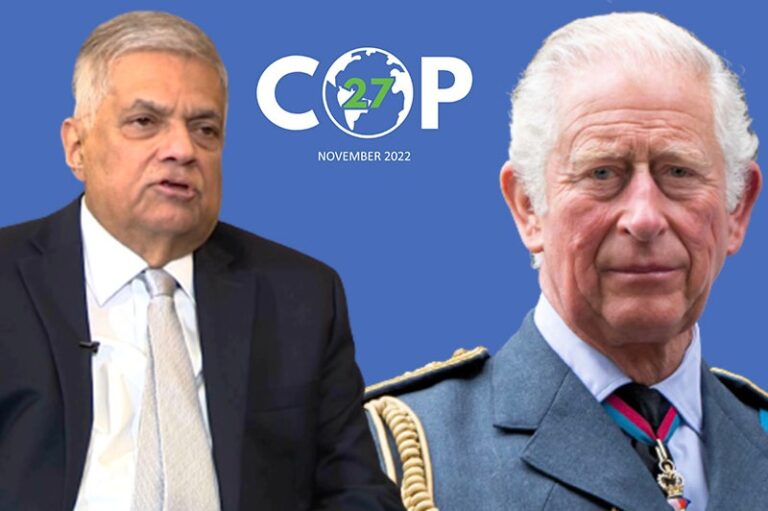
President Ranil Wickremesinghe, in an interview with Pasini Withanage on The Leader YouTube channel on Thursday (13), emphasized the importance of King Charles III attending the United Nations Climate Change Conference (COP27) scheduled to be held in Egypt from 6 – 18 November 2022.
The President made this observation in response to a statement made by Buckingham Palace on October 02 which stated that a decision had been made for King Charles III not to attend COP27.
The President of last year’s summit and member of Liz Truss’s Cabinet Alok Sharma however had stated that King Charles III should attend the upcoming climate change conference. Sharma was responding to a report which claimed British Prime Minister Liz Truss had ordered the king not to attend the conference.
According to British news reports, the King- then the Prince of Wales had indicated he would attend the annual conference.
King Charles III has been a staunch climate action advocate with a long history of campaigning to reduce the effects of climate change and made a speech during the opening of last year’s summit.
President Wickremesinghe, who recently appointed former Norwegian Minister of Environment Erik Solheim as his international advisor on climate, is expected to attend COP27 in Egypt next month.
The full text of the interview is as follows;
Q. Why is Sri Lanka placing so much importance and emphasis on climate change, especially during the economic crisis?
A. Well, if you are looking at the economic crisis, we have to emphasize climate change because today the economy and climate change are interlinked. We have to recover from this position. There must be economic development in the country. We have to go ahead. Then, our economy now must be on the lines of a green economy. That’s what everyone else is doing in the world. We can’t be outside that. Secondly, tremendous potential Sri Lanka has as a green economy. We’re getting into renewable energy. There are many other fields in which Sri Lanka can really benefit and we should go ahead.
Q. What are some of the initiatives that Sri Lanka has put in place, or is planning to put in place to address climate change?
A. Actually, we haven’t done much after COP26 due to the political instability in Sri Lanka, but we do have a plan. Our framework will take into account the 2015 Paris Climate Agreement we signed, the decisions taken at COP26, and the Commonwealth Heads of Government resolution on climate change. We are also looking at the blue economy. So within this framework, we’ll be working out our initiatives, and the potential we have. The steps we had to take. We even had to look at the water at some stage, degraded soils and reforestation. But in addition to that, I feel there has to be capacity building not only for Sri Lanka but for our whole region. We are also proposing 1s a climate change university which will be devoted to capacity building among the officials and the activists involved in climate change.
Q. You mentioned the COP summit. It has been announced that you will be attending the COP27 in Egypt next month. What is the government hoping to achieve by attending the summit?
A. No, we want to play our role there because we are very concerned as an Indian Ocean island nation, about the impact it can have on us. And we should also work together with India, especially in places like Tamil Nadu. A lot is being done on climate change. I also want to get support for the climate change university which we have been advocating. So we are going ahead and I’ve asked the former President of Maldives, Mr. Mohamed Nasheed, to act as my special envoy on climate change. He has been visiting several countries and Mr Eric Solheim came as an advisor, on both our legislation as well as the climate change university.
Q. The climate summit has been running for 27 editions now this year. Do you think the summit had been successful or do you think there’s space for improvement?
A. Well, 2015 was a really important one, when it came to the climate change agreement, and certainly 26 is very important. We have to follow up on COP26. Some of these countries have fallen behind or they’ve sort of retreated from the position they have taken. This is why COP27 is important. The President of Egypt had invited King Charles III to come and address COP 27. I also think it’s very important. Unfortunately, there seem to be some issues in the UK about him attending COP27. I can’t talk of the UK, but talking as a member of the Commonwealth, King Charles is the head of the Commonwealth and last February at the CHOGM, we passed a resolution on climate change. Therefore, he should be here. I think the UK government should reconsider it and enable him to be in Egypt for COP27 because he has an important role to play.
THE LEADER
Ambassador Savitri Panabokke presents credentials to President of the Republic of Korea
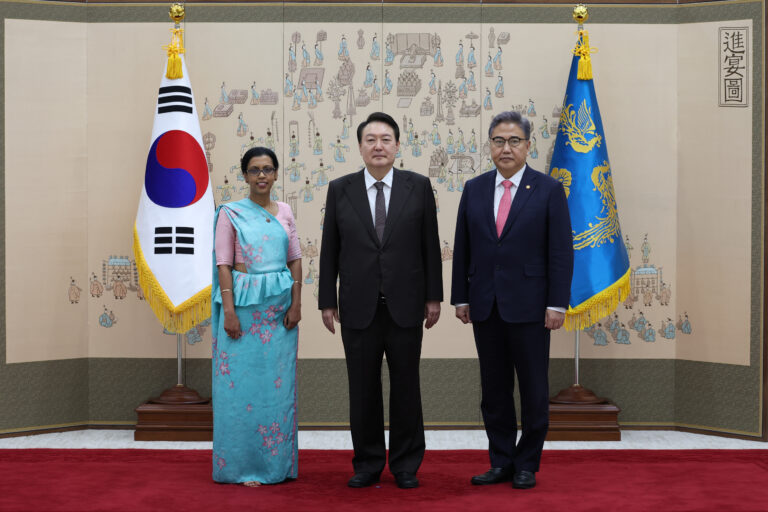
Ambassador of Sri Lanka to the Republic of Korea, Savitri I. Panabokke presented Letters of Credence to the President of the Republic of Korea, Yoon Suk-yeol, at a ceremony held at the President’s Office on 11 October, 2022.
Following the presentation of Credentials, the Ambassador had a call on the President. Minister of Foreign Affairs, Park Jin was also present at the meeting. Ambassador Panabokke conveyed warm greetings from President Ranil Wickremesinghe to his counterpart and expressed Sri Lanka’s wish to further strengthen co-operation with the Republic of Korea in several spheres. She also thanked President Yoon for the employment opportunities afforded by the Republic of Korea for Sri Lankans workers. President Yoon welcomed the Ambassador to the Republic of Korea and recalled the strong bilateral relations between the two countries.
Ambassador Panabokke joined the Sri Lanka Foreign Service in the year 2000 and has served in several Sri Lanka Missions abroad including in Brussels, Singapore, Vienna and New York. She served as the Director General of the State Ministry of Regional Co-operation of the Foreign Ministry immediately before her appointment as Ambassador.
Ms. Panabokke holds a Master’s Degree from the National University of Singapore and a Bachelor’s Degree from the University of Colombo.
Second Secretary, Sachini Dias and Minister Counsellor (Commerce), Rekha Mallikarachchi accompanied the Ambassador to the ceremony.
Embassy of Sri Lanka
Seoul
13 October, 2022
Recovery of costs through User-Pay is better rather than making exporters and private sector employees pay higher taxes
Damien Fernando, MBA (Sri.J), FCMA (UK)
The highest rate for employee income is now increased from 18% to 36%. It appears that the revenue planners of this country do not like to learn from developed countries how to recover the cost of government services to the people. They would instead stick to the traditional methods of taxing income earners. There are other ways of recovering the costs of the government and services. The only success story in this in Sri Lanka is the passport office. Changing from when people had to wait for several weeks to obtain a passport for a small fee, they successfully introduced one day service for payment of a higher fee. If I am not mistaken, this system recovers the cost of the passport operation and possibly makes a surplus for the department. Apart from this, the treasury or the revenue planners have been incapable of thinking outside the box, increasing the taxes on the private sector employees and exporters.
While none of the government sector employees pay any tax on their employment income, private sector employees (who do not qualify for any pension on retirement) have to pay taxes on their employment income. The unfair part of this is that private sector employees are made to subsidize the services the government provides for everyone.
As the current tax-free threshold is Rs. 100,000/= a month, why cannot the income taxes apply to government sector employees as well? A salary of Rs. 100,000/= is way more than an average govt sector employee gets. There would not be resistance from anyone as only the people with higher incomes get taxed as their counterparts in the private sector. A private sector employee making over Rs. 100,000/- a month must pay the same prices for goods and services as a government sector employee would.
Most governments have three ways of recovering the expenditure. One is direct taxes such as VAT and income taxes. The second is indirect taxes, such as taxes on food and other imported items. The third, user–pay, is rarely used in Sri Lanka except for passports and motorway use. Unlike other taxes, the user-pay collection is not hated by the payers as they get a direct benefit for what they pay. Also, the user-pay method is a fair system of recovery of costs, unlike making few people subsidize the services mainly provided to others.
Following are a few examples where the system can be changed to shift to a user-pay method and reduce dependency on the higher income tax from the exporters and the private sector employees.
- One of the most significant expenditures of the government is education and higher education. There are approximately 4.2 million schoolchildren between grades 1-12. It is fair to assume that at least 15% of these students come from families with a monthly income of over Rs. 100,000 or assets over Rs. 25 million. If such children are made to pay Rs. 5,000 a month for education, the total revenue of the education department would be Rs. 37.8 billion a year. Parallel to this, the govt could also impose a fee of Rs. 5,000 a seat in every private school.
- Except for the few motorways, all other roads do not recover any cost from the users for the usage. A per kilometer fee (say 1/3 of the per/km fee for motorways) for the use of the other major roads, the government could at least recover a part of the maintenance and renovation of roads. Rather than having staffed booths like on our highways, there are electronic user fee-collecting systems. An exemption could be given to passenger buses, motorcycles, three-wheelers, and Lorries.
- The govt. also spends a considerable amount of money on the work done by the local government institutions. However, the rates charged by the local government institutions are negligible compared to the costs—an apartment or a house worth Rs. Fifty million has to pay only Rs. 2,500 a year as rates. The government could easily charge 0.5% of the property’s value, which would be Rs. 250,000/= a year or around Rs. 20,000/= a month. That is 100 times the current rates. The government could allow the local bodies to retain 30% of the amount they collect as rates and take the balance to cover the infrastructure cost they must maintain. Also, this will eliminate the costs the central government is paying to local governments. With the government’s infrastructure costs, the property value goes up substantially. Hence it is fair to recover 0.5% a year on the property value as the owners could enjoy 99.5% of the gain.
- The present revenue license fee charged for motor vehicles is also way too small. For example, a Rs. 20 million worth of Land Cruiser Prado has to pay a license fee of Rs. 4,000/=. This is compared to the famous SRI tax introduced by Dr. N.M Perera in the ’70s, where a car with a registration number starting from 6 SRI had to pay Rs. 600/= a year. While the owner of a Prado would pay only Rs. 4000/= for the revenue license, he would pay Rs. 300,000/= to insure the same car for one year. The RMV should charge at least 0.2% for the revenue license, which will be Rs. 40,000/- a year. The Automobile Association could easily provide the average valuation of each YOM and model of a vehicle to RMV. Such a fee will increase the revenue of RMV by ten times.
- The govt. can implement a student loan scheme for higher education by the govt. Universities. The loan is to be paid monthly for ten years after completion of the degree without interest. This will recover a substantial portion of the costs govt. incurs on universities. Subsequently, the student loan scheme could be extended to include private universities. To estimate the recovery, if one assumes 50,000 students enter state universities a year, and the fee for higher education degrees is Rs. 10,000/- a month, then the income for a year will be in the range of Rs. 24 billion. There are several advantages of this method. One is that the students will attempt to complete their degree on time rather than staying in the university without completing the degree. This is as every month his cost will increase by Rs. 10,000/=. Other is as the university gets paid Rs. 10,000/= a month for every student, they admit they will try to increase the capacities and the intake to increase their revenue.
- Even for healthcare, a fee of Rs. 100/= for a consultation and, say, Rs. 500/- a day for hospitalization and Rs. 5000/= for surgery is not unfair for members of a family that has an income over Rs. 100,000/= a month or Rs. 25 million in assets.
- Although not an example of a possible user-pay service, the cost of a poverty alleviation scheme (samurdhi) could also be modified to be less costly to the government and more effective for recipients. The poverty alleviation systems have failed to pull a significant portion of the poor out of their situation. If the government coordinates a scheme in that people and companies volunteer to look after a needy family by providing Rs. 10,000 a month, it will be way better than Rs. 3,000 or so the samurdhi pay. The most significant advantage is that the sponsor could provide children with used or new clothes, books, and education and career guidance. Some would help their recipient families with assistance to home renovation, household goods, food, etc. While many well-to-do individuals and families will volunteer to sponsor another (poor) family, large state-sector and private-sector banks and other organizations will volunteer to support hundreds of families. The most crucial part of such a scheme is the guidance and further help the low-income families would get so that many families would come out of poverty after a few years.
There could be many government services that are now provided free of charge or for a small fee. Subsidizing for low-income earning families is always justified in any society. However, providing free or subsidized services to those who can afford to pay and making the private sector employees pay higher taxes on their income is grossly unfair.
The government should introduce a free services card for families with income of less than Rs. 100,000 a month or Rs. 25 million in assets so they can be provided with free education and healthcare. This should be done based on an affidavit signed by the head of the household. If an applicant gives a false affidavit on their income and assets, they could be prosecuted, and a fine of several folds of the cost of free services provided could be recovered. Similar systems are implemented in developed countries with reasonable success.
The opposition unites against the government’s postponement of elections! (VIDEO)
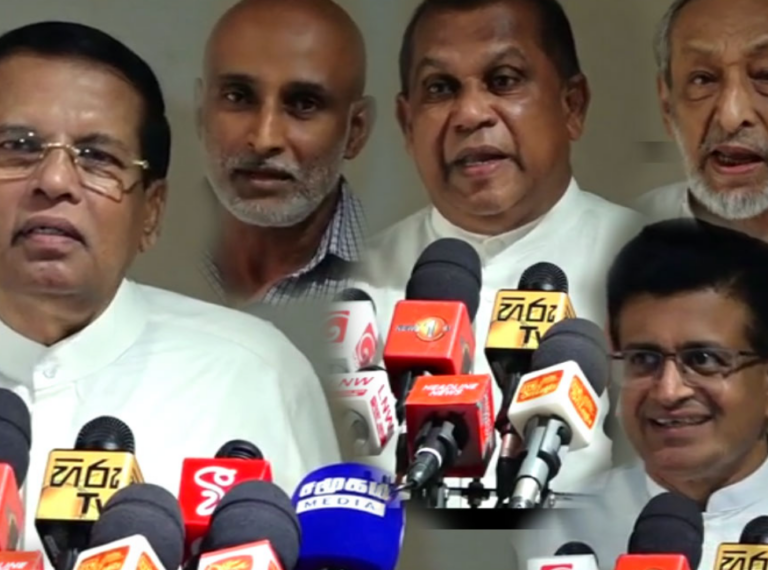
In recent days, the opposition has continuously accused that the government is working to postpone the elections by presenting various opinions.
The opposition emphasizes that the local government election to be held should be conducted and the public opinion should be checked as there is currently a distorted public opinion.
The Chairman of Sri Lanka Podujana Peramuna Prof. G.L. Peris and Dallas Alahapperuma, who acted as representatives of the government, held a special discussion yesterday (12) against the postponement of these elections in Colombo with the participation of opposition party representatives.
Accordingly, the party representatives representing the opposition participated and it was agreed that the government’s attempt to postpone the elections should be defeated at the first moment.
After that discussion, the representatives of the opposition made a comment to the media about the agreement.
A warrant issued for the arrest of Sanath Nishantha
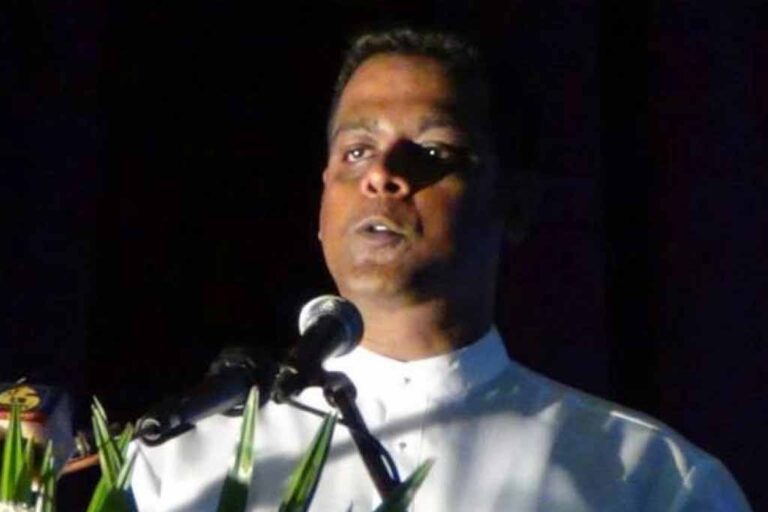
The Court of Appeal has issued a warrant to arrest the Minister of State Sanath Nishantha and bring him to court.
This is due to the fact that a notice was issued to appear before the Court of Appeal today (13) in relation to the complaint filed against him regarding contempt of court, but he did not appear before the court when the case was called this morning.
Accordingly, this warrant was issued to the IGP by the Court of Appeal Judges Nishanka Bandula Karunaratne and R Gurusinghe.
However, it was reported that after some delay, Sanath Nishantha had arrived at court.
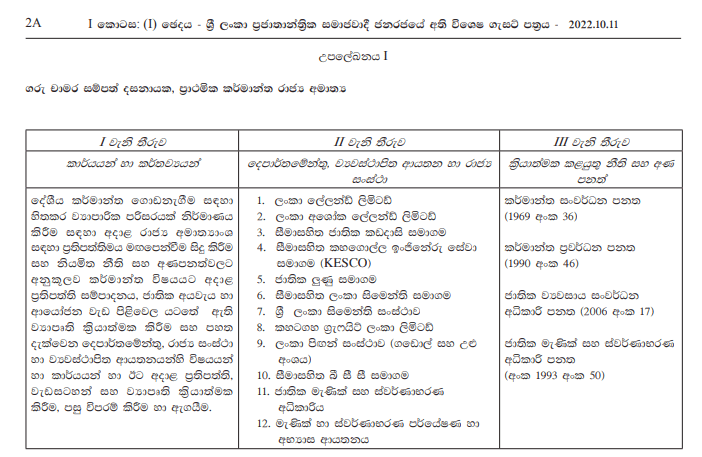
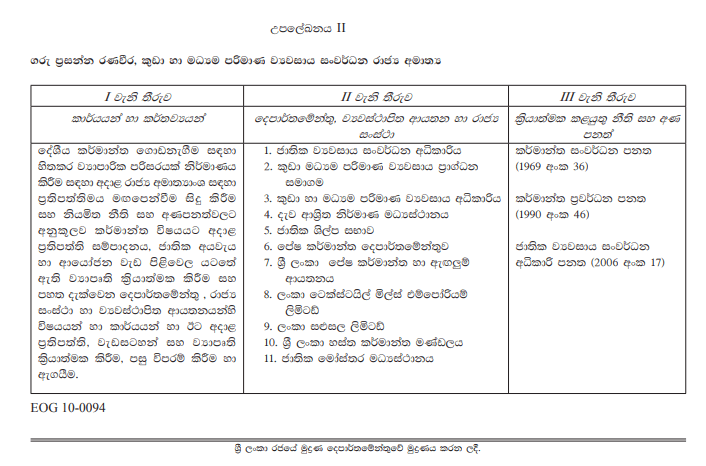
The subjects and functions of two Ministers of State gazetted
The subjects and functions of the two Ministers of State under the Ministry of Industry have been published through a special gazette.
Industry Minister Ramesh Pathirana has issued this gazette announcement.
Accordingly, the functions and government institutions allocated to Chamara Sampath Dasanayake, Minister of State for Primary Industries and Prasanna Ranaweera, Minister of State for Small and Medium Enterprise Development are as follows.