December 25, Colombo (LNW): Authorities have moved swiftly to detain suspects following the interception of a large consignment of narcotics found aboard a multi-day fishing vessel off Sri Lanka’s southern coastline.
The Police Narcotics Bureau (PNB) has secured seven-day detention orders for those initially taken into custody, after they were produced before the Hulftsdorp Magistrate’s Court.
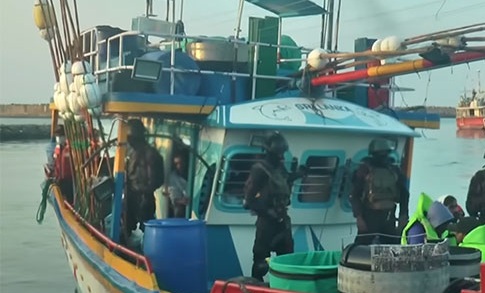
The operation began on December 20 when Sri Lanka Navy personnel, carrying out routine maritime surveillance, boarded a fishing vessel and detected suspicious cargo. The vessel, along with five individuals on board, was escorted to the Dikkowita Harbour on December 24 for further examination.
Detailed searches conducted at the harbour uncovered a substantial haul, including 21 kilogrammes of heroin and 172 kilogrammes of crystal methamphetamine, commonly known as ‘Ice’.
Early investigations suggest the drugs had been transferred at sea from a foreign vessel believed to be of Iranian origin. Expanding the probe, PNB officers arrested a further six suspects at the Mirissa Fisheries Harbour, who are suspected of assisting in transporting the narcotics into the country.
The Sri Lanka Navy, commenting on the wider picture, said maritime drug smuggling remains a major focus of enforcement efforts. According to naval figures, nearly 99 boats and long-range fishing vessels linked to narcotics trafficking have been seized so far this year, along with the arrest of around 360 suspects.
The Navy also reported the confiscation of more than four tonnes of illegal drugs during the year, including over 2,982 kilogrammes of crystal methamphetamine and more than 1,050 kilogrammes of heroin. In addition, significant quantities of other narcotics were intercepted, such as hashish, nearly 1.7 million illicit pills, and approximately 5,900 kilogrammes of both locally grown and imported cannabis.
Major Sea Drug Bust Leads to Detentions and Fresh Arrests
Police Warn of Firm Action Against Environmental Offenders
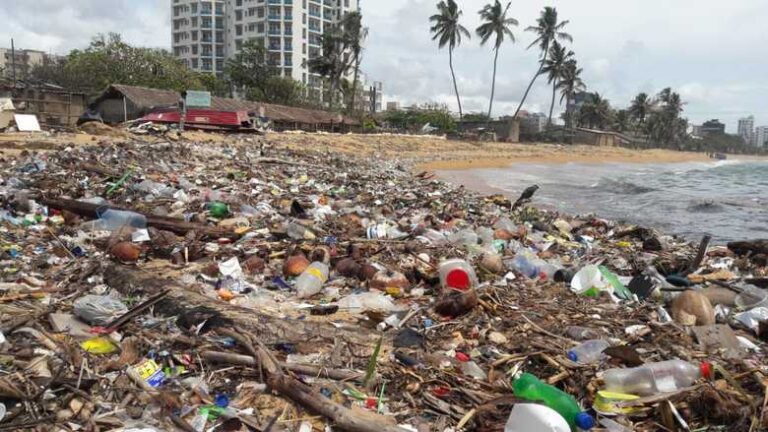
December 25, Colombo (LNW): Police have issued a strong warning that breaches of environmental laws will be met with uncompromising enforcement, as part of a renewed drive to protect natural resources.
Police Media Spokesperson, Assistant Superintendent of Police F. U. Wootler, said a series of recent operations had already led to the arrest of 23 individuals suspected of violating environmental regulations. The raids, carried out in several areas over the past few days, targeted activities deemed harmful to the environment.
He added that these actions were only the beginning, noting that further inspections and enforcement operations are planned nationwide. Authorities stressed that those who continue to disregard environmental laws should expect swift legal action, as the police step up efforts to deter environmental damage and uphold existing regulations.
Christmas Day Visits Allowed for Prison Inmates Across the Island

December 25, Colombo (LNW): Prison authorities have announced that inmates in correctional facilities nationwide will be allowed to receive visitors today in observance of Christmas Day, offering a rare moment of personal connection during the festive season.
According to the Prison Media Spokesperson and Commissioner of Prisons, Jagath Weerasinghe, families and close relatives may meet inmates under special arrangements made for the day.
Visitors have been advised to limit any food items or sweets they bring to quantities intended for a single prisoner, in keeping with prison regulations.
The initiative is intended to mark the spirit of Christmas by allowing detainees to spend time with loved ones and share simple gifts or festive treats. Officials said the measure was designed to promote goodwill and emotional wellbeing among inmates, while maintaining security and order within prison premises.
Pope Leo Urges Christians to Open Their Hearts to the Marginalised This Christmas

December 25, World (LNW): Pope Leo has called on Christians to see the Christmas story as a clear moral challenge, reminding them that faith must be expressed through care for the poor, migrants and those pushed to the edges of society. Speaking on Christmas Eve, he said the circumstances surrounding the birth of Jesus carried a powerful message about human responsibility and compassion.
Preaching during a candlelit mass in St Peter’s Basilica, the Pope reflected on the Gospel account of Jesus being born in a stable after his family was turned away from an inn. He told worshippers that shutting out those in need was not merely a social failure but a spiritual one, warning that indifference towards others amounted to turning away from God. Around 6,000 people attended the service inside the basilica, while thousands more followed proceedings from St Peter’s Square despite heavy rain.
The Pope, who has made the defence of migrants and the disadvantaged central to his young papacy, said the Christmas message affirmed the dignity of every human being. Drawing on the words of his predecessors, he criticised an economic system that reduces people to commodities and ignores children, the poor and foreigners. He stressed that wherever human life is welcomed and respected, God is present, even in the most humble of places.
Now 70, Pope Leo is marking his first Christmas as pontiff since his election in May, becoming the first pope born in the United States. Before the mass began, he stepped outside to greet the crowds sheltering under umbrellas, thanking them for their perseverance and spirit. He is due to celebrate Christmas Day mass and later deliver his traditional Urbi et Orbi blessing, addressing the city of Rome and the wider world.
President Calls for National Unity and Compassion in Christmas Message

December 25, Colombo (LNW): President Anura Kumara Dissanayake has appealed to Sri Lankans to stand together with courage and a shared sense of purpose, urging the nation to turn to compassion and solidarity as it confronts ongoing challenges.
In his Christmas Day message, the President reflected on the significance of the festival for Christians across the world, who mark the birth of Jesus Christ as a moment of hope, humility and renewal. He noted that this year’s celebration comes at a particularly testing time for Sri Lanka, following a severe natural disaster that has placed heavy burdens on communities while also revealing the country’s resilience and determination to recover.
Emphasising that the spirit of Christmas goes beyond ritual, the President highlighted values such as love, generosity, peace and self-sacrifice, describing them as essential not only to Christianity but to the moral foundation of society as a whole. He said these principles are most clearly expressed through standing up for those who are vulnerable and ensuring that no one is left behind.
The President praised citizens who came forward to help those affected by recent hardships, often travelling through difficult conditions to deliver assistance. Such acts, he said, demonstrated the finest human qualities and gave real meaning to the idea of loving one’s neighbour, a teaching shared across all faiths.
Reflecting on Christian teachings, he spoke of light overcoming darkness and of perseverance in the face of suffering, drawing inspiration from the life of Jesus Christ, whose message of faith and wisdom continues to guide millions.
Concluding his message, President Dissanayake called on all Sri Lankans to face reality with unity and bravery, expressing hope that the Christmas season would rekindle compassion and bring peace, happiness and renewed hope to households across the country. He wished all citizens a calm, joyful and humane Christmas.
President’s Christmas Message:
Christians around the world joyfully commemorate the birth of Jesus Christ with deep devotion today (25), marking the sacred celebration of Christmas.
This year, the people of Sri Lanka observe Christmas at a decisive moment in our national journey, having faced an extremely challenging natural disaster as a nation and while striving with determination to overcome its hardships and rise again. The true meaning of Christmas is love, peace, joy, sharing and sacrifice.
At the forefront of these values is the commitment to support the oppressed and the unwavering dedication to the liberation of all people.
In the face of the recent disaster, the people of Sri Lanka once again demonstrated, in the most practical manner, the noble human virtue of embracing a neighbour in distress with compassion and unwavering resolve, a principle that is upheld by Christianity and all religions. I believe that our citizens who traversed difficult paths to deliver relief to the affected have given living meaning to the Christmas message of loving one’s neighbour and building a society founded on empathy and solidarity.
To dispel darkness, light must be spread. Christianity teaches that Jesus Christ, born in humble surroundings in Bethlehem, sacrificed on the Cross to save humanity from sin on Mount Calvary. He triumphed over death and was resurrected through his unwavering determination, faith and the brilliance of his wisdom.
Therefore, I invite all of you to rise together as a nation, facing the painful challenges of reality with courage and unity. May this blessed Christmas renew our humanity through compassion, and bring peace, joy and hope to every home.
I wish you all a peaceful, joyful and compassionate Christmas!
Showers, thundershowers to occur in select districts: Fairly heavy falls above 50 mm expected (Dec 25)

December 25, Colombo (LNW): A few showers may occur in Uva province and in Ampara, Batticaloa, Matale and Nuwara-Eliya districts, the Department of Meteorology said in its daily weather forecast today (25).
Showers or thundershowers will occur at several places in Sabaragamuwa province and in Galle, Matara and Kaluthara districts after 2.00 p.m. Fairly heavy falls above 50 mm are likely at some places.
Misty conditions can be expected at some places in Sabaragamuwa and Central provinces and in Kaluthara, Badulla, Galle and Matara districts during the early hours of the morning.
The general public is kindly requested to take adequate precautions to minimise damages caused by temporary localised strong winds and lightning during thundershowers.
Marine Weather:
Condition of Rain:
Showers or thundershowers may occur at a few places in the sea areas off the coast extending from Kaluthara to Hambantota via Galle in the evening or night.
Winds:
Winds will be north-easterly and wind speed will be (30-40) kmph. Wind speed can increase up to (45-50) kmph at times in the sea areas off the coast extending from Colombo to Mannar via Puttalam and from Hambantota to Pottuvil.
State of Sea:
The sea areas off the coast extending from Colombo to Mannar via Puttalam and from Hambantota to Pottuvil will be fairly rough at times. The other sea areas around the island will be moderate.
India’s generosity in Ditwah’s wake, a partnership of reliability
By Krishantha Prasad Cooray
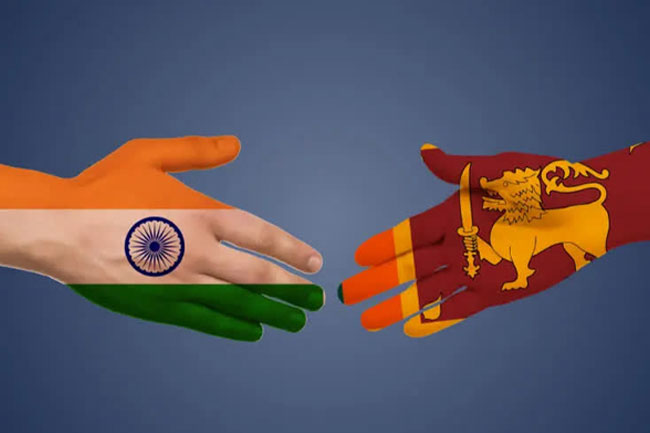
Dr. S. Jaishankar, India’s foreign minister visited Sri Lanka today. Arriving on the island in Ditwah’s wake and as the personal envoy of Prime Minister Modi, his visit is more than a diplomatic formality. It is a substantive reaffirmation of a Sri Lanka-India partnership built on the bedrock of strategic reliability.
As Sri Lankans, we must all extend our sincere appreciation for the speed and scale of India’s response to the devastation of Cyclone Ditwah.
We often discuss the “First Responder” concept in abstract terms. However, over the past few weeks, India showed what the words really meant. The deployment of men and helicopters from the INS Vikrant in Colombo harbor on the very day of the cyclone’s landfall, the sustained presence of search and rescue teams, the operation of a field hospital and Bailey Bridges have given that concept a very tangible and human meaning. We will not forget this immediate and most human kindness from the people of India.
Reliability is defined by presence when it matters most. As we move onto the recovery and reconstruction phase – which follows the crises of the Easter Bombings, COVID and economic collapse – assistance for reconstruction is the need of the hour. India has proved its reliability. We must thank the people of India and the people of all other countries who have stood by us at this hour of peril and need.
The Indian assistance package of $450 million is generous – including $100 million as an outright grant. It fits well with our needs: focusing on reconstruction of roads and rail, housing, health and education, and agriculture. We must also commend the Indian government for its efforts to promote tourism and FDI into Sri Lanka.
For Sri Lanka, the aftermath of Cyclone Ditwah has been a sobering reminder of our vulnerability. India’s generosity – and the generosity of the many other countries that have come to our aid – is a reminder that in an increasingly precarious, uncertain and transactional world; universal, civilizational values and fundamental empathy between peoples not only remains but flourishes.
Through this crisis, us islanders are reminded that we have friends and family among the community of nations. And while friends and family may have their quarrels and differences – in times of crisis like this their true character reveals itself. Through this crisis, we can draw comfort that not only do we have friends, we have reliable friends.
India’s $450 Million Cyclone Aid: Relief, Strategy and Indian Ocean Stakes
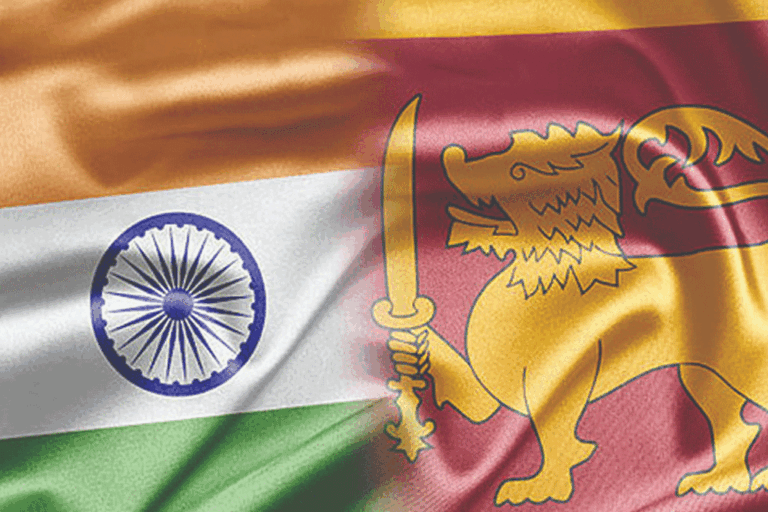
India’s decision to extend a USD 450 million financial assistance package to Sri Lanka in the aftermath of Cyclone Ditvah goes far beyond humanitarian relief, reflecting New Delhi’s broader strategic, economic, and geopolitical calculus in the Indian Ocean region.
Announced by Indian External Affairs Minister Dr. S. Jaishankar, the package consists of a USD 350 million concessionary line of credit and USD 100 million in outright grants, targeted at rebuilding cyclone-ravaged infrastructure and livelihoods. The commitment was formally conveyed through a letter from Indian Prime Minister Narendra Modi to President Anura Kumara Dissanayake, underlining the political significance attached to the initiative.
The assistance is being structured in close coordination with the Sri Lankan government and focuses on five critical areas: restoring road, rail, and bridge connectivity; rebuilding fully and partially damaged housing; rehabilitating health and education facilities; supporting agriculture to avert short- and medium-term food shortages; and strengthening disaster preparedness mechanisms.
India’s rapid response under Operation Sagar Bandhu reinforced its role as Sri Lanka’s first responder. Naval assets INS Vikrant and INS Udayagiri, Indian Air Force Mi-17 helicopters, an 80-member National Disaster Response Force unit, and a field hospital near Kandy with 85 medical personnel were deployed within hours of the cyclone’s landfall. Emergency care was provided to over 8,000 affected persons, supported by two modular BHISHM emergency care units airlifted to the island.
Material assistance was equally extensive. More than 1,100 metric tons of relief supplies—ranging from dry rations and tents to hygiene kits, water purification units, and essential clothing—were delivered, along with 14.5 tons of medicines and medical equipment. India also moved quickly to restore transport links, constructing a Bailey bridge in Kilinochchi and initiating another in Chilaw.
Economically, the assistance helps Sri Lanka manage post-disaster reconstruction at a time when fiscal space remains limited following the 2022 economic collapse. The heavy reliance on grants and concessional credit reduces immediate debt stress, a key consideration as Colombo remains under IMF-supported reforms.
Politically and strategically, the package reinforces India’s “Neighbourhood First” policy and its intent to remain the most reliable partner in South Asia during crises. By linking disaster relief with longer-term support for tourism, investment, and connectivity, New Delhi is embedding humanitarian assistance within a wider framework of economic integration and regional stability.
For Sri Lanka, the aid offers immediate relief. For India, it consolidates influence in a strategically vital island at the heart of the Indian Ocean—where humanitarian diplomacy and geopolitical interests increasingly intersect.
Why MSMEs Fall Through the Cracks After Every Disaster

The devastation caused by Cyclone Ditvah has once again exposed a recurring policy failure: the systematic neglect of MSMEs in post-disaster recovery frameworks, despite their central role in employment, local markets, and economic revival.
In the immediate aftermath of disasters, MSMEs face severe disruptions to local markets and supply chains, undermining operational continuity. Many rely on borrowed capital to sustain daily operations, and forced closures only deepen debt burdens, pushing enterprises closer to insolvency. Yet, despite their economic significance, MSMEs consistently struggle to access affordable recovery finance, whether through government relief mechanisms or commercial credit.
This widespread collapse of micro- and small enterprises often goes under-recognised, even though its long-term consequences, job losses, income erosion, and delayed regional recovery are profound. A fundamental problem lies in how MSMEs are positioned within disaster response policies. Assistance frameworks typically prioritise households and public infrastructure, while enterprises fall into a policy blind spot.
MSMEs are frequently deemed “not poor enough” to qualify for social protection schemes, yet lack the financial capacity to purchase commercial insurance. The diversity of enterprises ranging from informal micro traders to medium-scale manufacturers further complicates standardised assistance norms. As a result, many viable businesses collapse permanently after disasters, taking local livelihoods with them.
This neglect is economically short-sighted. When MSMEs recover, communities recover. These enterprises generate employment, stimulate local demand, restore supply chains, and rebuild confidence. In this sense, MSME resilience is a cornerstone of community resilience.
On the occasion of Micro, Small and Medium-sized Enterprises Day, a five-point agenda has emerged to address these structural vulnerabilities. First, policymakers must work with formal and informal MSME associations to develop simple risk self-assessment tools, covering both physical hazards and financial risks. These tools should help enterprises understand vulnerabilities not only to themselves, but to workers and dependent households.
Second, identified risks must be addressed through a graded toolkit of resilience solutions, linked to affordable financing mechanisms that allow MSMEs to invest progressively in protection and adaptation.
Third, there is an urgent need for locally appropriate risk-transfer solutions, including group-based and pooled insurance models, which can reduce premiums and expand coverage for small enterprises.
Fourth, disaster recovery finance systems must explicitly include MSMEs, using a balanced mix of grants and concessional loans rather than debt-heavy instruments that worsen insolvency risks.
Fifth, MSME owners must be given a formal role in local disaster risk reduction and recovery planning, ensuring that “building back better” translates into more resilient enterprises and diversified livelihood opportunities.
Across all these actions, digital innovation and new insurance models offer transformative potential. Digital payments, participatory risk mapping, and localized assessments can help integrate informal businesses into resilience frameworks before disasters strike. Parametric insurance schemes, which trigger payouts based on predefined thresholds such as storm intensity, offer faster, dispute-free compensation and have proven effective in reducing recovery delays.
Global initiatives such as the UNDER-supported ARISE Network, which has promoted MSME-led disaster risk reduction for over 15 years, demonstrate that resilient small businesses can be powerful agents of community recovery if policy frameworks allow them to be.
IMF Flags CycloneShock, Warns Sri Lanka’s Recovery at Risk
Sri Lanka’s fragile economic recovery has been dealt a fresh and potentially destabilising blow by Cyclone Ditwah, with the International Monetary Fund (IMF) warning that the disaster could erase between 2.5% and 5% of GDP, widen the balance of payments gap by nearly $700 million, and push inflation back above the Central Bank’s comfort zone in 2026.
In an IMF staff assessment released last week, the Fund acknowledged that estimates remain subject to wide margins of error, but stressed that the cyclone’s economic footprint is likely to be significantly larger than recent climate shocks. Damage from Ditwah is already assessed as more severe than the 2016 and 2017 floods, which required recovery spending equivalent to 1.1% and 0.8% of GDP, respectively.
The IMF projects that economic growth could slow to 2.9% in 2026, down from an estimated 4.2% in 2025, as disruptions ripple through key sectors. Agriculture and tourism jointly accounting for about 11% of GDP have been hit hardest.
Severe crop losses, destruction of livestock, and the cyclone’s timing at the start of the peak tourism season are expected to reduce output and foreign exchange inflows. While reconstruction-driven construction activity may provide a partial offset, IMF staff cautioned that this rebound would be uneven and time-bound.
Inflation has already begun to respond. Headline inflation rose to 4% year-on-year in December 2025, up from 2.1% in November, while average inflation in 2026 is projected at 5.4%, exceeding both the Central Bank’s 5% target and the IMF’s earlier forecast of 3.3%. Selected food prices have surged by 30% to 200%, echoing the 2016–17 disaster period when food inflation spiked from 3% to 14.4%.
Externally, the IMF estimates the current account deficit could widen by $700 million (0.7% of GDP) over the next year. Higher food, fuel, and reconstruction-related imports, combined with weaker tourism receipts and agricultural exports, will strain foreign exchange inflows. Although remittances are expected to rise, the IMF stressed they will only partially offset the shock.
To meet urgent financing needs, the IMF assessed $205 million in Rapid Financing Instrument (RFI) support as appropriate, against total external financing requirements of about $720 million.
Beneath the technical projections lies a clear warning. While acknowledging improved pre-cyclone fundamentals including reserves covering about three months of imports the IMF cautioned that the disaster has raised debt sustainability and external vulnerability risks.Transparency in emergency spending, strict public financial management, and disciplined investment decisions will be critical. Any slippage, the IMF implied, could undo hard-won stabilisation gains just as Sri Lanka attempts to consolidate recovery