Home Blog Page 2085

SLPP MP team meets with President, agrees to support RW

0

The MP team of the Sri Lanka Podujana Peramuna (SLPP) has met with President Gotabaya Rajapaksa this (14) morning and agreed to extend their support to the new government led by Prime Minister Ranil Wickremesinghe.

Stay tuned for more information..

MIAP

Ranawaka having second thoughts on new government after RW’s Committee reveal

0

MP Patali Champika Ranawaka, who had initially been endorsing the idea of joining the new government on due formation led by Prime Minister Ranil Wickremesinghe, has changed dis decision today (14), internal sources disclosed.

Although Ranawaka himself and several other members of the Samagi Jana Balawegaya (SJB) close to the 43 Senankaya Leader had decided to join the Wickremesinghe-led government from the beginning, talks have been surfacing within the group that the mistakes made during the 2015 Good Governance regime should not be allowed to happen again.

Following close observation on the proceedings of Wickremesinghe since his swearing in, the group has concluded that the UNP Leader is preparing to return to his usual ways of administration. Sources further claimed that Ranawaka was convinced that the government due on formation may not be able to secure a long-run given the manner in which the selection process for appointments is being carried out, the persons selected for the tasks and the Committee appointed by Wickremesinghe to supply essential commodities amidst such a questionable conduct.

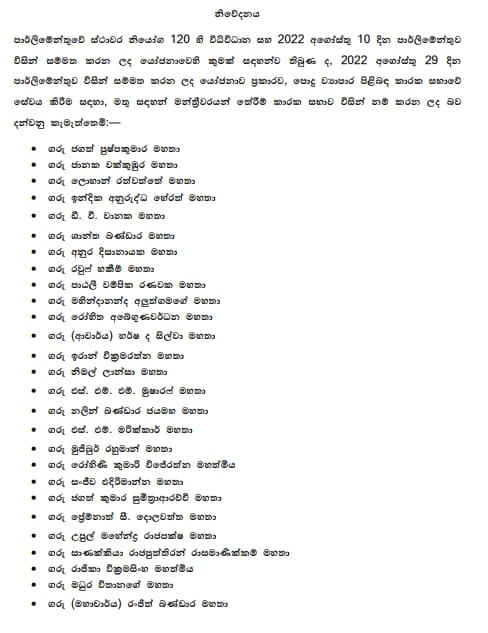
The Committee appointed by the Prime Minister comprises of well known UNP figures, Ruwan Wijewardena, Sagala Ratnayake, Akila Viraj Kariyawasam, Vajira Abeywardena and Palitha Range Bandara.

In the backdrop, Ranawaka has told his close associates that he has no intention of ending his political career by submitting himself to a ministerial post in a government which probably will meet its end in about two and a half months being accountable for its familiar corrupt conduct, sources further claimed.

Four Cabinet Ministers representing SLPP sworn in

0

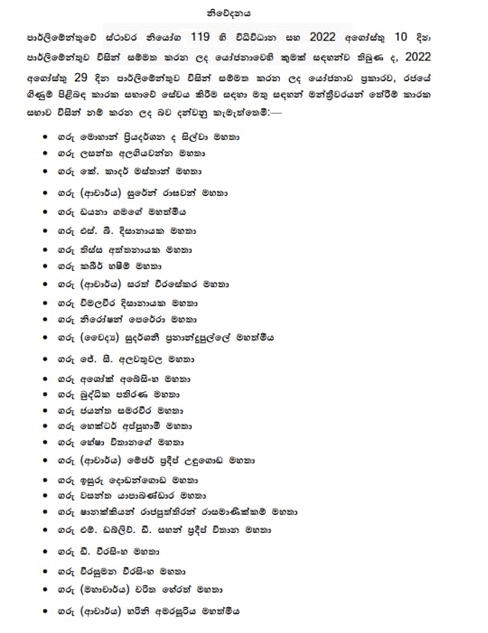
Four Cabinet Ministers representing the Sri Lanka Podujana Peramuna have been sworn in this (14) afternoon.

Prof. G.L. Peiris – Minister of Foreign Affairs

Dinesh Gunawardena – Minister of Public Administration, Home Affairs, Provincial Councils and Local Government

Prasanna Ranatunga – Minister of Urban Development and Housing

Kanchana Wijesekara – Minister of Power and Energy

No photo description available.

PM Wickremesinghe invites Opposition Leader Premadasa to form a non-partisan government

0

Prime Minister Ranil Wickremesinghe in a letter has invited Leader of the Opposition Sajith Premadasa to form a non-partisan government by reaching beyond the traditional parliamentary politics.

Wickremesinghe called on all parties to join hands in fulfilling the national responsibility of resolving the burning issues of the people without delay by putting a collective effort in the objective of stabilising the country economically and socially.

MIAP

No photo description available.

Extraordinary gazette declaring RW as Prime Minister issued

0

The extraordinary gazette declaring Ranil Wickremesinghe as the Prime Minister of the Democratic Socialist Republic of Sri Lanka has been issued last (13) night.

MIAP

Gammanpila says even if he has no trust in Ranil, they will not try to overthrow the govt.

0

MP Udaya Gammanpila says that although they will not attempt to overthrow the government as there should be a government to run a country, they have no trust in Ranil Wickremesinghe either.

He said that his history did not set the stage for such confidence.

However, if the agenda pursued by Ranil Wickremesinghe when he was in power is not further implemented and the country continues to act in a manner that does not further abyss, he said that they can act in a manner that does not destabilize the government.

People protests at Navinna Junction demanding for gas

0

Traffic at the Navinna Junction on the High Level Road and the Baseline Road leading to Colombo has been blocked due to public protests demanding gas.

Despite being told that gas will be available today, the people are protesting by blocking the road due to the lack of gas in the distribution centers.

On the 8th, residents of the area blocked the Navinna Junction on the High-Level Road and staged a protest against the non-availability of gas.

A meeting between the President and the independent MPs of the government

0

It is reported that a discussion between the President and the independent members of parliament is to be held at the President’s Residence this morning (14).

It is said that with the appointment of Ranil Wickremesinghe as the new Prime Minister, the future political activities of the country will be discussed.

The group and the President have been in discussions for some time and despite their opposition to Ranil Wickremesinghe, the group stated at a media briefing in Colombo yesterday that they are ready to support the good work being done by the new government.

However, the SLFP had stated that it would not support the government of Prime Minister Ranil Wickremesinghe.

Lakshman Hulugalle passes away

0

Lakshman Hulugalle, the Consul General of Sri Lanka in Sydney, Australia has passed away.

He passed away in Australia this morning (14) at the age of 66.

During Mahinda Rajapaksa’s presidency, Hulugalle served as the Director General of the Media Center for National Security.

The morning after

0

Sri Lanka has no money and no government. What now?

For more than a month the anti-government protesters camped along Galle Face, the seafront in the Sri Lankan capital of Colombo, had been mostly peaceful. They were demanding the departure of the president, Gotabaya Rajapaksa, and the prime minister, Mahinda Rajapaksa, his brother. There were tents, stages for political plays, and singing. “Go home Gota!” their signs read, using the name by which the president is commonly known. He did not budge. Neither did the protesters

All that changed on May 9th when hundreds of government supporters descended on the camp at Galle Face and other protest sites in the city. Unmolested by police, they attacked the demonstrators and burnt down their tents. Many had come straight from a meeting at the residence of the prime minister, who had hosted them in a bid to cling to his job. As anti-government protesters counter-attacked and the violence began to spiral out of control, the prime minister at last heeded calls to resign, in the process triggering the dissolution of his cabinet.

In theory, that should pave the way for a new government of national unity led by a prime minister who enjoys cross-party support, and made up of representatives of all the main parties and perhaps some technocrats. But unity is the last thing on the minds of many Sri Lankans, who are enraged to find themselves demoted from relatively well-off by South Asian standards to begging for handouts from India. The protesters responded to the attacks on them by burning down the homes of many cabinet ministers and a museum dedicated to the Rajapaksas. The buses that had carried government supporters into Colombo were also set ablaze. A minister’s car was dumped in a lake.

Hundreds of people were injured as the violence continued into the next day. Several died, including a member of parliament who shot and killed a protester as a crowd surrounded his car, according to police reports. Mahinda and his family were airlifted to safety by security forces on May 10th after an angry mob surrounded his residence. Troops were deployed across the country and ordered to shoot on sight anyone seen damaging property or attacking people. The following afternoon, police told protesters at the Galle Face encampment to clear the area to comply with an island-wide curfew, though they did not immediately enforce the order. The governor of the central bank said he would resign unless political stability was restored.

Perhaps it was this threat that cured the president of the temptation to rule by decree, as he would have been entitled to do following the dissolution of the cabinet. Late on May 11th Mr Rajapaksa addressed the nation, promising to appoint a new government. He appeared to agree to most of the conditions outlined by the opposition, including a reduction in the powers of the presidency, which he had boosted by amending the constitution in 2020.

All-party talks to choose ministers for an interim cabinet were under way as The Economist went to press. Ranil Wickreme singhe, a veteran lawmaker, looked set to be sworn in as interim prime minister. But his putative government faces obstacles, not least the fact that many mps do not want to sabotage their careers by associating themselves with Mr Rajapaksa. The president’s refusal to step down may damage the credibility of any interim government from the start. A way forward will require balancing the necessary political stability with enough accountability to command public support.

That is particularly important given the daunting task facing any new government. Sri Lanka must implement a series of painful economic reforms—a tall order in such a febrile atmosphere. A combination of bad policy and external shocks, notably a collapse of tourism during the pandemic and spiking commodity prices following Russia’s invasion of Ukraine, have depleted Sri Lanka’s foreign-currency reserves and raised consumer-price inflation to almost 30% year-on-year in April, from 19% in March (see chart). For nearly two months, Sri Lankans have had to live with long power cuts, soaring prices for staples such as rice, and shortages of essentials as petrol—largely a function of the lack of currency with which to pay for imports.

The government’s foreign reserves are down to $50m—nothing, in effect. It burned through all its cash in recent months in a doomed effort to prop up the currency and service its foreign debts. On April 12th it conceded defeat and said it would stop paying interest, seek a bail-out from the imf and ask creditors, including China and India, to restructure their loans. Since then the government has relied on temporary credit, mostly from India, to import essentials such as food and fuel. Even if the political class gets its act together, turning Sri Lanka’s economy around is getting harder by the day. ■

This article appeared in the Asia section of the print edition under the headline “The morning after”

THE ECONOMIST