- New Commissioner General of Inland Revenue Department D R S Hapuarachchi says the Department will improve revenue collection and get back the forex lying outside the country.
- Ports Minister Nimal Siripala de Silva says the Colombo West and East Deep-water Terminals will be fully operational by 2024-2025.
- Bloomberg reports that debt default and widespread protests shrank Sri Lanka’s economy to it’s worst levels in two years: the economy contracted by 8.4% in the 3 months up to 30 June 2022.
- President Ranil Wickremesinghe transfers Sri Lanka Export Development Board, Board of Investment of Sri Lanka and Colombo Port City Economic Commission to the Ministry of Investment Promotion.
- Public Security Ministry Secretary S Hettiarachchi says steps being taken to extradite 13 wanted underworld criminals who are hiding in Dubai: among them are notorious underworld gang leaders Harak Kata, Ganemulle Sanjeewa and Kudu Dharme.
- Prisons Spokesman Chandana Ekanayake says that the maximum capacity of all prisons in the country is 13,200, but around 24,000 inmates are cramped into them currently.
- Hundreds of thousands of people queue up at Galle Road to face interviews for jobs at Qatar Airways.
- Police summon “Black Cap Movement” Convenor Vimukthi Dushantha, whose organisation actively participated in the Galle Face Aragalaya (struggle).
- National Dengue Control Unit says that by the 36th week of this year, a total of 55,012 dengue cases have been reported in Sri Lanka: corresponding number last year was 18,265.
- Cases of snatching gold chains, mobile phone, bracelets, pendants and cash from women walking on roads, increase.
Sri Lanka Original Narrative Summary: 18/09
Sirisena to kick out SLFP members who were sworn in as ministers!
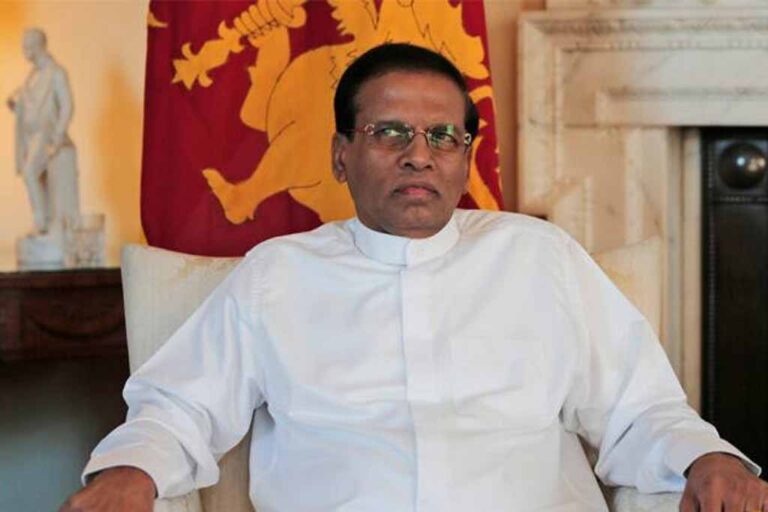
Sri Lanka Freedom Party (SLFP) Leader and former President Maithripala Sirisena is preparing to dismiss party members who were sworn in as Cabinet Ministers and State Ministers of the Ranil Wickremesinghe regime, sources disclosed.
In a first step of his move, the former President has decided to relieve them all from the titles in the party, and several days ago, a special discussion was also held in this regard at his residence, according to sources.
The SLFP Party Constitution was recently amended allowing the Party Leader, who is Sirisena, to dismiss any member who violates decisions made by the Party.
MIAP
The economic crisis driven the people into stealing: Handunnetti
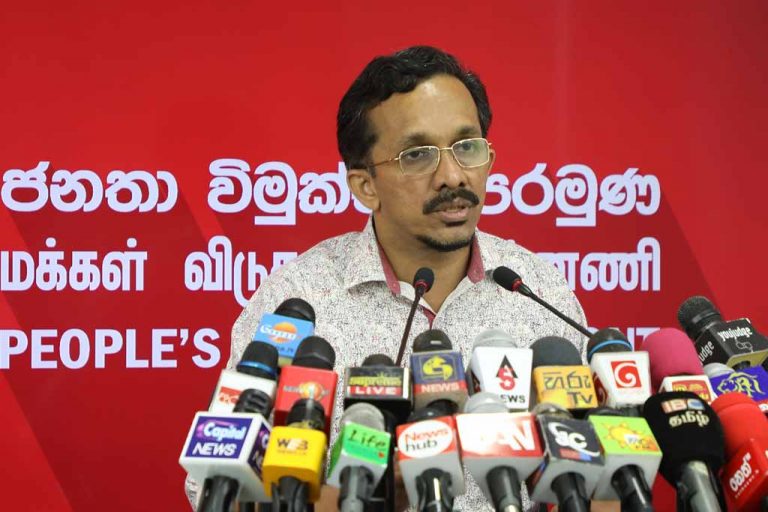
Janatha Vimukthi Peramuna (JVP) Politburo Member and former MP Sunil Handunnetti speaking to a press conference called in by the Party yesterday (17) said the country’s economic crisis has not only put severe pressure on the people but also has driven them into stealing pots of rice and loafs of bread from houses.
“Robbery has increased in the Northern and Eastern Provinces today to a point which did not exist even during the war. The World Food Programme (WFP) has stated that 6.3 million people people in Sri Lanka are starving today. Yesterday in Kilinochchi, I met a nine-month-old baby with his mother in a state of hyper-malnutrition. But no subsidy is given. Not even the Rs. 5000 subsidy is given by the government,” Handunnetti disclosed.
The former MP added: “Today, people have been driven into a state in which they steal the pot of rice and the loaf of bread; they have begun to break into shops. When people cannot afford to live, when they cannot afford to feed their children, the rulers have made them robbers.”
MIAP
Govt responds to allegation on importing poisoned rice
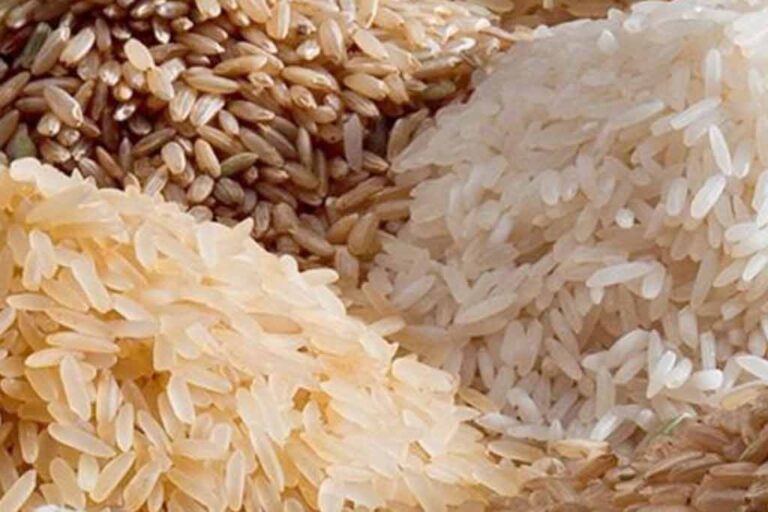
The report on poisoned rice being imported to Sri Lanka published on two weekend newspapers is completely false, said the acting Pesticides Registrar.
Accordingly, the Secretary to the Ministry of Trade, Commercial and Food Security has also lodged a complaint with the Criminal Investigation Department (CID) in this regard.
MIAP
Several powerful govt institutions under the Finance Ministry taken over by the Investment Promotion Ministry
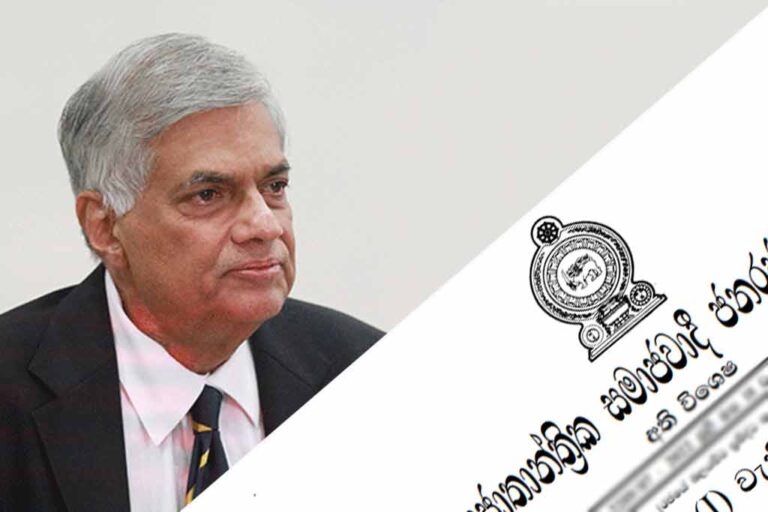
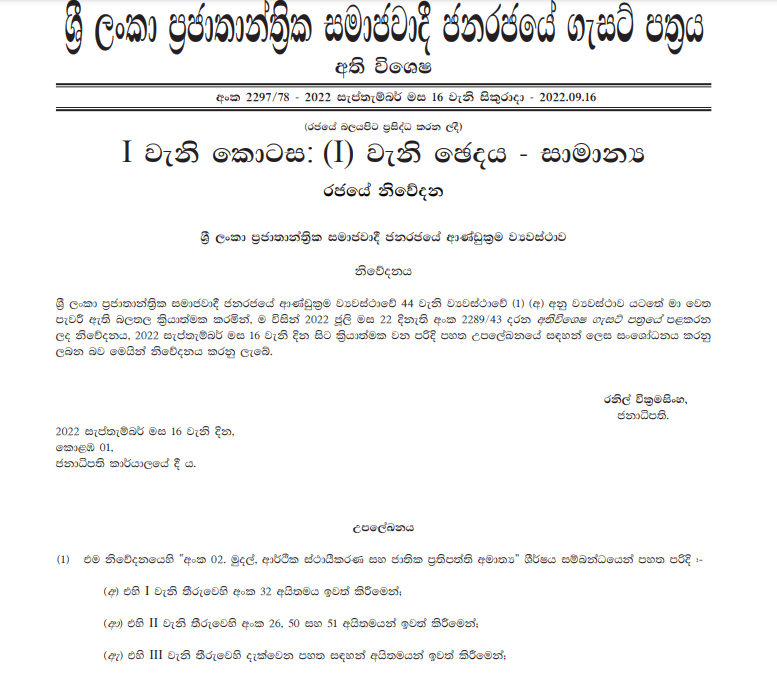
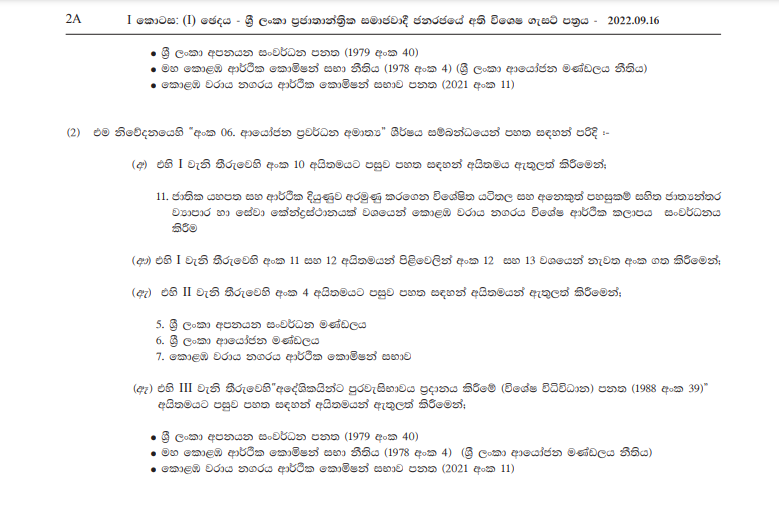
President Ranil Wickremesinghe has issued an extraordinary gazette declaring that three powerful government institutions which were under the Ministry of Finance, Economic Stabilisation and National Policies be taken over by the Ministry of Investment Promotion.
Accordingly, the following bodies have been taken over by the Ministry of Investment Promotion, in compliance with the President’s gazette;
Sri Lanka Export Development Board
Sri Lanka Board of Investments
Colombo Port City Economic Commission
Despite these institutions being taken over by the said Ministry, they will continue to remain under the scope of the President himself given that no Cabinet Minister for Investment Promotion has yet been appointed.
MIAP
Col HC issues warrant to arrest Vass Gunawardena’s wife
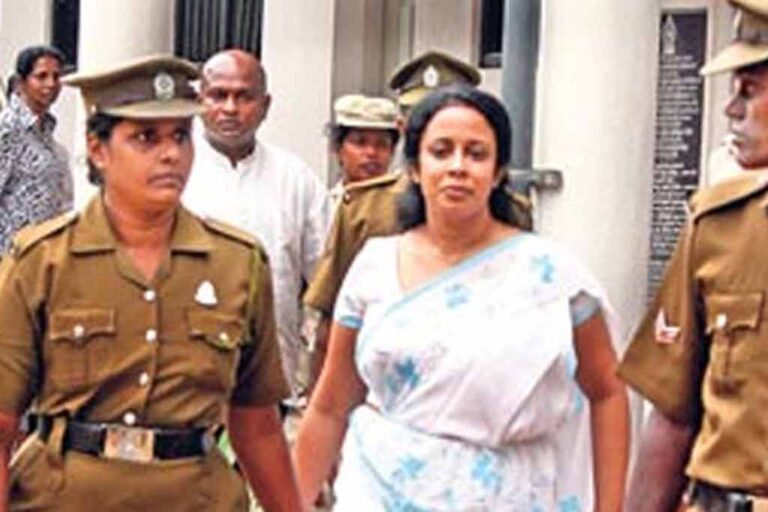
The Colombo High Court has issued a warrant to arrest Shyamali Perera Gunawardena, wife of former Deputy Inspector General of Police (DIG) Vass Gunawardena, and former Superintendent of Police Indika Pushpakumara, in connection with the abduction and torturing of a student allegedly committed in 2009.
The warrant was issued as the case on the abduction and torturing of Nipuna Ramanayake, a student of the Sri Lanka Institute of Information Technology (SLIIT), was called in two days ago (16).
The warrant was issued for their arrest as the two defendants, who were on bail, failed to appear in Court despite being summoned.
MIAP
State Minister goes berserk at President’s brother’s party

Channa Wickremesinghe, younger brother of President Ranil Wickremesinghe, hosted a party for State Ministers who recently assumed duties. A majority of the invitees were in attendance.
As the night grew many State Ministers who attended the wine and dine session appeared overly inebriated, a State Minister who hailed from a political family was quite ‘high’ and was seen being very vocal and animated.
Channa Wickremesinghe was in for a shock when the State Minister suddenly pulled out his personal pistol and shot in air bringing down part of the ceiling down.
The host was then compelled to rush one of his friends, who were in attendance, to the hospital as he was injured after part of the ceiling fell on him.
GTF calls for a strong resolution on SL at the UNHRC reflecting the recommendations of the High Commissioner’s Report
Global Tamil Forum calls for a strong resolution on Sri Lanka at the UN Human Right Council reflecting the recommendations of the High Commissioner’s Report
The Global Tamil Forum (GTF) welcomes the Comprehensive Report of the United Nations High Commissioner for Human Rights on the ‘Situation of human rights in Sri Lanka’, released on 6 September 2022 and calls upon the member countries of the United Nations Human Rights Council (UNHRC) to adopt a new resolution reflecting the recommendations of the report.
For the Tamil people who have suffered enormously during the war, and indeed for the victims of human rights violations from all communities who are denied accountability and justice in Sri Lanka, the UNHRC has consistently provided much needed hope. The role played by the Office of the High Commissioner for Human Rights (OHCHR) is crucial in this regard. GTF expresses its sincere appreciation to Michelle Bachelet for her exemplary service as the High Commissioner till last month and welcomes the new High Commissioner Volker Turk in this important role.
Economic crisis
It is clear from the High Commissioner’s report that the unprecedented economic crisis in Sri Lanka has its roots firmly in its long history of unaccountable governance associated with the ethnic conflict and war. The report argues that ‘deepening militarisation and lack of transparency and accountability in governance have embedded impunity for serious human rights violations and created an environment for corruption and the abuse of power.’ For the first time related to Sri Lanka, the UN review recommends ‘investigation of economic crimes that impact on human rights and the tracing and recovery of stolen assets.’
The High Commissioner’s report also recognises the opportunity provided by the economic crisis, to charter a new path spurred by broad-based demand by all communities for deeper reforms and accountability. And the report recommends ‘a more fundamental constitutional reform through broad-based consultative process to strengthen democratic checks and balances and devolution of political authority, which is integral to reconciliation and the full enjoyment of human rights by all members of its population.
However, the report is highly critical of the hard-line approach taken by the Ranil Wickremesinghe government – including continued usage of the Prevention of Terrorism Act (PTA) to detain student leaders and to continue to detain long-term Tamil and Muslim prisoners, despite years of promises to repeal, and rescinding on the recent commitment to a de facto moratorium on its use. And the report calls to immediately end the reliance on draconian security laws to crack down on peaceful protests, reverse the drift towards militarisation and to show renewed commitment to deliver on security sector reform and ending impunity.
The OHCHR report notes that in 2022, Defence was allocated 373.1 billion rupees (then US$1.86 billion), which accounted for 15 percent of total government expenditure, and this was more than double that allocated for Health. Such high defence expenditure in a country under major financial crisis and that too for defence activities disproportionately concentrated in the North-East where their actions only prevent return to normalcy, defies logic.
History of failure to address war time accountability
GTF would like to emphasise that the genesis (from 2009) and the continuing driver of the UNHRC process have been about addressing accountability for war time atrocities committed during the war and promoting reconciliation among all communities. It is in this aspect the High Commissioner’s report is more scathing. The Easter Bombing (2019) is now part of a long list of emblematic cases where truth seeking has been intentionally made impossible.
The OHCHR report unambiguously states, ‘The Sri Lankan state, through successive governments, has consistently failed to pursue an effective Transitional Justice process to hold perpetrators to account and to uphold victims’ rights to truth, justice, and reparation. Rather, they have created political obstacles to accountability and actively promoted and incorporated some military officials credibly implicated in war crimes in the highest levels of government.’
The report identifies that even the tokenistic initiatives from the government, such as the Office on Missing Persons (OMP), has lost the confidence and trust of the relatives of victims, following a series of problematic appointments to the Chairperson and Commissioners. In effect, the OMP has not been able to trace a single disappeared person or clarified the fate of the disappeared in meaningful ways and it is focussed on expeditiously closing the files and issuing families with ‘Certificates of Absence’.
The High Commissioner’s report calls Sri Lanka to ‘re-launch a comprehensive, victim-centred strategy on Transitional Justice and accountability, to establish credible truth seeking mechanism and ad hoc special court’. This statement is unambiguous in that as per the view of the OHCHR, after 13 years of solemn promises and commitments to its citizens and to the international community, the accountability project within Sri Lanka has reached the dead end.
In reality, Sri Lanka went through many distinct phases in its dealing with war related accountability issues – outright denials initially; followed by half-hearted actions and perceived cooperation through internal investigations and co-sponsorships of UNHRC resolutions; and finally playing for time hoping that the issue will disappear. But it is to the credit of the international community, the core group of countries, the NGOs and the United Nations system that their focus never wavered. In fact, there has been progressive ramping of up of initiatives – Secretary General’s Panel of Experts on Accountability in Sri Lanka (2011); Secretary-General’s Internal Review Panel on United Nations Action in Sri Lanka (2012); OHCHR Investigation on Sri Lanka (2015) and the OHCHR Accountability Project as per the Resolution 46/1, Paragraph 6 (2021).
The High Commissioner’s report states that the OHCHR Accountability Project is fully staffed and operational since May and is focussed on four tracks – “Collecting, consolidating, analysing and preserving information and evidence”; “Developing possible strategies for further accountability processes”; “Advocating for victims and survivors” and “Supporting relevant judicial and other proceedings”. It is pleasing to note that the OHCHR has received requests from national authorities for information and evidence related to eight individuals, as well as a number of alleged violations, and we strongly support High Commissioner’s call for ‘renewing the mandate and reinforcing the capacity of OHCHR for its specialised accountability project’.
Future options
It is important to note that that the time has arrived to explore further options for advancing accountability in Sri Lanka. The High Commissioner’s report refers to communications submitted in October and November 2021 to the Prosecutor of the International Criminal Court requesting that the Prosecutor exercise jurisdiction over alleged crimes occurred partially on the territory of States Parties (to the Rome Statute).
The report calls on ‘states to cooperate in accountability efforts, including available avenues of extraterritorial and universal jurisdiction to investigate and prosecute crimes under international law’ and ‘to explore further measures including targeted sanctions, restrictive measures and travel bans in relation to those who are credibly implicated in serious crimes.’
It is in this context the international community needs to view the announcement by the Sri Lankan Foreign Minister Ali Sabri that the Ranil Wickremesinghe government would not agree to any external mechanism and looking for internal truth seeking arrangements within the framework of Sri Lankan constitution. After 13 years of dithering and deceiving, and co-sponsoring resolutions (30/1, 34/1) which called for establishing hybrid court with international participation, that too by a government when Ranil Wickremesinghe was the Prime Minister, Sri Lanka now wants to go back to square one and start all over again. The absurdity of this proposition will not be lost on any keen observer of Sri Lanka.
We also thank India for comments during the Interactive Dialogue on Sri Lanka: Indian delegation notes with concern the lack of measurable progress by Government of Sri Lanka on their commitments of a political solution to the ethnic issue — through full implementation of the 13th Amendment of the Constitution, delegation of powers to Provincial Councils and holding of Provincial Council elections at the earliest. The HRC process should facilitate devolution of political authority to the North and East provinces building up on the 13th Amendment and finding a lasting political solution to ensure non-recurrence of the violent past.
Our asks
GTF is of the view that Sri Lanka is at crossroads. The nascent transformation Sri Lanka presently undergoing is significant and there is a developing environment where an unaccountable government will be under increased scrutiny. In addition to wartime accountability, legal, financial, and other governance accountabilities are also under intense focus. Unfortunately, many of the recent actions by the Ranil Wickremasinghe government are not conducive to promote this healthy development. Irrespective of that, this emerging trend needs to be conscientiously promoted by the international community, which is possible only by adopting a well-targeted UNHRC resolution. The new resolution needs to build on the key aspects of the March 2021 UNHRC resolution (A/HRC/RES/46/1) and mirror the comprehensive set of recommendations listed in the High Commissioner’s reports of February and September 2022. GTF is of the view that the reports mandated in the proposed resolution should be transmitted to all relevant United Nations Bodies and the Secretary-General for appropriate action.
We also fully endorse the request by Human Rights Watch and 3 other NGOs calling the HRC to adopt a Resolution that: Strengthens the mandate for monitoring and reporting, by establishing an expert mechanism to monitor and report (both to the Human Rights Council and the General Assembly) on the current rights situation in Sri Lanka and make concrete recommendations to ensure the protection and realization of rights. It is also the responsibility of the Member States including the Core Group of Sri Lanka to adequately fund the increased scope and capacity of the Sri Lanka Accountability Project throughout the new period envisaged in the Resolution.
Japan extends additional grant aid of US$ 3.5 million to Sri Lanka
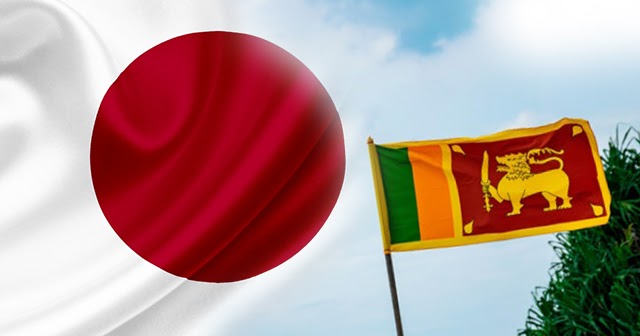
The Government of Japan has decided to extend additional Emergency Grant Aid of USD 3.5 million for Sri Lanka in response to the deterioration of the humanitarian situation.
This Emergency Grant Aid will allow implementing humanitarian assistance activities delivering food worth USD 2 million through the World Food Programme (WFP), food, nutrition, health, sanitation worth USD 1 million through the International Federation of Red Cross and Red Crescent Societies (IFRC).
,It includes finacial assistencefor nutrition worth USD 0.5 million through the United Nations Children’s Fund (UNICEF) for the people of Sri Lanka affected by the deteriorating humanitarian situation.
With the implementation of earlier assistance worth USD 3 million announced on May 20, this builds Japan’s support in response to the current situation up to USD 6.5 million in total.
“Japan hopes that this assistance will contribute to overcoming the hardship faced by the people of Sri Lanka, with whom Japan has long-standing and amicable relations,” officials said.
Indian based Clarks Hotels and Resorts opens its first property in Sri Lanka

Indian based Clarks Hotels and Resorts opens its first property in Sri Lanka
The Clarks Hotels and Resorts of India is strengthening its footprints in Sri Lanka by opening The
Albatross Boutique Villa in Digana, Kandy. They are aiming to promote the country to Indian travellers and take advantage of the growing Sri Lankan business and leisure travel market.
The brand is aggressively looking for expansion in the neighbouring country by opening properties in different key locations in Sri Lanka, reportedwww.hotelierindia.com.
The Albatross Boutique Villa Digana, Kandy by The Clarks, is perched on top of “The Coconut Hill” and has a backdrop of Pidurutalagala Peak.
The property is in close proximity to an 18-hole Golf Course with breathtaking views of the hills and the Victoria reservoir. It is centrally located and is near the temple of the Tooth Relic in Kandy and the Pallekelle International Cricket Stadium.
The resort is frequented by many well-known international golfers, celebrities, business tycoons, entrepreneurs, and international test cricketers.
This upscale property has eight modern rooms divided into three categories – The Royal Albatross Suite, The Tee off Suite and Deluxe Rooms catering to guests from all over the globe.
The Royal Albatross Suite provides a fascinating wide-span view of the famed Hunnasgiriya, Hanguranketha, Galaha and Piduruthalagala mountain ranges, with the Golf Course, Victoria Waterways and Dam.
The magnificent suite boasts a private balcony, Jacuzzi, rain shower, butler service, and is equipped with other modern amenities.
Further to meet the requirements of MICE and corporate, the property has the arrangement to cater to 50 persons.
The Clarks Hotels and Resorts Vice President Rahul Deb Banerjee said: “As a part of corporate strategy we are expanding both nationally and internationally. We are present in almost all the states of India and we recently have also opened a unique property in Sri Lanka. We are price conscious and believe in providing value for money to our travellers.
“This is the best time to be in the tourism industry, with the Sri Lankan Government pushing tourism, and the pandemic has changed the attitude towards travelling, coming days will witness a further increase in tourism. We are also now promoting Sri Lanka and The Maldives as our new international destinations.”
Head Development – Sri Lanka and the Maldives Gabriel Gunesekere said: “We are optimistic that The Clarks expansion has created a buzz in the Sri Lankan market and will further add more properties to The Clarks Hotels and Resorts portfolio in the coming months. By 2023, the brand will comprise about 150 properties within its chain.”
The brand wants to offer an opportunity for Indian travellers to enjoy a slice of Indian hospitality at international locations.