The Sri Lankan protesters who acquired the President’s House, the Presidential Secretariat, Temple Trees and the Prime Minister’s Office have handed them over to the authorities.
MIAP
The Sri Lankan protesters who acquired the President’s House, the Presidential Secretariat, Temple Trees and the Prime Minister’s Office have handed them over to the authorities.
MIAP
A private jet has reportedly landed at the Male Airport in the capital of the Maldives and President Gotabaya Rajapaksa and his entourage are preparing to leave for Singapore on the same jet.
The Sri Lankan President and his entourage is currently staying in the capital city of Male.
Rajapaksa had arrived in Maldives with his wife and two bodyguards in a craft belonging to the Sri Lanka Air Force with the intention of leaving for another country and had asked the Maldivian authorities to provide a jet for his departure.
After landing on Singapore, Rajapaksa is hoping to send his letter of resignation to Speaker Abeywardena this afternoon, according to sources.
MIAP
As Colombo descends into crisis, British parliament held an urgent debate on the state of Sri Lanka with growing calls for a new pluralist constitution, the recognition of self-determination for Tamils, the ratification of the Rome Statute, the arrest of Gotabaya Rajapaksa and justice for the Tamil genocide.
Contributing to Parliament debate, Ed Davey, leader of the Liberal Democrats, placed blame for the “horrible appalling situation for the people of Sri Lanka” on the “corruption of the Rajapakse government”. Noting that “their populist unfunded tax cuts their, skyrocketing defence expenditure, the draconian police powers and the cronyism corruption the like we’ve rarely ever seen”.
He called for an economic package with the IMF with the caveat that such support should include “ a political package which includes an international arrest warrant for President Rajapaksa and his cronies. Can it also include a demand for political freedom, the respect of rights and human rights of everyone on the island of Sri Lanka; including the Tamil and Muslim minorities.”
Meanwhile, Stephen Timms MP raised the issue of Sri Lanka’s non-compliance with the UNHRC resolution noted that the resolution was intended as “a mechanism for resolving the legacy of the issues we’ve heard about today”.
He further asked if aid for Sri Lanka should be conditional on compliance with the UNHRC resolution.
Source: Tamil Guardian
External Affairs Minister S Jaishankar recently reiterated that the situation in Sri Lanka is very sensitive and New Delhi is focusing on ways it can help Colombo economically at this time of need.
Addressing a press briefing in Kerala, Jaishankar said, “The situation in Sri Lanka is very sensitive and complicated. Even as we speak there are developments taking place.
The Indian government’s commitment is to support the Sri Lankan people because they are our neighbours.
Sri Lankans are friendly people. India wants to help them as they are going through a very difficult phase.
Indian government wants to help because of this feeling of friendship, he said adding that thery have been extremely supportive of the island nation in the last few months.”
“India’s focus is on Sri Lanka’s economic situation and how it can help them. We are not involved in the other matters.
Only focused on economic aspects of the issue and we are not concerned about other factors. We can not respond to everything that comes on social media,” the Minister added.
Under the ‘neighbourhood first policy’, India has responded with urgency to the government of Sri Lanka’s request for assistance for overcoming hardships and will enhance economic linkages between the two countries be it through infrastructure connectivity and renewable energy.
“India has delivered aid of around 3.5 billion dollars which has been given through currency swap, financing of food, and fuel. medicines and fertilisers,” MEA spokesperson Arindam Bagchi had said earlier.
In line with its “neighbourhood first” policy, India has been highly active to help Sri Lanka during its economic crisis.
More than 25 tons of drugs and medical supplies which were donated by the Government and people of India during the last two months are valued at close to Rs 370 million.
This is in addition to the economic assistance of around US$ 3.5 billion and supply of other humanitarian supplies such as rice, milk powder, kerosene.
These humanitarian supplies are in continuation of the Government of India’s ongoing support to the people of Sri Lanka in multiple forms such as financial assistance, forex support, material supply and many more.
These efforts prove that Prime Minister Narendra Modi’s ‘Neighborhood First’ policy which places people-to-people engagement is still active.
India is becoming a stronger and more mutually beneficial partner to Sri Lanka. Apart from assistance during the pandemic and fertilizer chaos, India is also donating basic products to the island nation.
Sri Lanka has been suffering a diesel shortage since February, which led to hours of daily power cuts. Presently, Sri Lanka is struggling with acute food and electricity shortages, forcing the country to seek help from its neighbours.
The recession is attributed to foreign exchange shortages caused by a clampdown on tourism during the Covid-19 pandemic.
The country is unable to buy sufficient fuel and gas, while the people are being deprived of basic amenities as well, he claimed.
China will continue providing assistance for the economic and social development of Sri Lanka and support its efforts to recover the economy and improve its people’s livelihoods, the Chinese Foreign Ministry said on Tuesday.
The remarks came after foreign media claimed that Sri Lanka, mired in economic and debt crises and suffering political instability, is in discussions with Japan, and possibly with China in the future, on “bridge financing.”
China is ready to work with relevant countries and international financial institutions and will continue to play a positive role in helping tackle Sri Lanka’s current difficulties, ease its debt burden and realize sustainable development, Foreign Ministry spokesperson Wang Wenbin said on Tuesday.
Wang said that China has stated on many occasions that China feels deeply for the difficulties and challenges Sri Lanka faces and China has provided emergency humanitarian assistance including food and medicines to Sri Lanka.
China has also provided multiple batches and various kinds of assistance to sectors of Sri Lankan society through the government and local friendship organizations.
China will continue to provide assistance for the economic and social development of Sri Lanka within its capacity and support its efforts to recover the economy and improve its people’s livelihood, Wang added.
Qian Feng, director of the research department at the National Strategy Institute at Tsinghua University, told the Global Times that China’s attitude indicates friendship and kindness toward its long-term partner.
It is not only about China’s own sympathy but also a call to international society to help Sri Lanka overcome its difficulties, Qian said. “Sri Lanka urgently needs the support of international financial institutions as well,” Qian said.
In terms of the “Chinese debt trap” that Western countries claim contributed to Sri Lanka’s crisis, Qian pointed out that China’s share of the external public debt of Sri Lanka is only a small proportion.
The reason why Western countries are smearing China over Sri Lanka’s debt crisis is that they are unwilling to see the growing influence of China.
Qian expects that in the next step China will certainly make appropriate arrangements and offer help within its capacity in terms of restructuring the debt and the method of repayment.
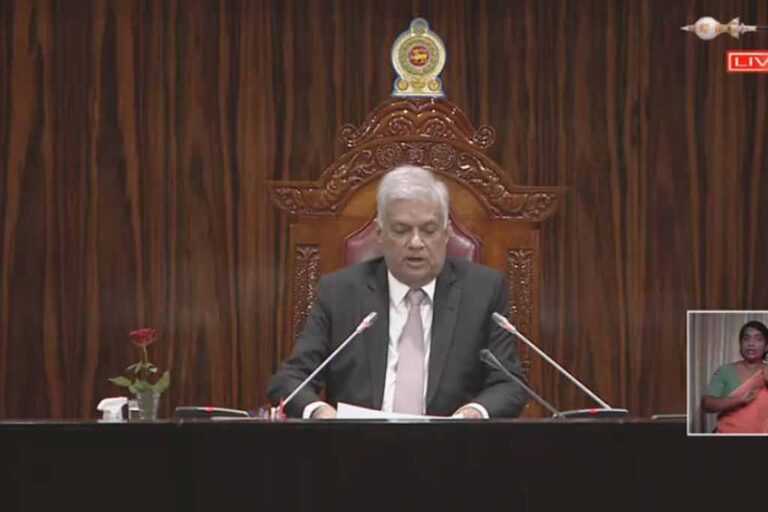
Speaker Mahinda Yapa Abeywardena responding to a query by reporters this (14) morning said he has not received President Gotabaya Rajapaksa’s resignation letter yet.
MIAP
The purchase of spare parts including tires for Sri Lanka Transport Board (SLTB) buses is in a problematic situation in the current competitive market due to the increase in prices, the Committee on Public Accounts (COPA) was told recently.
This was revealed when the Committee met under the chairmanship of MP Tissa Vitharana to examine the plans developed under the Ministry of Transport and Highways to provide efficient transport services to the general public under the current economic crisis in Sri Lanka.
Officials of the Ministry of Transport and Highways explained to the Committee about the future plans of the Ministry and pointed out that due to rising prices, it has become problematic to buy spare parts for buses in today’s competitive market. They said there have been problems especially in making purchases after calling for tenders.
They also said that even though the public transport service should be further developed, it has become a problematic situation for a public institution to buy equipment at the current prices and get profit.
The Committee also discussed providing diesel to private buses through filling stations belonging to SLTB depots.
The officials specially pointed out that some private buses are getting diesel from these fuel stations and selling it at a higher price. They stated that it is cheaper for bus owners to sell diesel at a higher price than to run buses on the route.
Accordingly, the Committee pointed out that this situation should be controlled and the public should be prevented from being inconvenienced, and a system should be developed to check whether the buses that pump fuel from the depot filling stations are running.
Especially, the possibility of applying of G.P.S. technology for buses was also discussed here.
In addition, it was also revealed that although $ 1,056,555 was spent on the Sri Lanka Railways Master Plan in 2017 based on the financial grants of the Asian Development Bank, the same was not included in the ministry’s budget or financial statements.
Accordingly, a report on this was recommended to be given to the COPA. Also, there was a discussion about combining railway transportation with new technology.
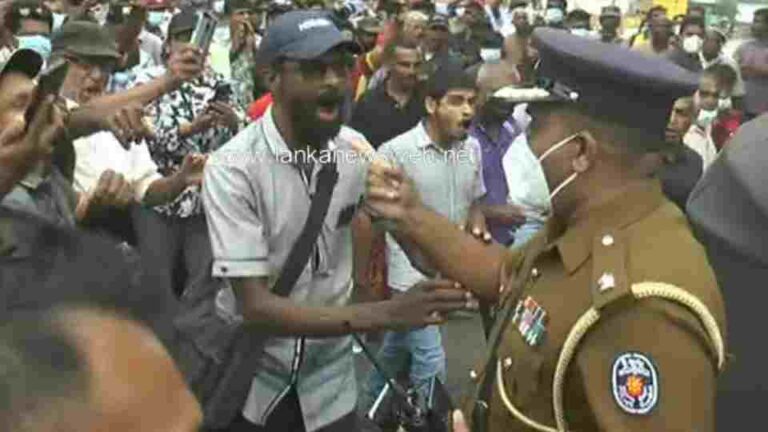
A police officer and an army officer were assaulted and a T56 and 60 ammo were stolen by the protesters at the Parliament entrance in Polduwa Junction, Battaramulla yesterday (13), a statement by the Police Media Division alleged, citing a complaint.
However, media reports claimed that the Police and the Army had brutally assaulted the protesters at the site and 42 were hospitalised.

MIAP
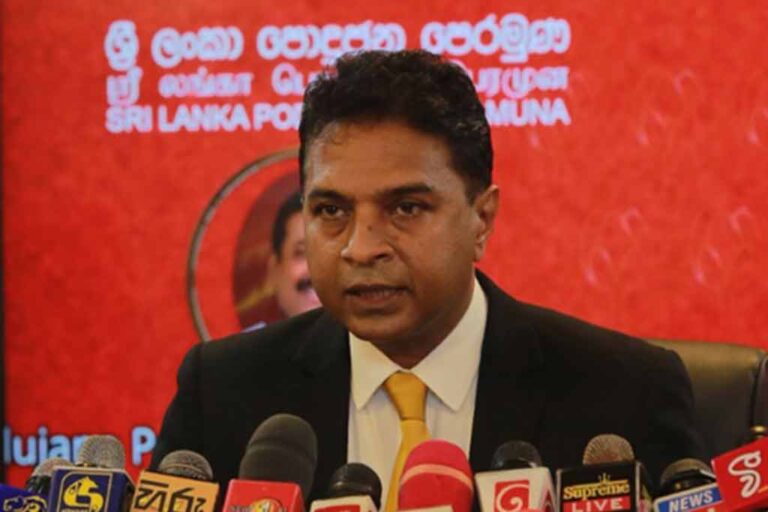
Parliament must be convened immediately and a no confidence vote against Prime Minister Ranil Wickremesinghe must be called in and passed within a day to oust him, said Sri Lanka Freedom Party (SLFP) Secretary General MP Dayasiri Jayasekara.
Discussions are already underway with other party leaders in this regard and the SLFP will be informing Speaker of the motion as soon as possible, he revealed.
A group of Sri Lanka Podujana Peramuna (SLPP) MPs are also in favour of this motion, the SLFP Secretary added.
Jayasekara’s comments come in in the backdrop that SLFP Leader Maithripala Sirisena has been angry with Wickremesinghe for some time, and he had once publicly stated that he would attack like a hawk who harasses him.
MIAP
Some Sri Lankan EdTech products had the capacity to surveil children in ways that risked or infringed on their rights, Human Rights Watch found.
Human Rights Watch raised concerns over the Nenasa app and e-Thaksalawa app used in Sri Lanka.
The overwhelming majority of education technology (EdTech) products endorsed by 49 governments of the world’s most populous countries and analyzed by Human Rights Watch appear to have surveilled or had the capacity to surveil children in ways that risked or infringed on their rights.
Human Rights Watch released technical evidence and easy-to-view privacy profiles for 163 EdTech products recommended for children’s learning during the pandemic.
Of the 163 products reviewed, 145 (89 percent) surveilled or had the capacity to surveil children, outside school hours, and deep into their private lives.
Sri Lanka was among countries that directly built and offered learning apps that may collect Android Advertising ID from children.
In doing so, these governments granted themselves the ability to track an estimated 41.1 million students and teachers purely for advertising and monetization.
An advertising ID is a persistent identifier that exists for a single use: to enable advertisers to track a person, over time and across different apps installed on their device, for advertising purposes. For those using an Android device, this is called the Android Advertising ID (AAID)
“Children, parents, and teachers were largely kept in the dark about the data surveillance practices we uncovered in children’s online classrooms,” said Hye Jung Han, children’s rights and technology researcher and advocate at Human Rights Watch.
“By understanding how these online learning tools handled their child’s privacy, people can more effectively demand protection for children online.”
Few governments checked whether the EdTech products they rapidly endorsed during the Covid-19 pandemic were safe for children to use. Many governments put at risk or violated children’s rights directly.
Of the 42 governments that provided online education to children by building and offering their own EdTech products for use, 39 governments made products that handled children’s personal data in ways that risked or infringed on their rights.
Human Rights Watch found that the data surveillance took place in educational settings where children could not reasonably object to such surveillance.
Most companies did not allow students to decline to be tracked, and most of this monitoring happened secretly, without the child or their family’s knowledge or consent.