Home Blog Page 2150

Another fuel queue-related death found

0

Another person waiting in a fuel queue reportedly died.

The victim, 60 and a three-wheel driver in Moratuwa, was queuing up at a fuel station in Payagala and died of a sudden heart attack after being admitted to the Kalutara Teaching hospital.

The event occurred at 02.30 am this (07) morning, according to reports.

MIAP

Minister Dhammika Perera streamlines FDI approval process

0

The Ministry of Technology and Investment Promotion has taken measures to streamline the investment approval process by eliminating the heavy paper work and filling of application forms with a view of attracting more Foreign Direct Investments into the country, a senior official of the ministry said.

Prompt action has been taken to remove obstacles and bureaucratic red tape in obtaining approval for foregn investment projects from the Board of Investment(BOI) and other relevant state institutions, he disclosed.

FDI application form with several pages to be filled by the prospective foreign investors has been reduced to single page from 14 pages with immediate effect and the approval will be given within 24 hours if they fulfill necessary requirements, he revealed.

It has been planned to simplify the rules and regulations of the investment approval process to overcome official red tape.

The new FDI online approval system has been devised on the directions of Minister Dhammika Perera, investment promotion ministry senior official said that the BOI will revitalise its status as the one stop shop for investment approval process, he added. .

An action plan will be implemented soon to ensure US $ 7 billion in annual local investment by 2025, $ 7 billion in annual Foreign Direct Investment (FDI) by hesame year and , improve Sri Lanka’s rank in the Ease of Doing Business Index to 50 this year from 100 , and improve Sri Lanka’s rank in the Global Competitiveness Index to 45 from 85

The action plans include streamlining the investment approval process by reducing the number of pages in the investment application from 14 toone , providing a preliminary approval within 24 hours, and simplifying the rules and regulations of the investment approval process to overcome red tape.

Also, he suggested granting guaranteed tax benefits in agreement with the Board of Investment (BOI) for 25 years, to gain the competitive advantage of investing in Sri Lanka.

Some of the sectors that will be exempt from corporate tax, value-added tax, and dividend tax for 25 years under this proposal would be education, information services, air transport, and the manufacture of motor vehicles.

Additionally, Minister Dhammika Perera’s plans under the Technology Ministry include increasing ICT revenue from $ 1.2 billion to $ 5 billion by 2025, increasing ICT jobs from 80,000 employees to 400,000 employees by 2025, and transforming developed Sri Lanka into a “Smart Sri Lanka” in 2030.

Perera in his plan intends to develop Sri Lanka into a “Smart Sri Lanka” in three years and achieve the status of an emerging market by 2030 with the use of an AI-driven unified ICT platform for all public services.

Some of his focus areas include smart education, smart health, smart agriculture, smart transport, and smart tourism.

His targets for the private sector include a fourfold increase in ICT revenue from $ 1.2 billion to $ 5 billion by 2025, a fivefold increase in ICT jobs from 80,000 employees to 400,000 employees by 2025.

India demands advance payment for fuel supply to Sri Lanka

0

India is seeking payment in advance for supply of fuel to Sri Lanka after credit lines were exhausted, according to people with knowledge of the matter, official sources said.

The larger South Asian neighbor stopped supplying gasoline and diesel on credit after the island nation ran out of dollars to purchase fuels amid its worst economic crisis.

That’s holding up some fuel shipments pending cash payment by Sri Lanka’s Ceylon Petroleum Corp., according to two Indian government officials, who asked not to be identified citing rules.

Ceylon Petroleum’s cargo schedule tweeted by Energy Minister Kanchana Wijesekera showed at least four shipments of gasoline and diesel from state-run refiner Indian Oil Corp. are pending confirmation of advance payment. India has already extended over $3.5 billion of support to Sri Lanka in the last few months for food, medicines and fuel.

Sri Lanka, which has depleted its foreign exchange reserves, was hoping for a fresh approval from India of a $500 million credit line for fuel purchases. The island nation’s government has sent envoys to Qatar to secure fresh supplies and is also seeking oil from Russia.

A spokesman for India’s Ministry of External Affairs didn’t have an immediate comment.

Indian Oil has delivered about 450,000 tons of gasoline and diesel to Ceylon Petroleum between March and June, according to a spokesperson for the company.

The fuel crisis has led to a shutdown of public schools and offices until July 10 to conserve fuel, even as thousands of vehicles continue to queue for miles waiting for filling stations to be replenished.

The bankrupt nation is offering a guaranteed fuel quota to companies that can pay dollars to Ceylon Petroleum Corporation in advance to ease the crippling shortages. It also plans to allow foreign companies to distribute fuel to help ease the crisis that has paralyzed most economic activity.

PM alleges certain CBSL officials want SL to be like North Korea (VIDEO)

0

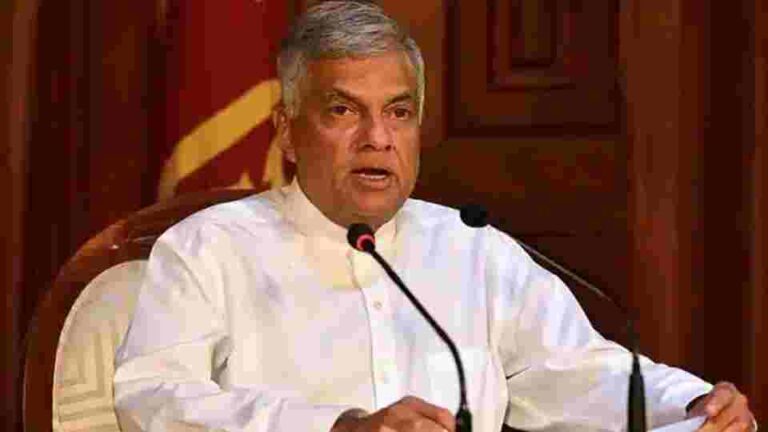
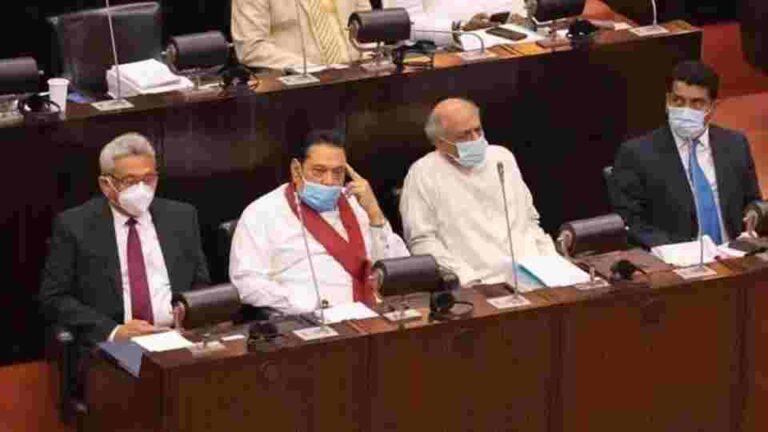
Some officials at the Central Bank of Sri Lanka (CBSL) want Sri Lanka to be administered like North Korea and such a rule cannot be approved of, said Prime Minister Ranil Wickremesinghe, responding to Ruling Party MP Wimal Weerawansa in Parliament yesterday (06).

Weerawansa: The Foreign Exchange Act was fully liberalised in 2017 by Minister Ravi Karunanayake during your government. That means if someone earns foreign exchange, it is not necessary to have it brought to Sri Lanka, nor was there any penalisation for not bringing it in. So they are not brought in. They can be parked elsewhere. The Central Bank officials were helpless when they went to Courts to take action against someone who did not bring in foreign exchange. In a crisis situation like this, the bill has not even been touched. It should be prioritised than the 22A. Why is to not amended?

PM: Actually, when it was implemented, our country received more foreign exchange, if we look at 2018 – 2019. Money did not come to Sri Lanka with the old method. Nor had anyone brought in. It is under this new method can money be brought in and taken back. We brought a law that exists in all other countries. That law was not a different one, but one parallel to the laws of every country in the world. You and I may have a different opinion about it, but because of this, the amount of forex entering the country soared.

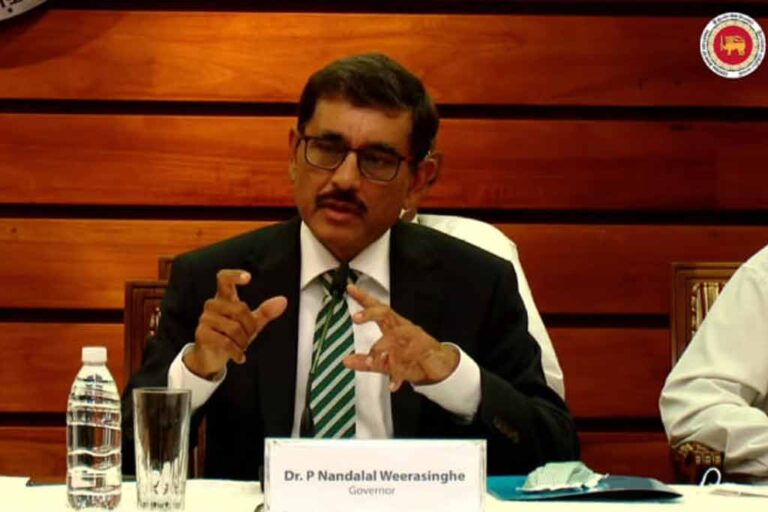
Weerawansa: When the current Governor of the Central Bank came to the CoPE, or some Committee like that, he has mentioned that due to the amendment of the Foreign Exchange Act, on average, more than US $300 million per month will not flow in to the country. It is not me who said this, the Central Bank Governor did. You say no and that the inflow of forex has soared. There is no way to inflow, the law encourages not to bring in forex but to establish them in other countries. So call in a discussion and take an action.

PM: No matter who said it, I will not agree. Even MP Harsha De Silva may confirm it. Money inflow soared due to the Foreign Exchange Management Act. This exists in every country. Other countries care less for arguments like these.

Weerawansa: Not in India.

PM: We do not wish to do everything India does. This is suitable for the country for now. This may increase. In fact, certain officials at the Central Bank has a problem with the administration. They want to live in a North Korea. I do not agree to it.

MIAP

Colombo Port enhances its services to Bangladesh shippers

0

Sri Lanka Ports Authority (SLPA) is set to expand the Colombo Port services now being provided to Bangladesh shippers, official sources said. .

Colombo Port provides four-five days transit advantage to the west bound shipments which is a significant advantage for the apparel trade of Bangladesh

SLPA Chairman Dr. Prasantha Jayamanna briefed about the present facilities as well as ongoing and future expansion plan of Colombo Port which when completed in 2025-26, would increase their container handling capacity to 15 million TEUs.

He was addressing a stakeholders’ consultation forum on enhancing shipping connectivity between Chattogram and Colombo Ports organised by the Bangladesh High Commission to Sri Lanka in Colombo on 29 June 2022 pursuant to observance of the First Economic Diplomacy Week.

The event was joined by Sri Lanka Ports Authority terminal operators and the service providers such as feeder operators, freight forwarders, NVOCCs and shippers and from Bangladesh, members from the ports and shipping community and service providers joined the discussion online.

The purpose was to facilitate greater understanding of operational issues between Chattogram and Colombo Ports and ensure greater connectivity and supply chain security and stronger partnership between the two ports.

Dr. Prasantha Jayamanna announced that State-owned Jaya Container Terminal (JCT) of Colombo Port would extend priority berthing to Bangladesh feeder vessels. It may be mentioned that the Bangladesh High Commission has been pursuing this priority berthing issue with SLPA for a long period.

The SLPA Chairman said that the Bangladesh trade lane is an important customer for Sri Lanka and the port of Colombo was keen to facilitate Bangladesh shippers to be competitive when shipping west bound.

Currently Colombo handles about 23% of Bangladesh transshipment cargo which has crossed the 700,000 TEU mark and has had a growth even during the pandemic.

The logistics and freight forwarders said that Sri Lanka also gives an advantage for air-sea and sea-air cargo from Bangladesh and if capacity is increased more business can be developed.

Representative of the Chattogram Port Authority shared, inter alia, that Bangladesh’s container traffic through Colombo Port has increased significantly last year.

Representatives of Bangladesh stakeholders shared the users’ perspective about Colombo Port, emerging trends, and challenges in shipping operations. The Chattogram Port Authority representative also indicated that there is potential to increase volumes and that this kind of bilateral discussions will help both sides for greater understanding.

The logistics and freight forwarders joining the discussions said that Sri Lanka also gives an advantage for air-sea and sea-air cargo from Bangladesh and if capacity is increased more business can be developed.

Court order against protesters including omnist protesters

0

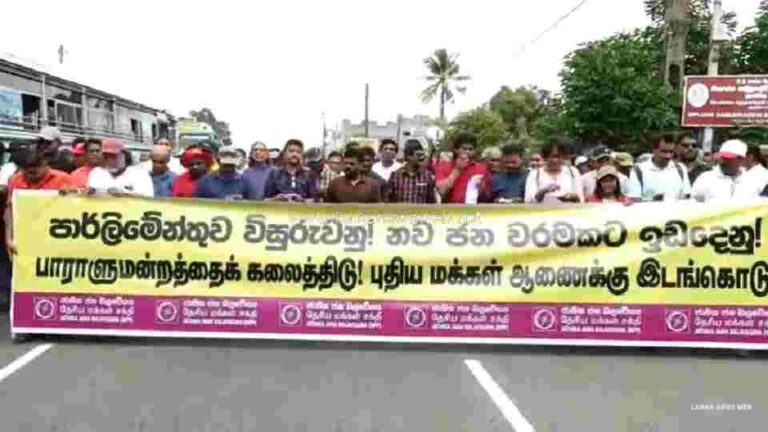
The Aluthkade Magistrate Court in Colombo has issued an order against a protest to be held in Colombo Fort today (07) by a group of omnist priests, the Police Media Division said in a statement.

Accordingly, the Court order bars the omnist group consisting of Pahiyangala Ananda Thero, Ulapane Sumangala Thero, Kalubowila Paduma Thero and many others from entering the Olcott Road in the Pettah Police Division, or staying in front of the Bodhirukharama Temple or at any other place in Pettah.

Any breach of this Court order will be an offense under the Penal Code, Police said.

MIAP

SriLankan Airlines and Kuwait Airways Launch Codeshare partnership

0

SriLankan Airlines and Kuwait Airways are to launch a new codeshare partnership effective 20 June 2022, which provides enhanced connections and convenience to customers of both airlines, Chairman of the Airline Ashok Pathirage said.

Each airline will place the other airline’s marketing code on its flights operated between Colombo and Kuwait with the alliance coming into effect , he added. .

The new codeshare partnership will strengthen and take to new heights the cordial commercial relationship that has existed between SriLankan Airlines and Kuwait Airways since 1999.

SriLankan Airlines has carried passengers between Colombo and Kuwait for over four decades and currently operates a daily flight to Kuwait, he disclosed.

Similarly, Kuwait Airways has been serving passengers on this route since 1978 and plans to operate three weekly flights to Colombo starting from October 2022.

Passengers may essentially expect to gain all the benefits of codeshare flights including seamless connectivity and the convenience of having their entire journey managed by one airline from the point of purchasing tickets until they arrive at their final destination with the launch of this partnership.

Furthermore, passengers of both airlines will enjoy increased alternative flight options, specifically to the Middle East and Europe via Kuwait and to the Indian Subcontinent and the Far East via Colombo.

Richard Nuttall, Chief Executive Officer of SriLankan Airlines stated, “We are delighted to enter a new chapter in the longstanding relationship between Kuwait Airways and SriLankan Airlines that is expected to generate value to our customers in multiple ways.

The Middle Eastern market has always been important to SriLankan Airlines, and we continually endeavour to expand our network and product portfolio to serve this segment better.

We look forward to working with Kuwait Airways and creating greater synergy between our combined networks for the benefit of our passengers.”

Maen Razouqi, Chief Executive Officer of Kuwait Airways stated, “We welcome SriLankan Airlines as our codeshare partner.

The new beginning of this partnership will support Kuwait Airways and SriLankan Airlines operations between the two cities and allow more travel options, facilities for the public. Passengers and travel agents will be able to book directly on these flights through our offices/website/APP and agents’ reservation system.

Further, this Codeshare Partnership will not only enhance the relationship between the two airlines but also the strong relationship between the two friendly States, Kuwait and Sri Lanka. On this occasion.

Both SriLankan Airlines and Kuwait Airways are also working on incorporating the Frequent Flyer Program for codeshare flights, so that passengers can be rewarded with the benefits of such programs. Further, both airlines anticipate exploring other avenues for future mutual co-operation and expansion of their partnership.”

Interest rates further soared!

0

The Central Bank of Sri Lanka (CBSL) has decided to further soar interest rates.

Accordingly, the CBSL’s Standing Deposit Facility Rate (SDFR) and Standing Lending Facility Rate (SLFR) have been raised by 100 basis points each to 14.5 per cent and 15.5 per cent respectively.

The CBSL has also announced that the statutory reserve ratio will be maintained at the current level of 4.00 per cent.

MIAP

Delivery of a fuel ship before July 22 costs more: Energy Minister

0

Although there is a proposal to receive a ship carrying petrol before July 22, such a delivery would cost more, revealed Energy Minister Kanchana Wijesekara, speaking in Parliament yesterday (06).

“As of now, the first petrol ship given to us by the IOC Company is expected to arrive on 22 – 23. That is the delivery confirmed to us. Of the ships we proposed earlier – we proposed to receive a petrol ship on 10 – 15 – we were offered a proposal from PETRONA by the representative of the Malaysian Prime Minister in the South Asian Region. But they could not confirm the date of arrival in this country. Not a single supplier elsewhere has yet been able to confirm to us a petrol ship before 22. Last night we were given approval by the Committee of officers appointed by the Cabinet to receive the fuel needed for this country on 13.

But there is a problem. They have offered them for a higher price than what we used to get. Now we have a problem. No one else has come forward to offer either. The only company that did has offered a higher price, the Committee has approved it too. But now those companies have informed to us that they will not be delivering the orders, for certain political groups of this country are interpreting it in different ways and publicise the wrong opinion that they are going to receive commissions from this. So, these companies too find it severely problematic. I spoke to the President and the Prime Minister, and they said to take the first available ship. Therefore, we will be making the advance payment today with the approval of the Cabinet Sub-Committee. We hope to receive the ship on 15.”

MIAP

It’s time to reconcile energy policy with long term generation plan

0

WIND POWER PROJECT  it says Wind project

Energy is a vital factor for any country’s economy and in Sri Lanka there is much public focus on the subject because of the power cuts the people are experiencing every day. The power cuts have an impact on every home, people’s life style and children’s education, especially in the post-COVID environment where many are learning online. 

On the economic front it affects all businesses while its impact on production is severe because factories and their supply lines are affected in many ways. Here I am talking mostly on the supply side of energy. Energy must be available continuously for people to maintain their living standards as well as for country’s economic progress. 

Then the other important thing about energy is basically it has to be environment friendly. From time to time there have been many global discussions and agreements on the subject such as Earth Summit and Tokyo Declaration which talks about the carbon footprint. 

They focused on reducing global warming in different ways, but my main emphasis here is environmental impact of energy and pricing because it needs to be affordable. Lower energy costs also make a country’s manufacturing industries competitive. Sri Lanka’s energy costs have been high and that is why we are not very competitive in the industrial sector. 

“By about 1996, Sri Lanka fulfilled its energy requirements with nearly 100% renewable energy. Over a period of time we have moved away from that and now we are heavily dependent on thermal energy as well. Now the main sources of energy are our major hydros, renewable, liquid fuel and coal”

Need for renewable energy

By about 1996, Sri Lanka fulfilled its energy requirements with nearly 100% renewable energy. Over a period of time we have moved away from that and now we are heavily dependent on thermal energy as well. Now the main sources of energy are our major hydros, renewable, liquid fuel and coal. 

If we look at the production of our energy major hydros give about 25-30%, renewable is about 15%, coal is about 25-30% and the balance is from liquid fuel. Main point here is major hydros and renewable sources produce 50% or below while the majority 50-55% is thermal which is coal and liquid fuel. So that is not satisfactory both on cost side and in terms of protecting our environment. 
On the cost side there are huge variations in the cost of a unit kilo watt hour. In hydro it is about Rs. 7 or 8 a unit, renewable is between Rs. 15 to 20 per unit, coal is about Rs. 50 and if you take liquid fuel it is about Rs. 100 or more so that you can see the huge price differential. 

Significance of energy policy

That is one of the big issues facing Sri Lanka and the country needs an energy policy as well as an energy generation plan. The energy policy must be driven by the government and unfortunately in our country some people seem to think that Ceylon Electricity Board (CEB) should decide the energy policy. 
Government decides the energy policy and CEB has to prepare the long-term energy generation plan to suit that policy. In doing so government has to take into account economic reasons but unfortunately some sidetrack arguing that whole energy policy has to be driven technically.

Technical limitations are surely there, for example there is so much of hydro power that you can actually produce; you cannot produce more than what the nature has given you. But then the government has to decide how much is going to be thermal and how much is sustainable energy.

The incumbent President made a pronouncement that when he gets elected he would have 70% sustainable energy and he gave a time frame for it to be achieved. The long-term generation plan is normally done by the CEB for 20 years. Accordingly, they did the 2022-2041 energy plan limiting sustainable energy to 50%. 

The plan was submitted to the Public Utilities Commission of Sri Lanka (PUCSL) but they did not approve it because it was not in keeping with the government stipulated policy. The PUCSL has asked the CEB to re-produce an amended plan by June 30, 2022. In the plan they have not spoken about increasing coal power, but they talk about increasing the use of gas. 

“That is one of the big issues facing Sri Lanka and the country needs an energy policy as well as an energy generation plan. The energy policy must be driven by the government and unfortunately in our country some people seem to think that Ceylon Electricity Board (CEB) should decide the energy policy. “

Battle between CEB and sustainable energy authority

Apart from the CEB and the PUCSL there is Sri Lanka Sustainable Energy Authority and they had approved about 1374 sustainable energy projects giving them licenses to proceed. These 1374 projects were to generate about 4000 megawatts. However, these projects were stalled because the CEB refused to give them power purchasing agreements. The country has suffered as a result of the battle between these two entities.

Under the law there is provision for government to government projects, where there is an offer from a foreign sovereign government to the government of Sri Lanka for which approval of the cabinet of ministers has been obtained. In a recent project, Indian company Adani Group wanted to do a wind power project in Mannar. The question there was whether it was a government to government one and the other issue was how the pricing was to be determined. 

Whichever the project we have to look at it from the consumers’ point which means it has to be at the lowest possible price. If it is an open tender, then it is clear how the price is determined. If it is through feeder tariff scheme it also has a method to determine the price. It gets complicated when it is a large project and if there is no tender. That is an issue that needs to be sorted out. 

My focus here is not the Adani project, but I wish to make the larger point why we need renewable energy and why it needs to be at low cost. If there are large projects, they need to be ideally tendered out so there is transparency, competition and the consumer gets the best deal. 

Then I am also making the point that the CEB has to come up with a power generation plan which is in keeping with the government policy. CEB is a monopoly and therefore we need to have multiple buyers. We have many producers, but we only have a single buyer. That is why even though sustainable energy authority gave licenses for people to produce energy they could not go ahead with it because they need to sign a power purchasing agreement with the CEB which is a monopoly. Clearly from the consumers’ point of view we have to question that. 

“The other issue that has come up recently in the public domain is why emergency power purchases are often resorted to. There are also allegations that water levels in the reservoirs are reduced and then emergency power is procured”

Need for multi buyer models

Now there is a need for multi-buyer models as well particularly in buying corporate clean energy. The purchaser should have the option to buy from any one while the seller also should have the option to sell to anyone.

Today, there are sophisticated product buyers who want to see whether the producers are using clean energy. Twenty years ago, they were checking whether factories producing the garments were using child labour. Now it has moved to another stage where they want to know what kind of energy was used whether it was clean energy or energy creating global warming. 

So, the factories using clean energy will have the advantage because some of the buyers may stipulate what kind of energy use they prefer. So, there are multi buyer models all over the world and we also need to open ourselves to looking at that and opening it out. 

Then the other issue that has come up recently in the public domain is why emergency power purchases are often resorted to. There are also allegations that water levels in the reservoirs are reduced and then emergency power is procured.
People have serious doubts because politicians and public officials at higher levels are probably corrupt. An independent audit needs to be done over these allegations. CEB’s promises to conduct internal audits will not be good enough and we need external parties to confirm that as well. 

Some of the regulatory functions originally vested with the CEB have been later placed under the PUCSL by subsequent legislation such as Sri Lanka Electricity Act while Sri Lanka Sustainable Energy Authority also has been given certain powers. PUCSL has the authority to act as the economic, technical and safety regulator for the electricity industry in Sri Lanka. The provisions of these laws need to be properly adhered to ensure a proper energy mix for Sri Lanka and an efficient energy administration. The author is a former VP, Citibank and Director/CEO, National Development Bank

Daily Mirror