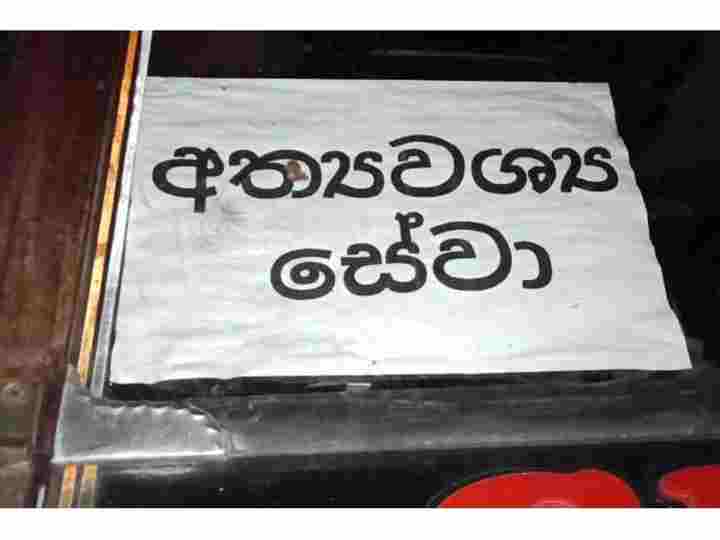
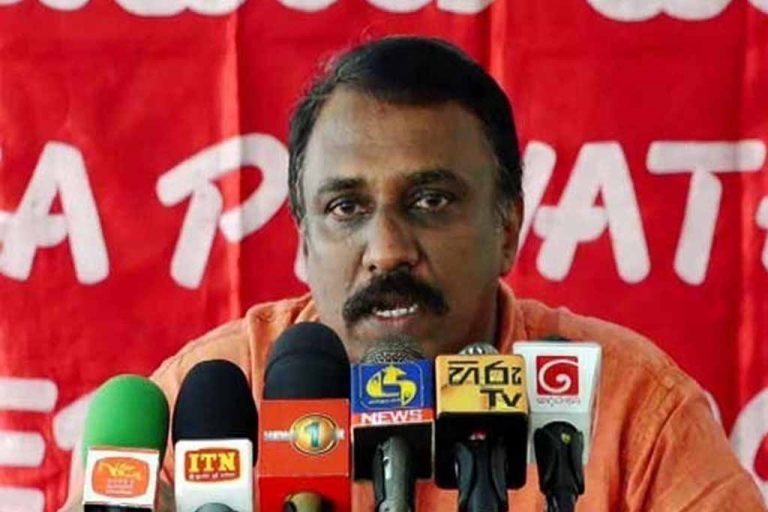
Despite the declaration of essential services, the country can no longer be administrated and every sector has now been disrupted, emphasised the Sri Lanka Administrative Service Association, urging the government to immediately call for a state of national crisis.
The Union pointed out that a proper mechanism should be implemented to maintain essential services and the the programme should be implemented under a proper authority. Should the government fail to declare a state of national crisis and maintain the essential services, strong trade union actions would be inevitable, it warned.
The Union pointed out that government officials are committed to their duties regardless of the risk of their lives to maintain these essential services, adding that the law is not properly implemented regarding the oppression befallen these employees.
The Administrative Service Association disclosed that government officials across the country are subjugated to threatening and harassment by politicians and other forces and no action has been taken to arrest those responsible, risking the total collapse of essential services upon possible resignation stemmed by intimidation and fear.
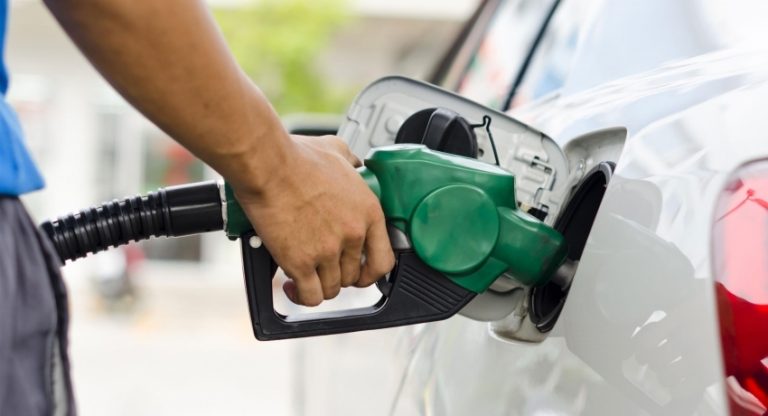
More than 100,000 litres (103,095 l) of fuel stocks illegally hidden amidst the prevailing fuel crisis in the country have been recovered upon raids. As of now, security forces have launched 954 raids in search of hidden fuel stocks.
Among the stockpiled fuel were 27,152 litres of petrol, 62,723 litres of diesel and 13,220 litres of kerosene. 885 persons were arrested in alleged connection with the stockpiling.
Operations are continuously being carried out to seize those involved in stockpiling fuel, said Police Spokesman SSP Nihal Thalduwa.
Despite the ongoing fuel crisis, the Ceylon Petroleum Corporation (CEYPETCO) is of the view that there are fuel stocks enough for another month’s period. It added that some people are illegally stockpiling fuel for future consumption, hence an artificial fuel shortage in the country.
The prime suspect of the recent double homicide at Bastian Road, Pettah has died this (04) morning as the Police opened fire.
The suspect, 41, was a resident of Darga town and Elpitiya.
Based on a tip-off received by the Colombo Crimes Division (CCD) that the suspect was in Gampaha, a search operation has been carried out in the area this morning, and as the Police found the suspect while travelling on a motorcycle he has fired at the Police vehicle with a T56 in his possession.
The suspect, who was severely injured in the retaliatory attack by the Police, died after being admitted to the Gampaha hospital, Police said.
Only 10 per cent of the private buses will operate Monday (04), revealed President of the Ceylon Private Bus Owners Association Gemunu Wijeratne, speaking to a briefing yesterday (03).
“Both Minister Kanchana and the Chairman of the CEYPETCO go one saying that we have been given enough fuel through the SLTB. But the CEYPETCO does not operate on Sunday. Therefore, no distribution of fuel takes place. So, this would be a serious problem to us. Around 1000 of our buses operate throughout Sri Lanka. Running down for about a week, today (03) is the day where the lowest number of buses operate. About 05 per cent of buses operate today.”
“We will not be able to fully operate on Monday (04). We will try to operate about 10 per cent.”
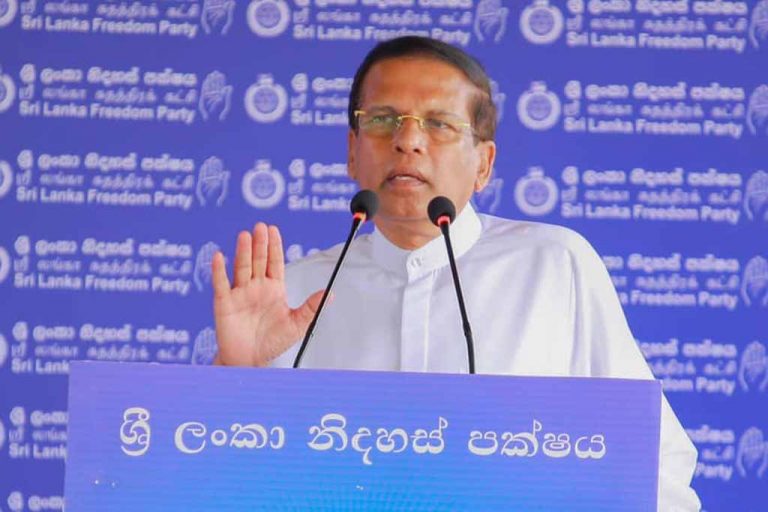
The forming of an all-party government in the face of the current situation of the country would be very soon, said former President Maithripala Sirisena, speaking to reporters in Gurudeniya, Kandy two days (02) ago.
“Given the people’s protests and the heat appeared in the country, the forming of an all-party government blessed by the Maha Sangha would be very soon. Because, otherwise the country may be driven into a very bad state with the people taking to streets”
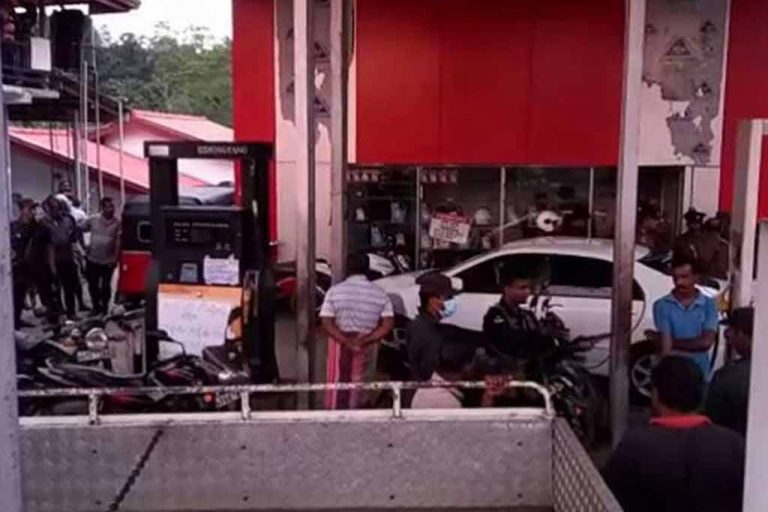
An army soldier has reportedly been injured during a clash at a fuel station in 99 Kanuwa, Embilipitiya yesterday (03).
The station had received fuel after a five day-absence and the people queuing up for fuel have demonstrated objection as the stocks have run out.
Two people have entered into a heated argument with an army personnel deployed at the station and the escalation of the situation has made one attempt to grab his firearm and the other attack him with a sharp weapon.
The injured solider has been admitted to the Embilipitiya General Hospital.
Globalization was seen by much of the western public as the ultimate project of the neoliberals, conceived by people in fancy boardrooms who made money out of trading in money and shamelessly exploiting the privations of the poor. We are living with its consequences today. Sri Lanka is simply the most proximate and visible manifestation of a broader global crisis.
The economic crises being undergone by a number of countries today, most strikingly, in our own neighbourhood, Sri Lanka, emerge from a larger trend epitomised by the setbacks endured by the globalization experiment with the recession of 2008-09. There were two paradoxical precursors to this development: the advent and spread of neoliberalism, and the backlash in developed countries to globalization. The former saw the dominance, in the world’s macro-economic thinking, of what became known as the ‘Washington Consensus’, whose custodians were not just the governments of the US and its allies but also international organizations such as the World Bank, the International Monetary Fund, and the World Trade Organization. The latter, the backlash against globalization, reflected the crumbling of that consensus at its very source.
A snapshot of the protest outside Sri Lanka President’s home. Photo:AFP
The doctrine of neoliberalism is commonly attributed to the Austrian-British economist Friedrich August von Hayek, hailed by Margaret Thatcher and Ronald Reagan as their inspiration, whose impact on economic policy in the era of globalization, thanks to the dissemination of his ideas by acolytes like the American economist Milton Friedman, was immense. Hayek’s was a philosophy that went beyond economics, for he conceived of society itself, in the British writer Stephen Metcalf’s brilliant summary, ‘as a kind of universal market (and not, for example, a polis, a civil sphere or a kind of family) and of human beings as profit-and-loss calculators (and not bearers of grace, or of inalienable rights and duties)…. [Hayek’s neoliberalism] was a way of reordering social reality, and of rethinking our status as individuals.’ Hayek constructed neoliberalism as sufficient unto itself: the deregulated market would function as the overarching ‘mind’ that would govern and direct all human affairs, protecting individuals against the excesses of governments, whose only job was to keep the market free. Individuals would, of course, act in their economic self-interest, but the product of their choices would lead to better results than governments could craft through policy interventions.
Alan Greenspan
Rampant economic growth and what was dubbed (by the American economist and Federal banker Alan Greenspan) as the ‘irrational exuberance’ of the 1990s, especially after the fall of the Soviet Union and the collapse of the Berlin Wall, led the world into a period of widespread financial deregulation and privatization, expanding free trade, the creation of businesses whose supply chains cut across many countries, and a worldwide illusion of perpetually rising prosperity. Neoliberalism came into its own, privileging a heady cocktail of free-market policies, including deregulating capital markets, lowering trade barriers, eliminating price controls, establishing global supply chains, rampant privatization, and the reduction or abandonment of state welfare for the poor, often accompanied by austerity measures to bring fiscal policies in line with what western ratings agencies wanted to see.
But the seeming success of economic globalization also facilitated the illusion of the ‘end of history’ (seen as the ultimate triumph of liberal democracy and capitalism), the heedless and hubristic military adventurism of the ‘global war on terror’, including disastrously unsuccessful wars in Afghanistan, Iraq and Syria, which displaced nearly 20 million people (among the largest refugee crises in modern history), all of which in turn led to the market crash, and an unprecedented level of inequality and suffering among the working-class of the developed world. The top 1 percent of the global population came to own half the world’s wealth, while the bottom 70 per cent had less than 3 per cent. With the Great Recession that began in 2008-09 and political convulsions in a number of countries, what Metcalf calls ‘the militant parochialism of Brexit Britain and Trumpist America’ was the result, as was rising ethno-nationalism, populist authoritarianism, and illiberal democracy in a slew of countries. There was an inevitable relationship between the utopian ideal of the free market and the troubles of the present. Our descent into a post-truth world and illiberalism in many countries followed.
People wait in a queue to buy diesel at a Ceylon Petroleum Corporation fuel station in Colombo. Photo: AFP
As the Canadian journalist Tyler Stiem explains, the problem was that neoliberalism’s pretensions of universalism and over-idealisation of the market ignored the deep inequality that existed between and within nations. Because neo-liberalism was seen as a broad, one-size-fits-all solution to the challenges facing impoverished and traumatised nations (whether post-Soviet or post-colonial, or as in Sri Lanka’s case, post-civil war) it proved disastrous for many. In June 2016, three economists in the IMF’s Research Department officially and openly questioned neoliberalism in a prominent paper. While praising aspects of the neoliberal agenda-the poverty alleviation made possible by the expansion of global trade, the transfer of technology to developing economies and the ‘more efficient provision of services’ resulting from the privatization of state-owned enterprises-the authors concluded that the benefits of increased growth ‘seem fairly difficult to establish’, that inequality increased as a result of neoliberal policies, and that this in turn hurt the level and sustainability of growth.
Interesting recent work by the Canadian historian Quinn Slobodian argues that neoliberals used states and global institutions-the United Nations, the European Court of Justice, the World Trade Organization, and international investment law-to insulate financial markets against sovereign states, resist political change, and stave off turbulent democratic demands for greater equality and social justice. Far from discarding the regulatory state, neoliberals wanted to harness it to their grand project of protecting capitalism on a global scale. It was a project, he suggests, that changed the world, but that was also undermined time and again by the inequality, unrelenting change, and social injustice that accompanied it.
A backlash was inevitable. Much of twenty-first century nationalism, it can be argued, is shaped by the current crisis of globalism. Kenichi Ohmae’s classic bestseller The Borderless World argued persuasively in 1990 that national borders are less relevant than ever before in the new globally interlinked world economy. His certitudes did not survive three decades. Globalization was seen by much of the western public as the ultimate project of the neoliberals, conceived by people in fancy boardrooms who made money out of trading in money and shamelessly exploiting the privations of the poor. The predictable reaction followed. We are living with its consequences today. Sri Lanka is simply the most proximate and visible manifestation of a broader global crisis.
The senior management of the Ceylon Petroleum Corporation (CPC) has been questioned by the President and Finance Ministry as to why a fuel shipment has not been ordered before June 22 and the reasons behind the failure of the 40,000 MT fuel tanker’s arrival at the Colombo Port on June 22 -23 Official sources said.
Finance Ministry expressed dismay on the delay of the CPC to place an order for fuel before June 22 even after being informed that the funds are ready to be released by the treasury
In a meeting held last week between the President, treasury officials and CPC management, the CPC was asked to explain as to why an order had not been placed for fuel at its earliest despite the funds being ready for immediate purchase.
the CPC had replied that the premiums to be paid were high which is why they were awaiting the next fuel shipment to arrive on July 22.
The discussion then led to a heated argument with treasury officials questioning the CPC as to how they could consider high premiums as an excuse when the CPC had run out of fuel leading to the country coming to a virtual halt.
The CPC was also informed that when they attempted to pay lesser premiums and place an order last month, the vessel never arrived which led to the severe shortage across the country.
Finance Ministry officials also questioned the CPC as to why they were now delaying placing the new orders when the treasury was ready to release the funds, including the premium fee to get a fuel shipment from a reputed company as soon as possible.
As of last evening, that the next fuel shipment is due to arrive only on June 22 by which time the country will come to a complete halt. No fresh orders have been placed before that leading to a query as to why the shipment was not being ordered now that the funds were in hand,Official sources said. .
President Gotabaya Rajapaksa last week instructed the treasury to immediately release the funds to place an order for the fuel shipment without further delay as millions continue to languish in queues outside fuel stations for days.
The very first shipment of 40,000 metric tons of petrol ordered by one of the six suppliers as the initial step of this plan scheduled to arrive in Sri Lanka on June 23 was delayed by almost two days and it was seen moving away from the Colombo Port, CPC official said.
Thereafter Sri Lanka government restricted fuel supplies and requested residents countrywide to stay home imposing unofficial lock down with public transport coming to a standstill as the oil stocks at Ceypetco dropped to very low level.
The stock position of fuel at storage complexes of Ceylon Petroleum Corporation (CPC) at present was around 1,100 tonnes of petrol and 7,500 tonnes of diesel only sufficient for a day, senior energy ministry official said and it was confirmed by CPC sources.
Energy Minister Kanchana Wijesekera has given several assurances to the people confirming the arrival of this shipment on June 22-23 finally admitting that this deal will not materialise without giving any dates for other shipments scheduled to arrive in the island.
The very first shipment of 40,000 metric tons of petrol ordered by one of the six suppliers as the initial step of this plan scheduled to arrive in Sri Lanka on June 23 was delayed by almost two days and it was seen moving away from the Colombo Port, CPC official said.
Thereafter Sri Lanka government restricted fuel supplies and requested residents countrywide to stay home imposing unofficial lock down with public transport coming to a standstill as the oil stocks at Ceypetco dropped to very low level.
The stock position of fuel at storage complexes of Ceylon Petroleum Corporation (CPC) at present was around 1,100 tonnes of petrol and 7,500 tonnes of diesel only sufficient for a day, senior energy ministry official said and it was confirmed by CPC sources.
When importing fuel under such unsolicited proposals by new private suppliers, there was the practice of commissions changing hands among various parties connected to the transaction of this deal, a senior CPC official explained.
He noted that one of the reasons for this fuel tanker to desist from arriving at the Colombo port for unloading of fuel may be some issues relating to these commissions.
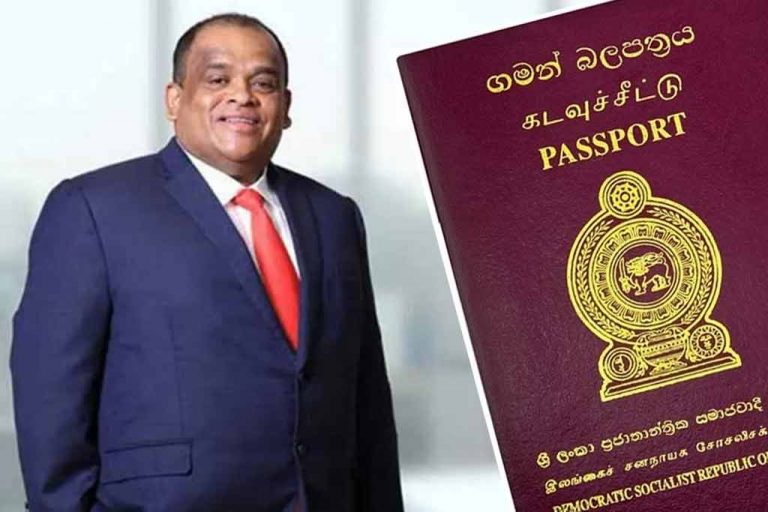
The one-day passport issuance service will be enabled at offices of the Department of Immigration and Emigration in three more cities outside Colombo from tomorrow (04), in a swift one week move by new Minister of Investment Promotion Dhammika Perera.
Accordingly, those prone to visiting Colombo for the one-day passport service can now obtain their own passports from the offices located in the cities below, said the Minister.
Matara, Monaragala, Hambantota and Galle Districts – Matara Office
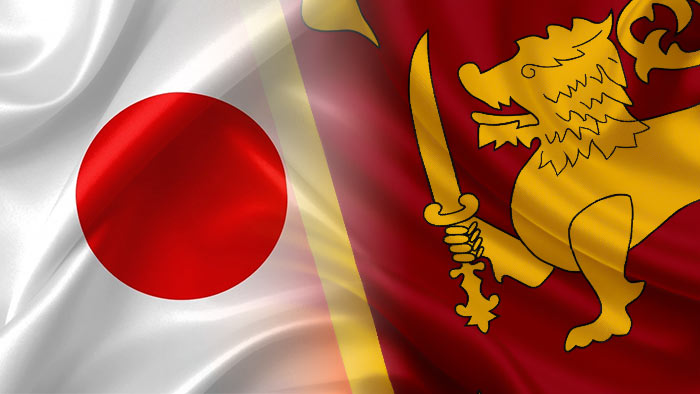
The Government of Japan has decided to provide Emergency Grant Aid of USD 3 million through UNICEF and World Food Program (WFP) for the provision of medicine and food in a manner that would directly benefit the Sri Lankan people.
In a statement regarding its position on the economic situation in Sri Lanka, the Japanese Embassy in Colombo said, Japan sincerely hopes that this assistance will be of help to overcome the hardship faced by the people of Sri Lanka.
The Japanese government would like to consider its further contribution to Sri Lanka in consultation with the Sri Lankan government and other developing partners, while giving attention to the situation of Sri Lanka and the negotiation progress between Sri Lanka and IMF, the statement read further.
“Japan, time-tested partner in Sri Lanka’s socio-economic development, has been supporting Sri Lanka and will continue to do its part in combining its efforts with the people and Government of Sri Lanka.”
The embassy also stated that Japan is closely paying attention to the current difficult economic situation in Sri Lanka and severe humanitarian situation accompanied.
Meanwhile, the Japanese Embassy in a statement on their FaceBook page said that Japan is closely paying attention to the current difficult economic situation in Sri Lanka and the severe humanitarian situation accompanying it.
“Considering such a situation, the Government of Japan has decided to provide Emergency Grant Aid of USD three (3) million through UNICEF and WFP in order to provide medicine and food in a manner that would directly benefit the Sri Lankan people.
Japan sincerely hopes that this assistance will be of help to overcome the hardship faced by the people of Sri Lanka, Japan’s long-standing friends,” the Embassy said .
The statement further added that the Japanese government would like to consider its further contribution to Sri Lanka in consultation with the Government of Sri Lanka and other developing partners while giving attention to the situation of Sri Lanka and the negotiation progress between Sri Lanka and IMF.
Earlier also, Japan had come forward and helped Sri Lanka. Even Japan had joined hands with Sri Lanka to address the crisis in Sri Lanka.
Both the countries reached this agreement after the meeting on May 24, on the sidelines of the powerful regional grouping, the ‘Quadrilateral Security Dialogue’ (QSD) meeting, Colombo Gazette reported.
“They also discussed the situation in Sri Lanka and confirmed that they will cooperate with each other in light of the current economic crisis and deterioration of the humanitarian situation in the country,” the Japanese Foreign Ministry said in a statement.
Earlier in May, the Japanese government came forward to help Sri Lanka by providing USD 1.5 million for essential medicines through UNICEF to meet the urgent needs of the population.
The contribution of USD 1.5 million will help UNICEF to procure the medicines for over 1.2 million people including 53,000 pregnant mothers and nearly 122,000 children in immediate need, Colombo Page reported.
Deputy Ambassador of Japan in Sri Lanka, Katsuki Kotaro said, “It is our great honour that Japan will be providing USD 1.5 million emergency grant assistance to the people of Sri Lanka to procure the most urgently needed 25 types of medicines within the next two months through UNICEF.
He neoted that they believe that this will help improve access to essential life-saving medical services, especially for pregnant women and children, who are most likely to be affected by the economic crisis.”
Presently, Sri Lanka is facing its worst economic crisis since independence with food and fuel shortages, soaring prices, and power cuts affecting a large number of the citizens.