Home Blog Page 2174

Firms struggle amid Sri Lanka’s economic crisis

0

It is a daily struggle for Ranjith Koralage, the boss of a Sri Lankan clothing manufacturer, to find enough diesel to run his company’s machines and steam rollers. 

The chief of Kolonna Manufacturing, which is based in Sri Lanka’s central province, has been running from station to station looking for 400 litres of fuel for the generator – just enough for one day. 

With long power outages, interruptions have become the order of the day in factories across Sri Lanka. Thankfully, a generator brings power back up in some factories. But the fix is temporary with limited fuel. 

Mr Koralage told the BBC: “Today we survived somehow, but I don’t know about tomorrow.” 

His export unit makes knitted garments for Victoria’s Secret, Puma and Levi’s, and is among dozens of clothing factories struggling to meet production targets. 

Garments are the second largest foreign exchange earner for the Sri Lankan economy. The sector had just recovered from the pandemic, with export earnings increasing by 22.1% to $514m (£393m) in January 2022 compared with a year ago. 

Kolonna’s order book is full for the next three to six months. But now disruptions are adding to existing worries around losing business to rivals in Indonesia, Bangladesh and Vietnam. 

“If [the] government doesn’t provide fuel we have to stop production, that affects customers’ deliveries. Our clients are already asking us daily if we will be able to complete the orders in time or not,” Mr Koralage says.

Sri Lanka is facing its worst financial crisis in decades, with foreign exchange reserves shrinking by more than 16% to $1.93bn in March, central bank data showed on Thursday.

Kolonna Manufacturing is a prime example of the model of economic development that Sri Lanka wanted: a factory in the island nation’s hinterland that creates local jobs. It employs 800 workers, all from the region, including its chief executive Mr Koralage. 

The unit makes garments for export and generates almost $140,000 a year for the local villages. 

But it is now stuck in a vicious cycle. The dollar shortage has left the country struggling to pay for imports including food, medicine and fuel. 

Even Sri Lanka’s power plants are struggling to maintain operations. Long, rolling, power cuts are crippling businesses, especially export-oriented ones that are capable of earning the much-needed dollars. 

Exporters like Kolonna typically lock in orders at fixed prices and have limited capacity to absorb rising costs. While a weaker Sri Lankan rupee benefits exporters, rising costs are draining all positives. 

This affects both the business and its employees. Mr Koralage says as the cost of living goes up, retaining skilled workers will be another yet challenge.

BBC

Peru declares state of emergency on highways as protests continue

0

Peru has declared a one-month state of emergency to allow the armed forces to supervise its highways, as the government of President Pedro Castillo tries to stem nationwide protests over rising fuel and food prices.

Hundreds of truckers and farm workers have been blocking roads across the country for more than a week in anger over rising costs, which have spiked since Russia invaded Ukraine.

The decree, published in the official newspaper on Thursday, allows for the army to be deployed to clear the blockades while also suspending certain constitutional rights such as freedom of movement and assembly.

“The police will keep control of internal order, with help from the armed forces,” it read.

Clashes between protesters and police in Ica, about 300km (185 miles) south of the capital, Lima, left one farm worker dead and 15 people injured, mostly police officers.

Demonstrators rally in Peru
Protests against rising costs continue to be held in the Peruvian capital, Lima [Alessandro Cinque/Reuters]

Castillo’s government has faced growing public anger over the crisis, especially after he imposed a mandatory, 24-hour lockdown in Lima and a neighbouring port city earlier this week in a bid to “re-establish peace”.

The left-wing president, who was sworn into office in July of last year, backtracked on the measure after opposition politicians and human rights groups slammed it as a “disproportionate” infringement on freedom of movement.

Thousands of people had taken to the streets in defiance of the measure before Castillo cut the lockdown short on Tuesday evening, calling on Peruvians to “be calm”.

The government has cut taxes on fuel, raised the minimum wage and proposed exempting essential food items from sales tax.

The episode marks the first time in Castillo’s eight months in power that he has faced a social protest movement.

AL JAZEERA

Mystery of alleged Chinese hack on eve of Ukraine invasion

0

Allegations of Chinese cyber activity as the recent conflict broke out in Ukraine have been emerging. 

The details appear unusually murky but one Western intelligence official believes the aim was espionage – and the cyber-attack may have been broader than previously reported.

The Times first reported that hackers, alleged to be based in China, began targeting Ukrainian websites on 23 February, the day before the invasion. 

That led to questions as to whether they had advance notice of Moscow’s plans and if their intention was somehow to support Russia. 

A broad set of Ukrainian government and commercial organisations were said to have been targeted by hackers, including organisations linked to nuclear power.

It is unclear how far this activity was scanning for vulnerabilities online and how many websites were actually compromised.

But the aim looks to have been espionage – stealing secrets – rather than the kind of sabotage operations which Russia was accused of carrying out just before the invasion, and when it started.

The Times cited intelligence documents – but the Ukrainian security service denied they had handed anything over and seemed to downplay the revelations, adding to confusion. 

Some analysts wondered if they were worried about antagonising Beijing. 

On Monday, the Chinese embassy in the UK rejected the claim and described the Times report as “sheer irresponsible talk and not credible at all”.

Sri Lanka calls for $1 bln debt restructure as crisis rages: REUTERS Report

0

COLOMBO, April 7 (Reuters) – Sri Lanka must urgently seek funds from multilateral lenders and aim to restructure a debt payment due in July, its outgoing finance minister said on Thursday, pleading for political stability amid the country’s worst economic crisis in decades.

The opposition and some partners of the ruling coalition rejected calls this week for a unity government from President Gotabaya Rajapaksa after he disbanded his cabinet, hoping to quell weeks-long street protests over shortages of fuel, power, food and medicine.

With its foreign exchange reserves shrinking quickly, massive debt payments due and the rupee currency slumping, analysts say the government – controlled by Rajapaksa and his elder brother Mahinda, the prime minister – is running out of options.

Reserves dropped 16% to $1.93 billion in March, central bank data showed on Thursday.

“We must look at how to structure the $1 billion international sovereign bond payment maturing in July,” said Ali Sabry, who submitted his resignation to Rajapaksa on Tuesday.”We must go to the IMF, there is no other solution that I can see.”

Sabrywas moved to finance from the justice ministry on Monday to replace President Rajapaksa’s younger brother Basil Rajapaksa.

It was not immediately clear if Rajapaksa had accepted Sabry’s resignation, submitted days ahead of scheduled talks with the IMF for emergency loans.

As the island nation attempts to fast-track the formulation of proposals to present to the IMF President Rajapaksa on Thursday appointed K.M.M Siriwardana, a deputy governor at the central bank who previously worked with the Fund, as treasury secretary.

The $1 billion bond maturing on July 25 was trading at 54 cents in the dollar, its lowest level since spring 2020 when the COVID-19 rout hit global financial markets, data from MarketAxess showed .

Other Sri Lankan dollar-denominated sovereign bonds traded at even more stressed levels, with most changing hands around 40 cents in the dollar.

“We must have political stability to find solutions to the financial crisis,” Sabry said.

“We must discuss with the World Bank and we must have a bridge-financing plan with the ADB. If we don’t have stability, who will conduct these talks?,” he said, referring to the Philippines-based Asian Development Bank.

Opposition lawmakers continued to call for the president to step down. At least 41 parliamentarians withdrew from the ruling coalition this week, though they could still support the government in the house and the opposition has not called for a no-confidence vote. read more

Foreign Minister G. L. Peiris told diplomats in a briefing that the government still held a majority in parliament and that “despite the agitation”, there was no consensus on who could replace the president, prime minister and parliament.

DEEP IN DEBT

Critics have accused the government of mismanagement, but the tourism-reliant economy has also been hit hard by the COVID-19 pandemic.

Help from the IMF would likely come with some tough political choices – policy reforms that could add to the pain in the short term in hopes of getting the economy back on more solid footing in a few years.

J.P. Morgan analysts estimated this week that Sri Lanka’s gross debt servicing would amount to $7 billion this year, with the current account deficit coming in around $3 billion.

As the search for a replacement for Sabry at the finance ministry continues, P. Nandalal Weerasinghe took over as the central bank governor, succeeding Ajith Nivard Cabraal, who quit on Monday.

A court in the commercial capital Colombo on Thursday barred Cabraal from leaving the country until March 18, Rajith Keerthi Tennakoon, a well-known anti-corruption activist who accused Cabraal of misusing public funds during his tenure, told Reuters. Tennakoon had petitioned the court.

Reuters could not immediately contact Cabraal and his lawyer did not answer calls.

Weerasinghe, a former senior central bank deputy governor who has also worked with the IMF, will hold a monetary policy meeting on Friday. It was originally scheduled to be held on Monday.

An analyst said the central bank was expected to hike key interest rates by 300-400 basis points – following a 100 bps increase in early March – to tame inflation that hit 18.7% in March.

“We also expect the newly appointed governor to outline potential measures to be included in the IMF reform plan, views on potential debt restructuring, and currency management,” said Lakshini Fernando of Asia Securities.

REUTERS

Sri Lanka: the masses must organise and trust their own strength!

0

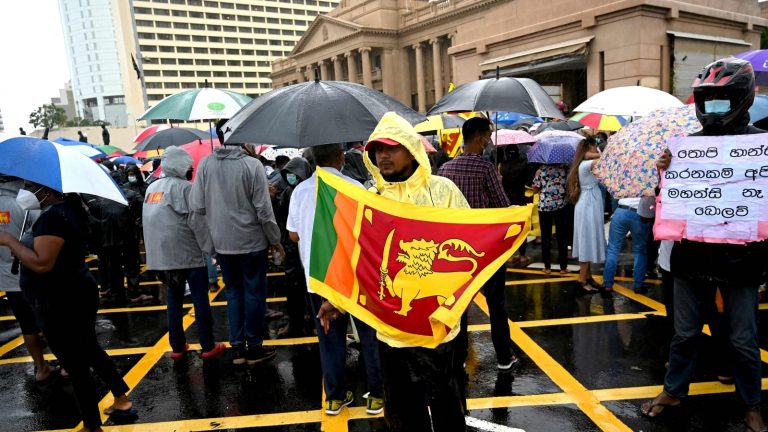
After spontaneous protests demanding the resignation of President Gota last Friday in Colombo, the capital of Sri Lanka, anticipation was mounting about how this movement in the crisis-ravaged country would develop.

Some parties and groups were calling for protests last Sunday, in response to which, a nervous President Gota called a curfew. The entire country was to be shut down from 6pm on Saturday 2 April through to 6am on Monday 4 April. Nevertheless, groups of youth across the country defied the curfew – the biggest act of defiance taking place in the city of Kandy, where thousands of students from Peradeniya University faced water cannons.

As soon as the curfew was lifted on Monday morning, the masses returned to the streets. Despite being a working day, large crowds were amassing from 7.30am. No strike was called by the trade unions, but the crowds grew larger and larger anyway, with bosses in many areas having no choice but to give workers dispensation to attend.

Crowds gathered in locations across the island. In every neighbourhood of Colombo there were protests. Crowds gathered in Independence Square. Angry crowds gathered outside the personal residences of almost all the government ministers. At one point, thousands of protesters broke through a police barricade outside Carlton House – the seat of the Rajapaksa family in Tangalle on the southern coast of the island.

Every corner of the country and every layer of society has been swept into the movement. There were protests among the Tamil tea plantation workers demanding the fall of the government in central Sri Lanka; as well as protests of Tamil groups in the North and East, who added their own demands to the call for Gota to resign, including the demand for the repeal of the repressive Prevention of Terrorism Act.

University students have been out en masse raising slogans such as, “you’ve fucked with the wrong generation,” whilst pickets were formed outside hospitals all over the island as healthcare professionals marched in demand of access to drugs, medical equipment and food for patients.

The lawyers have been particularly organised in this movement. They staged a mass protest at Mirihana police station, demanding the release of those arrested on Friday night for protesting outside Gota’s residence, whilst thousands of lawyers staged protests outside the courts demanding the prosecution of corrupt politicians.

Such is the breadth of the movement that even the armed bodies of the state are showing cracks. On Friday night, footage emerged in Mirihana of the driver of a police van raising his fist in encouragement of the protests, whilst on Monday footage was posted on social media of a police officer in Kottawa fraternising with the protests and even getting on the megaphone to say, “Even though we are wearing uniforms, we are with you.”

In one incident, protesters were scandalised to see members of the armed forces on motorcycles carrying automatic weapons and heading for the protests at the parliament building, only to be challenged by the police. An army commander has now demanded the police officers face disciplinary action.

These are hairline cracks in the state and it isn’t our wish to exaggerate them, but they are important symptoms of how the mood in society is also affecting even the rank and file of the police and the army, sections of whom could be won over to the side of the masses.

Parliament in crisis

The action of the masses on the street has opened up a deep crisis in the government and parliament. On Monday, events moved quickly: the governor of the Central Bank of Sri Lanka, Nivard Cabraal, resigned. The courts have since banned him from leaving the country. Twenty-six cabinet members also resigned. President Gotabaya Rajapaksa, and his brother, the Prime Minister Mahinda Rajapaksa, were the only ones left standing in the government!

The corrupt clique around the Rajapaksas has become a focal point for the disgust of the masses. The workers and the poor have been driven to desperation by the severe economic crisis. Meanwhile, they see this clan above them, robbing them blind.

Nandasena Gotabaya Rajapaksa Image Ministério da Defesa FlickrThe action of the masses has opened up a deep crisis in the government – after twenty-six cabinet members resigned president Gotabaya Rajapaksa and his brother were the only ones left standing in the government! / Image: Ministério da Defesa, Flickr

The political representatives of the ruling class in Sri Lanka now face a dilemma. They desperately need a government, including a new Finance Minister and a Secretary to the Treasury, in order to begin negotiations with the IMF. All of the parties acknowledge this. The governing parties as well as the opposition are talking about the need for “national unity” to get out of this crisis.

But as long as Gotabaya Rajapaksa is in place, no one is willing to commit political suicide and serve under him as a minister. Even the president’s nephew, Namal Rajapaksa, was among those ministers who have resigned – showing that even Rajapaksas don’t want to be associated with the Rajapaksas! The comedy was finished off when Gota attempted to appoint a new Finance Minister… only for him to resign immediately!

And on Tuesday, as parliament convened to debate the ongoing crisis, 42 MPs from Gota’s coalition announced that they would sit as independents and were withdrawing their support from the government. As a result, Gotabaya Rajapaksa’s coalition has been reduced to 108 seats – just shy of the 113 seats it needs to form a majority. But no other grouping has a majority either.

Despite the depth of the crisis, no one can force Gotabaya Rajapaksa out as president. And he has made it quite clear: he isn’t voluntarily going to go anywhere. In fact, as the protests continue, he has only ratcheted up his belligerence.

Rejection of all parties

One particularly noteworthy feature of the protests that have escalated this week has been their rejection of the entire political establishment and all political parties. Alongside the core slogan, “Gota must go”, the masses have added another slogan, “225 must go” – that is all of the 225 MPs represented in the parliament must go. They are all as rotten as each other.

This mood shows a very healthy instinct. The masses understand that all the bourgeois parties represented in the parliament – including the opposition – merely represent different wings of their exploiters. The masses see through their game, played year in and year out, of rotating through ministerial portfolios to give the illusion of change. They aren’t taken in by the spate of resignations, and cynical jokes are going round about how these same characters will be back in new ministries at the next cabinet reshuffle.

Meanwhile, the people on the street rightly sense that the opportunists in the opposition are false friends who conceal daggers behind their smiles.

Indeed, where these opportunists have tried to turn up and feign sympathy with the protests, they have swiftly been chased off the street. In one case, the reactionary Buddhist monk Battaramulle Seelarathana Thero – leader of the Sinhala-chauvinist Janasetha Peramuna party, which has a record of supporting the Rajapaksas – was chased back to his luxury car amid shouts of, “it’s because of the people like you, we suffer today like this!”

Elsewhere, members of the official opposition, the Samagi Jana Balawegaya (the SJB, a party which emerged from the ruins of the discredited traditional party of the Sri Lankan capitalists, the UNP), have also found themselves chased away. They have been rightly rejected by the masses.

On the streets, it has proven tough for these representatives of capital to pass themselves off as “champions of the people”. But in the air conditioned chamber of parliament, under the adoring gaze of the capitalist press, they have had a much easier time.

The scandal that has been going on inside parliament shows that the people are quite right to reject all of these criminals.

On 6 April, members of the SJB even raised placards in parliament and mimicked the slogans on the street calling for Gota to go! “There can be no voice that runs counter to that voice heard on the streets. We are here to represent the people,” said SJB leader, Sajith Premadasa.

And it’s not just the opposition who, like a wolf in sheep’s clothing, are trying to ingratiate themselves with the elemental movement of the masses. Even the major capitalists of Sri Lanka have now come out “in favour” of the protests. The spokesperson of Sri Lanka’s biggest supermarket chain, John Keells Group, which profits from the suffering of the people as it ratchets up the prices of foodstuffs to maintain its profits, declared (without apparent irony) how it “acknowledges the hardships and pressures the current environment is placing on our citizens and our team members.”

The largest apparel exporters and biggest private-sector employer, MAS Holdings, that has grown rich off the sweat of the workers who cannot now even afford to eat, have not only expressed their sympathy for the masses, but have explained how they “stand by and respect our citizens and our team’s right to participate in peaceful protests and to express themselves freely.”

One tweet very succinctly summed up the attitude of the masses to this game of opposition that the ruling class are now playing:

“Don’t be fooled by cricketers, public figures who work alongside Rajapakshas arriving late to the party. Note their missing hashtags #GoHomeRajapkshas #gohomegota from their perfunctory statements. Even Namal Rajapaksa quit. They’re just playing along to save their businesses.”

These criminals are attempting to offload their role in the present crisis onto the shoulders of the Rajapaksas alone. But it is not just the Rajapaksas who are responsible for the present suffering of the Sri Lankan people. Rather, the entire class to which the Rajapaksas belong – the capitalist class – is responsible.

The “executive presidency”

The masses are correct to be suspicious of the manoeuvres not only of the ruling party, but also of the pro-big business opposition. Right now, the opposition are trying to focus the entirety of the attention of the masses on reforming Sri Lanka’s capitalist democracy. But this is a complete deception. All talk of reforming democracy in Sri Lanka, as long as capitalism exists, can only be mere rhetoric aimed at fooling the masses.

SJB leader Sajith Premadasa has given us plenty of examples of such rhetoric in the past week. His party has declared that the main problem is the nature of the presidency, with its extreme concentration of powers in the hands of the president himself:

“The time has come to abolish the Executive Presidency”, he told parliament. “Let us use this opportunity to change this system and introduce one with checks and balances. Let us use all the available emergency constitutional tools available and within this week bring laws to abolish the Executive Presidency.”

This demand has been picked up by a number of other lawmakers and media pundits. But what is its real content? Certainly the Sri Lankan constitution is far from democratic. Parliament enjoys relatively few powers next to the “Executive Presidency”.

The constitution has many of the features of what Marxists refer to as “Bonapartism” – a regime that has been seen in other places and at other times in history when the capitalist class has become to rotten and discredited to govern, but where the working class is not yet class conscious enough to govern.

It is no accident that the Sri Lankan constitution has tended in this direction, nor were the latest powers acquired by the presidency under Gotabaya Rajapaksa’s 20th amendment the beginning of this process.

It was in the late 1970s and early 1980s, under the regime of J. R. Jayewardene of the United National Party – the predecessor of the SJB opposition – that the executive presidency was introduced.

The tendency towards Bonapartism and the concentration of political power in the hands of the strongman-president is a symptom of the weakness of Sri Lankan capitalism. It is as a result of the extremely sharp social antagonisms in society that the ruling class is forced to concentrate all power in the hands of an individual just to secure a modicum of political stability for itself.

But problems occur when the “strongman” becomes a destabilising factor in the situation, as Gota has now become. It is very difficult for the ruling class to get rid of this thorn in their side, which they have endowed with tremendous amounts of power.

The talk of the opposition parties about “checks and balances” and “getting rid of the executive presidency” are fundamentally aimed at getting the masses, who they despise and fear, off the street! They want to form a government with some legitimacy in order to negotiate with the IMF and Sri Lanka’s other imperialist creditors. Whatever system they settle upon – and it seems they can settle upon very little right now! – they will struggle to find a grain of legitimacy among them.

Let us be clear – the idea that it is possible to establish a “perfect” democracy in Sri Lanka under capitalism is an illusion. Its Bonapartist features are a symptom of the crisis of capitalism on the island, and a sign that capitalism and the entire bourgeois regime are ripe to be overthrown.

Argentina 2001 and Sri Lanka 2022

The masses are correct to distrust all of the bourgeois and petty bourgeois parties and politicians. This is the strong side of the slogan, “225 must go!”

But the slogan also has a weak side. To illustrate this point, it is worth looking at a time when a very similar slogan was raised by the masses in another time and place. In 2001, the Argentinian masses erupted onto the streets and raised the slogan: “que se vayan todos!” (“kick them all out!”)

argentinazo Image public domain

There are a number of parallels between the present situation in Sri Lanka and the situation that developed in Argentina in 2001 / Image: public domain

There are a number of parallels between the present situation in Sri Lanka and the situation that developed in Argentina in 2001. At that time, Argentina was facing bankruptcy, and was forced to turn repeatedly to the IMF. In order to pay back its debts, the IMF demanded the Argentinian government apply brutal zero-deficit austerity budgets – i.e. that they make the workers and poor pay for the crisis.

This eventually led to a situation in which the masses could take no more, and their anger exploded in massive protests.

Much like Sri Lanka today, the movement made Argentina ungovernable. The country even went through five presidents in the course of two weeks! Ultimately, however, the masses became exhausted and returned home.

What happened next? The government defaulted on its unpayable debt, the currency was massively devalued, and unemployment and inflation continued to worsen. In fact, these were the only two options facing Argentina on the basis of capitalism: either pay the debts and conduct massive austerity attacks; or default and allow inflation and unemployment to rip through society. Either way, the working class would be made to pay for the crisis of capitalism.

And today, Argentina is back in the same situation! The Argentinian government has once again returned to the IMF for help, having been battered by the exact same, worldwide crisis of capitalism that is gripping Sri Lanka. The IMF has been willing to oblige… in exchange for promises to carry out further austerity attacks on the working class.

Trust your own strength!

As in Argentina in 2001, in the absence of a political alternative, the ruling class politicians of Sri Lanka can simply wait for the masses to become exhausted. One so-called “left”, Vasudeva Nanayakkara, who was among the 42 MPs to resign from the governing coalition, expressed the strategy of the ruling class thus:

“This government cannot move forward now. There must be a government with everyone participating for at least 6 months and then have an election.”

All talk of elections in the indefinite future must be recognised for what it is: an attempt to defuse the movement of the masses – to get them off the streets and to frustrate them in parliamentary games. Other politicians complain that to hold a new election amidst such an acute economic crisis would be an inexcusable waste of resources that the country does not have. There is an answer to that: save money by cutting the inflated wages, expenses and ministerial cars of the MPs themselves! No representative should be on more than the average workers’ wage.

The masses have a healthy instinct in distrusting all the representatives of the rotten capitalist class. The workers and the poor must trust only in their own strength. But they need organisation in order to harness this elemental power. Today, power is literally in the hands of the workers and the poor: it is there, in the streets. The problem is, the working class is not conscious of this fact. And if they are not made conscious of this fact, the movement will inevitably exhaust itself.

Trotsky once explained how, “without a guiding organisation, the energy of the masses [will] dissipate like steam not enclosed in a piston-box.” What is necessary is to give the mass movement organisation.

In all workplaces, among the peasants, in the fisheries and neighbourhoods, committees of the workers and poor must be formed to coordinate the struggle. Linked up on a district-wide and national level, such committees could become the organs of an alternative power to the rotten parliament, presidency and the entire capitalist state in Sri Lanka.

What is missing is a party that the masses can have confidence in, and organise through. The masses reject all the existing parties, but they do not have a party of their own. Sri Lanka has a longstanding tradition of left parties, but they threw away the authority they once had precisely because they entered into coalition governments with bourgeois and petty bourgeois parties, thus tainting themselves with the austerity measures of past governments. That is why they have no authority today.

The left in Sri Lanka should seriously look at its own past and understand that what is needed today is a complete break with any idea of class collaboration. The left and the trade unions should be coming together to promote workers’ committees everywhere and coordinate them at the national level in order to give an expression to the will of the people on the streets. This, combined with a powerful all-out general strike across the whole country, would bring down the whole rotten regime and prepare the ground for the workers, the peasants, the urban poor, and all the downtrodden layers of society to finally seize power, take over the wealth of the privileged few at the top and use if for the benefit of the mass of working people. There is no other way!

Ben Curry 07 April 2022

Signing of the no-confidence motion against the government begins

0

It is reported that the signing of the no-confidence motion against the government has begun.

According to political sources, the opposition has a majority of 113 seats.

Accordingly, it is reported that the government could have lost the opportunity to leave with great honor and a powerful foreign country would be behind the defeat of the government.

Sources said that Tissa Attanayake, Rajitha Senaratne, Harsha de Silva, Mujibur Rahman, Rishad Bathiudeen, Eran Wickramaratne, Kabir Hashim and many others have already signed the no-confidence motion.

However, the special debate in Parliament is still active today (08).

30 member cabinet will be limited to 15 members?

0

The next cabinet will be limited to 15 members, according to internal government sources.

It is said that the decision to reduce the 30 member cabinet to 15 has been taken in view of the protests taking place in the country.

It was reported that the two separate Ministries of Power and Energy which were previously under the present government will be merged and handed over to Mahindananda Aluthgamage.

The cabinet is scheduled to be sworn in today, but will be sworn in on the 10th after observing the massive public protests scheduled for tomorrow (09), sources said.

However, at least by the 10th, even only the Minister of Finance will have to be sworn in, as the IMF talks are scheduled to begin on the 11th.

Sarath Fonseka says that the government should leave now!

0

Samagi Jana Balawega MP Field Marshal Sarath Fonseka said that the government and the president should resign since they have no ability or interest to support people who are suffering.

He was participating in a mass protest in Kiribathgoda.

Fonseka said the government’s failure had now been realized by the people.

However, he emphasized that the people’s struggle must continue.

Imran Khan: Pakistan court rules no-confidence vote block is illegal

0

Pakistani Prime Minister Imran Khan could face removal from office this weekend, after the country’s top court ruled his move to block a no-confidence vote was unconstitutional.

Last Sunday, Mr Khan’s ruling party blocked a no-confidence vote which he was widely expected to lose.
His government then dissolved parliament and called a snap election.

Furious opposition members launched an appeal with the Supreme Court to decide the legality of the blocked vote.

The Supreme Court said in a ruling late on Thursday that the vote should go ahead.

In response to this, Mr Khan announced that he had called a cabinet meeting and would address the nation on Friday evening.

“My message to the nation is that I have always fought for Pakistan and will continue to fight till the last ball,” he wrote in a Twitter post.

Sri Lanka and the Netherlands hold inaugural bilateral political consultations

0

The inaugural session of the bilateral political consultations between Sri Lanka and the Netherlands at Foreign Ministry level was convened on Tuesday 05 April, 2022 on a virtual platform.  The consultations coincided with a year-long programme jointly organized by the Embassies of Sri Lanka and the Netherlands in Colombo and in The Hague to commemorate 70 years of diplomatic relations between the two countries.

The two sides engaged in productive discussions on a multitude of areas of bilateral and multilateral interest comprising political cooperation and the exchange of high-level visits; trade, investment and tourism; air connectivity; climate change; capacity building and training of the public service; women’s empowerment; cooperation in defence, education and agriculture; as well as cultural cooperation. The two sides reiterated their mutual interest in further consolidating trade and prosperity through engagement in the Indian Ocean.  Sri Lanka apprised the Netherlands of progress in reconciliation including the PTA reform process.  The discussion identified a number of areas of follow up, with particular attention to development cooperation.

Sri Lanka appreciated the support extended in multiple spheres by the Netherlands through its development cooperation portfolio, as well as the market access provided for Sri Lanka’s exports to the Netherlands via the EU GSP plus scheme.

Recalling historical relations spanning 400 years, Sri Lanka and the Netherlands deliberated on enhancing cultural cooperation through technical assistance in the restoration of Dutch heritage sites, cooperation between museums and the national archives and discussions on ongoing on the restitution of artifacts.

Sri Lanka acknowledged the support rendered by countries in Europe through the European Union and bilaterally, in addressing the shared challenges posed by Covid-19.

The Consultations were co-chaired by the Additional Secretary/ Bilateral (West), Ministry of Foreign Affairs of Sri Lanka Manisha Gunasekera and the Director General/Asia and Oceania (DAO), Ministry of Foreign Affairs of the Netherlands Karin Mössenlechner.

The Netherlands delegation included the Ambassador of the Kingdom of the Netherlands to Sri Lanka Tanja Gonggrijp, the Head of South Asia and South-East Asia/ Department for Asia and Oceania Max Valstar and senior officials from the Netherlands Foreign Ministry. The Sri Lankan delegation included the Ambassador of Sri Lanka to the Kingdom of the Netherlands Aruni Ranaraja, Director General Europe/ Varuni Muthukumarana and senior officials from relevant line Ministries/agencies and the Foreign Ministry.

The second session of bilateral political consultations between Sri Lanka and Netherlands will be held in the Hague, the Netherlands in 2024.

Ministry of Foreign Affairs

Colombo

07 April, 2022