The earnings from merchandise exports expanded by 20 percent year-on-year (YoY) in the month of June, fetching foreign exchange earnings amounting to
US $ 1,208 million.
The Export Development Board (EDB) attributed the increase in earnings to improved performance in the exports of apparel and textile, rubber-based products, coconut-based products, food and beverages and seafood.
Exports of apparel and textiles increased by 36.85 percent YoY to US $ 566.78 million in June 2022. The increase was driven by both segments.
The export earnings from rubber and rubber finished products grew by 7.18 percent YoY to US $ 102.36 million in June, with good performance in exports of pneumatic and retreated rubber tyres and tubes (15.2 percent).
The monthly analysis carried out by the EDB shows that the export earnings of kernel products, fibre products and shell products, categorized under the coconut-based products, increased by 30.15 percent, 1.63 percent and 21.3 percent in June 2022 compared to June 2021.
Meanwhile, the export earnings from seafood increased by 130.75 percent YoY to US $ 36.39 million in June 2022. The expansion was contributed mainly by the higher exports of frozen fish (89.3 percent), fresh fish (219.18 percent) and shrimps (219.25 percent), the EDB said.
Earnings from the electrical and electronics components increased by 5.71 percent YoY to US $ 39.82 million for the month in review. The strong performance was observed in the exports of insulated wires and cables (14.5 percent) and switches, boards and panels (23.55 percent).
However, the export earnings from tea in June 2022, which made up 12 percent of merchandise exports, contracted by 5.99 percent when compared to the corresponding month of the previous year. The reduced exports of bulk tea, which was only 10.99 percent, resulted in the sector, fetching a revenue of
US $ 116.49 million.
The grim export performance was also observed from the spices and essential oils segment, where the earnings reduced by 10.9 percent YoY to US $ 31.74 million.
The cumulative analysis shows that for the six months ending in June 2022, merchandise exports increased by 12.4 percent to US $ 6,408.3 million compared to the corresponding period of 2021. Major product sectors, except tea and spices and concentrates, recorded increased exports
Meanwhile, the estimated value of services exports for the first half of 2022 was US $ 1,337 million, increasing 45.72 percent over the corresponding period of 2021. The services exports estimated by the EDB consist of ICT/BPM, construction, financial services and transport and logistics.
The data shared by the EDB revealed that a strong export growth was recorded for the top five export markets in the month of June 2022 and the period of January to June 2022.
Merchandise export earnings record new high of US $ 1.2bn in June

BOI now operates ’Partnership Finder’ platform to lure investments
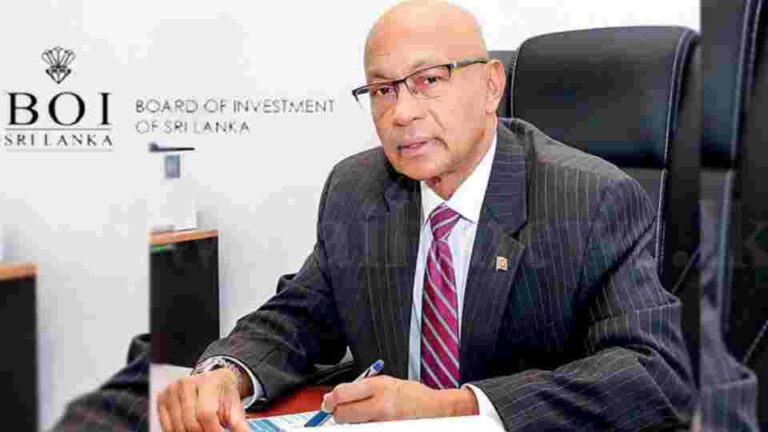
The Board of Investment (BOI), the apex organization driving investments into the country, introduced a new strategic initiative under the banner ‘Partnership Finder’ to lure investment from existing investors in the country and facilitate business partnerships with foreign and Sri Lankan companies/investors.
The interactive platform provides the BOI registered investors and other prospective investors opportunities to connect with new entrepreneurs and innovators.
“Given the global context in terms of attracting investment, the BOI’s take is that it needs to embrace an aggressive and competitive approach to show the world that the BOI is functioning on par with the global standards.
“As such, the BOI hopes to explore the possibilities of linking companies/individuals with similar business interests through this platform, in order to promote joint ventures and collaborations for further business development,” said BOI Director General Renuka M. Weerakoon.
The platform will operate as a network for both foreign and local companies and is designed to help businesses, research institutes, and startups to succeed by finding the right partners for their next innovation or business venture.
The database will consist of the companies’ details according to the business categories such as agriculture, apparel, infrastructure, knowledge services, manufacturing, services, tourism & leisure and utilities.
Besides, the launch of the business matchmaking platform will be accompanied by a communication campaign and once implemented, the companies registered on this platform get the opportunity to directly connect with the other Company/Investor using the contact information on their profiles.
Sri Lanka is aiming to attract well over $1 billion in foreign direct investment this year, an official said on Friday, as the country wrestles with its worst financial crisis since independence in 1948.
These include proposals by Marubeni Corp and India’s Adani Group to set up renewable energy plants on the island, Renuka Weerakoon, director-general of the Board of Investment (BoI)said.
Marubeni has put forward a proposal to set up an 800 megawatt (MW) solar and wind plant while the Adani Group has already completed feasibility studies on a similar 500 MW project that it hopes to wrap up in 18-24 months, she said. Two Chinese companies are also eyeing similar projects.
The Sri Lankan government has revamped legislation governing the energy sector, Weerakoon said,adding that it would allow large-scale projects to be implemented more smoothly.
SRI LANKA: An emergency means nothing less than ‘legalizing lawlessness’

By Basil Fernando
A declaration of emergency means suspensions of all the laws which normally operate within a country for the protection of the people. A declaration of emergency takes away all the basic protections which are considered essential to the normal functioning of the society. Lawlessness is declared to be normal under a period of emergency.
It means that the government as well as security forces would do during an emergency things that under normal circumstances would be considered illegal and punishable under the law. An emergency tells the security forces “Now you are not bound by the rules which you are normally bound by and you could do things without fear of legal consequences.”
It is due to these tremendous implications of declarations of emergency within a functional democracy, emergencies are declared only on rarer occasions due to circumstances overwhelming calling for some extraordinary methods. For example, in a situation of a tsunami where the normal laws of protection become impossible to operate, a limited emergency may be declared in order to temporarily suspend some of the laws which operate in the country. However, in a functioning democracy, for many decades, one could not find a single occasion on which emergency as being declared.
Dangerous- Experience of last fifty years
It is most dangerous to declare a situation of lawlessness as permissible for anyone including the security forces. The explanation is simple. Once state of lawlessness is allowed, it is not possible to ensure that it could be contained within a limit.
An example for this could be found quite near at home when examining about the last 50 years of history in Sri Lanka where on many occasions, emergencies have been declared. In all these occasions, the major feature that emerged was an uncontrolled excessive use of force which often leading to quite largescale killings.
1983 state sponsored violence
Emergency that was declared in 1983 was following a riot that was primarily inspired and initiated by the government of J.R. Jayawardene ,with his direct involvement, as later recorded by some of his close associates of the time. That emergency virtually changed the nature of the Sri Lankan democracy to such an extent that no substantial return had been possible even up to now. By the act of declaring emergency, the government itself destabilized the country and also destabilized its own capacity to govern the country within the framework of law.
Killings After arrests
Subsequent emergencies led to largescale killings of persons after arrest. Emergency laws itself did not directly authorize killing of persons after arrest. However, once the lawlessness was allowed, even the government was not in position to control the violence that arose from the state agencies themselves. Later, some of the leaders of the time spoke to parliament saying that excesses have been reported and these were not envisaged. Once lawlessness is allowed, it is not possible to control what is called excesses. Excesses in these instances like in the event of control in the 1978 JVP rebellion went into thousands of cases of mostly young people who were killed after arrest. All these are later brushed aside as excesses. In fact, under a functional democracy, these would have been called crimes against humanity.
The same applies to emergencies those were declared in the South in the latter part of 80s and also emergency that operated in the North and East for a much longer time. The biggest logic of emergency declarations is this. Emergency allows the security forces to use excess of force on people or a section of people. This itself leads to various forms of violent retaliation on the part of those who have become victims of the state’s use of excessive force. Once these retaliations start, then they have developed a logic of their own.
A Contest of Killings
Both parties engage in contest of killings and harming others and later such situations come to be called even a war. In fact, what is called a war under those circumstances simply means the failure on the part of the state to be able to democratically contain the expressions of protest by way of rational discourse. The rational discourse often provides opportunities to resolve problems which have hither to not being properly addressed. The rational discourse strengthens the society and after the disputes are settled, the nation and the people are in a better position to function in every sphere including the economy, social relationships, political systems and also all levels of culture. As against this, turning the discourse in an irrational direction, the emergency declaration makes the rational solution hard or even impossible to achieve. It pushes the society backwards and creates almost a permanent situation of lawlessness.
The Loss of Rule of Law
The greatest loser when emergency declarations are made is the rule of law. Often, emergency declarations are falsely justified at an attempt to restore the rule of law. In fact, what happens is the suspension of rule of law and undermining of factors that have been established within a society over a long period of efforts in order to ensure that everyone and everything is done within a society within a framework of rule of law. When the rule of law is broken down, it is one of the hardest things to reveal.
When a policing system loses its hard learned rules of discipline due to being allowed to use excessive power, it is nect to impossible to put such a system into a normally functioning situation even for decades. Heavy number of resources and commitments are needed to put back the rule of law as the foundational principle and the organizing principle of a society once it has been abandoned by allowing lawlessness to operate. Thus, the consequences of the emergency that is now being declared should not in any way be underestimated. Sri Lanka is already a failed state and the situation of the operation of rule of law is at the lowest. At this time, what is needed is to put all the resources to strengthen the rule of law in a way that the security forces will function only within that framework. Instead, if excessive powers are given as it has been done, the result will be much greater chaos and unimaginable levels of violence that may erupt within the society.
Impact on Doller Crisis
Facing the worst economic crisis in the country, this is not what the country needs. The country needs to return to a strong system of operation of rule of law which is able to crush the forces of corruption and restore order in a manner that the economy could function successfully in order to avoid problems such as a food crisis, crisis of health, education, transport, and every other crisis associated with public finance.
Thus, the present declaration of emergency is antinational, counterproductive and could have disastrously adverse impact on the future of Sri Lanka.
The 1978 Constitution is soaked in blood
July is a month that reminds Sri Lankans of one of the bloodiest months which in fact ushered a period of continuous blood shedding in Sri Lanka. That bloodbath which took place in 1983 July was initiated and blessed by the President of Sri Lanka and the Ministers of his Cabinet. It is true that the Prime Minister R. Premadasa disagreed with the President’s strategy in this regard going by some of the published reports on that terrible date. However, now President Ranil Wickremesinghe readily participated in the riot which brought the reputation of Sri Lanka as a peaceful democracy to an end.
Ever since, Sri Lanka has been one of the countries in Asia which has continuously seen the large scale shedding of blood and at no time has the Sri Lankan State or the prominent leaders ever regretted this record. Instead, the attempt had been to internationally deny any responsibility and to even put the blame on various groups which engaged in armed struggles during this period. What the Sri Lankan leaders and also the society at large are unable to acknowledge is that the chief initiator of this violence was the political leaders of the country itself.
Now, within a few days of being artificially elected as the President, Mr. Wickremesinghe’s approach as demonstrated by his actions is to prepare for another confrontation which will certainly lead to another period of the shedding of blood. The event which took place on the 14th of July where a huge group of members of the Armed Forces, the Police, the Special Task Force, and also paramilitary groups participated in a violent attack on a peaceful demonstration was a clear signal that now, once again, the arrangements are for a Sri Lankan style of ‘war’. At the moment, this war is directed towards the people of Sri Lanka, particularly for people of lower income groups. These people are complaining of the large scale malnutrition of children and also the inability to have their normal way, the lack of medical facilities, enormous hardships for children and parents trying to continue with the children’s education, unimaginable levels of hardship regarding transport, ever increasing levels of inflation and a long list of other problems which could normally be described as a rapid fall into a destitute situation.
How does the new President and his Cabinet plan to deal with the destitute people of Sri Lanka? That approach is to take up the gun. The threat of violent assaults on everyone who participates in any kind of protest has now been openly made.
Added to this, there is the readily available weapon of public security laws. In the period from 1978, the country has been ruled more through so called public security laws than by what is usually called normal laws. An average young person is very unlikely to grasp what the normal law means in Sri Lanka. The reason is that enforced disappearances on a large scale became normal, imposed during the J.R. Jayewardene period in Sri Lanka. So, were also the use of torture, extrajudicial killings, the denial of fair trials, the denial of inquiries into crimes in terms of the country’s Criminal Procedure laws, impunity extended by various ways to convicted criminals, and ever rampant corruption which was encouraged and which has never been brought seriously under the control of the law. This is only a short list of a situation of illegality that prevails in Sri Lanka. The frequent utterance of people throughout the country is that Sri Lanka is a lawless country. Even that seems an understatement by now.
Under these circumstances, the criticizing of the new President on the basis that he has violated Sri Lanka’s Constitution blatantly is a very naïve criticism. The new President knows that there is no such thing as a Constitution that upholds the rule of law in Sri Lanka. What exists is a kind of Constitution which enables the lawlessness of every kind and he has long experience of how to manipulate that Constitution in order to create situations of violence and also in order to undermine everyone who believes that they have an entitlement to be treated as equals before the law. Equality before law in Sri Lanka is a total illusion.
The basic contradiction between those who appear to be liberal and demand that the rule of law should be observed and that the Constitution should be respected and the likes of the new President is that the former lives in a world of illusion. They believe that there is a Constitution that can save them and the nation. However, the new President with his long experience under his master, J.R. Jayewardene and the manner in which Jayewardene’s Constitution was used by others, knows very well that such illusions are quite useful to a ruthless ruler. When the liberals are singing lullabies, the hardcore elements of the right wing are getting their guns ready.
That is the real background to the present situation. The coming weeks will see the unfolding of this scenario. How many will die, be illegally imprisoned, tortured and subjected to other forms of severe punishments is unpredictable. The manner in which the blood has been shed in Sri Lanka during the last few decades would be beyond the imagination of anybody who
lived prior to that period. A similar situation is not outside the possibility.
The world has condemned the tendency towards violence that is developing in Sri Lanka. However, the people of Sri Lanka themselves have expressed themselves quite clearly about where they stand in this confrontation. They certainly are not standing on the side of the Government. None of these may matter. Going by the past, all protests and all expressions of concerns can be ignored when a Government envisages to move ahead in implementing a ruthless plan.
If the fair minded people in Sri Lanka ignore these messages, they will pay the price not only of having to live in a lawless country but also to live within an economy that will further collapse.
Asian Human Rights Commission
India vows to “Safeguard Interests” as China Vessel heads to Sri Lanka
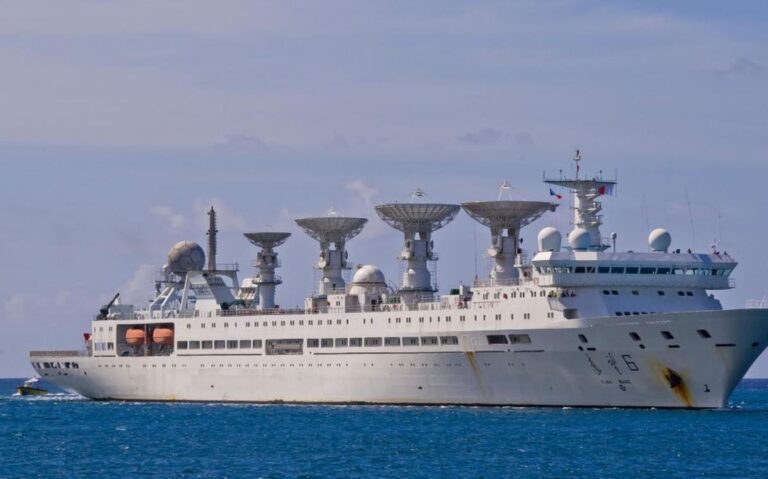
India says it was aware of reports about the planned visit of a Chinese vessel to a Sri Lankan port built with funds from Beijing.
Shipping data from Refinitiv Eikon showed research and survey vessel Yuan Wang 5 was en route to the southern Sri Lankan port of Hambantota and was expected to arrive on August 11.
“The government carefully monitors any developments having a bearing on India’s security and economic interests, and takes all necessary measures to safeguard them,” foreign ministry spokesperson Arindam Bagchi told a weekly media briefing.
“I think that should be a clear message.”He did not say what measures India was taking and who the message was addressed to.
China’s foreign ministry did not immediately respond to a request for comment. Sri Lankan officials could not immediately be reached for comment.
A Sri Lankan government official said on condition of anonymity that Indian diplomats in Colombo had lodged a verbal protest with the Sri Lankan foreign ministry on Monday.
A Sri Lankan consulting firm, the Belt & Road Initiative Sri Lanka, says on its website that Yuan Wang 5 would be in Hambantota for a week.
“The vessel will conduct space tracking, satellite control and research tracking in the north-western part of the Indian Ocean region through August and September,” it says, without citing a source.
Sri Lanka formally handed over commercial activities in its main southern port to a Chinese company in 2017 on a 99-year lease after struggling to repay its debt. The port is near the main shipping route from Asia to Europe.
US and Indian officials have been concerned that the $1.5 billion port could become a Chinese military base.
A Sri Lankan official said Monday Beijing was welcome to pour more money into vast China-backed projects in Hambantota and Colombo.
China is one of Sri Lanka’s biggest lenders and has also funded airports, roads and railways, unsettling India.
As Sri Lanka now battles its worst economic crisis in seven decades, India this year alone has provided it support of nearly $4 billion.
Responding to a tweet on the proposed Hambantota visit, Indian security analyst Nitin A. Gokhale invoked Sri Lanka’s decision to allow a Chinese submarine and a warship to dock in Colombo in 2014, a move that angered India at the time.
“2014 redux?,” Gokhale said on Twitter. “Harmless port call or deliberate provocation?”
India’s concerns over Chinese influence in Sri Lanka come as US President Joe Biden and China’s Xi Jinping held their fifth call as leaders on Thursday amid tensions over a possible visit to Chinese-claimed Taiwan by U.S. House Speaker Nancy Pelosi.
Also on Thursday, Taiwan’s military fired flares to warn away a drone that “glanced by” a strategically-located and heavily fortified island close to the Chinese coast that was possibly probing its defences, the Taiwanese Defence Ministry said.
CB urges all stakeholders to join hands in tackling economic crisis
In the best interest of the nation, the Central Bank will be taking all to strictly monitor and ensure compliance with all regulations on foreign exchange transactions, including repatriation requirements of export proceeds, conversions, and mandatory sales to the monetary authority.
Any instances of non-compliance will be dealt with stern action within the provisions of all applicable laws.
The Central Bank has strengthened its capacity in relation to monitoring of foreign exchange transactions through the implementation of the Export Proceeds Monitoring System (EPMS) and the International Transactions Reporting System (ITRS), which is a comprehensive monitoring system of cross-border transactions and domestic foreign currency transactions.
These systems facilitate regular monitoring of foreign exchange inflows and outflows. Further, assistance from independent professional bodies, including audit firms, is also being sought for the timely identification of any malpractices.
Hence, Licensed Banks and the trading community are urged to comply with the existing regulations and complement the efforts of the Government and the CB to provide much-needed assistance to all stakeholders of the economy under these extremely challenging circumstances.
The export trading community is urged to continue to repatriate all export proceeds within the stipulated timeframe and surrender the residual earnings in accordance with the regulations.
The banking community is requested to ensure strict adherence to all regulations in relation to foreign exchange transactions.
The Government and the Central Bank are relentlessly pursuing efforts to secure bridging finance to reduce and alleviate economic stresses in the near term.
A notable progress has been made in the ongoing negotiations for an economic adjustment programme with the International Monetary Fund.
The debt restructuring process is also underway, capably assisted with the Legal and Financial Advisers. The Government and the CBSL remain committed to implementing much needed reforms to overcome long-standing structural issues in the economy
To ensure adequate foreign exchange liquidity in the banking system, the CB had to impose surrender requirements on export earnings.
Further, measures were taken by the Government and the CB to discourage foreign exchange outflows, such as imposing restrictions on certain imports and payment terms and introducing margin requirements, while encouraging foreign inflows through the banking system, rather than those being channelled through the grey market.
The success of these regulatory measures and the ability to achieve the intended outcomes depend on the support and cooperation from the trading community and the banking system.
However, it has been brought to the notice of the CBSL that certain market players are not being fully compliant with these regulations.
Such practice, if continued, would deprive the people of the support expected from the Government in difficult times, while undermining the moral obligation of ‘equal burden sharing’ that is expected of all stakeholders under difficult and extraordinary circumstances.
Against this backdrop, and. The Central Bank reiterated that overcoming current economic woes and distresses requires substantial and concerted efforts from all stakeholders of the economy.
Foul play on the part of any group of stakeholders would inevitably result in the worsening of the crisis, thereby having widespread detrimental effects.
It is the duty of everybody to act conscientiously and responsibly, and extend their unhindered support during this hour of need, for the nation to recover rapidly and emerge stronger from this crisis, the Central Bank emphasised.
China defends loans offered to Sri Lanka following US concerns on debt trap
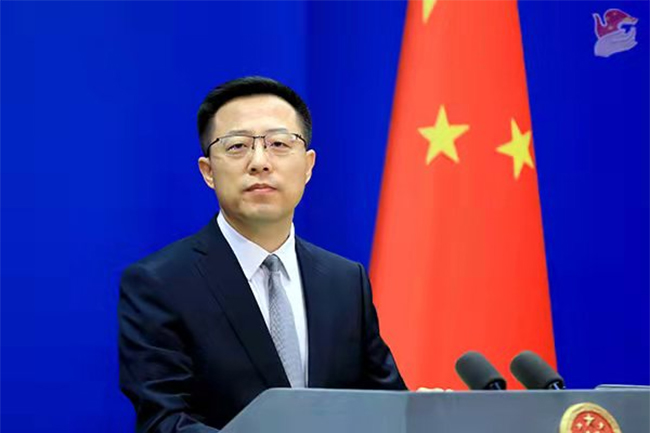
China has defended the loans it has offered to Sri Lanka following concerns raised by the United States on unproductive development projects funded by China countrywide. .
Chinese Foreign Ministry spokesman Zhao Lijian said that the cooperation between Sri Lanka and China has always followed the principle of being Sri Lanka-led.
“All cooperation projects have gone through scientific planning and thorough assessment and are never attached with any political strings. The cooperation has contributed to Sri Lanka’s economy and brought tangible benefits to the Sri Lankan people,” he said.
The Chinese Foreign Ministry spokesman said that Sri Lanka’s foreign debt is made up of multiple components.
He said the share of China-related debts is far lower than that of the international capital market and multilateral development banks.
Besides, he says China mostly extends to Sri Lanka preferential loans with low interest rates and long-term maturity, which have helped improve Sri Lanka’s infrastructure and livelihood.
“Shortly after Sri Lanka’s announcement to suspend international debt payments, Chinese financial institutions reached out to the Sri Lankan side and shown full readiness to find a proper way to handle the matured debts concerning China and help Sri Lanka to overcome the difficulties,” the spokesman said.
The Chinese spokesman also said that the global economic and financial markets have suffered enormously as a result of the US’s recent sudden interest rate hike and balance sheet reduction.
He says this has rapidly siphoned off dollars on top of the US’s long-running quantitative easing policy and irresponsible massive stimulus.
“The US’s wayward unilateral sanctions and tariff barriers have undermined the security of global supply and industrial chains, and worsened the price surge of energy, food and other bulk commodities.
This has further aggravated the economic and financial condition of developing countries including Sri Lanka. US and other Western capital speculation in Sri Lanka and manipulation of the credit rating of the country seriously undermined Sri Lanka’s financing credibility and channels,” he added.
The Chinese official said that the US should ask itself what it has done for the sustainable development of developing countries like Sri Lanka.
“We hope the US will genuinely help Sri Lanka overcome the current difficulties, ease debt burden and realize sustainable development, instead of unscrupulously latching onto every opportunity to shift the blame, smear other countries and advance geopolitical contests,” he added.
Sri Lanka hopes to conclude discussions with China “soon” on a $4 billion aid package, the country’s ambassador to Beijing told Nikkei Asia.
Ambassador Palitha Kohona said in an email that talks were progressing. “We hope that these discussions could be concluded soon, as a positive outcome would definitely assist Sri Lanka to reestablish confidence in the financial markets and recover from its unprecedented and dire financial circumstances.”
China has been a major creditor of Sri Lanka, though it remains a burning question exactly how much the latter owes the former.
Since Sri Lanka plunged into a severe foreign exchange crisis this year and defaulted for the first time in May, Beijing has reportedly been reluctant to go along with debt restructuring.
But new Sri Lankan President Ranil Wickremesinghe, who was elected by parliament on July 20 after the resignation of much-criticized Gotabaya Rajapaksa, is looking to China again as he attempts to cement his grip and quell unrest.
SL’s first home-grown fully electric car to hit the streets soon

Sri Lanka’s first home-grown fully electric car ‘Moksha’ was launched today as the most practical solution in the current technology transition phase towards a sustainable, carbon-neutral future.
The unveiling ceremony was held at the JAIC Hilton hotel Colombo by Ideal Motors while drawing inspiration from the iconic Austin Mini Moke that took the world by storm.
The four-wheeled electric quadricycle with a weight of just 870 kg is fitted with a 22.46 kWh Lithium battery that provides a range of up to 200 km on a single charge by plugging into a 15-amp domestic charger overnight.
The interior of the car packs a spacious cabin offering comfortable seating for the driver and three passengers.
Furthermore, Ideal Moksha offers complete peace of mind with a 2-year warranty on the electric motor as a standard benefit to the customer.
The warranty available on the battery will be 5 years from the date of purchase. Our island-wide aftermarket network will ensure an unmatched level of service.
The car is offered in matching two-tone exterior colours. The customer can access information, favourite music, and maps using the 7-inch multimedia touchscreen display that comes with Apple CarPlay and Android Auto compatibility. The fully air-conditioned car includes, push start, and alloy wheels.
Furthermore, Ideal Moksha offers complete peace of mind with a 2-year warranty on the electric motor as a standard benefit to the customer.
The warranty available on the battery will be 5 years from the date of purchase. Our island-wide aftermarket network will ensure an unmatched level of service.
The vehicle is the ideal for every household in the country, especially for the 1.5 million three-wheelers and 4.5 million two-wheelers registered on the island, driving holistic change by empowering drivers with a cost effective solution to upgrade to a safe and smarter vehicle.
The fully automatic car offers 100% torque from start with no gear changes, facilitating ease of learning and a relaxed driving experience.
With these innovations, the Moksha is set to transform the very nature of commuting and travel in the country and it is the ideal vehicle for everyone and anyone, from the corporate executive looking to conserve and the two-wheeler owner looking to upgrade.
This package is particularly aimed at 5.5 million households that use less than 100 and 200 Kw of electricity units per month.
The package includes the installation of up to 4 Kw of rooftop solar energy, where an average household will be able to meet their daily requirements of energy and completely do away with paying electricity bills.

Ronald Chithranjan Perera PC new SLIC Chief
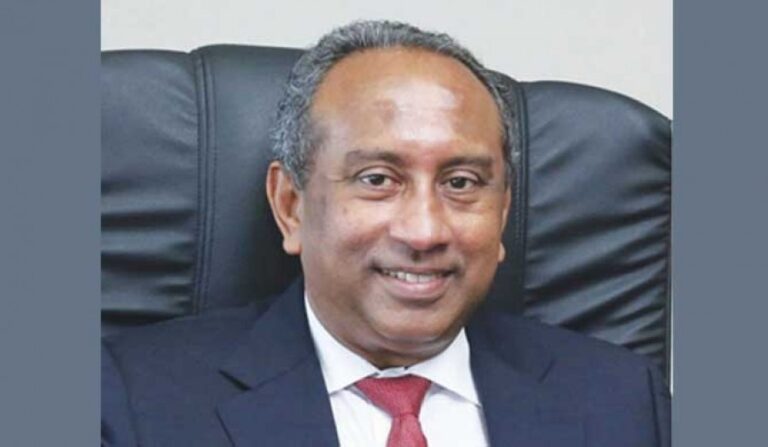
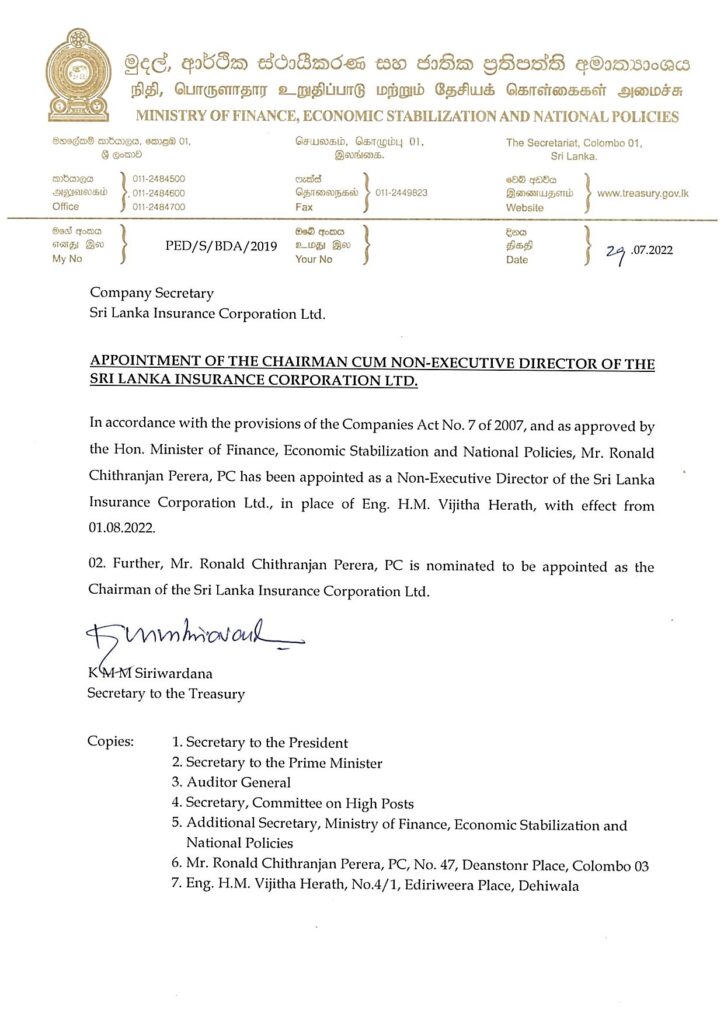
Ronald Chithranjan Perera PC has been appointed as a Non-Executive Director of the Sri Lanka Insurance Corporation (SLIC) Ltd., following the resignation of predecessor Eng. H.M. Vijitha Herath.
In accordance with the provisions of the Companies Act No. 7 of 2007 and as approved by the Finance Minister, Mr. Perera has been appointed as a Non-Executive Director of the state-run insurance body, with effect from 01.08.2022.
Further, Perera PC has also been nominated to be appointed as the Chairman of the SLIC.
MIAP
An open letter to US Ambassador Julie J. Chung
You are mindful no doubt that there are no office hours for arrests of wrongdoers and the Police and armed forces have the legal right enforce the law night or day
Dear Madam Ambassador,
On April 2, 2022 you tweeted “Sri Lankans have a right to protest peacefully–essential for democratic expression. I am watching the situation closely, and hope the coming days bring restraint from all sides, as well as much needed economic stability and relief for those suffering”
Salutary words Madam. Neither the then incumbent President, the opposition, the Aragalaya or anti Aragalaya forces nor the members of the ordinary general public to which I belong, tweeted, face booked, instagrammed any objection to this rational and admirable point of view and justifiably so.
When you declared that Sri Lankans have a right to protest peacefully we presume that right to peaceful protests you condone are those that are truly peaceful, held in a manner where no laws are flouted. We presume you would not condone any protests, where protesters occupy state property and refuse to vacate the premises forthwith, when court orders are issued, directing them to do so. A protest, based on the upholding of democracy and eradication of corruption, must practice what they preach and violate no laws themselves. A protest engaged in defacing public and private property in the name of democracy, a protest with slogans violating the constitution of our country cannot be defined as a peaceful protest by any means!
As you were watching the situation closely in Sri Lanka, you would have no doubt observed the repeated requests from the government, the police and court orders to vacate state owned property, that were being scorned by the protesters. They in fact treated the police with jest and ordered them to leave the area occupied by them when the police visited the area to deliver notice of court orders and advice them on the offences, as seen in the video clips circulating on social media. The “peaceful protesters” did not vacate the Presidential Secretariat premises on the 20th July 2022; which they were unlawfully and illegally occupying from 09th July 2022 – committing the offence of criminal trespass, an offence recognised by the Penal Code. No law enforcement authority is obliged to consent to the protesters’ stance that they will vacate in the near future. You will appreciate that they could not have awaited for auspicious times to vacate a premises illegally occupied and must do so forthwith when they are duly noticed to vacate, as every moment they occupied state property is considered as acting in violation of the law of this land. The law should be applied equally to all. The definition of criminal trespass cannot vary exclusively for aragalaya protesters. If Aragalaya protesters are exempted from the charge of criminal trespass, then the same exemption should apply to all accused presently prosecuted for criminal trespass throughout the country.
You are mindful no doubt that there are no office hours for arrests of wrongdoers and the Police and armed forces have the legal right enforce the law night or day.
In your wisdom you would have drawn parallels with the law and order in your own country and assessed how your own law enforcement agencies would have handled a similar situation where protesters are trespassing on state property. You would have recalled the manner in which your own forces treated those who stormed the haloed capital building of the land of the free and home of the brave. There are many clips on You Tube for you to watch how the US law enforcement reactz to protesters be it, storming the capitol building or engaging in street protests. Did they handle the protesters with kid gloves? Did you issue statements and criticise your own government for using force on protesters by your own forces? I wonder whether there is a single country on earth, which had not exercised minimum force when evicting trespassers from state property? A country where those illegally occupying state property are given red carpet royal treatment to vacate!
No one in Sri Lanka will condone violence. Our multi religious society does not propagate violence. However, at times for the greater good of the nation, the exercise of minimum force becomes the need of the hour. The clearing of the Presidential Secretariat of the Aragalaya Protesters must be assessed against the detrimental impact their behaviour was having on the stability of the country both economic and social, and you will agree it cannot be equated to unsolicited, illegal use of excessive force.
Madam Ambassador, you must be aware, on that fateful day of 9th July 2022, when the Aragalaya protesters stormed the President’s House, the Prime Minister’s official residence was destroyed. The private residence of the Prime Minister of the country was trespassed and destructed. Acts of hooliganism were shown repeatedly in the global media; resulting in irreparable loss and damage to the Sri Lankan economy. We are a country predominantly based on an export market and we are at present losing a large number of overseas orders and investors due to our inability to maintain law and order. Who would give orders to a country which cannot guarantee secure delivery? Who would invest in a country where the safety of their investment is in doubt! The State must protect and secure their own state property first in order to guarantee safety and security to its investors and its citizens.
As a person who wished for much needed economic stability and relief for those suffering, you should applaud that the State took right royal steps to clear the Presidential Secretariat of trespassers, which was the need of the hour to bring stability. You would have noted that the GotagoGama on Galle Face which is a recreational area for the public is very much in tact and the law enforcement agencies confined their operations to clearing the premises of the Presidential Secretariat. Having visited your country and observing the level of high security, surrounding the public areas near the white house and the state buildings, it is apparent your own country does not risk or tolerate any invasion of state property.
As such as a ordinary citizen of Sri Lanka, I implore you to be circumspect and fair in your tweets, by assessing all facets of the issue and refrain from unfairly demonising the necessary action the State implemented on July 9, 2022 to clear the all important Presidential Secretariat of trespassers !
Citizen Jane
DAILY MIRROR
Invitation from the President to form an all-party government
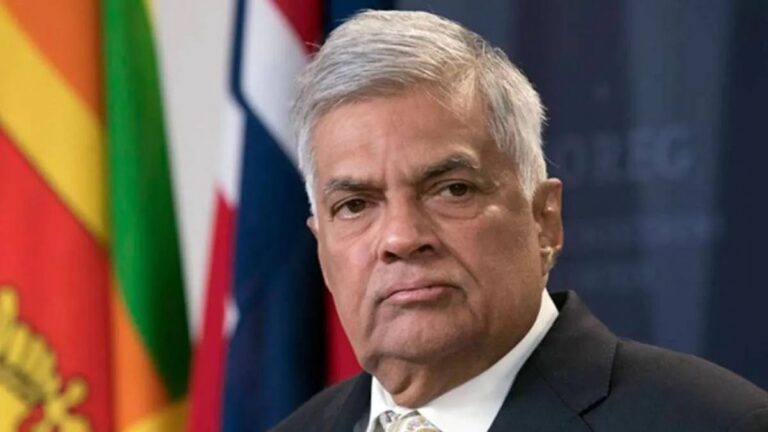
President Ranil Wickremesinghe is requesting the parliamentarians to form an all-party government separately.
Wickramasinghe requests that the agreement of the MPs and parties be given as soon as possible as he intends to build a broad dialogue on the next steps including the 19th constitutional amendment and the re-introduction of the parliamentary oversight committee system.