Home Blog Page 2189

Government gets set  to face severe domestic debt crisis 

0

Sri Lanka is getting ready to face evere domestic debt crisis by further increasing the credit limit of Rs. 3000 billion (3 trillion) previously approved by a resolution of Parliament under the Local Treasury Bills Ordinance, by another Rs. 1000 billion (1 trillion) was passed in Parliament without debate.

Accordingly, all necessary permission under Section 2 (1) of the Local Treasury Bills Ordinance will be given to the Minister of Finance for the purpose of borrowing a sum not exceeding Rupees Rs. 1,000 billion (1 trillion) through the issuance of Treasury Bills by the Government of Sri Lanka.

Thus, by 2021, the upper limit approved by Parliament for the issuance of Treasury bills is Rupees 3,000 billion (one trillion), and the total value of Treasury bills due by the end of April 2022 is about Rupees 2,860 billion.

Significant decline in government revenue collection due to COVID 19 epidemic conditions and other causes, approved expenses under Appropriation Act No. 30 of 2021 in addition to debt service payments, especially recurrent expenses and welfare expenses have to be borne, has led to an increase in the credit limit.

Further, the Ministry of Finance has had to resort to borrowing from local sources as it has lost access to international markets to raise funds from foreign sources due to the downgrading of Sri Lanka’s credit rating. 

Domestic debt service payments increased by 36.0 percent to Rs. 1,590.1 billion in 2021 reflecting the increase in amortization payments on the domestic debt by 74.5 percent to Rs. 795.5 billion and the increase in interest payments on the domestic debt by 11.4 percent to Rs. 794.6 billion in 2021, compared to Rs. 713.6 billion in 2020, Finance Ministry data shows.  

Domestic debt service payments as a percentage of GDP increased to 9.5 percent in 2021 from 7.8 percent in 2020. Domestic debt service payments recorded 109.1 percent of Government revenue in 2021, compared to 85.5 percent in 2020.

 Total domestic debt service payments which accounted for 66.9 percent of total debt service payments notably increased by 36.0 percent to Rs. 1,590.1 billion in 2021 whereas total foreign debt service payments marginally increased by 1.8 percent to Rs. 785.5 billion in 2021.

 Total domestic repayments increased significantly by 74.5 percent to Rs. 795.5 billion in 2021 from Rs. 455.9 billion in 2020 mainly due to the increase in maturing of Treasury Bonds and  Sri Lanka Development Bonds  SLDBs, Finance Ministry said.  

Interest payments on domestic debt increased notably by 11.4 percent to Rs. 794.6 billion in 2021 from Rs. 713.6 billion in 2020 due to the increased domestic borrowings owing to limited receivables of foreign financing and the rise in domestic interest rates particularly in the second half of 2021. 

In contrast, interest payments on foreign debt declined by 4.8 percent to Rs. 253.8 billion in 2021 from Rs. 266.7 billion in 2020 due to the decline in interest payments on ISBs, FCTFF and project loans. 

As a percentage of government revenue, total debt service payments increased to 163.0 percent in 2021 from 141.9 percent in 2020. Both debt repayment and interest payment as a percentage of government revenue increased to 91.1 percent and 72 percent, respectively in 2021. 

Total debt service payments as a percentage of GDP increased to 14.1 percent in 2021 from 12.9 percent in 2020. Debt repayment to GDP ratio increased to 7.9 percent in 2021 from 6.4 percent in 2020. In contrast, interest payments as a percentage of GDP declined to 6.2 percent in 2021 from 6.5 percent in 2020, the Finance Ministry disclosed. 

SL food prices hit record highs as shortages became the order of the day.

0

In the middle of its worst economic crisis in decades, Sri Lanka has been hit by a critical shortage of food  with the majority of the people now in starvation eating one or  two meals per day as prices of food items have become unbearable, consumer protection societies claimed. 

A top agricultural official warned last month of impending famine and asked the government to implement an orderly food rationing scheme to avoid such a scenario.

Food shortages have been worsened by the government’s ban on agrochemical imports, which was lifted in November after widespread crop failures and intense farmer protests.

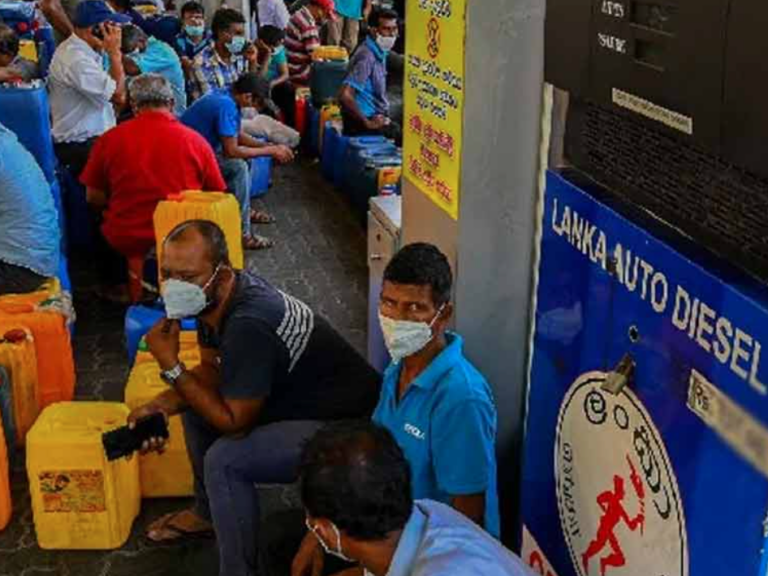
Food and beverage prices in Sri Lanka have skyrocketed due to inflation. People are waiting in queue for hours to buy groceries. 

The price of rice in Sri Lanka has risen to Rs.300- 500 per kg. In Sri Lanka, 400 grams of milk powder costs Rs 790. In the last three days, the cost of milk powder has risen by Rs 250.

Dhal (lentils) has risen from Rs.168 to Rs.500 and wheat flour from Rs.65–70 rupees to Rs.200 rupees.

A 450-gram loaf of bread went from Rs.60 rupees in January to      Rs. 150 while a kilo of chicken rose from Rs.750 rupees to Rs.1300 rupees. A kilo packet of milk power has gone from Rs. 1,345 rupees to Rs.1,945.

Official food inflation stood at 57.4% in May, the highest ever year-on-year food prices ever recorded since 2004. 

Advocata Institute’s Bath Curry Indicator (BCI), which tracks changes in the retail price of food, also recorded its highest ever increase of 71% from May 2021 to May 2022 and an increase of 13% over the past month. 

It said this is the largest ever increase in food prices since the index started measuring a basket of commonly consumed food items from 2019. 

With food prices increasing at this rate, a family that had to spend Rs. 1140 for a week of food in May 2019, now has to spend Rs 1940 to consume the same basket of food items. 

The BCI uses the Pettah retail price for its calculation.  Similarly, prices for the same basket in supermarkets for the same basket of goods have nearly doubled since May 2020. 

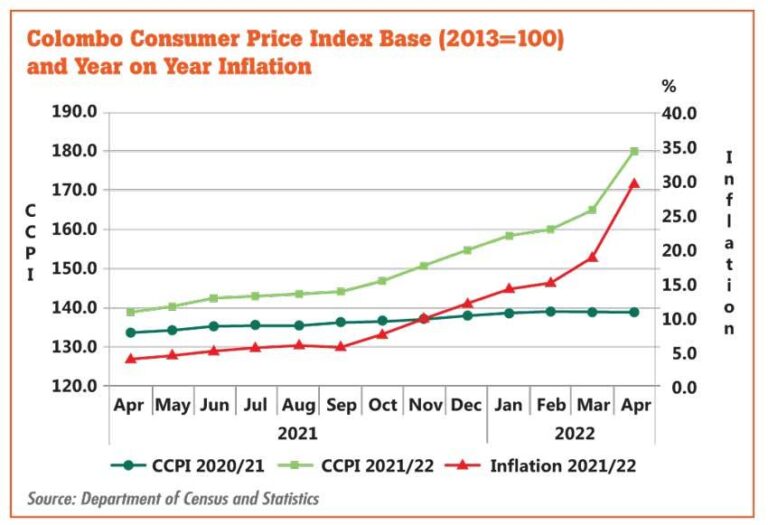
The Colombo consumer price index that looks at overall inflation, stood at 39% in May 2022. This is the highest inflation rate recorded for the past 70 years.

SL  tax evasion rises amidst reduction of tax rates and relief for businessmen  

0

The Inland Revenue Department (IRD) plans to prioritise its drive against tax evasion running up to over billions of rupees and promote voluntary compliance with the aim of boosting revenue collection at a time of unprecedented economic crisis this year.

The majority of tax avoidance has been identified in the 15 percent direct tax payers including the corporate sector, a senior official of the IRD said.

The government has foregone massive amount of over Rs.515.15 billion during the past six years due to tax avoidance by several companies and the department is still continuing the recovery process and legal procedures against those tax evaders.

“These tax evaders were making use of the loop holes in tax net specially, regulations, taxation complexity, weakness in tax administration as well as official collection procedures and corruption”, chairman of the Inland Revenue Commissioners association and senior commissioner Sarath Abeyratne said.

Tax revenue has come down OVER rs.1.2 trillion due tax reductions and abolition of certain taxes  since 2019 up to last year.

The 2019 reforms included the reduction of tax rates of Value Added Tax (VAT), Personal Income Tax (PIT) and Corporate Income Tax (CIT), and narrowing tax bases of VAT and PIT, while introducing a plethora of tax incentives, such as tax exemptions for agriculture and Information Technology (IT) and enabled services, tax deductions and tax holidays.

This caused an annual loss of around Rs 600 billion – Rs. 800 billion in tax revenue to state coffers per year.    

At present, the situation has aggravated to a very critical level where the General Treasury has to increasingly obtain Central Bank financing to make the government expenditures, including a substantial part of interest, salaries and wages, pensions and Samurdhi payments etc. 

This is clearly unsustainable and hence the implementation of a strong fiscal consolidation plan is imperative through revenue enhancement as well as expenditure rationalization measures in 2022 and beyond to ensure macroeconomic stability to support the medium to long-term economic growth objectives of the country.

Majority of the tax officers are well qualified, experienced and  honest persons but there are few officials alleged of being involved in mal practices he said.

He added that allegations of corruption against the department could be minimised by giving official protection to whistleblowers and eliminating the involvement of tax consultants by simplifying taxes and official procedures.

The IRD expects to embark on a range of tax administration measures to strengthen revenue mobilisation through digitalisation while ensuring improvements in tax compliance, and risk-based tax audits.

Mandatory payment of taxes by an electronic tax filing system is expected to expand to the non-corporate sector which will improve efficiency and reduce opportunities for corruption.

Leveraging technology such as electronic registration facilities and electronic payments will provide a platform for revenue collecting agencies.

The IRD will simplify taxpayer compliance by identifying unregistered businesses by the use of third-party information while strengthening its audit and investigation unit and further digitisation of tax administration.

On the tax compliance monitoring front, taxpayers are to provide additional ways including the use of a taxpayer registration database to carry out tax transactions and improve service delivery.

The IRD plans to speed up complaints handling and further promote digital tax-filing providing a single source of taxpayer information, he disclosed.

Protest in front of Dhammika Perera’s house (VIDEO)

0

A protest was held in front of the house of Dhammika Perera, a National List MP of the SLPP, this morning (12).

They were seen chanting slogans against the arrival of Dhammika Perera in Parliament.

The program to grant leave to public servants to be implemented from next week

0

Dinesh Gunawardena, Minister of Public Administration, Home Affairs, Provincial Councils and Local Government says that the program to grant leave to public servants on Fridays will be implemented from next week.

He said that the program was being implemented due to the current fuel crisis in the country.

He further stated that the Ministry of Public Administration will provide assistance and various other reliefs to those who wish to engage in agriculture in the areas where they reside, by utilizing the holiday given on Fridays.

The AP Interview: Sri Lanka PM says he’s open to Russian oil

0

COLOMBO, Sri Lanka (AP) — Sri Lanka may be compelled to buy more oil from Russia as the island nation hunts desperately for fuel amid an unprecedented economic crisis, the newly appointed prime minister said.

Prime Minister Ranil Wickremesinghe said he would first look to other sources, but would be open to buying more crude from Moscow. Western nations largely have cut off energy imports from Russia in line with sanctions over its war on Ukraine.

In a wide-ranging interview with The Associated Press on Saturday, Wickremesinghe also indicated he would be willing to accept more financial help from China, despite his country’s mounting debt. And while he acknowledged that Sri Lanka’s current predicament is of “its own making,” he said the war in Ukraine is making it even worse — and that dire food shortages could continue until 2024. He said Russia had also offered wheat to Sri Lanka.

Wickremesinghe, who is also Sri Lanka’s finance minister, spoke to the AP in his office in the capital, Colombo, one day shy of a month after he took over for a sixth time as prime minister. Appointed by President Gotabaya Rajapaksa to resolve an economic crisis that has nearly emptied the country’s foreign exchange reserves, Wickremesinghe was sworn in after days of violent protests last month forced his predecessor, Rajapaksa’s brother Mahinda Rajapaksa, to step down and seek safety from angry crowds at a naval base.

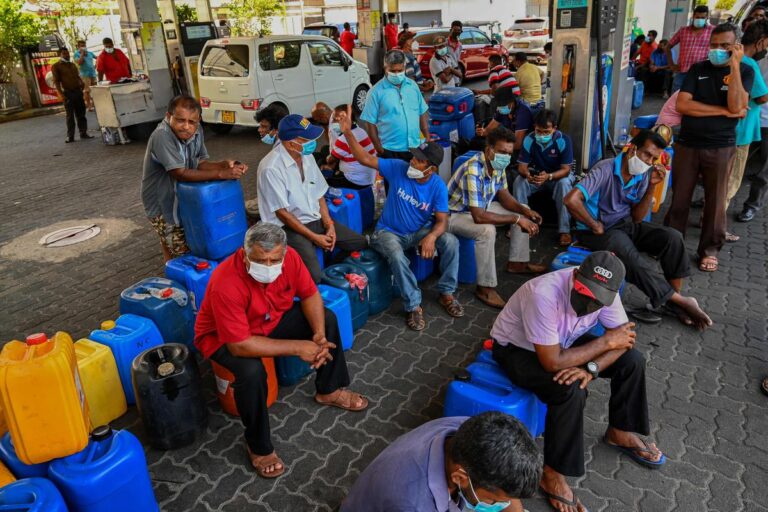
Sri Lanka has amassed $51 billion in foreign debt, but has suspended repayment of nearly $7 billion due this year. The crushing debt has left the country with no money for basic imports, which means citizens are struggling to access basic necessities such as food, fuel, medicine — even toilet paper and matches. The shortages have spawned rolling power outages, and people have been forced to wait days for cooking gas and gasoline in lines that stretch for kilometers (miles).

Two weeks ago, the country bought a 90,000-metric-ton (99,000-ton) shipment of Russian crude to restart its only refinery, the energy minister told reporters.

Wickremesinghe did not comment directly on those reports, and said he did not know whether more orders were in the pipeline. But he said Sri Lanka desperately needs fuel, and is currently trying to get oil and coal from the country’s traditional suppliers in the Middle East.

Youtube video thumbnail

“If we can get from any other sources, we will get from there. Otherwise (we) may have to go to Russia again,” he said.

Officials are negotiating with private suppliers, but Wickremesinghe said one issue they face is that “there is a lot of oil going around which can be sourced back informally to Iran or to Russia.”

“Sometimes we may not know what oil we are buying,” he said. “Certainly we are looking at the Gulf as our main supply.”

Since Russia’s invasion of Ukraine in late February, global oil prices have skyrocketed. While Washington and its allies are trying to cut financial flows supporting Moscow’s war effort, Russia is offering its crude at a steep discount, making it extremely enticing to a number of countries.

Like some other South Asian nations, Sri Lanka has remained neutral on the war in Europe.

Sri Lanka has received and continues to reach out to numerous countries for help — including the most controversial, China, currently the country’s third-largest creditor. Opposition figures have accused the president and the former prime minister of taking on a slew of Chinese loans for splashy infrastructure projects that have since failed to generate profit, instead adding to the country’s debt.

Critics have also pointed to a beleaguered port in the hometown of then-President Mahinda Rajapaksa, Hambantota, built along with a nearby airport as part of China’s Belt and Road Initiative projects, saying they cost too much and do too little for the economy.

“We need to identify what are the projects that we need for economic recovery and take loans for those projects, whether it be from China or from others,” Wickremesinghe said. “It’s a question of where do we deploy the resources?”

The prime minister said his government has been talking with China about restructuring its debts. Beijing had earlier offered to lend the country more money but balked at cutting the debt, possibly out of concern that other borrowers would demand the same relief.

“China has agreed to come in with the other countries to give relief to Sri Lanka, which is a first step,” Wickremesinghe said. “This means they all have to agree (on) how the cuts are to take place and in what manner they should take place.”

Sri Lanka is also seeking financial assistance from the World Food Programme, which may send a team to the country soon, and Wickremesinghe is banking on a bailout package from the International Monetary Fund. But even if approved, he doesn’t expect to see money from the package until October onwards.

Wickremesinghe acknowledged that the crisis in Sri Lanka has been of its “own making.” Many have blamed government mismanagement, deep tax cuts in 2019, policy blunders that devastated crops and a sharp plunge in tourism due to the coronavirus pandemic. But he also stressed that the war in Ukraine, which has thrown global supply chains into a tailspin and pushed fuel and food prices to unaffordable levels, has made things much worse. 

“The Ukraine crisis has impacted our … economic contraction,” he said, adding that he thinks the economy will shrink even further before the country can begin to recoup and rebuild next year.

“I think by the end of the year, you could see the impact in other countries” as well, he said. “There is a global shortage of food. Countries are not exporting food.”

ADVERTISEMENT

In Sri Lanka, the price of vegetables has jumped threefold while the country’s rice cultivation is down by about a third, the prime minister said.

The shortages have affected both the poor and the middle classes, triggering months of protests. Mothers are struggling to get milk to feed their babies, as fears of a looming hunger crisis grow.

Wickremesinghe said he felt terrible watching his nation suffer, “both as a citizen and a prime minister.”

He said he hasn’t ever seen anything like this in Sri Lanka — and didn’t think he ever would. “I have generally been in governments where I ensured people had three meals and their income increased,” he said. “We’ve had difficult times. … But not like this. I have not seen … people without fuel, without food.”

___

Associated Press writers Bharatha Mallawarachi and Krishan Francis contributed to this report.

43,000 metric tons of rice to be released to the market from today

0

The Paddy Marketing Board will start releasing 43,000 metric tons of rice to the market from today.

Chairman of the Paddy Marketing Board Neil de Alwis stated that the rice will be sold to the public through Sathosa, cooperatives, and supermarkets.

Accordingly, a kilogram of red/white Kekulu rice can be bought for Rs. 197, a kilogram of Nadu rice for Rs. 199, a kilogram of Samba rice for Rs. 205 and a kilogram of Kirisamba rice for Rs. 215.

The Impact of the tactless debt Default by Central Bank

0

By 12th June 2022, it will be 2 months from the time Finance Minister Ali Sabry and Governor Nandalal Weerasinghe hastily announced a Forex debt default (without prior Cabinet and/or Parliament discussion or approval) while sugar-coating the highly damaging and controversial exercise by saying it’s a “soft” debt standstill. 

From then onwards, Sri Lanka’s economic and social pains have been increasingly exacerbated and everyone now realises that the country is presently gripped with the repercussions of a “hard” default.

It is also now well known in the government inner circles that the debt default decision was taken by then Finance Minister cum President’s personal lawyer Ali Sabry and “behind-the-scenes” IMF pensioner and incoming Governor Nandalal Weerasinghe with the concurrence of President Gotabaya Rajapaksa and the persistent advice and support of SJB MP Dr. Harsha de Silva.

However, so far, after 2 months into the default, there is NO timeframe set for restructuring, NO loan settlement proposals, NO restructuring conditions announced for the creditors’ consideration,  NO macro-economic or fiscal targets set for debt sustainability, NO bilateral funding support received from any other multi-lateral institution, and NO tangible financial assistance forthcoming from any other country as “bridging finance”. It’s only the steps taken by the previous authorities that are being pursued by the Governor and the Treasury Secretary to secure any bridging finance.

Meanwhile, as is well known, after the sovereign forex loans were defaulted, the credibility of the country has been lost. The country’s international credit rating has been slashed. Foreign direct investments and forex loans have stopped. The country has lost access to international capital markets for many years to come. Local Banks find it almost impossible to open letters of credit and carry out forex transactions. Forex funding of local banks have been curtailed by international lenders. Forex-funded infrastructure projects have stopped. Certain forex creditors and bond holders are reportedly getting ready to file legal action to recover their dues. Some Forex creditors are also reportedly calling for the re-structure of local debt, which, if done, could lead to serious socio-economic repercussions. Thousands of small and medium sized entrepreneurs are facing the risk of collapse. Hundreds of thousands of livelihoods are in jeopardy. Inflation is escalating to unbearable levels. Interest rates have risen sharply. Issue of Treasury Bills to the Central Bank (money printing) has increased significantly. The LKR is losing value. The Government’s local currency payments, including salary and pension payments are being stressed, more than ever before. Food, fuel, medicine, gas, and electricity shortages are occurring very frequently, with no solution in sight. All normal living conditions are being threatened and/or interrupted, with signs of the situation getting much worse.

That is the mess that the “debt default” has put Sri Lanka into. In fact, after the default, Sri Lanka is the pariah of the financial world, with Sri Lankan banks being unable to even open a simple letter of credit for 100,000 US dollars.

It’s time to deal with this debt default crisis as the country’s highest priority and deal with it in a PRACTICAL manner, as the fate of the nation depends on resolving this crisis VERY SOON. Impractical and theoretical lectures and pathetic blame-games by pompous ‘Doctors’ who have placed the country at this grave risk, will not work, as already proved by them at the ground level.

It’s also time to investigate the actions and the motives of the persons who advised the President to take this suicidal path of debt default, particularly the actions and motives of Ali Sabry and Nandalal Weerasinghe, who have to explain their actions which have pushed Sri Lanka into a new and irrecoverable economic abyss. The duo will need to explain first, as to why they announced the debt default without making arrangements to secure the payment of just USD 78 million on 18th April 2022 to the China Development Bank, and second, as to why they did so on 12th April 2022, even as Sri Lanka’s envoy in China Dr Palitha Kohona was confirming to Bloomberg that Sri Lanka was on the verge of securing a loan of USD 1 billion and a trade facility of USD 1.5 billion from China.

In these circumstances, the action of default by Ali Sabry and Weerasinghe is surely the most irresponsible and reckless action ever taken by any public officer in independent Sri Lanka, which should be investigated very soon at the highest level. President Gotabaya must take 

the responsibility for this like the organic fertilizer disaster that has created a food security issue.

Public Interest 

CEB chairman withdraws the statement on the proposed Mannar Power Project

0

CEB Chairman MC Ferdinando says he will withdraw his statement before the COPE Committee on the proposed Mannar Power Project.

In a letter to the COPE chairman, he had said that he had made the statement due to the pressure and sentiments at the time and that the name of the Indian Prime Minister had been mentioned there.

Accordingly, he has informed in his letter that he apologizes unconditionally in this regard.

The Chairman of the Ceylon Electricity Board (CEB) had told the COPE Committee that President Gotabhaya Rajapaksa had pressured him to hand over the Mannar Power Project to the Adani Company as the Prime Minister of India Modi was insisting on giving it to Adani.

Ministry of Women and Child Affairs and Social Empowerment to be given to Pavithra or Diana?

0

Former Minister Pavithra Devi Wanniarachchi and former Minister of State Diana Gamage have been nominated for the newly gazetted Ministry of Women and Children’s and Social Empowerment, reports say.

Although Pavithra Wanniarachchi has been at the forefront of seniority, due to her failure in all the three Ministries of Health, Power and Transport in the past, as well as the general dislike of the ministers who have held cabinet posts in the past, Diana Gamage is more likely to be in charge of the Ministry of Women and Child Affairs and Social Empowerment.

On the contrary, it is said that Diana Gamage has been talked about in the ruling party as an MP who is interested in rebuilding the country’s economy, who speaks out and stands up for her views despite criticism and insults, as well as who is eager to work.

According to sources, Diana Gamage will most likely hold the ministry post.