Home Blog Page 2260

President issues extraordinary gazette declaring two more ministries!

0

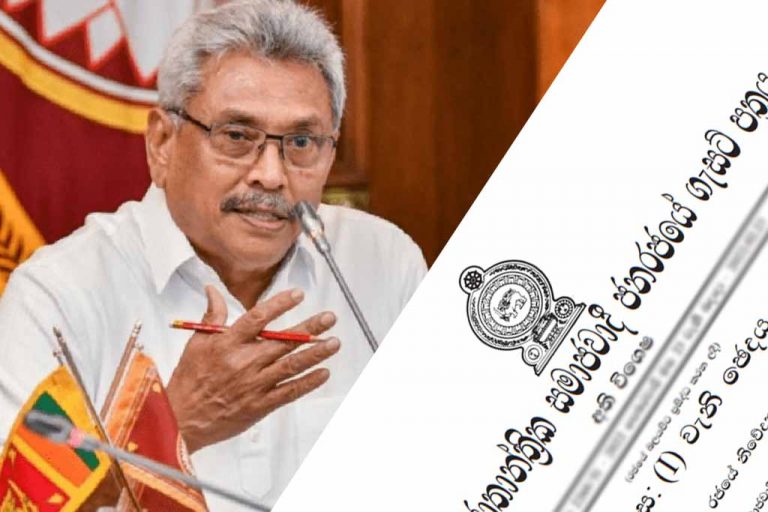
President Gotabaya Rajapaksa has issued an extraordinary gazette declaring two more ministries.

Accordingly, the following two ministries have been declared.

The Ministry of Technology and Investment Promotion

The Ministry of Women, Children’s Affairs and Social Empowerment

Read the full gazette declaration

MIAP

Election Commission Chairman says no election can be held right now (VIDEO)

0

The holding of an election may not be possible given the current situation of the country, said Chairman of the Election Commission Nimal Punchihewa, speaking to a briefing yesterday (09).

“Money is not the only problem. Should a free and fair election be held, the mental atmosphere for the people to cast their vote should also exist. Are these people who are queuing up for gas and kerosene capable of making a free decision truthful to their conscience? So, to go for an election is to loosen this situation. It may not be possible with this situation. Also, people are very emotion and anxious these times. The situation could reflect in their vote, unpredictable of which direction they may lead to. Having it said, sometimes gangs and groups outside parties may be organised, and the security of the polling stations might be compromised. If so, it could be like the 1982 Referendum, the 1982 District Development Council Polls, or the 1999 Vayamba Provincial Council Polls. We do not need that to happen,” he said.

MIAP

China readies to ease Sri Lanka’s debt crisis but no debt cuts  

0

China says its initiative to build ports and other infrastructure across  Sri Lanka with Chinese loans, will boost trade and it is ready to help the island nation to ease foreign debt

 But in a cautionary tale for borrowers, Sri Lanka’s multi billion-dollar debt to Beijing threatens to hinder efforts to resolve a financial crisis so severe that the Indian Ocean nation cannot import food or fuel 

Chinese Foreign Ministry Spokesman said China is ready to play a constructive role in easing the island nation’s debt burden.

Responding to a media query whether China be willing to be treated on par with other Sri Lankan creditors given the country’s inability to repay debts, Zhao said that China understands the difficulties and challenges Sri Lanka currently faces and is ready to play a constructive role in Sri Lanka’s sustainable economic and social development.

“We feel deeply for the difficulties and challenges Sri Lanka faces and are ready to play a constructive role in the steady economic and social development of Sri Lanka.”

The spokesman further said, as for Sri Lanka’s China-related debts, China supports relevant financial institutions in discussing with Sri Lanka and properly resolving them. 

We also stand ready to work with relevant countries and financial institutions to continue to play a constructive role in easing Sri Lanka’s debt burden and realising sustainable development.”

The Spokesman said China believes that Sri Lanka will work on its own to get through the difficulties and to protect the legitimate rights and interests of foreign investment and financial partners.

“At the same time, we hope and believe that Sri Lanka will work together with the parties concerned and boost its own effort to get through the difficulties, and protect the legitimate rights and interests of foreign investment and financing partners and maintain the stability and credibility of its own investment and financing environment,” Zhao said.

 Sri Lanka owes $7 billion this year to Chinese banks and other lenders but suspended payment April 13 while it talks with the IMF. The government also owes $25 billion, or about half its total, to private sector bond investors.

A restructuring agreement with China or Japan would be a “positive signal” for a recovery in a written response to questions, the Chinese foreign ministry said Beijing is ready to “play a positive role in easing Sri Lanka’s debt burden” but gave no indication whether the amount owed might be reduced. 

“China is willing to support relevant financial institutions to negotiate with Sri Lanka,” the ministry said.

In April, then-opposition leader Ranil Wickremesinghe told broadcaster Republic TV that China offered a $1 billion loan instead of reducing Sri Lanka’s debt. That would allow the government to make payments, but the total owed would rise

The spokesman Zhao  further said, as for Sri Lanka’s China-related debts, China supports relevant financial institutions in discussing with Sri Lanka and properly resolving them. “We also stand ready to work with relevant countries and financial institutions to continue to play a constructive role in easing Sri Lanka’s debt burden and realising sustainable development.”

The Spokesman said China believes that Sri Lanka will work on its own to get through the difficulties and to protect the legitimate rights and interests of foreign investment and financial partners.

“At the same time, we hope and believe that Sri Lanka will work together with the parties concerned and boost its own effort to get through the difficulties, and protect the legitimate rights and interests of foreign investment and financing partners and maintain the stability and credibility of its own investment and financing environment,” Zhao said.

Mattala and Ratmalana airports up for  joint ventures

0

The Government is seriously considering the possibility of forming joint ventures for Mattala and Ratmalana international airports separately due to its heavy losses of revenue in dwindling traffic and passenger slump in the present social unrest and economic crisis.

Both these airports are not generating enough income even to meet the operating expenses including the payment of salaries of its staff, transport costs and maintenance expenditure, a senior official of the Ports and Aviation Ministry said.

The new administration is looking at the option of resurrecting the two airports by entering into joint venture partnerships with a foreign aviation companies because the profits as well as the losses will be shared by the parties at an agreed ratio.

If two airports are folded, its buildings and facilities are still there and someone else would have to take it over on long term lease basis, he said.

“Sometimes back Airport Authority of India has submitted its business plan for operating the loss-making Mattala Rajapaksa International Airport (MRIA) by entering into a 70-30 joint venture agreement, he disclosed pointing out that but  it was not a sell-out”

However this business plan was not materialized due to pre-conditions put forward by the Sri Lanka side , he added.

Mattala Rajapaksa International airport has now become the lease used airport in the world and it has earned meager revenue of around Rs.474 million during the past eight year period since its opening in 2013, a recent report prepared by the treasury revealed.

Its expenditure was whopping Rs 14.4 billion while the T income generation of the Katunayake Bandaranaike International Airport is being used for the maintenance of Mattala Airport.

The construction cost of US$ 247.7 million was borne from loans provided by China Exim Bank ($190 million), the China Harbor Engineering Company ($ 40 million) and the balance by Sri Lankan government.

 Sri Lanka’s first and oldest international airport, the Ratmalana airport upgraded as Colombo International Airport- Ratmalana was reopened on March 27 after nearly five decades.

According to aviation ministry official, a flight from the Maldives landed at Sri Lanka airport, the first flight arrived there in 54 years.

It was planned to operate the 50-seater Maldivian flight according to a schedule of three flights every week to Colombo and it has to expand up to five flights per week in the coming months.

The national carrier Maldivian, the first to land at the Ratmalana airport as the first international regional flight operations from Velana Airport, was called off within 96 hours.

It has been revealed that some of the top officials had suggested this route without even assessing whether this route is marketable or not.

At the moment this airport operation has been folded and it is not generating any income after spending around Rs 6 million on the exorbitant gala launching ceremony with a celebratory water cannon salute upon arrival of the inaugural Maldivian flight, report divulged.

Former treasury secretary defends Sri Lanka’s tax reduction policy 

0

Former Secretary to the Ministry of Finance Mr. S.R. Attygalle says it is unreasonable to claim that the country lost nearly Rs. 500 billion due to the change in tax policies of the new government, as this was due to the loss caused by the import restrictions imposed, including the suspension of the import of vehicles, and the economic contraction caused by the Covid situation.

He made these observations while speaking at a meeting of the Committee on Public Finance held in Parliament yesterday (08) under the chairmanship of MP Anura Priyadarshana Yapa.

Mr. Attygalle further stated that these decisions regarding tax policies were taken in keeping with the first Cabinet Paper presented by the former Prime Minister Mahinda Rajapaksa on December 04, 2019.

Former Secretary to the President Dr. P.B Jayasundara, former Secretary to the Ministry of Finance S. R. Attygalle, former Governor of the Central Bank Ajith Nivard Cabraal, former members of the Monetary Board, current Governor of the Central Bank Dr. Nandalal Weerasinghe and other senior officials of the Central Bank were summoned before the Committee yesterday.

The Members of the Finance Committee were of the view that in presenting a Cabinet Paper, there should be a background note and a report on the subject matter concerned and that the officials in charge of the subject should take responsible for it. 

Though, there were some unavoidable circumstances, which arose at the time, decisions should have been taken after a proper study by the Central Bank and the Ministry of Finance, the committee members said.

The Members of the Committee on Public Finance further inquired whether any action had been taken by any of the Economists and Professionals in writing to submit a report containing clear conclusions of the Monetary Board with regard to the monetary policy decisions taken by the then political authority.

Former Secretary to the President Dr. PB Jayasundara said that such decisions would be tabled in Parliament are then referred to Committees.

Members of the Committee on Public Finance again inquired as to whether the economists and professionals had duly pointed out and informed their superiors as responsible officials of the Government at that time, regarding the incorrect policy decisions taken by the political authorities.

The current Governor of the Central Bank (Dr.) Nandalal Weerasinghe said that responsible government officials should refrain from engaging in politics and that the difference between a politician and an official should be properly recognized. 

He further said that it is the responsibility and duty of the officials to inform the politicians when they are not correct and the politicians alone are not responsible for the consequences of such decisions.

The MPs who participated in the committee said that although they had told the responsible officials and the then political authorities on various occasions about the possible side effects of such policies, no one had paid attention to them.

The Chairman of the Committee Anura Priyadarshana Yapa also emphasized that the relationship between the officials of the Central Bank and the Parliament should be enhanced and a proper communication process should be established when making important decisions pertaining to the country.

UN appeals for over US$47 million to help Sri Lankans hit by economic crisis 

0

The United Nations team in Sri Lanka and non-governmental organisations launched a joint Humanitarian Needs and Priorities (HNP) Plan today, calling for US$47.2 million to provide life-saving assistance to 1.7 million people worst-hit by the economic crisis over a four-month period, from June to September.

This directly responds to the Government of Sri Lanka’s request for a United Nations-backed multi-sector international assistance to respond to the most urgent needs arising from the recent crisis, particularly focusing on health care and essential medicines, food and agriculture—including targeted nutrition services— safe drinking water, emergency livelihoods and protection.

Development and humanitarian partners in Sri Lanka estimate that nearly 5.7 million women, children and men are in need of immediate life-saving assistance. The 1.7 million people targeted under the HNP are among those whose livelihoods, food security and access to health services are most at risk and need immediate support.

“Sri Lanka’s once-strong healthcare system is now in jeopardy, livelihoods are suffering and the most vulnerable are facing the greatest impact. Now is the time for the international community to show solidarity with the people of Sri Lanka. 

The UN and humanitarian partners are calling on donors, the private sector and individuals to urgently support this plan to provide life-saving assistance to the women, men, and children most affected by the crisis and thus prevent a deterioration of humanitarian needs in the country,” she added. 

Sri Lanka, formerly an upper-middle income country, is facing its worst economic crisis since independence. In May, food inflation stood at 57.4 per cent, while shortages of key food items, as well as fuel for cooking, transport, and industry, remain widespread, with ongoing daily power outages. 

The economy is bracing for a sharp contraction due to the unavailability of basic inputs to production, an 80 per cent depreciation of the currency (since March 2022), coupled with a lack of foreign reserves and the country’s failure to meet its international debt obligations.

The economic crisis has particularly impacted food security, agriculture, livelihoods, and access to health services. Food production in the last harvest season was 40 – 50 per cent lower than last year, and the current agricultural season is at risk, with seeds, fertilizers, fuel and credit shortages.

Nearly 5 million people (22 per cent of the population) are currently in need of food assistance. Latest surveys reveal that 86 percent of households are using at least one coping mechanism such as reducing food intake, including skipping meals.

Currently close to 200 essential medicines are now out of stock, with a predicted shortage of another 163 critical over the next two to three months. Additionally, over 2,700 essential surgical and more than 250 regular laboratory items are also out of stock. 

 Due to power cuts and the lack of fuel to operate generators, many hospitals have had no choice but to postpone routine and non-urgent surgeries and procedures.
Ambassador Sanjiv Gunasekara calls on Parliamentary Vice – Minister for Foreign Affairs of Japan, Honda Taro

0

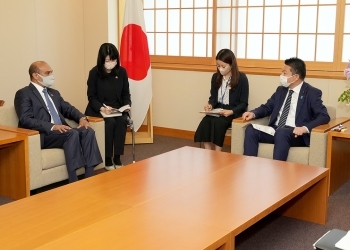
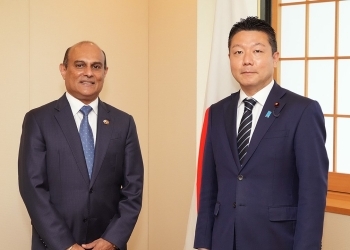
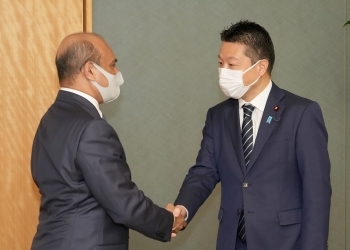
Ambassador Sanjiv Gunasekara called on Parliamentary Vice – Minister for Foreign Affairs of Japan, Honda Taro on 02 June 2022 and held wide-ranging ranging discussions on Sri Lanka’s current economic situation and matters related to Sri Lanka and Japan bilateral relations.

Vice Minister recalled the strong bonds of friendship between the people of the two countries and appreciated the contribution made by the Ambassador during his tenure particularly in building bridges between people, promotion of investments and trade relations and promoting health diplomacy with special reference to the donation of COVID-19 vaccines by the Government of Japan to the people of Sri Lanka. 

The Ambassador briefed the Vice Minister on the ongoing economic situation in Sri Lanka and sought support from the Government to mitigate the challenges of the crisis.  He also thanked the Government of Japan for the donation of USD three Mn worth of humanitarian assistance for food and essential medicines for the people of Sri Lanka and invited Japan and other donors to play a more meaningful role in assisting Sri Lanka in its hour of need. Vice Minister Taro in response mentioned that Japan is closely monitoring the situation and was saddened by the impact of this economic crisis on the ordinary people and suggested to accelerate the dialogue with IMF, leading towards a transparent and comparable restructuring of debt.

He added that they find the situation in Sri Lanka politically and economically critical and hoped that the Government under the leadership of new Prime Minister Ranil Wickramasinghe would bring a lasting solution to gradually improve the economic situation. Ambassador Gunasekara informed the Vice Minister of the latest developments in Sri Lanka including the measures taken to mitigate the crisis and the commitment of the Government to overcome this crisis with the support of international partners.

The Ambassador, referring to the commemoration of 70 years of the establishment of Diplomatic Relations between Sri Lanka and Japan, expressed satisfaction that during his tenure he has done utmost to support the economy of Sri Lanka through Japanese involvement and hoped that at this critical juncture, Japan would act as a catalyst to assist Sri Lanka bilaterally and through its allies to bring about economic stability.

Embassy of Sri Lanka

Tokyo

Women entrepreneurs receive business development support and resources amidst economic crisis

0

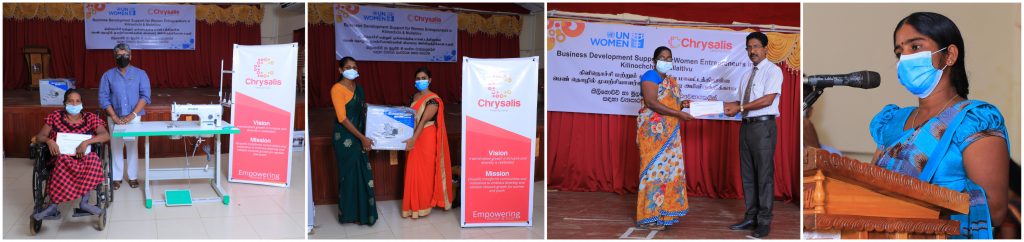
9 June 2022 (Mullaitivu, Sri Lanka): UN Women together with Chrysalis recently distributed LKR 13.4m worth of equipment and resources to support women owned businesses in the North of Sri Lanka.
The initiative is part of a larger project to strengthen the social and economic status of women returnees in resettled communities in Kilinochchi and Mullaitivu districts.

The project aims to empower small business owners, particularly female heads of households with entrepreneurial skills to support sustainable income generation and long-term self-employment. As part of the project, over 100 women entrepreneurs and business owners were given trainings ranging from business development, financial literacy, and technology transfer.

S. Rathika, a participant of the trainings conducted by UN Women and Chrysalis stated: “I run my business as a confident businesswoman now. My business skills have been strengthened through the four types of business skill development trainings provided. Earlier I did not have enough knowledge on pricing my products and utilizing resources efficiently. My labour management was also very poor. But since receiving these trainings, I have enhanced my skills to utilize available resources effectively and reduce unwanted expenses”.

The in-kind support is provided at a time when women entrepreneurs and small businesses are disproportionately impacted by higher cost of living and increased unemployment as a result of the ongoing economic crisis.

The distribution ceremony was attended by key divisional, district and provincial authorities including K. Vimalanathan, Government Agent of Mullaitivu district.

BOI goes digital to attract FDI and  boost business efficiency

0

The Board of Investment (BOI) said yesterday it has set up a paperless documentation platform where any enterprise registered can submit relevant documents electronically without coming to its office physically. 

The sole objective of this system is to provide a speedy service to our valued enterprises where processes and procedures have been simplified and streamlined. The system is open for both local and foreign enterprises who aspire to embark on an investment journey with the BOI. 

The system comprises six categories. Under the first category, enterprises/Customs House Agents (CHA) can electronically submit import and export Customs Declarations (CUSDECS) along with shipping documents to the BOI computer system (Asycuda Customs Computer System i.e., an integrated customs management system for international trade and transport operations in a modern automated environment).

 Here, the physical presence of CHA is eliminated while CUSDECs are approved electronically through the system saving time and cost.   

The second category, which is a Risk Management initiative and auto validation system, automatically validates relevant BOI compliances. 

When the CUSDEC is submitted to the system by CHA, it is confirmed to BOI by BOI enterprises through the web portal. This system provides the enterprise with the opportunity to trace the status of CUSDECs submitted and access the system even after office hours when and where needed.

Automation of import of chemicals by the BOI enterprises, which is the third category, oversees the import of chemicals and quantities by the BOI enterprises while the submission of annual requirements of chemicals with quantities is updated electronically to the web.

The next category is the automation of import verification charges, where all the charges are automated and recovered when the CUSDECs are submitted to the Asycuda system with the enterprise can see the balance of the prepaid account as well.

Automation of Export Verification Charges, the fifth category aims at reducing verification charges electronically while automatically updating export details. Besides, relevant companies will receive an automated Gate Pass to mobile phones through a technology-driven gate pass system with QR codes.

The final category is called automation of capital goods imports, which facilitates enterprises to upload the application to BOI through a web portal with no physical pressure enabling them to import plants, machinery, and relevant equipment.

The adoption of this approach makes it easier to do business with efficiency, agility, and productivity and stay organised and help reduce negative environmental impacts like natural resource consumption, pollution, and waste. It can also potentially do away with fraudulent activities and the time-consuming process, prevent the submission of forged documents and reduce the excess workforce. 

 In addition, this makes it even more pertinent for BOI to connect with their enterprises seamlessly and enable exceptional experiences so that the trust is built and strengthened. 

At the same time, it is apparent that the entire process is directly backed by digitization, which has a proven impact on enhancing quality, reinventing profitable methods and improving quality of life, consistency, and boosting citizens’ access to public services.  

The BOI said the new system has the potential to increase the effectiveness of doing business while identifying new investors and providing value through digital service delivery.

World-renowned expert advises the government to stay on debt restructuring

0

World-renowned expert Prof. Lee Buchheit advised the Sri Lankan Government to stay the course on the external debt restructuring even though the exercise is most challenging and called for transparency and professionalism to be successful and minimise the pain on the citizens. 

Prof. Buchheit said: “All sovereign debt restructurings are always and everywhere painful. It is not a pleasant undertaking but it can be gotten through and the country can return to a position of normalcy.” 

“I would tell the Government not to give up hope. It is a difficult and disagreeable process but there is light on the other side,” said Prof. Buchheit, widely considered as a veteran having worked on over two dozen sovereign debt restructurings during his 43-year legal career. 

He led the legal teams advising Greece in the 2012 restructuring of Government bonds totalling over 206 billion euros (the largest sovereign-debt workout in history). He also advised the Republic of Iraq in the 2004-08 restructuring of $ 140 billion of debt accumulated by the Saddam regime.

The go-to expert for debt-ridden nations Prof. Lee Buchheit highlightrd some of the thorny issues involved that can prolong the process in Sri Lanka’s debt restructuring.

The two important non-financial clauses in sovereign bond documentation: the ‘collective action clause’ and the ‘pari passu clause’.

 The pari passu clause requires the issuer of a bond to maintain the equal ranking of the instrument with its other “senior” indebtedness. It is not a promise by each bondholder to accept equal treatment with its fellow bondholders.

The Collective action clauses (CAC) are undoubtedly helpful to reduce holdout creditor behaviour in a sovereign bond restructuring.  But they are not a complete solution.   It is sometimes fairly easy for a holdout to acquire — on its own or in collaboration with other similarly-minded investors — a blocking position in a particular bond (typically 25 percent of the principal). 

For example, in Greece in 2012, the Hellenic Republic had 35 series of English-law governed bonds, each with its own CAC. Only 17 of those series joined the restructuring. Holdout creditors had acquired blocking positions in the other series.

The holdout creditor problem in sovereign debt workouts is a nightmare. Argentina’s $ 68.8 billion in foreign-bonds and Lebanon’s default on $ 1.2 billion debt. 

Both remain exposed to the potential cheap tactics of holdout creditors: where funds seek full repayment of their original bonds through litigation, as opposed to participating in debt negotiations. 


Interestingly, such an inter-creditor promise is to be found in syndicated bank loans. It is called a “sharing clause” and requires any bank that receives a disproportionate payment to share it with the other members of the syndicate. But sharing clauses have never been used in bond issues.

The use of trust structures in sovereign bonds can discourage holdout creditor interest, at least for bonds that have not matured according to their original terms.  Fortunately, SL ISBs use a trust indenture.