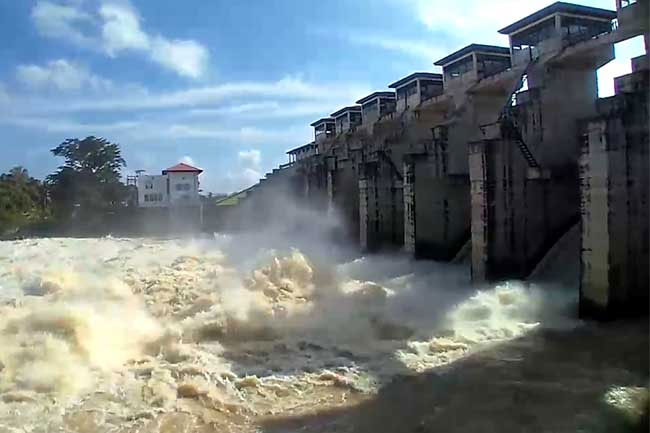
December 21, Colombo (LNW): A significant number of reservoirs managed by the Department of Irrigation have reached capacity and begun to overflow following recent rainfall, officials confirmed on Tuesday. Of the 73 major reservoirs overseen by the department, just under half are currently releasing excess water, alongside dozens of medium-scale tanks experiencing similar conditions.
Engineer L.S. Sooriyabandara, Director of Hydrology and Disaster Management at the department, said the situation remains under control and does not warrant public concern at this stage. He explained that the controlled spilling of reservoirs is a routine response to sustained rainfall and is not, by itself, an indicator of impending floods.
Nevertheless, he cautioned that river levels remain sensitive to further monsoon activity, noting that changes could occur if heavier rains arrive in the coming days. Continuous surveillance of river basins and reservoirs is therefore being maintained, with precautionary measures ready to be implemented if required.
According to departmental data, the most intense rainfall over the past 24 hours was recorded in regions linked to the Nilwala River basin. Several locations in the area experienced between 50 and 100 millimetres of rain, while much of the wet zone received around 25 millimetres. Comparable rainfall totals of roughly 50 millimetres were observed in parts of the Central Highlands and the Kelani River basin.
Elsewhere, sections of the Eastern Province saw rainfall ranging from 25 to 50 millimetres. Despite this widespread precipitation, officials report that river levels across most catchment areas have remained within safe limits.
Sooriyabandara noted a modest rise in the Nilwala River’s water level but stressed that it remains well below thresholds associated with flooding. He also said that water levels at Manampitiya along the Mahaweli River, though still elevated, are showing a gradual downward trend.
Overall, the department maintains that current conditions do not pose a flood risk, while reiterating the importance of vigilance as the monsoon season continues.
Several Reservoirs Overflow: Authorities Assure Public There Is No Immediate Flood Threat
Showery conditions continue across Island: Strong winds expected ( Dec 21)

December 21, Colombo (LNW): Several spells of showers will occur in Eastern, Uva and Central provinces and in Polonnaruwa and Hambantota districts, the Department of Meteorology said today (21).
Showers or thundershowers may occur at a few places in Sabaragamuwa province and in Galle, Matara and Kalutara districts after 2.00 p.m.
Fairly strong winds of about 40 kmph can be expected at times over Eastern slopes of the central hills, Northern, Eastern, North-central and North-western provinces and in Hambantota and Monaragala districts.
Misty conditions can be expected at some places in Western, Sabaragamuwa and Central provinces and in Galle and Matara districts during the early hours of the morning.
The general public is kindly requested to take adequate precautions to minimise damages caused by temporary localised strong winds and lightning during thundershowers.
Marine Weather:
Condition of Rain:
Showers may occur at several places in the sea areas off the coast extending from Batticaloa to Colombo via Hambantota and Galle.
Winds:
Winds will be north-easterly. Wind speed will be (30-40) kmph. Wind speed can increase up to (50-55) kmph at times in the sea areas off the coast extending from Colombo to Mannar via Puttalam and from Matara to Batticaloa via Hambantota.
State of Sea:
The sea areas off the coast extending from Colombo to Mannar via Puttalam and from Matara to Batticaloa via Hambantota will be rough at times. The other sea areas around the island will be moderate.
From Megaphones to Motorcades: Can AKD Deliver the ‘New’ Sri Lanka?
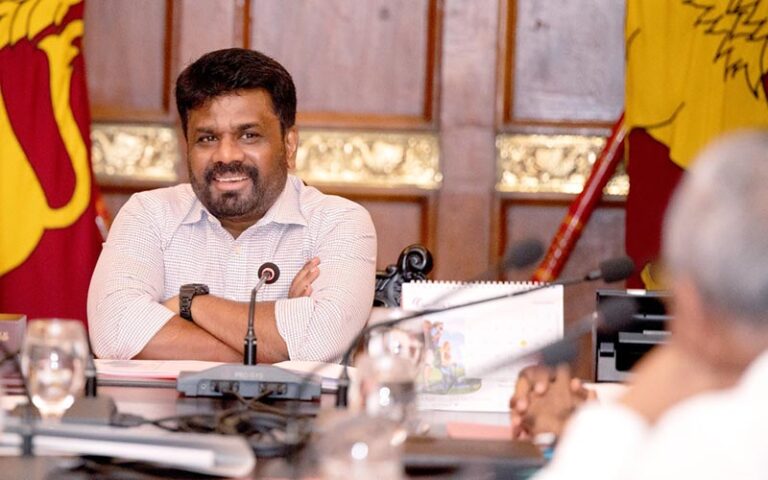
By Faraz Shauketaly
This morning taking a long, hard look at the “AKD Era”—or as some in the corridors of power might call it, the “Great Marxist Makeover.”
Our President, Anura Kumara Dissanayake, has inherited a plate that isn’t just full; it’s positively overflowing with the leftovers of decades of mismanagement. It’s a bit like being handed the keys to a Ferrari, only to realize the engine has been sold for scrap, the wheels are square, and the previous owner left the bill for the petrol on the dashboard.
The IMF Tango
First, let’s talk about the economy. AKD is currently engaged in a high-stakes tango with the IMF. On the campaign trail, he promised the masses a “people-centric” economy—which sounds lovely over a cup of tea—but the IMF prefers a “math-centric” economy. He’s trying to lower taxes and increase wages while promising a group of stern-faced men in Washington that he’ll keep the purse strings tighter than a pair of trousers after a heavy Christmas dinner. One wonders: can you really have your cake, eat it, and then ask the baker for a discount on the next one?
The Bureaucratic Brake
Then there’s the “system change.” AKD swept into office on a broomstick, promising to clean out the stable. But he’s found that the bureaucracy is less like a stable and more like a giant bowl of spaghetti—tangled, slippery, and very difficult to straighten out. We’re hearing that decision-making has slowed to a glacial pace. It seems the bureaucrats are so terrified of making a mistake and ending up in the “naughty corner” of an anti-corruption inquiry that they’ve decided the safest thing to do is… absolutely nothing at all. If the wheels of government turn any slower, they’ll actually start moving backward.
The Crony Conundrum
And what of our “Captain-Industry” types? The President has vowed to end crony capitalism. Now, for some of our business elite, “competition” is a four-letter word. They’ve spent twenty years getting rich by being the only ones allowed to sell us anything. AKD wants to open the doors to the free market, but he’s discovering that the “hidden hands” of the past have very long fingers. Squeezing out excess profits is one thing, but making sure the baby isn’t thrown out with the bathwater—that’s the real trick.
A Bright Orange Future?
So, is the future looking bright, or is it just a very vivid shade of orange? The President has the mandate—a massive one, in fact. He’s managed to convince the world he’s not the fire-breathing Marxist some feared, but rather a center-right pragmatist in a red shirt.
The challenge now is to move from rhetoric to reality. Can he transform Sri Lanka from a “rent-seeking” paradise into a productive powerhouse without causing a riot at the supermarket? It’s a tall order, even for a man who’s spent his life shouting from the rooftops.
We have a President who has successfully transitioned from the ‘angry outsider’ to the ‘pragmatic insider.’ He’s managed to charm the IMF, soothe the markets, and keep the red flags flying—all at the same time. It’s a performance that would put a world-class circus acrobat to shame.
But let’s be brutally honest: the honeymoon isn’t just over; the bags are unpacked, and the utility bills have started arriving. Over the next six months, the ‘AKD Era’ will face its true litmus test. Can he move beyond the arrests and the investigations—the ‘low-hanging fruit’ of political popularity—and actually fix the plumbing of this nation?
If the bureaucracy remains paralyzed by fear, if the ‘hidden hands’ simply find new pockets to hide in, and if the cost of a loaf of bread remains a luxury for the many, then the mandate of 2024 will sour faster than unchilled milk in the March sun.
The President tells us he is a man of the people. Well, the people are patient, but they are not eternal. They want to see that the ‘System Change’ they were promised isn’t just a fresh coat of paint on a crumbling house. They want a home that’s safe, stable, and—most importantly—affordable.
We’ll be here, keeping a very close eye on the ledger. Because at the end of the day, it’s not about the color of the shirt; it’s about the content of the character—and the balance of the bank account.
I am still thinking of a Christmas Message but frankly its Challenging. The displaced, the shifting sand in them there hills, the elephant that was burnt alive till death overcame his agony, the cancelled tourists, the hundreds of millions of uninsured stock in Mom and Pop shops across this paradise isle, the dodgy medicine thats killing more of our population even if Keheliya has been charged and awaits the tick tock of his watch – except his Patek Phillipe makes no sound – as you can tell we have a connundrum situation!
Unified Brand, Rising Revenues, But Can Tourism Deliver?

Sri Lanka’s tourism sector is once again being presented as a pillar of economic recovery, supported by rising levy revenues, improving earnings, and ambitious plans for a unified national brand. Yet behind the optimistic figures and policy rhetoric lies a critical question: can the government realistically steer tourism growth through branding and community-centred narratives without addressing deeper structural weaknesses?
According to data presented to Parliament by Foreign Affairs, Foreign Employment and Tourism Minister Vijitha Herath, revenue from the Tourism Development Levy (TDL) reached Rs. 2.58 billion in 2024 and has already climbed to nearly Rs. 2.93 billion during the first nine months of 2025. These figures point to a sector recovering steadily from years of crisis, helped by improved arrivals and stronger foreign exchange inflows.
Tourism earnings reinforce this trend. Total revenue stood at around USD 3 billion in 2024, while earnings from January to October 2025 amounted to USD 2.66 billion. Average daily tourist spending was USD 181.15 in 2024, with wide variations depending on source markets, ranging from mid-USD 150 levels to over USD 200 for visitors from countries such as the UK, Germany, China, Russia, and India.
The government now wants to move beyond numbers and reposition Sri Lanka under a single, unified national brand. Minister Herath acknowledged that Sri Lanka is already known globally as a tourist destination, but branding has evolved in a fragmented and uncoordinated manner. Under the Sri Lanka Tourism Promotion Bureau, work has begun on a “nation branding” framework intended to be used across institutions linked to tourism.
However, critics argue that branding alone cannot resolve fundamental challenges. Room rates remain relatively low despite growing demand, partly due to a sharp expansion in capacity, with an estimated 90,000 rooms added over recent years. Even after shocks such as the Easter Sunday attacks, room rates were reportedly around 20 percent lower than comparable star-class hotels in competing destinations, raising concerns about value erosion rather than value creation.
The government has also pushed back against criticism of “low-cost tourists,” emphasising community-centred growth. Budget travellers, the Minister argued, spend directly in local economies through homestays, small restaurants, transport providers, and informal vendors, spreading benefits beyond large hotel chains. He also noted that today’s low-budget visitor could become tomorrow’s high-spending family tourist.
Yet this narrative raises questions about sustainability. While inclusive growth is desirable, Sri Lanka still lacks a clear strategy to upgrade tourism products, improve skills, and increase per-visitor value without pricing itself out of the market. High-end tourists, who often seek authentic experiences rather than luxury alone, do not automatically compensate for low accommodation yields.
Institutionally, the government has attempted to tighten coordination through a Presidential Task Force on tourism development, established in August 2025, which has already met three times. Combined portfolios and faster decision-making are presented as strengths, but the effectiveness of this approach will depend on implementation rather than intent.
As Sri Lanka pursues a unified brand and community-focused tourism model, the gap between policy ambition and on-the-ground realities remains wide. Without realistic pricing strategies, product diversification, and governance reforms, the promise of sustainable tourism growth may prove harder to deliver than official projections suggest.
Official Creditor Committee Clears SriLankan Airlines Debt Deal, Risks Remain
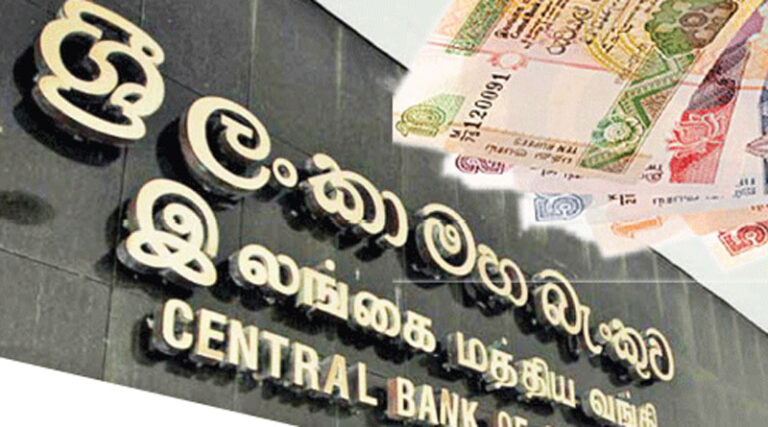
Sri Lanka has crossed another sensitive checkpoint in its long and complex debt restructuring journey, with the Official Creditor Committee (OCC) granting approval for the proposed repayment structure of the debt-linked to state-owned SriLankan Airlines. While the decision eases immediate pressure on the government, it also raises deeper questions about fiscal accountability, sovereign risk, and the future viability of the national carrier.
Treasury Secretary Harshana Suriyapperuma confirmed that the OCC has formally conveyed its “no objection” stance, allowing Sri Lanka to proceed with the settlement terms already shared with creditors. The approval relates specifically to a USD 175 million sovereign-guaranteed bond issued by SriLankan Airlines, which had gone into default amid the country’s broader external debt crisis.
The bond itself traces back to structural weaknesses within the airline. Losses escalated after the government removed Emirates as the managing shareholder during the Mahinda Rajapaksa administration, leaving the airline heavily dependent on state support. The sovereign guarantee effectively transferred commercial risk from the airline to taxpayers—a liability that crystallised when Sri Lanka defaulted on its external debt in 2022.
Under the newly approved restructuring framework, bondholders will absorb a 15 percent haircut. Creditors can opt for a combination of cash repayment and an exchange into a Sri Lankan government bond carrying a 4.00 percent coupon, amortising between 2026 and 2028. Up to USD 60 million will be allocated for a voluntary cash tender at 85 percent of total claims, while remaining balances will be converted into government securities.
From the government’s perspective, the OCC’s approval is strategically significant. Suriyapperuma noted that more than 90 percent of Sri Lanka’s restructured debt by value has now been agreed, bringing the country closer to finalising its IMF-supported recovery programme. The restructuring terms were also shared with the International Monetary Fund to ensure consistency with long-term debt sustainability targets.
However, the arrangement highlights a persistent moral hazard. Losses generated by a commercially struggling airline are once again being socialised through sovereign instruments. Even with a haircut, the exchange shifts SriLankan Airlines’ liabilities onto the government balance sheet, adding to medium-term repayment obligations at a time when fiscal space remains extremely limited.
The structure also creates unequal outcomes among creditors. Voluntary participants receive more favourable exchange ratios, while non-consenting bondholders face mandatory conversion at lower recovery values. Although legally permissible, this raises concerns about future investor confidence in Sri Lanka’s state-backed entities.
SriLankan Airlines Chairman Sarath Ganegoda welcomed the agreement, describing it as a pragmatic compromise that avoids prolonged litigation and allows the airline to focus on its operational future. Yet the fundamental question remains unresolved: whether SriLankan Airlines can operate without recurring reliance on sovereign guarantees.
As Sri Lanka edges closer to completing its debt restructuring, the airline deal underscores a recurring theme of the crisis: state-owned enterprises continue to pose systemic fiscal risks. OCC approval may close one chapter, but without deeper reforms to governance and commercial discipline, similar liabilities could re-emerge, undermining the very debt sustainability this process aims to restore.
GovPay’s Digital Gains Buffer Fiscal Strain after Cyclone

As Sri Lanka grapples with rising public expenditure following recent cyclone-related disasters, the Government’s digital payment platform, GovPay, is emerging as an unexpected stabilising force for state finances. While the sums involved remain modest relative to national budget needs, the platform’s rapid growth signals a structural shift in how the Government collects, tracks, and safeguards public revenue during periods of fiscal stress.
By the end of 2025, GovPay surpassed Rs. 2 billion in cumulative digital transactions—half of which was generated in just 45 days. This acceleration occurred against a backdrop of emergency spending, delayed revenue flows, and mounting pressure on public finances following severe weather disruptions. Analysts note that the timing is significant: disaster recovery often exposes weaknesses in cash-based collection systems, leakages, and administrative delays.
GovPay’s expansion has helped counter these risks by improving real-time revenue visibility and reducing transaction friction across more than 3,300 government services. Covering 215 public institutions, the platform has enabled over 69,000 digital payments since its launch in February 2025. This has strengthened cash flow predictability at a time when fiscal planning has been complicated by unanticipated disaster costs.
One of the most notable contributions to fiscal resilience has come from the digitisation of traffic fine payments. Since April 2025, over 50,000 fines have been settled digitally, generating more than Rs. 66 million in revenue. Previously prone to delays and inefficiencies, this income stream has become faster, more transparent, and easier to audit—an important gain when emergency expenditure requires tighter fiscal discipline.
The platform’s role extended beyond routine revenue collection during the cyclone response. GovPay facilitated donations to the Rebuild Sri Lanka Disaster Relief Fund, collecting nearly Rs. 14 million, including contributions from overseas Sri Lankans. While not a substitute for large-scale financing, the mechanism ensured transparency and accountability in emergency fundraising key to maintaining public trust during crises.
However, questions remain about scale. Compared to the billions required for reconstruction, GovPay’s collections are small. Critics argue that digital platforms alone cannot offset disaster-related fiscal shocks. Yet policymakers counter that GovPay’s real value lies in systemic reform: reducing leakages, broadening the revenue base, and strengthening institutional capacity.
With plans to digitise all local authorities by 2026 and expand reporting capabilities, GovPay represents a shift toward more resilient public finance infrastructure. In an era of climate-driven fiscal shocks, such systems may prove as important as emergency loans—quietly reinforcing stability when it is needed most.

High Court Upholds Construction Rights in Pentara Residences Dispute

Sri Lanka’s Civil Appellate High Court has decisively rejected legal attempts by nearby residents to halt construction of Home Lands Group’s Pentara Residences in Thummulla, Colombo, and reinforcing judicial support for projects that have secured regulatory clearance and progressed without undue delay.
By an order issued on 11 December 2025, the Court refused leave to appeal and interim orders sought by residents challenging the Colombo District Court’s earlier refusal to grant urgent enjoining relief. The appellate judges concluded that there was no basis to interfere with the District Court’s decision to hear both parties at the interim injunction stage rather than stopping construction immediately.
A key factor influencing the ruling was the timing of the applications. The Court observed that the petitioners approached the judiciary after construction had been ongoing for several months, weakening claims of immediate harm. The bench explicitly referenced the equitable doctrine that undue delay can bar relief, noting that the legal action appeared structured to avoid its application.
The residents had alleged that construction activities—particularly piling and excavation—generated excessive vibration, dust and noise, adversely affecting their living conditions and health. They argued that urgent judicial intervention was necessary to prevent further disruption until the matter was fully adjudicated.
However, the District Court was not persuaded that the situation warranted emergency relief. Instead, it held that the appropriate course was to proceed with notice and a structured hearing on interim injunctions, ensuring procedural fairness to both sides. This approach was fully endorsed by the Civil Appellate High Court.
Importantly, the appellate court noted that the residents themselves acknowledged that several competent government agencies had already investigated their complaints. These included the NBRO, the Central Environmental Authority and the Electro Technology Laboratory, each of which assessed the alleged impacts prior to litigation.
Despite the filing of 12 separate cases by residents living close to the site, the Court dismissed all applications and ordered costs against the petitioners, effectively closing the door on attempts to secure immediate court-ordered stoppages.
Pentara Residences is positioned as the largest single residential real estate investment undertaken by a Sri Lankan developer. The US$100–110 million project consists of twin 40-storey towers and is being developed on nearly an acre of land acquired for Rs. 4.5 billion—an unprecedented transaction in Colombo’s property market.
The development is a BOI-approved venture and is financed with the support of Hatton National Bank PLC. Construction commenced following the issuance of a development permit by the Urban Development Authority, alongside full environmental and technical approvals from statutory bodies.
Home Lands Group was represented by a senior legal team led by President’s Counsels Ali Sabry, Kushan De Alwis and Eraj De Silva, while President’s Counsel Kuvera de Zoysa appeared for the residents.
Imports Versus Assembly: A Test for Sri Lanka’s Industrial Policy
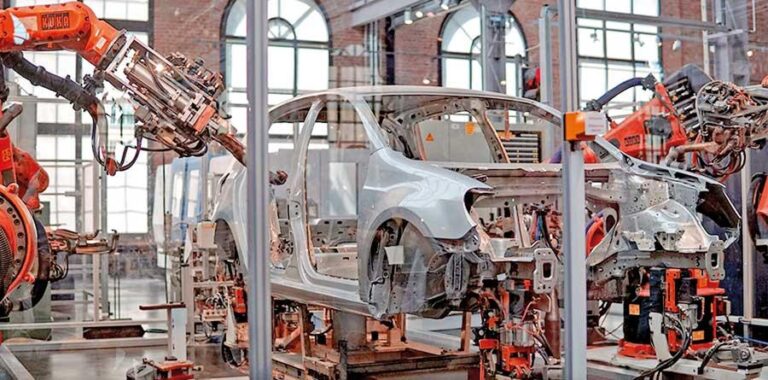
Sri Lanka’s automobile market is entering a decisive phase as the post-ban import boom gives way to a likely slowdown, exposing deeper questions about industrial policy and fiscal sustainability. In 2025, vehicle imports were a major revenue engine, accounting for the bulk of the unexpected surge in tax collections identified by the Public Finance Committee. But dependence on imports is proving to be a double-edged sword.
Local vehicle assembly expanded rapidly during the import ban years, attracting investors and building capabilities across passenger vehicles, SUVs and electric three-wheelers. Seventeen assembly plants now operate nationwide, with an equal number of prospective entrants signalling confidence in the market. Beyond output, the sector created skilled employment and stimulated upstream activities, from logistics to component manufacturing.
The reopening of imports, however, has shifted the competitive balance overnight. Imported vehicles arrive with price advantages rooted in scale and global sourcing, while domestic assemblers face higher per-unit costs. Industry representatives argue that, without targeted incentives such as differentiated excise structures or localisation-linked tax credits locally assembled vehicles will be crowded out, undermining sunk investments.
The policy tension is sharpened by Sri Lanka’s green transition goals. Electric vehicles remain central to near-term decarbonisation, but the global industry is also exploring hydrogen fuel cell vehicles. For Sri Lanka, hydrogen remains a long-term prospect due to high infrastructure and production costs. Maintaining a viable local industry is critical if the country is to participate meaningfully in future mobility technologies rather than remain a pure importer.
Meanwhile, the auto components segment stands out as a bright spot. Manufacturers are scaling exports and targeting integration into regional value chains, with ambitious plans to more than double export earnings within five years while adding tens of thousands of jobs. This momentum depends on consistent demand, skills retention and policy certainty.
Fiscal realities cannot be ignored. As import volumes normalise, the extraordinary tax gains of 2025 are unlikely to repeat, raising the prospect of revenue gaps. A policy mix that balances revenue needs with industrial development—by rewarding domestic value addition while managing imports—could smooth volatility and anchor long-term growth.
Sri Lanka’s auto sector is no longer just about cars; it is a test of whether short-term fiscal fixes can coexist with a coherent industrial strategy.
Rs.10 Billion 5G Auction Opens New Digital Chapter

Sri Lanka has taken a decisive step toward next-generation connectivity after the Government raised around Rs. 10 billion through its first commercial 5G spectrum auction, clearing the path for the launch of advanced mobile services. Dialog Axiata PLC and SLT-Mobitel, a subsidiary of Sri Lanka Telecom PLC, emerged as the sole bidders, securing long-term licences in a process officials describe as a milestone for the country’s digital economy.
The spectrum licences were formally awarded at a ceremony attended by Digital Economy Deputy Minister Eng. Eranga Weeraratne and Telecommunications Regulatory Commission of Sri Lanka (TRCSL) Director-General Air Vice Marshal (Retd.) Bandula Herath.
The auction followed the issuance of the Final Notice of Assignment in October, concluding years of regulatory groundwork aimed at preparing the market for 5G deployment.
Spectrum was allocated in two globally significant frequency ranges: the 3.5 GHz band, widely regarded as the backbone for wide-area 5G mobile broadband, and the 27 GHz millimetre-wave band, designed for ultra-high-capacity, short-range use cases.
Licences have been granted for a 10-year period under a clock-auction mechanism, which authorities say ensured transparency and market-based price discovery.
Addressing the event, Deputy Minister Weeraratne said the auction marked the largest spectrum sale by value in Sri Lanka’s history and demonstrated confidence in the country’s digital trajectory. He noted that operators are expected to move swiftly from spectrum assignment to network rollout, enabling commercial 5G services in the near term.
Beyond faster mobile internet, the Government views 5G as a platform technology with broad economic implications. Officials say it will support Industry 4.0 applications such as smart manufacturing, precision agriculture and intelligent logistics, while enabling low-latency services critical for telemedicine, connected transport and advanced enterprise solutions.
The technology is also expected to accelerate adoption of artificial intelligence, the Internet of Things and cloud-based services across both public and private sectors.
The Government is also moving to finalise enforceable rules on active and passive infrastructure sharing, with technical assistance from the World Bank and the Asian Development Bank. Policymakers argue that shared access to towers, fibre and related assets is essential to reduce duplication, lower costs and speed up nationwide 4G and 5G coverage.
With satellite-based internet services expanding rapidly worldwide, authorities believe a robust 5G ecosystem will help local operators remain competitive by offering high speeds, low latency and large bandwidth at affordable prices. The auction, officials say, highlights what coordinated action between the Government, regulator and private sector can achieve as Sri Lanka pushes ahead with its digital economy agenda.
Small Firms Face Long Road Back After Cyclone Shock

Cyclone Ditwah has laid bare the fragility of Sri Lanka’s MSME sector, raising concerns that rebuilding may prove harder than the initial clean-up. Fresh data from the Industrial Disaster Support Centre show that tens of thousands of businesses have sought assistance, underscoring the breadth of the impact.
Micro and small enterprises dominate the affected pool, reflecting their exposure to flooding, power outages and transport disruptions. While some firms have resumed activity, many are operating below capacity, struggling with damaged equipment, depleted inventories and weakened demand.
The recovery challenge is not just financial. Delays in restoring utilities, supply-chain interruptions and labour displacement are slowing restarts, particularly for enterprises outside major urban centres. Medium-sized firms, though better capitalised, also face rising repair costs and uncertain cash flows.
Officials say relief schemes will be prioritised using IDSC data, but business groups argue that speed is critical. Without rapid disbursement of funds and flexible credit terms, the risk of closures and job losses will rise.
The cyclone, they warn, could become a turning point for the MSME sector either accelerating reform and resilience, or deepening long-standing structural weaknesses.Sri Lanka’s MSME sector is grappling with heavy losses following Cyclone Ditwah, with official data showing nearly 9,630 enterprises directly affected.
Micro and small businesses account for the majority of cases, reflecting their vulnerability to infrastructure damage and business interruptions.
While about 44% of affected firms have resumed operations, many others face weeks or months before reopening, largely due to damaged machinery, lost inventories and limited access to finance. Nearly 8% of enterprises expect recovery to take more than three months.
Authorities say the data will guide emergency relief, concessional loans and technical assistance. Industry groups stress that timely and targeted support is crucial to prevent permanent closures and job losses, particularly in regional economies heavily dependent on MSMEs.