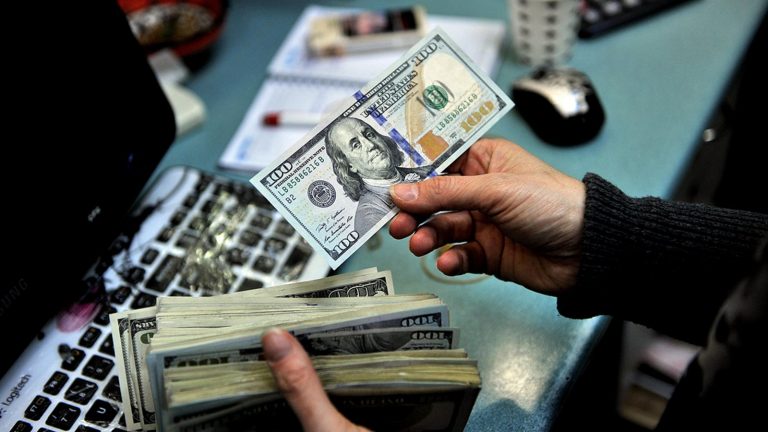
Sri Lanka is facing a deepening financial and humanitarian crisis with dollar and rupee crunch amidst heavy money printing that could lead it to bankruptcy in 2022 as inflation rises to record levels, official sources warned.
The financial crisis in Sri Lanka is primarily caused by a low growth rate, currently at four per cent and huge debt service repayment obligations and the situation is worsening with high fiscal deficit and trade deficit.
As of January 2022 available foreign currency reserves were just US$ 2.36 billion while in the next 10 months, the government and private sector of Sri Lanka will have to repay an estimated $6.3 billion in domestic and foreign loans
The Country has to pay at least $ 2 billion for debt servicing by march 31 and April this year including a $ 750 million of Sri Development Bonds (SLDB) and Indian Swap and interest payment.
It is estimated that the foreign currency reserves of the country would completely deplete by March 2022 and it would need to borrow at least$ 1 billion for necessary payments.
If the country could get an Indian loan facility of Rs1 billion then it could wither the debt servicing storm, they predicted. .
They further stated that in an “attempt temporarily to ease the problems the government has resorted to temporary relief measures, such as credit lines to import foods, medicines and fuel from its neighbouring ally India, as well as currency swaps from India, China and Bangladesh and loans to purchase petroleum.”
Sri Lanka will be facing severe shortage of rupees while reeling from the foreign reserve issues and the dollar crunch, several top officials warned.
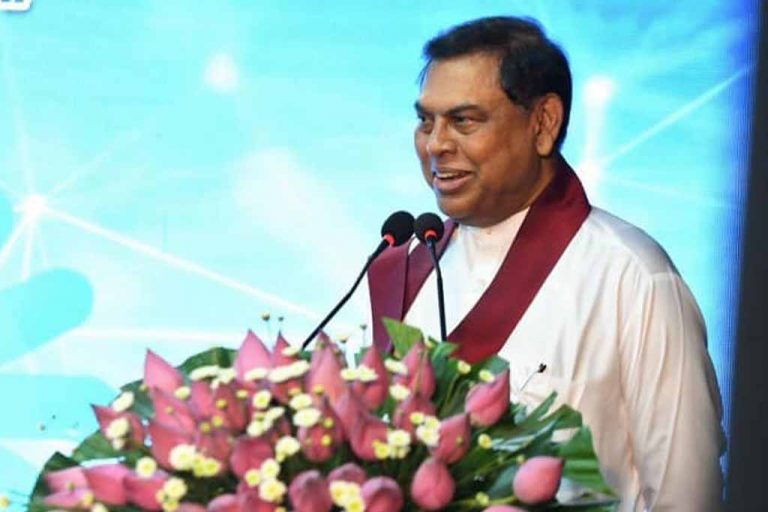
The country’s precarious financial situation has been brought to the notice of Prime Minister Mahinda Rajapaksa at a meeting with senior officials in several l leading ministries recently, PM’s office sources revealed.
They have requested the Prime Minister to brief this situation and convey their warning to the President and the Finance Minister to take immediate remedial measures.
They have also emhssied the need of increasing fuel prices to prevent the impending financial crisis
These officials informed that it was not only the shortage of dollars that the Government had to worry about, but a possible shortage of rupees as well.
It is well known fact that the Government receives money from the sale of Treasury Bills. Around 90 percent of the bills are purchased by state owned funds and private banks while around 10 percent is bought by the Central Bank
Since recently the Central Bank has been purchasing around 90 percent of the bills. The Central Bank finances these purchases by printing money, several economic experts said.
Workers remittances have plunged to a new low of $ 259 million in January 2022which has been executing multiple measures to woo inflows via official channels.
The figure of $ 259.2 million in January is down by nearly 62% from a year ago and lowest in 13 years. The previous lowest was $ 261.6 million in November 2009.
Earnings from Tourism were $ 268.3 million in January this year, compared to $ $5.5 million in January 2021, Central Bank data showed.
The reserve money increased compared to the previous week mainly due to the increase in currency in circulation and deposits held by the commercial banks with the Central Bank
Reserve Money increased to Rs1339.34 billion in Februray 24 from Rs. 1,326.05 billion in Feb 17 .Central Bank data showed. The total outstanding market liquidity was a deficit of Rs. 673.903 bn by end of last week, compared to a deficit of Rs. 693.539 bn by the end of previous week ending February 18. During the year up to 25th February 2022, the Sri Lankan rupee depreciated against the US dollar by 0.9 per cent.
A common minimum program to respond to Sri Lanka’s current crisis
NATIONAL MOVEMENT FOR SOCIAL JUSTICE
We are in the throes of an unprecedented crisis. No useful comparisons may be drawn from the 2001-02 period of negative economic growth. The only analogue may be from 90 years ago, when per capita GDP collapsed from USD 80 to 33 in a few years as part of the Sri Lankan manifestation of the Great Depression. Conventional politics based on the auction of non-existent resources offer no solutions to this crisis. Problems that have festered for over seven decades must be honestly analyzed and root causes addressed courageously and collectively.
The purpose of this discussion document is not the presentation of complete or perfect solutions to all problems that beset our society and economy. It has the limited objective of clearing a path out of the crisis in a manner that prevents periodic recurrences, as has been the case in the past. We believe that this document, which was prepared by drawing on the expertise of many, has room for further improvement. To enable agreement to be reached within a reasonable timeframe, we present five preconditions for the implementation of the economic measures, seven immediate actions, and four actions that must be initiated now even though their fruition is unlikely within the proposed two-year time frame.
Unbearable burden on the people
Our people are beset not only by shortages of essential items, but also by escalating prices. In January 2022, the annual inflation rate increased from 12.1 percent to 14.2 percent. The inflation rate for food which was 22.1 percent in December 2021 increased to 25 percent in January.
Figure 1: Inflation trends from 2021
It has become a struggle to prepare the food one has obtained at a high price. Cooking gas is in short supply; its price has doubled. Alternatives have also been affected. All businesses, including micro enterprises, that depend on a reliable supply of electricity are in difficulty.
The immediate causes of the present difficulties of debt management are the commercial loans obtained since 2007 for non-revenue yielding projects. The problem was aggravated by the ill-considered tax breaks given in 2019. Underlying all this was a fundamentally unsound economy afflicted by twin deficits (fiscal and current account) that were not addressed by any government since Independence. The self-inflicted reduction of state revenues over the past two years resulted in the inability to manage the accumulated debt burden.
Figure 2: Sri Lanka’s debt composition, 2010-2020 (source: Central Bank of Sri Lanka)
What the people see is a flailing government that is exacerbating problems through ill-considered actions. Examples are aplenty. The government banned the import of fertilizer, weedicides and insecticides overnight in the name of making Sri Lanka the world’s first country with 100 percent organic agriculture, though the desire to conserve foreign exchange and get rid of the subsidy burden may have played a part. The end results include increased costs of food imports, massive compensation having to be paid to farmers, and USD 6.7 million being paid for unusable fertilizer imports. The government’s efforts maintain an artificial exchange rate has resulted in the drying up of remittances from workers abroad.
We are no longer talking about a crisis that is to come; we are in its midst though not in its depths. The 2022 Budget offered no remedies for the twin deficits and has led to the worsening of shortages and black markets. Most of the new revenue proposals are one-off. Where will the revenues come from in 2023? Most of the cost cutting is cosmetic. The additional expenditures proposed in January 2022, unaccompanied by new revenue proposals, add to the confusion. Those in the informal sector who suffered the most have not been offered any relief.
This is not about one bad year; it will drag on. Simple arithmetic will show that it is not possible to pay our debts which average around USD 5 billion per year and maintain the levels of imports necessary for the normal functioning of the economy. The improvisational responses result not only in the worsening of the living conditions of the people; they are causing long-term harm to export industries as well as to those supplying the domestic market. Not only is new investment being discouraged, but existing firms are being incentivized to relocate. Small, medium and micro enterprises are being decimated. The effects of the present economic mismanagement are likely to felt for decades.
The necessity of debt restructuring
The 3.6 percent contraction of the economy in 2020 is merely a sign of things to come. Sri Lanka has the highest income inequality in South Asia (between China and the US in international comparisons) and provided the least compensation for the harms caused by the pandemic and lockdowns. Our citizens in the lower deciles are unable to withstand more shocks. We will not be able to get out of this crisis without any pain. But we can minimize the pain, especially for the most vulnerable, by a well thought out recovery program that includes debt restructuring program involving the IMF. The likelihood of achieving monetary stabilization is higher if the IMF is involved.
We should not abandon the commitments to fiscal discipline on the first possible occasion, as was the case in the past. We must stick with these reforms because they are our decisions and because this is the only way recurrences can be avoided.
The government may be unwilling to accept working within the framework of an IMF program because of the fear of being made responsible for the difficult, but necessary, reforms. That is why we should collectively get behind a common minimum program which provides a meaningful role to the opposition parties and is anchored on Parliament’s Constitutional responsibility for the control of finances. This is also likely to put a brake on the perpetual blame game. Unless these actions are taken, Sri Lanka may well end up like Lebanon.
Essential pre-conditions
The 20th Amendment must be rolled back. It is essential that the minimum program be implemented over a minimum of two years if we are to get on the path to recovery. The present Constitution, especially after the enactment of the 20th Amendment, makes the President extraordinarily powerful; it is not conducive to meaningful collaboration among parties represented in Parliament. It was seen in 2018 that the 19th Amendment was the best defense against over-reaching Presidential power. Therefore, restoring the 19th Amendment with some pragmatic accommodations is a foundational pre-condition for a cooperative effort to bring the country out of crisis.
Proper appointments must be made to the independent Commissions. The appointments made to the Commissions at the whim of a single individual must be reversed and fresh appointments made through the Constitutional Council. A central bank that is independent and acts professionally requires a Governor appointed through the proper procedures.
The Provincial Councils must be activated. The much-delayed Provincial Council elections must be held forthwith, based on the old law. This will allow the Provincial Councils to fulfil their responsibilities, and permit the central government to focus on economic recovery.
The common minimum program must be implemented over a minimum of two years. The 20th Amendment makes it possible for the President to unilaterally dissolve Parliament any time after February 2023; under the 19th Amendment that would have been possible only after February 2025. It is necessary to focus on economic recovery for a minimum of two years without the diversion of election campaigning. At least that length of time is needed to lay the foundation for tackling the twin deficits through structural reforms and the restructuring of debt.
Democratize the media space by regulating frequency-using & related entities through an independent commission. It is necessary to introduce a formal, independent regulatory system through legislation for all entities using electromagnetic frequencies and related media enterprises. The objective is to democratize the media space. It will be difficult to build the public trust necessary for the successful implementation of the recovery program in the current media environment. This will also enable the realization of the currently unrealized value of spectrum and increase the transparency of the allocation process. Transparent auctions of frequencies can yield significant revenues for the state. The benefits of this action, that are best done in a non-partisan manner, are both political and economic.
Elements of a common minimum program
A common minimum program must be discussed and agreed upon by interest groups including but not limited to political parties represented in Parliament. The list below is not final and is intended to initiate the discussion. Below are suggested immediate and medium-term actions that will address the twin deficits and build trust in the recovery program.
Immediate actions
Relieving ourselves of the burden of at least one white elephant. A headline grabbing action that will effectively communicate the seriousness of the common program in achieving economic recovery is essential. Selling off SriLankan Airlines as was done with Air India appears a good candidate. Calculated based on 2018, 2019 and 2020, the average loss per day incurred by SriLankan is LKR 99 million. Treasury will be protected from further losses on this scale by a sale. Similar to the Indian government which sold off 100 percent of Air India and retained responsibility for some of the accumulated losses, the Sri Lanka government may also have to take on at least a portion of the accumulated losses, while giving complete control to the buyer. This action will serve to reinforce the statement in the 2022 Budget Speech that losses of state-owned enterprises (SOEs) will no longer be covered by Treasury. The sale will protect Treasury (and taxpayers) from never ending demands for handouts. Debtors will receive a clear message that we are serious about getting our house in order. The proposal to sell SriLankan Airlines should not be interpreted as blanket call for privatization. The reform appropriate for each SOE will take different forms. For example, simply selling land owned by the Railway Department will not result in the improvement of passenger or freight services. While it is important to end the hemorrhaging of public funds, weight must also be given to how services to the public can be improved through sector-wide reforms, not limited to the SOE only. As was done in telecommunications, competition must be introduced where feasible under formal regulation and actions must be taken to change the internal culture of the SOE being privatized. This may require the setting up of PPPs similar to Sri Lanka Telecom.
Introduction of formula-based pricing for petroleum products and related services. Formula-based pricing should be introduced for imported petroleum products, including cooking gas. This is essential for addressing the twin deficits problem. Refined and crude oil imports amount to around 15 percent of Sri Lanka’s total merchandise import bill. These prices are determined by international market forces. Unless the increases driven by these market forces and the devaluation of the rupee are passed on to the end consumers, the difference must be covered by public funds, thereby widening the fiscal deficit. Application of formula-based pricing will ripple through the economy, including electricity and water supply. These services should be brought under formal public utility regulation and tariffs that reflect costs should be set. The poor who are disproportionately affected by the price movements should be provided with targeted subsidies as described below.
Accelerating the establishment of an efficient and flexible social safety net. The ongoing initiative to consolidate over 40 welfare schemes under the Welfare Benefits Board and build a beneficiary database must be quickly completed. Because the pressure on the rupee is likely to continue for some time leading to increases in prices of essential items, it will be necessary to develop the targeted subsidy scheme using the resources available under the World Bank funded social safety net project. Implementing the social safety net will alleviate the pain that comes with the reforms. If it is possible to close down the Samurdhi Department whose personnel eat up 25 percent of the total allocations for Samurdhi as part of this consolidation, it will send a powerful message about the seriousness of the effort to tackle the fiscal deficit.
Establishing an independent Central Bank. Many observers have concluded that the actions of the Central Bank have contributed to the aggravation of the present crisis. Unless a specialist committee is forthwith tasked to come up with re commendations on reforms, including reactivation of the Monetary Law Bill that is currently not in consideration, and are acted upon quickly, it is likely that problems will recur.
Increasing state revenue. A long-term solution to chronic fiscal deficits must include increases in state revenues. In the name of fairness, indirect taxes (now contributing around 80 percent of the total) must be decreased to around 60 percent within a few years with the difference being made up with a greater contribution from direct taxes. It is true that the 2019 tax breaks reversed the progress that was being achieved in this regard. However, it may not be feasible to restore the status quo ante at once, given the economy is in crisis and many taxpayers are in distress. The tax reforms should be implemented carefully and gradually, beginning with perhaps the increase of the VAT rate, restoration of PAYE and broadening the income tax base. Retrospective taxes, super or otherwise, are not advisable.
Export promotion. Promotion of exports is a high priority. There is no need to start from scratch as some politicians believe, because a broadly consulted National Export Strategy (NES) exists. Based on data and systematic analysis, six priority sectors, including electronics and software and BPM, have been identified. The sectoral committees responsible for implementation have been operating for some time. As Prabash Subasinghe, the Chairman of the Export Development Board appointed by the President in 2019, correctly stated there is no need to work up new priorities and strategies; the NES implementation should continue. Each of the NES Committees should meet regularly with teams of relevant officials to identify the difficulties experienced by exporters including the reemerging license raj and the ever-changing bank regulations. The recommendations of these committees should be acted upon speedily by a high-power government committee.
Assuring market access. Market access is of great importance in these post-pandemic times because all economies are under stress and protectionist sentiments are rising. The first steps would be the completion of the bilateral trade agreements with India and China that have been under negotiation for some time. They must be given priority because of their current and future economic significance. The next priority should be creating the conditions to join the RCEP which came into effect in January 2022, and which is already providing advantages to competitors such as Viet Nam. If policy stability and market access can be assured through trade agreements, it will be easier to attract foreign direct investments.
Medium-term actions
Reducing energy imports. Refined and unrefined petroleum products are responsible for around 15 percent of the total merchandise import bill. Irrespective of one’s stance on economic policy, it is difficult to argue that a reduction of import expenditures will not help narrow the current account deficit. But the reduction of the import of investment and intermediate goods (making up 80 percent of the total) is difficult except in the case of petroleum products. The reduction of these imports will also be welcomed by environmentalists. These imports are mostly consumed by the over seven million two, three and four wheeled vehicles now operational in the country. Depending on rainfall patterns, imported petroleum is also used to produce electricity. Greater reliance on hydro, wind, and solar, which are plentiful within the country, and gradual conversion of the powering of transport to electricity, will allow reductions of fossil fuel imports. However, it is not possible to significantly increase the use of intermittent sources such as wind and solar without making major investments to modernize the transmission grid and connect it to the Southern Indian grid. The intermittency and volatility of these sources requires their contribution to be kept in the range of 15-25 percent of the total supply. If the small Sri Lankan grid is interconnected to a larger grid through an HVDC cable, the amount of energy from intermittent sources that can be absorbed is much higher. Sri Lanka has an evening peak in electricity use, different from India’s. This will help to reduce the high costs incurred in supplying the peaks in both systems and in avoiding load shedding. Due to the need to conduct the necessary studies and mobilize the resources for the modernization of the grid, it will not be possible to see results within the two-year timeframe. However, if we are to reduce the current account deficit and respond effectively to climate change, action must be initiated now.
Upgrading state service personnel. To reduce the fiscal deficit and to provide better services to the public, it is necessary to improve and upgrade the administrative service and other state services. The efficiency of the state machinery must be enhanced. A pre-condition for this is the immediate cessation of further unsystematic recruitment. The actual personnel requirements of the state, of the armed forces, and SOEs must be calculated, and surplus personnel redeployed. The state must make major investments to upgrade the capacity of the retained personnel. To assure productive performance, they must be provided with the necessary facilities. This should not be limited to tangible things such as computers, but must include proper performance reviews, the formulation of customized training plans and the provision of necessary resources for training, etc. Professor Mick Moore, a long-time observer of the Sri Lankan state has documented the decline of the resources spent on making state employees more productive at the same time as the numbers of employees have been going up. This must change.
Review of National Export Strategy. The NES for 2018-2022 was developed based on systematic methods of identifying the products and services with the greatest export potential and broad consultation with knowledgeable exporters. Outside that strategy, it appears that some observers are placing a great deal of weight on the potential of mineral sands, graphite (a major export in the 1930s), etc. Therefore, it would be appropriate to review and update the NES, paying attention to pandemic-related changes and specifically to the potential of the above natural resources (including the technical skills and capital that are needed and the value chains that the local industry must become part of).
Formulation of a stable tax policy. A stable, long-term tax policy must be formulated through broad consultation, ending the practice of tailor-made provisions to favor one group or another. The now obsolete policy of attracting foreign investment using tax concessions must be replaced by one that is consistent with the OECD led agreement to impose a 15 percent minimum tax on global companies, which has already attracted 136 signatories.
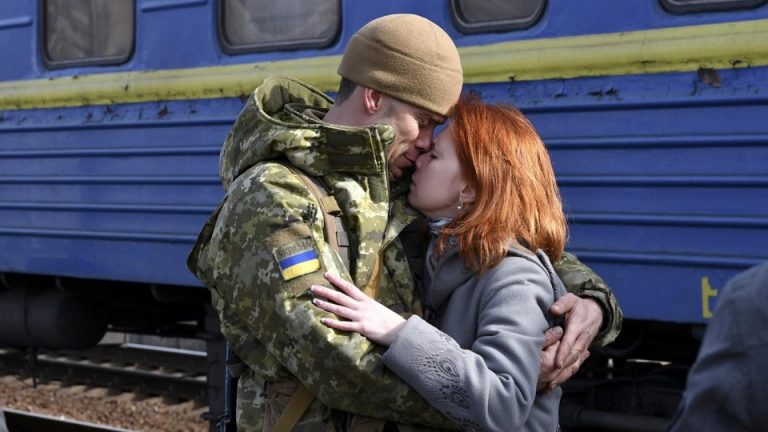
Russian troops have invaded Ukraine and are advancing towards its capital, Kyiv. Already almost 200 people including children and civilians are among the dead, and 1,115 injured. Russian president Putin claims that this war is to protect Russian speakers in the breakaway satellite ‘republics’ of Eastern Ukraine; and to remove the right-wing, pro-western, Ukrainian government whom he describes as “drug addicts and Neo-Nazis”. These are lies to justify the unjustifiable: an unnecessary and senseless war.
It is true that the imperialist North Atlantic Treaty Organisation’s (NATO) eastward expansion, including encouragement of Ukraine’s interest in membership, provoked Moscow. There is no reason for NATO’s existence since the end of the Cold War and the dissolution of the Warsaw Pact in 1991. It should be dismantled. No NATO or foreign military should enter Ukraine. Down with imperialism, in all its manifestations: political, economic, and military.
However, let us be in doubt as to what is happening now. An independent state has been invaded and occupied by the most powerful country in the region. This is not a conflict between the Russian people and the Ukrainian people. The right to self-determination of the people of the modern state of Ukraine is being violated.
The weak statement by the Sri Lankan Foreign Affairs Ministry is not surprising. Russia has long been a supporter of the authoritarian and racist Rajapaksa’s. As the Government of Sri Lanka needs Russia’s diplomatic support in international forums where its own war crimes are highlighted, this is no surprise. Putin and his ‘Greater Russian’ chauvinism has long been a model for right-wing Sinhala nationalism. However, Ukraine has close ties with Sri Lanka too. For many decades Sri Lankans have studied in its universities. Ukraine is a major buyer of its main agricultural export, tea; and it is the third largest source of tourists to Sri Lanka.
The Socialist People’s Forum of Sri Lanka demands an immediate end to the violence, bloodshed, and suffering. Russia must pull back its troops into its own territory. We salute the anti-war demonstrations and heroic acts of protest by the Russian people, under the authoritarian and murderous rule of Putin.
We call on working people, trade unions and other organisations, and the Left, to organise protests against this war around the world; and to build a global movement against wars everywhere: from Afghanistan, Kashmir and Ethiopia, to Palestine and Yemen. Stop all Wars Now!
Russia must recall at this moment the bitter lessons learned from the USSR’s invasion and occupation of Afghanistan in the 1970s, which only strengthened the reactionary forces of Islamic fundamentalism. Likewise, Russia’s current invasion will only make stronger the far-right in Ukraine. Russia out of Ukraine! Solidarity with the people of Ukraine!
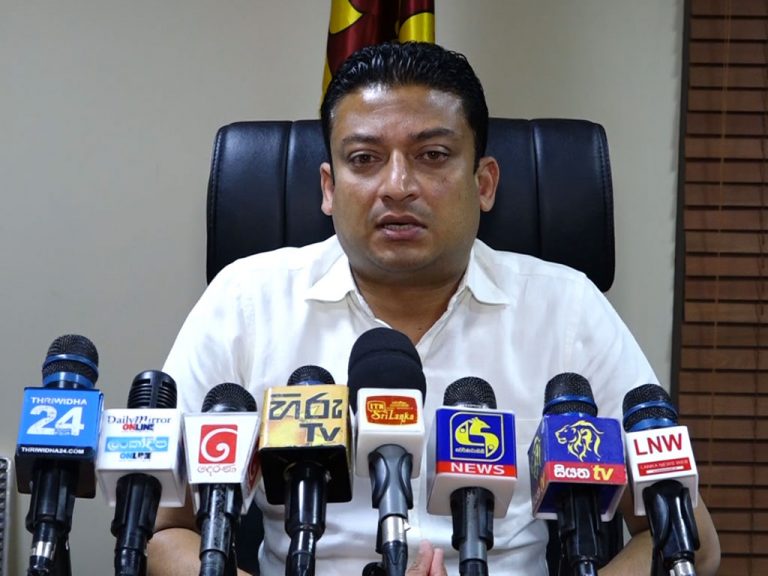
Within the next two-or-three days private buses will be given diesel via the depots of the Sri Lanka Transport Board (SLTB) said State Minister Dilum Amunugama, speaking to media today (28).
The Finance Minister has also instructed in this regard and discussions have been held with the Chairman of the Ceylon Petroleum Corporation (CEYPETCO), he added.
Accordingly, about four hundred thousand litres of diesel will be required by the SLTB buses daily and about five hundred and thirty one thousand litres of diesel by the private buses, the Minister revealed.
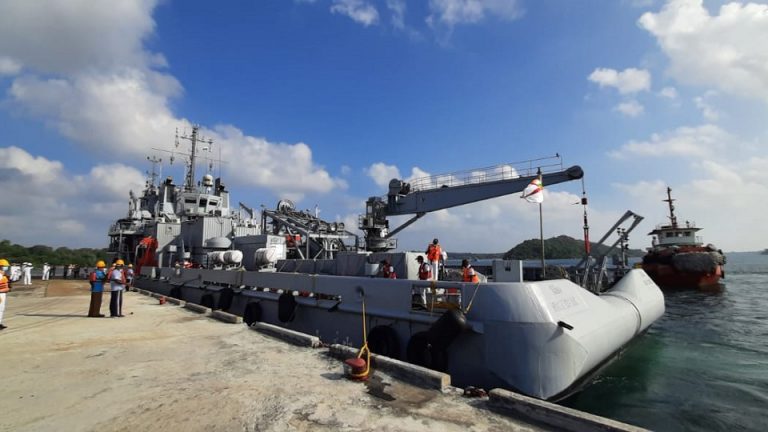
Indian Naval Ship ‘Nireekshak’, which is a highly advanced diving support ship of the Indian Navy, arrived at the port of Trincomalee on 28 February 2022 for facilitating Mixed Gas Diving training for the Sri Lanka Navy.
2. The ship was warmly welcomed by the Sri Lanka Navy in accordance with naval tradition. After arrival, the Commanding Officer of the Indian Naval ship, Commander Mohammad Ikram called on Commander of Eastern Naval Area, Rear Admiral PDS Dias. They held cordial discussions on furthering training in diving during the ten day deployment.
3. Indian Naval Ship ‘Nireekshak’ (A-15) is equipped with two six-men recompression chambers and one three-man diving bell. The ship is fully capable to undertake rescue operations from a submarine in distress and training of saturation divers. The ship had earlier visited Trincomalee in September 2019 for a similar training deployment for SLN divers. Such continued engagement of Indian Naval ships with the Sri Lanka Navy is in keeping with Government of India’s capacity building initiative as part of its ‘Neighborhood First’ policy.
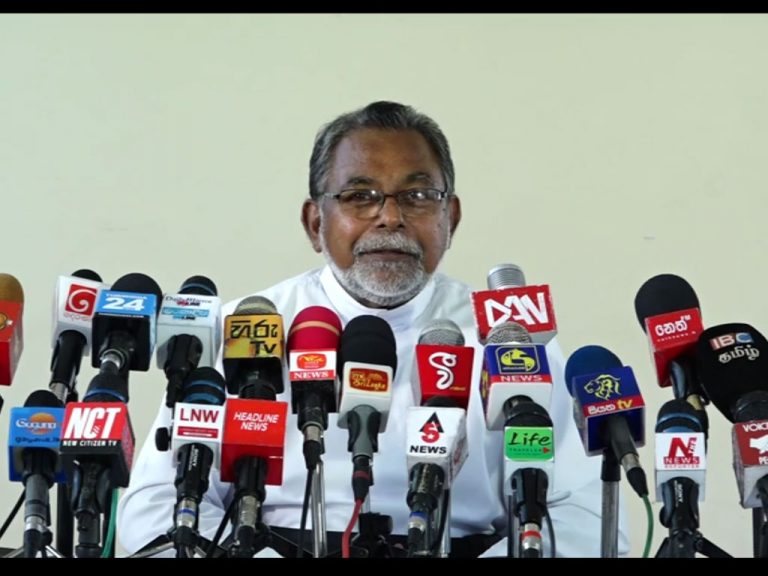
Reverend Father Cyril Gamini speaking to the briefing held at the Archbishop’s House today (28) responded to the claim made by former President Sirisena on the Easter Sunday Massacre, stating that there is no need to swear before the public about his ‘unawareness’ of the attack and that he should be appearing before law and proving his innocence.
Accordingly, the matter should be solved before the Court of Law, he emphasised.
Although the PCoI (Presidential Commission of Inquiry) report on the genocide recommends the action to be taken against about 30 people, it would be problematic as to why none of the recommendations are being implemented, Fr. Gamini pointed out.
In the backdrop, the former President shall not be making public statements swearing that he was ‘not aware’ of the attack, but should be proving his innocence before law, he added.
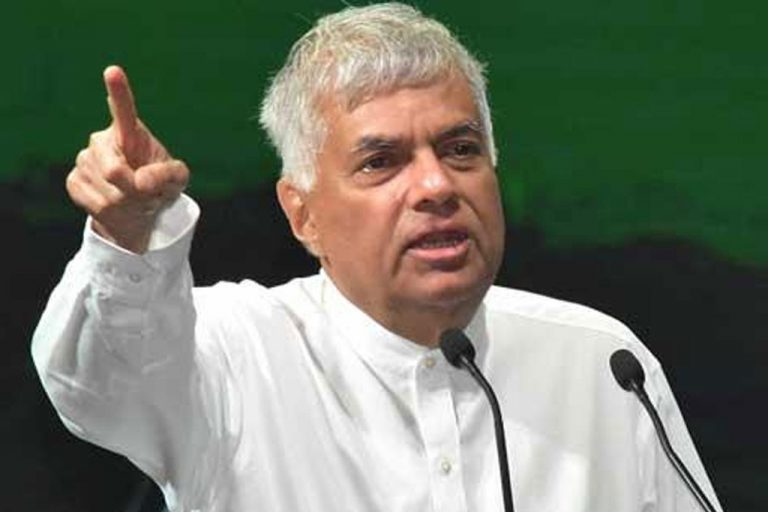
The government has failed in its ability to fulfill the promises made before the people and the people, therefore, are seeking an alternative, said Leader of the United National Party (UNP) MP Ranil Wickremesinghe, speaking at a discussion held with the Party seniors.
Suggesting that the people should be made aware that the only alternative to move the country forward backed by the international community would be the UNP, Wickremesinghe emphasised that the Party should be ready to gain power for an alternate programme.
The UNP Leader also spoke at length regarding the fuel crisis in Sri Lanka, warning that the price of crude oil in the global market could soar up to US$115.
The United Kingdom has already announced that it will increase fuel prices by nearly two pounds, Wickremesinghe revealed, adding that the entire world has to face a fuel crisis.
As of now, Sri Lanka is suffering from a severe energy crisis and the prices of fuel will have to be increased definitely, he warned.
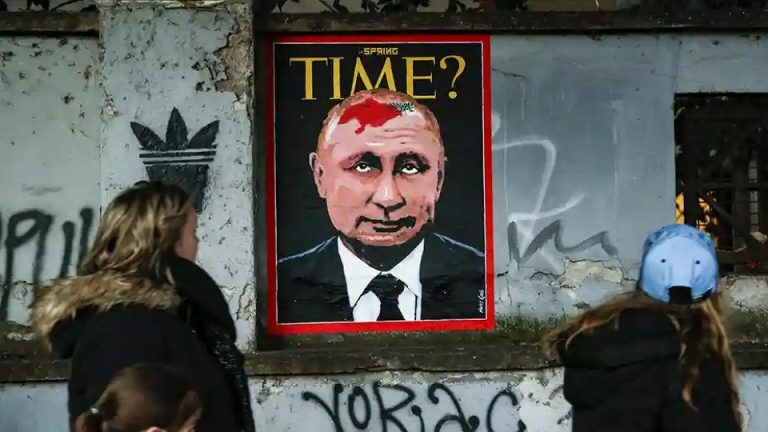
On 24 February, the armor of the “enlightened autocrat” that had housed Vladimir Putin for the previous 20 years cracked and fell to pieces. The world saw a monster –crazed in its desires and ruthless in its decisions. The monster had grown gradually, gaining strength from year to year, marinating in its own absolute authority, imperial aggression, hatred for western democracy, and malice fueled by the resentment engendered by the fall of the USSR. Now, Europe will have to deal, not with the former Putin, but the new Putin who has cast aside his mask of “business partnership” and “peaceful collaboration”. There shall never again be peace with him. How and why has this come to pass?
In the final film of Peter Jackson’s The Lord of the Rings trilogy, when Frodo Baggins has to throw into the seething lava the cursed Ring of Power, the ring which has brought so much suffering and war to the inhabitants of Middle Earth, he suddenly decides to keep it for himself. And, by the will of the ring, his face suddenly begins to change, becoming evil and sinister. The Ring of Power had taken total possession of him. Even so, in Tolkien’s book, there’s a happy ending …
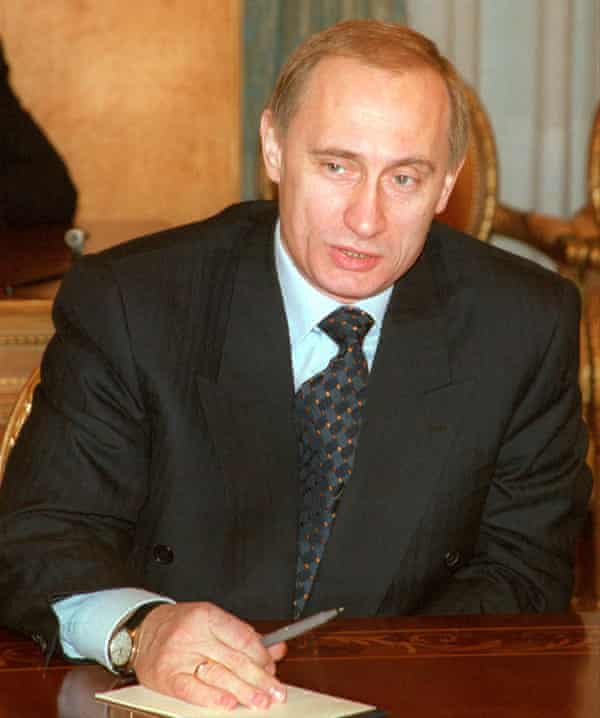
When Putin was put on the throne of Russian power by an ailing Boris Yeltsin in 1999, his face was rather sympathetic, attractive even – and his rhetoric was entirely sound. It seemed to many that the man ascending the heights of the Russian pyramid of power was an intelligent official devoid of pride and arrogance and a modern individual who understood that post-Soviet Russia had only one possible path into the future: democracy. He talked about democracy quite a bit in his interviews back then, promising the citizens of the Russian Federation continued reforms, free elections, freedom of speech, the observance of human rights by the authorities, cooperation with the west, and, most importantly, a constant rotation of those in power.
“I have no intention of holding onto this chair!” he said.
Vladimir Putin was put on the throne of Russian power by an ailing Boris Yeltsin in 1999. Photograph: AP
In Russia, as everyone knows, people still believe in the words and appearances woven by their rulers. And, back then, this man was “an individual pleasant in every respect”, as Nikolai Gogol wrote of his protagonist in Dead Souls: open to discussion, seeking to understand everyone, serious, but not devoid of humor or even the ability to make fun of himself.
Furthermore, certain politicians, intellectuals, and political theorists, who are now fierce opponents of Putin and his system, supported him, some of them even passing through the doors of his campaign headquarters to help him win the coming elections. And he did. But the fatal Ring of Russian Power was already on his finger and doing its insidious work; an imperial monster began to take the place of this handsome, lively individual.
In Russia, power is a pyramid. This pyramid was built by Ivan the Terrible in the 16th century – an ambitious, brutal tsar overrun by paranoia and a great many other vices. With the help of his personal army – the oprichnina – he cruelly and bloodily divided the Russian state into power and people, friend and foe, and the gap between them became the deepest of moats. His friendship with the Golden Horde convinced him that the only way to rule the hugeness of Russia was by becoming an occupier of this enormous zone. The occupying power had to be strong, cruel, unpredictable, and incomprehensible to the people. The people should have no choice but to obey and worship it. And a single person sits at the peak of this dark pyramid, a single person possessing absolute power and a right to all.
Paradoxically, the principle of Russian power hasn’t even remotely changed in the last five centuries. I consider this to be our country’s main tragedy. Our medieval pyramid has stood tall for all that time, its surface changing, but never its fundamental form. And it’s always been a single Russian ruler sitting at its peak: Pyotr I, Nicholas II, Stalin, Brezhnev, Andropov… Today, Putin has been sitting at its peak for more than 20 years. Having broken his promise, he clutches onto his chair with all his might. The Pyramid of Power poisons the ruler with absolute authority. It shoots archaic, medieval vibrations into the ruler and his retinue, seeming to say: “you are the masters of a country whose integrity can only be maintained by violence and cruelty; be as opaque as I am, as cruel and unpredictable, everything is allowed to you, you must call forth shock and awe in your population, the people must not understand you, but they must fear you.”
Judging by recent events, the idea of restoring the Russian Empire has entirely taken possession of Putin.
Judging by recent events, the idea of restoring the Russian Empire has entirely taken possession of Putin.
Alas, Yeltsin, who came to power on the crest of the wave of Perestroika, did not destroy the pyramid’s medieval form, he simply refurbished its surface: instead of gloomy Soviet concrete, it became colorful and was covered over with billboards advertising western goods. The Pyramid of Power exacerbated Yeltsin’s worst traits: he became rude, a bully, and an alcoholic. His face turned into a heavy, motionless mask of impudent arrogance. Toward the end of his reign, Yeltsin unleashed a senseless war onto Chechnya when it decided to secede from the Russian Federation. The pyramid built by Ivan the Terrible had succeeded in awakening the imperialist even in Yeltsin, only a short-lived democrat; as a Russian tsar, he sent tanks and bombers into Chechnya, dooming the Chechen people to death and suffering.
Yeltsin and the other creators of Perestroika surrounding him not only didn’t destroy the vicious Pyramid of Power, they didn’t bury their Soviet past either – unlike the post-war Germans who buried the corpse of their nazism in the 1950s. The corpse of this monster, which had annihilated tens of millions of its own citizens and thrown its country back 70 years into the past, was propped up in a corner: it’ll rot on its own, they thought. But it turned out not to be dead.
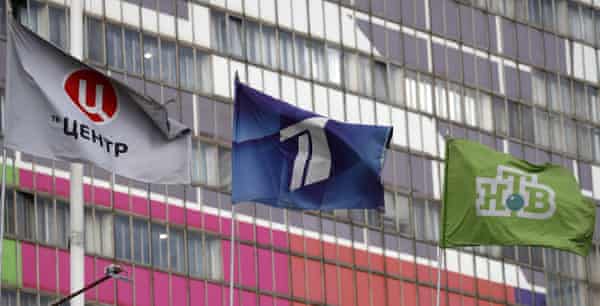
After coming to power, Putin began to change. And those who initially welcomed his reign gradually understood that these changes didn’t bode well for Russia. The TV channel NTV was destroyed, other channels began to pass into the hands of Putin’s comrades-in-arms, after which a regime of strict censorship came into effect; from that point forward, Putin was beyond criticism.
The flags of TVC Channel, Channel One and NTV Channel at the Ostankino TV Center. Photograph: Artyom Geodakyan/TASS
Mikhail Khodorkovsky, the head of the richest and most successful company in Russia, was arrested and imprisoned for 10 years. His company Yukos was looted by Putin’s friends. This “special operation” was designed to intimidate the other oligarchs. And it did: some of them left the country, but the rest swore allegiance to Putin, some of them even becoming his “coin purses”.
The Pyramid of Power was vibrating and its vibrations stopped time. Like a huge iceberg, the country was floating through the past – first its Soviet past, then only its medieval past.
Putin declared that the collapse of the USSR was the greatest catastrophe of the 20th century. For all clear-headed Soviet people, its collapse had been a blessing; it was impossible to find a single family unscathed by the Red Wheel of Stalinist Repressions. Millions were annihilated. Tens of millions were poisoned by the fumes of communism – an unattainable goal requiring moral and physical sacrifices by Soviet citizens. But Putin didn’t manage to outgrow the KGB officer inside of him, the officer who’d been taught that the USSR was the greatest hope for the progress of mankind and that the west was an enemy capable only of corruption. Launching his time machine into the past, it was as if he were returning to his Soviet youth, during which he’d been so comfortable. He gradually forced all of his subjects to return there as well.
The perversity of the Pyramid of Power lies in the fact that he who sits at its peak broadcasts his psychosomatic condition to the country’s entire population
The perversity of the Pyramid of Power lies in the fact that he who sits at its peak broadcasts his psychosomatic condition to the country’s entire population. The ideology of Putinism is quite eclectic; in it, respect for the Soviet lies side by side with feudal ethics, Lenin sharing a bed with Tsarist Russia and Russian Orthodox Christianity.
Putin’s favorite philosopher is Ivan Ilyin – a monarchist, Russian nationalist, anti-Semite, and ideologist of the White movement, who was expelled by Lenin from Soviet Russia in 1922 and ended his life in exile. When Hitler came to power in Germany, Ilyin congratulated him hotly for “bringing the Bolshevization of Germany to a halt”. “I categorically refuse to evaluate the events of the last three months in Germany from the perspective of German Jews … The liberal-democratic hypnosis of non-resistance has been cast off …” he wrote. However, when Hitler declared the Slavs to be a second-class race, Ilyin was offended and the Gestapo soon took him into custody for the criticisms he’d begun to level. He was then rescued by Sergei Rachmaninov, after which he left for Switzerland.
In his articles, Ilyin hoped that, after the fall of Bolshevism, Russia would have its own great führer, who would bring the country up from its knees. Indeed, “Russia rising from its knees” is the preferred slogan of Putin and of his Putinists. It was also taking his cue from Ilyin that he spoke contemptuously of a Ukrainian state “created by Lenin”. In fact, the independent Ukraine was not created by Lenin, but by the Central Rada in January 1918, immediately after the dissolution of the Constituent Assembly by Lenin. This state arose because of Lenin’s aggression, but not thanks to his efforts. Ilyin was convinced that if, after the Bolsheviks, the authorities in Russia were “[to become] anti-national and anti-state, obsequious toward foreigners, [to dismember] the country, [to become] patriotically unprincipled, not exclusively protecting the interests of the great Russian nation without any regard for whorish Lesser Russians [Ukrainians], to whom Lenin gave statehood, then the revolution [would] not end, but enter its new phase of perishing from western decadence.”
“Under Putin, Russia has gotten up from its knees!” his supporters often chant. Someone once joked: the country got up from its knees, but quickly got down onto all fours: corruption, authoritarianism, bureaucratic arbitrariness, and poverty. Now we might add another: war.
A lot has happened in the last 20 years. The president of the Russian Federation’s face has turned into an impenetrable mask, radiating cruelty, anger, and discontent. His main instrument of communication has become lies – lies small and big, naively superficial and highly structured, lies he seems to believe himself and lies he doesn’t. Russians are already accustomed to their president’s lie-filled rhetoric. But, now, he’s also inured Europeans to those lies. Yet another head of a European country flies to the Kremlin so as to listen through their traditional portion of fantastical lies (now at an enormous, totally paranoid table), to nod their head, to say that “the dialogue turned out to be fairly constructive” at a press conference, then to just fly away.
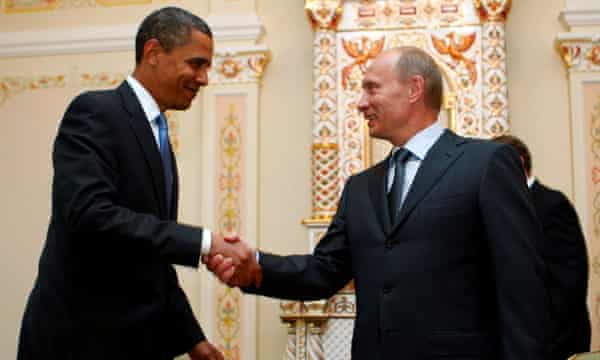
Merkel admitted that, in her opinion, Putin lives in his own fantasy land. If that’s so, what’s the point of seriously engaging with such a ruler? He’s not a writer or an artist, he has to live in the real world and be responsible for every single one of his words. For 16 years, Merkel, who grew up in the GDR and should therefore understand Putin’s true nature, “has established a dialogue”. The results of that dialogue: the seizure of certain territories in Georgia, the annexation of Crimea, the capture of the DPR and LPR, and now: a full-scale war with Ukraine. After the war with Georgia and the seizure of its territories, the “peacemaker” Obama offered Putin … a reset of their relations! Which is to say, c’mon, Vladimir, let’s forget all of that and start from scratch. The result of that “reset” was the annexation of Crimea and the war in Eastern Ukraine.
Barack Obama meets with Vladimir Putin in Moscow on 7 July 2009. Photograph: Jim Young/Reuters
Putin’s inner monster wasn’t just brought up by our Pyramid of Power and the corrupt Russian elite, to whom Putin, like the tsar to the satraps, throws fat, juicy bits of corruption from his table.
It was also cultivated by the approval of irresponsible western politicians, cynical businessmen, and corrupt journalists and political scientists.
“A strong and consistent ruler!” This bewitched them. “A new Russian tsar” was, for them, something like Russian vodka and caviar: invigorating!
During this period of time, I met many admirers of Putin in Germany, from taxi drivers to businessmen and professors. One aged participant in the student revolution of ’68 confessed:
“I really like your Putin!”
“And why exactly is that?”
“He’s strong. Tells the truth. And he’s against America. Not like the slugs we’ve got here.”
“And it doesn’t bother you that, in Russia, there’s monstrous corruption, there are practically no elections or independent courts, the opposition is being destroyed, the provinces are impoverished, Nemtsov was murdered, and TV’s become propaganda?”
“No. Those are your internal affairs. If Russians accept all of that and don’t protest, that must mean they like Putin.”
Ironclad logic. The experience of Germany in the ’30s didn’t seem to have taught such Europeans anything.
But I hope most Europeans aren’t like that. That they know the difference between democracy and dictatorship – between war and peace. In his lie-filled address, Putin called the attack on Ukraine a “military special operation” against “Ukrainian aggressors”. Which is to say: the peace-loving Russia first annexed Crimea from the “Ukrainian junta”, then unleashed a hybrid war in eastern Ukraine, and is now attacking the whole country. Pretty much exactly like Stalin with Finland in ’39.
Now, one thing has become clear: with this war, Putin has crossed a line – a red line
For Putin, life itself has always been a special operation. From the black order of the KGB, he learned not only contempt for “normal” people, always a form of expendable matter for the Soviet Moloch-state, but also the Chekist’s main principle: not a single word of truth. Everything must be hidden away, classified. His personal life, relatives, habits – everything has always been hidden, overgrown with rumors and speculation.
Now, one thing has become clear: with this war, Putin has crossed a line – a red line. The mask is off, the armor of the “enlightened autocrat” has cracked. Now, all westerners who sympathize with the “strong Russian tsar” have to shut up and realize that a full-scale war is being unleashed in 21st-century Europe. The aggressor is Putin’s Russia. It will bring nothing but death and destruction to Europe. This war was unleashed by a man corrupted by absolute power, who, in his madness, has decided to redraw the map of our world. If you listen to Putin’s speech announcing a “special operation”, America and Nato are mentioned more than Ukraine. Let us also recall his recent “ultimatum” to Nato. As such, his goal isn’t Ukraine, but western civilization, the hatred for which he lapped up in the black milk he drank from the KGB’s teat.
Who’s to blame? Us. Russians. And we’ll now have to bear this guilt until Putin’s regime collapses. For it surely will collapse and the attack on a free Ukraine is the beginning of the end.
Putinism is doomed because it’s an enemy of freedom and an enemy of democracy. People have finally understood this today. He attacked a free and democratic country precisely because it is a free and democratic country. But he’s the one who’s doomed because the world of freedom and democracy is far bigger than his dark and gloomy lair. Doomed because what he wants is a new Middle Ages, corruption, lies, and trampling on human freedoms. Because he is the past. And we must do everything in our power to make this monster remain there – in the past – for all time, together with his Pyramid of Power.
Vladimir Sorokin has written numerous novels, plays, short stories, and film scripts. His novels Telluria and Their Four Hearts, translated by Max Lawton, will be published this year
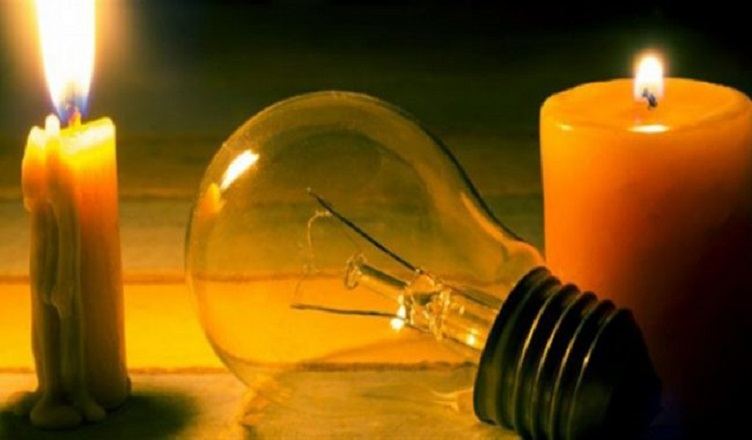
A three-hour power cut will occur in the period between 08.30 am and 05.30 pm islandwide tomorrow (01) said the Public Utilities Commission of Sri Lanka (PUCSL).
Nevertheless, an additional but unplanned power cut of 30 minutes may occur at night should the power demand increase, the Commission added.
The PUCSL, accordingly urges the public to use electricity sparingly between 06.00 pm and 10.00 pm.
The Kaduwela Magistrate Court today (28) has dropped charges against Finance Minister on another case involving the misappropriation of public funds.
The case was filed by the Police Financial Crimes Division during the previous Good Governance regime alleging misappropriation of Samurdhi officers’ bonuses and was dropped as the Attorney General’s Department had informed that it could not be continued.
Accordingly, all charges against Rajapaksa have been dropped, ordered Kaduwela Magistrate Manjula Ratnayake.