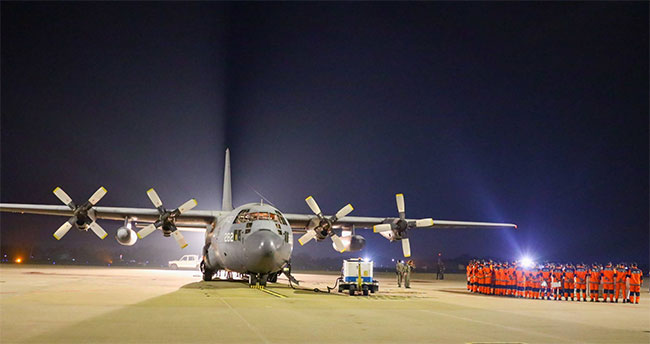
December 04, Colombo (LNW): Sri Lanka received a significant boost to its disaster-relief efforts yesterday (03) evening as a Pakistan Air Force C-130 transport aircraft touched down in Colombo carrying vital supplies and a specialist search-and-rescue unit.
The consignment was formally handed over by Pakistan’s High Commissioner and accepted on behalf of the government by Deputy Minister Janitha Ruwan Kodithuwakku.
The delivery forms part of a wider emergency mobilisation launched by Islamabad in the aftermath of Cyclone Ditwah, which caused extensive destruction across several districts in Sri Lanka. Pakistan’s National Disaster Management Authority confirmed that a 47-member expert rescue team from the Pakistan Army, supported by 6.5 tonnes of technical equipment, was flown out earlier on the instructions of Prime Minister Muhammad Shehbaz Sharif.
The aid package is substantial and wide-ranging, including tents for displaced families, warm bedding, life jackets, inflatable boats, pumping equipment for flood-hit zones, lanterns, ground mats, mosquito nets, essential medicines, dry infant formula and ready-to-eat food packs. Pakistani naval vessels and helicopters are also reported to be contributing to relief missions already under way in Sri Lankan waters and coastal regions.
A formal send-off ceremony was held in Islamabad, attended by Pakistan’s Federal Minister Dr Tariq Fazal Chaudhry, NDMA Chairman Lt Gen Inam Haider Malik, and Sri Lanka’s High Commissioner in Pakistan, Rear Admiral Fred Senevirathne (Rtd). Their presence underscored the close cooperation between the two nations, which intensified following recent discussions between Prime Minister Sharif and President Anura Kumara Dissanayake.
In addition to the airlift, NDMA has arranged further consignments on SriLankan Airlines flights operating between Lahore and Colombo. Under special orders from the Prime Minister, Pakistan also dispatched 200 tonnes of relief goods by sea yesterday, and preparations are under way to send temporary modular bridges from the Pakistan Army to help reconnect isolated communities.
Pakistan has emphasised that it will continue providing whatever assistance is required, reaffirming its longstanding commitment to humanitarian support and regional solidarity during times of crisis.
Pakistan Deploys Aircraft and Relief Teams as Colombo Receives Major Humanitarian Consignment
Global Development Partners Pledge Robust Support for Sri Lanka’s Post-Cyclone Relief and Recovery
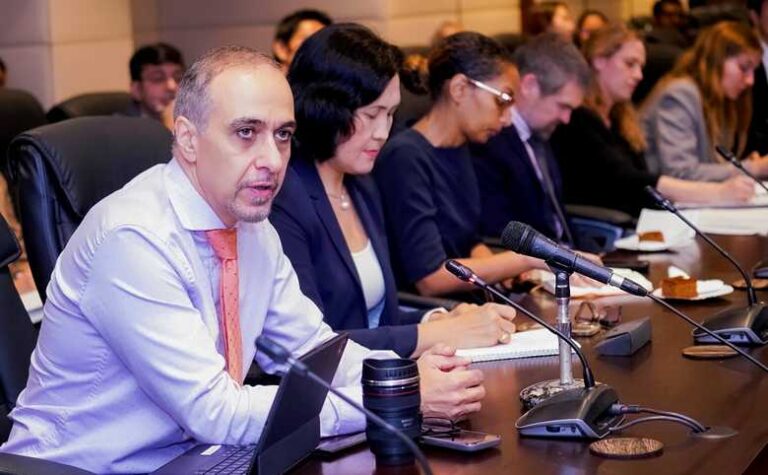
December 04, Colombo (LNW): The Ministry of Finance yesterday (03) convened a high-level donor forum bringing together diplomatic missions, bilateral and multilateral development partners and international lending agencies to assess the aftermath of Cyclone Ditwah and coordinate assistance for national relief, rescue and restoration efforts.
The meeting, co-chaired by the Governor of the Central Bank and the Secretary to the Treasury, was attended by senior government officials, including Senior Economic Adviser to the President, Mr.Duminda Hulangamuwa, Senior Additional Secretary to the President, Mr. Russell Aponsu, Secretary to the Ministry of Public Administration, Mr.Aloka Bandara, as well as representatives from the Prime Minister’s Office, Ministry of Foreign Affairs, Foreign Employment and Tourism, the Disaster Management Centre and Treasury Departments.
The Secretary to the Treasury presented an overview of the extensive damage caused by the cyclone across all sectors of the country, stressing the government’s intention to transition from emergency response to a broader, long-term recovery framework. He underscored the urgent need for development assistance from bilateral and multilateral partners, particularly rapid humanitarian support such as food supplies, grants, concessional financing and short- to medium-term aid.
The Central Bank Governor highlighted the importance of external financial support, noting the constraints posed by contracting economic sectors and limited scope for domestic borrowing. Government authorities also urged development partners to encourage international engagement and promote travel to Sri Lanka to help revitalise the tourism sector.
Development partners reaffirmed their strong commitment to support Sri Lanka during this critical period. A representative of the International Monetary Fund announced that Sri Lanka is expected to receive swift access to approximately USD 350 million, the sixth tranche of the Extended Fund Facility, within two weeks.
Several development and donor partners have also committed to immediate assistance, including disaster relief missions, emergency services and essential humanitarian supplies such as food, clean drinking water, hygiene kits, medical supplies and emergency healthcare to stabilise affected communities and prevent disease outbreaks. Some countries have already deployed disaster relief and humanitarian teams on the ground.
Partners also agreed to repurpose and redesign existing loan facilities to support medium-term rehabilitation of damaged economic and social infrastructure including major roads, bridges, irrigation systems and transport networks. They further explored options for new loan and grant packages to address long-term development needs.
The World Bank has already initiated a rapid post-disaster assessment, while development partners held detailed discussions on a comprehensive damage and needs assessment covering housing, infrastructure, agriculture and services to mobilise funding for medium- and long-term recovery.
Sri Lanka extended its deep appreciation to all international development partners for their proactive engagement, solidarity and continued support as the country works to restore essential services, assist affected families and rebuild the nation.
(PMD)
Rebuilding Fund Sets Out New Strategy With Overseas Sri Lankans Rallying Behind Recovery Effort
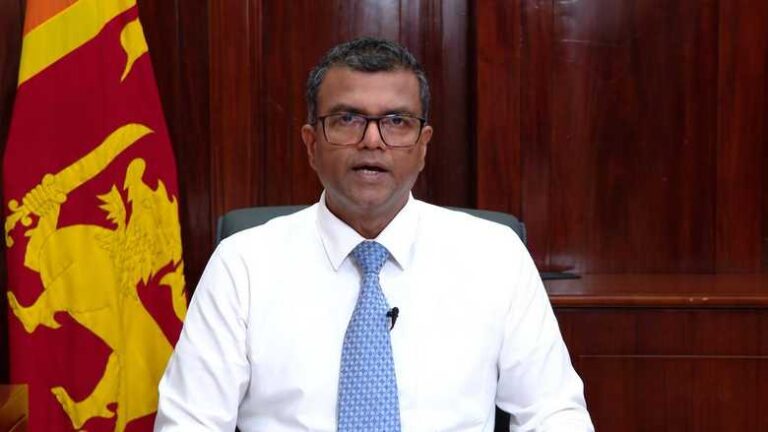
December 04, Colombo (LNW): The Management Committee of the “Rebuilding Sri Lanka” Fund—created on the direction of President Anura Kumara Dissanayake to support the nation’s post-cyclone recovery—convened at the Presidential Secretariat yesterday (03) morning.
The session was led by Dr Anil Jayantha Fernando, Minister of Labour and Deputy Minister of Finance and Planning, who called for an intensified push to secure the financial resources needed to revive communities and industries damaged by Cyclone Ditwah.
Committee members reviewed funding gaps across multiple sectors and explored avenues to strengthen the national recovery drive.
Much of the discussion centred on widening the country’s fundraising network. Suggestions included deepening engagement with foreign missions, cultivating support from international development partners, and channelling the goodwill of Sri Lankans living overseas.
Officials also examined how public institutions, private enterprises, charitable foundations, and individual citizens might meaningfully contribute to rebuilding efforts.
Senior Additional Secretary to the President, Rusell Aponsu, who serves as the committee’s convener, joined other representatives from state agencies and the business community in mapping out the next phase of the fund’s operations.
In a related update, Secretary to the Ministry of Finance, Planning & Economic Development, Dr Harshana Suriyapperuma, reported that more than 19,000 Sri Lankan migrant workers have already contributed to the fund. Delivering a statement yesterday, he outlined a series of coordinated measures introduced to accommodate the widespread desire among overseas Sri Lankans to aid the country during this difficult period.
He said that, in addition to the dedicated bank account established at the Bank of Ceylon to receive cash donations, a parallel mechanism now allows overseas contributors to send essential supplies to Sri Lanka free of customs charges and with simplified documentation.
A special task force under the Director General of Customs is overseeing the clearance process to ensure that relief goods reach the Disaster Management Centre without delay.
All Sri Lankan diplomatic missions have been briefed on these procedures, enabling donors abroad to channel assistance either through official banking routes or via their nearest mission. Once received by the DMC, consignments are dispatched to affected districts through local administrative offices.
Dr Suriyapperuma emphasised that every contribution—whether monetary or material—helps rebuild shattered lives. He urged all Sri Lankans, both at home and overseas, to extend whatever support they can, noting that the collective effort remains crucial as the country navigates its path to recovery.
28,500 Military Personnel Deployed to Bolster Nationwide Rescue Efforts Amid Crisis
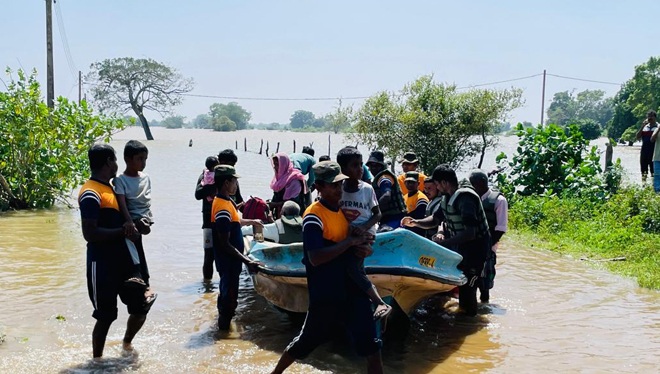
December 04, Colombo (LNW): Lieutenant General Lasantha Rodrigo has revealed that nearly 28,500 members of the armed services are now on the ground across the country, working around the clock to assist communities struck by the recent spell of destructive weather.
Their efforts range from emergency evacuations to clearing debris and helping restore day-to-day life in areas still reeling from the impact.
According to the Army Commander, tri-forces teams have already brought 31,057 people to safety, often carrying out rescues in difficult terrain and challenging conditions. Officials say operations will continue until all affected regions are stabilised and essential services are fully reinstated.
In a separate update, the Telecommunications Regulatory Commission of Sri Lanka reported that more than three-quarters of the disrupted communications network is now back online. Director General Air Vice Marshal Bandula Herath (Retd.) noted that engineers are also repairing damaged fibre lines, with priority given to districts where connectivity remains patchy.
The Sri Lanka Tourism Promotion Bureau offered reassurance to the international community, confirming that no visiting tourists have suffered serious harm during the disaster. Chairman Buddhika Hewawasam added that travellers can continue to access the country’s key attractions, as most tourism sites and transport links have resumed regular operations despite the wider challenges faced by local communities.
Colombo-Kandy Key Arterial Route Shut Again as Authorities Assess Fresh Risks in Kadugannawa
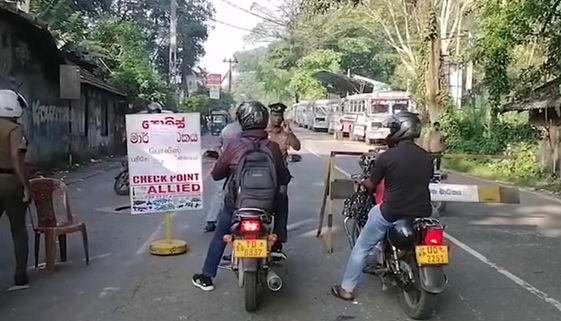
December 04, Colombo (LNW): The main highway linking Kandy and Colombo has been closed once more at Pahala Kadugannawa, following renewed concerns over safety in the area.
Police confirmed that traffic will not be allowed to pass between Kadugannawa town and Ganetenne until further notice, citing instability along the affected stretch.
Despite the closure, vehicles carrying essential goods and those involved in ongoing relief efforts have been granted passage. Officials from the Road Development Authority (RDA) are on site, carrying out detailed inspections to determine whether the ground conditions have deteriorated after the recent spell of severe weather.
The Ministry of Transport, Highways and Urban Development had reported only yesterday that one lane of the previously blocked section had reopened to motorists, with movement permitted from 6 a.m. to 9 p.m.
The renewed shutdown has therefore come as an unwelcome development for commuters who rely heavily on the route.
In a wider update, the RDA announced that 159 roads affected by landslides, flooding and debris following the heavy rains triggered by Cyclone Ditwah have now been cleared and made accessible.
Engineering teams continue to operate on extended schedules to stabilise weakened embankments, repair damaged surfaces, and restore safe travel across the island.
Authorities say that the remaining closed roads will be reopened as soon as engineers deem them secure, stressing that public safety remains the foremost priority while recovery work continues.
President Directs Fast-Tracked Aid Delivery as Government Ramps Up Post-Disaster Response
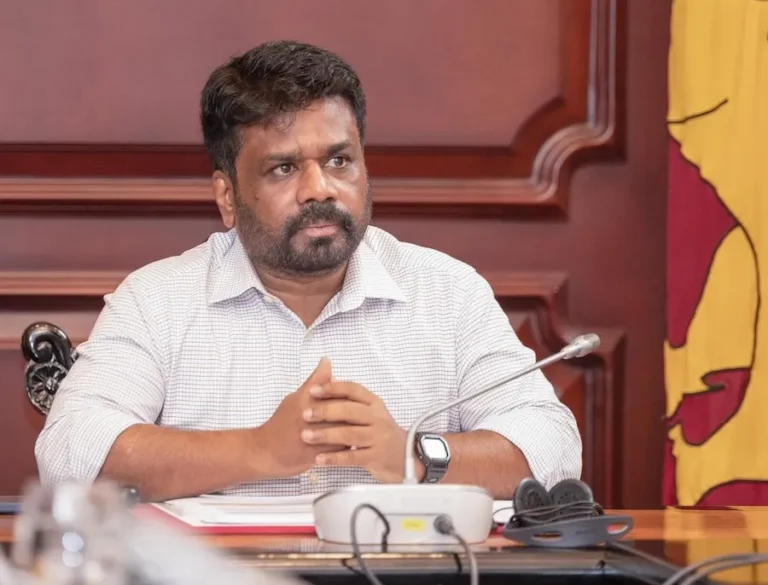
December 04, Colombo (LNW): President Anura Kumara Dissanayake has reaffirmed his administration’s determination to ensure that assistance reaches every household struck by the recent calamity, stressing that no community should face setbacks due to bureaucratic or financial holdups.
According to the President’s Media Division, state officials have been instructed to submit all required information without delay so that compensation can be processed swiftly for those who meet the criteria. The directive also underscores the importance of gathering precise data, as accurate records will guide both immediate relief measures and longer-term recovery plans.
These comments came during a high-level discussion convened to speed up the delivery of support to families and businesses hit hardest by the disaster. The meeting, held at the Presidential Secretariat and chaired by the President, brought together ministry secretaries and senior figures from the Ministry of Finance to map out a streamlined approach.
In a bid to avoid the administrative bottlenecks that often emerge after large-scale emergencies, a dedicated team has been appointed to work outside the usual procedural boundaries. Officials say the unit will operate with an accelerated mandate, ensuring that verification and distribution processes proceed smoothly and without unnecessary red tape.
The President also called for meticulous assessments of those displaced, the number of affected schoolchildren, and the extent of damage to homes across impacted districts. Particular emphasis was placed on the agricultural sector, with instructions to document the losses in paddy fields, vegetable plots, livestock, and other vital rural assets.
During the discussion, participants outlined clear procedures and target timelines for channelling assistance to each affected group, with the aim of restoring stability and helping communities regain their footing as efficiently as possible.
ADB Unlocks Emergency Funds to Aid Sri Lanka and Neighbouring Nations after Cyclone Havoc
December 04, Colombo (LNW): The Asian Development Bank has unveiled a fresh package of emergency assistance for countries battered by the recent bout of extreme weather in South and Southeast Asia.
Sri Lanka is set to receive roughly US$3 million to bolster its disaster-response efforts in the wake of Cyclone Ditwah, while Thailand and Viet Nam have each been allocated around US$2 million to help them cope with widespread flooding and the disruption left in the storm’s wake.
ADB President Masato Kanda confirmed the support after regional governments appealed for urgent help. He expressed deep concern for communities whose homes and livelihoods had been swept away, noting that the bank would work hand-in-hand with national authorities to deliver immediate relief and to steady the path towards recovery.
According to Kanda, the priority is to ensure that affected families regain access to safe shelter, essential supplies, and a sense of security as quickly as possible.
The money will be channelled through the Asia Pacific Disaster Response Fund, a mechanism designed to release rapid-fire grants to developing members facing acute humanitarian needs following natural calamities.
Officials say the fund has been activated to accelerate life-saving interventions—ranging from temporary housing to emergency medical support—in areas where floodwaters have erased roads, damaged power lines, and isolated villages.
Cyclone Ditwah and the resulting floods have caused heavy casualties and widespread devastation across Sri Lanka and parts of Southeast Asia, with rescue teams continuing to navigate treacherous conditions to reach stranded residents.
Local authorities report that the scale of the destruction may take weeks to fully assess, and early estimates suggest significant rebuilding will be required in both urban centres and rural districts.
US Pledges Fresh Aid as Sri Lanka Reels from Cyclone Ditwah

December 04, Colombo (LNW): Washington has announced a new emergency package worth roughly $2 million to help Sri Lankans struggling in the aftermath of Cyclone Ditwah, which tore across the island with devastating force.
The support is intended to bolster urgent humanitarian work, including medical assistance, safe shelter, and basic supplies for communities left reeling.
According to a statement from the US State Department, officials will draw on the Department of War’s long-range airlift resources to speed up the wider American relief effort—an unusual move underscoring the scale of the crisis.
Diplomatic staff and disaster specialists are said to be liaising closely with Sri Lankan authorities, local volunteers, and international charities to ensure that help reaches isolated and heavily damaged districts without delay.
US representatives have also emphasised that this latest emergency package is just one part of a broader commitment to assist Sri Lanka as it embarks on a lengthy process of rebuilding shattered homes, restoring essential services, and supporting affected families.
In offering sympathies to those who lost loved ones or livelihoods, Washington noted that the destruction left by Cyclone Ditwah has been “deeply saddening”, adding that the United States stands ready to support Sri Lanka through both immediate relief and longer-term recovery.
Several spells of showers expected across Island (Dec 04)

December 04, Colombo (LNW): Several spells of showers will occur in Northern, North-Central, Eastern and Uva provinces and in Hambantota and Matale districts, the Department of Meteorology said in its daily weather forecast today (04).
Showers or thundershowers will occur in the other areas of the island after 1.00 p.m. Fairly heavy falls about 75 mm are likely at some places in Western and Sabaragamuwa Provinces.
Misty conditions can be expected at some places in Western, Central, Sabaragamuwa, Uva and North-central provinces and in Kurunegala and Vavuniya districts during the early hours of the morning.
The general public is kindly requested to take adequate precautions to minimise damages caused by temporary localised strong winds and lightning during thundershowers.
Marine Weather:
Condition of Rain:
Showers will occur at several places in the sea areas off the coast extending from Kankasanthurai to Hambantota via Trincomalee and Batticaloa.
Winds:
Winds will be North-easterly or variable in the sea areas around the island. Wind speed will be (25-35) kmph.
State of Sea:
The sea areas around the island may be slight to moderate.
Serviced Office Giant Kerner Haus Bets Big on Colombo Hub

Kerner Haus Global Solutions PLC has taken a decisive step in its turnaround efforts by entering Colombo’s serviced-office market, an industry increasingly critical to Sri Lanka’s slowly recovering business ecosystem. The company signed a Property Management Agreement with VKM Services Ltd. to operate a prime commercial building at No. 46/10, Nawam Mawatha, Colombo 2, marking the first execution phase of its “asset-light” expansion strategy.
On paper, the deal promises Rs. 12.6 million annually from existing leases alone. But behind the optimism lies a deeper strategic gamble: Kerner Haus is trying to rebuild credibility after years of financial distress, including a negative net asset value of Rs. 72 per share by September 2025. The firm’s majority ownership lies with Ekta Global Ltd., which controls 63.62%, while the public float remains just 27.4%.
The company’s plan revolves around developing a scalable property-management platform before venturing into selective acquisitions. This is a deliberate shift from capital-heavy real-estate models that contributed to its earlier instability. The Nawam Mawatha building—located in the heart of Colombo’s financial district will serve as its test case. With capacity for about 300 office seats, surrounded by major banks, corporate headquarters, and quick transport access, the property sits in one of the most commercially valuable zones in the country.
Under the Kerner Haus brand, the location will operate as a fully serviced office centre, offering plug-and-play workspaces, high-speed connectivity, maintenance, utilities, and on-demand support services. Such setups have become essential for startups, BPO and KPO operators, and internationally oriented SMEs seeking flexibility without the burden of long-term leases.
Industry analysts note that Sri Lanka’s outsourcing sector is expanding even amid macroeconomic uncertainty, fuelled by foreign firms seeking lower operational costs. As a result, demand for professionally managed, short-term office solutions is rising. However, the market is also highly competitive, with global operators, local coworking brands, and tech-park developers all vying for the same pool of tenants.
Kerner Haus’s challenge, therefore, is twofold: restoring investor confidence while proving its ability to manage premium-grade serviced-office facilities. Yesterday’s market response was favourable, its share price climbed from Rs. 656 to Rs. 780.50but sustaining momentum will require consistent operational performance, not just strategic announcements.
If executed effectively, the project could become a lifeline not only for the company but also for Colombo’s entrepreneurial community, offering much-needed modern workspace solutions at a time when startups struggle with overheads and economic volatility. But if mismanaged, it risks becoming yet another unrealised corporate promise in Sri Lanka’s fragile commercial property landscape.