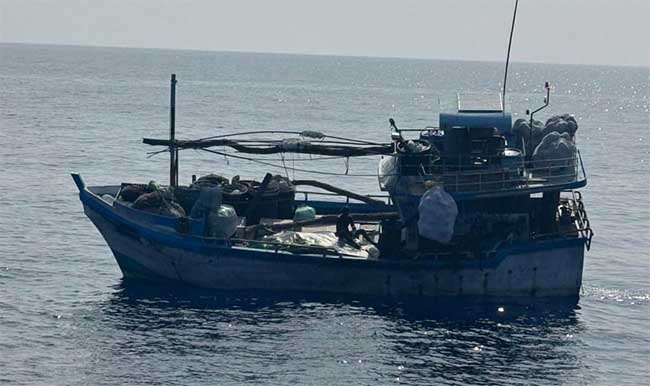
November 11, Colombo (LNW): Maldivian authorities have confirmed that a Sri Lankan fishing vessel intercepted within the country’s territorial waters was carrying a significant consignment of narcotics, marking what officials describe as the largest drug seizure ever recorded in the Maldives.
The vessel, identified as Avishka Putha, was detained by the Maldives National Defence Force (MNDF) Coast Guard on November 07 after it was found operating illegally inside Maldivian maritime boundaries. Aboard the trawler were five Sri Lankan nationals, aged between 28 and 63, all of whom were taken into custody.
Following a court order, Maldivian police conducted a detailed search of the vessel, uncovering 58.6 kilogrammes of heroin and 297.3 kilogrammes of crystal methamphetamine (commonly known as ‘Ice’) hidden in 24 secret compartments. In total, the confiscated drugs weighed over 355 kilogrammes.
The operation was the result of close cooperation between the Maldives National Defence Force, the Maldivian Police, the Sri Lanka Navy, and the Sri Lanka Police. Law enforcement agencies from both countries are continuing to coordinate their efforts to trace the origins and intended destination of the narcotics.
On the advice of the Maldivian Attorney General, arrangements are reportedly underway to transfer the arrested crew members and the confiscated drugs to Sri Lanka for further legal proceedings. A specialised team from Sri Lanka’s Police Narcotics Bureau and Navy has already arrived in the Maldives to assist with the joint inquiry.
Authorities have hailed the bust as a major success in regional maritime surveillance and counter-narcotics collaboration, underscoring the growing need for vigilance against transnational drug trafficking across the Indian Ocean.
Maldivian Authorities Confirm Seized Sri Lankan Vessel Contained Narcotics
Browns EV Unveils Sri Lanka’s Most Affordable Electric Car, the BAW E7, with Test Drives in Kegalle

November 11, Colombo (LNW): Browns EV is set to introduce the newest addition to Sri Lanka’s electric vehicle market — the BAW E7 — with an exclusive three-day launch event taking place at the LOLC II branch in Kegalle from November 13, to 15.
During this event, visitors will have the opportunity to test drive the vehicle and experience its performance first-hand.
Manufactured in China, the BAW E7 stands out as the most economical electric car currently available in Sri Lanka, priced at just Rs. 4.7 million. Despite its affordability, the vehicle comes fully equipped with an array of modern technological features designed to enhance comfort, efficiency, and driving pleasure.
The BAW E7 offers an impressive driving range of up to 220 kilometres on a single charge, making it one of the most cost-effective options for everyday commuting. Adding to its appeal, Browns EV has partnered with LOLC to offer exclusive leasing packages, enabling customers to enjoy flexible and convenient financing options. Prospective buyers can also reserve their vehicle with an initial payment of Rs. 50,000.
Those interested in getting behind the wheel are encouraged to contact 0773644647 to book their test drive during the event dates.
This launch marks a significant step in Browns EV’s mission to make electric mobility accessible to a wider audience in Sri Lanka — combining luxury, advanced technology, and sustainability at an unprecedented price point.
India and Sri Lanka Launch Joint Military Drills in Karnataka to Strengthen Defence Ties
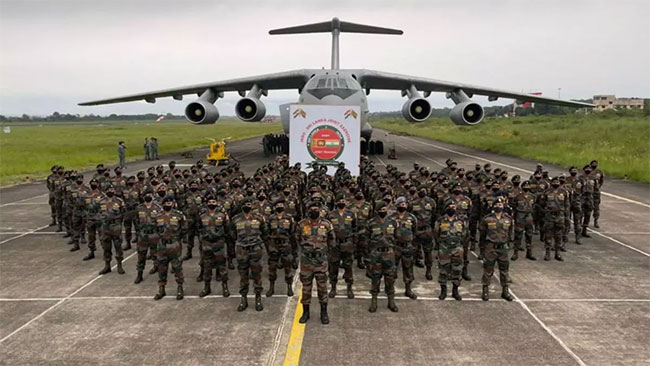
November 11, Colombo (LNW): A two-week joint military exercise between India and Sri Lanka commenced yesterday (10) in Belagavi, Karnataka, marking the beginning of the 11th edition of Exercise Mitra Shakti.
The annual engagement aims to bolster cooperation and coordination between the two neighbouring nations’ armed forces, particularly in counter-terrorism and modern combat operations.
According to the Indian Army, this year’s exercise is focused on improving interoperability in joint missions and refining tactical responses to complex security challenges. The Indian contingent, comprising 170 personnel primarily from the Rajput Regiment, is joined by 135 officers and soldiers from Sri Lanka’s Gajaba Regiment.
In addition, the Indian Air Force has deployed 20 members, while 10 personnel from the Sri Lankan Air Force are also taking part in the manoeuvres.
Participants will train together on a range of tactical scenarios, including search and destroy missions, heliborne raids, and coordinated responses to simulated terror threats. The exercise will also integrate cutting-edge technologies such as drones, counter-unmanned aerial systems, and helicopter operations to reflect the evolving nature of modern warfare.
Mitra Shakti 2025 underscores the deepening defence cooperation between India and Sri Lanka, serving as a platform not only for military skill-sharing but also for strengthening mutual trust and regional stability in the Indian Ocean region.
Sri Lanka Backs Global Push for Digital Transformation in Tourism
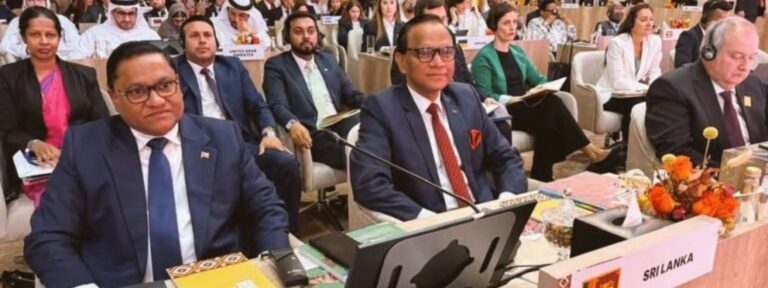
November 11, Colombo (LNW): Sri Lanka has voiced its firm backing for the Riyadh Declaration on the Future of Tourism, joining other nations at the 26th Session of the United Nations World Tourism Organisation (UNWTO) General Assembly, held in Riyadh, Saudi Arabia.
Delivering Sri Lanka’s statement at the gathering, Foreign Affairs Minister Vijitha Herath reaffirmed the country’s commitment to the principles of the Declaration, noting that its focus on digital transformation and sustainability mirrors Sri Lanka’s own tourism and economic development strategies.
Minister Herath emphasised that Sri Lanka’s recovery and growth efforts hinge significantly on the modernisation of the tourism sector through digital innovation. He observed that the Declaration’s policy framework and practical measures were closely aligned with the government’s ongoing initiatives to integrate technology and enhance visitor experiences.
Expressing optimism about the global cooperation that the Riyadh Declaration seeks to foster, the Minister welcomed forthcoming initiatives such as reports on artificial intelligence applications in tourism and the exploration of a future international convention.
Herath concluded by reaffirming Sri Lanka’s readiness to collaborate with the international community in shaping a more resilient, inclusive, and tech-driven future for global tourism.
Parliament to Continue Intense Deliberations on 2026 Budget for Third Day
November 10, Colombo (LNW): The third day of discussions on the Second Reading of the 2026 Appropriation Bill will resume in Parliament this morning (11), with proceedings beginning at 9:30 a.m. and the main budget debate set to start at 11:00 a.m.
President Anura Kumara Dissanayake presented the 2026 Budget to the House last Friday, outlining the government’s financial roadmap for the coming year. The proposed figures forecast state revenue at approximately Rs. 5,300 million, while total expenditure is projected to reach Rs. 7,057 million—leaving a shortfall of Rs. 1,757 million, equivalent to 5.1 per cent of the nation’s Gross Domestic Product.
Parliamentary debate on the Second Reading will continue over six sittings, culminating in a vote on Friday (14) at 6:00 p.m. Once concluded, attention will turn to the Committee Stage—often regarded as the most detailed phase of scrutiny—which is set to run for 17 days, from November 15 until December 05. The final vote on the Third Reading is scheduled for 6:00 p.m. on December 05.
Sessions are expected to be held daily throughout the Budget Period, with the exception of Sundays and public holidays. Lawmakers are anticipated to engage in rigorous exchanges as fiscal priorities and spending commitments for 2026 come under close examination.
Afternoon showers, thundershowers to further continue: Fairly heavy falls above 75 mm expected (Nov 11)

November 11, Colombo (LNW): Showers or thundershowers will occur at most parts of the island after 1.00 p.m., and fairly heavy falls above 75 mm are likely at some places in Uva, Southern, Sabaragamuwa and Central provinces and in Ampara and Batticaloa districts, the Department of Meteorology said in its daily weather forecast today (11).
Showers may occur in Northern province and in Trincomalee district during the morning too.
Misty conditions can be expected at some places in Western, Southern, Sabaragamuwa, Central and Uva provinces and in Ampara district during the early hours of the morning.
The general public is kindly requested to take adequate precautions to minimise damages caused by temporary localised strong winds and lightning during thundershowers.
Marine Weather:
Condition of Rain:
Showers or thundershowers will occur at several places in the sea areas around the island.
Winds:
Winds will be North-westerly or variable in direction and speed will be (20-30) kmph.
Wind speed can increase up to 40 kmph at times in the sea areas off the coast extending from Galle to Hambantota via Matara.
State of Sea:
The sea areas off the coast extending from Galle to Hambantota via Matara will be moderate. The other sea areas around the island will be slight.
Temporarily strong gusty winds and very rough seas can be expected during thundershowers.
Sri Lanka’s Digital Energy Drive Faces Hurdles despite Early Gains

By: Staff Writer
November 10, Colombo (LNW): Sri Lanka’s push toward a digital energy ecosystem is gathering momentum, but progress remains uneven, hampered by funding shortfalls, weak coordination, and the absence of a unified national roadmap, according to the Institute of Policy Studies’ (IPS) State of the Economy 2025 report.
The report highlights that while the National Energy Policy (NEP) 2019 laid the groundwork for digitalisation, its implementation has been fragmented, particularly amid the country’s macroeconomic crisis. Rising import costs and foreign currency shortages have further strained the power sector, limiting the rollout of digital initiatives.
Despite these challenges, interviews with key stakeholders including the Ministry of Power and Energy, the Ceylon Electricity Board (CEB), the Public Utilities Commission of Sri Lanka (PUCSL), Lanka Electricity Company (LECO), and the Sri Lanka Sustainable Energy Authority (SLSEA) reveal pilot-level progress and early adoption of smart technologies.
Support from the Asian Development Bank (ADB) has been a critical driver, with a $200 million loan aimed at strengthening the national grid and introducing battery storage facilities.
These investments are enabling smart-grid technology adoption, and pilot projects like the one at the University of Moratuwa are advancing both research and student skill development. Feasibility studies are also underway to establish renewable-energy control centres capable of monitoring generation digitally, including wind power plants, under ADB guidance.
Operationally, LECO has launched several digitalisation pilots, including an Enterprise Resource Planning (ERP) system and around 5,600 smart-metering initiatives. Roughly 25% of its 38,000 consumer accounts now have smart meters, allowing remote reading and billing. Weather stations installed at key transformers support predictive maintenance, helping staff locate faults within a 10–15 kilometre range.
CEB, serving 7.2 million customers, has also developed its own digital platforms. The CEB Care app and SMS services provide billing, account management, and outage reporting through GPS and GIS-linked tools. LECO’s MyLECO app complements these services with usage tracking, alerts, and multi-language support. Both apps, developed locally, are seen as foundational steps toward transforming utility–consumer engagement.
However, IPS notes that digitalisation targets set under the 2020–2024 energy policy have only been partially met. Constraints include limited resources, lack of coordination, and no comprehensive national digital roadmap.
While LECO is advancing renewable-energy forecasting tools and GIS-based network automation, and CEB pilots digitalisation across its value chain, structural gaps remain. Proposed data-governance policies and mandatory building-management systems through UDA regulations have yet to be fully implemented.
SME Engine under Strain: Restructure IDB Now or Stall Growth

By: Staff Writer
November 10, Colombo (LNW): Sri Lanka stands at a critical juncture for its small and medium-enterprise (SME) sector. With the newly announced 2026 budget proposing a consolidation of the Industrial Development Board (IDB), the National Enterprise Development Authority (NEDA) and the Small & Medium Enterprise Development Division (SMED) under a single umbrella, the question is whether this institutional overhaul can deliver the leap in performance that SMEs so desperately need.
According to President Anura Kumara Dissanayake, the move is a bid to achieve “more efficient coordination” in the development of SMEs. Under the plan: IDB will absorb the functions of NEDA and SMED, with a proposed allocation of Rs. 4 billion to the IDB and an additional Rs. 1 billion earmarked for the establishment and development of industrial zones.
The overall budget for SMEs is set at Rs. 55.7 billion (Rs. 53.4 billion for capital expenditure and Rs. 2.3 billion for recurrent). A new loan scheme also aims to provide up to Rs 50 million at concessional interest rates, under a Rs. 7.7 billion allocation, and a further Rs. 5.9 billion and Rs. 6.2 billion are allocated respectively for the “Enhancing SMEs Finance Project” and the “Agriculture Value Chain Financing / Commercialisation Project”. These are significant moves indeed.
Yet behind the headline numbers lies a complex reality. SMEs are said to contribute over 52 % of GDP and employ nearly half the workforce, according to Mr. Dissanayake.
However, the structural and institutional framework to support them has long shown fragmentation and sub-optimal performance. The IDB itself only last year embarked on a structural overhaul of its staff roles and KPIs, signalling that institutional transformation is still in early phases.
For the first nine months of 2025, broader economic data offers both opportunity and caution. Export earnings rose to approximately US$12.99 billion, a 7 % increase year-on-year. Foreign direct investment (FDI) inflows reached about US$787 million over the same period.
Meanwhile the government’s budget deficit was reduced significantly to Rs. 441.4 billion from Rs. 970 billion in the January-September window, thanks to a 31 % rise in revenue to Rs. 3.83 trillion.
And yet private-sector borrowing rose in the first seven months to over Rs. 9.5 trillion. What does this mean for SMEs and the proposed restructuring? First, the rise in exports and FDI signals that external opportunities are growing but SMEs must be ready and able to tap them.
That requires well-coordinated institutional support, streamlined access to finance, stronger value-chain integration, and relevant industrial zones outside the main hubs. The proposed consolidation of IDB, NEDA and SMED, if executed with clarity and accountability, could help deliver this.
However, the risks are real. Consolidation can lead to disruption, duplication, cultural friction and delays unless clear transitional governance, performance metrics and stakeholder engagement are built in. The loan allocations are welcome, but access, monitoring and repayment performance will matter: the increase in private-sector borrowings shows risk is elevated. Without strong credit-risk management and targeted capacity building, SMEs may still struggle to scale and contribute meaningfully to growth.
Moreover, while macro-data is positive, the growth rate is still modest: 2025 is expected to grow only about 4–4.5 % according to the IMF and local analysts, weighed down by project delays and weak capital spending.
In that context, SMEs must become engines of productivity, not just of employment, meaning the new industrial zones and value-chain financing must enable export-ready manufacturing or services, not mere substitute imports.
In short: the restructuring of the IDB, NEDA and SMED presents a significant opportunity for Sri Lankan SMEs to break out of the longstanding institutional gridlock. But the deliverables matter clarity on roles, accountability, financing terms, zone activation, value-chain linkages and monitoring.
The risk is that this turns into another institutional reshuffle without meaningful results, at a time when the SME sector and national economy need a genuine growth boost. The proof will be in execution — the next 12 months will test whether the change is cosmetic or transformational.
IMF Pushes Sri Lanka to Free EPF from Central Bank
By: Staff Writer
November 10, Colombo (LNW): Sri Lanka’s flagship retirement savings vehicle, the Employees’ Provident Fund (EPF), is sitting at the heart of a governance tug-of-war between the government and the International Monetary Fund (IMF). Under current legislation the Central Bank of Sri Lanka (CBSL) holds custodianship of the EPF’s assets yet the IMF’s recent Governance Diagnostic Assessment clearly flagged this as a conflict-risk and recommended the creation of an independent fund manager to oversee the scheme.
During a recent appearance before the Parliamentary Committee on Public Finance, CBSL Governor Nandalal Weerasinghe disclosed that the government had formally instructed CBSL to retain its custodianship role for now, despite the IMF recommending legislative reform to spin out EPF management into a separate institution akin to a Public Debt Management Office.
The IMF argues that with the EPF owning very large shareholdings across Sri Lanka’s banking and financial sector many state-owned and subject to potential political influence guardianship by CBSL creates a material risk of conflict of interest.
They note that “state-owned financial institutions are often exposed to increased risk of political influence over their operations” and that when a fund is investing in banks supervised by the same central bank, the appearance of compromised governance arises.
The EPF is the largest defined-contribution scheme for private and semi-government employees in Sri Lanka. As at the end of 2024 the Fund’s net worth stood at approximately Rs 4.38 trillion up roughly 12.6 % from Rs 3.89 trillion at end-2023.
According to the EPF’s website, assets reached Rs 4.3757 trillion at end-2024, with liabilities to members of Rs 4.2895 trillion. Member contributions jumped to Rs 234.4 billion, refunds fell to Rs 188.1 billion, and the number of contributing accounts rose by 10.8 % to 2.92 million.
During 2022 the EPF declared a rate of return of 9.00% to members, with assets at Rs 3.4599 trillion, up 9.3 % from the previous year.
With such a large asset base amounting to several % of GDP the EPF is more than a pension pool: it is a strategic national financial lever. The IMF’s governance diagnostic warns that when a large pension fund is overseen by the same institution that supervises banks and invests in them, it may indirectly shape government or banking behaviour, reduce transparency, and increase risk of politically-driven investments.
Creating a separate, independent fund manager could enhance clarity of accountability, reduce the potential for conflicted decision-making, and raise transparency (especially important given the IMF’s broader governance agenda, which calls for stronger independence of oversight institutions).
From an economic-policy standpoint, retention of the EPF under CBSL custody means the same entity that steers monetary policy (and supervises banks) also invests the largest retirement fund in the country heightening systemic concentration risk. In a situation of banking stress or large-scale government borrowing (as Sri Lanka continues to face), the EPF could be exposed to losses that bleed into general economic stability or foreshadow hidden contingent liabilities
Sri Lanka Defunct Shipping Corp Drains Millions amid Mismanagement
By: Staff Writer
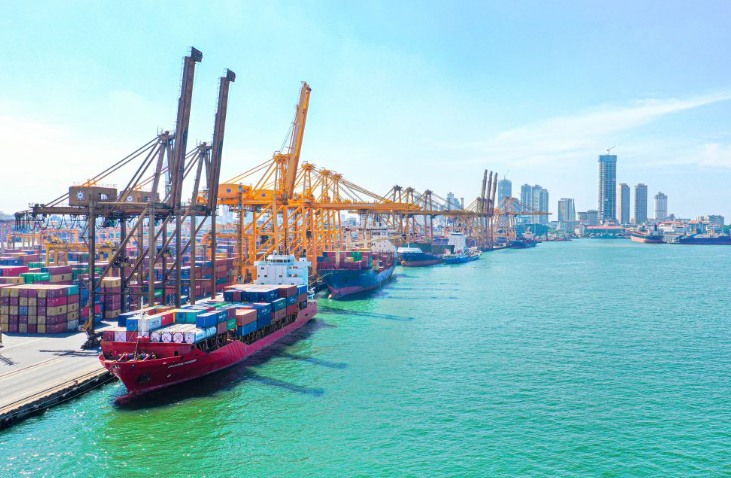
November 10, Colombo (LNW): Once envisioned as a vital link between the Sri Lanka Ports Authority (SLPA) and the global maritime industry, a semi-state company jointly owned by the SLPA (40%) and the Ceylon Shipping Corporation (15%) has now become a financial burden on the national economy.
Established to elevate the quality of port services to international standards, the company’s steady decline in profitability, operational inefficiency, and poor financial discipline have turned it into a defunct enterprise struggling for relevance.
The company was initially tasked with a wide range of functions from controlling port transportation and managing cargo handling to administering employment agencies, managing Galle Face Green, and recruiting Sri Lankan seafarers for international employment. Despite these strategic responsibilities, its financial performance in 2023 paints a grim picture of mismanagement and stagnation.
According to audited data, the company’s total income for 2023 amounted to Rs. 145.66 million, against an expenditure of Rs. 143.24 million, leaving a meagre profit of Rs. 2.4 million a sharp drop from Rs. 7.1 million in the previous year. The 3% decline in income reflects operational inefficiencies and a lack of strategic direction, raising serious questions about its economic viability.
The financial setbacks have not been limited to reduced profits. In a glaring example of mismanagement, the company entered into an agreement in 2014 with Tangyo Haulage (Pvt) Ltd to obtain carrier vehicles. Its subsequent failure to meet payment obligations led to a court-ordered compensation of Rs. 28.9 million in 2017, draining valuable public funds. This legal debacle remains a testament to weak financial control and oversight.
Further compounding its troubles, the company leased out a cafeteria at the Macculum Gate premises of the Ports Authority to a third party from 2008 to 2023. Despite the operation spanning 15 years, a sum of Rs. 4.5 million remains unpaid to the company, with no recovery action initiated even by the end of 2023. This negligence not only highlights lax financial governance but also exposes the absence of accountability mechanisms within the management.
Economists warn that the prolonged inefficiency of such semi-state enterprises imposes a silent but significant burden on the national economy. If a company with state ownership continues to generate negligible returns while holding valuable assets, it effectively ties up public capital that could be reallocated to productive sectors like logistics modernization, trade facilitation, or digital port management.
Given Sri Lanka’s ongoing efforts to reform and commercialize state-owned enterprises, the question of whether this company should continue to operate in its current form has become increasingly relevant. Analysts argue that unless the entity undergoes deep restructuring, transparent management reforms, and performance-based accountability, it will remain an economic liability rather than a contributor to national growth.
In the face of recurring losses, unpaid dues, and outdated operational practices, the company’s viability is now in serious doubt. Without decisive government intervention either through restructuring or strategic partnerships with private operators the once-promising venture risks becoming yet another failed state-owned enterprise draining scarce public resources