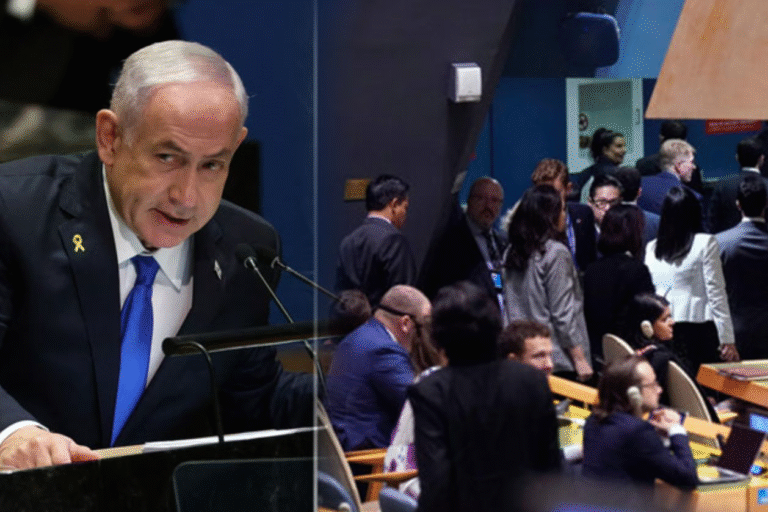
Israeli Prime Minister Benjamin Netanyahu delivered a defiant address to the U.N. General Assembly on Friday, vowing that Israel “must finish the job” against Hamas in Gaza, even as his government faces unprecedented international isolation and mounting war crimes accusations.
Dozens of delegates walked out of the hall before his speech, while others shouted protests. The U.S. delegationremained in place, though it was represented only by lower-level diplomats rather than senior officials or the ambassador.
Wearing a special pin symbolizing the October 7 hostage crisis, Netanyahu held up a large map titled “THE CURSE” and praised former U.S. President Donald Trump, calling him his chief ally. He also announced an “unprecedented operation” in which the Israeli army would broadcast his speech directly onto the mobile phones of Gaza residents, as well as via loudspeakers placed on the Israeli border.
Netanyahu’s remarks came as Australia, Canada, France, the U.K. and other nations formally recognized a Palestinian state, while the EU considers sanctions and tariffs against Israel. The International Criminal Court has issued an arrest warrant against Netanyahu on charges of crimes against humanity, while the International Court of Justice is weighing South Africa’s allegation of genocide in Gaza—both of which Israel rejects.
The conflict, triggered by Hamas’ October 2023 attack that killed about 1,200 Israelis and saw 251 taken hostage, has since killed over 65,000 Palestinians and displaced 90% of Gaza’s population, according to U.N. figures.
On Thursday, Palestinian President Mahmoud Abbas addressed the Assembly via video, urging stronger international action to deliver Palestinian statehood. “The time has come for the international community to do right by the Palestinian people,” Abbas said.
Netanyahu, however, dismissed a two-state solution, calling it a reward for Hamas. “This will not happen,” he declared before leaving Israel for New York.
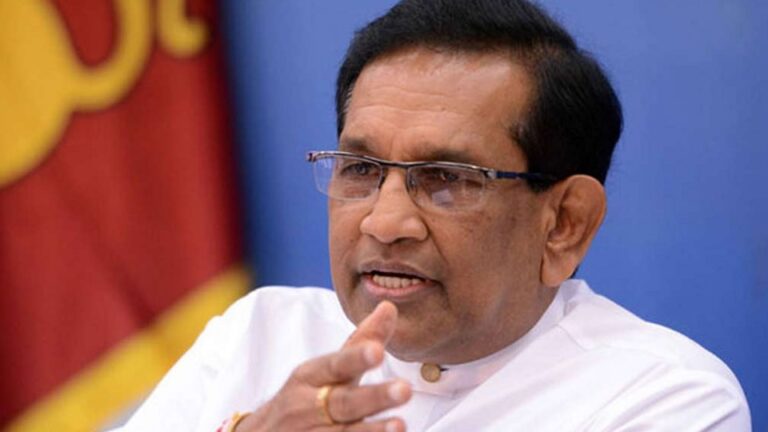
The Commission to Investigate Allegations of Bribery or Corruption (CIABOC) informed the Colombo Magistrate’s Court that indictments will be filed before the High Court against former Fisheries Minister Rajitha Senaratne and two others over alleged irregularities in awarding a sand mining project at the Kirinda Fishery Harbour.
The case was taken up yesterday (26) before Colombo Chief Magistrate Asanka S. Bodaragama, court reporters said.
According to CIABOC officials, investigations revealed that the government suffered a loss of over Rs. 26 million after the project was awarded to a Korean company in violation of legal procedures.
Along with Senaratne, former Ceylon Fishery Harbour Corporation Chairman Upali Liyanage has also been named as a defendant. Both suspects have already been released on bail.
The case will be taken up again on January 30, 2026.
The Meteorology Department states that showers will occur at times in Western, Sabaragamuwa, North-western, and Southern provinces, and in Kandy and Nuwara Eliya districts.
Fairly heavy rainfall of above 50 mm is likely at some places in Western, Sabaragamuwa, and North-western provinces, and in Galle, Matara, Kandy, and Nuwara Eliya districts.
Light showers may occur in the North-central Province, and in Matale, Mannar, and Jaffna districts, the Department said.
Strong winds of about 40–50 kmph can be expected at times over the western slopes of the central hills, and in Central, Northern, North-central, and North-western provinces, as well as in Trincomalee and Hambantota districts.
The general public is kindly requested to take adequate precautions to minimize damage caused by strong winds.
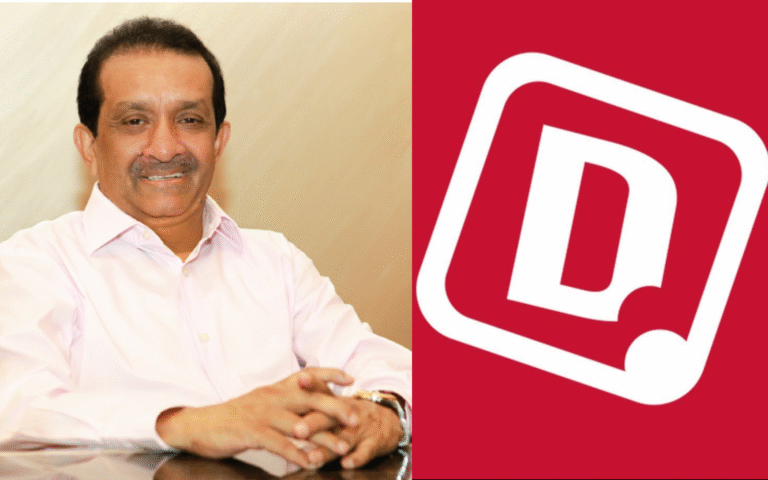
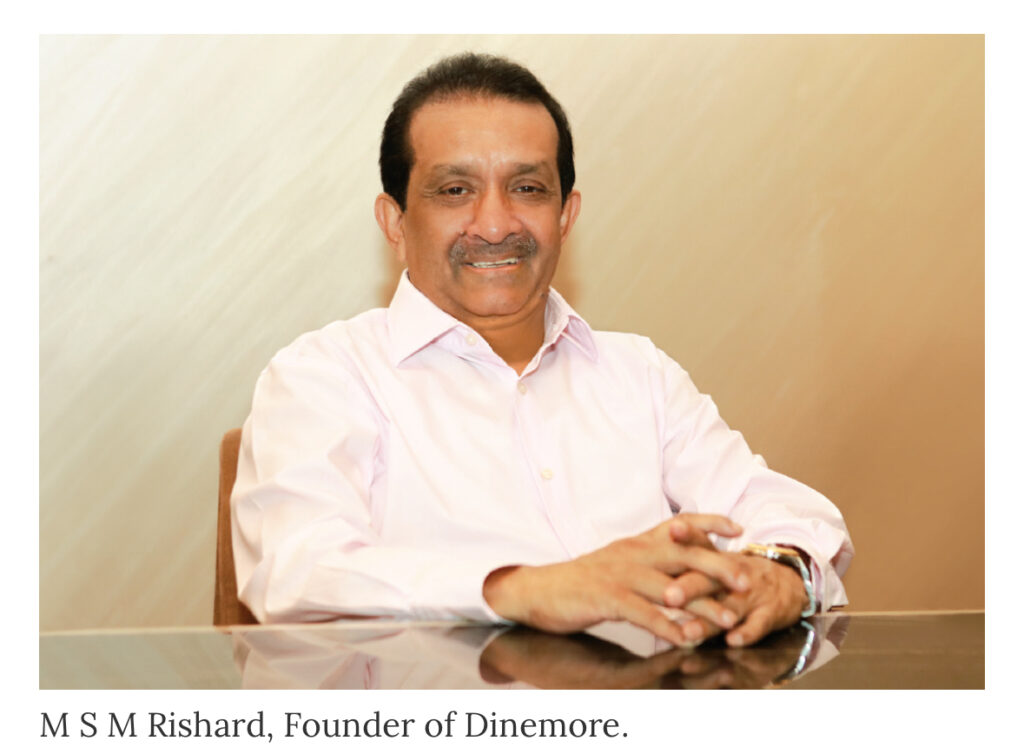
In the buzzing Colombo, while explosions echoed through the streets and uncertainty gripped the nation, a quiet dreamer was sketching his vision on the back of a napkin. M.S.M. Rishard didn’t set out to revolutionize Sri Lanka’s dining landscape, he simply wanted to feed people well.
The Dreamer’s Beginning
Rishard was never one for grand announcements or flashy proclamations. While others spoke of their ambitions, he worked in silence, his hands already busy perfecting recipes that would one day feed millions. His colleagues from his days training with an American fast food chain remember him not for his words, but for his watchful eyes, always observing, always learning, always planning something bigger than what met the eye.
The dream was simple yet profound: create a place where every Sri Lankan, regardless of their station in life, could enjoy a quality meal that respected both their palate and their pocket. In a country divided by class and circumstance, Rishard envisioned something revolutionary, a table where everyone belonged.
Building in the Shadows of War
When Dinemore first opened its doors in 1997, few believed it would survive. The country was bleeding, the economy was fragile, and starting a restaurant seemed like financial suicide. But Rishard saw what others couldn’t, that in times of darkness, people crave normalcy, comfort, and the simple joy of sharing good food.
He didn’t launch with fanfare or celebrity endorsements. Instead, he quietly perfected his craft, spending countless hours in the kitchen, his apron stained with the evidence of his dedication. When customers began trickling in, they found not just food, but the warm presence of a man who genuinely cared about their satisfaction.
The early days were humbling. Four submarine sandwiches sold on the first day might have discouraged others, but Rishard smiled quietly and returned to his kitchen. He understood that greatness isn’t built overnight, it’s earned one satisfied customer at a time.
The Heart of a Servant
Those who worked with Rishard tell stories that reveal the depth of his character. When a chef once refused to fulfill a large order, claiming it was too much work, Rishard didn’t argue or replace him. Instead, he rolled up his sleeves, tied his apron, and cooked every single biryani pack himself.
This wasn’t about proving a point, it was about honoring a promise. In that moment, sweating over the stoves, Rishard established something more valuable than a business philosophy: he showed that service isn’t beneath anyone, especially not the person at the top.
His restaurants became sanctuaries of equality. The executive in his pressed suit sat beside the laborer in his work clothes, both savoring the same carefully prepared meal. Rishard had achieved something remarkable, he had created spaces where Sri Lanka’s social barriers dissolved over shared plates.
The Philanthropist in Shadows
While Rishard built his business empire, he was simultaneously building something else entirely, a network of quiet generosity that touched lives across the island. His charitable work was conducted with the same discretion that marked his business philosophy. No press releases, no naming ceremonies, no public acknowledgments.
Staff members would sometimes notice him disappearing for hours, returning with a satisfied smile but never an explanation. Community leaders in remote villages knew of mysterious donations that arrived exactly when needed. Children in orphanages discovered their meals had quietly improved in quality and quantity, never knowing who had made it possible.
His left hand truly didn’t know what his right hand was doing, and that was exactly how he preferred it. For Rishard, charity wasn’t about recognition, it was about the simple joy of knowing that somewhere, someone was sleeping with a full stomach because of his generosity.
Success in Silence
As Dinemore grew from one location to multiple outlets across Sri Lanka, Rishard remained the same humble figure he had always been. While competitors sought media attention and celebrity endorsements, he continued working behind the scenes, perfecting recipes, training staff, and ensuring that every customer received the same quality experience whether they visited the first outlet or the fifteenth.
His success metrics weren’t measured in headlines or industry awards, but in the smiles of customers, the loyalty of his team, and the quiet satisfaction of knowing he had created something meaningful. When business publications tried to feature him as a success story, he politely declined, preferring to let his restaurants speak for themselves.
The Joy of Feeding Others
At his core, Rishard was driven by something beautifully simple: the pure joy of seeing people well-fed and happy. Colleagues remember his habit of quietly observing the dining area, his face lighting up whenever he spotted a customer savoring their meal or a family sharing laughter over their dinner.
He understood that food is more than sustenance, it’s comfort, celebration, and connection. Every recipe he perfected, every service standard he established, was guided by a single question: “Will this bring joy to the person eating it?”
The Legacy of a Silent Giant
Today, as DinemoreGo expands across Sri Lanka, the story continues to be written in the same quiet manner that Rishard has always preferred. The acquisition of twelve new locations represents not just business growth, but the expansion of a philosophy, that good food, served with genuine care, can build bridges and create community.
Nearly three decades after that first day with four submarine sandwiches, Rishard’s vision has become reality. He has built not just a successful business, but a beloved institution that has fed millions and employed thousands. He has proven that true success doesn’t need to shout, it simply needs to serve.
In an age of self-promotion and social media fame, M.S.M. Rishard remains delightfully old-fashioned. He builds in silence, serves with humility, and gives without expectation. His story is proof that the most powerful legacies are often written by those who never sought to have their names in lights, but simply wanted to light up the faces of those they served.
As Sri Lanka continues to evolve, one constant remains: somewhere in Colombo, there’s a quiet man with a gentle smile, still perfecting recipes, still serving his community, still believing that the greatest success comes not from what you achieve, but from whom you feed along the way.
As part of its expansion strategy, Dinemore recently acquired International Restaurant Services (Pvt) Ltd., which previously held an international franchise for a global brand. This acquisition secures 12 prime restaurant locations across Sri Lanka, strengthening Dinemore’s presence in high-visibility hubs and enhancing its ability to serve millions of Sri Lankans with the same trusted quality it has upheld for nearly 30 years.
Mr. M.S.M. Rishard, Founder of Dinemore, commenting on the launch, said:
“We are proud to unveil DinemoreGo, which marks an exciting new phase of our journey. These new outlets will deliver our fresh and exquisite dining experience with greater convenience, while carrying forward Dinemore’s heritage of quality and service.”
With this milestone, Dinemore reinforces its position as one of Sri Lanka’s leading QSR brands. By evolving to meet modern lifestyles, the company continues to shape the island’s dining landscape while staying true to its legacy of innovation and customer trust.
Sri Lanka finds itself confronting a silent crisis in its microfinance sector, an industry once heralded as a vehicle for inclusion is now accused of functioning as an informal loan shark network. In response, the government has moved to regulate what many civil society observers call a predatory, largely unregulated system that disproportionately targets the poorest.
On 11 August, the Cabinet formally approved the draft Micro Finance and Credit Regulation Authority Bill, forwarding it for publication in the Government Gazette before parliamentary debate.
The shift reflects mounting evidence that the existing Micro Finance Act No. 6 of 2016 is insufficient to curb abusive practices. The new legislation aims to create a standalone authority empowered to supervise microfinance and credit operations a move long demanded by activists and victim groups.
In recent years, microfinance in Sri Lanka has ballooned outside formal channels. A UNDP-commissioned brief estimates that around 15,000 microfinance institutions operate unlawfully nationwide, well beyond the regulatory reach of current law.
Only a small fraction of providers are licensed: as of May 2025, the Central Bank lists entities such as Berendina Micro Investments, Lak Jaya Micro Finance, Dumbara Micro Credit and Sejaya Micro Credit among the few authorized ones.
Despite the proliferation of lenders, official research and media investigations point to widespread abuse. According to The Morning, “hundreds of thousands” of Sri Lankans — particularly women in rural communities — are caught in spirals of debt, sometimes pushed toward desperation, eviction and even thoughts of suicide.
GroundViews reports similar patterns across impoverished districts including Polonnaruwa, Batticaloa and Nuwara Eliya, where microfinance borrowers regularly lose assets and dignity under aggressive recovery tactics.
Women’s advocacy groups have sounded alarms over the government’s regulatory proposal. Some argue that it privileges for-profit microfinance companies while imposing stricter controls on community-based and female-oriented self-help groups. Critics say these protections, which once shielded grassroots lenders, are now being dismantled despite their relatively benign role.
When grassroots borrowers fall behind, reports indicate that some lenders resort to psychological intimidation, forced repayments, and public shaming practices that can amount to human rights violations.
Proponents of regulation argue that a strong supervisory authority is essential. Without oversight, microfinance companies can levy exorbitant interest rates, hidden fees, and unsecured debt traps without recourse for victims.
The draft bill’s structure reflects lessons drawn from prior legal challenges: seven petitions were filed in the Supreme Court to block earlier drafts, prompting revision and influence from the parliamentary Sector Supervision Committee.
Yet passage and enforcement remain uncertain. The bill’s provisions on licensing, audit power, consumer protection, interest caps, transparency, and dispute resolution will determine whether it merely formalizes exploiters or protects vulnerable borrowers. Civil society insists that the regulatory body must include meaningful representation of borrowers and NGOs, not be dominated by industry interests.
Sri Lanka’s poor are already burdened by inflation, rising food costs and limited state safety nets. A microfinance regime unchecked has magnified their plight. If regulation is weak or captured, the reform could amount to a façade. Conversely, a well-crafted law, backed by vigilance and civil society participation, might begin to heal one of the country’s most persistent economic injustices. Only then could microfinance return to being a tool of support, not oppression
Emerging from one of the worst economic crises in its history, Sri Lanka is fast-tracking the push to attract foreign direct investment (FDI), fueled by far-reaching reforms under the newly passed Economic Transformation Act (ETA).
The ETA, today’s most important investment law in the country, seeks to overhaul obsolete systems, streamline approval processes, and provide a more investor-friendly environment.
The law’s key provisions are the replacement of current investment regulations, setting up new institutional frameworks, and enhanced transparency and efficiency in approvals.
According to a senior Finance Ministry official, one of the act’s primary goals is to slash the average time required to green-light investments from a staggering 269 days to just 82.
A significant focus is also being placed on Public-Private Partnerships (PPPs), with the government planning to introduce a separate Investment Management Act.
This would offer incentives like the Accelerated Depreciation Allowance (ADA) to attract private sector interest in public infrastructure projects.
Foreign direct investment (FDI) inflows to Sri Lanka reached $ 783 million as of 15 September, according to Board of Investment (BOI) Chairman Arjuna Herath.
“We are on track to cross the $ 1 billion FDI mark for 2025. The last time Sri Lanka achieved a billion dollars in FDI was in 2022,” Herath said.
While construction and telecom projects dominated in 2022, this year’s inflows have been more diversified. “We have a good mix with investments in ports, solid tyre manufacturing and the hospitality sector,” he noted.
Some of the inflows in 2022 were from projects that had Strategic Development Project Act concessions, which are no longer available.
In the twelve months to mid-September, the BOI approved 134 projects with a combined value of $ 1.3 billion.
“Investor appetite is improving because they see Sri Lanka has come a long way since the 2022 economic crisis,” Herath said.
Commenting on Sinopec’s proposal to develop a $ 3.5 billion refinery in Sri Lanka, Herath said the project had stalled over the issue of granting the company greater market access. Negotiations are still underway.
“Both sides are committed to reaching an agreement, and we believe a decision will be reached shortly,” he said, while declining to speculate on whether consensus could be achieved.
But even with all these protective measures, there are still problems. Eminent Professor Wijitapure Wimalaratana Thera, Chairman of Sri Lanka Economic Association, cautioned that geopolitical instability say, the war between Iran and Israel has a tendency to drive investors into safer assets like gold or U.S. Treasury bonds and divert capital away from emerging economies like Sri Lanka
As per finance experts, the difference in FDI data of finance ministry, BOI and othe relevant state agencies such as the ministry of industries most probably arises from using different methodologies: one could be total committed investments approved projects that have not been disbursed yet while the other is realised inflows, i.e., actual cash that has flowed into the economy.
Such numbers need to be clarified, economists say, for transparency and investor confidence. With Sri Lanka seeking $2 billion in FDI this year and looking to receive $4 billion from the tourism industry, consistency in the presentation of official numbers will be key to figuring out the reliable economic turnarounds.
Sri Lanka’s tea industry is enjoying one of its strongest export performances in over a decade, yet beneath the surface, structural weaknesses and policy uncertainty threaten to blunt its momentum.
Customs data analysed by Asia Siyaka Research shows that in the first eight months of 2025, tea exports rose to 174.5 million kilograms, a 7 percent increase compared to the same period in 2024.
Export earnings climbed to Rs. 306 billion (around US$1.2 billion), up from Rs. 288 billion (US$942 million) a year earlier.
This makes the January–August 2025 dollar earnings the highest since 2014, despite total export volumes that year being significantly higher. The free-on-board value per kilogram reached US$5.88, edging past last year’s US$5.80 and well above the 2014 average of US$5.09.
A closer look at the export structure reveals an ongoing shift toward value-added products. Bulk tea accounted for 42 percent of shipments, while packeted tea rose to 45 percent, up from 40 percent a year earlier.
Exports of tea bags remained stable at 10 percent, but volumes increased marginally. High-value categories such as instant tea grew steadily, lifting the overall share of value-added tea exports to 58 percent, compared to 53 percent in 2024.
The global market map for Sri Lankan tea is also shifting. Iraq retained its position as the largest importer with 26 million kilograms, or 15 percent of all shipments, while Russia remained in second place though volumes slipped slightly.
The standout destination this year has been Libya, where exports surged 198 percent to 14.3 million kilograms. Other major destinations included the UAE, Turkey, Iran, Chile, China, Azerbaijan and Saudi Arabia.
Yet industry leaders caution against mistaking this export surge for long-term stability. Producers are under intense pressure from soaring costs.
A government-mandated 70 percent wage hike has raised estate workers’ daily wages to Rs. 1,700, a move that producers warn could increase overall costs by nearly half, undermining competitiveness in global markets.
Fertilizer and fuel costs, coupled with high inflation, have further squeezed margins, leaving both corporate plantations and smallholders vulnerable.
The sector is also grappling with the legacy of erratic government policies. The fertilizer ban imposed in 2021, though later reversed, left lasting damage to yields and confidence.
More recently, planters complain of inconsistent decisions on subsidies, taxation, and mechanization support, with state-owned plantations remaining significantly less productive than their private counterparts.
Climate change has compounded the challenge, with erratic rainfall and prolonged droughts hitting yields and quality. Meanwhile, labor conditions remain under scrutiny.
Academic studies have flagged risks of labor exploitation and weak protections in certain plantations, raising ethical concerns that could jeopardize Sri Lanka’s access to premium international markets.
The government of President Anura Kumara Dissanayake has pledged large-scale support for the industry, including a Rs. 312 billion package aimed at clearing debts and upgrading quality.
While this marks a significant commitment, details of how the funds will be deployed remain vague. More broadly, critics argue that the administration’s tea policy remains reactive, guided by short-term political considerations rather than long-term restructuring.
For now, Sri Lanka’s tea sector stands at a delicate crossroads. The export surge of 2025 provides much-needed revenue and a boost to national morale, but it risks masking the deep fissures in the industry.
Without coherent reforms, sustained investment in technology, and careful balancing of wage demands with global competitiveness, the sector’s current success may prove fleeting. The Ceylon Tea brand may still carry prestige abroad, but at home, the foundations of the industry remain perilously fragile.
When the NPP government moved to lift the vehicle import ban early in 2025, it bet heavily on recapturing lost tax revenues. But the timing could not be worse: Sri Lanka is scrambling to shore up foreign exchange inflows and rebuild its dwindling foreign reserves. The question now: did the state trade away scarce dollars just to boost rupee-tax collections and at what longer-term cost?
As of 16 September, Sri Lankan commercial banks had opened about USD 1,570 million in Letters of Credit (LCs) for vehicle imports. According to Finance Ministry disclosures before the Committee on Public Finance, this is the magnitude of foreign exchange commitment tied to the import liberalisation. (User’s assertion)
Official testimony further indicates the government expects tax revenue from vehicle imports to reach Rs. 460 billion in 2025, but ministry officials now privately suggest that figure may exceed Rs. 700 billion by year end.
On paper, that sounds like a revenue success. But the caveat is stark: opening LCs for nearly USD 1.57 billion implicitly drains the dollar reserves money that could otherwise shore up the external buffer or service critical imports.
The finance ministry’s claim that rupee collections offset a “loss” of dollars is disingenuous: the government has effectively swapped liquidity in foreign currency for rupee revenue a zero-sum game at a perilous moment.
Public data already hints at the pressure. From January to May 2025, vehicle imports accounted for USD 312 million out of total merchandise imports of USD 1,507 million.
Meanwhile, Central Bank data shows that Sri Lanka is running a widening trade deficit, even as remittances and services exports attempt to cushion the external position.
Blooming import demand is already drawing alarm: Treasury sources indicate that LCs worth USD 742 million had been opened at one point during the year.
Additionally, independent commentary warns of trade-off risks from rising vehicle import pressures.
Central Bank projections also point to total vehicle import flows climbing to about USD 1.5 billion by end-2025.
Contrast that with last year’s constraints: during the import restrictions, the tax intake from vehicle imports dried up, but the FX outflow was curbed. The state accepted shortfalls in revenue in exchange for retaining precious dollars. Now it has reversed that trade.
What is glaringly missing from public records is a transparent cost–benefit breakdown:
How many dollars were actually drained from reserves to satisfy these LCs?
What is the net foreign reserve position today, compared with the same point last year?
How much incremental rupee revenue is “net gain” versus what would already have been collected via other taxes or suppressed domestic demand?
The government’s posture that rupee tax gains outweigh the “lost” dollars — masks a precarious assumption: that future foreign inflows (via exports, remittances, tourism) will more than replenish the reserves. This is a gamble. For now, Sri Lanka is running with a thinning external cushion.
The NPP’s vehicle import liberalisation may have succeeded in swelling coffers in rupee terms, but it has also exposed the country to foreign exchange stress at a moment of external fragility.
An independent forensic inquiry is needed to compare month-by-month FX reserve movements, vehicle import outflows, and incremental tax gains including cross-checks against prior year performance to assess whether the tradeoff was economically justified or merely a fiscal sleight-of-hand at the expense of external stability.
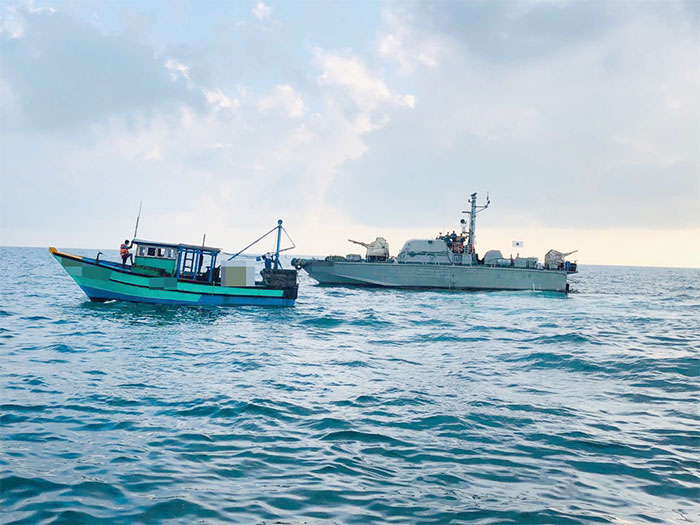
Prime Minister Dr. Harini Amarasuriya has stressed the need for international cooperation to combat illegal activities in the Indian Ocean, including drug trafficking, illegal migration, and piracy, while highlighting Sri Lanka’s role in ensuring maritime security.
She made these remarks at the Twelfth International Maritime Conference – Galle Dialogue 2025, held under the theme “Maritime Outlook of the Indian Ocean under Changing Dynamics” at the Navy Wave and Lake Banquet Hall in Welisara.
“The Indian Ocean is one of the most strategic maritime regions in the world. It is both a stage for competition and a platform for cooperation. Sri Lanka’s aim is to work with all partners to make the Indian Ocean a region that is peaceful, secure, sustainable, and governed on the basis of justice and cooperation,” the Prime Minister said.
Dr. Amarasuriya emphasized that climate change, rising sea levels, overfishing, and pollution threaten biodiversity, human security, and economic stability, underscoring the importance of marine conservation and effective maritime governance.
On combating drug trafficking, she noted:
“This is an important responsibility of our Navy and Coast Guard. The Government is committed to safeguarding national security and public health, and preventive measures are already being implemented.”
The Prime Minister further announced that the Government has allocated Rs. 92.5 billion to the Navy in the 2025 Defence Budget, a 12% increase from the previous year, describing it as a clear commitment to strengthening maritime security.
She praised the Navy’s dedication in regular patrols, intelligence-based operations, and narcotics seizures, but stressed that no nation can tackle these challenges alone.
“Freedom of navigation, maritime security, and responses to piracy and trafficking all depend on coordination and trust-building between navies and coast guards. Sri Lanka calls upon all stakeholders to contribute to a cooperative security framework founded on transparency and respect for international law,” she added.
The event was attended by Defence Deputy Minister Major General Aruna Jayasekara, Admiral of the Fleet Wasantha Karannagoda, Defence Secretary AVM Sampath Thuyacontha, Indian Navy Chief Admiral Dinesh K. Tripathi, as well as the commanders of the Army, Navy, and Air Force, along with senior Tri-Forces officials.