By: Staff Writer
September 18, Colombo (LNW): Sri Lanka is on the verge of embarking on a $3.7 billion oil refinery project with Chinese state-owned Sinopec, but the deal has raised alarm bells over energy sovereignty, market control, and mounting geopolitical influence. Approved in 2023, the proposed Hambantota refinery will process up to 200,000 barrels of crude oil per day, positioning the southern port city as a central hub in Sri Lanka’s energy landscape.
While Energy Minister Kumara Jayakody insists that the government has completed land allocations and preparatory facilities, the project’s start date hinges on unresolved negotiations with Sinopec regarding domestic fuel sales. Sources familiar with the discussions say the company has long sought greater access to Sri Lanka’s local fuel market. Originally restricted to selling only 20% of output domestically, Sinopec may now be allowed to sell up to 40% locally—a compromise that could tip the balance between national energy security and corporate profitability.
Arjuna Herath, chair of the Board of Investment, noted the delicacy of the negotiations: “If they don’t have greater market access, feasibility and viability in the current context could be challenging. That’s the point being negotiated.” Sinopec has declined public comment. Observers warn that excessive reliance on a foreign state-owned enterprise could leave Sri Lanka vulnerable to supply and pricing pressures.
In parallel, the government plans a $3 billion expansion of its Colombo-based state refinery, aiming to increase capacity from 38,000 barrels per day to 150,000 barrels per day. While this expansion is intended to bolster domestic energy security, Sinopec and other foreign companies from India, Qatar, and China have shown interest, raising concerns that foreign influence may overshadow state-run operations.
Geopolitical stakes further complicate the issue. Sri Lanka sits along critical maritime routes linking Asia, Africa, and Europe, drawing interest from both China and India. With India establishing plans for an energy hub on the eastern coast, the Hambantota refinery could become a strategic foothold for China, reinforcing fears that Sri Lanka’s energy policy is increasingly shaped by external powers rather than domestic needs.
Critics also highlight economic risks. The refinery deal could saddle Sri Lanka with high financial exposure, given Sinopec’s scale and the associated infrastructure costs. Additionally, if the majority of fuel output is exported, domestic supply could remain limited, keeping local prices high and undermining energy independence.
Experts argue that the success of Sri Lanka’s energy strategy will depend on how well the government balances foreign investment with national control. Allowing Sinopec significant market influence without robust regulatory safeguards may deliver short-term capacity gains but could lock the country into long-term dependence on a single foreign player.
As construction timelines loom, Sri Lanka faces a critical test: ensuring that its energy ambitions enhance national security and economic stability, rather than serving the strategic and commercial interests of foreign powers. The next few months of negotiation with Sinopec will be decisive in determining whether the refinery becomes a pillar of domestic energy resilience—or a geopolitical lever that leaves the country vulnerable.
Sinopec Refinery Sparks Concerns over Sri Lanka’s Energy Independence

TAX Revenue Management IT System Flaws Threaten Billions in State Revenue

By: Staff Writer
September 18, Colombo (LNW): Sri Lanka’s much-hyped Rs. 10 billion Revenue Administration Management Information System (RAMIS), introduced in 2016 to overhaul tax collection, is faltering under severe governance and technological weaknesses, raising concerns over its ability to safeguard billions in state revenue, the World Bank has cautioned.
In its latest Sri Lanka Public Finance Review – Towards a Balanced Fiscal Adjustment, the Bank warned that the Inland Revenue Department’s (IRD) reliance on an underperforming IT backbone is constraining the country’s fiscal reform agenda. RAMIS, developed by a Singaporean firm, was intended to automate core tax functions, from taxpayer registration to compliance monitoring. Yet, nearly a decade later, many of those functions remain unreliable or absent.
“The lack of functionality in RAMIS remains a binding constraint in improving tax administration,” the Bank said, noting that the IRD continues to rely on manual interventions that are resource-intensive, error-prone, and open to inefficiencies.
A critical gap lies in the maturity of the IRD’s IT department. Without strong in-house capacity, the department is heavily dependent on vendors, leaving key functions vulnerable if external support fails. The World Bank flagged weak IT governance, poor vendor management, and inadequate human resources as compounding risks.
RAMIS has yet to deliver essential tools such as fully operational taxpayer portals, automated risk management, or comprehensive data analytics. These shortcomings, the Bank argued, highlight not just technical flaws but broader institutional weaknesses.
While the IRD has laid out an IT Strategic Plan, the World Bank said it falls short of addressing urgent challenges: building a proper governance framework, attracting and retaining skilled IT staff, and developing capacity to manage vendors effectively. “The inability to attract and retain skilled IT staff undermines long-term capability,” the review stressed.
The government has set 2027 as a deadline for the IRD to build internal capacity to manage and run RAMIS independently. But the Bank stressed that this transition will require heavy investment, stronger project management, and political backing. It recommended adopting international governance standards such as COBIT or ISO/IEC 38500, expanding IT staffing, and establishing a data warehouse for better tax analysis.
Despite these structural flaws, IRD has improved efficiency in recent years. Between 2020 and 2023, its cost of collection fell from Rs. 0.86 to Rs. 0.41 for every Rs. 100 collected—well below the global average of Rs. 1. But the Bank warned that such efficiency gains cannot substitute for structural reform. To sustain higher revenue, Sri Lanka must modernise its tax authority through detailed, sequenced, and well-resourced reforms, it said.
The report also pressed for a shift towards risk-based audits and refunds, backed by legislative reform. It urged the government to introduce a new Tax Administration and Procedures Law to replace discretionary practices with transparent, codified rules.
Ultimately, the World Bank’s message is clear: unless Sri Lanka strengthens its IT backbone, governance, and human resources, RAMIS risks becoming a costly, underperforming system that threatens rather than protects the country’s fiscal future.
Spice Import Licenses Spark Fears of Backroom Deals and Industry Betrayal

By: Staff Writer
September 18, Colombo (LNW): A government decision to allow spice imports under a new “approved enterprise” scheme has sent shockwaves through the plantation sector, with mounting suspicion that the policy is less about boosting exports and more about paving the way for a handful of powerful players to dominate the spice trade.
The Planters’ Association of Ceylon (PA), in a strongly worded statement, warned that the new licensing framework could become a smuggling pipeline, dragging down prices of locally grown cinnamon, pepper, nutmeg and cloves, while tarnishing the internationally trusted Pure Ceylon Spices brand.
Officially, the move is justified as a strategy to process imported spices into value-added products such as oil extracts and oleoresins for re-export. But industry insiders allege that this narrative masks deeper motives. They fear that politically connected businesses will profit from importing cheaper raw material, blending it with local produce, and quietly releasing it into domestic and export channels.
History offers a cautionary tale. In 2016, large consignments of imported pepper allegedly entered the export stream under dubious classifications, prompting India Sri Lanka’s largest buyer—to clamp down on Ceylon spice imports. Farmers bore the brunt, with farm-gate prices collapsing and livelihoods wiped out overnight. The PA warns the country is on the brink of repeating the same debacle, this time with official sanction.
Several exporters, speaking on condition of anonymity, questioned the opaque nature of the approvals. “Nobody knows who these ‘approved enterprises’ are or on what basis they were selected. The secrecy itself raises red flags,” one exporter remarked. “This is how smuggling is legitimized through loopholes dressed up as policy.”
The danger extends beyond economics. Imported spices, grown under different environmental and sanitary standards, could introduce pests and diseases into local plantations. Once established, such infestations could devastate crops and cripple national food security. Yet, critics ask, where is the robust inspection regime to prevent such outcomes?
International markets are already reacting. Reports indicate delays in clearing spice consignments at Indian ports, amid suspicions that foreign-grown produce could be passed off under Sri Lanka’s country-of-origin certification to exploit tariff concessions. Should such fears be confirmed, India and other trading partners could retaliate, eroding hard-won export credibility across multiple commodities.
The Planters’ Association also drew parallels to the areca-nut fiasco, where hasty policy changes enabled cross-border rackets, international disputes, and a collapse in local prices. The concern is that once consumer trust in Pure Ceylon Spices is lost, no marketing campaign or policy reversal will be able to restore it.
Critics argue the bigger question remains unanswered: who stands to gain from these imports? Farmers and small-scale producers see little benefit, exporters warn of reputational ruin, and consumers face the risk of adulterated products. “This decision does not protect farmers or strengthen our brand it protects a select few enterprises whose names remain hidden,” a veteran industry analyst observed.
With livelihoods, food security and an iconic global brand at stake, the Government’s silence on the identities of license-holders and the safeguards against abuse is only fuelling suspicions. Unless transparency is enforced and farmer interests safeguarded, many fear that a centuries-old industry could be bartered away for the benefit of a privileged few.
National Library and Documentation Services Board’s Manuscripts accepted for Publication Assistance Project
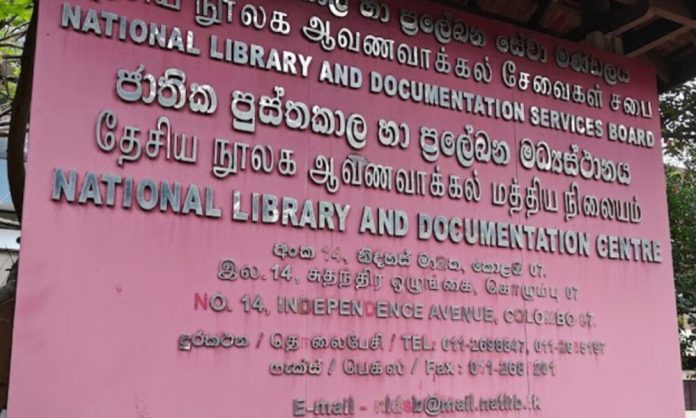
The National Library and Documentation Services Board has announced that the manuscripts accepted for the Publication Assistance Project 2026 implemented by the National Library and Documentation Services Board will be implemented from September 22, 2025 to December 31, 2025.
Under the Publication Assistance Project, it is planned to provide assistance for higher academics, research, novels, short stories, poetry, youth literature and children’s works. The National Library and Documentation Services Board further announced that it will award Rs. 150,000 for the best academic and research works, Rs. 125,000 for novels, Rs. 100,000 for short story collections and works of various genres, and Rs. 75,000 for poetry, youth literature and children’s works, and that all these works are expected to be launched for the Literature Month of 2026.
Interested writers can visit the National Library and Documentation Services Board located on Independence Avenue, Colombo 7 or call 0112-687583 for further information. Information and applications related to this project can also be obtained by visiting the website www.natlib.lk and via the email address [email protected].
Ex-Sabaragamuwa Provincial Minister Remanded Over Alleged Misuse of Public Funds
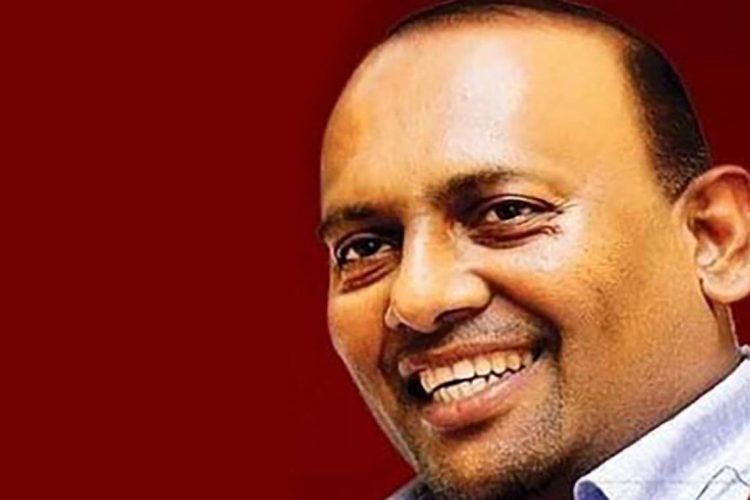
September 18, Colombo (LNW): A former Provincial Minister in the Sabaragamuwa region, Athula Kumara Rahubaddha, has been ordered to remain in remand custody until October 02, following his appearance before the Embilipitiya Magistrate’s Court today (18).
Rahubaddha was taken into custody a day earlier by officers attached to the Financial Crimes Investigation Division (FCID), operating under the Criminal Investigation Department (CID). The arrest is linked to a major financial misconduct inquiry concerning approximately Rs. 70 million in public funds that were allocated during his ministerial term between 2016 and 2017.
According to information presented in court by CID investigators, 77 development initiatives were officially approved during the relevant period, and state funds were reportedly disbursed for 15 of these projects. However, the investigators allege that there is no evidence to show that these projects were ever carried out.
The prosecution argued that this points to a deliberate misappropriation of state resources and a breach of public trust, prompting the court to order Rahubaddha’s continued detention while further inquiries are carried out.
Sri Lanka Strengthens Overseas Diplomatic Role in Trade and Investment Push
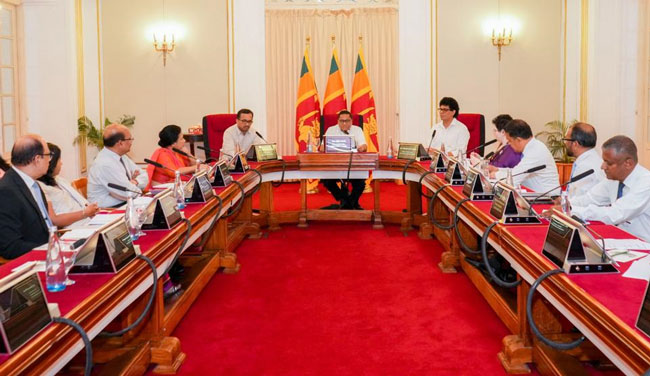
September 18, Colombo (LNW): In a bid to energise the nation’s economic diplomacy and strengthen global trade ties, Sri Lanka has unveiled a new inter-agency coordination framework designed to align its foreign missions with national trade, investment, and industrial objectives.
The initiative was formally launched by Foreign Affairs Minister Vijitha Herath, alongside Industry Minister Sunil Handunneththi and Trade Minister Wasantha Samarasinghe. Senior ministry officials, secretaries, and heads of key agencies participated in the strategic session held on September 16, which brought together all of Sri Lanka’s Heads of Mission and Post from around the world.
The gathering served as a platform to exchange key policy priorities and generate actionable proposals aimed at improving Sri Lanka’s international economic engagement. According to the Ministry of Foreign Affairs, Foreign Employment and Tourism, the session marked a decisive shift towards a more integrated, mission-driven approach to advancing the country’s economic agenda abroad.
Opening the session, Foreign Secretary Aruni Ranaraja provided a comprehensive overview of Sri Lanka’s current export and investment climate. She stressed the importance of diversification and the urgent need to move beyond traditional export sectors, urging missions to adopt strategic targeting to attract high-quality foreign investment.
She noted that coordinated inter-agency efforts—both at home and abroad—are essential to building economic resilience, especially as Sri Lanka works to stabilise and reposition itself in the global market.
Foreign Minister Vijitha Herath underscored the critical role of Sri Lanka’s diplomatic network in the post-crisis recovery phase, highlighting that embassies and consulates are now expected to serve not only as diplomatic outposts but also as active facilitators of trade and investment.
“Our Heads of Mission must now be economic ambassadors—proactive in identifying growth opportunities, cultivating investor confidence, and promoting Sri Lanka as a competitive export hub,” he said. He further added that accountability mechanisms would be put in place to monitor progress and ensure that each mission contributes meaningfully to national targets.
Minister Handunneththi addressed the need for revitalising the industrial sector, which remains a key engine of economic growth. He highlighted plans to draw foreign direct investment into key manufacturing zones, particularly in areas where Sri Lanka has natural resource advantages. He also emphasised the importance of moving up the value chain and reducing reliance on raw exports.
From a trade policy standpoint, Minister Samarasinghe warned of the shifting dynamics in global commerce, calling on officials to adopt a future-focused mindset to achieve Sri Lanka’s ambitious export goals for 2030. He emphasised the need for tailored, adaptive strategies to secure long-term trade partnerships and penetrate emerging markets.
Trade Secretary K.A. Vimalenthirarajah reaffirmed the ministry’s commitment to supporting overseas missions in executing these economic mandates, stressing that a united front among all government actors would be essential.
The session also featured detailed presentations from the leadership of the Board of Investment (BoI) and the Export Development Board (EDB), who outlined the country’s medium-term economic goals. These included data-backed projections, export growth benchmarks, and the roadmap for attracting strategic investments over the next five years.
A consensus was reached to translate the proposals into concrete action plans, with regular reviews to track implementation and make course corrections where necessary.
Ex-Lotteries Board Director Released on Bail Following Arrest Linked to Shooting Incident
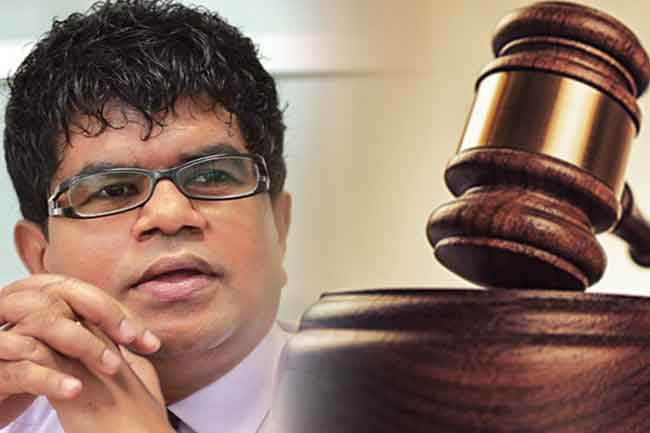
September 18, Colombo (LNW): The former Executive Director of the National Lotteries Board, Thusitha Halloluwa, has been granted bail after being produced before the Colombo Magistrate’s Court today Wednesday (18), in connection with an ongoing investigation into a shooting incident.
Presiding over the hearing, Colombo Additional Magistrate Lahiru Silva ruled that Halloluwa be released on two surety bails amounting to Rs. 500,000 each. In addition to the bail conditions, the court imposed a strict travel ban and ordered that the suspect’s passport be handed over to the authorities, effectively barring any attempt to leave the country while the case remains under judicial scrutiny.
Halloluwa, who had been evading court proceedings for several weeks, was apprehended by law enforcement officials in the Colpetty area on 19 August. His arrest follows a reported shooting incident involving his vehicle in Narahenpita—a case that has since drawn significant public and media attention due to Halloluwa’s prior role in a high-profile state institution.
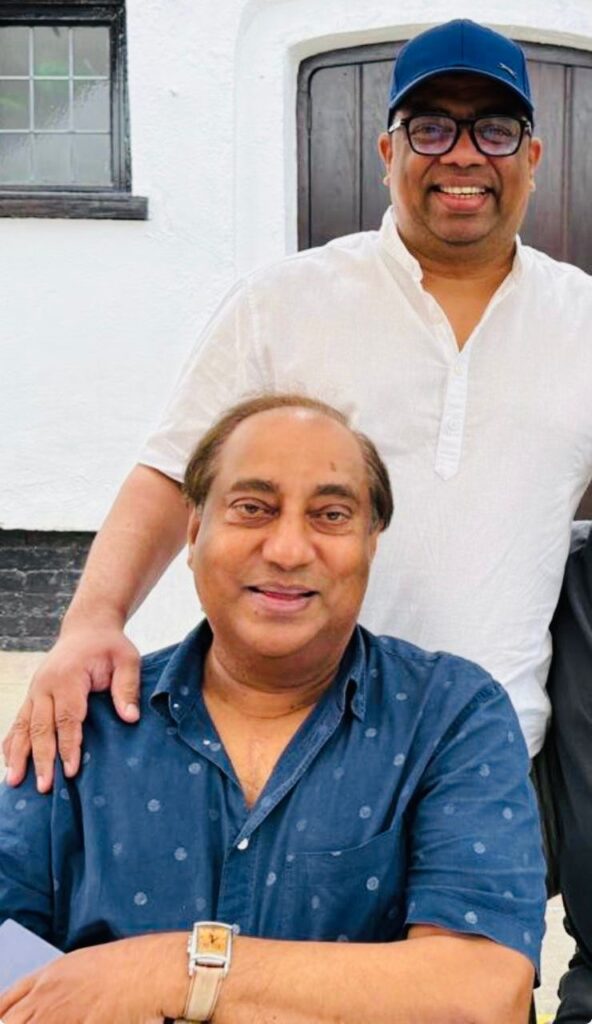
Tribute to Rajiv Perera on his 60th birthday

By Krishantha Prasad Cooray
September 18, Colombo (LNW): In life we meet many people, most of whom hardly leave a trace of their passing. Some, very few in fact, leave a mark so deep that no passage of time can erase it. For me, at the very top of that list is Rajiv Perera.
I knew of Rajiv at school – St Thomas’, Mount Lavinia – where he was a few years senior to me. A fine sportsman, he played rugby for S. Thomas’, CH & FC, and Sri Lanka. On the field he was fearless yet always a gentleman, respected by teammates and opponents alike. That same spirit carried into the rest of his life competitive when it mattered, but always fair, always gracious.
But I only really got to know him when I went to the UK for my higher studies, about 35 years ago. This was around the time that John Major had replaced the Iron Lady, Margaret Thatcher, and was just settling in as Prime Minister. I knew only a few people in London. It was through the Thomian network that I met Rajiv. We clicked immediately.
The UK Old Boys’ Association always looked after students who had just arrived in Britain. But Rajiv went far beyond that. He quickly became my closest friend and my greatest asset in London. I must confess that I sometimes took his friendship for granted. He never complained, never made me feel a burden. He simply gave with a loyalty that cannot be expressed in words.
I was living in the university halls of residence, yet Rajja would drive more than one and a half hours just to take me for a haircut. If I craved a Sri Lankan meal, he would pick me up, take me home and cook a spread that no one could match. He could cook almost anything, always tasty, always fast, and always better than anyone else. I would never have survived my university years without him.
In those days, Old Thomians gathered often, and a meal at Rajja’s was almost compulsory. Krishan Perera, Roshan Perera, Johann Wijesinghe, who is sadly no longer with us, Mahendra Iddamalgoda, Milinda Gunawardane, and Gamini Gunawardane, whom we called “Chucker” and who is also no longer with us, were regulars. And it wasn’t just Thomians. DIL Wijemanne, Aravinda de Silva, Rajind Ranatunga, Priyantha Ekanayake, Rohan Abeykoon, Dharshana Wathudura who later became Rajja’s brother-in-law, Shantha Jayasekera and Nigel Issac often joined in too. Later, Thomian Prasad Wimalasekera became a frequent visitor as well.
Rugby also brought us together. The old Thomian team used to practice at Northwick Park, with Rohan Karunaratne, another who is sadly no longer with us, as a coach. Rajiv played a key role in all this, not just as a former player himself, but as the man who bound everyone together. Some days, after rugger practice, the natural next stop was Rajja’s place, where food, laughter, and insults there were in abundance.
Those nights at Rajiv’s house were unforgettable. It was the stage for endless banter. Nobody was spared, and the teasing flew as freely as the food and drinks. We laughed until our stomachs hurt, and if you went home without being embarrassed, you knew you hadn’t really been part of the evening. Rajiv himself rarely drank, and then only for company, but he was always at the centre of it, cooking, serving, laughing, and making sure everyone left happier than when they arrived.
Rajiv became, for thousands of Sri Lankans, the first port of call in London. He did the pick-ups and drop-offs from Heathrow, drove people around, fed them, and often even sent them away with gifts. Many of us, when a friend travelled to London, would simply call Rajiv knowing he would step in, without hesitation, to provide a meal, a lift, or simply good company.
When Johann Wijesinghe fell seriously ill and was in London for treatment, Rajiv, despite not being in the best of health himself, drove Johann and his wife Kalpana around and stood by them in a remarkable way. They were deeply grateful to him. That was Rajiv in essence: his instinct was always to give, to help, and to care, even when it came at a cost to himself.
As an impatient man, I sometimes found Rajiv’s patience almost irritating. Even when people took advantage of him, he never reacted in anger. He is an extremely civilised man who would never utter hurtful words to anyone. Whenever he did a favour, he did it quietly, without making a song and dance about it. His only concern was to make people happy, never to make them sad.
Rajiv’s biggest weakness, if one can call it that, is his inability to say no – even to those who offered little or nothing in return. He helped those who deserved it, and even those who did not. It is a reflection of his kindness and generosity of spirit.
And yet, despite all that, Rajiv is an accomplished Thomian; a man full of grit and determination, and a human being overflowing with kindness and affection for everyone. He has a wonderfully dry sense of humour, delivered with a straight face, and a heart that is as big as any I have known.
God above has been kind to me in giving me extraordinary friends. Once, a Lebanese friend I came to admire within a very short time told me, “Krishantha, my address book is the wealth I will leave my children.” I understood what he meant. My own address book is perhaps even wealthier because it has in it a man like Rajiv.
On his 60th birthday, my wish for Rajiv is simple: may he know, in his heart, how much he has accomplished, not through wealth or position but through simple goodness, steadfast loyalty and the countless lives he has touched along the way. When all is said and done, life is not measured by the titles we carry or the fortunes we amass but by the laughter we inspire, the friendships we keep, and the loyalty we show.
By that measure, Rajiv, you are a rich man, richer than most. In my book, and in those of so many others who you helped, inspired and stood by every day of your life, you are our true legend. Happy birthday my dear brother.
Sri Lanka Confronts Hidden Crisis of Child Abuse with Sweeping Reforms

September 18, Colombo (LNW): Sri Lanka is facing a profound challenge in safeguarding its children, with newly released figures revealing over 15,000 reported incidents of abuse in 2024 alone—a number that officials say likely masks a far more disturbing reality.
The Minister of Women and Children’s Affairs, Saroja Paulraj, speaking candidly on the matter, described the situation as a national emergency requiring urgent and wide-reaching reform. “There is no place in a civilised society for violence against children,” she stated, calling for meaningful change across institutions, communities, and mindsets.
Statistics compiled from multiple agencies paint a troubling picture. The National Child Protection Authority (NCPA) reported receiving more than 8,700 calls via its dedicated helpline last year, whilst police records show over 6,400 formal complaints linked to abuse and exploitation. Despite the sheer volume of reports, Minister Paulraj cautioned that the official figures likely underrepresent the true scale of the issue.
“Many children suffer in silence—unseen, unheard, and unaided. Fear, shame, and social stigma often prevent them from coming forward. What we see is only the surface,” she said.
In response, the government is advancing a broad child protection strategy under the National Policy Framework 2025, aimed at creating a more responsive and compassionate system that genuinely places children at its heart.
Key reforms include the development of a more agile reporting and case-handling process, the introduction of child-sensitive investigation methods, and enhanced collaboration between protection services, schools, law enforcement, and health professionals. Training and capacity building across frontline services are also being prioritised, to ensure a skilled and empathetic response to children in distress.
“Children are not statistics. They are individuals—complex, emotional, and deserving of our full care and attention,” Minister Paulraj emphasised. “We need to move away from purely bureaucratic responses and start treating children as human beings first.”
Sri Lanka’s efforts are also being shaped by its international commitments. At the 2024 Inter-Ministerial Conference on Violence Against Children in Bogotá, the country pledged to introduce a range of progressive measures by mid-2025. These include:
* Establishing a national network of survivor support services rooted in child-centred care
* Strengthening the social services workforce with a focus on community-level prevention
* Outlawing corporal punishment in all settings, including homes and schools
* Promoting schools as safe spaces within a broader national violence prevention plan
What sets these reforms apart is the inclusion of children’s own voices. Over 1,200 children were consulted in shaping the current agenda, ensuring that the policies reflect not just adult assumptions, but the lived realities of young people across the island.
As part of its commitment to this transformative agenda, the Ministry has already increased funding allocations for care institutions, family reunification efforts, and community-based interventions. Further financial support is expected in the 2026 national budget, particularly to scale up new models of care and professionalise the role of child protection officers.
Revised Visitor Access Restrictions at BIA Departure Lobby Announced
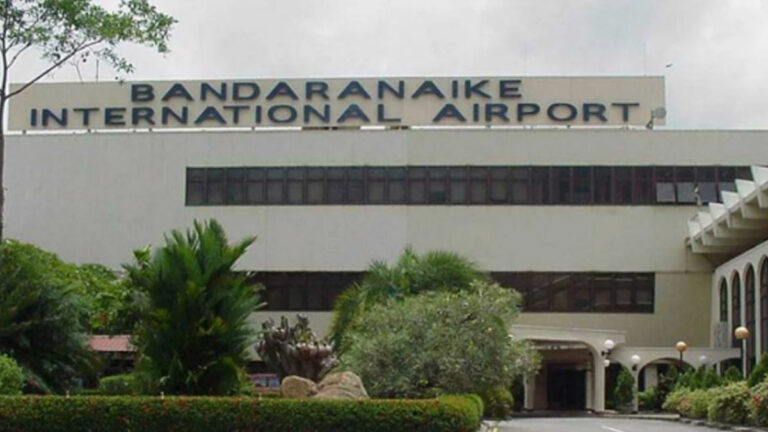
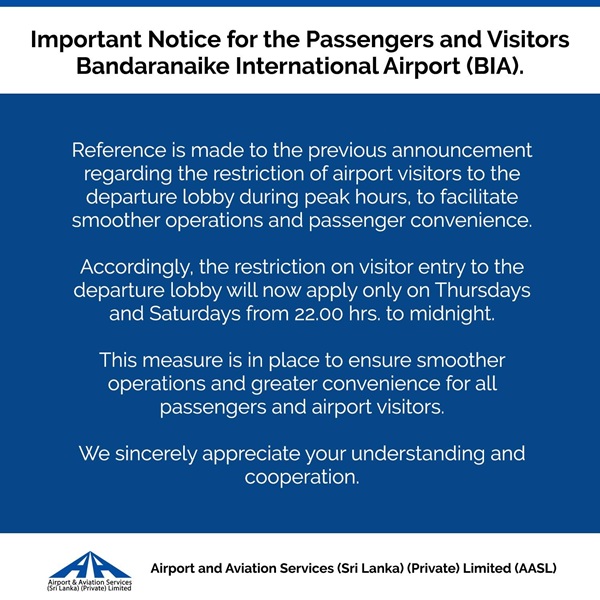
September 18, Colombo (LNW): The Airport and Aviation Services (Sri Lanka) (Private) Limited (AASL) has issued an updated notice regarding visitor access to the Departure Lobby at Bandaranaike International Airport (BIA), refining the restrictions previously put in place to reduce congestion during peak hours.
Under the new guidelines, visitor access to the Departure Lobby will now be restricted only on Thursdays and Saturdays, between 10:00 p.m. and midnight. This is a revision from the earlier policy, which restricted entry from Thursdays to Saturdays during the same hours.
The adjustment comes as part of ongoing efforts to ensure smoother airport operations and improve passenger convenience, particularly during high-traffic periods. By limiting non-traveller presence in key areas, AASL aims to streamline passenger movement and enhance the overall airport experience.
AASL has extended its gratitude to the public for their understanding and cooperation in helping maintain a more efficient and comfortable environment for all airport users.