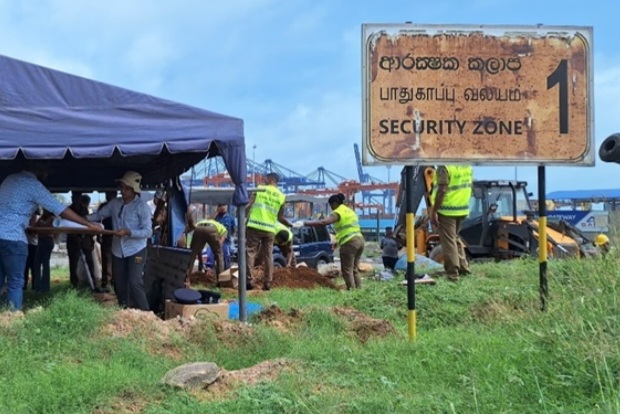
August 21, Colombo (LNW): Ongoing excavations at a mass burial site uncovered within the Colombo Port premises have led to the discovery of skeletal remains believed to belong to at least 88 individuals, officials have revealed.
The site, which came to light in July 2024 during groundwork for an elevated expressway project, has quickly drawn national and international attention due to its scale and historical significance.
The excavation is being conducted under the close supervision of Colombo Additional Magistrate Kasun Kanchana Disanayake, with forensic and archaeological support led by Senior Professor Raj Somadeva.
The process is being handled with considerable care to ensure the preservation of evidence and to assist in any future identification efforts or legal proceedings.
Though the full context of the grave is still under investigation, its discovery has prompted fresh scrutiny of Sri Lanka’s past, particularly in light of the island’s history of conflict and political unrest.
Justice Minister Harshana Nanayakkara, commenting on the broader context, confirmed that this site brings the number of officially recorded mass graves in the country to 17.
Human Remains of 88 Individuals Unearthed at Mass Grave Site in Colombo Port
President Meets Catholic Church Leaders for High-Level Talks
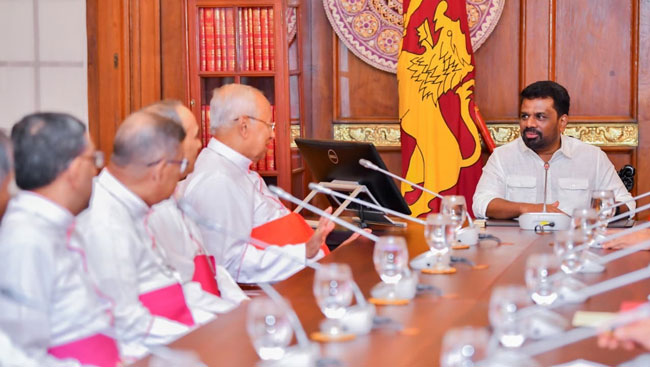
August 21, Colombo (LNW): A significant meeting took place on Wednesday (20), at the Presidential Secretariat, where President Anura Kumara Dissanayake engaged in discussions with His Eminence Cardinal Malcolm Ranjith, Archbishop of Colombo, and members of the Catholic Bishops’ Conference of Sri Lanka (CBCSL).
The discussions, held in a cordial atmosphere, provided a platform for the Church’s leadership to share key insights and concerns arising from the recent tri-annual gathering of the Catholic Bishops.
According to the President’s Media Division (PMD), Cardinal Ranjith briefed the Head of State on a range of topics deliberated during the bishops’ conference, including matters of social, ethical, and national significance.
The delegation, led by Bishop Harold Anthony Perera, President of the CBCSL, also presented the President with a set of views and proposals currently under consideration within the Catholic Church.
President Dissanayake, in turn, welcomed the dialogue and affirmed his commitment to maintaining open lines of communication with religious leaders.
Arrest Warrant Issued for Former State Minister Diana Gamage Over Immigration Law Violations
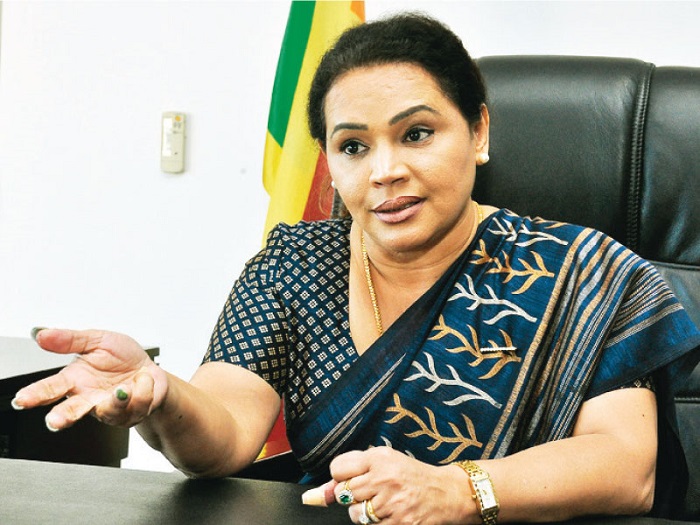
August 21, Colombo (LNW): The Colombo Magistrate’s Court has issued a warrant for the arrest of former State Minister Diana Gamage, following her failure to appear in court over a case concerning alleged breaches of Sri Lanka’s immigration laws.
The case was heard earlier today before Chief Magistrate Thanuja Lakmali Jayatunga, who ordered the warrant after noting the absence of the former state official during the scheduled court proceedings.
Ms Gamage stands accused of violating provisions of the Immigration and Emigration Act—offences which carry serious legal consequences, particularly for public figures who are expected to uphold the law.
The nature of the alleged infractions has not been disclosed in detail at this stage, but legal sources suggest the charges may relate to documentation irregularities or questions surrounding her citizenship status.
Her continued absence from proceedings has prompted the judiciary to take firm action, reinforcing the principle that no individual, regardless of political status, is above the law. The issuance of the arrest warrant signals the court’s intent to proceed with the case without delay and ensure accountability through due legal process.
Government Launches National Decluttering Drive Across Public Sector Institutions
August 21, Colombo (LNW): In a move aimed at enhancing workplace efficiency and cleanliness within the state sector, the government has unveiled a focused programme to eliminate long-neglected and redundant items from public offices across the country.
Branded as “Seiri Week,” the initiative is scheduled to run from September 01 to 04 and is set to involve all government bodies.
The campaign, introduced under the broader “Clean Sri Lanka” national initiative, is intended to foster a more orderly, hygienic, and secure working environment, enabling public servants to carry out their duties more effectively and comfortably.
Officials hope that by tackling years’ worth of accumulated clutter, institutions will not only become more presentable but also more functional.
The Ministry of Public Administration, Provincial Councils and Local Government has taken the lead on the initiative, issuing a formal circular outlining the programme’s objectives and procedures.
This directive has been disseminated to Ministry Secretaries, Provincial Chief Secretaries, Department Heads, District Secretaries, as well as the heads of public corporations and statutory bodies.
According to the circular, each institution is expected to conduct a thorough inventory to distinguish between essential items and those deemed obsolete, damaged, or otherwise unnecessary.
The disposal process must be handled responsibly, with emphasis on environmental considerations, recycling where possible, and adhering to public sector regulations on asset management.
Ex-Police Chief Deshabandu Tennakoon to Appear in Court Following Arrest
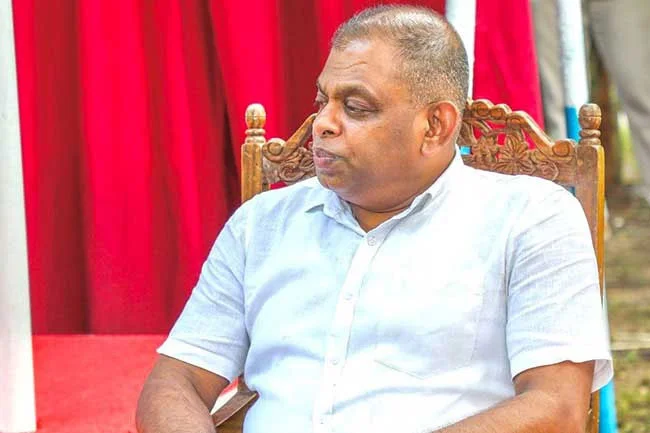
August 21, Colombo (LNW): Former Inspector General of Police (IGP) Deshabandu Tennakoon is due to be presented before the Colombo Fort Magistrate’s Court today (21), following his arrest by officers attached to the Criminal Investigation Department (CID).
The arrest, which took place at his residence yesterday, marks a significant development in ongoing investigations linked to the controversial crackdown on anti-government demonstrators in May 2022.
The former top-ranking police officer has been taken into custody in relation to the violent incidents that unfolded at Galle Face Green on 9 May 2022, during the peak of the ‘Aragalaya’ protest movement. The protest, which drew widespread public participation and international attention, was forcefully dispersed amid allegations of state-sanctioned violence and collusion between law enforcement and pro-government groups.
Tennakoon, who was serving in a senior police capacity at the time, has faced persistent scrutiny over his alleged role in either facilitating or failing to prevent the assault on peaceful protesters. His arrest follows a series of legal manoeuvres undertaken by his legal team to avoid detention, including the submission of an anticipatory bail application earlier this week.
However, on August 20, Colombo Fort Magistrate Nilupuli Lankapura dismissed the bail request after considering the submissions made by Tennakoon’s lawyers. The application sought to forestall any attempt to arrest the former IGP, citing concerns over due process and potential political motivations behind the case. The Magistrate, however, found no sufficient grounds to grant the protective relief requested.
Legal observers view this arrest as a critical test of accountability in the aftermath of the 2022 unrest, which saw public institutions, including law enforcement, accused of failing to uphold constitutional protections.
With Tennakoon now in custody, the court proceedings are expected to shed light on the extent of institutional involvement in the events of that day.
Supreme Court Faces Fresh Legal Challenge to Bill Stripping Ex-Presidents of Privileges
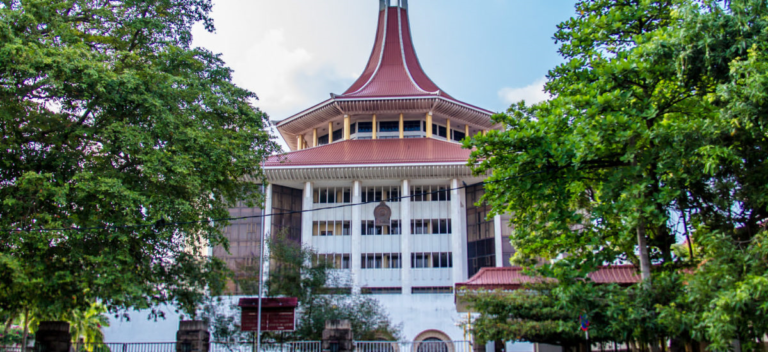
August 21, Colombo (LNW): Three new petitions have been brought before the Supreme Court, as opposition mounts against a contentious government bill seeking to remove privileges granted to former Presidents. The latest petitions allege that key sections of the proposed legislation are fundamentally incompatible with the nation’s Constitution.
The legal actions have been initiated by Mahinda Pathirana, a lecturer from the University of Sabaragamuwa; Raveendra Manoj Gamage, an attorney-at-law and former media secretary to ex-President Mahinda Rajapaksa; and retired Navy Chief of Staff, Mohan Wijewickrama. The Attorney General has been cited as the respondent in all three cases.
At the core of the challenge are Clauses 1 through 4 of the bill, which the petitioners argue breach the constitutional principle of separation of powers. They assert that the proposed law, in its current form, not only infringes upon the independence of state institutions but also undermines the sovereignty of the citizenry, which is enshrined in the country’s foundational legal document.
According to the petitioners, the bill disregards several essential constitutional safeguards, notably those outlined in Articles 1, 3, 4, and 12(1). These include provisions related to the supremacy of the Constitution, the sovereignty of the people, the framework of governmental authority, and the guarantee of equal rights under the law.
In their appeals, the petitioners have urged the Supreme Court to declare that the contentious clauses cannot be lawfully enacted unless they receive the backing of a two-thirds majority in Parliament, followed by approval through a national referendum. Such a requirement, they contend, is necessary given the bill’s potential to alter core democratic structures and civil liberties.
This wave of legal scrutiny follows an earlier petition lodged by Renuka Perera, Administrative Secretary of the Sri Lanka Podujana Peramuna (SLPP), along with two others, signalling broad-based concern over the implications of the proposed legislation.
Atmospheric conditions favourable for evening thundershowers (Aug 21)

August 21, Colombo (LNW): Atmospheric conditions are getting favourable for evening thundershowers
in the Northern, North-Central, Central, Uva and Eastern provinces during the next few days, the Department of Meteorology said in its daily weather forecast today (21).
Showers or thundershowers may occur at a few places in Northern, North-Central, Central, Uva and Eastern provinces and Hambantota district after 1.00 p.m.
The general public is kindly requested to take adequate precautions to minimise damages caused by temporary localised strong winds and lightning during thundershowers.
Marine Weather:
Condition of Rain:
Mainly fair weather will prevail over sea areas around the island.
Winds:
Winds will be westerly to south-westerly and wind speed will be (25-35) kmph.
Wind speed can increase up to 50 kmph at times in the sea areas off the coast extending from Matara to Pottuvil via Hambantota.
State of Sea:
The sea areas off the coast extending from Matara to Pottuvil via Hambantota may be fairly rough at times.
Sri Lanka’s Judiciary at a Crossroads: The Fight for Independence in the Face of Political Interference
By: Ovindi Vishmika
August 21, Colombo (LNW): The independence of the judiciary has long been considered the cornerstone of democracy. In Sri Lanka, however, this vital pillar appears increasingly fragile, as recent judicial transfers and appointments by the Judicial Service Commission (JSC) have triggered fresh concerns about political interference in the courts. The turmoil has revived longstanding questions: Can Sri Lanka’s judiciary remain impartial in the face of political pressure, or is it becoming another extension of partisan power?
A Wave of Controversial Transfers
On August 25, 2025, the JSC reassigned several key judges in a move that has shaken the judicial establishment. Colombo Chief Magistrate B.J.T.L. Jayasinghe—ranked 17th in seniority—was transferred as Mahara District Judge. Kesbewa District Judge Y.R.B. Nelumdeniya, ranked 26th, was moved to Hambantota. At the same time, less senior judges, some ranked as low as 65th, were elevated to powerful posts.
The most controversial appointment was that of Judge Asanka Bodaragama, ranked only 58th in seniority, as the new Colombo Chief Magistrate. His past as a junior lawyer under Justice Minister Harsha Nanayakkara has raised serious doubts about whether his promotion was merit-based—or politically motivated. The Colombo Chief Magistrate’s Court is no ordinary bench; it is a central hub for high-profile cases involving politicians, officials, and powerful business interests.
Legal circles fear that these transfers are not about efficiency or experience but about influence. Cases against Cabinet Minister Wasantha Samarasinghe, Deputy Minister Mahinda Jayasinghe, and other politically exposed figures may now be affected, undermining public trust in the fairness of
proceedings.
Politics in the Courtroom
While senior government officials have denied involvement—claiming even President Anura Kumara Dissanayake was unaware of the decisions—opposition voices are unconvinced. SLPP MP Namal Rajapaksa, addressing Parliament, accused the government of “politicizing the judiciary,” warning that judges presiding over cases linked to top government MPs had been transferred. His words echoed a wider sentiment: the judiciary, once viewed as the ultimate check on executive excess, is fast losing credibility.
This erosion of judicial independence is not new. At independence in 1948, Sri Lanka’s judiciary enjoyed relative autonomy, with traditions of professionalism and integrity. But constitutional changes in 1972 and 1978 cut back on protections, concentrating judicial appointments in the presidency’s hands. The absence of transparent promotion rules or reliable oversight mechanisms left space for manipulation.
The impeachment of Chief Justice Dr. Shirani Bandaranayake in 2013 remains the starkest example of political overreach. Widely condemned as illegal and politically motivated, her removal demonstrated how far the executive and legislature were willing to go to bend the judiciary to their will.That episode created a “chilling effect” on judges, making them reluctant to challenge government abuses.
Consequences for Democracy
The politicization of the judiciary has profound implications for democracy. First, it undermines the doctrine of separation of powers. When judges feel pressured to rule in line with political interests, they cease to act as a check on executive or legislative excesses. This imbalance corrodes governance, allowing corruption, abuse of power, and human rights violations to go unpunished.
Second, it erodes public trust. For ordinary citizens, the courts are the final recourse against injustice. If appointments and transfers are seen as politically engineered, people lose faith in the legal system’s impartiality. In a country scarred by decades of ethnic conflict, such mistrust exacerbates divisions rather than fostering reconciliation.
Third, it weakens protections for minorities and vulnerable groups. Emergency laws such as the Prevention of Terrorism Act (PTA) have long given security forces wide powers, often used disproportionately against Tamils. In such cases, only an independent judiciary can offer relief. Yet repeated failures of magistrate courts and high courts to provide remedies against arbitrary detention and torture demonstrate the dangers of a bench compromised by politics.
The Bigger Picture: A Legacy of Interference
International reports highlight how Sri Lanka’s judiciary has been systematically undermined. The International Bar Association and International Commission of Jurists (IBA/ICJ) noted that judicial appointments and removals have become politicized, while intimidation and attacks against lawyers further erode accountability.Transparency International Sri Lanka warned that the impeachment of Chief Justice Bandaranayake disrupted the constitutional balance of power, violating both domestic and international legal norms.
These practices entrench impunity. From the killings of journalists and aid workers to allegations of war crimes, politically influenced courts have failed to hold perpetrators accountable. As a result, victims remain without justice, while political elites remain untouchable.
The Way Forward
Despite this grim picture, Sri Lanka is not without options. A path to reform exists, but it requires both political will and judicial courage:
• Reconstitute the Constitutional Council: To depoliticize judicial appointments and limit executive overreach.
• Reform Emergency Laws: The repeal or radical revision of the PTA and Public Security Ordinance is vital to restore judicial authority.
• Strengthen the JSC: Clear rules must govern transfers and promotions to protect judges from arbitrary punishment or reward.
• Ensure Accountability: Attacks on judges and lawyers must be investigated and prosecuted to guarantee the safety of those who defend the rule of law.
Above all, the new leadership in the judiciary must demonstrate independence, resisting the temptation to serve political masters. As retired Justice C.V. Vigneswaran once warned, “Power tends to corrupt, and absolute power corrupts absolutely.” Without checks and balances, Sri Lanka risks sliding further into a state where democracy exists in name only.
Justice at Stake
The judiciary is more than a branch of government—it is the heartbeat of democracy. When its independence is compromised, so too are the rights and freedoms of every citizen. The recent transfers by the JSC may seem administrative on the surface, but their implications run far deeper. They raise the specter of a politicized judiciary, one that fails to act as guardian of the constitution and protector of justice.
For Sri Lanka, the stakes could not be higher. Restoring faith in the judiciary is essential not only for good governance but also for reconciliation, stability, and peace. Without an independent judiciary, the promise of democracy risks becoming an illusion.
Judicial Transfers and Appointments Spark Concerns of Political Influence
The judicial sector has been thrown into turmoil following a series of transfers and appointments made by the Judicial Service Commission (JSC), raising concerns over political interference in the country’s legal system.
According to reports, several senior and additional magistrates have been reassigned effective August 25, 2025. Colombo Chief Magistrate B.J.T.L. Jayasinghe, ranked 17th in seniority, has been transferred as Mahara District Judge, while Y.R.B. Nelumdeniya, the Kesbewa District Judge and 26th in seniority, has been moved to Hambantota as District Judge.
In the lower ranks, further changes have been made. Mount Lavinia Magistrate A.D.C.C. Silva (48th in seniority) has been appointed as Kesbewa District Judge. Colombo Additional Magistrate K.P.S. Harshan (51st in seniority) has been named Embilipitiya District Judge, while Colombo Additional Magistrate L.M. Ratnayake (65th in seniority) has been transferred to Wellawaya as District Judge.
Meanwhile, Judge Asanka Bodaragama, ranked 58th in seniority, has been appointed as the new Colombo Chief Magistrate. Reports highlight that he previously served as a junior lawyer under incumbent Justice Minister Harsha Nanayakkara, a connection that has drawn attention given the prominence of the Colombo Chief Magistrate’s Court, which hears a significant number of high-profile cases.
Further changes include the appointment of Judge Pasan Amarasekara from Hulftsdorp Magistrate’s Court No. 3 as the new Mount Lavinia Magistrate. Legal circles have voiced concern that this move may affect ongoing cases involving powerful political figures such as Cabinet Minister Wasantha Samarasinghe, Deputy Minister Mahinda Jayasinghe, Kaduwela Mayor Ranjan Jayalal, and the Secretary to the Ministry of Public Security.
It has also been reported that the Ampara Magistrate has been given charge of the highly sensitive Kotuwa Magistrate’s Court. However, she has formally notified the JSC that she lacks adequate experience for the position, further fueling questions about the motivations behind the appointment.
These developments have led to strong suspicion that the transfers and appointments are politically motivated, threatening the independence of the judiciary and undermining public trust in the rule of law.
When contacted, senior government officials denied any involvement, stressing that the government had no connection to the changes and insisting that President Anura Kumara Dissanayake was unaware of the decisions.
Nevertheless, critics argue that the government must act swiftly. They have called on the President to intervene immediately to safeguard both public confidence in the judiciary and the credibility of his administration in the face of growing skepticism.
Govt Launches Rs. 5 Million Concessionary Loan Scheme to Create 50,000 Young Agri-Entrepreneurs

The Cabinet of Ministers has approved the implementation of a Rs. 5 million concessionary loan scheme for individual agricultural entrepreneurs, with the aim of attracting more young people into the agriculture sector, Cabinet Spokesman and Mass Media Minister Dr. Nalinda Jayatissa announced on Tuesday (19).
The initiative is part of the Government’s plan to create 50,000 agricultural entrepreneurs within the next five years.
Key Features of the Loan Scheme
- Loan amount: Up to Rs. 5 million per individual
- Interest rate: 4% annually on the outstanding balance
- Duration: Five years
- Partner banks: Bank of Ceylon, People’s Bank, and Regional Development Bank
Dr. Jayatissa explained at the weekly Cabinet briefing that limited access to affordable financial facilities has long been a barrier to entrepreneurship in both the agriculture and industry sectors.
“This has discouraged investment, reduced the participation of young entrepreneurs in agriculture, increased the extent of uncultivated land, and ultimately lowered food production,”
he said.
To address these challenges, the Government has allocated Rs. 500 million under the 2025 budget to fund the new scheme, which will support the development of entrepreneurs in agriculture and related industries.
The Cabinet gave approval to the proposal presented by the Minister of Agriculture, Livestock, Land and Irrigation to proceed with the program.