The International Monetary Fund (IMF) has stressed the urgent need for Sri Lanka to diversify its export markets and foster an investment-conducive environment, particularly amid uncertainties stemming from recent tariff adjustments.
Speaking at the 2025 Spring Meetings of the World Bank Group and the IMF, Krishna Srinivasan, Director of the IMF’s Asia and Pacific Department, addressed the challenges presented by sudden policy changes during a Regional Economic Outlook – Asia and Pacific session held on April 24.
Referring to the recent tariff modifications introduced by the Sri Lankan government, Srinivasan noted that such changes have complicated economic forecasting and programme implementation. “It became quite difficult to put together a macro framework,” he stated, citing the impact on exports, growth, and investor confidence.
Highlighting the vulnerability of key sectors such as apparel, Srinivasan warned that excessive tariffs could significantly hamper competitiveness. “This is a country affected by high tariffs… the garment sector could see notable impacts,” he said, adding that regional integration and export market diversification are vital to mitigating external risks.
On the investment front, Srinivasan urged the Sri Lankan government to support private sector growth without compromising fiscal stability. “Promote investment not through tax exemptions, but by creating an environment where domestic private investment can thrive,” he advised.
The IMF also acknowledged the progress achieved under Sri Lanka’s ongoing programme, particularly regarding macroeconomic stabilization, reduced inflation, and modest growth recovery. Srinivasan concluded that the current environment presents an opportunity to undertake broader structural reforms to sustain long-term growth and resilience.
Katarina Zimmer put vinegar to the test as a cleaning product and discovered a wide range of benefits, for people and the planet.
A few months ago in my new Berlin apartment, my toilet and I were at war. No amount of scrubbing or toilet cleaner would evict the limescale coating inside. Frustrated, I turned to Google and stumbled across a page recommending vinegar – something that the previous inhabitant had left behind in abundance. After dropping two tablespoons full of “Essigessenz” – essentially concentrated vinegar – into the toilet and waiting for half an hour, I scrubbed and the limescale came off in a moment.
Since then, I’ve enthusiastically used vinegar to rid my world of limescale. I’ve found it even more effective than my regular kitchen spray cleaner for getting my sink sparkling. That includes the faucet, which I wrapped in a vinegar-soaked kitchen tissue – whereas my regular cleaning spray dribbled off. And rather than having to buy special tablets to clean my limescale-smothered glass kettle, I simply poured two tablespoons of concentrated vinegar inside and boiled it. As the limescale crackled off, it made a satisfying sizzling sound.
I wondered if vinegar had other advantages. Did it also kill off bacteria and other germs? And, importantly, was this simple, natural product better for the environment and for my health than regular cleaning products?
The internet is full of sustainability influencers and green cleaning blogs that advertise vinegar as a jack-of-all-trades and a safer and “greener” alternative to “toxic” cleaning products. These claims make sense on the surface; vinegar is after all just fermented alcohol and has long been used as a food preservative, in salad dressings, as well as a household cleaner – but I wanted evidence. After interviewing three experts, I learned that while some of these claims are true, the benefits of vinegar depend a lot on how it’s used and the kind of grime you’re trying to get rid of.
Limescale dissolves more easily in acidic fluids like vinegar (Credit: Getty Images)
Reassuringly, Eric Beckman, a chemical engineer and emeritus professor at the University of Pittsburgh in Pennsylvania, told me that the best cleaning use for acetic acid – the main component of vinegar – is exactly what I had been using it for: as a descaler. Limescale – and rust, for that matter – consists of certain ions that dissolve more easily in acidic fluids like vinegar, he says. Beckman uses vinegar himself to get limescale off mirrors, while the microbiologist Dirk Bockmühl of Germany’s Rhine-Waal University of Applied Sciences prefers using lemon juice, which contains citric acid, which he says is a more effective descaler and smells better. (Read more about why vinegar is such an effective cleaner.)
That said, vinegar doesn’t work on everything. Beckman says that soap does a better job at removing oily films on dishes, while baking soda is effective against processed oils that have stuck onto surfaces while cooking. (Read more about whether baking soda is environmentally friendly).
However, Beckman expresses exasperation about a popular remedy of mixing vinegar together with baking soda. The mixture is chemically quite useless, he says, as the acid of vinegar and the base of baking soda effectively cancel each other out. “I use both, but not together,” says Beckman. “Together, they give you nothing.”
And while vinegar is often touted as a powerful antimicrobial, Bockmühl says, the truth is more nuanced. In a 2020 study, Bockmühl and his colleagues put vinegar to the test against a selection of disease-causing bacteria, viruses and fungi. While many internet recommendations suggest adding a dash of vinegar into a bucket of water for cleaning, Bockmühl found that its anti-microbial effects only kick in at an acetic acid concentration of 5% – its concentration in pure vinegar. And it was only fully effective at distilled concentrations of 10% – to which the researchers added a dash of citric acid – in killing off five common bacteria, including Escherichia coli and Staphylococcus aureus, as well as a mould, a yeast and a weakened strain of the vaccinia virus. Other studies have found that similar concentrations also work against Sars-CoV-2, the virus that causes Covid-19.
But even these concentrations didn’t work against the MRSA bacterium, an especially stubborn strain of Staphylococcus aureus that’s resistant to certain antibiotics, while countless bacteria remain untested. Many bacteria – including the ones that ferment alcohol into vinegar – thrive in acids, Beckman adds: “Then they’ll be like, ‘ooh, yay, vinegar.'” Some moulds, too, are resistant to acetic acid while some viruses – like norovirus – might be, too, Bockmühl suspects. Beckman says that soaps are more effective against bacteria, while standard disinfectants work better against viruses and moulds. Harsh treatments like bleach will definitely kill everything, Beckman says – although bleach can be unsafe if used incorrectly.
Vinegar is less effective against processed oils that have stuck onto surfaces during cooking (Credit: Getty Images)
Bockmühl stresses that, even for the germs that vinegar does kill, a relatively high concentration is needed. The concentration won’t be adequate “if you just put a teaspoon of vinegar into your cleaning solution”, Bockmühl says.
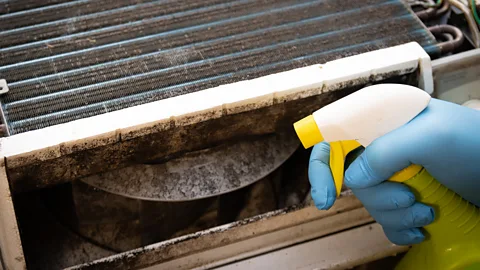
However, the higher the dose of acetic acid, the more irritating it can be on the skin, he adds. It is harmful if it gets into your eyes. Surfaces can suffer, too: vinegar corrodes natural stone and metals like copper, bronze and brass, according to the Italian chemist Dario Bressanini’s book The Science of Cleaning. And in dishwashers or washing machines, it can harm the rubber gaskets used to seal them, while it could also damage coffee machines and strip away the coating on tiles and grout, Bressanini writes. But Bockmühl assures me that it’s fine to use vinegar on glass and ceramic surfaces – like my toilet – and stainless steel sinks.
The trouble that Bockmühl sees with using homemade cleaning products is that they don’t come with instructions or safety recommendations. “They might be safe if you know what you’re doing,” he says, “but there are a lot of really stupid and absurd recommendations on the internet”.
To learn more about how the health risks of vinegar compare with those of conventional cleaners, I called up Nicola Carslaw, professor of indoor air chemistry at the University of York in the UK. Her concern is how cleaners disrupt the air in our homes and buildings. It’s known that professional domestic cleaners tend to have higher rates of asthma than other occupational groups, although it’s proven difficult to pin that on any single product or ingredient.
In a recent study, Carslaw and her colleagues tested 23 different cleaning products including dishwasher fluid, washing up liquid and spray products, and found that many of them released volatile chemical compounds (VOCs). Some of these compounds, like terpenes, are often added to give pleasant aromas, such as lavender or pine oil, but they’re highly reactive in the atmosphere. Terpenes for instance, easily react with ozone in the air, creating miniscule particles. In general, inhaling particles of this size has been linked to lung and heart disease.
“Your nose is a really good filter for the big particles, but the smaller ones can get all the way into your lungs [and] into the bloodstream,” Carslaw says. Interestingly, in her study she found that cleaning products marketed as “natural” or “green” didn’t seem any healthier in this regard. “The natural/green ones had as many, if not more VOCs as the standard cleaners, and in many cases they were more reactive,” she says.
Vinegar passes muster on any sustainability scale because it’s simple and it’s degradable – Eric Beckman
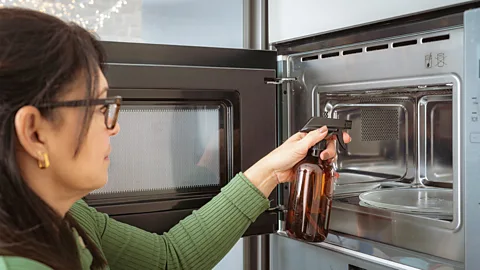
But vinegar, by contrast, only consists of water and acetic acid (and a few other substances that make the difference between red and wine vinegar, for instance). As such, “it’s just not going to be chemically reactive in the same way”, Carslaw says. Another advantage of vinegar is that it’s usually applied on a cloth to wipe surfaces rather than used as a spray, Carslaw adds. Research shows that cleaning products applied in spray form have more harmful effects on the respiratory system than liquids and wipes. (Read more about the health risks associated with cleaning products in Jessica Bradley’s story).
“When you spray something, you’re turning the chemical into a form that’s much easier to breathe [in] than if you have the liquid,” Carslaw says. That said, she always advises gloves when there’s risk of skin contact, good ventilation and avoiding excessive cleaning, whatever product is used. (Read more about whether we‘re cleaning too much for our own good).
Vinegar quickly breaks down and therefore its environmental impact is low (Credit: Getty Images)
This all left me with one remaining question: is using vinegar more environmentally friendly than conventional cleaners?
That’s a hard question to answer, says Beckman. Ideally, there would be life cycle analyses for cleaning products which track impacts from cradle to grave, tracing each ingredient back to its source, how it’s produced, transported, packaged and eventually disposed of. But very few companies do that thoroughly, even if they do brand their products as “green”, Beckman says.
“But I will say this about vinegar. [Its] strength is its simplicity,” Beckman says. Conventional cleaners can consist of more than a dozen different ingredients, many of them industrially manufactured in energy-consuming processes, he says. Acetic acid is born through the natural, yeast-driven fermentation of alcohol, which itself comes from the natural fermentation of sugar. The biggest environmental impact of vinegar-making is where the sugar came from – whether it’s grapes, apples, grains, potatoes, or rice – which are largely renewable resources. Bockmühl cautions that this only applies to naturally fermented vinegars, the ones typically sold as food products; there are also synthetic vinegars which are derived from fossil fuels, meaning they come with all the environmentally harmful impacts of oil and gas extraction.
Even at the very end of its life, vinegar has little impact. While many ingredients in soaps are tough molecules and don’t easily biodegrade, sometimes continuing to kill organisms once they’re in the environment, vinegar quickly breaks down, Beckman says. “Vinegar passes muster on any sustainability scale because it’s simple and it’s degradable,” he says.
After discovering all of this, I felt even better about using vinegar. I probably won’t rely on it for ridding my surfaces of germs, but I’ll keep using it to remove limescale and look forward to trying it out on the next rusty item I find. I’m happy to put up with the smell, knowing that I’m using a sustainable product that’s likely better for my health.
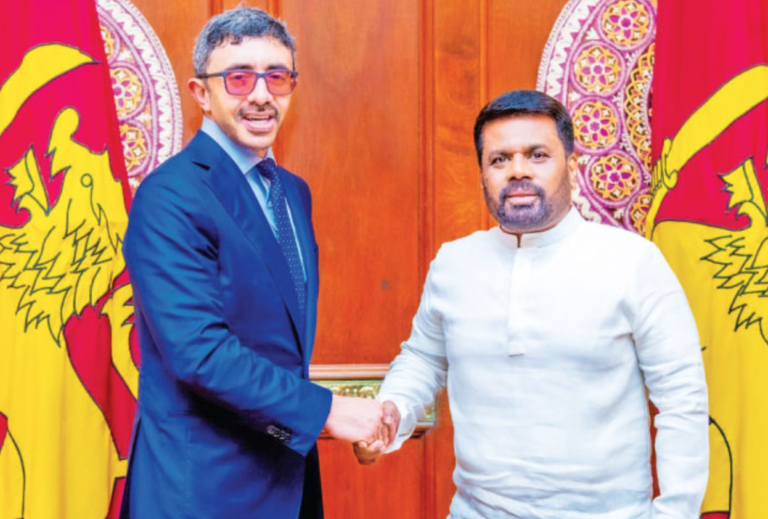
The Deputy Prime Minister and Minister of Foreign Affairs of the United Arab Emirates (UAE), Sheikh Abdullah Bin Zayed Al Nahyan, reaffirmed the UAE’s commitment to deepening bilateral relations with Sri Lanka, with particular focus on energy, tourism, foreign investment, and employment sectors.
Sheikh Abdullah made these remarks during an official visit to Sri Lanka on April 22, in a meeting with President Anura Kumara Dissanayake at the Presidential Secretariat. Accompanied by a high-level UAE delegation, the Deputy Prime Minister emphasized that the visit aims to expand longstanding ties and enhance mutual economic cooperation.
Offering warm congratulations to President Dissanayake and the people of Sri Lanka, Sheikh Abdullah pledged the UAE’s full support for Sri Lanka’s new development agenda, praising the President’s commitment to national rebuilding and his constructive approach to international relations.
In response, President Dissanayake underscored the government’s efforts to establish a stable, investment-friendly environment, with robust legal safeguards now in place to protect foreign investments. He detailed ongoing initiatives in debt restructuring, economic stabilization, and highlighted key investment opportunities in port development, Port City Colombo, tourism, energy, and transport infrastructure.
The President reiterated his government’s strategic goal of positioning Sri Lanka as a leading regional investment and tourism hub.
Also in attendance were Minister of Labour and Deputy Minister of Economic Development Dr. Anil Jayantha Fernando, senior officials from the Presidential Secretariat, and the visiting UAE delegation, including UAE Minister of State Ahmed Ali Al Sayegh, UAE Ambassador to Sri Lanka Khaled Nasser Al Ameri, and other high-ranking dignitaries from the Ministry of Foreign Affairs of the UAE.
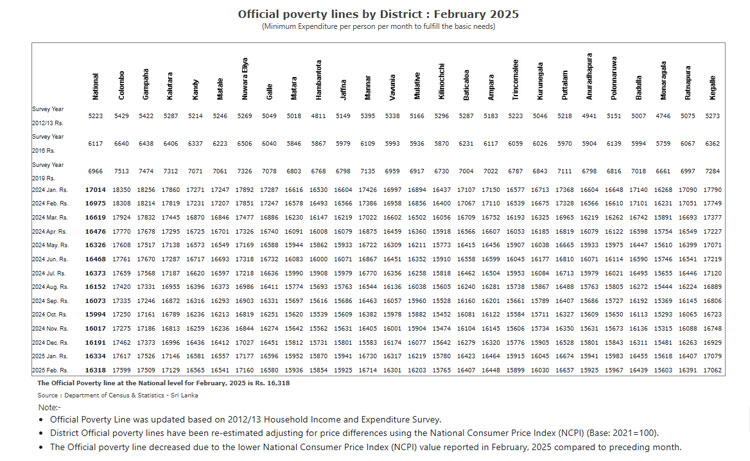
The Department of Census and Statistics has released the official poverty line for February 2025, setting the national threshold at Rs. 16,318 per individual per month. This figure represents the minimum income required to meet basic needs such as food, shelter, and essential services.
Based on this benchmark, a family of four would require a minimum of Rs. 65,272 per month to maintain essential living standards.
The poverty line, which is revised monthly, varies by district. For February, the Colombo District reported the highest threshold at Rs. 17,599, while Monaragala District recorded the lowest at Rs. 15,603.
Officials attribute the marginal decline in the poverty line to a drop in the National Consumer Price Index (NCPI) for February compared to January 2025.
The complete district-wise poverty line chart for February 2025 is available via the Department of Census and Statistics.
The Secretary to the President, Dr. Nandika Sanath Kumanayake, announced that the government has made a policy decision to continue the “School Nutrition Programme” aimed at reducing anemia among schoolchildren, in collaboration with the World Food Programme (WFP).
Speaking at a discussion held today (April 23) at the Presidential Secretariat with representatives from relevant ministries, international organizations, and partner institutions, Dr. Kumanayake emphasized the programme’s uninterrupted continuation as a national priority.
The initiative, which provides nutritious lunches to primary school students in malnutrition-prone districts, is designed to address iron deficiency. It is coordinated by multiple stakeholders, including the Ministries of Education and Health, Provincial Councils, the Food Promotion Board, and the Partnership Secretariat for WFP Cooperation. For 2025, the government has allocated Rs. 32 billion to support the effort.
A pilot project is currently underway in four districts, incorporating fortified rice enriched with iron and folic acid. A formal health and nutrition study is being conducted to assess its effectiveness in reducing anemia, with plans to expand the programme nationwide based on its findings.
The World Food Programme, the Bill and Melinda Gates Foundation, the Gateway Foundation, and the Pathfinder Foundation have pledged their continued support.
Key officials present included Secretary to the Prime Minister Pradeep Saputhanthri, Secretary to the Ministry of Education Nalaka Kaluwewa, Secretary to the Ministry of Health Dr. Anil Jasinghe, and other senior representatives.
The Intertropical Convergence Zone (where winds from the Northern Hemisphere and Southern Hemisphere converge) affects the island’s weather.
Showers or thundershowers will occur at times in Western, Sabaragamuwa and North-western provinces and in Galle and Matara districts. Heavy falls above 100 mm are likely at some places in these areas.
Showers or thundershowers will occur elsewhere of the island after 1.00 p.m.
Fairly heavy falls about 75 mm are likely at some places in Central, and Uva provinces and in Batticaloa, Ampara and Polonnaruwa districts.
The general public is kindly requested to take adequate precautions to minimize damages caused by temporary localized strong winds and lightning during thundershowers.
Misty conditions can be expected at some places in Central and Uva provinces and in Ampara district during the morning.
April 24, Colombo (LNW): In the wake of Sri Lanka’s unprecedented economic crisis in 2022, the government launched a bold and far-reaching reform agenda aimed at stabilizing the economy, restoring public trust, and building long-term resilience. Under the leadership of Secretary to the Ministry of Finance, Mahinda Siriwardena—appointed during the peak of the crisis in April 2022—the government prioritized macroeconomic stability, debt sustainability, and inclusive social protection measures.
The 2022 crisis, rooted in structural weaknesses, policy missteps, and external shocks, saw Sri Lanka’s foreign reserves dwindle to just $24 million. The country’s credit rating was downgraded, inflation soared to 70%, and essential goods were in short supply. Widespread power outages and public unrest further underscored the urgency of comprehensive reform.
Recognizing the scale of the challenge, the government collaborated closely with the International Monetary Fund (IMF) to design and implement a wide-ranging economic reform programme. This programme emphasized debt restructuring, revenue-based fiscal consolidation, and institutional strengthening. Siriwardena noted that special attention was given to building a resilient social safety net, acknowledging the disproportionate impact of the crisis on vulnerable communities.
Since January 2021, Sri Lanka has benefited from over 200 IMF missions and training initiatives—around 80 of which focused on public financial management and fiscal governance. This technical support played a crucial role in embedding a culture of disciplined fiscal management and aligning Sri Lanka’s recovery strategy with the IMF’s Extended Fund Facility (EFF) arrangement, approved in March 2023.
Reforms targeted improvements in revenue administration, public finance management, and governance. These efforts not only addressed the immediate symptoms of the crisis but also tackled its root causes, creating a more sustainable economic foundation.
The results have been encouraging. After years of economic contraction, Sri Lanka recorded a 5% GDP growth in the past year. Inflation, once at 70%, has dropped to nearly zero, and foreign exchange reserves now exceed $6 billion. A consistent primary budget surplus reflects the government’s firm commitment to fiscal responsibility.
Despite these gains, Siriwardena cautioned that the recovery remains fragile. Sustaining progress requires continued fiscal discipline, strong macroeconomic management, and enduring collaboration with development partners. He emphasized the importance of context-sensitive reforms, political consensus, stakeholder engagement, and transparent communication as key to maintaining momentum.
Sri Lanka’s path to recovery, while challenging, offers a blueprint for overcoming crisis through timely, coordinated, and inclusive reform strategies.
April 24, Colombo (LNW): Sri Lanka is fast-tracking its transition to electronic money and digital transactions in a bid to curb the extensive informal financial sector. With around 45% of the nation’s financial activity taking place outside the formal banking system, the government is moving swiftly to bring these operations under regulatory oversight.
The Ministry of Finance has emphasized that this shift is intended not only to promote financial inclusion but also to strengthen economic efficiency and mitigate the risks associated with unregulated financial practices. This informal sector includes cash dealings, illegal lending operations, and unauthorized digital transfers—practices that, while serving communities with limited banking access, severely challenge financial regulation and transparency.
In response, the Central Bank of Sri Lanka (CBSL) is advancing plans to introduce a Central Bank Digital Currency (CBDC). This government-backed digital currency will offer a secure, traceable, and regulated method of transaction to encourage widespread adoption of e-money. A proof-of-concept for the CBDC was released in 2024, and its findings are expected to shape future integration efforts.
While the Central Bank has not publicly disclosed the full extent of unbanked money, Finance Ministry estimates indicate that approximately Rs. 1.3 trillion circulated outside the formal banking system in 2024. This vast volume of unmonitored capital poses a threat to monetary policy stability, financial oversight, and anti-money laundering efforts.
Economist Prof. Priyanga Dunusinghe of the University of Colombo supports the government’s digital finance agenda, stressing the importance of enhancing digital payment infrastructure and expanding formal banking access—especially in underserved regions. These initiatives, he notes, are vital for reducing financial informality and fostering economic resilience.
In tandem with its digital efforts, the Central Bank has also implemented active monetary policies to absorb excess liquidity. During the first half of 2024, it withdrew about Rs. 546 billion in foreign exchange from the domestic economy to reinforce monetary discipline and curb inflationary pressures.
Digitization offers a host of benefits, including broader financial access, particularly in rural communities, greater transparency through traceable transactions, and reduced costs and delays in processing. For both individuals and businesses, these reforms could lead to more reliable and secure financial practices.
As Sri Lanka undergoes this significant financial transformation, it is vital that regulatory frameworks evolve alongside technological innovation. A forward-looking and inclusive approach will be key to building a more transparent, resilient, and equitable financial system.
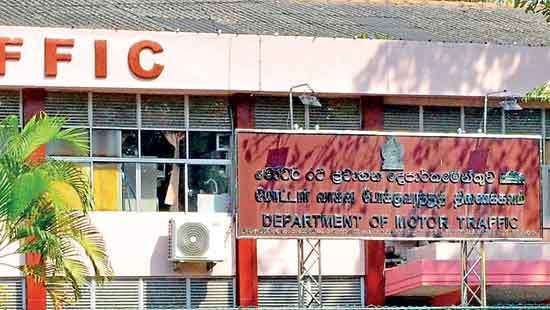
April 24, Colombo (LNW): Sri Lanka’s Motor Traffic Department (DMT) is once again at the center of a significant corruption scandal, highlighting deep-rooted fraudulent activities within the organization. A recent investigation revealed that corrupt officials exploited regulatory gaps to unlawfully import luxury vehicles under false pretenses. This scandal exposes systematic corruption within the DMT, raising serious concerns about governance, accountability, and the integrity of motor vehicle registration procedures.
The fraud involves the illicit importation of luxury cars, including BMW and Mercedes-Benz models, misclassified as tractors in order to bypass regulations and avoid taxes. This was uncovered during a session of the Committee on Public Accounts (COPA), which revealed that DMT officials had been involved in falsifying documents to facilitate these illegal imports. In one instance, 158 vehicles were illegally classified as imports for religious places of worship, violating licensing and registration rules. These abuses show a clear disregard for legal procedures within the department.
During the recent COPA meeting, a high official of the Motor Traffic Department , acknowledged that an internal investigation had led to the suspension of an officer, but the officer was reinstated after a lack of evidence, raising doubts about the effectiveness of accountability mechanisms within the DMT.
COPA members expressed strong dissatisfaction with the department’s preparedness for the meeting and sent officials back with instructions to come better prepared for the next session. The Department of Auditor General, together with the Centre for Public Affairs, uncovered that DMT officials had avoided tax payments and violated laws by misreporting luxury vehicles as tractors. Despite being summoned for questioning, DMT officials failed to fully cooperate with the investigation.
COPA also directed the department to submit a report on the registration of vehicles involved in the fraudulent scheme. However, authorities claimed that no relevant files existed, sparking suspicion that evidence was intentionally destroyed or concealed to protect the culprits.
DMT high official defended his department by stating that the fraud occurred before his tenure. However, his predecessor had already filed a complaint with the Criminal Investigation Department (CID) before leaving office, but no significant follow-up action has been taken under the current administration, fueling further concerns of a cover-up.
As investigations continue, the public remains eager for transparency and accountability. The ongoing corruption scandal at the DMT has severely undermined public trust. Urgent reforms and stricter oversight are needed to restore integrity and ensure that Sri Lanka’s motor vehicle registration system operates without exploitation.
April 24, Colombo (LNW): The Phase II expansion of the Bandaranaike International Airport (BIA) has plunged into controversy following serious allegations of corruption and legal irregularities involving the Sojitz – Larsen & Toubro (L&T) consortium. This development not only questions the legitimacy of the bidding process but also casts doubt on the effectiveness of the government’s anti-corruption promises.
A critical piece of evidence fueling the controversy is a letter from Welcome Hotels, a subsidiary of the ITC Group in India, directed at L&T. The letter accuses the Indian construction company of unprofessional behavior, stating that it abruptly withdrew from a significant hospitality development project mid-execution. This sudden departure allegedly inflicted lasting reputational and financial harm on the hotel group. The incident raises fears about L&T’s reliability and accountability, especially when entrusted with crucial national infrastructure like an international airport terminal.
The situation worsened with a second major revelation: the consortium’s submission included a Power of Attorney (POA) document that had not been attested by a local registrar—a clear and compulsory legal requirement under Sri Lankan procurement laws. This is not a minor oversight; POA attestation is vital to validate the legitimacy of a bidding entity. Historically, similar technical disqualifications have led to outright bid rejection. However, the Sojitz – L&T consortium appears to be progressing in the process, reportedly aided by insiders within the Technical Evaluation Committee (TEC) and airport authorities.
Industry experts argue that overlooking such a critical violation compromises the integrity of the procurement process. If exceptions are made for influential bidders, it could set a dangerous precedent, allowing companies to sidestep legal requirements with the backing of powerful allies. Such a move not only violates procurement norms but also threatens fair competition and national credibility.
Chairman of the TEC, Hasitha Karunaratne, declined to comment when contacted by The Sunday Times Business, stating that the process was conducted in line with government regulations. His silence has only intensified public concern over transparency and fairness.
Critics say the government’s credibility is now at stake. If authorities allow a consortium to proceed despite submitting a legally non-compliant bid and having a history of project abandonment, it would reflect a serious failure in governance and a betrayal of public trust. Reputed project consultants and construction sector leaders stress that this is a defining moment for Sri Lanka’s commitment to anti-corruption. Ignoring due process in favor of convenience or influence would damage investor confidence and international reputation.
As the spotlight remains fixed on the TEC and government response, this case may well become a benchmark for how seriously Sri Lanka upholds procurement laws and fights systemic corruption.