The vessels “BUNGO” and “ETAJIMA” of the Japan Maritime Self-Defence Force (JMSDF) arrived at the Port of Colombo this morning (April 01) on a goodwill visit.
The Sri Lanka Navy welcomed the visiting ships in accordance with naval traditions. According to a statement by the Navy, JMSDF BUNGO, a 141-meter Uraga-Class Minesweeper Tender, is commanded by Commander Tanaka Kojiand operates with a crew of 125 personnel. Meanwhile, JMSDF ETAJIMA, a 65-meter Minesweeper, is under the command of Commander Oda Takayuki and has a crew of 54 personnel.
During their stay, crew members will visit several tourist attractions in Colombo. The ships are scheduled to depart from Colombo on April 04.
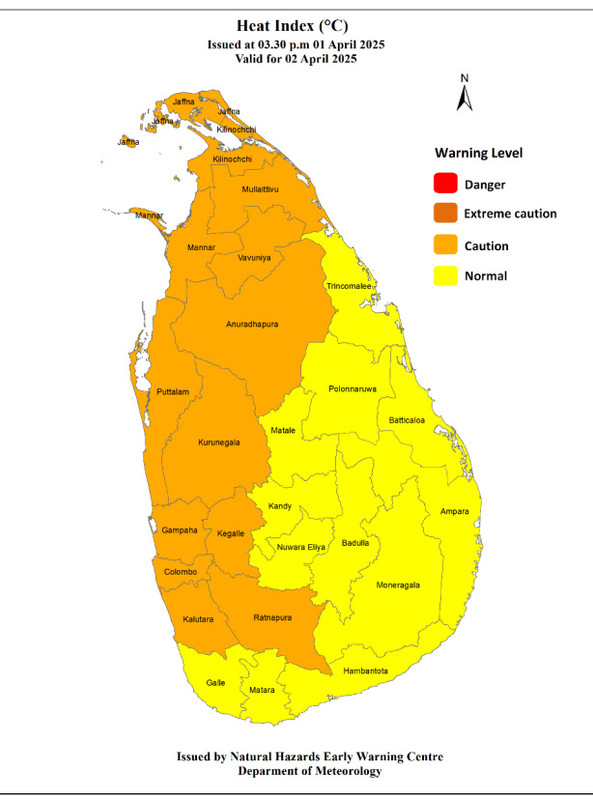
The Department of Meteorology has issued a warm weather advisory for today (02), warning that temperatures in several provinces and districts may reach the ‘Caution’ level on the heat index.
According to the advisory, the heat index—reflecting the temperature felt on the human body—is expected to rise in the Northern, Western, North-Western, and Sabaragamuwa provinces, as well as in the Anuradhapura district. Under the ‘Caution’ level, prolonged exposure and physical activity may lead to fatigue, while continued exertion could result in heat cramps.
The public is advised to stay hydrated, take breaks in the shade, and limit strenuous outdoor activities. Additionally, people are urged to check on the elderly and sick, avoid leaving children unattended inside vehicles, and wear lightweight, light-colored clothing.
The Heat Index Forecast is calculated using relative humidity and maximum temperature, representing the temperature felt on the body rather than the actual recorded temperature. The forecast is generated by the Department of Meteorology using global numerical weather prediction models.
The new National People’s Power (NPP) Government has announced plans to develop Palali International Airport as part of its efforts to revitalize the economy of the Northern region, which has been severely affected by the war.
Government’s Vision for Palali Airport
Transport, Highways, Ports, and Civil Aviation Minister Bimal Ratnayake emphasized the strategic importance of Palali International Airport during an inspection visit on Sunday (30). He stated that the government is prioritizing the airport’s expansion due to rising demand from both local and foreign tourists.
Minister Ratnayake engaged with airport staff and assessed existing facilities, assuring that the government will provide the necessary guidance and support to upgrade infrastructure and operations.
Key Development Plans
Upgrading Infrastructure: Enhancing airport facilities, including extending the runway and improving the terminal.
Tourism Facilitation: Supporting Northern travelers, particularly those who currently rely on Bandaranaike International Airport in Katunayake.
Legislative Reforms: Amending aviation laws to accommodate domestic flight operations more effectively.
Business-Oriented Strategy: Implementing new business plans based on feasibility studies to ensure long-term sustainability.
The Chairman of Airport and Aviation Services confirmed that funding is available for these development projects, paving the way for swift implementation.
Government’s Commitment
Minister Ratnayake stressed the urgency of transforming Palali into a fully functional international airport. “These development works are feasible, and we aim to commence construction very soon,” he affirmed.
The inspection visit was attended by Fisheries, Aquatic, and Ocean Resources Minister Ramalingam Chandrasekar, Members of Parliament, Defence Secretary Air Vice Marshal Sampath Thuyacontha, and officials from Airport and Aviation Services.
The Board of Governors of the President’s Fund, led by President Anura Kumara Dissanayake, has decided to extend financial assistance to support the uninterrupted education of children from families impacted by frequent elephant intrusions into their villages.
Eligibility and Selection Criteria
Priority will be given to families who have lost a member or have individuals injured due to elephant intrusions. Additionally, children from families that have suffered property or crop damage as a result of such incidents will also be eligible to apply.
Eligibility will be assessed based on observations made by the respective Divisional Secretaries. Families must have children enrolled in school from Grade 1 up to the G.C.E. Ordinary Level or Advanced Level to qualify. The assistance applies to families affected by elephant intrusions on or after January 1, 2025. However, students already receiving the G.C.E. Advanced Level scholarship under the President’s Fund will not be eligible.
Financial Assistance Details
Students from Grade 1 to Grade 11 will receive a monthly allowance of LKR 3,000 for up to 12 months.
Students in Grades 12 and 13 will receive LKR 5,000 per month for the same period.
Disbursement of funds is set to commence on April 1, 2025.
Divisional Secretaries have been instructed to gather details of eligible students, conduct personal assessments, and submit applications along with their recommendations to the Secretary of the President’s Fund without delay.
The Sri Lanka Transport Board (SLTB) has announced a special bus service to facilitate travel during the Sinhala and Tamil New Year period.
According to Panduka Swarnahansa, Deputy General Manager of the SLTB, 500 additional buses will be deployed to accommodate passengers traveling to their hometowns for the celebrations.
Phase 1 (April 9–13): Special buses will be available for those traveling to their villages.
Phase 2 (April 16–20): Services will cater to those returning to Colombo after the festivities.
This initiative aims to ensure safe and efficient transportation during the peak travel season, easing congestion and providing convenience to the public.
The Committee on Public Enterprises (COPE) has raised serious concerns over financial mismanagement at the Gem and Jewellery Authority (GJA), questioning the rationale behind spending Rs. 2 billion on renting a separate building instead of renovating its own facility for just Rs. 21 million, as estimated by the Central Engineering Consultancy Bureau (CECB).
Questionable Relocation and Excessive Rental Costs
COPE’s inquiry revealed that the Authority vacated its original building in 2021 due to structural issues caused by an adjacent shopping complex. Despite receiving a Rs. 3 million monthly compensation offer from the responsible company, the Authority rejected it and relocated, incurring substantial rental expenses. COPE strongly criticized this decision as an irresponsible misuse of public funds, further straining government resources.
Lack of Transparency in Gem Mining and Court Proceedings
The committee also scrutinized unauthorized gem mining activities in Heraniaka, raising concerns over the lack of proper approval processes and the unexplained contract extensions granted to private companies. COPE expressed dissatisfaction with officials’ failure to provide clear explanations, leading to recommendations for an internal investigation and possible referral to the Commission for Investigation of Bribery or Corruption.
Additionally, COPE condemned the release of a Rs. 2.5 billion gem consignment that had been seized by the court for under-valuation. Instead of imposing the maximum fine of Rs. 333,000, only a Rs. 10,000 penalty was enforced. Officials argued that the case was a breach of conditions rather than a criminal offense, but COPE dismissed this justification, accusing them of misleading the committee.
Regulatory Gaps in Imports and Exports
The committee further highlighted significant gaps in the regulation of gem imports and exports. Despite its mandate, the Authority lacks a dedicated imports division, leading to taxation inconsistencies. Data shows that between 2022 and 2024, only 1,664.06 kg of gems were re-exported out of a total of 46,815.94 kg imported, raising concerns about potential tax discrepancies.
As a corrective measure, COPE has directed the Gem and Jewellery Authority to develop a robust regulatory framework to enhance transparency in exports and ensure proper revenue collection while fostering industry growth. The committee also demanded a comprehensive report detailing gem imports, exports, and tax evaluations.
Showers or thundershowers will occur at several places elsewhere of the island during the afternoon or night.
Heavy showers above 100 mm are likely at some places in Central, North-western and North-central provinces and in Mannar and Vavuniya districts.
Misty conditions can be expected at some places in Western, Sabaragamuwa, Central, North-central and Uva provinces and in Kurunegala districts during the morning.
The general public is kindly requested to take adequate precautions to minimize damages caused by temporary localized strong winds and lightning during thundershowers.
April 01, Colombo (LNW): A recent case involving a female attorney in Sri Lanka has sparked national attention, not only because of the charges against her but also due to the broader implications of contempt of court laws. Attorney-at-Law P. Udayangani was remanded for contempt of court by the High Court of Puttalam after an incident on March 28. The charges against Udayangani involve allegations that she disrespected the court during two separate court proceedings. While the specifics of her behavior have become the subject of legal debate, the incident brings attention to a legal concept that is often misunderstood: contempt of court.
What is Contempt of Court?
Contempt of court refers to any act that disrespects or undermines the authority of a court, tribunal, or judicial officer. Under Sri Lanka’s Contempt of Court, Tribunal or Institution Act No. 8 of 2024, contempt can be committed by willfully disobeying a court order, scandalizing the court, or making statements that damage the reputation or dignity of the judiciary. This offense can also occur when actions or words interfere with the due administration of justice or obstruct ongoing legal proceedings.
The law is designed to preserve the integrity and dignity of the judiciary, ensuring that courts are respected and that legal processes proceed without undue disruption. Contempt can either be criminal or civil in nature. Criminal contempt typically involves actions like willfully disobeying a court order, defaming the judiciary, or making statements that incite public dissatisfaction with the court. Civil contempt, on the other hand, typically occurs when a person fails to comply with a court’s specific order, such as failing to pay alimony or comply with a ruling in a legal dispute. Article 105(3) of the Constitution grants the Supreme Court and the Court of Appeal the power to punish for contempt of themselves, whether committed in the court or elsewhere.
Therefore,Contempt of court is considered a grave offense, as it undermines the rule of law and the proper functioning of the judicial system. In Sri Lanka, those found guilty of contempt can face penalties including fines of up to LKR 500,000, imprisonment for up to one year, or both. If a person is convicted of contempt more than once, the penalties are significantly increased. This harsh stance reflects the importance of maintaining the dignity and integrity of the judiciary, but it also raises concerns about the breadth and potential misuse of contempt laws.
The Case of Attorney-at-Law Udayangani
The controversy surrounding Attorney-at-Law P. Udayangani stems from two separate allegations of contempt that occurred in March 2025.
On March 7, during a bail hearing for an accused individual, Udayangani was accused of addressing the court without due respect. This incident was compounded on March 28 when she entered the courtroom without bowing to the judge, which, according to the charge sheet, allegedly constituted a failure to show the required respect.
The High Court Judge of Puttalam, Nadee Aparna Suwandurugoda, took immediate action by remanding Udayangani for contempt of court. The charges cited her failure to address the court properly and her behavior during a bail hearing. However, the case took a turn when newly appointed President of the Bar Association of Sri Lanka (BASL), Rajeev Amarasuriya, intervened, filing an urgent petition in the Court of Appeal.
Court of Appeal Ruling
On March 31, the Court of Appeal issued an interim order suspending the Puttalam High Court’s decision to remand Attorney-at-Law P. Udayangani. This ruling came after a writ petition was filed by BASL President Rajeev Amarasuriya, who argued that the High Court’s actions were unjust, arbitrary, and unreasonable.
A two-judge bench of the Court of Appeal, consisting of Acting President Justice M.T. Mohammed Laffar and Justice K. Priyantha Fernando, ordered Udayangani’s immediate release from remand custody. The court also issued notices to the relevant parties, setting a return date for April 28.
The petition cited multiple respondents, including Judge Nadee Aparna Suwandurugoda of the Puttalam High Court, the Registrar of the Puttalam High Court, the Commissioner General of Prisons, Udayangani herself, and the Attorney General.
The controversy began when Udayangani was remanded for failing to meet bail conditions related to contempt charges. BASL President Amarasuriya contended that the High Court’s ruling was arbitrary and posed a threat to the judicial system. He emphasized that the petition was filed in good faith to address the potential negative effects of the case, which could lead to tensions between the judiciary and legal professionals.
Legal Community Responds
The Bar Association of Sri Lanka (BASL), led by newly appointed President Rajeev Amarasuriya, intervened in the matter, filing an urgent petition in the Court of Appeal. The appeal was heard on March 31, a public holiday for the Eid-al-Fitr festival, underscoring the seriousness with which the BASL viewed the case. The Court of Appeal granted interim relief, suspending the remand order and releasing Udayangani on the condition that she appear before the court on April 28.
Prominent legal figures, including senior lawyers Faisz Musthapha, PC, and Saliya Pieris, PC, supported the appeal, arguing that the remand was disproportionate and highlighted the difficulties in fulfilling the bail conditions within the given time frame.
In their submission, the lawyers pointed out that the High Court Judge had not adhered to procedural safeguards in contempt cases, specifically the requirement that an accused person be offered the option of being tried by a different judge, as outlined in Section 11(2) of the Contempt of Court Act.
While the case has focused attention on Udayangani’s actions, it also brings to light the broader issue of contempt laws in Sri Lanka. Legal professionals have long expressed concerns about the vague nature of contempt provisions. Terms such as “disrespect,” “scandalizing the court,” and “obstructing justice” are not clearly defined, which leaves room for subjective interpretations by judges. This vagueness has led to fears that contempt charges could be used to silence criticism or dissent, particularly when it comes to judicial decisions or actions.
Critics argue that in cases like Udayangani’s, the response to alleged contempt may be disproportionate to the alleged offense. In her case, the failure to bow and the tone of her address may be seen as disrespectful, but many question whether such actions warrant such severe consequences, including remand and stringent bail conditions. Furthermore, the lack of clarity surrounding what constitutes contempt of court in practice raises concerns that individuals could be unjustly punished for minor missteps.
In response to these concerns, the BASL has stated that it will be pushing for amendments to the Contempt of Court, Tribunal or Institution Act to ensure greater clarity and fairness. The association has expressed its commitment to ensuring that the law is applied in a way that protects both the dignity of the judiciary and the rights of legal professionals to express themselves without fear of retaliation.
Looking Forward
The case has also prompted a wider debate about the delicate balance between the judiciary and the legal profession in Sri Lanka. While mutual respect between the bench and the bar is essential for the smooth administration of justice, there is a growing call for a more transparent and predictable system that allows for a fair balance between the authority of the court and the rights of individuals while respecting the freedom of expression.
Contempt of court is a serious offense that ensures the integrity of the judicial system, but it also carries significant consequences for those involved. The case of Attorney-at-Law P. Udayangani highlights the complexity and gravity of contempt charges, especially when they involve legal professionals bound by high standards of conduct.
As the legal proceedings continue, the case of Udayangani will likely serve as a touchstone for future discussions on contempt of court in Sri Lanka. With its potential to reshape how the law is applied, this case is one to watch closely, as it highlights both the importance of upholding judicial dignity and the need to protect fundamental freedoms in a democratic society.
April 01, Colombo (LNW): Sri Lanka is expediting the establishment of a Casino Regulatory Authority aimed at addressing key issues like online gambling, tax evasion, and money laundering. A senior official from the Finance Ministry highlighted that the regulation would provide clearer operational guidelines and improve transparency in revenue collection.
The proposed regulatory body is set to oversee the licensing process, monitor financial transactions, and enforce consumer protection measures aligned with international standards. The authority’s key objective is to promote responsible gambling practices and curb illegal activities such as money laundering and underage gambling. The regulation will introduce stricter monitoring and compliance measures to ensure the industry operates within legal frameworks.
The growth of Sri Lanka’s gambling sector has been rapid, with the market projected to reach US $410.04 million by 2026, up from $293.93 million in 2020. This represents a compound annual growth rate of 5.24%. By 2024, the market was expected to reach around $376 million, with projections for a growth of $396 million by 2025. This expansion is driven by political stability, enhanced infrastructure, rising disposable incomes, and an increasing interest in online gaming.
Despite this growth, the absence of a dedicated regulatory body has made it difficult to properly regulate online casinos and ensure proper taxation. Recently, the Committee for Public Finance (COPF), headed by MP Dr. Harasha De Silva, raised concerns over the Inland Revenue Department’s (IRD) inability to regulate online gambling platforms, with initial claims denying their existence in Sri Lanka. However, investigations later confirmed the operation of these platforms, particularly those dealing with cryptocurrencies.
Another significant concern has been the rise of offshore gambling networks. As regulations tighten in other regions, many offshore gambling operators have shifted their operations to Sri Lanka. These operators, who often run call centers and use agents, have been targeting Indian gamblers. Popular international platforms such as 888casino, 22Bet, and Spin Casino have gained traction, particularly among Sri Lanka’s youth. Joint ventures between foreign and local companies are also expected to further boost market growth.
In response to these challenges, Sri Lanka has implemented significant tax reforms in its 2025 budget, aiming to close regulatory gaps. Key provisions include an 18% tax on casino gross revenues and an increase in entry fees from $50 to $100 per person. These measures are expected to generate additional tax revenue from the gaming sector.
Further regulations to strengthen oversight include stringent compliance policies introduced in 2023 to monitor financial transactions and reduce money laundering risks. Gambling operators also face higher taxes, leading to increased operating costs. While online gambling remains legally ambiguous, the government is considering formal regulations for this segment.
Looking ahead, as Sri Lanka’s economy stabilizes, the gambling industry is poised to become a significant contributor to national revenues. In the coming years, the sector can expect:
Increased casino licensing due to a more regulated environment that could attract foreign operators.
Potential legalization and regulation of online gambling.
Enhanced consumer protections through new laws promoting responsible gambling.
With the establishment of an independent regulatory body, Sri Lanka aims to address criminal gambling activity while maximizing the economic benefits of the gambling industry. The evolving policies will foster a safer, more regulated gambling environment, balancing economic growth with social responsibility.
April 01, Colombo (LNW): The Telecommunications Regulatory Commission of Sri Lanka (TRCSL) has been receiving increasing public requests to introduce Number Portability (NP) services. In response, the government has announced concrete steps to implement this long-awaited feature after facing regulatory, financial, and industry-related hurdles for over 17 years.
According to a statement from a recent Ministerial Consultative Committee on Digital Economic Affairs meeting, the government aims to introduce NP services by June 2025. The meeting, chaired by President Anura Kumara Dissanayake, included discussions on allowing mobile phone users to retain their numbers when switching service providers. Officials confirmed that the service would be operational from mid-next year.
The TRCSL first engaged telecom operators to develop a suitable implementation plan. A Public Consultation Paper was published in 2021 to gather stakeholder feedback, followed by collaborative efforts between TRCSL and service providers to determine the best technical model. To facilitate operations, Lanka Number Portability Services (Guarantee) Limited (LNPS) was established with the participation of all mobile and fixed-line operators. TRCSL granted LNPS the necessary license to operate NP services, while the Attorney General’s Department approved the accompanying regulations and guidelines.
Following regulatory approvals, LNPS initiated a procurement process to identify a suitable service provider for the necessary technical infrastructure. By January 2025, the financial evaluation of bids was completed, setting the stage for selecting a supplier and installing the system, with service commencement expected shortly after.
The delay in implementing NP has been a persistent concern. Reports indicate that TRCSL initially secured a $472,000 grant from the World Bank’s Institutional Development Fund (IDF) in 2010 to develop regulatory and implementation frameworks. However, efforts to launch the service faced resistance from private telecom providers, who were reluctant to invest in the infrastructure required for seamless call rerouting.
In 2011, the TRCSL decided against implementing Mobile Number Portability (MNP), citing high costs. Then-Director General Anusha Palpita estimated a $96 million investment would be required, arguing that Sri Lanka’s mobile market was too small to justify the expense. He also warned that the cost burden could be passed on to consumers and suggested that improving overall service quality would be a better alternative.
Despite these past challenges, progress resumed when LNPS, following legal approval, initiated the procurement process. In May 2023, TRCSL invited tenders for installing and commissioning NP services. The then-State Minister of Technology, Kanaka Herath, had promised MNP would be introduced within a year. However, implementation was later postponed to late 2024, with the latest target now set for mid-2025.
Sri Lanka remains one of the last countries in South Asia without number portability. Pakistan, which served as a model for implementation, introduced MNP as early as 2007. With recent developments, Sri Lanka is finally on track to offer this service, aligning itself with global telecom standards and providing greater flexibility for mobile users.