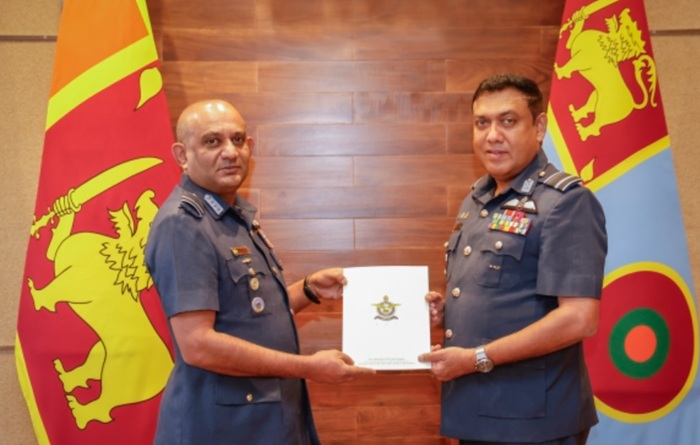
March 04, Colombo (LNW): Air Vice Marshal Lasitha Sumanaweera has been officially appointed as the new Chief of Staff of the Sri Lanka Air Force (SLAF), a decision approved by President Anura Kumara Dissanayake in his capacity as the Commander-in-Chief of the Armed Forces.
The formal announcement was made today, March 04, 2025, when Air Marshal Bandu Edirisinghe, the Commander of the Air Force, presented the letter of appointment to Air Vice Marshal Sumanaweera.
Sumanaweera, an experienced and distinguished officer, will now take on the critical responsibility of overseeing the strategic development and operational efficiency of the Air Force.
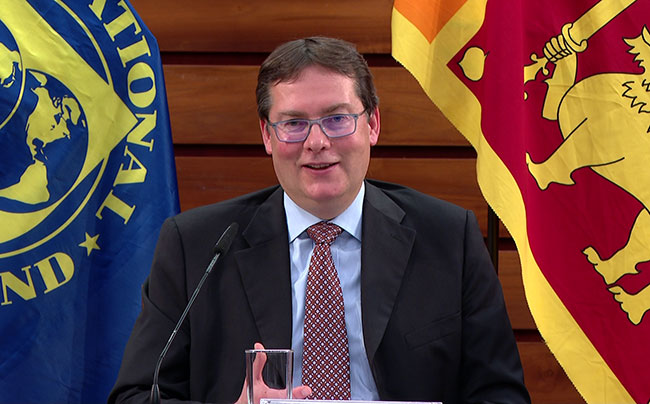
March 04, Colombo (LNW): Peter Breuer, the Senior Mission Chief for Sri Lanka at the International Monetary Fund (IMF), has praised the nation’s remarkable economic recovery in recent years, emphasising that as economic opportunities continue to expand, both income levels and living standards will rise, making it more appealing for people to stay in Sri Lanka rather than emigrate.
Breuer was speaking at a press conference following the completion of the third review of Sri Lanka’s Extended Fund Facility (EFF) programme.
He noted that the country’s reserves have significantly improved under the EFF, reaching nearly half of the set programme targets—a performance Breuer described as “impressive.”
Reflecting on Sri Lanka’s transformation, Breuer highlighted the striking contrast between the country’s current economic outlook and the dire situation he witnessed when he first arrived in Sri Lanka in June 2022.
At that time, the country was grappling with severe shortages of essential goods, with long queues for fuel, cooking gas, food, and medicine. Economic activity had all but come to a standstill, with the nation experiencing a substantial contraction in its economy, losing about 10 per cent of its activity due to the crisis.
However, in a remarkably short period since the implementation of the IMF-backed programme in 2023, Sri Lanka has recovered approximately 40 per cent of the economic activity it lost in the previous five years. Breuer noted that the most recent growth figure of 5.5 per cent further underscored the nation’s significant rebound.
“It’s clear that Sri Lanka has made tremendous strides in a short period, and this recovery will positively impact crucial factors like poverty reduction,” he said.
Breuer also pointed out that as Sri Lanka continues to bounce back, it will not only boost incomes but also create more opportunities for its citizens.
“As the economy stabilises and growth accelerates, people will be more likely to stay in Sri Lanka, finding new prospects within the country rather than seeking opportunities abroad. Those who have emigrated will also be drawn back by the renewed economic potential,” he concluded.
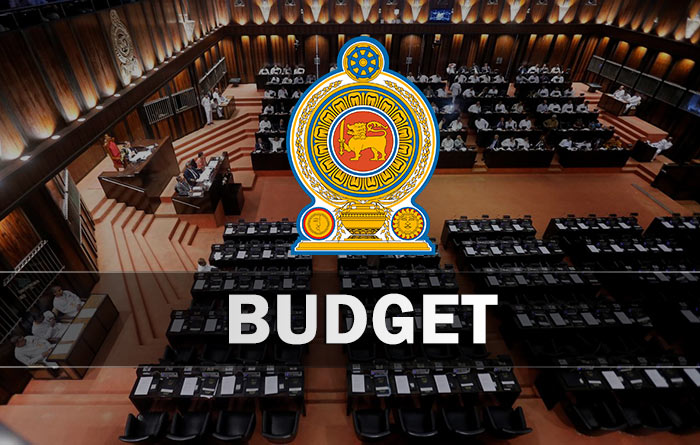
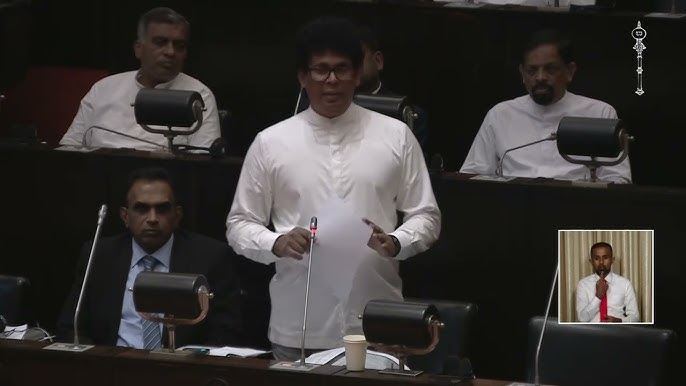
March 04, Colombo (LNW): The ongoing debate on the third reading of the Appropriation Bill, commonly referred to as the Committee Stage debate, continues for the fourth consecutive day today (04).
As Parliament continues to scrutinise the bill, lawmakers will focus on the expenditure allocations for the Ministry of Public Administration, Provincial Councils and Local Government, as well as the Ministry of Labour.
The Committee Stage debate, which commenced on February 27, is scheduled to run for a total of 19 days, spanning across weekdays and four Saturdays, with the final session taking place on March 21.
During this period, MPs will deliberate on the various spending proposals outlined in the bill, discussing the financial allocations for each government ministry and state institution.
The debate will culminate in a vote on the third reading of the Appropriation Bill, which is set for 21 March at 6.00 PM.
The bill, once passed, will outline the government’s financial plan for the upcoming fiscal year, determining how funds will be allocated across various sectors, including public administration, local governance, and labour.
March 04, Colombo (LNW): The government has assured the public that there will be an uninterrupted supply of essential food items during the upcoming Sinhala and Tamil New Year season, with measures in place to ensure both availability and affordability.
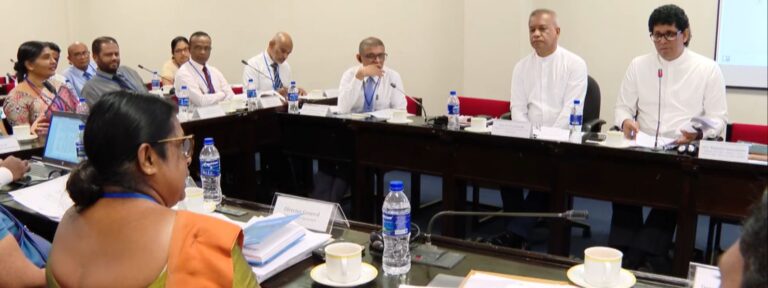
This assurance was given following a key meeting convened by the President’s Media Division (PMD) on 3 March 2025, where relevant ministers and members of the Food Policy and Security Committee met to discuss strategies for maintaining food security throughout the festive period.
According to the PMD, the meeting was focused on ensuring that essential food items are available at reasonable prices during the peak festive season, a time when demand typically surges.
Participants discussed ways to provide these goods to the public without disruptions, and efforts were made to guarantee that stocks are maintained at sufficient levels to avoid any shortages.
Further deliberations during the meeting also centred on implementing additional measures to protect food security within the country. The government stressed the importance of ensuring that all steps taken during this period would not only secure supply but also protect the interests of consumers, local farmers, and food producers.
This holistic approach aims to balance demand with local production capacity and safeguard the entire supply chain.
In addition to the ongoing food security discussions, the meeting also addressed the issue of importing maize for animal feed production, with approval anticipated for shipments of this essential raw material after April 01, 2025.
This decision is expected to help support the agricultural sector and maintain stability in food prices for animal products during the festive season and beyond.
March 04, Colombo (LNW): The government is set to introduce a new Electricity Amendment Bill which will eliminate the planned division of the Ceylon Electricity Board (CEB), Minister of Trade Wasantha Samarasinghe announced in Parliament yesterday (03).
Speaking on the matter, Minister Samarasinghe emphasised that the current administration has no intention of privatising any power stations or the transmission of electricity.
He pointed out that the previous government had proposed dividing the CEB into eight separate entities, a move that the present government will not pursue.
“We are committed to maintaining the integrity of the Ceylon Electricity Board as a single entity. Unlike the previous administration’s plans, we will not fragment the CEB into multiple companies,” Samarasinghe clarified.
The Minister also highlighted the government’s success in reducing electricity prices, revealing that the cost of power has decreased significantly, now ranging between Rs. 18 to 19 per unit, down from Rs. 30 per unit previously.
This reduction, he noted, demonstrates the government’s commitment to ensuring affordable power for the public.
The Ministry of Trade reiterated that the current government remains focused on purchasing electricity at the lowest possible rates, further assuring the public of continued efforts to make energy consumption more affordable and accessible for all citizens.
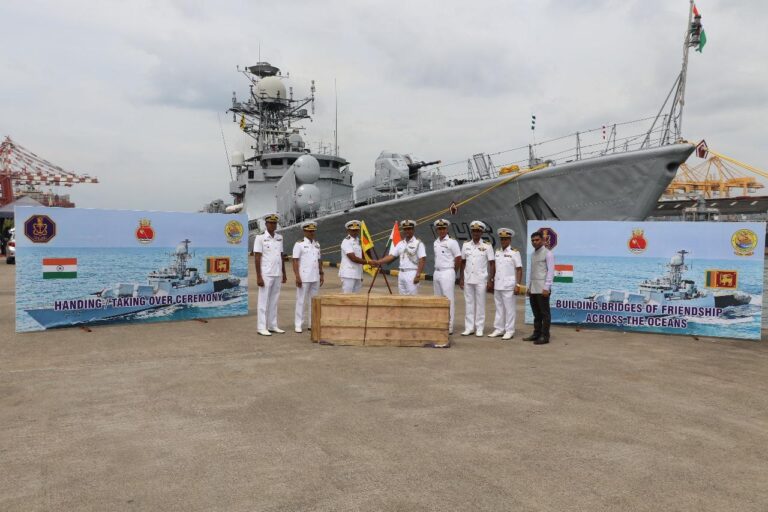
March 04, Colombo (LNW): The Indian Naval Ship Kuthar, an indigenously built Khukri-class corvette, docked at the Port of Colombo yesterday (03) for a three-day goodwill visit.
The vessel was greeted with a warm and traditional reception, including a performance by the Sri Lankan Navy band and an official welcome from senior naval officers.
Upon its arrival, the commanding officer of INS Kuthar, Commander Nitin Sharma, paid a courtesy call to Rear Admiral MHCJ Silva, the Commander of the Western Naval Area of the Sri Lanka Navy.
The occasion marked an important step in furthering the strong maritime cooperation between India and Sri Lanka.
One of the key events during the visit was a ceremony held on board INS Kuthar, where the ship’s crew handed over a refilled fire-fighting system cylinder to the Sri Lanka Coast Guard Ship Suraksha.
This system is a vital component of the vessel’s safety infrastructure. SLCGS Suraksha, an Offshore Patrol Vessel, was transferred to Sri Lanka by the Indian government in October 2017, and India has previously provided spare parts and technical support to the ship, including similar assistance in June 2021, April 2022, and June 2024. The refilling of fire-fighting cylinders was also carried out by India in January 2024.
During its stay in Colombo, INS Kuthar will engage in a series of professional interactions aimed at enhancing the skills and knowledge of Sri Lankan Navy personnel.
These exchanges will focus on sharing best practices and enhancing operational efficiency between the two navies. A special demonstration on Visit, Board, Search, and Seizure (VBSS) operations, as well as Force Protection tactics, will be conducted by the Sri Lanka Navy for the Indian crew.
Additionally, the ship’s crew will take part in sports activities and yoga sessions with their Sri Lankan counterparts, further strengthening the camaraderie between the two forces.
INS Kuthar is scheduled to depart from Colombo on March 06, 2025, marking the conclusion of this important visit that highlights the continued close ties between the Indian and Sri Lankan navies.
March 04, Colombo (LNW): A police constable from the Weeraketiya Police Station has been apprehended in connection with the horrific triple murder that occurred in Middeniya.
The arrest took place yesterday (03) evening, when officers from the Middeniya Police Station made the breakthrough following an ongoing investigation.
The 36-year-old suspect, a resident of Julampitiya, stands accused of supplying a crucial component to the individuals responsible for the shooting.
It is alleged that he provided 12 rounds of live T-56 ammunition to the assailants, who are believed to have carried out the attack.
The tragic shooting occurred on February 18, claiming the lives of Aruna Vidanagamage and his two young children.
Authorities have made significant progress in the investigation, with a total of seven individuals now in custody in relation to the crime.
March 04, Colombo (LNW): Sri Lanka has firmly rejected several resolutions passed by the United Nations Human Rights Council (UNHRC), reaffirming its stance against Resolutions 46/1, 51/1, and 57/1, as well as the external evidence gathering mechanism on Sri Lanka.
These resolutions, which were discussed during the 58th Session of the UNHRC, have sparked significant controversy in the country.
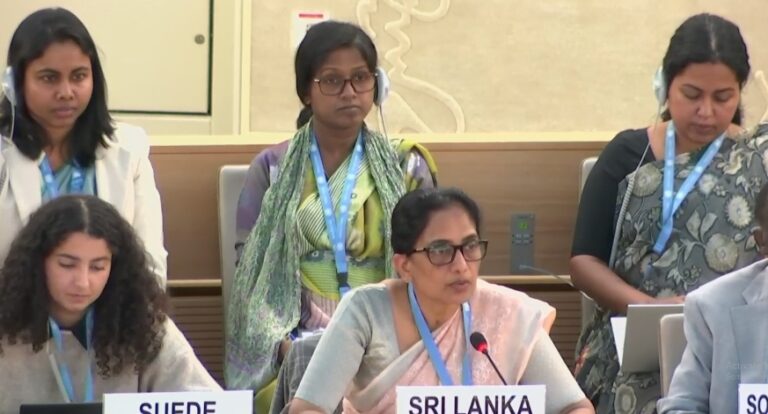
Sri Lanka’s Permanent Representative to the UN in Geneva, Ambassador Himalee Subashini Arunatilaka, made the nation’s position clear during the High Commissioner for Human Rights’ oral update on Sri Lanka, stating that the country is resolutely opposed to such external interventions.
The government of Sri Lanka has consistently expressed its belief that national ownership, coupled with gradual, internally driven reforms, is the most effective path towards transformative change.
As a sovereign nation, Sri Lanka insists that progress should be shaped by its own legal processes and frameworks, and that any external mechanisms that undermine this principle are unacceptable.
Expressing deep regret, Sri Lanka condemned what it perceives as the inconsistent application of human rights principles within the UNHRC. Ambassador Arunatilaka pointed out that this selective approach to human rights has eroded trust in the global human rights system.
She warned that such practices have made countries more reluctant to engage with the Council, undermining the very values on which the UNHRC was established.
“We have long maintained that country-specific resolutions, which are passed without the consent of the country concerned, are deeply problematic,” Arunatilaka explained. “Sri Lanka remains opposed to Resolutions 46/1, 51/1, and 57/1, as well as the external evidence-gathering mechanism that was established through these divisive and intrusive resolutions.”
Sri Lanka also strongly criticised the establishment of an external evidence-gathering mechanism on Sri Lanka within the Office of the High Commissioner for Human Rights (OHCHR).
The government views this as an unprecedented overreach of the Council’s mandate, which contradicts the founding principles of impartiality, objectivity, and non-selectivity.
According to the Sri Lankan government, no sovereign state should be subjected to an external mechanism that contradicts its Constitution and undermines its domestic legal processes.
Adding to these concerns, several countries have raised alarm over the financial implications of the external evidence-gathering mechanism, especially in light of the United Nations’ ongoing budgetary constraints.
The Sri Lankan representative emphasised the need for a more responsible and balanced approach to human rights issues, one that respects national sovereignty and the principle of fairness.
Whilst strongly rejecting external interference, Sri Lanka reaffirmed its commitment to addressing human rights challenges, including reconciliation, through domestic processes. Ambassador Arunatilaka highlighted that the Sri Lankan government will continue its constructive engagement with the UNHRC and other human rights instruments, citing recent cooperative efforts with the Committee on the Elimination of Discrimination Against Women (CEDAW) during the review of the country’s ninth periodic report.
At the same time, Sri Lanka reiterated its dedication to multilateral cooperation in fostering peace, prosperity, and sustainability, alongside the promotion and protection of all human rights.
The government assured that efforts to rebuild the nation’s economy will be inclusive, ensuring that all citizens have equal opportunities to benefit from the country’s growth.
Arunatilaka emphasised that economic development would be pursued in a way that promotes transparency, accountability, and social justice. The government is committed to ensuring that the benefits of growth reach all segments of society and that the rule of law, reconciliation, and human rights remain central to the nation’s progress.
The Sri Lankan government has also outlined its focus on key national priorities, including the eradication of rural poverty, the implementation of the ‘Clean Sri Lanka’ initiative aimed at promoting social and environmental revival, and the creation of a robust digital economy to support sustainable development.
In line with its commitment to peace and reconciliation, Sri Lanka will continue to support the most vulnerable populations, particularly those affected by past conflicts, ensuring they are not left behind in the country’s development journey.
“By expanding the work of the proposed truth and reconciliation commission, we will investigate the impact of violence stemming from racism and religious extremism, whilst guaranteeing that all domestic processes remain credible and independent,” Arunatilaka concluded. “The government is determined to protect the human rights of all citizens, address past grievances, and create a more inclusive and prosperous Sri Lanka for future generations.”
March 04, Colombo (LNW): Prevailing showery condition over the island is expected to be reduced from today (04).
Showers or thundershowers may occur at a few places in Western and Sabaragamuwa provinces and in Galle and Matara districts in the evening or night.
A few showers may occur in Eastern coastal areas during the morning.
The general public is kindly requested to take adequate precautions to minimise damages caused by temporary localised strong winds and lightning during thundershowers.
Marine Weather:
Condition of Rain:
Mainly fair weather will prevail over the sea areas around the island.
Winds:
Winds will be north-easterly to easterly and speed will be (25-35) kmph. Wind speed will increase up to (40-45) kmph at times in the sea areas extending from Galle to Hambantota via Matara.
State of Sea:
The sea areas off the coast extending from Galle to Hambantota via Matara can be fairly rough times. Other sea areas around the island will be moderate. Temporarily strong gusty winds and very rough seas can be expected during thundershowers.
March 03, Colombo (LNW): The National Shoora Council (NSC) a consultative body comprising several Muslim Organisations and individuals formed to address the challenges currently faced by Muslims in Sri Lanka in a proactive manner is set to make a clarian call to countries worldwide to invest in Sri Lanka.
The Executive Committee of the National Shoora Council (NSC) last week decided to urge countries worldwide, including the 57-member Organisation of Islamic Cooperation (OIC) headquartered in Jeddah, Saudi Arabia, to make and encourage direct investments in Sri Lanka.
They request the Islamic world to make foreign direct investment in Sri Lanka’s in agriculture, dairy farming, fisheries, and housing projects, preferably in collaboration with existing Sri Lankan developers.
NSC’s newly-elected Head M.M. Zuhair, PC stated that prospective private sector investors should be supported to make direct investments in Sri Lanka through the Board of Investment (BOI).
The NSC, a non-profit civil society, would facilitate in the national interest collaboration with existing Sri Lankan companies of repute across the board. Government-level investments could be facilitated to discuss investments at government to government level, an NSC media release said.
The NSC would also urge the Government to create an attractive environment to encourage investments in the island nation, presently affected by high electricity and labour costs.
The civil society organisation has decided to suggest that the country’s President visit Riyadh and invite Saudi Government investments in Sri Lanka, and also meet with the heads of the OIC and other high-profile entities.
These are necessary to encourage closer cooperation to support the country’s efforts to develop and overcome the hitherto critical economic sectors. That would help other Middle Eastern countries too to come in, the NSC release said.
Sri Lanka presently receives the highest foreign exchange earnings annually from mainly the Middle East, with employment remittances topping $ 6.58 billion in 2024 without any debt constraints, while the highest volumes of remittances came last year from Kuwait, the UAE, Saudi Arabia, and Qatar.
Merchandise exports meanwhile earned $ 12.78 billion as against imports costing $ 18.84 billion in 2024, adding a foreign exchange liability of $ 6.06 in the import-export sector. Tourism brought in $ 3.17 billion, while IT earnings were $ 0.85 billion in 2024.
Progressive sectors of the country should presently support genuine governmental efforts to overcome economic sector bottlenecks and help achieve self-sufficiency and higher export targets, the NSC President said.