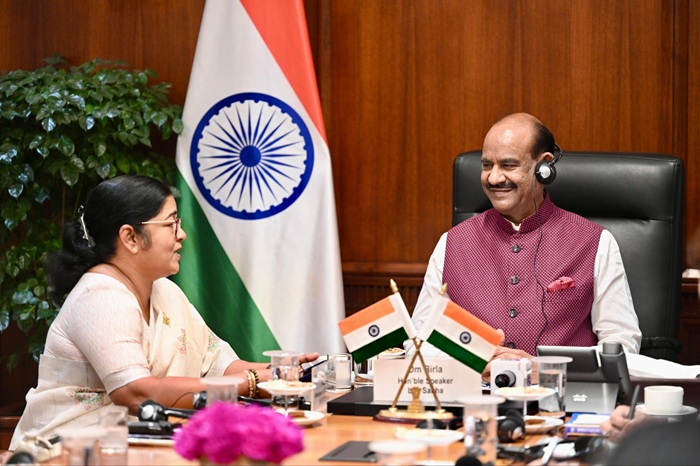
February 10, Colombo (LNW): Sri Lanka’s Ministry of Industry hosted the third round of consultations on Monday with World Bank experts Richard Walker and Anna Twum, focusing on the nation’s planned overhaul of its import tariff system.
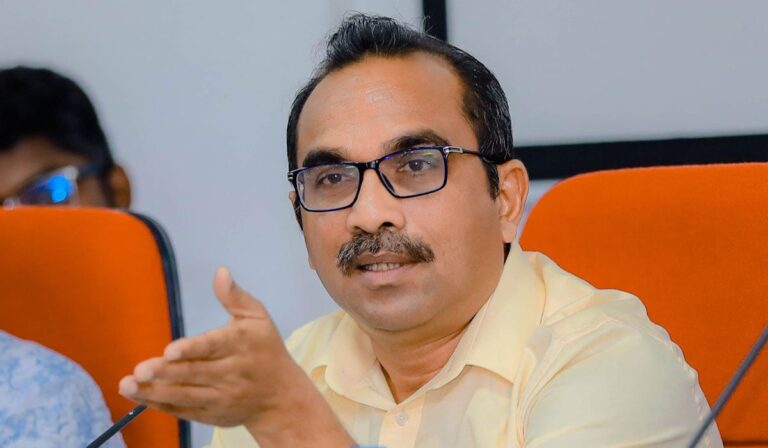
Deputy Minister of Industries and Entrepreneurship Development, Chathuranga Abeysinghe, said the 2026 policy will mark a major shift in the country’s economic framework by removing para-tariffs such as Cess and PAL, while introducing a simplified four-tier tariff structure for imports.
Speaking on social media, the Deputy Minister described the reform as “the most significant step in Sri Lanka’s economic transformation in recent years,” aimed at better aligning the economy with global value chains. He added that the new structure is designed to ensure a more transparent, efficient, and internationally compatible trade regime.
Abeysinghe noted that discussions with the World Bank delegation, which is providing technical guidance for the reform, emphasised several key priorities: strong institutional oversight during implementation, phased execution according to a clear timeline, establishing robust national standards for imported goods, and curbing the entry of under-invoiced or substandard products.
According to the Deputy Minister, the revamped tariff system is crucial not only for enhancing Sri Lanka’s export competitiveness but also for paving the way for the country to engage more fully in international trade agreements, strengthening its position in global markets.
Sri Lanka Plans Major Tariff Overhaul to Boost Trade Competitiveness
Devnimori Buddha Relics Draw Devotees to Gangaramaya for Sixth Day
February 10, Colombo (LNW): The sacred Devnimori relics of Lord Buddha, recently brought from India, continue to be on public display at Colombo’s Gangaramaya Temple for the sixth consecutive day today (10).
Venerable Kirinde Assaji Thero, head of the temple, announced that devotees will be able to pay their respects until 10:00 p.m. this evening. The display has already attracted large crowds, including the Speaker of Parliament, government ministers, diplomats, and numerous devotees, who gathered yesterday to venerate the precious relics.
The Devnimori relics, unearthed during excavations in the 1960s at the historic Devnimori site in Gujarat, India, have never before been taken outside India, making this exhibition particularly significant for both Sri Lankan and international Buddhists.
A delegation of Indian dignitaries, including Madhya Pradesh Governor Mangubhai C. Patel and Arunachal Pradesh Deputy Chief Minister Chowna Mein, arrived in Sri Lanka yesterday to accompany the relics on their return journey to India.
The exhibition is set to conclude early tomorrow morning, at 6:00 a.m., after which the relics will be ceremoniously returned, marking the end of a historic visit that has strengthened cultural and religious ties between the two nations.
Sri Lanka’s Reserves Slip Slightly in January Amid Gold Gains
LISTEN TO STORY
WATCH STORY
By: Isuru Parakrama
February 10, Colombo (LNW): Sri Lanka’s official reserve assets experienced a modest decline in January 2026, according to figures published by the Central Bank of Sri Lanka (CBSL).
The country’s reserves fell from US$ 6,838 million at the end of December 2025 to US$ 6,824 million by the close of January, representing a minor drop of 0.2 per cent.
Foreign exchange reserves, which make up the bulk of official holdings, decreased by 1 per cent, moving from US$ 6,747 million to US$ 6,680 million over the month.

Conversely, gold reserves recorded a substantial gain, rising sharply by 26.8 per cent from US$ 86 million to US$ 109 million, reflecting the Central Bank’s strategic accumulation.
The CBSL also highlighted that official reserves incorporate foreign exchange swap proceeds of around US$ 1.4 billion secured from the People’s Bank of China, though these funds carry certain usage restrictions.
Analysts note that while the overall decline is slight, the increase in gold holdings provides some buffer against currency volatility.
India and Sri Lanka Deepen Health Cooperation Through New HTA Knowledge Exchange in New Delhi
February 10, Colombo (LNW): India and Sri Lanka have launched a five-day knowledge exchange programme in New Delhi aimed at strengthening Sri Lanka’s capacity in Health Technology Assessment, a key tool for evidence-based healthcare decision-making.
The workshop, which began on Monday at the Sushma Swaraj Bhawan, brings together officials from Sri Lanka’s Ministry of Health with Indian experts and policymakers. It is being organised by India’s Department of Health Research under the Ministry of Health and Family Welfare, in partnership with the Ministry of External Affairs, reflecting a broader commitment to regional collaboration in public health.
Opening the programme, Dr Rajiv Bahl, Secretary of the Department of Health Research and Director General of the Indian Council of Medical Research, described the initiative as an important step in health diplomacy between the two neighbours. He noted that sharing India’s experience in Health Technology Assessment would support Sri Lanka’s efforts to build robust, transparent and sustainable health systems.
Anu Nagar, Additional Secretary at the Department of Health Research, drew attention to the growing influence of Health Technology Assessment India in shaping cost-effective and evidence-driven healthcare policies. She expressed optimism that the exchange would help Sri Lanka develop its own institutional framework for assessing health technologies and interventions.
Health Technology Assessment India, an attached office of the Department of Health Research, has been instrumental in guiding decisions on medical technologies, pricing and resource allocation within India’s health sector. Its methodologies and governance models are expected to form a central part of the discussions.
Over the course of the week, participants will explore topics ranging from institutional design and regulatory oversight to evaluation methods, pricing strategies and procurement processes. The programme also seeks to identify areas for future collaboration, with officials from both countries looking to build long-term partnerships that strengthen Health Technology Assessment systems across the region.
Sri Lankan President Welcomes Green Light for India–Pakistan World Cup Clash in Colombo
LISTEN TO STORY
WATCH STORY
By: Isuru Parakrama
February 10, Colombo (LNW): President Anura Kumara Dissanayake has conveyed his appreciation to Pakistan’s Prime Minister Shehbaz Sharif for backing the decision to allow the high-profile India–Pakistan encounter at the T20 Cricket World Cup to go ahead in Colombo as planned.
In a message shared on social media, the President said Sri Lanka, as one of the tournament’s co-hosts, was pleased that consensus had been reached to ensure the continuation of the much-anticipated fixture. He also acknowledged the role played by the International Cricket Council and other stakeholders in navigating the complexities surrounding the match.

Reflecting on cricketing history, President Dissanayake pointed to the 1996 Cricket World Cup, recalling how both India and Pakistan stood by Sri Lanka by agreeing to play in Colombo at a time when security concerns had led others to hesitate. He noted that such gestures of solidarity had left a lasting impression and continued to resonate decades later.
The President’s remarks underlined Sri Lanka’s broader view of sport as a bridge between nations, expressing satisfaction that cricket’s biggest rivalry would once again be played on Sri Lankan soil, reinforcing the island’s place as a trusted and welcoming host on the global sporting stage.
Thank you Prime Minister @CMShehbaz for ensuring the game we all love goes on. Delighted that the eagerly awaited India and Pakistan match at the ongoing T20 Cricket World Cup in Colombo will proceed as planned.
— Anura Kumara Dissanayake (@anuradisanayake) February 9, 2026
As co-host of the tournament, Sri Lanka thanks the @ICC and all…
Reform or Regression? How Sri Lanka’s Proposed Mineral Policy is backfiring
By: Staff Writer
February 10, Colombo (LNW): The government’s suspension of heavy mineral mining and exploration licenses marks a decisive and divisive intervention in Sri Lanka’s mineral sector. Framed as a reset to correct decades of mismanagement, the move has instead exposed the fragility of policy-driven governance in a sector that relies on continuity, certainty, and investor confidence.
Industry and Entrepreneurship Development Minister Sunil Handunneththi recently said the decision will remain in effect until Cabinet approval is obtained, relevant guidelines are gazetted and the policy is presented to Parliament. The suspension applies to all heavy mineral exploration and mining licenses, excluding minerals required for housing and construction activities.
It makes clear that the suspension will remain until Cabinet approval, gazette notification, and parliamentary presentation of the National Mineral Policy are completed. Yet no definitive timeline has been offered. For an industry already contributing only about USD 389 million in exports against a potential of USD 778 million, this uncertainty is proving damaging.
Supporters of the decision argue that drastic action was unavoidable. The minister acknowledges widespread illegal mining, unpaid royalties, and political interference under past governments. The claim that no new mineral extraction approvals have been granted under the current administration is presented as proof of a clean break from the past.
But this “zero-approval” approach has consequences. By halting all heavy mineral licensing regardless of compliance history the government has effectively punished regulated operators alongside illegal ones. Exploration companies, which operate on long investment horizons, say Sri Lanka is now viewed as a high-risk jurisdiction.
The policy’s stated objective of ensuring maximum national benefit is undermined by its failure to address value addition, export diversification, or downstream processing. The document focuses heavily on control and enforcement but offers little insight into how the new framework will expand exports, raise unit values, or move Sri Lanka up the mineral value chain.
The planned special enforcement unit may help curb illegal activity, but enforcement alone does not generate revenue. Without parallel reforms such as faster approvals for compliant operators, transparent royalty structures, and incentives for processing the industry risks shrinking rather than reforming.
Another concern is institutional capacity. The Geological Survey and Mines Bureau, already overstretched, will be central to implementing the new policy. However the document does not outline how staffing, technology, or funding constraints will be addressed raising doubts about effective enforcement and administration.
The suspension also sends mixed signals to investors. While the government speaks of transparency and accountability, sudden policy freezes without transition frameworks suggest unpredictability. In global mineral markets, predictability is often as valuable as resource quality.
Sri Lanka’s mineral sector does require reform few dispute that. But reform achieved through prolonged suspension risks becoming self-defeating. Each delayed project, each lost export order, and each diverted investor erodes the very national benefit the policy claims to protect.
The challenge for the government is clear: move swiftly from control to clarity, from suspension to structure or risk turning a reform agenda into an industry downturn.
Government Holds Line on Coal Deal despite Rising Opposition Fury
LISTEN TO STORY
WATCH STORY
By: Staff Writer
February 10, Colombo (LNW): The Government has chosen to stand its ground on the controversial long-term coal supply agreement with Trident Chemphar Ltd., defying mounting political pressure, expert warnings, and street protests over allegations of importing substandard coal.
Energy Ministry officials insist that the decision is driven by contractual obligations and technical assessments rather than political convenience. The move follows preliminary findings by the Lanka Coal Company (LCC) indicating that the third coal shipment complies with required quality specifications, weakening the opposition’s demand for immediate cancellation.
Energy Secretary Prof. Udayanga Hemapala said the Cabinet-approved emergency procurement of 300,000 metric tonnes would remain a contingency option. “Emergency procurement is not an automatic response. It will only be triggered if there is a clear technical failure,” he said, adding that the official quality report of the third shipment was expected shortly.
The long-term agreement covers the supply of 1.5 million metric tonnes of coal between December 2025 and April 2026. By last week, six shipments had already been unloaded, although quality reports have been officially released for only two consignments.

Inspection data from those shipments reveal uneven results. The first consignment recorded an ash content of 22.42%, exceeding tender limits, while maintaining a Gross Calorific Value (GCV) of 6,032 kcal/kg. The second shipment showed improved figures, with a GCV of 6,535 kcal/kg and ash content marginally above the 16% threshold.
Tender conditions stipulate rejection only if GCV falls below 5,900 kcal/kg, ash content exceeds 16%, or moisture levels rise above 16%. Contract termination is permitted only if two shipments fail to meet these criteria or if consistent discrepancies are found between load port and jetty test results.
Opposition parties argue that the Government is exploiting narrow technical loopholes. “This is not about legal thresholds alone; it’s about national energy security and long-term damage to power plants,” an opposition energy spokesperson said.
Despite criticism, officials warn that cancelling the contract prematurely could expose the State to costly arbitration and supply disruptions. For now, the Government appears determined to let contractual technicalities not political outragedecide the fate of the coal deal.
Sri Lanka’s Tax Reset: Inside the New Unit Meant to End Ad Hoc Fiscal Policy
By: Staff Writer
February 10, Colombo (LNW): Sri Lanka has formally operationalised its Tax Policy Analysis Unit (TPAU), a move that senior officials describe as a long-overdue structural correction to decades of fragmented and politically driven tax policymaking. Established under the Ministry of Finance and functioning within the Department of Fiscal Policy, the Unit is a key structural benchmark under the International Monetary Fund’s programme-linked reform framework.
The creation of the TPAU marks a decisive shift towards evidence-based taxation after years of ad hoc tax measures, sudden reversals, and weak analytical foundations that undermined revenue stability and investor confidence. A senior Finance Ministry official described the Unit as “a turning point in fiscal governance,” noting that it centralises tax policy formulation, appraisal, and monitoring under a single technically specialised entity for the first time.
Historically, Sri Lanka’s tax reforms were often shaped by short-term political considerations rather than rigorous analysis. The absence of a permanent institutional body meant that revenue measures were frequently poorly costed, inconsistently designed, and vulnerable to rollbacks. This not only eroded the tax base but also created uncertainty for businesses and taxpayers.
The Government’s decision to operationalise the TPAU comes at a critical moment. Sri Lanka recorded unprecedented income tax and duty revenues in 2025, offering fiscal breathing space after years of crisis. However, authorities are acutely aware that revenue gains alone do not resolve long-standing weaknesses in tax design, exemptions, and equity. The new Unit is expected to help capitalise on these gains by ensuring future policies are sustainable, fair, and growth-oriented.
The operational launch of the TPAU was preceded by a capacity-building programme conducted by the IMF during its recent fact-finding mission. The training exposed officials to modern tax policy tools, including revenue forecasting, tax expenditure analysis, and distributional modelling based on internationally accepted methodologies. Following the programme, IMF officials engaged Treasury Secretary Harshana Suriyapperuma and senior fiscal experts to refine the Unit’s mandate and scope.
According to the Ministry of Finance, the TPAU’s functions include revenue impact assessments, economic analysis of proposed tax measures, evaluation of tax exemptions, and analysis of distributional outcomes. It will also engage key stakeholders and support work on international, regional, and global tax cooperation.
IMF diagnostics have repeatedly flagged governance weaknesses in Sri Lanka’s tax administration agencies, including the Inland Revenue Department and Sri Lanka Customs. The Fund has warned that without a dedicated, technically competent tax policy unit, governments tend to rely on temporary commissions or politically expedient tax changes that weaken compliance and long-term revenue mobilisation.
By embedding analytical discipline into the policymaking process, the TPAU is intended to ensure that future tax reforms are not only fiscally sound but also economically rational and socially equitable.
Wetlands for Sale: How Real Estate Is Redrawing Colombo’s Suburbs
By: Staff Writer
February 10, Colombo (LNW): Colombo’s expanding suburbs are becoming a frontline in the struggle between urban growth and environmental protection, as real estate development increasingly targets nature-rich landscapes. A new report by the Centre for a Smart Future finds that weak governance, fragmented planning and rising land values are placing wetlands and paddy fields under unprecedented strain.
The study focuses on Thalangama Lake and nearby communities, where improved infrastructure and lifestyle-driven demand have made proximity to nature a lucrative selling point. Land prices in these areas have reportedly climbed by 30 to 40 percent each year, transforming once-rural landscapes into prime development zones.
As land in central Colombo becomes scarce and expensive, developers have shifted toward suburban belts, promoting projects that promise tranquillity, greenery and scenic views. The report notes that while such developments appeal to affluent buyers, they often accelerate horizontal sprawl and ecological fragmentation, creating a patchwork of condominiums, gated housing schemes and isolated green remnants.
Governance failures emerge as a central concern. Multiple urban plans including the Western Region Megapolis Master Plan and various Urban Development Authority proposals offer competing visions for Colombo’s growth. According to the study, these plans pay limited attention to liveability or integrated green space management, leaving environmentally sensitive areas vulnerable to ad hoc decision-making.
Zoning regulations are described as ambiguous and easily overridden, particularly for infrastructure projects. Legal provisions allowing the conversion of so-called abandoned or low-yield paddy lands have further enabled reclamation, even in flood-prone zones. Within the Thalangama Environmental Protection Area alone, responsibility is divided among eight government agencies, resulting in weak enforcement and regulatory gaps.
Environmental safeguards are also falling short. Environmental Impact Assessments are required only for large-scale or prescribed projects, allowing many high-density developments to proceed without rigorous scrutiny. The cumulative effects of multiple smaller projects on flooding, biodiversity and water quality are rarely assessed, while limited public access to land-use data restricts community oversight.
For local residents, the consequences are tangible. Communities report worsening traffic congestion, increased noise and waste, declining air quality and heightened flood risks. Rising land prices have displaced long-standing farming families, reshaping the social fabric of these neighbourhoods. Yet the report also documents a growing wave of community-led environmental activism, with residents mobilising to oppose projects they see as environmentally destructive.
Despite differing perspectives among developers, regulators and residents, the study finds consensus on one point: the need for clearer zoning, stronger protection of suburban ecosystems and more coherent urban governance. Without reform, the report warns, Colombo’s current development path threatens to undermine the natural systems essential to the city’s long-term resilience and liveability.
Parliamentary Panel Clears Expert Blueprint for Proposed National Education Council
February 10, Colombo (LNW): A key parliamentary body has endorsed the findings of an expert group tasked with shaping the proposed Education Council, marking an important step in Sri Lanka’s ongoing education reforms.
The approval was given at a recent meeting of the Parliamentary Sub-Committee on the establishment of the Education Council, chaired by Deputy Minister of Labour Mahinda Jayasinghe. During the session, the final report prepared by the expert committee appointed by the Ministry of Education was formally accepted for onward consideration.
The document was presented to the sub-committee by Professor O.G. Dayaratne, who led the expert panel. Members of the parliamentary body had already submitted their observations and recommendations on the report prior to the meeting, contributing to its refinement.
According to Deputy Minister Jayasinghe, the report has since been published in all three national languages—Sinhala, Tamil and English—and circulated among sub-committee members to ensure wider accessibility and informed discussion.
The sub-committee has now resolved to submit the report to the Parliamentary Consultative Committee of the Ministry of Education, which is expected to take it up at its meeting scheduled for 18 February. Formal clearance is anticipated at that stage.
Once approved, the proposals will be opened to public scrutiny for a month, allowing teachers, school administrators, trade unions and other stakeholders to share their views. Officials have indicated that constructive feedback received during this consultation period will be carefully reviewed and, where appropriate, incorporated.
Deputy Minister Jayasinghe said the intention is to move swiftly thereafter, introducing the necessary legal framework to establish the Education Council, with amendments made to reflect both expert guidance and public input.