November 11, Colombo (LNW): Several spells of showers may occur in Northern and North-central Provinces and in Trincomalee district, with showers or thundershowers being expected to occur at a few places in Central, Uva, Sabaragamuwa and Southern provinces in the evening or night, the Department of Meteorology said in its daily weather forecast this (11) morning.
Fairly heavy showers above 50mm are likely at some places.
Misty conditions can be expected at some places in Western, Sabaragamuwa, Central and North-western provinces and in Galle and Matara districts during the morning.
The general public is kindly requested to take adequate precautions to minimise damages caused by temporary localised strong winds and lightning during thundershowers.
Marine Weather:
Condition of Rain:
Showers or thundershowers may occur at several places in the sea areas off the coast extending from Kankasanthurai to Trincomalee. Showers or thundershowers may occur at a few places in the other sea areas during the evening or night.
Winds:
Winds will be North-easterly in the sea areas extending from Puttalam to Hambantota via Kankasanthurai and Trincomalee and Northerly or variable in direction in the other sea areas around the island. Wind speed will be (25-35) kmph in the sea areas around the island. Wind speed can increase up to (40-45) kmph at times in the sea areas off the coast extending from Trincomalee to Galle via Kankasanthurai, and Puttalam.
State of Sea:
The sea areas extending from Trincomalee to Galle via Kankasanthurai, and Puttalam can be fairly rough at times. Other sea areas around the island will be slight to moderate. Temporarily strong gusty winds and very rough seas can be expected during thundershowers.
November 11, Colombo (LNW): In immediate response to the LNW’s disclosure on former Health Minister Keheliya Rambukwella’s family’s attempt to retrieve an undisclosed sum of Rs. 50 million amidst the ongoing probe into Rambukwella’s alleged financial misconduct, the Financial Intelligence Unit (FIU) of the Central Bank of Sri Lanka (CBSL) has frozen the transaction from being made.
The probe had already led to the suspension of transactions on multiple fixed deposit accounts and life insurance policies linked to Rambukwella and five of his family members.
The attempt to retrieve this unexamined deposit was reportedly made by Rambukwella’s daughter at a Bank of Ceylon branch. However, the intervention of the FIU of the CBSL successfully blocked the transaction, ensuring that the funds remained accessible to investigative authorities.
This recent development follows LNW’s exclusive report on the matter, which shed light on the attempted transaction. LNW expresses its gratitude for the public’s support in advancing the investigation, emphasising its commitment to transparency and accountability in exposing potential misuse of funds.
The CID’s investigation into Rambukwella’s finances remains active, with further scrutiny expected to ensure that no undisclosed assets evade accountability.
President Anura Kumara Dissanayake pledges imminent developments regarding the 2019 Easter Sunday attacks, emphasising an end to politically-facilitated murders: highlights unresolved cases, including the deaths of Thajudeen, Lasantha, and Eknaligoda, vowing to pursue justice and ensure citizens’ safety: promises the public “good news” soon on the Easter attacks investigation.
SJB former MP (Dr.) Harsha De Silva says the President can increase the threshold of the pay as you earn (PAYE) tax from Rs. 100,000 to Rs. 200,000 without parliamentary approval: acknowledges such a move can be passed into law in Parliament after the election, but asserts the PAYE tax can be increased at the moment without any parliamentary power: confirms that funds have already been allocated in this regard as claimed by ex-President Ranil Wickremesinghe, asserting that Senior Economic Advisor to the President Duminda Hulangamuwa has already inked his signature for the move.
The Frontline Socialist Party (FSP) urges President Anura Kumara Dissanayake to investigate state-sanctioned crimes from the 1988-89 period, honouring JVP figures, including Rohana Wijeweera, ahead of the JVP’s 35th commemoration: urges a comprehensive probe into kidnappings, disappearances, and extrajudicial killings, demanding transparency and accountability, and pledges support, including evidence, to help achieve justice.
The Ministry of Health warns the public and health staff about scammers impersonating senior health officials to solicit funds: No authorised health official will request money through calls or messages: urges people not to transfer funds and has begun legal action against those involved in this fraud.
The Defence Ministry announces legal action will be enforced against civilians who fail to return firearms by the 21 November deadline: Firearms not returned or appealed for will be deemed illegal: A senior official stated that the ministry holds records of all issued firearms and will impose strict penalties for non-compliance.
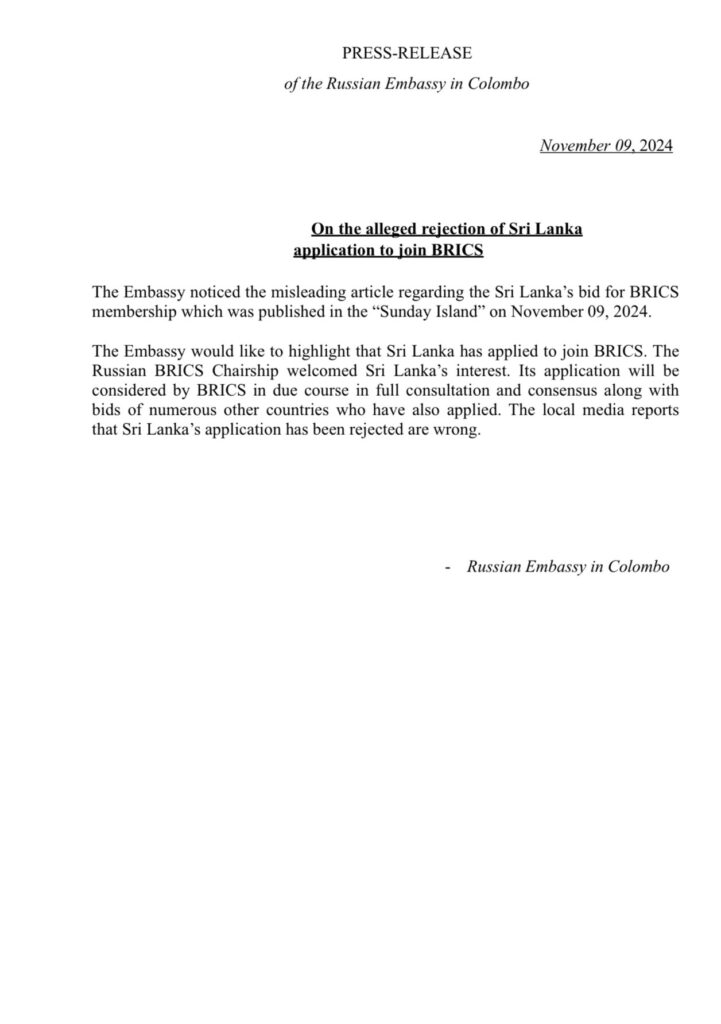
Sri Lanka’s bid to join BRICS will be reviewed in due course alongside other applications, under Russia’s chairmanship: The Russian Embassy clarifies that reports of Sri Lanka’s rejection are inaccurate: Foreign Affairs Minister Vijitha Herath requested BRICS support for Sri Lanka’s membership, aligning with BRICS’s goal of strengthening ties with the Global South and promoting a multipolar global order.
Indian Navy submarine INS Vela arrives in Colombo for a formal visit, welcomed by the Sri Lanka Navy with traditional honours: Commanded by Commander Kapil Kumar, the 67.5m-long submarine with a 53-member crew will allow its personnel to explore Sri Lanka’s tourist spots: INS Vela is set to depart on 13 November.
The Election Commission reports a rise in complaints related to the 2024 Parliamentary Poll, with 232 new grievances on 9 November, bringing the total to 2,580 since September 26: Of these, 1,999 have been resolved: The Commission is addressing remaining complaints as the General Election approaches on November 14.
The Disaster Management Centre (DMC) will launch a special unit on 12 November to manage potential disaster situations around the parliamentary election period: Coordinating with the Election Commission, this unit will oversee disaster readiness and response from two days before to two days after election day, ensuring safety and preparedness throughout the election process.
An IMF delegation, led by senior mission chief Peter Brewer, will visit Sri Lanka next week for the third review of the country’s Extended Fund Facility (EFF) programme: This assessment will address Sri Lanka’s economic policies and reforms: Upon successful review, the IMF will release the next loan installment, as the government reaffirms its commitment to the IMF agreement.
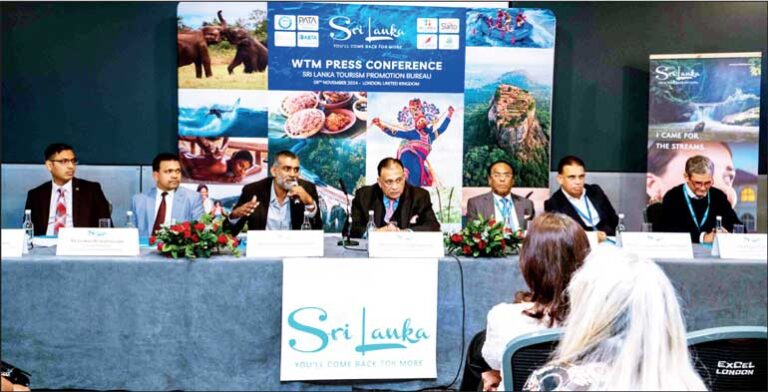
November 10, Colombo (LNW): At the World Travel Market (WTM) 2024 in London, Sri Lanka unveiled an ambitious new vision for its tourism industry, centered on sustainability. The strategy aims to enhance engagement with visitors while safeguarding the island’s exceptional natural beauty and cultural heritage.
The event, which saw the participation of over 80 UK travel media professionals, marked a significant shift in Sri Lanka’s approach to attracting environmentally conscious tourists, while deepening its relationship with the UK market.
Buddhika Hewawasam, Chairman of Sri Lanka Tourism, outlined the country’s commitment to integrating sustainable practices into all aspects of its promotional and marketing efforts.
He emphasized that this focus on sustainability reflects Sri Lanka’s dedication to preserving its scenic landscapes and unique cultural traditions, with the goal of attracting tourists who prioritize responsible travel.
This updated strategy is set to position Sri Lanka as a leader in eco-tourism, setting it apart in an increasingly competitive global tourism market.
Dushan Wickramasuriya, Director of Marketing at Sri Lanka Tourism, pointed to the significant 46 percent growth in UK visitor arrivals year-on-year, highlighting the UK as a vital market for the island nation.
In response, Sri Lanka has curated a diverse range of experiences designed to appeal specifically to British tourists. These offerings include eco-tourism, wellness retreats, cultural exploration, and adventure tourism, all tailored to meet the preferences of UK travelers.
This targeted strategy aims to boost Sri Lanka’s appeal as a premier destination for British tourists who are seeking sustainable travel options, according to Wickramasuriya.
Additionally, SriLankan Airlines and the Sri Lankan High Commission shared plans to expand air connectivity with the UK, strengthen diplomatic and trade ties, and increase direct flight services.
These efforts are intended to make travel to Sri Lanka more accessible, ultimately supporting an increase in tourism and fostering stronger bilateral ties between the two countries.
During the conference, Miguel Cunat, the founder of the Pekoe Trail—one of Sri Lanka’s renowned trekking routes—introduced new adventure tourism options along the trail.
These initiatives target travelers seeking immersive, active experiences amidst Sri Lanka’s varied landscapes.
To show appreciation for the UK media’s ongoing support, the event concluded with a raffle draw, offering travel prizes, including flights and exclusive stays provided by SriLankan Airlines, Jetwing, Browns Hotels, and other key hospitality partners.
This gesture highlighted the tourism industry’s dedication to promoting Sri Lanka’s sustainable tourism initiatives.
The response from the media was overwhelmingly positive, with many expressing enthusiasm about promoting Sri Lanka’s eco-friendly travel options to the UK market, according to the Sri Lanka Tourism Promotion Bureau.
November 10, Colombo (LNW): The U.S. Department of Justice recently unveiled new charges against Farhad Shakeri, an Iranian national accused of being involved in a series of assassination plots orchestrated by Iran’s Revolutionary Guard Corps (IRGC). Shakeri.
He, currently believed to be in Iran, has allegedly received orders to assassinate then-presidential candidate Donald Trump and target Israeli tourists in Sri Lanka. The charges were announced on Friday, detailing the extent of Shakeri’s involvement in these terror plots.
According to court documents, Shakeri, 51, was recruited by the Iranian government in September 2024 to carry out the assassination of Donald Trump.
Prosecutors claim that the IRGC initially tasked him with surveillance of several U.S. and Israeli targets within the U.S. However, on October 7, the IRGC focused Shakeri’s mission exclusively on Trump, giving him a mere seven days to devise an assassination plan.
When Shakeri indicated that he could not complete the task in time, IRGC officials reportedly agreed to postpone the operation until after the U.S. election, anticipating Trump’s loss.
Shakeri, an Afghan-born national residing in Tehran, has a criminal background, having immigrated to the U.S. as a child before being deported in 2008 after serving 14 years for a robbery conviction.
In recent years, he has been involved with criminal networks that support the IRGC, reportedly assisting in surveillance and assassination operations targeting individuals of interest.
In addition to the plot against Trump, Shakeri was also tasked with surveilling two Jewish businesspeople in New York City.
He reportedly worked alongside two other individuals—Carlisle Rivera and Jonathan Loadholt, both U.S. citizens—who were arrested for helping the Iranian government track a U.S. citizen of Iranian descent.
The two men were charged and detained in New York, where they made their initial court appearance on Thursday.
Another significant component of the plot involves a planned attack on Israeli tourists in Sri Lanka. Shakeri revealed to investigators that the IRGC directed him to plan a mass shooting targeting Israeli travelers in the Arugam Bay area of Sri Lanka in October 2024.
U.S. and Israeli authorities issued public warnings about this threat, and Sri Lankan authorities arrested several individuals linked to the plot. According to Shakeri, one of these individuals, referred to as “CC-2,” had previously surveilled the Israeli consulate in Sri Lanka and was involved in the attack planning.
The U.S. Justice Department charged Shakeri with several offenses, including conspiracy to provide material support to a foreign terrorist organization, which could lead to up to 20 years in prison. He also faces charges related to sanctions violations and providing support to a designated terrorist group.
Iran has strongly denied the allegations, calling the charges “baseless” and claiming that such accusations are part of a broader “malicious conspiracy” designed to worsen tensions between the U.S. and Iran. The Iranian government has made similar denials in the past in response to accusations of state-sponsored terrorism.
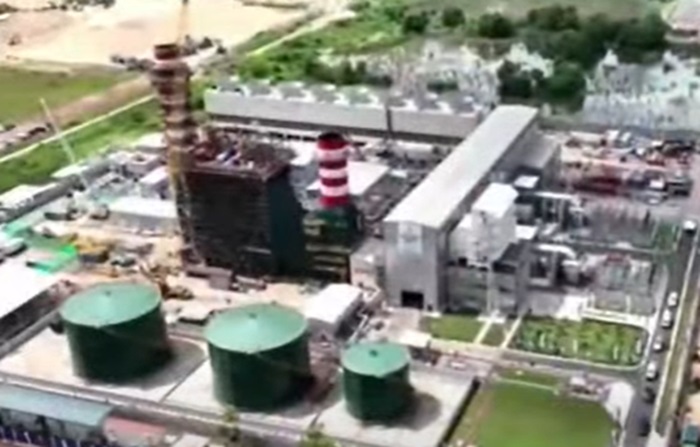
November 10, Colombo (LNW): Sri Lanka’s new government has revived plans to develop the Sobadhanavi Combined Cycle Power Plant in Kerawalapitiya, which includes the procurement of Liquefied Natural Gas (LNG) for a Floating Storage Regasification Unit (FSRU) and LNG pipeline.
The new Sri Lankan government is set to reopen the Liquefied Natural Gas (LNG) procurement process to establish a Floating Storage Regasification Unit (FSRU) and an LNG pipeline, a project previously canceled under former President Ranil Wickremesinghe’s administration.
In August 2023, the then Cabinet had suspended the delayed LNG procurement process for the FSRU and pipeline project.
Ceylon Electricity Board (CEB) Spokesman Eng. Dhanushka Parakramasinghe emphasized the critical importance of LNG supply for the country, noting that Sri Lanka has two LNG power plants—Yugadanavi and Sobadhanavi—which could help meet the national power shortfall if LNG is available.
Together, the plants have a total capacity of about 650 MW, but they are currently running on heavy fuel. The recently completed Sobadhanavi plant can only operate with diesel, and Parakramasinghe explained, “We are not operating Sobadhanavi because we cannot afford the diesel costs.”
He underscored the urgency of securing LNG supply to ensure the operation of these plants.
Following the cancellation of the original tender, Petronet LNG, an Indian company, submitted a proposal to supply LNG. However, Parakramasinghe confirmed that the current government would not consider this proposal and would instead move forward with the original tender.
The new Government is compelled to implement the Sobadhanavi Combined Cycle Power Plant in Kerawalapitiya and it will initiate Liquefied Natural Gas (LNG) procurement process for the establishment of a Floating Storage Regasification Unit (FSRU) and an LNG pipeline, which was cancelled by the previous administration led by former President Ranil Wickremesinghe.
The previous government has re-engaged with India’s Petronet LNG Limited, ending a seven-year hiatus, to enhance infrastructure for the Sobadhanavi Plant, designed to significantly bolster Sri Lanka’s electricity supply.
The first phase of the 350 MW plant, commissioned in August 2024, includes a 220 MW gas turbine, which is expected to contribute substantially to the national grid. The second phase, slated for completion in 2025, will add an additional 130 MW via a steam turbine, bringing the total capacity to 350 MW.
The project aims to meet about 12% of the nation’s electricity demand and drive economic growth by providing stable, affordable energy. The Sobadhanavi Power Plant will play a crucial role in reducing energy production costs, supporting industrial growth, and fostering job creation.
Additionally, the previous government has signed a Memorandum of Understanding (MoU) with Petronet to reduce energy costs, promote cleaner energy, and develop a local LNG market.
The move to shift from thermal power to LNG-based solutions is part of Sri Lanka’s long-term strategy to transition to more sustainable energy sources.
The Ceylon Electricity Board (CEB) is finalizing the deal, with LNG supply crucial for meeting the country’s energy demands, particularly as the Yugadanavi and Sobadhanavi plants, both running on heavy fuel, have been unable to operate efficiently due to high diesel costs.
This initiative is poised to establish Sri Lanka’s largest independent power producer and contribute to a greener, more sustainable energy future.
November 10, Colombo (LNW): The Department of Animal Production and Health has identified improperly disposed food waste as the primary contributor to the recent African Swine Fever outbreak affecting pig farms across Sri Lanka.
According to Director General Hemali Kothalawala, the disease’s spread is largely due to leftover food from ships and aeroplanes arriving from overseas.
Kothalawala explained that food scraps from international passengers, often distributed to pig farms as feed, have inadvertently introduced the virus into the local swine population.
She emphasised that the use of these imported food remnants, without proper treatment, has exacerbated the outbreak, leading to significant concerns within the farming community.
The Department has urged farm owners and relevant authorities to adopt stricter measures for the handling and disposal of foreign food waste, stressing that contamination from such sources poses a serious threat to the island’s livestock health.
Efforts are now underway to raise awareness among farmers about safe feeding practices and to explore regulations that prevent the use of untreated food waste from international sources as animal feed.
November 10, Colombo (LNW): The Ceylon Electricity Board (CEB) has requested an additional two weeks from the Public Utilities Commission of Sri Lanka (PUCSL) to finalise and submit a revised proposal for electricity tariff adjustments.
This extension follows the CEB’s need for more time to refine the proposal, which remains incomplete.
Initially, the PUCSL had set a November 8 deadline for the CEB to present its updated proposal.
This requirement arose due to concerns surrounding inconsistencies in the earlier submitted formula for tariff changes, which raised questions about fairness and transparency.
The PUCSL urged the CEB to ensure that the revised tariffs accurately reflect both consumer needs and operational costs.
The CEB’s request for more time highlights the complexity of adjusting electricity rates in a way that balances affordability with the financial sustainability of the board.
Given the rising operational costs and fuel prices, the CEB is under pressure to revise its pricing structure while also addressing public concerns about affordability and accessibility.
November 10, Colombo (LNW): The Ministry of Defence has issued a stern warning to civilians holding firearms, urging them to comply with the November 21 deadline for returning these weapons or face legal repercussions.
A high-ranking official from the ministry explained that any firearms not returned by the specified date—or for which no formal appeal has been filed—will be classified as illegal.
The ministry has emphasised that it maintains detailed records of all legally distributed firearms and their registered holders, allowing authorities to closely monitor compliance with the mandate.
Highlighting the gravity of the situation, the official stated that the ministry is prepared to initiate strict legal action against those failing to adhere to the instructions.
This move is part of broader efforts to regulate and control civilian-held firearms, ensuring that weapons do not fall into unauthorised hands or contribute to public safety risks.
The ministry’s directive comes amid concerns about unauthorised use of firearms and aims to reinforce accountability among firearm holders.
By reclaiming these weapons, authorities seek to curb potential misuse and enhance overall security across the nation.
Holders of licenced firearms are encouraged to act responsibly by either returning their firearms or formally seeking an extension before the deadline.
The ministry has urged the public to cooperate, warning that non-compliance will be met with firm legal measures.
November 10, Colombo (LNW): The Russian Embassy in Colombo has issued a statement addressing misleading media coverage concerning Sri Lanka’s BRICS membership bid.
A recent article had implied that Sri Lanka’s application for entry into the influential economic bloc had been rejected, a claim the Embassy now denies.
According to the Embassy’s release, Sri Lanka’s formal application to join BRICS has indeed been received and welcomed by the Russian BRICS Chairship.
It clarified that Sri Lanka’s bid, alongside several others from interested countries, will undergo a thorough review process.
This process is expected to involve extensive consultation and consensus-building amongst the existing BRICS members, ensuring a fair and transparent assessment.
The Embassy’s response comes amidst growing international interest in BRICS membership, with several nations from across the globe expressing a desire to join the group.
BRICS, which currently comprises Brazil, Russia, India, China, and South Africa, represents a significant global economic force, and membership could offer various economic and strategic benefits for Sri Lanka.
The Embassy also underscored that reports of a formal rejection of Sri Lanka’s application are categorically false.
It expressed disappointment over the misrepresentation of facts in certain media outlets and called for responsible reporting, especially on sensitive diplomatic matters.