Home Blog Page 885

X-Press Pearl Captain Pleads for Return after Three-Year Detention in Sri Lanka 

0

August 21, Colombo (LNW): More than three years after being detained in Sri Lanka following the fire and sinking of the container ship X-Press Pearl, Captain Vitaly Tyutkalo remains unable to return home, according to Seatrade Maritime News. 

The X-Press Pearl, newly delivered from China in early 2021, caught fire in May 2021 due to leaking dangerous cargo and eventually sank off the coast of Sri Lanka despite the crew’s efforts to save it.

Captain Vitaly was arrested after the incident, released on bail, but his passport was confiscated, preventing him from leaving the country. 

His health has deteriorated during his prolonged stay in Sri Lanka, including suffering a heart attack. 

Captain Vitaly has appealed directly to Sri Lankan Prime Minister Dinesh Gunawardena, asking for assistance in returning home to his family, expressing his anguish over missing significant family events.

X-Press Feeders, the captain’s employer, has continued to support him with legal assistance, salary, accommodation, and a car.

 However, the slow legal process has left Captain Vitaly in limbo, with no clear resolution in sight. 

Despite the support from his employer, the uncertainty surrounding his case has taken a significant emotional toll on him

He describes the support he has received from his employers as “unbelievable” and says that his lawyer has been extremely involved in his case, Sea Trade Maritime news reported. 

“But unfortunately, they have no control over how slow the court process is, they have no control over my case, or who has my passport.”

The Sri Lankan government has received Rs 3,068 million in compensation from the London P&I Club for the X-Press Pearl disaster, but this amount is deemed insufficient for the affected fishermen. 

The insurance company has limited compensation to £19.8 million. In response, the Sri Lankan government has filed three separate lawsuits in Sri Lanka, Singapore, and the UK seeking additional compensation.

The disaster occurred on May 19, 2021, when the X-Press Pearl, carrying hazardous materials, caught fire near Colombo, leading to a significant environmental disaster. 

The incident resulted in widespread contamination and damage to marine life, severely impacting local fishermen and coastal communities.

Despite the initial compensation, many fishermen and those involved in the fishing industry have yet to receive adequate compensation.

 The disaster has also caused long-term economic and environmental damage, including reduced fish populations and tourism. 

Fishermen continue to face challenges in their livelihoods, with ongoing fears about unexploded containers and further environmental harm.


Sri Lanka Original Narrative Summary: 21/08

0
  1. Seventeen former Kurunegala Pradeshiya Sabha members of the Sri Lanka Podujana Peramuna (SLPP) have extended their support to President Ranil Wickremesinghe in the upcoming presidential election. This decision follows a meeting with the UNP Assistant Leader, Akila Viraj Kariyawasam.
  2. The Disaster Management Center reports that heavy rains have affected 3,243 people from 929 families across the Kalutara, Puttalam, and Ratnapura districts. The adverse weather has resulted in two injuries and partial damage to 27 houses. The Disaster Management Center has also issued red notices for several divisional secretariats in Kalutara and Ratnapura districts due to the ongoing landslide risk.
  3. The Colombo District Court has scheduled a hearing for January 21 in a defamation case filed by National People’s Power presidential candidate Anura Kumara Dissanayake against two members of the Sri Lanka Podujana Peramuna (SLPP), including MP Janaka Tissa Kutti Arachchi. Dissanayake is seeking Rs. 10 billion in compensation for alleged defamatory remarks made against him.
  4. Four suspects who had circulated offensive and detrimental information on Facebook about Parliamentarian Kavinda Jayawardena have been remanded till August 29, it was reported. The suspects were arrested by the Colpetty Police and produced before the Colombo Chief Magistrate.
  5. Former President Maithripala Sirisena has completed the payments of compensation of Rs. 100 million to the victims of the Easter Sunday terror attacks as ordered by the Supreme Court. Accordingly, it is reported that the former President has paid the remaining amount of Rs. 12 million on August 16, thereby completing the total compensation payment ordered by the court.
  6. The ‘Sarvajana Balaya’ presidential candidate, entrepreneur Dilith Jayaweera has formally accepted the invitation to take part in the historic debate that the ‘March 12 Movement’ is hoping to organize between six candidates contesting the 2024 Presidential Election.
  7. Tamil Progressive Alliance (TPA) MPs Palani Digambaram and Velu Kumar have been caught on camera engaging in a brawl while participating in a debate on local television. Video footage of the incident shows the two MPs speaking to each other in a derogatory manner leading to a physical brawl.
  8. A Memorandum of Understanding (MOU) was signed between LTL Holdings Limited of Sri Lanka and Petronet LNG Limited of India, for the development of infrastructure for the storage, regasification and supply of Liquefied Natural Gas (LNG) for the “Sobadhanavi” Combined Cycle Power Plant in Kerawalapitiya.
  9. The world’s longest stamp, measuring 205 mm and symbolizing the historic Sri Dalada Perahera in Kandy, was released by the Postal Department of Sri Lanka
  10. Matthew Potts and Dan Lawrence were included for England while Milan Rathnayake is poised for Sri Lanka debut in the first match of the crucial ICC World Test Championship series.

Showers or thundershowers expected throughout the island

0

August 21, Colombo (LNW): Showers or thundershowers will occur at times in Western, Sabaragamuwa, Southern and North-western provinces and in Kandy and Nuwara-Eliya districts. Fairly heavy showers above 75 mm are likely at some places in Western and Sabaragamuwa provinces and in Galle and Matara districts.

Showers or thundershowers will occur at several places in Eastern, Uva and North-Central Provinces during the evening or night.

Fairly strong winds about (30-40) kmph can be expected at times over Western slopes of the central hills and in Northern, North-central and North-western provinces and in Hambantota district.

The general public is kindly requested to take adequate precautions to minimize damages caused by temporary localized strong winds and lightning during thundershowers.

SL Insurance Sector Set for Growth amid Economic Recovery

0

By: Staff Writer

August 20, Colombo (LNW): Sri Lanka’s insurance sector is anticipated to benefit significantly from the ongoing recovery in economic activity, according to Central Bank Governor Nandalal Weerasinghe.

With improving business conditions, lower inflation, and reduced interest rates in traditional financial products, there is likely to be an overall increase in demand for insurance services.

The insurance market in Sri Lanka is expected to reach a gross written premium of approximately $1.66 billion by 2024, with the non-life insurance segment leading with an estimated market volume of $1.13 billion. The average insurance spending per capita is projected to be around $75.54 in the same year.

However, Weerasinghe cautioned that the sector’s substantial exposure to government securities might have resulted in lower returns due to the currently low yields compared to those during the crisis period.

The total Gross Written Premium (GWP) for the insurance industry, covering both Long-Term and General Insurance businesses, amounted to Rs. 78,589 million as of March 31, 2024, representing a 7.39% growth from the same period in 2023. This growth reflects an increase of Rs. 5,411 million year-on-year.

Speaking at the Sri Lanka International Insurance Summit 2024 in Colombo, the Central Bank Governor highlighted that although the Sri Lankan insurance industry is relatively smaller than those of some peer economies, it holds significant growth potential.

The total assets of insurance companies reached Rs. 1,098,988 million by the end of the first quarter of 2024, a 10.88% increase from Rs. 991,126 million at the end of the first quarter in 2023.

As of March 31, 2024, there were 29 insurance companies operating in Sri Lanka, with 15 engaged in Long-Term (Life) Insurance, 13 in General Insurance, and one operating as a composite company. Additionally, 78 insurance brokering companies were registered, with their total assets growing by 27.92% to Rs. 13,243 million by the end of the first quarter of 2024.

Despite the sector contributing 0.8% to the GDP in 2023, the penetration rate has remained below 2% over the past decade. Sri Lanka’s insurance industry has room for expansion, especially as the economy continues to recover.

Central Bank Governor stressed the insurance sector’s crucial role in fostering economic growth by managing risks associated with new ventures and technological advancements, supporting lenders, and providing protection in the wake of natural disasters.

Furthermore, he underscored the need for the insurance sector to enhance its role in social protection. With around 58% of Sri Lanka’s employed population working in the informal sector, there is an urgent need to develop insurance products tailored to this significant demographic

 The industry must also address challenges related to a rapidly aging population, rising health expenses, and increasing non-communicable diseases to ensure adequate coverage and reduce reliance on the limited fiscal sector.

Central Bank Chief Weerasinghe concluded by acknowledging that while Sri Lanka’s macroeconomic environment is expected to remain stable, uncertainties persist due to geopolitical risks, commodity price fluctuations, and slow recovery in key global markets.

SL Tourism Industry Urges President to settle Prior-Visa Processing Delays

0

By: Staff Writer

August 20, Colombo (LNW): The travel and tourism industry in Sri Lanka has urgently called on President Ranil Wickremesinghe to address ongoing issues with the prior-visa processing system, which they believe are critical to the national interest and the economy.

In a joint letter, several key industry bodies—including the Sri Lanka Association of Inbound Tour Operators (SLAITO), The Hotels Association (THASL), and others—highlighted the adverse effects of the current visa-on-arrival system, which is the only option available for tourists.

These organizations stress that travelers, especially groups, prefer obtaining visas online before their trip to reduce uncertainty and liability.

Due to delays in activating the Mobitel online visa platform, as mandated by the Supreme Court, many tour groups and individual travelers have canceled their trips to Sri Lanka. With the peak season approaching, the industry fears significant booking losses to other destinations that offer more streamlined and cost-effective visa processes.

The letter emphasizes that Sri Lanka’s tourism industry, still recovering from years of downturns, cannot afford another setback, particularly with high-season bookings at risk. The industry is concerned that the projected arrival numbers and revenue targets for the rest of 2024 will be unachievable if the situation persists.

The letter further explains that there are no technical barriers to activating the Mobitel ETA system. This has been confirmed by Mobitel, which has been ready to implement the Supreme Court’s order since early August 2024.

However, the necessary backend links required to make the system operational have not yet been activated by the Department of Immigration and Emigration. The industry has urged the President to instruct the Controller General to immediately activate these links.

The urgency of this request is underscored by the fact that tourist arrivals in the first 11 days of August reached 73,373, with a year-to-date total of 1.27 million. The industry insists that resolving this issue promptly is essential for sustaining and growing these numbers, which are vital to Sri Lanka’s economic recovery.

With competing destinations offering streamlined processes and zero cost, many potential Sri Lanka bookings are likely to be diverted due to the immigration delay,” the industry emphasised.

The industry said it understands that there’s no technical impediment whatsoever for the Mobitel ETA system to be activated with immediate effect. This fact has been confirmed by Mobitel in a letter to the Department of Immigration and Emigration Controller General dated 7 August 2024 and 13 August 2024 stating its readiness to give effect to the interim order of the Supreme Court.

SEC reconstitutes entry requirements for Capital Market professionals

0

By: Staff Writer

August 20, Colombo (LNW): In a move aimed at enhancing professional standards and increasing accessibility in the capital market industry, the Securities and Exchange Commission (SEC) has issued a Directive that provides new entry requirements and exemptions for its certification programs.

This Directive which came into effect from 1 August contains new entry requirements designed to better serve aspiring and current investment advisors by aligning educational and professional requirements with industry best practices and emerging market trends.

The SEC develops and administers professional education and Continuous Professional Development (CPD) programs as a part of Sri Lanka’s capital market licensing framework. The licensing processes is crucial to uphold high standards of professionalism and trust in the financial advisory sector, thereby protecting investors’ interests and enhancing the stability of financial markets.

The SEC administers the Certificate in Capital Markets (CCM) program, which is the only pathway to obtaining the Registered Investment Advisor (RIA) Qualification and is designed to provide comprehensive education and training for professionals in Sri Lanka’s capital market.

Relaxation of the entry requirements for CCM is expected to make it easier for a wider range of candidates to participate in this crucial program.

Previously, candidates seeking to register for the CCM were required to hold either 3 passes for Advanced Level (A/L), a completed degree or a completed professional qualification in any discipline.

 The new entry criteria now recognises a broader range of academic and professional qualifications allowing more individuals to pursue the certification program.

Additionally, to accommodate various professional backgrounds and prior learning experiences, the SEC has broadened the exemption policy for CCM.

Previously, the SEC only granted exemptions for candidates who had passed Level 2 of Chartered Financial Analyst. However presently, candidates who are passed finalists of Chartered Institute of Management Accountants (CIMA),

Association of Chartered Certified Accountants (ACCA), Institute of Chartered Accountants of Sri Lanka (CA) and candidates who have completed a Bachelor’s or a Master’s Degree in a finance related discipline can apply for exemptions as well.

Moreover, the eased minimum entry requirements and updated exemption policy apply to single asset class certification programs as well.

The first batch of the CCM program, featuring the revised entry requirements and exemptions, is set to begin on 31 August.

Comprehensive details are available on the SEC website www.sec.gov.lk. This launch represents a significant step forward in offering accessible, high-quality certification opportunities for capital markets professionals.

These revisions are designed to elevate the standards of the industry while making it more inclusive and supportive of ongoing professional growth.

Vijayakala Maheswaran Launches Campaign for President RW, Poised for Historic Victory in Northern and Eastern Provinces

0

August 20, 2024 – Jaffna: In a powerful and strategic move, Hon. Vijayakala Maheswaran, Former Member of Parliament, Former State Minster for Education, Women and Child Affairs and Chief Organiser of the United National Party (UNP) for Jaffna and Killinochi Districts, has officially kicked off her campaign in support of His Excellency President Ranil Wickremesinghe across the Jaffna and Killinochi districts. With the Northern and Eastern Provinces set to play a decisive role in the upcoming presidential election, Maheswaran’s campaign is gathering unprecedented momentum, signaling an imminent and overwhelming victory for President Wickremesinghe.

Unwavering Support Across the North and East

Vijayakala Maheswaran has boldly declared that President Ranil Wickremesinghe will secure at least 90% of the votes cast in the Northern and Eastern Provinces on September 21st. This is not an idle claim but a reflection of the deep-rooted trust and confidence that the people of these regions have in President Wickremesinghe’s leadership.

It is essential to recognize that the strong support which Sajith Premadasa received in the 2019 presidential election in these provinces was largely due to the influence of Ranil Wickremesinghe, who, as the then leader of the UNP, laid the groundwork for a broad coalition of support. Now, with President Ranil Wickremesinghe himself leading the charge, there is no doubt that the people of the North and East will rally behind him, ensuring a decisive and historic victory.

A Turning Point for the Northern and Eastern Provinces

The upcoming presidential election is a defining moment for the Northern and Eastern Provinces. These regions, which have long sought stability, development, and genuine representation, see in President Wickremesinghe a leader who not only understands their unique challenges but has the proven capability to address them. His administration has consistently demonstrated a commitment to peace, reconciliation, and economic development, and the people are ready to reaffirm their trust in his leadership.

Vijayakala Maheswaran’s campaign is not just about securing votes; it is about galvanizing the people of the North and East around a shared vision for a prosperous and peaceful future under President Wickremesinghe. Her extensive grassroots outreach and deep connections within the community make her a formidable force in mobilizing support, ensuring that every vote cast in these regions contributes to a landslide victory.

The Critical Role of the Northern and Eastern Votes

The votes from the Northern and Eastern Provinces are set to be a critical factor in this election. These regions have historically played a pivotal role in shaping the outcome of national elections, and this time will be no different. The people of the North and East are fully aware of the stakes and are prepared to deliver a resounding mandate for President Wickremesinghe, whose leadership they trust to bring about lasting change and progress.

A Vision for a United and Prosperous Sri Lanka

President Ranil Wickremesinghe’s vision for Sri Lanka is one of unity, stability, and prosperity for all its citizens. His leadership has been a beacon of hope for the entire nation, and the people of the Northern and Eastern Provinces are ready to stand with him as he continues to lead Sri Lanka towards a brighter future.

Vijayakala Maheswaran’s campaign is a testament to the enduring strength of this vision and the unwavering support it commands across the country. As the campaign gains momentum, it is clear that the Northern and Eastern Provinces will play a crucial role in delivering a historic victory for President Wickremesinghe on September 21st.

Pioneering tobacco harm reduction

0
  • In conversation with BAT Group Head of Life Sciences Elaine Round
BAT Group Head of Life Sciences 

Elaine Round
 

In an exclusive interview, British American Tobacco (BAT) Group Head of Life Sciences Elaine Round delves into the company’s ongoing efforts to innovate and drive tobacco harm reduction. With a strong emphasis on science and responsible manufacturing, BAT is transforming from a traditional cigarette business to a multicategory business of smokeless alternatives. Round is unequivocal about the substantial body of evidence supporting the reduced risk potential of smokeless alternatives.

“There’s a lot of evidence, not only from us but from other researchers as well, showing that smokeless alternatives present a reduced risk potential compared to cigarettes when consumers completely switch to them,” she states. The primary harm from smoking comes from the combustion of tobacco, which releases numerous toxicants. By eliminating combustion, smokeless products emit far fewer and lower levels of toxicants compared to cigarettes. 

BAT’s commitment to product innovation is reflected in its substantial investment in research and development (R&D). With an annual R&D budget exceeding £ 300 million, the company is focused on transforming its product portfolio. “Innovation is a driving force for us,” Round emphasises. “We aim to have 50 million consumers using our smokeless products by 2030 and to achieve 50% of our group revenue from these products by 2035. “These ambitious goals highlight the importance BAT places on developing reduced risk alternatives for smokers.”

BAT has three categories of smokeless alternatives in their product pipeline: vapour, heating products, and modern oral products. Vapour products, under the brand name Vuse, are battery-powered devices that heat a liquid containing nicotine. Heated products, known as Glo, is a battery-powered device designed to heat, rather than burn, tobacco stick. This creates an inhalable aerosol that contains nicotine with authentic tobacco taste. The modern oral product, Velo, is an oral nicotine product that is designed for use in the mouth with a placement between the gum and upper lip for nicotine to be absorbed through the tissue lines. 

Navigating communication and regulatory challenges

One of the significant challenges BAT faces is communicating the science behind smokeless products in markets with strict restrictions, often referred to as “dark markets.” Round acknowledges this challenge and stresses the importance of addressing public misperceptions about nicotine. “Many consumers wrongly believe that nicotine causes cancer and cardiovascular disease. It’s crucial to educate both groups that the primary harm comes from burning tobacco, not from nicotine itself,” referencing the widely accepted proposition by public health bodies, including the US FDA and Public Health England.

To ensure the efficacy and product safety of its smokeless products, BAT employs a rigorous nine-step framework for assessing risk profile of its smokeless alternatives. This comprehensive approach includes evaluating emissions, exposure, and risk. “We look at what comes out of the product (emissions), what consumers are exposed to when using it (exposure), and the biological impacts of usage (risk),” Round explains. For example, BAT’s studies show that products like our nicotine pouch brand Velo, although not risk-free, have more than 99% reduced toxicants compared to a scientific standard reference cigarette, when assessing the top 9 toxicants the WHO believes are mainly responsible for smoking-related diseases. Similarly, Vuse, our vaping device, showed 99% fewer toxicants based on a comparison of cigarette and Vuse emission for a number of key toxicants present in cigarette smoke, which have been identified as harmful.

Addressing the issue of counterfeit products

 The proliferation of counterfeit and low-quality nicotine products poses a significant risk to consumers. Round underscores the importance of responsible manufacturing and regulatory oversight to combat this issue. “Counterfeit products can be identified by lower pricing and poor quality, but it can be challenging for consumers to distinguish genuine products. Ensuring proper regulation, monitoring and enforcement is essential to protect consumers,” she states.

Since introducing its first smokeless alternative in 2013 with its vaping device, BAT has made significant strides in expanding its product offerings. “We launched our first vapor product, Vuse, in the UK and then expanded to the other markets globally,” Round recalls. BAT now follows a multi-category approach, offering heated, vapor, and oral nicotine products. “Different smokers have different preferences, so it’s important to provide a variety of choices to facilitate adult smokers to switch from smoking,” she explains. 

Given BAT’s origins as a traditional tobacco company, the transition to smokeless products involves balancing business objectives with public health priorities. Round emphasises the importance of offering less risky products to consumers who do not want to quit nicotine altogether. “It’s crucial to provide alternatives for the approximately 1.1 billion smokers worldwide, as it leaves millions of smokers who would otherwise continue to smoke without the option to switch to such alternatives.”

Overcoming challenges and misperceptions

 One of the major obstacles for Tobacco Harm Reductionar is the widespread misperception about nicotine among the general public. “The recent survey conducted by Foundation for a Smoke-Free World showed that nearly 80% of healthcare providers worldwide even mistakenly believe nicotine causes lung cancer,” Round points out. These misperceptions hinder the adoption of smokeless products. Correcting these beliefs through education and responsible communication is essential for promoting the benefits of smokeless alternatives.

BAT actively supports progressive regulation and risk-appropriate taxation for its smokeless alternatives containing nicotine. Round cites New Zealand as a prime example of successful regulatory support. “The government’s endorsement of smokeless products has led to a 43% decline in daily smoking rates in New Zealand,” she notes. Similarly, Sweden is on the verge of becoming the first smoke-free country in Europe, defined by the World Health Organization (WHO) as having less than 5% of the population smoking. These examples highlight the critical role of regulator buy-in who will then in turn endorse risk-proportionate regulation to achieve public health goals. 

Responsible manufacturing and sales practices are central to BAT’s strategy. “It’s vital to ensure that products are of high quality and responsibly marketed,” Round says. This includes not making it available to youth and ensuring that all products meet strict safety and quality standards. BAT’s commitment to transparency and publishing its research methodologies for peer review is part of its effort to maintain credibility and trust. 

Elaine Round’s insights offer a comprehensive view of the reduced risk potential of these smokeless alternatives, enabled by scientific innovation and responsible practices. There is a need for adequate education and regulation to ensure that the potential for transforming public health and reducing the global burden of smoking-related diseases becomes increasingly achievable. 

Source: DailyFT

Sri Lanka’s Planned Tax Relief costs offset by New Tax Measures

0

By: Staff Writer

August 20, Colombo (LNW): Sri Lanka’s plan to offer relief to personal income tax payers could result in a loss of Rs2.66 billion at constant price or (0.08% of the country’s GDP), according to Treasury Secretary Mahinda Siriwardana.

This shortfall in revenue would be offset by additional tax measures. President Ranil Wickremesinghe recently mentioned that discussions are ongoing with the International Monetary Fund (IMF) to provide income tax relief by expanding the tax brackets.

The government’s tax relief roposal involves increasing the threshold for personal income tax from 500,000 rupees to 720,000 rupees.

Currently, the maximum personal income tax rate has been raised to 36 percent from 24 percent, and the taxable monthly income threshold has been lowered to Rs. 100,000. From Rs. 250,000

The IMF, after reviewing the proposal, recommended providing more relief to lower tax brackets, maintaining similar relief for mid-level taxpayers, and slightly reducing relief for higher earners while keeping the essence of the proposal intact.

The Treasury’s proposal suggests maintaining a tax-free threshold of Rs. 1.2 million expanding the tax band to Rs. 720,000 from Rs 500,000, and keeping the top tax rate at 36 percent.

In contrast, the IMF’s counterproposal retains the Rs. 1.2 million tax-free threshold but extends the first tax band from Rs. 500,000 to Rs.  1 million with subsequent bands shifting up by Rs 500,000, while maintaining the top tax rate at 36percent, finance ministry sources said.

Siriwardana revealed that negotiations with the IMF on this amendment began as early as September 2023. Implementing such a proposal wasn’t feasible earlier due to revenue not meeting the targets.

However, with an improvement in revenue collection this year, it is now possible to negotiate adjustments to the Personal Income Tax (PIT) structure.

 These adjustments aim to provide relief to taxpayers in the middle-income brackets while ensuring that the highest earners do not receive disproportionate benefits.

The estimated cost of these adjustments is about 0.08% of GDP, and compensatory revenue measures have been discussed with the IMF to ensure that revenue targets remain on track.

Despite radical economic reforms post-1978, Sri Lanka’s currency suffered rapid depreciation due to attempts to target money supply without a floating exchange rate after abandoning an external anchor.

However, post-war, the return of peacetime monetary instability and inflationary policies led to crises following rate cuts, which reduced growth and tax revenues, resulting in ad hoc tax hikes.

Aggressive targeting of the call money rate led to dual stabilization crises within the same program, stifling growth while accelerating monetary debasement and debt accumulation. During the current stabilization crisis, income tax was increased, prompting several private companies to raise salaries to increase disposable income and prevent brain drain, thereby also boosting income tax collections. The central bank and some state-owned enterprises have also significantly increased salaries.

LKR sees minor setback against USD amidst currency fluctuations

0

August 20, Colombo (LNW): The Sri Lankan Rupee experienced a slight depreciation against the US Dollar today (20), reported the Central Bank of Sri Lanka (CBSL).

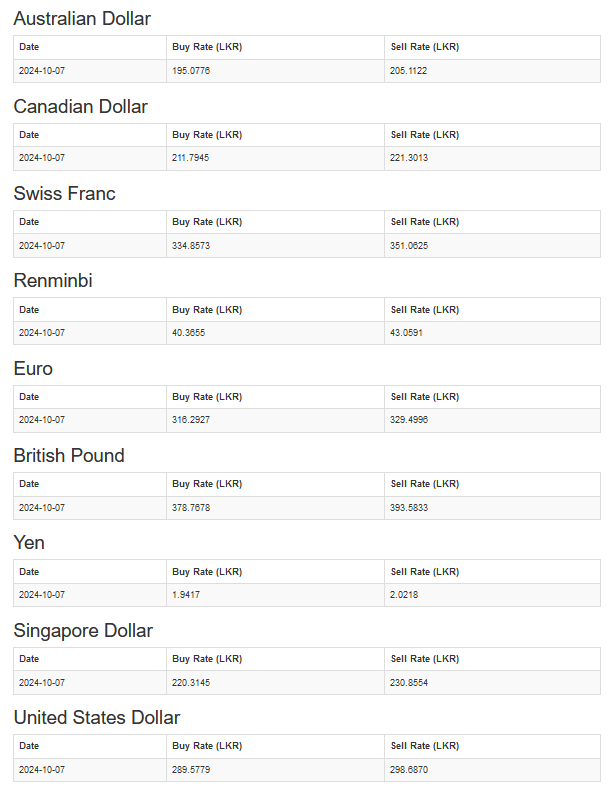
The buying price rose to Rs. 294.36 from Rs. 294.31, while the selling price to Rs. 303.57 from Rs. 303.52.

The currency also weakened against a basket of international currencies but showed an appreciation against several Gulf currencies.