LISTEN TO STORY
WATCH STORY
By: Staff Writer
June 02, Colombo (LNW): Sri Lanka’s plan to seek continued access to the European Union’s GSP+ trade concession scheme comes at a critical moment for the country’s economy. Export Development Board Chairman Mangala Wijesinghe’s recent confirmation that Sri Lanka intends to apply for the next GSP+ cycle reflects the government’s recognition of the scheme’s importance. However the path to renewal may be considerably more complicated than government officials appear willing to acknowledge.
The European Union remains one of Sri Lanka’s largest export destinations, and GSP+ has served as a crucial instrument in preserving market competitiveness. Thousands of jobs and billions of dollars in export earnings are linked directly or indirectly to the preferential tariff benefits granted under the arrangement.
However, the EU’s modern approach to trade preferences extends well beyond economics. Compliance with governance standards, human rights commitments, labour protections, environmental obligations, and institutional accountability now forms an integral part of eligibility assessments.
This reality presents a significant challenge for the current NPP administration. Since assuming office, the government has promoted itself as a reform-oriented alternative to previous administrations. Nevertheless, critics point to recurring examples of policy inconsistency, delayed implementation, and insufficient coordination among government institutions. Such weaknesses have created uncertainty among investors and development partners seeking clear signals regarding Sri Lanka’s long-term policy direction.
Recent comments attributed to European diplomatic representatives have underscored concerns regarding implementation rather than intention. While commitments made by political leaders are welcomed, European stakeholders increasingly seek evidence that announced reforms are being effectively executed. The gap between policy formulation and practical implementation remains one of Sri Lanka’s most persistent governance challenges.
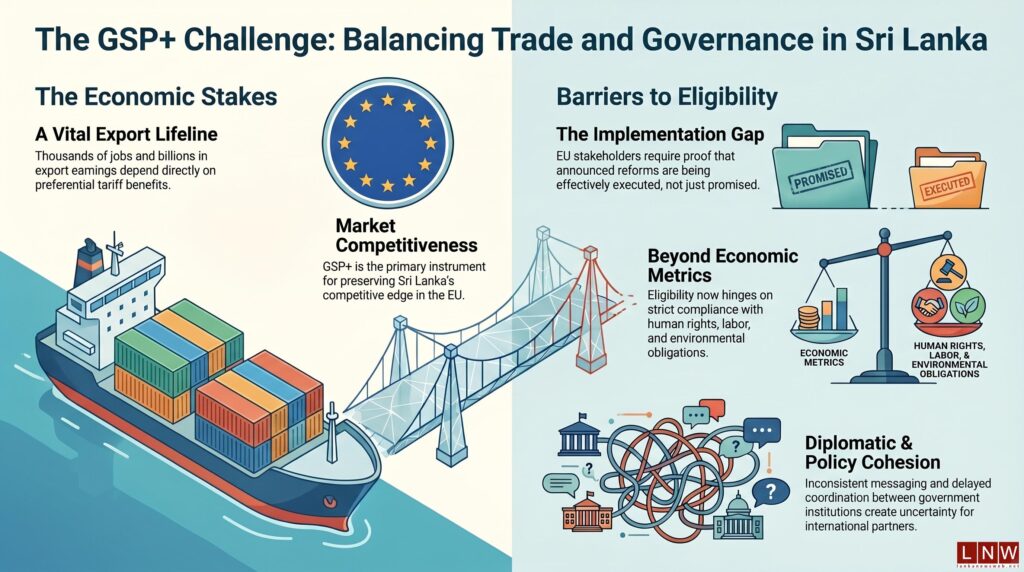
Another area attracting attention is the government’s communication strategy. Successful GSP+ negotiations require sustained engagement with European institutions, member states, business groups, and human rights monitoring mechanisms. Analysts argue that Sri Lanka’s diplomatic outreach has not always matched the complexity of these requirements. Mixed messages from different government entities can create uncertainty and weaken the country’s negotiating position.
Furthermore, the EU’s evolving trade framework places greater emphasis on transparency, accountability, and measurable progress. The bloc is unlikely to overlook shortcomings simply because Sri Lanka faces economic challenges. Instead, European authorities are expected to examine whether reforms are being implemented consistently and whether commitments under international conventions are producing tangible results.
The optimism expressed by the Export Development Board may therefore represent only one side of the equation. Positive political signals alone will not guarantee success. Sri Lanka must demonstrate administrative efficiency, coherent policy execution, and effective diplomatic engagement if it hopes to secure continued GSP+ access.
As the next evaluation approaches, the country’s prospects will depend less on declarations of intent and more on its ability to present a convincing record of governance, reform implementation, and institutional reliability. Whether the NPP government can meet that test remains one of the most important economic questions facing Sri Lanka today.