
By Adolf
There comes a point in the life of every new government when the excitement of electoral victory must give way to the far more demanding task of governing. Campaign rhetoric must be replaced by sound policy, institutional leadership, and practical solutions to the problems confronting ordinary citizens.
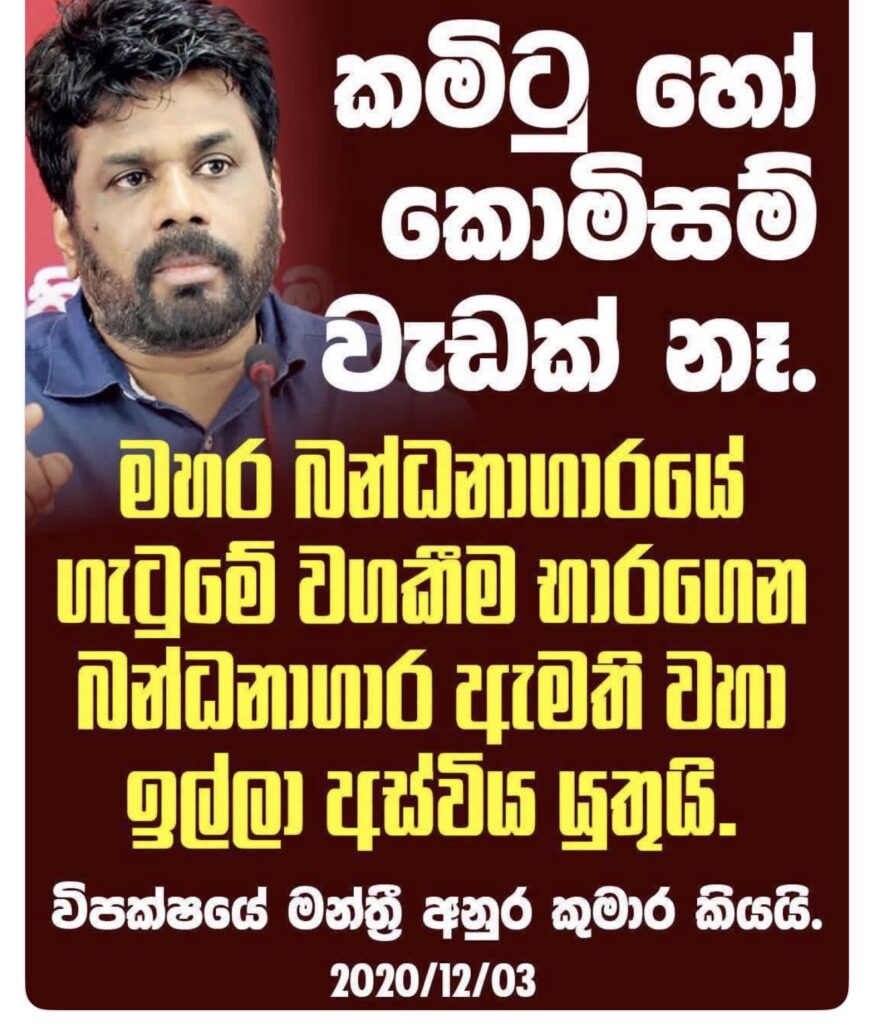
According to former Justice and Foreign Minister Ali Sabry, Sri Lanka’s current administration has yet to make that transition. Instead, it appears increasingly preoccupied with pursuing political opponents while the country’s most pressing economic and social challenges remain inadequately addressed.
His comments, made in the aftermath of the deadly incident at Negombo Prison, raise an important question: can a government effectively govern when so much of its political energy appears focused on arresting its predecessors?
This is not an argument against accountability. No one is above the law, and allegations of corruption or abuse of power should be investigated independently and fairly. However, there is an important distinction between impartial justice and governance driven by political retribution.
As Sabry aptly observed, a handcuff is not a health policy, nor is a remand order an agricultural policy. Arrests do not reduce the cost of living. They do not create jobs, improve schools, strengthen healthcare, or revive economic growth.
Rising COL
Meanwhile, Sri Lanka continues to grapple with rising living costs, recurring dengue outbreaks, overcrowded prisons, challenges facing farmers, weak investment, and the continuing need for sustainable economic reforms. These are the issues that affect the daily lives of millions of Sri Lankans and deserve the government’s undivided attention.
Sabry’s broader warning is equally significant. Governments come and go, but the precedents they establish endure. If state institutions are perceived as instruments of political revenge rather than impartial justice, public confidence in those institutions will inevitably erode. The machinery of coercion may serve one administration today, but it can just as easily be turned against another tomorrow.
The difference between vengeance and governance is fundamental. One looks backward, seeking political victories over former rivals. The other looks forward, seeking solutions that improve the lives of citizens.
Sri Lanka needs leadership focused on restoring economic confidence, attracting investment, creating employment, strengthening public institutions, and improving living standards. Those are the benchmarks by which any government should ultimately be judged—not by the number of arrests it makes.
To many observers, however, the overwhelming public narrative of this administration appears to revolve around the next arrest rather than the next reform. Whether that perception is entirely fair or not, it is becoming increasingly widespread and risks overshadowing the government’s broader agenda.
Future
It is also difficult to ignore the role played by certain influential public voices in reinforcing this climate. Critics argue that Controversial religious figures, including Cardinal Malcolm Ranjith and his sidekick Fr. Cyril Gamini, have, through their public interventions on accountability and past injustices, contributed to intensifying demands for prosecutions. This is hurting the Catholic community that is not generally focused on vengeance. Their supporters would contend that they are advocating justice for victims, while others see their interventions as adding momentum to an increasingly polarized political environment.
Ultimately, Sri Lankans are waiting not for the next headline about another arrest, but for tangible improvements in their daily lives. Governments are remembered less for the opponents they imprisoned than for the prosperity, stability, and hope they delivered to their people.
